

 SHARE:
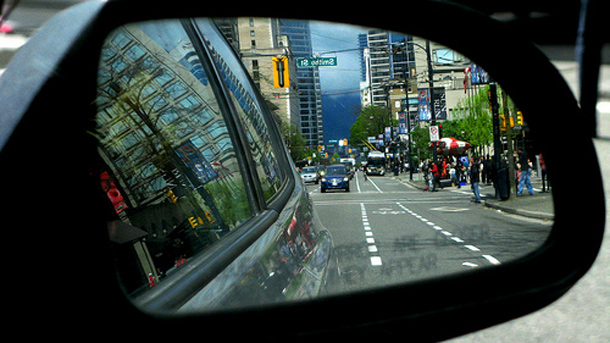
There's a war on cars? Really? Who's waging it?
Rob Ford is certain it exists. Upon taking office last winter, the conservative mayor of Toronto declared "the war on the car stops today." His declaration echoes an international trend. In the UK, Transport Secretary Philip Hammond promised to "end the war on motorists" when he took office last May.
But in Vancouver, cyclist Mayor Gregor Robertson, who over the last few years installed controversial bike lane trials in the downtown core and on other major thoroughfares, hasn't claimed to be waging any wars.
In Seattle, they may call Mayor Mike McGinn Mike "McShwinn" for city planning policies that promote cycling and walking over driving. But he's denied being gripped by battle fever, saying, "This 'war on cars' thing is just silly."
So who really wants a war on cars, and even seems ready to lead it?
Very few, it turns out, even at conferences all about making cities more bike-rider friendly. Most of the wonks and activists at such gatherings spend their time discussing ways to clear a bit more safe space for pedestrians and cyclists rather than hurling inflammatory rhetoric against drivers. We'll take you to one of those confabs later so you can hear for yourself.
In the meantime, meet two renegades who do urge a rush to the barricades. Bianca Mugyenyi and Yves Engler are authors of a new book, Stop Signs: Cars and Capitalism: On the Road to Economic, Social and Ecological Decay, a war-chest of facts, figures and arguments identifying cars as enemies of the people.
Carnage and Homo Automotivis
Stop Signs depicts a land of despair, where a mutation of the human being called Homo Automotivis forms an evil symbiosis with a destructive, resource-hungry beast of metal and glass. All the while the underclass of non-drivers is slowly building momentum to ultimately rise up and overthrow the dominant automobile culture.
Mugyenyi and Engler embark on a car-less journey across America to tell the story of Homo Automotivis, whom they describe as "the result of a century of people living with cars and capitalism," and its symbiotic relationship with the automobile.
"Neither can survive without the other and both define themselves through the other," they write of this symbiosis.
The two authors cite a litany of facts and figures and draw on examples from major cities across the U.S. in defence of their primary thesis: the age of the car must end.
Seven-hundred cyclists and 6,000 pedestrians die every year in the U.S. at the hands of the automobile, another 110,000 are injured, they write.
The average American works from the beginning of January till the end of March to pay for his or her automobile and spends about a month per year traveling in it -- one of every six waking hours.
Aside from some of the more obvious negative aspects of the automobile -- like automobile fatalities and injuries, noise and air pollution and urban congestion -- Mugyenyi and Engler find a lot more to blame on cars. Climate change, obesity, cancer, unemployment, racial segregation, poverty and even terrorism, they write, are all the result of cars and car culture.
It can't last forever, say Mugyenyi and Engler of car-domination. "It is easy to forget that evolutionary dead ends are more common than successful species," they write. "It seems likely that this will be the fate of Homo Automotivis."
'A crash or a whimper?'
"Will the end of automobility arrive with a crash or with a whimper?" they ask. "Are humans smart enough to see the signs of imminent destruction and change before it is too late?"
It's time to organize an uprising against private automobility and in a handful of cities around the world this "organized uprising" is already underway, they say.
Critical Mass, for example, which takes place on the last Friday of every month in more than 300 cities around the world, often pits angry motorists against a "mass" of cyclists, sometimes numbering in the thousands, who clog city streets and bring automobile traffic to a halt.
So-called "corkers" speed ahead of the pack to block intersections. One particular method of corking, called the "Chicago hold-up," has cyclists lift their bikes in the air to form the blockade.
The Vancouver chapter of Critical Mass calls it "a grassroots reclamation of public space" that allows "cyclists and other self-propelled people to move safely and comfortably through city streets in a car-free space."
But this "protest ride" sometimes ends in tragedy. In February an amateur video surfaced that shows a speeding motorist ploughing through a pack of more than 100 Critical Massers in Brazil. At least 40 were injured, but no one was killed, according to reports.
Other events aren't protest-oriented, but seek to raise awareness for the cyclist movement nonetheless. Earlier this month Vancouver hosted bike-to-work week and Velopalooza 2011, which includes more than 100 different rides and events over the first part of June. The city will celebrate Car-free Day later this month, an event that occurs in 1,500 cities around the world.
"One great thing about protesting the car is that street demos against auto domination make a political statement and simultaneously disrupt traffic," write Mugyenyi and Engler.
More cyclists, fewer crashes
Whenever cries of war sound in the land, there will be voices urging compromise, coexistence. A voice asking why everyone can't just get along.
That was the voice most often heard at an all-day conference in Vancouver titled "Changing Lanes: Improving the Bike Car Relationship on Canada's Roads." Hosted by the Canadian Automobile Association, the event brought a group of panelists together to further the conversation between cyclists and motorists.
Jennifer Dill, a transportation researcher in Oregon, presented findings that illustrate a virtuous circle of statistics in Portland.
"As more cyclists have been on the road, we are seeing the incidence of crashes going down," she said. It's a concept she calls "safety in numbers" because it raises the likelihood that drivers on the road are also sometimes cyclists, and therefore more aware of the exposed riders. Likewise, said Dill, as the safety level rises, more cyclists take to the roads.
Of all North American cities experimenting with bike infrastructure and promotion of cycling mode-share, Portland is widely viewed as a leader.
The city boasts more than 520 kilometres of separated and painted bike lanes, greenways and off-street bike paths.
And surveys suggest these initiatives played a role in driving up the city's cycling mode-share from three per cent in 1997 to seven per cent in 2009, in a country where less than one per cent of commuters travel by bike.
A two per cent minority ride bikes
Vancouver city councillors have taken many of their pro-cycling cues from Portland and also hope to drive up the cycling mode-share in the city.
About two-thirds of Metro Vancouverites regularly drive to work, while less than two per cent cycle, according to a 2009 Translink study. Yet the average British Columbian lives less than seven kilometres from work.
More residents of the City of Vancouver choose to cycle than in the rest of the Metro region. Almost four per cent of Vancouver residents bike to work, second most amongst Canadian cities.
And while the city's population has grown by 18 per cent, the number of vehicle trips into the downtown core is declining.
"Although we are very proud of what we have achieved, we do not say that Vancouver is on cutting edge," said city councilor Geoff Meggs of three separated bike lanes installed in Vancouver recently.
'Opportunity missed' to appease drivers
But Meggs and other city councillors have come under fire for sacrificing automobile lanes for cyclists.
"There was an opportunity missed to indicate to drivers why we were doing these things, that it wasn't a social engineering experiment or some counter cultural fit we were having, that would actually get integrated into a sensible transportation policy for the future of our city," said Meggs.
Not everyone at the conference saw more bike lanes as a "sensible" element of transportation policy.
Ted Laturnus, an automotive journalist who presented at the CAA conference, railed against militant cyclists and Critical Massers in Vancouver and decried the city's new bike lanes.
"Stop demonizing automobiles and acting like you have the high moral ground," said Laturnus, as if speaking directly to an audience of cyclists.
"Try to remember that a car is not a luxury or an unnecessary evil. The vast majority of people can't get by without their cars."
So why do people ride bikes and others drive cars? In a survey conducted by the City of Copenhagen, Denmark, where as many as 50 per cent of residents cycle to work, commuters expressed their reasons for choosing the bike over all other modes.
Fifty-five per cent of cyclists cited speed as their motive. In second place, 33 per cent said it's about convenience. Health and cost reasons came third and fourth. And rounding off the list, only nine per cent of respondents said concern for the environment or climate change was the reason.
Bicycling 'elitists'?
But motorists like Laturnus still see cyclists as elitists. "Just because you ride a bike, that doesn't mean you're special, cooler than motorists, holier than thou, or above the rules that apply to the rest of us," he said.
Laturnus makes some assumptions about the types of people who ride bicycles, when some statistics point to the contrary.
Americans with the lowest household income made almost a third of all bicycle trips in the U.S. between 2001 and 2009, according to a recent study conducted by the University Transportation Research Centre.
"Lower income workers without a vehicle, young people, recent immigrants and people who live in the central neighbourhoods of cities in which they work," states one BC Statistics report, "likely do not 'choose' alternate modes of transportation, but use them out of necessity."
But only 31 per cent of adults in the Metro Vancouver area categorized themselves as a regular, frequent, occasional or potential cyclist in a recent University of British Columbia survey.
"Look at the numbers," said Laturnus. "How many people ride bikes and how many drive cars? By all means build as many bike paths and rights of way as you can but don't do it at the expense of motorists."
The UBC study provided some of the reasoning behind Vancouver city council's decision to install separated bike lanes.
"The experience of other cities suggests that perception of safety is essential to attracting people to cycling," states a City Services and Budgets report presented to council.
"Separated bike lanes are perceived to be safer and more satisfying to cyclists than cycling next to traffic."
But Laturnus doesn't buy that argument.
"The tail is wagging the dog in Vancouver these days and the vast majority of commuters have to suffer because of a small group of zealots," he said, adding that Vancouver seems to have "more than its share of in-your-face, loathsome cyclists who will only be happy when every single automobile in the world is instantly vaporized."
Life during war time
It's a rainy Monday morning in Vancouver and I'm pedaling furiously down Main Street. A stream of silt-ridden rain droplets pepper my face, exceeding the protective abilities of my plastic fenders.
That clicking, creaking noise I can't seem to fix is really rattling now. I'm reaching the upper limits of my old Peugeot, racing down the hill towards Terminal Avenue.
I'm traveling in the right lane, the one with the bicycles painted on its asphalt every few hundred metres, but I know it doesn't belong solely to me, nor to the other two-wheeled commuters forming a spaced-out single-file line down this arterial street. Buses, taxis, motorcycles and cars travel here too.
I'm moving fast enough to keep up with the bus in front of me, the spray from its tail-end reminds me of this. I tilt my face down and to the left, hoping the brim of my helmet will protect my eyes.
The bus signals to the right, indicating it will pull over at the bus stop ahead. In what many would consider a dangerous maneuver, I exercise my right as an urban cyclist, the one that says I should be treated as any other moving vehicle on the road. I decide to pass the bus.
I push a little harder to pick up some speed, shoulder check to my left, signal and move swiftly to the center lane. Now I'm surrounded by heaps of rolling metal and glass, and traveling fast enough to know that an accident here would be serious.
The truck I pulled ahead of gives me enough space so that I don't feel threatened, but I'm anxious nonetheless. I manage to pass it safely and dive back into my position on the right, relishing the relative safety of this "bike lane."
When I reach the red light at the next intersection the bus catches up, pulling up beside me. The driver opens the door and says, "That's a good way to get yourself killed, squished on the side of a bus." I shrug my shoulders and respond, "I'll be okay, you just worry about driving your bus."
That little encounter is just one example of an evolving but difficult relationship between the cyclist and the automobile. And though no blood was spilled, nor bones broken, these types of incidents lead to the obvious conclusion, for some, that cars and bikes should be kept separate. Create a demilitarized zone, they say, and you will be able to keep an uneasy peace.
'Right-wing talking point'
Others, like Oregon researcher Jennifer Dill, say the more we mix bicyclists and drivers, the more we'll get used to each other, and war will be averted.
Some, like David Suzuki, suggest that if there really is a war, the motorists are winning. "Cars -- often with a single occupant -- still rule our cities and roadways," he writes in a Georgia Straight op-ed.
But some, like Sightline Institute researcher Eric de Place, claim that the war on cars is nothing more than a "right-wing talking point."
"There's something almost laughably overheated about the 'war on cars' rhetoric," he writes in a blog tracing the idea's history.
"It's almost as if the purveyors of the phrase have either lost their cool entirely, or else they're trying desperately to avoid a level-headed discussion of transportation policy."
And then there are voices like those of Mugyenyi and Engler, who can't wait for the day when the automobile has been vanquished. But even they remind the reader and the would-be warriors in this war, to "hate the car, but not the driver."
"Even if you depend on driving to work, it is possible to agree there's a big problem," they write.
Maybe we can all get along, after all. ![[Tyee]](/design-article.thetyee.ca/ui/img/yellowblob.png)
Read more: Transportation







Tyee Commenting Guidelines
Comments that violate guidelines risk being deleted, and violations may result in a temporary or permanent user ban. Maintain the spirit of good conversation to stay in the discussion.
*Please note The Tyee is not a forum for spreading misinformation about COVID-19, denying its existence or minimizing its risk to public health.
Do:
Do not: