Life

A Tyee Series

EduPunks Say School Yourself!

Their DIY movement is reinventing how, and why, we learn.

By Steve Howard, Nicole Veerman and Jim Saunders, 20 Mar 2010, TheTyee.ca

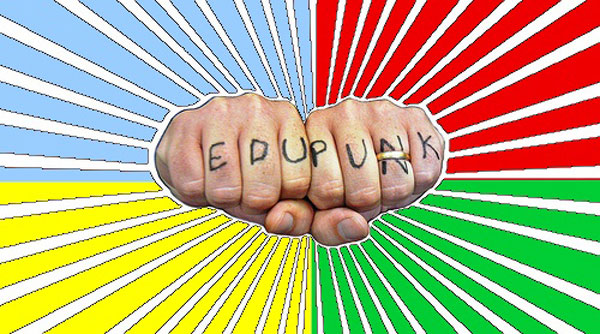
Edupunk graphic

'We're using our own tools.'

Related

[Editor's note: The Tyee is proud to co-publish with Rabble.ca a multi-part investigation of Maker Culture -- the do-it-yourself movement fast evolving in North America and beyond. This is episode ten of 11, running Fridays.]

One night in 2008 at a Brooklyn bar, a drunk Jim Groom coined a term that has changed the way the world looks at education.

The word is EduPunk and it sums up the need for educational reform -- reform that, to some extent, has already begun.

Ordinary people are taking their education into their own hands. Using Web 2.0 tools, they have a world of knowledge at their fingertips. And classrooms, lectures, and curriculums are changing, dramatically.

"What we're doing now as EduPunks is we're kind of taking the same concept, the same ethos of the punk era and we're applying it to education," says Steve Wheeler, a self-proclaimed EduPunk educator at the University of Plymouth. "We're doing it ourselves. We're using our own tools. We're bypassing the educational systems that have been put in place by the corporate companies and institutions. That's EduPunk."

What does that mean? It means people are coming up with their own ways of educating themselves. Ways that don't include conventional tools, but rather new devices like wikis, blogs, and open-source textbooks to learn what they want.           

"You try to do it cheap, you don't kind of overthink it. You don't necessarily need institutional buy-in. Anyone can do whatever they want in some way. All they need is a cheap web-hosting account to change the way they think about this stuff and then we're not tied to corporate entities to dictate what we do and how we do it," said Groom, an instructional technologist at the University of Mary Washington.

Define, please

Although many educators and students agree with the need for change and Groom's EduPunk approach to revolutionizing the education system, there is a debate around the term itself.

But for Groom, it's not the word that matters, it's the idea and spirit surrounding the movement.

"I don't know if the term itself will outlive the logic, but the logic is certainly alive and well and exciting to watch happen," he says.

Groom's friend and colleague, Gardner Campbell, supports the need for radical change in the education system, but feels the inclusion of the word 'punk' in EduPunk is encouraging the destruction of the system without a plan for reconstruction.

"There is a concern that I have, that the energy of the word punk can turn negative in ways that are not going to help us build... I just want be able to build something so that were not just looking at each other once everything is in pieces on the ground and saying 'well now what?'"

For Brian Frank, a self-educator in London, Ontario, the discovery of EduPunk finally gave him a word for his own approach to education.

"I've tried to figure out a word for years, but anything I've come up with is boring. EduPunk really resonates with people on a certain level and even if it's not perfectly accurate, it has the emotional appeal that a movement like this needs to build momentum," he explains. And build momentum it did. The word appeared all over the blogosphere since it was coined and doesn't seem to be disappearing. Now it's time for the rest of the world to catch up, especially the working world.

Since Frank began educating himself in 2002, he worked retail and customer service jobs to make ends meet. He says his self-education hasn't been well received by potential employers. "It ranges from incomprehension to being offended almost," he says. "I'll tell them I'm writing an essay about digital media, and people will say, well, 'what can you do with that?'"

Frank adds it's hard to account for everything he's doing when employers are programmed to look for academic credentials.

It's now 2009 and he is starting to see changes in workplace culture. He says he's on his way to accounting for his self-study. Public speaking engagements on digital media and democracy at London's public library and other local tech events are adding credibility. At the library talk, Frank drew parallels with times-past.

"Like in ancient Athens, we today are changing how we remember and learn things through new digital tools. The difference, though, is that with the Internet, the changes are happening a lot more rapidly because we are finally starting to take advantage of its capabilities."

Who needs credentials?

Frank also sees a move away from what he believes are the "tyranny of credentials."

"(We need to) get back to a system where we actually trust the people we work with and the people we go to school with. And we have more robust relationships with them," he says.

Gardner Campbell, director of the Academy for Teaching and Learning at Baylor University, believes this too. "You [will] come into a workplace and it's not just here's your workplace, here's your set of tasks, do them over and over until you find another job, you quit or you retire," he says. "It may be that the workplace becomes . . . another kind of learning community."

Campbell notes businesses will be hungry for people who aren't going to sit down and simply do a set of assigned tasks, but are going to invest themselves in the ongoing discovery that is necessary to fuel a business. But when are these businesses going to be ready?

Campbell couldn't be sure if it'd be a rapid change or an incremental one that will happen over the next five to 10 years. That doesn't offer much solace for Frank. However, Campbell expects a new educational model to emerge that could "eat everyone's lunch."

"Those people that are living through a very bad time right now will suddenly find the tables have turned," Campbell explains.

Steve Wheeler, of the University of Plymouth's education faculty in the U.K., says it's becoming increasingly difficult to help students with academic programs. He says three years after they've entered university and come out the other side, the world of work could have changed rapidly. "The students are coming out into a world of work, but they don't know what it's going to look like until they get there," he adds.

And just like Brian Frank, students are doing a lot of informal learning from the Internet, which in the long run can add up to a lot. That's why in the U.K., they've created a system called Accreditation of Prior and Experiential Learning. It's the beginning of a new way to account for this type of informal learning.

At the moment, Wheeler says employers still want university degrees, but admits that the world of employment is changing.

"We've got to accept that," he explains. "It's not just about qualifications anymore. It's about the whole life experience and what you can bring to a job. Who you are and not just what you know."

So with change due in the future, Frank also looked back, well past the punk era, for guidance and parallels from throughout history. He looked back 2,000 years. There he imagined classical thinkers sitting around maybe not discussing EduPunk, but having a similar discussion to the one Jim Groom had the night he coined EduPunk. 

'Wright brothers had no pilot's licence'

During his presentation on digital media, Frank explained that over a 100-year span, thinkers in classical times were coming to grips with new ways of organizing information. They decided to begin recording their history, to build schools and libraries. They invented history and politics, and organized information in a way that made it easier to learn.

Frank sees the same thing happening today. Not only are new technologies becoming part of how we learn, they are changing the way we communicate information. He sees the invention of hypertexts, Google and social media as turning points in the way we organize information.

In fact, Frank doesn't see EduPunk as a movement that's on the cutting edge. He sees it as the reinvention of an older method of learning.

In his presentation, he pointed out that at some point everything we take for granted as part of a standardized education was invented by someone.

"The Wright brothers didn't have a pilot license. The people who invented history and philosophy, they didn't go to school for it. I think we're in an anomaly right now. A historical anomaly where instead of just trusting people and being more adventurous, we're having to rely on paperwork to back up someone's qualifications."

If the idea of open information was around 2,000 years ago, when did it start to disappear?

"The industrial revolution, I guess," says Frank. "We use industrialization as a metaphor for how things should run. Harvard business school opened at the same time as the Ford assembly line started. Bit of a coincidence there."

Frank believes the financial system eventually swallowed up education. It's a view shared by Groom.

"I tend to think that our social system is really at the root of a lot of these issues. Even with EduPunk, people are, like, why don't you patent it? Why don't you try to make money out of it? People approach me with this. What's a better way to kill an idea then to co-opt it and to make it completely irrelevant? It's disgusting."

Groom believes financial institutions are at the heart of the problems with education. As evidenced by the story of Brian Frank, finding a solution to those problems is no simple task. Some educators believe the system needs to be torn down and completely rebuilt. Other critics, such as Gardner Campbell believe there is still a place for the institution of school, it just needs to be altered.

Client-driven education?

Somewhere in the middle lies a former college instructor from London, Ont., named David Hall.

"Probably for the past two years there has been this movement in health care, which is called client-driven care," explains Hall. "It's this thing about restructuring health care to the patient rather than the other way around. I think that's something education can benefit greatly from."

Hall imagines a system where the student is an active participant in their own education. In order for this system to work, though, students need to be engaged in their own education.  He says students don't realize how important education is when they're going through it.

"There's definitely a level of apathy," says Hall. "You have a lot of people who are so young going to school. They've come out of high school and they don't really know how to handle this new-found freedom. They just sort of show up, pay their tuition and go to class and that's kind of it."

Campbell doesn't believe the onus for change is necessarily on the students, though. He says if the universities of the future are to survive they will have to make the effort to capture the imagination of their students.

"The part that resonates most with me is that learning has to start with the learners desire to learn, and until and when that's awakened, you're putting people on a conveyor belt," says Campbell. "If that spirit is missing from the university, then the university has to find a way to recapture that and to be a platform for that."  [Tyee]

44  Comments:

Login or register to post comments

  • happy (not verified)

    3 years ago

    Ha! Fat chance

    "It's this thing about restructuring health care to the patient rather than the other way around. I think that's something education can benefit greatly from."

    Obviously the author never checked with the BCTF before writing that...

  • Takuan

    3 years ago

    educators bought in to the

    educators bought in to the diploma society just as heartily as human resource departments did, one to cover their asses on bad hires and the other to ensure their closed shop. They are right, if not also hypocritical, to blame things on the financial institutions. Which is why I don't see things changing. All we do is based on fear and greed. The fear of employees coming up from below and the greed to keep their pay as low as possible guarantees a lid on innovation. And since virtually everyone thinks this way any who try to abandon the old model are going to wither as solitary little sprouts here and there while the monolithic juggernaut trundles on, eating people and resources and shitting out a handful of millionaires and a world full of drones. We didn't come to our present state overnight. or have it fall out of the sky on us. Reform in this area is battling basic human nature.

    That said, I do agree the "edupunk" model is the wave of the future, but only after we, like mindlesly multiplying yeast, have totally exhausted all immediately available resources and are forced by physical reality to consider a new way.

  • barney

    3 years ago

    Nevermind the teachers, here's Edupunk!

    EduPunk is a classic and expected Generation-Y manifestation: a generation raised on a steady diet post-hippie self-esteem in the 1970s & '80s, emerging as narcissists with an unjustified sense of entitlement. In this case, anything to avoid the hard work of achieving an education or real credentials.

    Gardner Campbell hints at a glimmer of reason when he cautions that there is "need for radical change in the education system, but feels the inclusion of the word 'punk' in EduPunk is encouraging the destruction of the system without a plan for reconstruction." Let's expand his point to a logical conclusion: punks with no proven credentials or pedagogical training directing the future of education is a recipe for mass stupidity. Moreover, the teacher-student relationship is necessarily an unequal one, and that is not a bad thing. The classroom is not a live Sex Pistols show in which everybody gets to declare anarchy and then spit on each other for good measure. The day real educators of trained mentors are replaced by Wikipedia and YouTube is truly the day we are screwed as a society.

    The fact that some teachers and professors have jumped on this foolish bandwagon is not lost on critic Ken Carroll, who writes: "Am I the only one to find this Edupunk meme ridiculous? The adolescent ethos, music, etc, are matched only by the adolescent narcissism, anger, wilful non-conformity, sanctimony, and tirades against authority. Fine, except this is all coming from teachers!"

    Another problem I see is that the Web 2.0 self-education trend further lets governments off the hook in the public funding arena. EduPunk plays right into the false claim that public education has become too expensive, so we need creative ways to address that.

  • dorothy

    3 years ago

    The real job..

    "...get back to a system where we actually trust the people we work with..."

    Yes, this is a very worthy direction to take, in fact the right way of doing it. It will require that we let go of fear of what will happen to m-e-e-eh if I make a wrong call. Come on now, if you work with a bunch of people you know darn well who's really got their heart in it and the grip on it, and who's just making the moves to get the paycheck. You know, but you squelch those sound judgments, because they don't fit with the picture the hierarchy of the place paints. And you can't be angry all the time. So, you suspend your good sense and suffer being 'supervised' by a complete flakehead, whose attention is on his chance of winning Lotto max with a big one, before he could otherwise afford to 'get out'. I am talking about those types who actually subscribe to 'freedom 55', not understanding that you will never be more free than you are right in this moment. Who needs them? Not the people who are paying for and hoping for service, that's for sure...

    So, people who actually had the wherewithal to educate themselves in something would have my attention right away. There is a world of difference! You may actually get somebody who enjoys the job and will do it even if there is an interruption in the feedline of handholding, guidance and approval! Somebody, who use their resourcefulness to save the day once in a while and answers the ZAPP question "Who said you could do it that way??" with "I never asked"...Yippeeee!

  • barney

    3 years ago

    (oops, edit)

    The day real educators or trained mentors are replaced by Wikipedia and YouTube is truly the day we are screwed as a society.

  • Takuan

    3 years ago

    The first thing we do, we

    The first thing we do, we kill all the principals.

  • barney

    3 years ago

    PS: On self-education

    There has been some interesting research (which I can't cite off hand) on how young people absorb info and self-teach in the Internet era, and it's much different than how our grandparents did it. The nutshell version is that the rapid-fire information age has greatly changed attention spans (hence, the wild popularity of the 140 character Twitter mode of communication) and the nature of fragment information gathering. Kids get bored very quickly and move on to the next information soundbite to satisfy that constant need for instant gratification. Read a novel? Fuck that noise. Read the first paragraph of the Wikipedia on the novel, then move on. But most troubling is the tendency among Internet information gatherers to gravitate toward information they merely want to know or are already familiar with (which ends up being primarily frivolous), rather than what they ought to know -- or what might require critical thinking and evaluation -- to become more learned. This is where teachers and guidance come in, but Edupunks are having none of that oppressive authoritarianism.

  • dorothy

    3 years ago

    He who has ears, let him hear...

    "an unjustified sense of entitlement. In this case, anything to avoid the hard work of achieving an education or real credentials."

    This ‘sense of entitlement’ being thrown out as an epithet is one time too many without being questioned! I prevail on those who would use it that way, to tell us all exactly what is wrong with a sense of entitlement. Are not we calling our children into being? Are they not then justified in placing a ‘sense of entitlement’ directed at us? Would we become parents and count our children as entitled to nothing? Could we get more perverse?

    As for ‘real’ credentials, I am sorry. Credentials are an expression of agreements on what minimum is required for legal access to the public trough, nothing more. They do not make you into somehow a higher sort of being in possession of qualities unachievable by do-it-yourselfers, who never bother to get their knowledge and insight rubber-stamped. Who conferred the credentials on those founding fathers of universities world-wide, who must somehow have been original, self-made students with a magnum-sized sense of entitlement. There was a pioneer for everything, and everything can be pioneered anew. There is no monopoly that can be secured other than in the narrowest economical sense. Don’t get puffed up on credentials if you mean dialogue! If you are wrong about things going to Hel in a handbasket, that rigidity is merely laughable. If you are right, it is criminal.

    ...more

  • dorothy

    3 years ago

    more

    “adolescent narcissism, anger, wilful non-conformity, sanctimony, and tirades against authority.”

    And where do you suppose they pick that up? In the human species, behavior is learned. Yes, there is a natural need in adolescence to test one’s own wings, to pit oneself against odds, and sometimes the parents or society receive some of that burden. But I hear nothing in your tone of humor-filled understanding of youthful foibles. What I hear is intense anger if not outright hate. However, do me the favor of reading, really READING your daily newspaper for a long while. Take note of the frequency of recognized adults with a standing in society, the behaviors of whom show plenty of “adolescent narcissism, anger, willful non-conformity, sanctimony, and tirades against authority.” From cabinet ministers who throw tantrums in airports and drive drunk and commit borderline and not-so-borderline fraud, to celebs who let others have it in the face unchecked and screw up their life in more ways than a sane person can count. These are the occurrences that inform the choices young people see for themselves. And seldom are there any repercussions for these freaks and criminals to bear. They come out on the other side and do a speech, cry a little and the tap is on again for the corporate millions…the Devil takes care of his own.

    Where are we going? I don’t know. But I know that did I see a young person in the fly-in the-teacup situation, my very last choice as input into the situation would be “who the Hel do you think you are?”

  • dorothy

    3 years ago

    A good reference for Barney...

    I normally don't refer people to books, as I think it a cheap shot that you cannot defend a viewpoint in your own words, and you're really just trying to shut the other person up for a while.

    You, however have declared for a willingness to do the work and read a book, so I will mention one I think is written by what I at least understand by a 'real educator'. It is 'Somebodies and Nobodies' by Robert Fuller of California. I believe, based on what you have written here, that this will be a peep into new territory for you, but should be interesting. Robert Fuller was here some years ago, and I heard him speak. He told that as a teacher when younger, he had been assigned a class in a Seattle high school, which was the 'beyond redemption trash-bin' in everyone's view, that is, the view of real, serious educators. Robert Fuller keenly understood that conventional approaches with this class would simply have sent him into the ropes very fast, so he sat down with the students on his first day and simply asked them if there was anything they wanted to know, since he had knowledge and he was now available to them. They were first stunned that anyone asked their opinion on anything. But after overcoming their initial suspicion, they and their teacher endeavored to put together a list of 'stuff they wanted to know'. In the course of the year, things were added and others crossed out, through mutual agreement. Robert Fuller told his riveted audience, that at the end of the year, SOLELY GUIDED BY THIS LIST, the class had covered the standard curriculum, and there had only been minuscular disciplinary issues . His evaluation of that year was, that he was the one learning the most profound thing, namely that everyone is teachable, it's all about attitude.

    That story is not in the book, but many others are.

  • dorothy

    3 years ago

    it really is about attention - ours

    “Kids get bored very quickly and move on to the next information soundbite to satisfy that constant need for instant gratification.”

    This is of course not an inherent property of kids. Think about their incredible persistence and determination in learning how to walk and talk. A short attention span would not see any of these tasks to completion. If you watch them, you will see them tackle any task with the same total absorption and perseverance.

    The warping that leads to shorter attention span and a demand for instant gratification happens when we don’t accommodate, as adults, children’s need to focus on a task of learning. We very soon in heir life put them into scheduled activities and have them ‘educated’, long before they are finished with the basics that are best learned at their own pace. We are so insecure and over-anxious that we want to cram them with intellectual armour with no understanding of the vital importance of this happening at their own pace and by their own drive. We reject this, because we want them to fit into our lives, not us to bend for them. The mythology we favor is that they are happy in the daycare we pout them into in order to have time to earn two paychecks, and our insistence is, that the ‘learning’ they receive there will make up for a home ground where they can work at their own pace under guidance of somebody who loves them. I have even heard some vicious attempts at finding fault with parents who look after their kids, because they ‘deprive them of an education’ in their early years.

    We nullify our children that way. We tell them loud and clear that what they need, feel, and would dearly love, doesn’t count. The children you refer to as typical, short attention span, instant gratification, etc., are typical only of having had the stuffing beaten out of them, nothing else.

  • apocryphal

    3 years ago

    Educational Overhaul

    While the educational system needs an overhaul, i agree that it isn't needed from the , i dislike the term, "Cult of Amateurs" sector. As it is the Canadian education system does little to prepare students for the reality of life, post schooling. Nor are any truly applicable skills taught that will be immediately useful outside of the school environment. I would suggest that the school system be changed to something more inline with the German School System, at least there is preparation for a life outside of the institutions run by the state.
    http://library.thinkquest.org/26576/schoolpage.htm

  • speedo

    3 years ago

    hmmm

    there is some wrong-headedness here.

    Yes, you can learn to design webpages in your mother's basement and maybe even make some money that way. I know some grade 10s who even did it.

    There is, in fact, no substitute for being guided in your learning by someone who knows what they are talking about. I would not, for example, fly in a plane piloted by someone who had learned to do it on youtube, via wikipedia and certainly not all by himself.

    That institutions full of helpful experts to help us learn get funding from multinational corporations and have pop machines in their hallways is a bit of a red herring- knowledge is expensive! It always has been.

    “We use industrialization as a metaphor for how things should run. Harvard business school opened at the same time as the Ford assembly line started. Bit of a coincidence there.”
    Here we see a perfect example of cheap knowledge:it’s a pedestrian observation, framed by an uninformed point of view that wasn’t pushed with any rigor to any kind of helpful truth.

    Knowledge-building is a social exercise. It involves people working hard together in a coordinated, non-haphazard fashion. Very, very few of us can do it ourselves very well.

  • alive

    3 years ago

    get real!

    Try to get a job without a diploma to hang on your wall first!
    This society is such that those who do the hiring have to be sure, and therefore they choose the one with the best credentials that they can afford.

    All this do it yourself stuff may work once you are established and do not need to prove yourself.
    Besides I see a lot of misguided info on the web, Be it misguided intentionally or not I do not know, but I have met enough idiots who think they know something, while in fact they are ignorant.

  • Takuan

    3 years ago

    "As a child, he sold

    "As a child, he sold magazine subscriptions and garden seeds door to door. While attending the University of British Columbia, he washed cars and worked at a used car lot. He dropped out of college, but enjoyed a successful career as a car salesman in the 1950s which led to the purchase of his first dealership in Vancouver in 1961".

  • barney

    3 years ago

    Dorothy

    I will put Robert Fuller on my spring reading list. I thank you for the tip. I never am short of time for reading a book.

    As for your allegations that I somehow harbour hatred about something or someone in all of this, relax, and take my comments for what they really are: social criticism with a lining of satire and cynicism.

    You are on perilous ground when you say stuff like:

    As for ‘real’ credentials, I am sorry. Credentials are an expression of agreements on what minimum is required for legal access to the public trough, nothing more....

    Speedo makes the obvious, clear rebuttal to this when she/he says, "There is, in fact, no substitute for being guided in your learning by someone who knows what they are talking about. I would not, for example, fly in a plane piloted by someone who had learned to do it on youtube, via wikipedia and certainly not all by himself."

    Precisely, speedo! Would you, Dorothy, want a non-credentialed, self-taught 'doctor' performing life-saving surgery on you? I suspect not. I suspect you'd be rather vigilant, like the rest of us, in expecting and demanding a credential from the practitioner. The same could be said of most of the professions, and a good many other lines of work.

  • Takuan

    3 years ago

    yeah, but what did Jane

    yeah, but what did Jane Jacobs say about the failure of the self-policing professionss and the coming dark age?

  • jimgroom

    3 years ago

    I would be remiss...

    Thank you Steve, Nicole, and Jim for a great article and I can't stress strongly enough how cool it is to see EDUPUNk rolled into Maker Culture. In many ways Maker Culture is the real story, EDUPUNK just happens to be the term that got associated with Maker Culture education.

    One more thing, Brian Lamb (British Columbia's own!) was absolutely instrumental in both the coining and defining of EDUPUNK from the beginning. he was drunk with me in that bar in Brooklyn, and he recognized the potential power of the term well before me. So while I hate to give Canadians credit for anything, it would be completely remiss of me to not acknowledge Brian Lamb of UBC as the driving force behind a concept that would destined for bigger and better things, but was hijacked by me in my impetuosity.

  • toquer

    3 years ago

    Who needs credentials

    Would you choose and edupunk surgeon? Your case to a lawyer schooled by youtube? Go on and drive across that bridge built by the engineer schooled by google. I made you a vaccine in my bathroom, got the recipe online; lemme give you a shot. You can trust me, I'm an edupunk. The very term breeds confidence.

  • Gray

    3 years ago

    Useful Idiots

    I can only imagine that the greatest supporters of this idea are those conservatives who wish to tear down public education.

    Now they have useful idiots carrying their water.

  • Takuan

    3 years ago

  • RickW

    3 years ago

    Edupunk and Ayn Rand

    Edupunk for some reason has brought Ayn Rand's Atlas Shrugged to mind.

    http://en.wikipedia.org/wiki/Atlas_Shrugged

    Quote:
    As indicated by its working title The Strike, the book explores a dystopian United States where leading innovators, ranging from industrialists to artists, refuse to be exploited by society....
    Galt describes the strike as "stopping the motor of the world" by withdrawing the "minds" that drive society's growth and productivity...
    To produce Atlas Shrugged, Rand conducted research on American industry, specifically the railroad industry, which forms a key element in her novel. Her previous work on a proposed (but never realized) screenplay based on the development of the atomic bomb, including her interviews of J. Robert Oppenheimer, was used in the portrait of the character Robert Stadler and the novel's depiction of the development of "Project X." In order to do further background research, Rand toured and inspected a number of industrial facilities, such as the Kaiser Steel plant, rode the locomotives of the New York Central Railroad, and even learned to operate the locomotive of the Twentieth Century Limited...

    Except, Rand has it wrong. With her example above, she gives the impression it is the railway robber barons and their ilk who are the driver's of society's growth, whereas they represent the kleptocrats (who are even more prevalent today) that are strangling society, with "the people" being treated much as Louis XVI treated his subjects in France, or Nicholas II his in Russia.

    Edupunk is but the beginning of society's reaction to it's exclusion, much as Gen-X and Y has been. As with most reactions, it will cause untold grief and chaos, and will be eschewed by most (no, I would be hesitant to cross a bridge designed by a DIY engineer).

    The main point of edupunk phenomena is reaction to the emasculation of society in general. Whether it is a move in the right direction is yet to be seen.

  • Takuan

    3 years ago

    what? you mean the people

    what? you mean the people who have been getting screwed in a rigged game don't want to play any more?

  • RickW

    3 years ago

    They still wanna play.....

    ....but they don't like the rules......

  • Takuan

    3 years ago

    folks with official papers

    folks with official papers want to be paid for them. As the majority gets poorer, they will be happy to pay less to someone able to the job, but not certified officially. On average, are we getting richer? Or poorer?

  • dorothy

    3 years ago

    The proof is in the pudding. One of two

    Would you, Dorothy, want a non-credentialed, self-taught 'doctor' performing life-saving surgery on you? I suspect not

    See here, before I even look at credentials, I would look at track record, for to me, it’s not the framed papers on your office wall, it’s what you can do and have done. I am not going to indulge in parading up all those credentialed professionals who have made outrageous hatchet jobs out of tasks that should have been easy as per their credentials. That would be a cheap shot, although justified.

    What I will do is remind that credentials in themselves are simply proof that at some day in a maybe distant past, one was able to drag one’s ass through a series of standardized tests and performances. They show nothing of what kind of heart and presence one will put into every single job, whether one will do as prescribed when no one is looking, and whether everyone will necessarily enjoy uniform quality in one’s services.

    I will also remind that every single job for which we now require credentials was first done by people who had none. Every innovation in doing professional jobs was made by people with no credentials in the area they pioneered. So we are trusting criteria that are built on the work of a long line of un-credentialled people. We are doing this, because those works have stood the test of time and endless successful repetition.

    However, when these same pioneers first emerged, their established colleagues did not hail the majority of them as heroes. Many were branded as rebels, charlatans, heretics, irresponsible or fraudsters, outright criminals. Some were persecuted or even killed. This should serve as a warning to us to not rely or stand too rigidly on credentials. We all know hair-raising stories of people with such, who have botched jobs, made shortcuts, or even fashioned themselves on a mission and twisted their efforts to fit, sometimes to the severe detriment of those who had trusted them. Ultimately, in looking for professional help, we must use our horse-sense as final arbiter, for there are no guarantees in this life, regardless of what rubber stamps one may possess, or not.

  • dorothy

    3 years ago

    The proof is in the pudding. two of two.

    Our educational system is in a dismal state. I don’t care if a few star students bolstered by particularly dedicated and possibly well-heeled parents can make us look good on the international charts. Not as long as the ordinary Joe and Jane, i.e. most of us, have their kids screwed in the public education system, while their backs are turned to make a living. The massive DYI effort is a vote with the feet, and is possibly the most hopeful sign of life I have seen in Canada since moving here thirty-odd years ago, one of my major reasons ironically being that I saw the education in my old country move in the direction of ‘Americanization’, and abhorred that as a choice for my own, as yet unborn, children. Go figure.

    I agree with the guy who mentions the German education system. I believe we might benefit from looking eastwards for renewal and upgrade. I can certainly testify to the gobsmacking effect on a European in meeting with Canadian public education. The most striking feature is the low level of energy at play. Teachers I used to know in my youth and, in some cases, revere did not sit at a desk in front. No, they paced the classroom the entire hour and conducted dialogue with their students. My teachers did not clean up a messy arts room, because it ‘quicker to do it yourself’, as I was told by Canadian elementary school teachers. They would wait out their students. Guess who didn’t enjoy that little war of nerves? People got up to speed. Those teachers would not forgive the deadline of an assignment, because one-third of the class had the dog eat their papers. They would deduct marks for being late, making it meaningful to be on time. And so on. I could write a book, and maybe some day I will.

    Recently, I was working on an applied-science project. My boss used all his paid-for access to credentialed, peer-reviewed papers and journals to find references and information. When I came up with a couple of items he had not found, I quite enjoyed answering his ‘WHERE did you get those? With ‘I googled it’.

    It’s happening.

    Get used to it, hop on, and let’s talk.

  • Takuan

    3 years ago

    should doctors, lawyers,

    should doctors, lawyers, dentists and accountants be required to re-test every five years? How about engineers? Electricans? Vets?

  • dorothy

    3 years ago

  • dorothy

    3 years ago

    It is a quandary

    "should doctors, lawyers, dentists and accountants be required to re-test every five years?"

    This seems somewhat wasteful, doesn't it? And I can see a whole black market unfolding of easy passes sold for good rates. We are already battling rampant cheating at our institutes of higher learning. SO. Maybe we will just have to hope that continued practice will take care of keeping fresh, and WOM will take care of keeping to the straight and narrow. This is why community-based networking is so beneficial to all. The HUH question is much more likely to have a positive answer that in the great mill of anonymity...

  • North of Hope

    3 years ago

    jimgroom said

    jimgroom said, "One more thing, Brian Lamb (British Columbia's own!) was absolutely instrumental in both the coining and defining of EDUPUNK from the beginning. he was drunk with me in that bar in Brooklyn, and he recognized the potential power of the term well before me."

    Maybe the next time I go to a bar, I will take a secretary along to record the wisdom that ensues following the ingestion of the inspirational beverage. Perhaps that is where Gordon Campbell got all his good ideas?

  • Lila

    3 years ago

    EduPunk & Ivan Illich

    I was a little dismayed that "Deschooling Society" by Ivan Illich was not even mentioned in this article nor in its many comments/reactions.

  • Takuan

    3 years ago

    that was a long time ago

    that was a long time ago

  • RickW

    3 years ago

  • RickW

    3 years ago

    Dorothy

    Quote:
    What I will do is remind that credentials in themselves are simply proof that at some day in a maybe distant past, one was able to drag one’s ass through a series of standardized tests and performances

    Isn't amazing though, how "professionals" become extremely incensed over being questioned about their actual performance?
    Yet, they shrug off the errors they commit:
    http://www.shortnews.com/start.cfm?id=77287
    http://www.truehealthfacts.com/

  • North of Hope

    3 years ago

    Rick W

    If you want education to continue, quoting an article, "The End to Education," is not useful.
    And using someone's mistake to generalize that education is failing is not valid. Except, perhaps, in your case.

  • RickW

    3 years ago

    Quote:If you want education

    Quote:
    If you want education to continue, quoting an article, "The End to Education," is not useful.

    Education comes in all different formats. But we "zero in" on formal educaiton - which time and again has proven it's impracticability for Joe and Hanet Lunchbucket. So dissing formal education IS useful....

    Quote:
    And using someone's mistake to generalize that education is failing is not valid. Except, perhaps, in your case.

    ....just the same as dissing "someone's mistake" to draw attention to the oft times pompous asses who tellus they can do not wrong - until they do. In the so-called "professions" error is not an option -except, perhaps, in your case.

    Let's put it in terms you may understand. I am in a trade. I do what I do. If I screw up, I not only do not get paid, but I am liable for any repairs my screwup may have caused. What so-called "profession" is subject to that?

  • barney

    3 years ago

    formal education

    Rick and Dorothy, you both make salient points, some of which I share, others of which I don't share.

    Is formal education, trade school and the attainment of credential free of problem, or should it be free of scrutiny? Of course not. However, it doesn't follow from your stated complaints that formal education, the notion of credentials are therefore wrong, nor does it follow these things are necessarily an expression of social exclusion or unjust hierarchy. Citing cases of doctor malpractice or bad teachers says nothing more than the obvious: there are people who fail to live up to their credentials and/or their professional oaths. It simply says there are bad professionals out there.

    The solution to weaknesses in our public education, skills & training system is not YouTube, Google research skills or DYI information sharing via the Internet. The solution is a public policy solution. More funding for education and credential programs, and greater access. I say follow the European example and make all post secondary school free, because the social dividends are proven. Otherwise, If you aren't happy with the regulations that govern a line of work, work toward change of some kind.

    Edupunk is but the beginning of society's reaction to it's exclusion

    I doubt it. Edupunk has all the hallmarks of Internet fad-of-the-month, and I'd be very shocked if we were still talking about it in any substantive way a year from now. Edupunk, to me, smacks of an Gen-Y attitude characterized by wanting to get to the top of the mountain via helicopter or or gondola, rather than hiking it like the rest of us who made a decision early in life to pursue hard, formal training.

    Dorothy, you declare that when you "look at track record, it’s not the framed papers on your office wall, it’s what you can do and have done." I submit that neither should you look to someone's Google/Wikipedia search skills as a measure of their aptitude. The bottom line is, how are you supposed to know the practitioner/professional's 'track record' and abilities (what they can "do and have done") without some kind of system in place to assure their level of training or education? I don't mind bartering with strangers for some things, but for medical, legal, electrician and plumbing advice, I want to know they've met a basic level of sanctioned training so as they don't kill me or burn my house down by ignorance. I think society demands this as part of the social contract, part of our checks and balances. We live with the flaws and shortcomings because we know the alternative is far worse.

  • carfreecity

    3 years ago

    nothing new

    the internt allows us all to educate each other
    we share info and links and comment and even have meetups
    in the 60s, we hippie parents started our own schools.

  • RickW

    3 years ago

    barney

    Quote:
    I don't mind bartering with strangers for some things, but for medical, legal, electrician and plumbing advice, I want to know they've met a basic level of sanctioned training so as they don't kill me or burn my house down by ignorance

    But it is essential to be able to examine the experience as well as the credentials before (literally) putting your life into the hands of someone else, in what really amounts to a business transaction.

    http://en.wikipedia.org/wiki/Ferdinand_Waldo_Demara

    His(Ferdinand Waldo Demara, Jr.) most famous exploit was to masquerade as surgeon Joseph Cyr aboard HMCS Cayuga, a Royal Canadian Navy destroyer, during the Korean War. He managed to improvise successful major surgeries and fend off infection with generous amounts of penicillin. His most notable surgical practices were performed on some 16 Korean combat casualties who were loaded onto the Cayuga. As the only "Surgeon" on board all eyes turned to Demara as it became obvious that several of the casualties would require major surgery or certainly die. After ordering personnel to transport these variously injured patients into the ship's operating room and prep them for surgery, Demara disappeared to his room with a textbook on general surgery and proceeded to speed-read the various surgeries he was now forced to perform, including major chest surgery. None of the casualties died as a result of Demara's surgeries

    Now, would you 'trust' this person? Or would you place your 'trust' in the hands of someone who cuts off the wrong appendage?

  • barney

    3 years ago

    Rick

    You say:

    "But it is essential to be able to examine the experience as well as the credentials before (literally) putting your life into the hands of someone else, in what really amounts to a business transaction."

    Of course it's essential to be able to do this, which is why we have the College of Physicians & Surgeons, and other such bodies to oversee the professions, helping consumers ensure some measure of protection. What do we have under EduPunk to protect public safety from fraud, abuse and the worst kinds of professional poseurs and confidence men? Nothing that I can see because DIY education is not bound by credential, by governing bodies, by codes of ethics/conduct - so who the hell knows what they are, or are not, capable of, other than their own friends and families? Anyone can tell you: "trust me, I don't have a credential, but I've done my homework on the 'Net and know my stuff!" Catch Me if You Can-type con-men notwithstanding, not everyone can say: "I am a graduate of medicine from UBC, if you want to know my track record, feel free to search the various governing bodies, schools and public records to find out more."

    Again, your citation of highly exceptional cases of people slipping through the cracks is not a statement about credential, but a statement of the obvious: there are bad apples in every society, every profession and line of work or endeavor. How is EduPunk in any way a remedy or answer to this? If anything, EduPunk is a recipe for just this kind of fraud and lack or professionalism.

    Professional schools, trade schools require long, hard study and work - for good reason! This process is not "simply proof that one was able to drag one’s ass through a series of standardized tests and performances," as Dorothy says. There's a lot of hard work and training, and the tests are to ensure students have done this work. EduPunks want to bypass that hard work and do it all themselves at home on the Internet in a fraction of the time, and under no supervision. And they want to lay claim to the same qualifications.

    Yes, I agree, there are some exceptionally gifted, clever self-taught people who would be an asset to any company or workplace, and most of these people will do just fine getting ahead in the world on their own gifts. But for the rest of us normal, average citizens, employers need hard evidence of some kind that some are better trained/qualified than others. Formal education and credential is about all they have at their disposal.

    It's been an interesting discussion.

  • Takuan

    3 years ago

    yes, lazy, incompetent human

    yes, lazy, incompetent human resources departments do indeed depend on paper credentials. It is so much easier than actually becoming good at assessing character and ability.

  • RickW

    3 years ago

    barney - Caveat Emptor!

    That is what holds sway in so many transactions in this society of ours.

    How many peoples' lives have been ruined because they bought a crappy house (Holmes on Homes can arrest to this)?

    How about the recent spate of auto accidents caused by deficient parts in automobiles?

    Or the MP's who consider themselves above the hoi polloi - specifically Jean-Pierre Blackburn and Helena Guergis. They woould have been fired on the spot by a principled government.

    And how many de-certifications have the Colleges of Physicians and Surgeons ordered and enforced? This particular organization has become (and may have always been) nothing more than an old boys club, seeking to protect it's membership, over and above the memberships' clientele (that's you and me). That doctor who performed several wrong mastectomies is still allowed to practice. And it wasn't that long ago that a surgeon in Montreal sexually assaulted many of his patients, and was kept on because his surgical services were considered invaluable. Talk about incredible arrogance as well as disdain for the ultimate bill payers!

    But you are right in that edupunk is likely not the answer. It is however, an expression of the deep dissatisfaction many people have with the aforementioned disdain and arrogance authority has and does display in increasing brazenness.

    No one, in short, cares much for the people. So it behooves the people to care for themselves.

  • barney

    3 years ago

    QED

    But you are right in that edupunk is likely not the answer.

    I like ending on shared points. We can revisit the disagreed-upon solutions later.

    • The discussion for this story is closed. No more comments can be added.