

 SHARE:
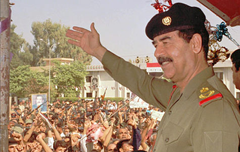
Saddam lives! That's just one of the startling secrets to be discovered in the ancient streets of the Holy City. Jerusalem offers plenty more revelations -- tales of the wisdom of Cleopatra, the fighting spirit of Texas, and just maybe a bit of genuine hope. Or maybe not.
First, the Saddam bulletin. While walking in Jerusalem's Old City, I happened to notice -- as who wouldn't -- a couple of pictures of the former Iraqi dictator on the wall of a little grocery store. I was shy about asking the proprietor about them. I needn't have been. "Yes, we all love him," the young man enthused. "He is king of the Arabs. He will return. He is not dead."
But -- the hanging video? "All faked," the young man assured me. Then he pointed to two Saddam portraits on the wall. "Only one of these is Saddam," he says. "Can you tell which?"
I couldn't. And it is true that Hussein was known to use doubles. So, I asked: was it a double in the hanging video? "No, no," he explained cheerfully, "that was all phony. No one was hung."
So there you go. Like the King of Rock and Roll, the King of the Arabs lives on. Add him to the list of Mideast messiahs holding return tickets with an open date.
More revelations
It may not be news to you that Jerusalem is a city thoroughly steeped in religion. But until you arrive as a lone wanderer, a secular free agent unprotected by tour guides or gangs of hymn-singing accomplices, you don't realize just how it plays out on the ground. In my case I mean shortly after touching down at the airport at 4:30 a.m. and boarding the mini-bus for the trip from Tel Aviv's Ben Gurion Airport into Jerusalem. A Jewish pilgrim from England promptly plunks down beside me and begins a sort of stream-of-consciousness ramble about the Holy Land. My seatmate might be described as a sort of holy fool, but the holy part would be generous. He's harmless enough, and his ramble is intermittently interesting -- for instance, the revelation that since the Romans could not destroy the sacred Western Wall of the Second Temple, some Jews believe that even an atomic explosion would leave it standing. But his credibility suffers when he makes reference to the great philosophers who influenced Judaism, such as Aristotle -- and Cleopatra.
He talks nonstop until, thanks be to Jehovah, he disembarks. It won't be the last sermon I get. One night in the Old City as shops were closing, a bearded Palestinian gentleman begins a vigorous pitch to sell me an old-fashioned Bedouin-style coffee pot. At some point he abruptly tacks into a general lecture on Islamic philosophy and worldview, a peroration that goes on for at least 20 minutes with hardly a breath. "I like you," he says. "You are more open-minded than many."
I have spoken less than a dozen words while nodding regularly.
Faith and T-shirt slogans
Although Jews and Muslims make up most of the populace, most of the local souvenirs have converted to Christianity. To say "Holy crap" in Jerusalem is merely to describe the merchandise. I've also seen one shop with plaques reading "Don't Mess With Texas" and "Go Longhorns." Also "Shalom, Y'all." My two favourites so far: a T-shirt reading "Guns 'n Moses," and another with those laughing cartoon figures usually associated with the phrase "You want it when?" only in this case the slogan is: "Peace in the Mideast?"
After religion, that's always the hot topic around here. To chat with folks on both sides of the Jewish/Muslim divide is to swing between despair and optimism like an undecided superdelegate. One Friday afternoon in the Old City as a mass of Muslims crammed the narrow streets on their way home for the most important of weekly prayers, I chat with a genial old man named Abu Abed. Sitting in a wheelchair greeting passersby, he gives me yet another long tutorial on Islam and regional history. His is much more interesting than previous lectures though, and ultimately more revealing. He admits what many Israelis always said -- that Yasser Arafat was a disastrous leader for the Palestinian cause. But when I ask hypothetically whether the deal Arafat is said to have rejected at Camp David in 2000 (reportedly most of the West Bank, all of Gaza, plus sovereignty over East Jerusalem) would be accepted by Palestinians today, he pauses a moment before answering. "I think no," he says. "I think most Palestinians would say no."
He pulls his glasses from his shirt pocket. "If a man steals your glasses and then offers you back one arm, will you agree? No! You want them back."
Today, he agrees, Israel and America are strong. But why make a deal now when the wheel is always turning? "Once the crusaders were strong," he says. "And the Soviet Union was strong. They are gone now."
A fascinating if somewhat depressing discussion. But not the last I would have.
'Combatants for Peace'
Next day in the Christian quarter of the Old City I meet Ibrahim Bader, the Palestinian proprietor of The Coral Beach, a carpet and jewelry shop (where I got a great carpet deal, really). Also in the shop is his friend and fellow jewelry merchant, Nurit Steinfeld. As Bader looks on with a little smile, she tells me how he had been hounded out of his previous location by the new security wall and increasingly stringent checkpoints that strangled his business. "Yet here he is," she says of Bader, "still hopeful, still in Israel, making a contribution to the community."
Steinfeld herself has gained hope from a group called Combatants for Peace, former fighters from both sides who now work for peaceful solutions. Members include a woman who was a failed suicide bomber, now working for rapprochement in the region.
"In order to make people want peace we have to make them comfortable," Steinfeld says. "We have to win hearts. We haven't been doing that."
"These women are exceptional," Bader later says of Steinfeld and her friends. "There are not many like them."
In my very brief time here, that's been my sense of it too. But it was good to meet the few.
Related Tyee stories:
- Luminous Calamity
Reviewed: 'The Last Resistance,' essays on Palestine and Israel by Jacqueline Rose - What to Read While the Cradle Burns
A Tyee booklist on the Middle East. - The Other Messiah
In Israel, unearthing the tale of a Jesus rival named Simon bar Kokhba.
![[Tyee]](/design-article.thetyee.ca/ui/img/yellowblob.png)



Tyee Commenting Guidelines
Comments that violate guidelines risk being deleted, and violations may result in a temporary or permanent user ban. Maintain the spirit of good conversation to stay in the discussion.
*Please note The Tyee is not a forum for spreading misinformation about COVID-19, denying its existence or minimizing its risk to public health.
Do:
Do not: