


 SHARE:
[Editor's note: This is drawn from Go Do Some Great Thing: The Black Pioneers of British Columbia, to be published by Commodore Press.]
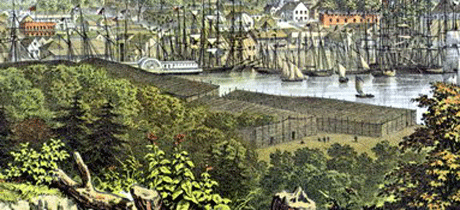
In April 1858, San Francisco's beleaguered and harassed black community sent a 35-member "Pioneer Committee" to Victoria. It was a response to an invitation to settle in the colony of Vancouver's Island, which was about to be flooded by American gold-seekers. The committee sailed on a steamer called the Commodore.
It was a rough voyage in an unseaworthy old ship, but after five days they were safe in Victoria harbour. As their fellow passengers invaded the town, seeking temporary shelter and quick transport to the mouth of the Fraser, the Pioneer Committee rented a room from a local carpenter for a prayer meeting.
One of the local residents who took an interest in the blacks was the Reverend Edward Cridge, an Anglican minister. In his diary, he reported their arrival and his first dealings with them: "On Sunday Apl 25 the Commodore Capt. Nagle, arrived with 400 or 500 Emigrants from San Francisco ... There were also 35 men of colour from the same place of different trades and callings, chiefly intending to settle here.
"On Monday (Apl 26) drinking tea at Mrs. Blinkhorn's with my wife she (Mrs. B.) told us that on the precedg evening she was surprised at hearing the sounds of praise. They proceeded from the men of colour who had taken a large room at Laing's the Carpenter: & they spent the Sabbath Evening in worshipping the word of God.
"On the following morning I called on them. They appeared much gratified by my visit. I requested permission to ask them a few questions which they decidedly acceded to."
Stories of oppression
The blacks told Cridge of the legal oppression they had endured in California. "They also told me that a deputation of three of their number had waited on the Governor who had given them a good reception and they were much encouraged by the statement he gave of the privileges they would here enjoy."
These three men were Fortune Richard, Wellington Moses (born in Britain), and a man named Mercier; they had been delegated to meet Douglas and report back to San Francisco.
When the blacks told him "that they did not intend to establish a distinct Church organization at Victoria but to join some Ch. already in existence here," Cridge invited them to attend his own church. Many of them did so over the next few weeks, and Cridge learned about their backgrounds. Several of them still had families in slavery, and hoped to earn enough in Victoria or the gold fields to buy their freedom.
Settling in
The Pioneer Committee lost no time in getting settled. Many bought land in town. Some formed a brickmaking company, and others found work at once on the farms of white settlers, who were delighted to hire them. Augustus Pemberton, an important settler who was later Commissioner of Police, hired several blacks less than a week after their arrival; they split rails, sheared sheep, and cleared acres of land.
Mercier returned to San Francisco within a few days and presented a detailed report on the colony to 350 listeners at Zion Church. The advance party, he said, had enjoyed a very good reception. Governor Douglas had made them welcome, and the delegates' meeting with him had been "very cheerful and agreeable."
Douglas had given them a good deal of information about settling. After nine months, anyone owning land had the right to vote and to sit on juries. While all immigrants would be protected by the laws, Douglas said, settlers could not claim all the rights of British subjects until they had lived in the colony for seven years and then taken an oath of allegiance to the Crown.
As the blacks were to learn to their sorrow, this preview of their status was not entirely accurate. But coming as it did from the governor himself, no one questioned it. The prospect of enfranchisement was especially attractive to the blacks, who had endured taxation without representation for generations.
Asylum 'in the land of strangers'
Mercier also read a letter from Wellington Moses, who had already fallen in love with Vancouver Island:
"To describe the beauty of the country my pen cannot do it. It is one of most beautifully level towns I was ever in. . . . I consider Victoria to be one of the garden spots of this world. . . . The climate is most beautiful; the strawberry vines and peach trees are in full blow. . . . All the colored man wants here is ability and money. . . . It is a God-sent land for the colored people."
Such reports only added to the growing enthusiasm for emigration. A week later, at yet another meeting, it was proposed that an emigration society be formed, to recruit a hundred members at $25 each. The society's governors would then charter a ship to transport the entire group to Victoria. It seems unlikely that such a society was actually formed; with a steamer ticket costing only $15 on the regular run, chartering a ship seemed unnecessary.
The meeting also passed twelve resolutions, preceded by a preamble both bitter and articulate:
"Whereas, We are fully convinced that the continued aim of the spirit and policy of our mother country, is to oppress, degrade and outrage us. We have therefore determined to seek an asylum in the land of strangers from the oppression, prejudice and relentless persecution that have pursued us for more than two centuries in this our mother country.
"Therefore a delegation having been sent to Vancouver's Island, a place which has unfolded to us in our darkest hour, the prospect of a bright future; to this place of British possession, the delegation having ascertained and reported the condition, character, and its social and political privileges and its living resources. This mission in the highest degree creditable, they have fulfilled and rendered the most flattering accounts to their constituents in their report. . . ."
The resolutions themselves thanked the delegation for its work in Victoria, Governor Douglas for his kindness, and Reverend Cridge for welcoming the delegation to his congregation.
'Avoid all social distinctions'
Perhaps the most important resolution set ambitious terms for the role of the emigrants. As B.C. historian James Pilton puts it, "They also resolved upon arrival in Victoria, to avoid all social distinctions such as colored churches, colored schools, or colored associations of any kind, such as they had been forced to adopt in the United States due to prejudice against their race."
The day after this meeting, all the African Methodist Episcopal ministers of San Francisco met in convention to discuss the impending migration. As one of them put it, "Just when we were asking ourselves, 'Where shall we go?' God Himself came to our aid and opened the door for us."
The ministers passed a resolution even more far-reaching: "In the opinion of this convention we deem it expedient to call upon our people throughout California in particular, and the Atlantic States in general, to save all the money they can and prepare themselves to emigrate to a country where the color of their skin will not be considered a crime and where they can in fine, enjoy all the rights and privileges which will alone make them a great and mighty people."
A whole community was on its way to Victoria.
Related Tyee stories:
- BC's Amazing Black Pioneer
Why Mifflin Gibbs still matters today. - Black Writers in Search of Place
A three-way conversation about history, role models, and inventing 'The Black Atlantis.' - Who Are Great Canadians?
Five people who prove our nation's potential.
![[Tyee]](/design-article.thetyee.ca/ui/img/yellowblob.png)
Read more: Rights + Justice






Tyee Commenting Guidelines
Comments that violate guidelines risk being deleted, and violations may result in a temporary or permanent user ban. Maintain the spirit of good conversation to stay in the discussion.
*Please note The Tyee is not a forum for spreading misinformation about COVID-19, denying its existence or minimizing its risk to public health.
Do:
Do not: