
Friends in Vernon take to heart the ideals of local feasting.
James is in Nova Scotia, and facing the thought of a 100-Mile Thanksgiving alone was a gloomy thing. He is the chef of this duo. What could I make? Humble potatoes, baked or boiled, sprung to mind. I can only deal with so many ingredients at once, or disaster ensues; also, I am happiest if everything can be made in one pot. James, meanwhile, emailed yesterday to say that there is maple syrup on the east coast. He'd better have some in his suitcase when he returns.
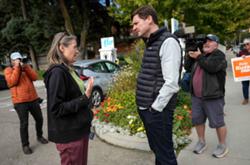
To lift my sagging spirits, friends in Vernon told me they were going to do a 100-Mile Thanksgiving. So hats off to Marcia McKenzie, a UBC education post-doctorate, and crown counsel Colly Blenkinsop. They have a cooking group with whom they regularly organize menus, go on shopping trips, and share the camaraderie of meals together. They (gently) foisted the idea of doing a 100-Mile Thanksgiving on these pals. I was, of course invited, though unfortunately, a collision of work and other plans made it impossible. Also, I thought people might find it ironic if I drove 400 miles to have a 100-Mile dinner.
Leading up to the dinner, Marcia reported on some of her reluctant dinner companions: "I think there's going to be some cheating going on." However, she and Colly imposed some admirably tough rules on themselves-no cupboard ingredients to supplement the local stuff. "After all, we're only doing it one day, not all year. It would be too easy otherwise," she says.
This is what Marcia bought at Vernon's Thursday farmer's market: radishes, red and yellow beats, zucchini, squash, rutabaga, and a bunch of fresh herbs. "And cantaloupe and watermelon, super cheap," Marcia said. What do you suppose they will make? She didn't know at that point either. She was a little concerned that there was no dairy stand, so no butter or cheese. She planned to investigate further. There was, however, a meat stand offering buffalo and a certain exotic bird. Who needs a turkey when you have an emu… No, they've decided not to be that unusual. A friend driving in from Maple Ridge is apparently bringing a turkey with him.
Say yellow to holiday season
I tried out a dinner the other night that is very Thanksgiving, though it was too uniformly yellow to consider serving it to guests. However, it was delicious and easy, so for all the rest of you who hate cooking like I do, here are the very simple instructions. Feel free to make one or the other for your own Thanksgiving-or both, if you are having a yellow theme party. Then I suppose you would add corn to it.
Yellow tomato soup. Sitting on my kitchen counter were the last of the 35 pounds of organic tomatoes James and I picked at a Delta farm. They were all yellow ones-we hadn't trusted canning them, because that type is less acidic. They were a bit smushy by this point. I stared at them and their overwhelming tomato presence. All I could think was sauce? So I chopped them up in quarters and put them in a pot on low heat to release the juices, and then cut them into smaller pieces. I added salt, a big bunch of dried rosemary from our community garden, and a little dried thyme from my now-dead balcony plant. I threw in a little oil left in a measuring cup from earlier that day. I simmered it all for half an hour until it was thicker. It wasn't yet sauce, but I tasted it. By God, it was soup! Delicious at that. The key was obviously good tomatoes.
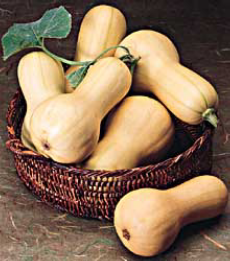
Baked butternut squash with feta cheese. For the main baking instructions, I got out my grandmother's trusty Good Housekeeping cookbook that dates from World War II. I quartered half of a leftover butternut squash and scooped out the seeds and goopy stuff as the Good ladies told me. I ignored GH's call for dollops of butter and brushed oil on the squash too. I sprinkled on some salt and, because I don't like to think too much about food, some of the rosemary I had out. Forty minutes at 375 degrees. For the last five minutes I tossed on some cubed feta cheese to warm. What do you know, this was delicious too. It was a real coup for a non-chef like me.
For people who eat turkey (as of yet I am still holding out as a fish-eating vegetarian), in Vancouver, Capers had a hotline for acquiring a local bird for Thanksgiving. However, if you haven't called by now-you're screwed. Well, for last minute types, there were still a few monstrous "utility grade" roasters ($6 a pound) and some precious organic cuts ($35 a pound) in the West 4th store on Saturday. Try your luck.
Home alone. Nuts!
My favourite fall treat is walnuts. James was amazed when I told him that there were local farms growing them. I suppose, like cantaloupe, it's something I also used to associate only with the southern United States. More common knowledge, perhaps, is the fact that hazelnuts grow here (and as far north as the eponymous Hazelton, near Terrace). In any case, I had planned to go to Mission on Saturday to get some organic walnuts, but when I phoned a few farms I learned they wouldn't be ready until at least next Wednesday. Mother Nature cannot be kept to our strict holiday timetables.
More accessible are the chestnuts from Agassiz, sitting pretty in Capers for $5.99 a pound. I have never tried roasting them, but here's the approximate internet consensus: score the skin so they don't burst, put them on a tray, cook in a 425-degree oven for 15 to 20 minutes, then wrap in a towel for a few minutes before eating. An Italian food website suggested drinking a "vino novello" (or Beaujolais nouveau) alongside. My Good Housekeeping book has a recipe for chestnut stuffing; the ladies decree that the nuts be roasted at 500 degrees for 15 minutes, skinned, and then boiled in water for 20 minutes.
So many Thanksgiving choices, but it all sounds like so much work. Perhaps I'll just eat buttered popcorn. The pilgrims would appreciate that.
Alisa Smith and J.B. MacKinnon will continue to write for The Tyee, once a month, about their attempt to eat well on the local-only 100-Mile Diet. For more information on finding locally produced food visit the web site of FarmFolk/CityFolk.
Read the whole 100-Mile Diet Series. ![[Tyee]](http://thetyee.cachefly.net/ui/img/ico_fishie.png)
J.B. MacKinnon is an independent magazine journalist and writer. He is the author of Dead Man in Paradise (Douglas & McIntyre, 2005), which won Canada’s highest award for literary nonfiction. He is also coauthor of The 100-Mile Diet (Random House, 2007, with Alisa Smith), a bestseller that is widely credited as a catalyst of the local foods movment, and I Live Here (Pantheon, 2008, written with Mia Kirshner, Paul Shoebridge and Michael Simons), a unique “paper documentary” about displaced people.
J.B.'s Connection to BC: Born is Sheffield, England, but raised in Kamloops, B.C., J.B. loves this province. (He has been down nearly every highway and a lot of the dirt roads, too.)
Reporting Beat: Environment, food.
Website: J.B. MacKinnon
14
Login or register to post comments
Dan
7 years ago
Comments on "Thanksgiving on the 100-Mile Diet"
Another wonderful article in this 100 mile diet series.
I noticed the footnote mentions that this series will continue to be written once a month.
I was counting down the days in the fortnight between the last couple of articles.
This is just my statement/opinion on-the-record that I would love to see this series more often than monthly.
redrivergirl
7 years ago
"By God, it was soup!" lol You sound like the same kind of cook I am. :)
I was thinking a cook book from the turn of the century would be a good thing to have on this way of eating just before your mention of your Grandmother's one. The older cookbooks often give tips on simpler food preperation as well.
I have an older friend well into her 80's who makes butter from cream and ice in her blender!
I really enjoy your articles and admire what you are doing. I wonder if you are feeling a lot healthier?
I know when I went organic, I was amazed at the difference.
Thanks for sharing your journey with us.
Happy Thanksgiving!
Louise
7 years ago
Didn't arbitration with Vince Reddy pull the BC Ferries strike out of the headlines? How did that arbitration work for them? Don't they have a 7 year contract? Does anyone know the particulars?
skeptikool
7 years ago
Louise,
I think that was a different kind of soup.
I suggest you go back to the "home" page, scroll up just a smidgen, and cut and paste your above post into one of the education dispute topics - where you'll surely get a response.
skeptikool
7 years ago
In the south of England there are many chestnut trees and a favorite sport of boys was to throw stick into the branches to dislodge the edible treats.
In South Delta we have also many chestnut trees, but of the "horse" variety. They are beautiful, in and out of blossom, but I wonder at the mean-spiritedness that seemed to prevail at the decision to plant only this non-edible(to humans) variety.
My favorite squash is the one with the redder flesh, the buttercup - sometimes called the kabocha. I eat the skin and enjoy the sweet chestnutty flavor - steamed, roasted or fried.
A medium-size squash mashed up with pepper and a little trans-fat-free margarine is a meal for me. Yummeeee.
foggybottom
7 years ago
It's all good when people enjoy using and rediscovering the vast array of local produce, it's natural for us to eat locally, - every other living thing does.
Please get to know your local farmers, they are the stewards of your relationship with the earth. By all means hold them accountable for the way your food is raised, this will enable trust to grow in this relationship.
Regulation is a poor substitute for trust and is largely responsible for waste and incomplete production cycles.
As trust develops then so does consumer responsibility, price becomes less important than stewardship. Without responsible stewardship we will never be sustainable.
Nature has no responsibility to be economic, this is a flawed ideology. A food producing farm is still a farm whether or not it is 'economically' viable, in that the food still provides a 'living' for people. Somehow we must allow farms to 'be' irrespective of whether or not they are economically viable, -after all society seems to be able to accept that parks don't need to be profitable.
I hope everyone is enjoying thanks-giving, please take the time to get to know where/how your food was produced -become responsible citizens of 'nature's social union
ROBBINS Sce Research
7 years ago
Since our family has put a recent stop to the big discount food shops, and really turned up the walking-jogging (rain too), we have begun to realize that although we were healthy, we weren't as healthy as we could be (without becoming obsessive).
Part of this new diet conciousness (with two daughters aged 16 and 10 the latter fussier than the former) we have come upon good old beef stew. Over the past month we have made 3 batches of beef stew (although we have pledged to use very little beef). Each batch has satisfied 3 full lunches and 3 full dinners. Each batch cost between $12 and $15.00 (including mushrooms, sweet potatoes, yams etc). If my math is correct this is under $1.00 per bowl not including the use of the stove.
We use only $5 of stewing beef which is browned, dipped in flour and sauted. The beef is cooked with the sauces (tomato-chicken broth-wine or balsamic vinegar).
Majoram, thyme, garlic, and red pepper flakes are used along with the usual suspect of delicious vegetables.
The fact that the meals are not expensive per serving in only a small part of the enjoyment. The major treat is the taste.
The wife and I love this, but what is fun to see, is the previous reluctant daughters, clamoring for the next batch of stew.
When I was young growing up with my seven brother and sisters, I could never understand why my father would rub his hands together in delight at the prospect of beef stew. I preferred fish and chips.
Now I get it.
Te Aro Arahina
7 years ago
Ah, nostalgia! One would think our ancestors knew what they were doing when it came to food. Alas, here's someone who has actually documented popular food choices from times past:
http://tinyurl.com/7m5p3
Te Aro Arahina
7 years ago
For example:
http://tinyurl.com/acayt
scylla
7 years ago
Given the trouble last-minute plans cause, and considering these are harvest-times when locally grown foods are available, perhaps we could take another of the old-timers' lessons to heart, that of planning well in advance.
We've been spoiled by the convenience of being able to buy what we want when we want it.
Is it too early to begin stocking up for Christmas Dinner?
skeptikool
7 years ago
No, scylla. I'm looking out of my window now as a squirrel is digging a hole in my front lawn. More filbert trees (courtesy of my neighbour) to dig out.
Te Aro Arahina
7 years ago
So, the roast beast at skeptikool's yule feast is squirrel?--stuffed with filberts?
skeptikool
7 years ago
Te Aro Arahina,
Re: the yuletide menu
Now that's an idea whose time has come, but as with the blackbirds, I'd need at least four-and-twenty.
mica
7 years ago
I just read one of your stories in Utne and went online to peruse the rest. Great thoughtful stuff, we try to utilize out local farmers as much as possible. It is amazing how many small producers of cheese, meat, grains and bread you can find if you look. What worries me is when legislation gets passed that reduces the small producers. A friend stopped selling as many locally grown chickens because the rules got changed. We may just try to grow our own. But think about how many people do not have the option to try to grow their own. Thank you for your stories and the comments are even more thought provoking. Dehydrating is another option to prolong the season. Eat well and thoughtfully.