


 SHARE:
I don't normally watch The Oprah Winfrey Show, but the other day I was idly roaming up and down the dial and happened upon her in full flight. L'Oprah was extolling the virtues of Eckhart Tolle's book The Power of Now, while all the middle-class ladies screamed themselves silly. Everyone got a copy of Tolle's latest book, A New Earth: Awakening to Your Life's Purpose, and the ensuing hullabaloo damn near raised the roof.
The screams of all those glossy ladies echoed oddly in my head when I watched Kung Fu Panda. Everyone wants to feel good about themselves, it seems, even big fat panda bears.
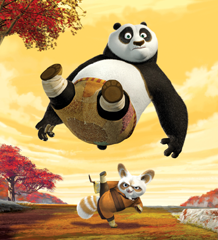
Kung Fu Panda is pretty much like it sounds. A panda named Po (voiced by Jack Black) wants to become a kung fu master. He's tired of not being all the bear he can be. He wants to be a bigger, better bear. Like most anti-heroes of late, Po is a type, he is a schlubby, chubby slob of a dude who lives with his elderly dad in an apartment above a noodle shop.
Po dreams of warrior glory, but collecting action figures of his favorite martial artists is as close as he gets. His dad (who oddly enough is a long-necked goose) wants him to take on the family business. "We're noodle folk, broth runs in our blood," he says. Po has other dreams, he just needs a little self-help. (Where is Eckhart Tolle when you need him? He was inside you all along. Eep! Get him out!)
Ka-Po!
The film's setting is ancient China, though "So Cal" accents predominate, and oriental wisdom is interspersed with slacker speak. To wit: skidoosh meets Confucius. If you can suspend disbelief for all that, then you're either on medication or you're not paying much attention. That's okay, there isn't much here we haven't seen a million times before. It's the heroes' journey all over again, with a few new kinks to add interest.
Po's destiny begins when the leader of the Jade Temple, an ancient turtle named Oogway, has a vision. Oogway has foreseen the return of arch villain of Tai Lung, who will bring ruin and destruction in his wake. Tai Lung can only be stopped by the Dragon Warrior, a legendary fighter who can wield unlimited power. A grand tournament is declared to anoint the chosen one and every kung fu fighter around struts their stuff. But where is this legendary warrior you ask? He's busily trying to lug his giant belly up the stairs.
Like Cinderella or King Arthur before him, Po carries hidden greatness within. In his case, it's apparently buried beneath layers of fat. But even fat can't stop fate. When Po is declared the Dragon Warrior, his kung fu training begins under the hard gaze of one Master Shifu, a pint-sized terror, given dry life by Dustin Hoffman. Shifu has already trained the Furious Five (Monkey, Mantis, Viper, Crane and Tigress) and now he must bend his will against the bulk that is Panda. You know the drill, our hero must learn to believe in himself, before he can claim his true destiny. A few training sequences later, a number of epic battles, one final moment of self-discovery and victory!
Everyone's special
Kung Fu Panda is not a bad little film, and in a few places it positively shines. The fight sequences are beautifully rendered and the opening credits, an overt homage to the anime classic Ninja Scroll (which is really worth watching by the way), are a great fun. Ian McShane makes one hell of a villain, and the rest of the cast (Angelina Jolie, Jackie Chan, Lucy Liu and Seth Rogen) do their bit. Although, it must be stated, they aren't really given all that much to do.
This is basically a one-Panda show, and Jack Black walks away with the bulk of the better lines. What is most interesting about this film is how it's part and parcel of a greater cultural message.
The lesson that even the most ordinary among us is actually super special, is everywhere at the moment. It might begin with kid's films, but it works its way up to adults in the form of Oprah-isms, or books like Become a Better You: 7 Keys to Improving Your Life Every Day from mega-preacher Joel Osteen. It even rears its head in reality shows where every sad sack that ever warbled a tune is convinced that his or her destiny is to be a super duper star.
Self-esteem has morphed into something almost monstrous in its proportions: it has become a political force. If you'd like evidence of this, just ask all the Obama-ites who swoon at the very sight of the man. Much has been made of the fact that Obama has united the American youth vote by tapping into the idea of feeling good about yourself and the world. Hope and change are fine and lovely notions, but reality is a harsh mistress. Getting harsher all the time it seems.
Overstroked, underchallenged
In amongst all this warm mush about being a better person, you might well ask, are we really any better? Or are we a whole lot worse? In a recent article in The New Statesman entitled "The Kindergarchy: Every child a dauphin," Joseph Epstein makes the argument that convincing children that they're great often has the opposite effect.
Writes Epstein: "The consequences of so many years of endlessly attentive childrearing in young people can also be witnessed in many among them who act as if certain that they are deserving of the interest of the rest of us; they come off as very knowing. Lots of their conversation turns out to be chiefly about themselves, and much of it feels as if it is formulated to impress some dean of admissions with how very extraordinary they are.
Despite all the effort that has been put into shaping these kids, things, somehow, don't seem quite to have worked out. Who would have thought that so much love in the home would result in such far from lovable children? But then, come to think of it, apart from their parents, who would have thought otherwise?"
Although Epstein's rant has little too much "When I was your age...," he has a point. You can see it reflected in a film like Kung Fu Panda, where the titular hero, having nothing but innate, albeit unrecognized genius, triumphs, while others of far greater ability and training fail. I hear similar stuff when my mother complains about her creative writing students who never bothered to learn the basic (boring) craft of writing, but nonetheless want to be commended for their natural and instinctive genius.
No time for coddling
It's easy to bash parents of this generation and the children they produced, but it isn't simply the Millennials and their outsized sense of entitlement that is to blame. Self-help advice, aimed at convincing people they're only a few steps away from being all that they can be, has been around a very long time. There is always someone willing to buy what someone else is selling. It's the guru effect that is particularly noticeable at the moment. Folks like Oprah or Barack Obama may be the most obvious examples, but you don't have to look hard to find a veritable sea of people selling seven simple lessons to total and complete happiness. Millennia of wisdom, culled from Buddha to Jesus, is packaged into bite-size morsels and delivered in glossy paperback.
This type of predigested pap is insanely big business. Osteen's book, Become a Better You, had an initial print run of three million copies. So, too, Mr. Tolle's book, under the blessed wing of Oprah, has sold in the millions. Neither man actually has much in the way of education. Osteen never studied theology, and Tolle dropped out of school at age 13 (although he later studied at the University of London). What they do have is an eager audience of people looking hard for something easy.
Kung Fu Panda is only one small example of the "we're all super special" phenomena. But if you want to give your kids a harder, more bitter pill to swallow, make them sit through Darwin's Nightmare. They'll hate you for it.
Related Tyee stories:
- Students Today: Lovable Lazies
Why (a college prof wonders) are you here? - My Favorite Kids' Films
Top of this mom's list: 'My Neighbour Totoro'. It's more David Lynch than Disney. - Rise of the Aristo-Brats
Fame and fortune flows to kids of the famous fortunate.
![[Tyee]](/design-article.thetyee.ca/ui/img/yellowblob.png)
Read more: Film




Tyee Commenting Guidelines
Comments that violate guidelines risk being deleted, and violations may result in a temporary or permanent user ban. Maintain the spirit of good conversation to stay in the discussion.
*Please note The Tyee is not a forum for spreading misinformation about COVID-19, denying its existence or minimizing its risk to public health.
Do:
Do not: