


 SHARE:
[Editor's note: Yesterday, Tyee columnist Murray Dobbin answered the question, "'Who's Obama proving to be?" by calling him the "reluctant imperial president." Read that article here.]
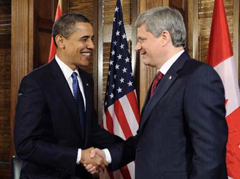
"I love this country," Barack Obama professed during his recent visit to Ottawa. The comment might be interpreted as a gentle rebuke to Stephen Harper who, when asked whether he loved Canada in 2005, hesitated, pursed his lips and replied, "Canada is a great country."
More likely, it was a straightforward expression of affection rooted in President Obama's family connections to this country as well his awareness of its historically important role -- as the terminus of the underground railway; as a deciding factor in two world wars; as a long-time proponent of human rights, international law and multilateral diplomacy; and as a model of successfully multicultural, social welfare state.
Most importantly, the comment also suggests an awareness of just how important Canada could be to achieving the new president's economic, environmental and foreign policy goals.
Smart power
Secretary of State Hillary Clinton has placed "smart power" at the centre of the Obama administration's foreign policy. According to this approach, influence is derived from many factors, including diplomacy, cooperation, a good reputation, economic vitality and military power.
"Smart power" plays to Canada's strengths -- which are truly multifaceted.
Geographically, we're the world's second-largest country. We have the eighth-largest economy. We're the United States' largest trading partner and its principal supplier of energy -- in the form of oil, natural gas, hydroelectricity and uranium.
We have a population of 33 million well-educated, globally connected people, and are well-remembered for our historic contributions to diplomacy, international law and UN peacekeeping.
Our military is small but highly competent. Our foreign service is among the very best. Seen through the lens of smart power, Canada has considerable potential influence that could and should be exercised on behalf of our own citizens, the international community and -- on issues of common cause -- the United States.
Afghanistan
Clearly, Afghanistan is an issue of common cause. The Canadian Forces have suffered the highest casualty rate, per soldier, of all the allied troops in Afghanistan. To date, 112 Canadian soldiers have lost their lives; hundreds more have been permanently injured.
The deaths, injuries and other demands of the mission have prompted retired Major-General Lewis MacKenzie to conclude that "Canada will not be capable of remaining in Afghanistan in a combat role beyond 2011."
Fortunately, President Obama is already applying the concept of smart power to Afghanistan. The appointment of the seasoned Richard Holbrooke as his envoy is a clear indication of just how important the diplomatic angle has become. President Obama is not going to try to fight his way to victory; he's going to focus on holding ground, making friends, and training the Afghan army and police.
And while President Obama is increasing the number of troops in Afghanistan, he's actually cutting -- by around 100,000 -- the number of U.S. soldiers deployed in combat missions abroad. The end result is that Canadian soldiers are less needed than they might have been before.
Consistent with the concept of "smart power," we can and should offer to contribute in other ways. Our diplomats could help negotiate with tribal and insurgent leaders in Afghanistan, as well as with regional actors such as Iran, India and Pakistan. The Canadian International Development Agency could provide more reconstruction assistance. The RCMP could do more to assist with the training of the Afghan police.
All indications are that the Obama Administration has made the same calculation, and that pressure is not being applied to keep Canadian soldiers in a combat role in Afghanistan after 2011 -- the withdrawal date set by Parliament last March. There is no reason, whatsoever, to even consider another extension. It's time for the Canadian Forces to rest, re-equip and retrain.
Economy
President Obama is demonstrating extraordinary leadership in addressing the global economic crisis. But he's looking for international support for his economic stimulus, and he hasn't received much from Canada so far.
According to the parliamentary budget officer, the net effect of Canada's stimulus plan is equivalent to just 0.7 per cent of GDP -- which is just one-quarter of President Obama's package and less than half of the stimulus recommended by the International Monetary Fund. And this despite the fact that Canada's per capita debt is lower than that of any other G7 country.
The Great Depression led to the creation of the World Bank, IMF and GATT. The current crisis is likely to generate similar international institutional reforms, including mechanisms for regulating multinational banks, stock exchanges and currency speculators.
Canada could play a major role here, bridging differences between American, European and Asian governments, and developing and circulating concrete proposals which could then be used as a basis for multilateral decision-making.
Canada could also seize on President Obama's declared intent to bring labour and environmental standards into the main body of NAFTA. Such changes would work to this country's comparative advantage -- since we have relatively robust standards already -- particularly if the practice of including such standards spreads to other trade agreements such as the WTO. And this, in turn, would help to tame one of the most destabilizing effects of globalization, namely capital flight to the most unregulated, human rights and environment-abusing states.
Energy and environment
The environment is a key economic issue -- because it is the foundation on which all human activity takes place. Sir Nicholas Stern made the point in his 2006 report on climate change to then-British Prime Minister Tony Blair, stating that every dollar spent on mitigating climate change now will save $20 in 2050.
President Obama understands this. Shortly after his election, he confirmed that the United States would "help lead the world toward a new era of global cooperation on climate change. Now is the time to confront this challenge once and for all. Delay is no longer an option. Denial is no longer an acceptable response. The stakes are too high. The consequences are too serious."
At the same time, every crisis creates opportunity -- in this case, to move through the next industrial revolution into a global economy based on non-hydrocarbon sources of energy. It is hugely significant that President Obama has appointed Stephen Chu -- the Nobel Prize-winning physicist and world-leading expert on climate change -- as his Secretary of Energy.
The tide has changed, and Canada risks being left high and dry. Already, we're seeing a seismic shift in public opinion in the United States. This month's issue of National Geographic, which singles out the Alberta tar sands as an ecological disaster, is only part of that.
President Obama has ignored Prime Minister Harper's proposal for a North American energy and environment accord because he wants to go much further -- and not exempt the tar sands. He wants to use firm caps and a 1990 baseline, not emissions intensity targets and 2006 numbers.
In the circumstances, it's time to abandon old plans and old thinking -- like a 1,200 kilometre gas pipeline across melting permafrost from the Beaufort Sea to Fort McMurray to fuel the extraction of oil from sand, or a 1,100 kilometre pipeline to ship condensate from Kitimat, B.C., to Edmonton to dilute the oil so that it will flow. It's time for new thinking: like ice-strengthened liquefied natural gas tankers to move that clean-burning fuel from the Arctic to Atlantic Canada; and wind, solar, tidal and geothermal developments on a scale comparable to Germany or Denmark today, and the United States tomorrow.
It's also time for massive investments in energy conservation and alternative forms of transportation. Where is the funding for high speed rail in the federal budget? Where's the new "national dream"?
It's time for the Climate Change Accountability Act, which passed the House of Commons last summer -- thanks to the support of all three opposition parties -- but had not yet cleared the Senate when the last election was called. The act, if implemented by a government that took the issue seriously, would rapidly transform Canada from a climate change rogue-state into a climate change leader.
The Arctic
The Arctic is not a priority for the Obama Administration, only because international cooperation is already well advanced in the region. Last May, the five Arctic Ocean countries -- Canada, Denmark, Norway, Russia and the United States -- collectively affirmed their commitment to the law of the sea and the "orderly settlement of any possible overlapping claims."
The Harper Government does everyone a disservice by feeding the media interest in conflict stories -- such as Defence Minister Peter MacKay's bellicose comments after two Russian bombers exercised the right that every country has to fly in international airspace.
As recently as November 2007, Prime Minister Harper and then-Prime Minister Viktor Zubkov issued a joint statement on cooperation between Canada and Russia in the Arctic. Since then, Canadian and Russian diplomats and scientists have been working together as both countries exercise their unchallenged rights to define the outer limits of their extended continental shelves under the Arctic Ocean.
Canada is also cooperating closely with the United States: In 1988, the Arctic Cooperation Agreement established procedures for Coast Guard icebreaker transits of the Northwest Passage and declared them to be of no consequence for the legal dispute. In 2006, the NORAD agreement was expanded to include joint maritime surveillance of the Northwest Passage. And the two countries have been jointly mapping the floor of the Beaufort Sea using U.S. and Canadian icebreakers.
More could be done. Canada should follow the lead of the United States in making public all of the data gathered by its scientists concerning the extended continental shelf, to ensure that common data sets are used by countries with potential overlapping claims.
Canada should be engaging the United States on the Northwest Passage, before the increasing traffic causes a diplomatic crisis. In February 2008, former U.S. ambassador Paul Cellucci and I demonstrated that negotiations could be quite fruitful: in just a day and a half, our two teams of non-government experts arrived at nine concrete recommendations for cooperation and confidence building between the two countries. Negotiations could also lead to a mutually acceptable resolution to the maritime boundary dispute in the Beaufort Sea.
In the Arctic, and elsewhere, some proactive Canadian diplomacy could make a world of difference -- and be of considerable assistance to a new president with far too much on his plate.
Equation has changed
For decades, the relationship between Canada and the United States has been understood as involving a degree of dependence, even subservience. The economic and environmental crises have changed much of that. But this is no time for celebration -- since the same crises have created shared perils that require more cooperation, not less.
Canadians have never watched humanity's great struggles from the sidelines. Barack Obama loves us because we're game changers. It's time to rise to the occasion again.
Related Tyee stories:
- Who's Obama Proving to Be?
Part 1: Murray Dobbin calls him the (reluctant) imperial president. - In Canada, a Push for Obama-style Green Stimulus
PM to get plan backed by 850,000 group members. - Is Obama Good for Canada?
How the US choice for president really affects us up here.
![[Tyee]](/design-article.thetyee.ca/ui/img/yellowblob.png)
Read more: Politics, Environment










Tyee Commenting Guidelines
Comments that violate guidelines risk being deleted, and violations may result in a temporary or permanent user ban. Maintain the spirit of good conversation to stay in the discussion.
*Please note The Tyee is not a forum for spreading misinformation about COVID-19, denying its existence or minimizing its risk to public health.
Do:
Do not: