Downtown Eastside Seeks Foreign Aid
Vancouver group asks UN to help homeless Canadians.
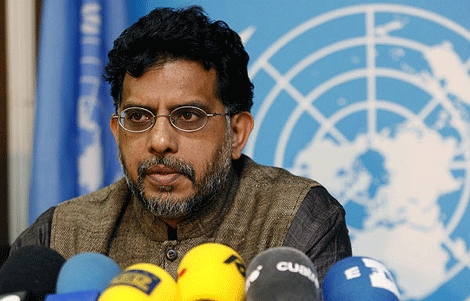
UN's Kothari: asked to 'intervene.'
[Editors note: The Carnegie Community Action Project (CCAP) met with United Nations representative Miloon Kothari this week and appealed to the UN to intervene on behalf of homeless people in the Downtown Eastside. After detailing the failure of federal and provincial governments to provide social housing, CCAP organizer Jean Swanson asked the UN representative whether "there's another country that could donate housing" to Canada. Swanson's presentation also detailed how two of the richest jurisdictions in the world are violating the human rights of its poor and homeless residents. This opinion piece is drawn from her presentation.]
We ask you, as the United Nations Special Rapporteur on Adequate Housing, to intervene on our behalf with the Vancouver municipal government, the government of British Columbia, and the government of Canada, to urge them to end homelessness and improve housing conditions in our neighbourhood, the city, province and country.
Homelessness in Vancouver was estimated in 2007 to be at the level of approximately 1,500-2,000 people sleeping outside at night and hundreds more in shelters and couch surfing. It is expected to reach 3,000 by the year 2010.
Last year, the provincial government set up a committee of government, business, and community-based organizations to determine how to implement the commitments. This group was called the Inner-City Inclusivity (ICI) Housing Table. It recommended that 3200 units of social housing be built by 2010.
In June, Vancouver City Council made implementation of the recommendations subject to "funding constraints." In other words, the Vancouver Olympic Organizing Committee (VANOC) and the three levels of government provided themselves with an excuse for breaking their Olympic promises.
Bursting coffers at home
There are no funding constraints. The suggested 3,200 units of social housing would cost $640 million. The provincial government is running a budgetary surplus this year of $4.1 billion. The federal government had a surplus of $6.4 billion in the first quarter of 2007.
With thousands of people remaining homeless, our municipal, provincial and federal governments are violating human rights treaties and commitments that have been ratified by Canada. In specific, we believe these human rights are being violated:
RIGHT TO FOOD AND SHELTER
The 1948 Universal Declaration of Human Rights states:
"Everyone has the right to a standard of living adequate for the health and well-being of himself and of his family, including food, clothing, housing, medical care and necessary social services, and the right to security in the event of unemployment, sickness, disability, widowhood, old age or other lack of livelihood in circumstances beyond his control."
This right is also set out in the International Covenant on Economic, Social and Cultural Rights (ICESCR):
"...Parties to the present Covenant recognize the right of everyone to an adequate standard of living for himself and his family, including adequate food, clothing and housing, and to the continuous improvement of living conditions. The States Parties will take appropriate steps to ensure the realization of this right..."
Canada is not currently implementing this right. Instead of continuous improvement in living conditions, Canada has seen a continuous decline.
In 2006, after reviewing Canada's "steps to ensure the realization of this right," the United Nations Committee on Economic, Social and Cultural Rights made a strongly-worded recommendation to Canada:
"The Committee reiterates its recommendation that the federal, provincial and territorial governments address homelessness and inadequate housing as a national emergency by reinstating or increasing, where necessary, social housing programs for those in need, improving and properly enforcing anti-discrimination legislation in the field of housing, increasing shelter allowances and social assistance rates to realistic levels, and providing adequate support services for persons with disabilities."
RIGHTS TO DECENT LIVING, HEALTH
Canada ratified the above-described covenant (ICESCR) in 1976. Thus did Canada agree that:
"Parties to the present Covenant recognize the right of everyone to the enjoyment of just and favourable conditions of work which ensure... Remuneration, which provides all workers, as a minimum, with... A decent living for themselves and their families."
Minimum wage levels set by the federal government and by the government of British Columbia do not provide an above-poverty-level income for full-time workers.
This violation was also noted in 2006. The Committee expressed it dismay that Canada has not addressed the treaty body's principal concerns about Canadian implementation of the ICESCR, including, "insufficiency of minimum wage and social assistance to ensure the realization of the right to an adequate standard of living."
Likewise, Canada agreed in 1976 that: "Parties to the present Covenant recognize the right of everyone to the enjoyment of the highest attainable standard of physical and mental health."
The Human Rights Committee, which oversees the implementation by States parties of the International Covenant on Civil and Political Rights, expressed its concern in 1999 that homelessness in Canada has lead to "serious health problems and even to death."
The Committee recommended that Canada take positive measures to address this serious problem. But those positive measures have not been implemented and conditions have deteriorated since 1999.
'Please help us'
Canada has been rebuked repeatedly by the UN for human rights violations.
Despite all the UN treaties and conventions that it has ratified, Canada has not moved forward in a concerted and positive way to ensure that residents actually enjoy the substance of their human rights.
We note that in the pledge made at the time of the elections to the new Human Rights Council, Canada, then an eager candidate said that it "commits to actively pursue the implementation of human rights domestically."
This is not what we witness. Instead, homelessness and poverty continue to plague the poorest people of Vancouver, despite British Columbia having one of the most prosperous economies in Canada, and despite Canada being one of the richest countries in the world.
We ask for your assistance in addressing this pressing human rights problem. Please help us.
Related Tyee stories:
- More Homeless than Athletes in 2010
(Series) - Olympic Partners Said to 'Fudge' Housing Claims
Critics, and a Tyee review, cast doubt on figure of 1,109 'new units.' - No New Homes in Premier's Homelessness Plan
Coleman challenges cities to 'step up.'


no1important
18-10-2007
Yet we have all this money
Yet we have all this money for Campbell to give himself a nice big raise, re instate the mla pension and make it retroactive. Money for the Olympics. Harper claims we have a big surplus.
Yet people still on the street, going hungry and in violation of international treaties we signed.
Like what the heck is going on here?
Why do we sign declarations and such and not honour them? Why can't politicians be held accountable or charged criminally?
Monte Paulsen
18-10-2007
Kothari replies: 'It's a valid request'
I spoke with Miloon Kothari during his visit to the Streams of Justice squat at 950 Main St on Wednesday evening. When asked about the Carnegie Community Action Project's request for foreign assistance, he replied:
"I think its a valid request... The governments at all levels have failed to meet the needs.... Whether we can do anything with that request is difficult to say."
"There are very serious housing needs in this country that have been unmet. And while Canada contributes to support housing or post-tsunami or other crises around the world, they also need to turn inward and look with open eyes at what is happening here."
-- Monte Paulsen
Blackbird
18-10-2007
My Time at the Microphone
I attended the public hearing at SFU's Harbour Centre and was granted an opportunity to speak to Mr. Kothari on the microphone. There were many sad and horrible, but also courageous and inspiring stories from many speakers. If I may, I would like to share with you what I had to offer.
Good morning, Mr. Kothari.
I am not homeless. I am a municipal worker who is happy to be back at work after 12 weeks on strike. I stand in solidarity with my brothers and sisters in our union's public library local who are still on strike.
I am here today because I lost my only sibling, a younger brother, to a heroin overdose. He lived in an old camper van the last year of his life. I am here today because he can no longer speak.
I know you have been well briefed by the good people with Pivot Legal Society on the homelessness problem in Vancouver and today you observed, first hand, our Downtown Eastside neighbourhood. It is good that you see it with your own eyes. Many who live here never travel through it.
All I wish to say is that until our Federal Government and the banking sector "just say no" to laundering profits from the sale of illegal drugs, the root cause of poverty, homelessness, addiction and the needless death resulting from them will remain unaddressed.
Our major banks have been issued fines in the millions of dollars - what I like to call the judiciary's cut - but they are paid out as a small cost of doing business. A $2.5m fine is nothing compared with the hundreds of billions of dollars that prop up our mutual funds. Society is the addict, and the drug is money.
Last week, our Prime Minister announced $63b in funding for its so called war on drugs. It sounds good, help for addicts and stiffer penalties for traffickers, but no new funding for Canada's ports, the major points of entry for heroin and cocaine. Current staffing levels and equipment allow for inspection of only a small percentage of containers.
Mr. Kothari, when you meet with the Federal Government in Ottawa at the end of your Canadian tour, please ask our Prime Minister to bring our troops home from Afghanistan where they are guarding poppy fields and put them to work inspecting containers on the ports. Our economy will suffer in the short term. We will go through withdrawal. And we will heal. But first, we have to stop the injections of laundered profits from the sale of illegal narcotics into bank and government coffers.
dorothy
18-10-2007
And?
"There are very serious housing needs in this country that have been unmet..."
- are we still importing people other than true refugees. If we are, why is that, if we cannot now offer everyone a roof over their head?
Percy
18-10-2007
Percy
It's worth reproducing the U.N. declaration in its entirety, rather than selectively:
http://www.un.org/Overview/rights.html
For example, Article 3 provides: "Everyone has the right to life, liberty, and security of the person".
Article 12 provides: "No one shall be subjected to arbitrary interference with his privacy, family, home, or correspondence, nor to attacks on his honour or reputation."
Article 16 provides: "The family is the natural and fundamental group unit of society and is entitled to protection by the society and state."
Article 20 provides: "No one shall be compelled to belong to an association."
ARticle 26 provides: "Parents have the prior right to choose the kind of education that shall be given to their children."
I guess it's all in the interpretation. But if we're serious about using this declaration as the basis for compelling government action, one could equally argue that the UN Charter guarantees against (for example):
-inadequate police protection, or laws which fail to protect the security of the individual (i.e. a lax justice system that fails to focus on the impact of crime)
-mandatory trade union membership in a bargaining unit
-secular state schools
-excessive taxation or expropriation of property
-gay marriage.
It's all in the interpretation, isn't it? So let's be careful before we begin banging the war drums.
As Dorothy as pointed out, we have mass immigration policies which inevitably create or contribute to housing shortages. Perhaps, rather than inventing fanciful interpetations of feelgood declarations, we should ask what can be done to reduce pressure on housing costs and housing markets?
G West
18-10-2007
If any of those things were actually 'real' concerns
In fact, as these data indicate, crime is actually going down in this country:
http://www.statcan.ca/Daily/English/050721/d050721a.htm
So far as I know, no one is forced to apply to work for a union firm and first time certification procedures are rigorously democratic in this country. That’s just the way it is – no one’s rights are infringed.
Keeping religion out of public schools has no impact whatsoever on anyone's freedom of religious observance - in fact, the opposite is true.
Excessive taxation is a problem - but once again, better to be turned on its head: Taxing all income equitably is a far better way to address this and would create, in short order, a much more equitable and affordable society for all.
Expropriation, so long as it is done legally with careful safeguards and process, hardly seems worthy of setting anyone's hair on fire.
Gay marriage is a human rights issue and shouldn't be a problem for anyone who accepts the universal declaration of human rights.
Now, Percy, did you have a point?
Working Memory
18-10-2007
Think Local Act Global
I will take the CCAP's approach to the UN any day over violent protest in our streets.
It is a brilliant move that will put Vancouver into context for the rest of the world.
It is also a perfect example of "think local act global" ... and it works.
John Furlong must be nearing absolute panic frenzy.
Today in The Vancouver Sun he pleaded for public support and implied that 2010 can't happen without our cooperation. It's a modern day understatement that should be etched on the back of a gold medal.
Deal effectively with the homeless issue first before you even hint at conscripting volunteers.
February 12 will be a piece of cake, but the 13th could be lonely.
BTW G, you're first post in this thread was also brilliant. Stick to the high road and never feel obligated to defend your, as always, sound moral and ethical judgement.
Percy
19-10-2007
Thank you, G West, you are
Thank you, G West, you are always good for a debate. My point is that characterizing something as a right--indeed, a binding obligation--raises difficult issues of interpretation, and one should be careful treading this path.
Does the UN charter require the building of social housing? I'm not sure I could find that there, it only arises from a rather broad--and self-serving interpretation. The UN Charter contains many feelgood principles, many of which are in conflict with each other. Moreover, the Charter ignores the problem that, if I'm entitled to certain things, other people must be somehow obliged to give them to me, whether or not against their will. I view this as a simple game of spoils: Let's characterize what we want as a right, and then say the government HAS to give it to us.
All of the points I raised--and I raised them indeed as straw men--are meant to illustrate that.
By the way, I live in a jurisdiction where violent crime is seriously increasing and has set new records almost every year. However, I'm not sure how the crime rate itself is relevant to the argument that the state must deter wrongdoing and protect the law-abiding citizen. It is very commonplace today to hear the sentiment expressed that the criminal justice sytem fails to protect the victims of crime (I heard ordinary people saying it on the radio this morning.)
And indeed, there are statutory schemes in this country which require trade union membership, although you may not be aware of them. And it is common for union membership to be a requirement of a job (unless there is a genuine religious objection, rather than a conscientious one). Moreover, membership in an association is a requirement of practicing most professions.
The social housing units defined as part of a UN obligation must be paid for by taxing the homes of others. Perhaps you don't live in a jurisdiction where home ownership is almost impossible, and property taxes make it impossible for anyone without inherited wealth to live comfortably in their homes, but I do live in such a jurisdiction.
Gay marriage rights may be a human rights issue in your view, but it isn't contained in the UN Charter, whose language (from 1948) appears to suggest the opposite.
Now, all I am saying is, these are arguable interpretations arising from the UN Charter, which illustrates why claiming "rights" in this way is self-serving and absurd.
mwatkins
19-10-2007
Over a hundred residents homeless as of last night
Yesterday an apartment building on Pandora street was declared unsafe to inhabit by the city, and just like that, dozens of working poor, elderly, young kids - you name it - were homeless.
They had a roof over their head - most paid between 650 - 750 per month to live in the rat and cockroach infested building that had rain water running into it so fast, buckets could be drained every minute.
Just as most had been evacuated from the building, a 15 foot section of ceiling collapsed with a massive bang onto the ground floor, not far from the frequently used elevator. Had someone been underneath, they'd have been seriously hurt.
This situation is not unique to Vancouver. There are dozens of such buildings; you can't tell which by looking at them as you speed by in your SUV, but rest assured there are thousands of suites in this city, run by slumlords, where water, mold, pest and vermin infestations are common place.
We are entering the worst weather season of Vancouver and there are thousands of persons who today have a roof over their head who are but one rain storm away from having to flee a similar situation.
Residents in these buildings are not "homeless" by definition, but they may as well be, given the tight housing market and the discrimination many of them face when trying to access housing.
I witnessed conditions in that building that are criminal in nature if not by the law.
This is not a new problem. The landlord and manager of the building is well known to all levels of government; their reputation precedes them.
Sam Sullivan pronounced this week as homeless action week. Recently Gordon Campbell issued an announcement that does essentially nothing to address the social housing problems in this or any BC city, carrying on the do-nothing legacy of this years "housing" budget.
Opening a few more 24 hour shelter spaces is one thing; a necessary thing to be sure, but it doesn't address the actual housing crisis that thousands of our fellow citizens face each and every day, and they are our fellow citizens and we do have a responsibility to holding these slumlords to account.
Frequently residents put up with unbelievably bad conditions far longer than they should, only because there are so few alternatives for them.
Given that dozens of buildings are within a hairs breadth of being condemned - Vancouver / BC have a social housing deficit already before even constructing a single unit.
Do the math; at 650 - 750 per unit, times many units times many buildings, someone is raking in some big change, and they aren't delivering what they are selling - a safe roof over tenants heads.
Here's an area where government could make a difference if it wanted to, if ideology about the ownership of property didn't get in the way.
Don't hold your breath.
G West
19-10-2007
I don't think human rights
I don't believe that defending human rights is ever self-serving or absurd. Suggesting that our tolerance for homelessness is anything other than willful blindness is - absurd that is - in my view.
I understand why someone who lives in Toronto might feel threatened by gang crime - despite the statistical 'fact' that overall crime rates are diminishing and that Toronto is still a very safe city.
I understand that they could hardly feel otherwise given the way this kind of violence is covered in the press and other media. The combination of 'fear' of crime and violence with prejudicial attitudes about recent immigrants (of a certain class and race) and the fact of immigration itself is a real problem and one that interferes with our ability as a society to actually address the core issues at the bottom of these questions - in my view. Which was, at bottom, why I agreed with Dorothy’s suggestion that there should be no further immigration (excepting genuine refugees) until issues like homelessness and poverty have been addressed.
I also disagree with your defence of the rest of your examples; unfortunately you'll have to wait for a more comprehensive response - busy day out here on the coast. As for the tax argument, zalm has elaborated my own views on that score very nicely – so I’ll assume that one has been covered.
joanie
19-10-2007
Downtown Eastside Seeks Foreign Aid
Welcome to vancouver, BC, the city that has consistently been rated as one of the top world cities to live in. That has the highest real estate values in Canada, maybe even in North America. Where on one corner you can witness the poorest, most depressed area in the country and a few blocks away, see high rise condos worth millions. Yet, there is starvation, homlessness, and desperation. Very Conservative values, where the rich get richer and the poor and hungry, well "Let them eat cake". We are headed for that same scenario, and after the Olympics, when 2011 greets the first wave of "Baby Boomers" reaching 65..retirement age..then we will see how poorly Campbell has planned for the future, how greed has ruled his government, and how so like harper and Bush he really is. We are headed for chaos, because greed and "me" has prevailed. Do somehting NOW, act, make gevernment act..it can be done, but EVERYONE has to participate, APATHY can no longer be excused.
Diogenes
20-10-2007
The root of poverty
I find it utterly amazing the mere mention of crime game send folks into a tizzy while hard fact about the capitalist gang goes near un-noticed
Perhaps this will correct that.
http://www.informationliberation.com/?id=8515
Watch the video, take notes Canadian banks of part of this monopoly as well
happy
20-10-2007
Slight exaggeration mwatkins
"Over a hundred residents homeless"
The (discredited here) Vancouver Sun states 50 occupants were removed and then put up in motels, payed for by the (discredited here) Government. Social agencies are seeking long term accomodations. Sounds to me that as much as possible, including free rent, is being done to help these unfortunates. Stop gap measure I agree,and nothing to do with the Big Picture of Homlessness which will be a work in progress for our lifetime All Over The World, but not quite the sensational Tossed Out On the Street senario you inferred. Its stuff like that hurts your Cause Brother
mwatkins
20-10-2007
No exaggeration whatsoever
happy - Nothing in my piece is inaccurate or exaggerated.
The residents of the Pandora street condemned building are homeless. If you lost your home to a fire, what would you call yourself?
That apartment building is currently under a NOT FIT FOR HABITATION declaration by the city, and after witnessing the conditions in the building first hand on Thursday, I'd be shocked if that building survived Friday nights rain, let alone all the rain that has fallen since and will fall.
Meanwhile personal belongings and household effects are locked up. It is actually unsafe in a number of areas of that building to even enter, and is probably worse.
Yes, its true that the state provides temporary emergency assistance to people in need. A province-wide Emergency Social Services program, run by the Provincial Emergency Program, is there to assist people - whether its a forest fire destroying half million dollar homes near Kelowna, or storm damage finishing off a building that the owner has quite deliberately not keep up to code or to any standard of decent condition for human habitation.
Emergency housing and food assistance (and in some cases clothing, incidentals and transportation) can be provided to individuals/families affected, for a period of up to 72 hours. That's it. Aside from doling out some vouchers and attempting to hook people up with other agencies, the ESS program goes no further.
Its a stop gap measure, largely intended to help those who will quickly be able to then help themselves. For those that can't, they have to turn to other social service agencies, many of which are non-governmental in nature.
In extraordinary circumstances, or when political pressure is put upon the government, the 72 hours *may* get extended. Given the proximity of this event to Campbell/Sullivan recent announcements, its likely that coverage will be extended for a little extra time.
Will it be enough? Will other social service groups be able to step in and find housing for these people, in a market that already was tight?
Will these people land in another building run by the same landlord? Its possible. Will the building the land in be any safer or cleaner? By various accounts the low-rent housing situation in the Vancouver area is already in crisis with thousands of suites required and next to no new suites having come on stream despite the declaration that this would be the year of housing for those in need.
Even before the rains came, the Pandora apartment was not truly fit for living in, not by the standards that you or I might apply. We don't put up with infestations of rats, mice, cockroaches, and bedbugs in our dwellings. Why should anyone else? They were not living in a 24 hour shelter, they were renters. Ought not renters have some reasonable expectation of receiving the product - clean habitation - that they paid for?
Absolutely we are not doing enough as a society nor are our many levels of government doing enough.
happy
20-10-2007
Good points mwatkins
I don't disagree with anything you point out - except whether its 50 or 100, nothing to argue over, I'll concede to you.
Maybe the one silver lining in this is that the landlord has now lost his cash cow and this might send a signal to others such as himself, that at least minimal standards will be enforced or you end up with zero income. Thats gotta hurt way more than a warning or fine.
Bailey
21-10-2007
Cash cow?
In this real estate market you believe that a deliberate slumlord finally getting his building emptied out without reference to landlord-tenant legislation is a punishment to him?
Please. For your thesis to work, a landlord would have to be seen to have tried to keep his investment up somehow. Clearly this was not done.
These people are not in the housing business by choice. The are holding properties against future capital gains, not living off the rents. They must, to realize these gains, somehow legally drive all tenants out.
This one seems to have succeeded by a strategy of prolonged misery. A triumph of capitalism over common decency.
SharingIsGood
21-10-2007
other "homeless" get a week -maybe more
mwatkins and happy might be interested to know:
Interesting that the people who have been living a more affluent life in the Richmond apartment building that was struck by a plane are being put up in hotels for at least a week on the government's tab.
http://www.ctv.ca/servlet/ArticleNews/story/CTVNews/20071021/displaced_071021/20071021?hub=TopStories
SharingIsGood
21-10-2007
erratum
"at least a week", above,
should read:
six nights
G West
22-10-2007
CLearly poor planning
The residents of the Pandora should have arranged to have their 'home' destroyed by an errant airplane.
As usual the Campbell government is blind to irony.