Opinion

Greenwashing Gateway

P3 firms are no fools. To make profit, Port Mann traffic must surge.

By Paul Keeling and Christopher Barrington-Leigh, 19 Mar 2007, TheTyee.ca

Kevin Falcon

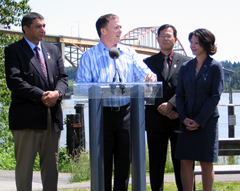
Falcon photo op with MLAs.

The provincial government is misleading the public when it touts the twinning of the Port Mann bridge and Highway 1 expansion as a "green" project. According to Transportation Minister Kevin Falcon, "When you get traffic moving, it is actually a lot better than having traffic sitting and idling for 13 hours a day pumping emissions out in the atmosphere." Minister Falcon has also reminded the public that the twinned Port Mann will be tolled.

But what Falcon doesn't emphasize is that, according to provincial policy, the Port Mann toll is very likely going to be paid to a private company in a public-private partnership (P3). If the project is a P3, Falcon's assurance about air quality is at odds with the traffic projections that private toll road companies use to attract potential investors.

On their "Why Invest in Toll Roads?" fact sheet, Macquarie Infrastructure Group advertises that "traffic growth, and therefore revenue growth, tends to increase annually." Macquarie boasts that over a 12-month period, their toll road investments experienced traffic growth of seven per cent. "Traffic growth combined with toll increases," it reads, "resulted in revenue increasing by 14.1 per cent."

Private paver

The Australia-based Macquarie is involved with the Sea-to-Sky Highway expansion, Golden Ears Bridge, and Canada's only privatized road, the 407 ETR in Toronto. It is one of the largest private road companies in the world and a likely private partner in the Gateway program. In January of this year, President Bush nominated Macquarie's own David Gribbin as general counsel to the U.S. Department of Transportation to push a strong road privatization agenda in the U.S.

With a private company like Macquarie operating the Port Mann toll, the interests of those in charge of the road are to maximize both traffic and toll rates on Highway 1. That means more pollution, more greenhouse gases, increasing costs to bridge users, and a larger overall number of frustrated drivers.

Private toll road investment is based on the certain knowledge that new road capacity induces more and more demand. The toll roads tend to get ever more traffic even as they charge more for the toll. This is because as the new road capacity becomes more congested, motorists are willing to pay more to get relief from that congestion. The private company then "invests" in more lanes, which fill up, and the process continues. But if Macquarie knows this, then so presumably does Minister Falcon.

Trading on misperception

When Falcon sells the idea of a Port Mann toll to the public, he is trading on the public perception of tolls as a demand management scheme. But we're not talking about a regional, system-wide road-tolling plan that channels funds from car use into better public transit. We're talking about a multinational corporation like Macquarie Infrastructure Group privatizing the highway. And many years from now, when Gordon Campbell and Kevin Falcon are gone, we will still have Macquarie cashing in on Highway 1 congestion.

Ever since the 407 ETR highway opened in Toronto in 1999, the private road consortium has raised toll rates steadily. In 2004, the Ontario government tried to sue the company for raising tolls without the government's permission, and lost the case. The previous Conservative Ontario government had given the private consortium (which now includes Macquarie) unfettered control to raise tolls for the next 99 years. And according to Macquarie's "asset portfolio" for the 407 ETR, the highway will eventually be 12 lanes wide, "when fully expanded."

In Australia, the State of New South Wales tried to solve a congestion problem in the city of Sydney by entering into a 30-year P3 contract with a private consortium,* to build and operate a tolled underground tunnel. When the Cross City Tunnel fell short of its projected 90,000 patrons a day because motorists refused to pay the high tolls and took free alternatives, the city, in order to meet its contract obligations, began closing surface roads in order to funnel traffic into the tunnel. When public outrage mounted, it became clear that in its secret P3 contract, the city had no choice but to employ such "traffic calming" measures to ensure non-competition with the tunnel.

Better alternative

A major problem with P3s in general is that all such contracts are considered private and are not subject to Freedom of Information requests. There is no accountability, therefore, until problems crop up after construction is complete. There is no way to know whether and how much the misfortune of Port Mann bridge users is being sold by Minister Falcon as an opportunity for monopoly profits.

There is an alternative. Toll revenues could go to the government, so that the incentives for increasing tolls are driven by democratically accountable priorities, and so that there are no perverse incentives to make traffic denser on the tolled roads.

In addition, tolls can be deployed system-wide (for instance, on all Fraser River crossings) rather than unfairly targeting the residents of Surrey and the lower Fraser Valley who have poor transit service and the most difficult access across the Fraser.

In fact, by the government's own projections (Gateway Program Definition Report, page 37), all the benefits of the proposed Port Mann bridge and highway expansion come from the traffic-reducing effect of tolls, not from the new road capacity. This is why many planners are arguing for public tolls instead of any new bridge. This plan would have an immediate, lasting, and adjustable effect, as the city of London's congestion charges have demonstrated.

The residents most affected by bad traffic on the Highway 1 corridor want a livable region and sustainable world like everyone else. They also want an equitable solution that acts soon and is long lasting. Many would feel conned to learn that the toll coming from their pockets is just paying off the investors of a huge foreign corporation that has a vested interest in traffic growth and congestion.

*The original Tyee story implied here that Macquarie was involved in the consortium which won the contract to build and operate the Cross City Tunnel. That is incorrect. Macquarie was part of another consortium which bid on, but did not secure, the contract.

Related Tyee stories:

 [Tyee]

31  Comments:

Login or register to post comments

  • Cycling Commuter

    4 years ago

    Peak-traffic tolls encourage carpooling, telecommuting, etc.

    Quote:
    Paul Keeling and Christopher Barrington-Leigh wrote:

    tolls can be deployed system-wide (for instance, on all Fraser River crossings)

    This could save us billions of dollars in infrastructure costs if the tolls are imposed only during peak traffic periods. It would encourage people to carpool, move their discretionary travel to offpeak hours, accept shiftwork, telecommute, move closer to work, etc. Transportation infrastructure is like electricity generation/distribution infrastructure in that a huge percentage of capital costs and operating costs are related to meeting peak requirements rather than average requirements.

    In order to make expanded tolls politically palatable, it's essential to make them revenue-neutral for most people by simultaneously reducing taxes in other areas. For example, reduce or eliminate the regressive Hydro transit levy and the regressive transit property tax plus increase the basic personal income tax deduction, which will be beneficial for low-income people.

    If peak traffic tolling is done in a competent way, the balancing tax breaks in other areas can be more than revenue neutral since flattening-out peak road/bridge usage means saving billions of dollars by eliminating the need to add more infrastructure as population increases. With more taxpayers making more efficient use of existing infrastructure, the overall amount of cash required from each taxpayer is actually reduced.

    Quote:
    residents of Surrey and the lower Fraser Valley who have poor transit service

    Get rid of the artificial limits on number of cab licenses issued, and every neighborhood would instantly have fast, convenient, safe, door-to-door transit service at the same cost as public transit, but without any tax subsidies whatsoever.

    New Zealand, The Netherlands and other countries have eliminated artificial limits on the number of cab licenses issued. They have allowed part-time rush hour cabbies to charge a lot less than full-time cabbies. In Amsterdam, undercover cops pose as passengers in the fiercely competitive taxi market to make sure cabbies behave themselves.

    With an unlimited number of cab licenses issued, the authorities can be very hard-nosed about safety and honesty by instantly pulling licenses from drivers who break the rules. There's no need to worry about causing cab driver shortages by getting the lousy drivers off the road, unlike in the medical system where incompetent doctors who screw up over and over again don't lose their licenses because there's a shortage of doctors.

    Someone I know in Langley has a neighbor who works in downtown Vancouver. The neighbor bought a 10-passenger van to run a non-stop Langley to downtown Vancouver carpool/vanpool. He charges about the same as what transit would cost - a tiny fraction of the cost per passenger of a single-occupant taxicab. The trip is a lot faster than public transit - almost as fast as a cab. Passengers are picked up from within a small geographic area in Langley and dropped off in a fairly small geographic area in Downtown Vancouver without any need for transfers or for picking up / dropping off a lot of passengers along the way.

    The main downside is that the carpool/vanpool driver is not yet tied-into a taxicab dispatch system with similar carpoolers. When passengers have to work late, they phone the carpool driver to let him know not to pick them up at the end of the day, then they take public transit home. It's not ideal since without a dispatch system to instantly find a new passenger, the reserved carpool/vanpool seat is left empty. The delayed trip home on public transit takes longer for the passenger, but getting home on time is not quite as urgent as getting to work on time anyway. And after working overtime for a few hours, peak traffic has subsided, so that helps speed-up the trip home on public transit.

    Unlike public transit, all passengers in the carpool/vanpool have seatbelts. And the driver has a perfect driving record. He doesn't smoke marijuana on the way to work as some public transit drivers are inclined to do.

  • jimmy_laroux

    4 years ago

    Falcon is a liar.

    Quote:
    According to Transportation Minister Kevin Falcon, "When you get traffic moving, it is actually a lot better than having traffic sitting and idling for 13 hours a day pumping emissions out in the atmosphere."

    The number of vehicles using a highway always increases to fill new capacity. This PR nonsense about reducing pollution by building more capacity is a complete lie. Surely Falcon knows this.

  • Grumpy

    4 years ago

    Gateway - as red as a transportation project can get!

    "When public outrage mounted, it became clear that in its secret P-3 contract, the city had no choice but to employ such "traffic calming" measures to ensure non-competition with the tunnel."

    Here is the problem > secret deals made by the provincial government to the winning P (ponsie scheme?)-3 bidder. SkyTrain was full of secret deals between the provincial government and Bombardier.

    If traffic usage doesn't climb then the taxpayer pays. RAV is the same as the ponsie - 3 winner, using public sector pension plan money to fund its minuscule portion of RAV will be handsomely compensated if projected ridership doesn't materialize.

    And yes cycling commuter, the great philosopher's stone of road pricing or road tolling is about to collapse as motorist all through Europe are rebelling against onerous tolling schemes. It's sending chills down politicians backsides as many planned road pricing schemes are being quietly shelved. And in the UK, Blair's government may collapse, not due to Iraq, but on a Labour plan to toll all road throughout the country.

  • Grumpy

    4 years ago

    Damn right Jimmy L!

    Once we had a 'bird' selling nonsense about RAV, now a Falcon selling snake oil on Gateway; birds of a feather............

  • Fiat lux

    4 years ago

    The real name of P3 projects

    The real name of P3 projects is "Plundering the Public Purse"

    All P3 projects are far more expensive on the long run, all the investments and all the costs are paid by the public, exactly as they would to publicly owned facilities and infrastructure, therefore there's no logical, or moral justification for them.

    In short, all P3 projects are fraud and theft from the public.

    Thousands of examples all over the world.

    Ed Deak.

  • Cycling Commuter

    4 years ago

    Japan charges transit fares equal to the full cost per passenger

    Here's the gist of a very interesting comment by Guillaume Afleck on the Globe and Mail website.

    Japan charges transit fares equal to the full cost per passenger.

    "Companies build transit options all over the place because they want to get in on making money. We get that backwards all the time. Every time you build a system based on subsidy per passenger you end up with unfinished subways like Toronto's 'stuck in 1959' system, and pressure to reduce service rather than increase it because they lose more money with more service rather that make more money with more service."

    The comment is from:
    http://www.theglobeandmail.com/servlet/story/RTGAM.20070316.wlanes16/CommentStory/National#comment730273

    Transit service would quickly evolve to be infinitely more useful if we charged passengers the full actual cost, then raised welfare rates to help unemployable people with the extra cost and lowered other taxes for employed people to compensate as suggested above.

    Some of the money collected from air pollution related taxes should be allocated to pay for 100% of safe, isolated transportation costs to doctors and hospitals for those with highly communicable airborne diseases such as tuberculosis, flu, SARS, ebola, etc. People with such diseases should not be taking public transit. Tuberculosis is now on the upswing since the vaccine is losing its effectiveness. It's largely a disease of the poor. Poor people generally take public transit. Also, a bird flu epidemic could strike any time. It's appropriate to use air pollution taxes to pay for medical transportation of people with lung-related diseases since air pollution makes the lungs vulnerable to these diseases.

  • Stump

    4 years ago

    Falcon knows, but doesn't care.

    Quote:
    The number of vehicles using a highway always increases to fill new capacity. This PR nonsense about reducing pollution by building more capacity is a complete lie. Surely Falcon knows this.

    He probably also knows that encouraging suburban sprawl will help him make money when he goes back to the real estate development after getting booted from office for being a numb-nuts... and who feathers the Liberal nest, organizations such as:

    New Car Dealers Association of BC who ponied up $150,299 in 2005.

    New Car Dealers probably aren't keen on solutions that encourage people not to buy more cars. Just a hunch.

  • freebear

    4 years ago

    Flim Flam Artists

    What a scam, and where is the mainstream media on this?

    The same media who profit selling ad space for automobiles, and suburban development!

    I grew up in Montreal and they had public toll roads on the autoroutes.

    Transit should be free, I guarantee that will increase ridership. Those that cry about subsidizing transit fares (making them free) are welcome to also take transit!

    No kidding, setting the stage for when Campbell and Falcon are out of politics and profiteering from the groundwork they did while in Government!

    Flim Flam indeed!

  • The brain

    4 years ago

    What a crock spin for greed

    I have yet to see any toll on any highway serve the public. Funny thing... I thought for some reason that's why we pay taxes... you know, to build highways and roads and other public infrastructure. How ugly it is to see corrupt governments cash in on milking the taxpayer again... and again... and again... only to remind us on a daily basis why it is so at the tolls. Greed. We complain about double taxation. This is as ugly as watching a crackhead pick scabs that won't heal.

    Quote:
    "When you get traffic moving, it is actually a lot better than having traffic sitting and idling for 13 hours a day pumping emissions out in the atmosphere." -Kevin Falcon

    13 hrs. Yes, we all travel to and fro for 13hrs on freeways every day. And yes, that's why we need to stall and stutter start traffic to milk the drivers in the name of fuel efficiency... its all for the good of the environment.

    Kevin Falcon... what a money grubbin' hypocrite. Wonder what the RCMP wire taps will reveal with this one. Oh, that's right. Harpers in government! Harper, Falcon, Campbell and Macquirie are all Bush buddies. No fed laws broken here...

    Well, Ed Deak, just another reason not to live in the city!

    And city folk know it, too. Did the Cons pick up an MP seat in the tri cities in the last election? No matter. The fix is still in. I wonder how Macquarie Infrastructure Group pieces off our corrupt politicians for rolling over on P3's... dubious overseas tax shelters perhaps?

    Lorne Mccuaig
    Revelstoke

  • Cycling Commuter

    4 years ago

    People in Stockholm and London in favour of congestion tolls.

    Quote:
    Grumpy wrote:

    road tolling is about to collapse as motorist all through Europe are rebelling against onerous tolling schemes.

    From http://www.canada.com/nationalpost/news/story.html?id=36c034e3-0b55-4f27-8bb1-158d3147dd93&k=76945
    "For whom the road tolls" in the October 18, 2006 issue of the National Post:
    Within a year of London traffic tolls, trips by car declined 30% while those by bicycle rose by 20%, by taxi 20%, and by public transit 23%. Ken Livingstone ran for re-election four years later on a vow to extend the tolling system. Londoners re-elected him.

    From: http://en.wikipedia.org/wiki/Ken_Livingstone
    US embassador Robert Tuttle refused to pay the Congestion Charge. Ken Livingstone described Tuttle as "one of George Bush's closest cronies and a big funder of his election campaign" and said he was trying to "skive out of [paying] like some chiselling little crook".

    From http://www.canada.com/nationalpost/news/story.html?id=36c034e3-0b55-4f27-8bb1-158d3147dd93&k=76945
    "For whom the road tolls" by Lawrence Solomon in the October 18, 2006 issue of the National Post:
    In Stockholm, the mayor and residents were against tolls but the national government imposed a 7-month trial followed-up by a referendum. When the trial ended, congestion jumped again. Residents voted to reimpose tolls and got rid of the mayor even though she changed her mind. With a $1.50-$3 fee, traffic injuries dropped by 10%, traffic declined by 22%, travelling speeds for buses and cars in the inner city increased 30%-50%, public transit use increased by 9%, emissions decreased 10%-14%. A cross-city rush-hour trip that once took two hours, compared to 30 minutes in off-peak hours, took less than 45 minutes during the Stockholm Trials. Sinking hundreds of millions into transit infrastucture carrots accomplished nothing until the toll stick was brought out.

    In both cases, people voted in favour of tolls after they had an opportunity to experience the benefits. In Stockholm, only a small toll was needed to make a substantial difference in behaviour.

    The following items are some important aspects of peak traffic tolling acceptance.
    *A trial period followed up by a referendum.
    *Do NOT impose tolls during off-peak hours!
    *Keep tolls as low as possible.
    *Offset tolls with tax breaks elsewhere.
    *Emphasize the lives saved. You do care about saving lives, don't you?
    *Target large, single-occupant vehicles with the biggest tolls.
    *Try to build a consensus of all major political parties before carrying out a tolling trial. This will take the fear away from individual political parties that their opponents will play headgames instead of doing what's best to save lives, save time, save money, and reduce pollution. An all-party implementation committee combined with public hearings can also address any unintended consequences.

    You've always got to leave people an out. I would be against tolls if there were no alternatives such as free access during offpeak hours, free access for carpoolers, and no offsetting tax reductions elsewhere. Some of the tolling schemes that people rebelled against involved 24-hour tolls for everyone, including carpoolers, no tax offsets elsewhere, and no trial period followed by a referendum.

    Some people in Europe were also concerned about privacy aspects of wireless electronic tolling. I don't expect privacy on a PUBLIC road. But anonymous electronic tolling credits can provide both privacy and convenience for those who are concerned about such things. I haven't been to the UBC library for a few years, but last time I was there, I fed cash into a machine that put credits onto a magnetic card that was used in photocopiers. These credits were not linked to my library card. Nobody kept track of my name, how many pages I was photocopying or whatever. Anonymous wireless tolls work the same way. The most paranoid individuals can buy a monthly pass and put a sticker on their windshield or pull into a toll both that accepts cash.

  • ov

    4 years ago

    Journal of Commerce

    The serving the construction industry since 1911, Journal of Commerce, is where you'll find Falcon's true colors. I wrote a few comments at GatewaySucks.org on Kevin's sucking up to road builders and promoters of urban sprawl.

    A few weeks ago at a Climate Change Film Festival at the VPL, I brought up this issue of greenwashing during the question period and asked how we could force the main stream media to report on this. MLA Gregor Robertson answered and suggested writing letters or going to alternate sources such as the Tyee. He also mentioned that even though Vancouver has the strongest media monopoly in North America it was losing credibility; when he asked the audience how many people read the Sun or Province religiously not a single person raised their hand.

  • Grumpy

    4 years ago

    Nada!

    I just hate it when so-called public transit experts advocate higher and higher taxes on cars. Using London and Stockholm as a comparison is nonsense as both cities are well served by 'rail' transit, unlike Vancouver.

    Even the die-hard public transit advocates are now waking up to the fact that the auto-lobby is gaining strength and may sway politicians to ignore even good public transit planning.

    London's road pricing scheme has increased costs to locals as the cost of tolls is passed on the the consumer. Major department stores are being subsidized for lack of business, but 'red' Ken is blind to all this. Blair is not!

    The Swedes are far more advanced with their public transport and it is a whole lot easier to use than Vancouver.

    Polls are polls and tend to support who pays for them. I know that the public in the UK is aghast at road pricing policies of Blair's government.

    What is needed is a sane public transit policy based on proven examples of providing public transit, not the invented crap that is passed off here.

    One thing is for certain, there has been no and repeat no public debate on regional transit,why? What are the politicians afraid of?

  • Fiat lux

    4 years ago

    What needed is a locally

    What needed is a locally based, dispersed economic system and more home jobs, so that people can stay at home and walk to jobs, as they have done it for thousands of years.

    But communting increases the GDP, so everything is peachy for economists and politicians.

    I hear Telus is allowing more and more people to work at home, which is a step in the right direction. After all, what's the difference whether they punch computer keys at home, or in an office ?

    100 businesses employing 1,000 people is a good economy, but a few businesses employing the same number is a tool for blackmail, for overcapitalized inefficiencies and economic disasters waiting to happen.

    Ed Deak.

  • BC Mary

    4 years ago

    Highway tolls may be the least of our worries.

    Consider the NAFTA SuperHighway planned to fast-track heavy transport trucks and trains (with pipelines alongside) from Mexico right up through British Columbia to Alaska ... 10 lanes wide.

    Consider the North American SuperCorridor Coalition or the NAFTA Triad ... when you start looking, there's puh-lenty to worry about. And indeed, Kevin Falcon is part of it ... though he's not Mr Big.

    There are two articles freshly posted on The Legislature Raids -- http://bctrialofbasi-virk.blogspot.com/ -- for one simple reason. When you look at the maps accompanying these articles, you can't miss seeing that B.C. Rail was an irresistible part of that grandiose scheme.

    Oh. And are you going to switch to a hybrid car and install new lightbulbs at home, to prevent climate change?? Or do you wonder what's the point, with 10 lanes of heavy traffic hauling stuff like dirty coal to China?

    We lost B.C. Rail for this, eh?

  • BDD63

    4 years ago

    Mcquarie Group

    Interesting! I was just reading about these guys last week. Seems like they are involved with the tolling of highways in Texas. They recently bought up 40 independent newspapers that had been running anti-toll editorials.

    http://www.landlinemag.com/todays_news/Daily/2007/Jan07/012207/012607-01.htm

    Could this be the end of The Tyee?

  • Chris H

    4 years ago

    Did they not know what they were doing?

    Anyone who chooses to live where they must cross the Port Mann during peak periods should know that they are asking for a commute from hell. It is simply unbelievable that we are going to build bridges to deal with this problem. My brother got a job in Langley, and guess what? He moved there! 25 years ago when my family lived in Richmond and my Dad didn't like the commute into downtown Vancouver, guess what? We moved across the Fraser! My commute is 20 minutes now, but if I had to work in Abbotsford, I would have to move. Why do people think that society should provide environmentally unsustainable solutions to their problems? I would rather see us build billion dollar skytrains in every direction than assist commuters in shortening their 100km daily commute in their single occupancy vehicle.

  • The brain

    4 years ago

    You missed it, Cycling Computer

    Quote:
    Within a year of London traffic tolls, trips by car declined 30% while those by bicycle rose by 20%, by taxi 20%, and by public transit 23%. Ken Livingstone ran for re-election four years later on a vow to extend the tolling system. Londoners re-elected him. - cycling computer

    Never mind Canada and London being apple's and oranges in terms of availability of transport and size of borders, I highly doubt people are going to take cabs over cars to cross the border... don't you?

    Lets be a little more realistic and in doing so, ask ourselves why private tolls are as good a substitute here as government tolls are in London, and why these private corporate taxes are going south and East to Australia instead of here. Sorry, but the missuse of government power and public funds just doesn't fit the minister of transport job description. Perhaps you should read the story again, cycling computer...

    Quote:
    But we're not talking about a regional, system-wide road-tolling plan that channels funds from car use into better public transit. We're talking about a multinational corporation like Macquarie Infrastructure Group privatizing the highway. And many years from now, when Gordon Campbell and Kevin Falcon are gone, we will still have Macquarie cashing in on Highway 1 congestion. Paul & Christopher

    And while were pretending to think, we can ask why a transport minister who perports that we travel 13 hrs a day in cars "for a better environment" would laud increased traffic with words coming outside of one side of his face and "green highways" the next. Last I looked, they're all still oil burners. Good for the environment... lets all take cabs... privatized highways with public funds, yegads, whats next.

    How is this crooked bunch of thieves and inept pretenders going to screw the public over next. Changing the subject to a different kind of crooked...

    Quote:
    I hear Telus is allowing more and more people to work at home, which is a step in the right direction. After all, what's the difference whether they punch computer keys at home, or in an office? - Ed Deak

    While it might be cost saving and practical, Ed, the profits sure doesn't trickle down to the users. I gotta ask why Telus lan lines bill 65 cents a minute plus for lan line connections in Canada without dubious $20.00 dollar packages that still ding you for a good chunk by the minute when anyone can pick up a no connection fee at $4.5 Cents a minute anywhere in Canada from a 7/11. Makes me feel violated every time I use their services. Don't get me started on Telus mobility overbilling, lol. :-)

    Lorne Mccuaig

  • RickW

    4 years ago

    Someone's been Kissing the Blarney Stone......

    The Gateway Program will be a very significant project, involving capital expenditures of approximately $3 billion.
    http://www.th.gov.bc.ca/gateway/reports/Gtwy_Benefits_Costs_Sept-2005.pdf

    In Canada, the last reactor was built near Toronto, started operation in 1993 and ended up costing $14 billion, a 250 per cent cost over-run.
    http://www.newmatilda.com/policytoolkit/policydetail.asp?PolicyID=583

    By attaching "green" to these, governments can be seen to be promoting environmental reclamation in a big way, without actually doing a damn thing except same old, same old.........

  • Fiat lux

    4 years ago

    Brain.....If you ever hear

    Brain.....If you ever hear me defending Telus, please call the guys with the net.

    I was only pointing our that if Telus can keep people at home, doing work, so can others, which would cut down at least some of the present unnecessary commuting.

    I've been fighting against big business and especially the multinational mafia, when most people on this blog were in diapers.

    Ed Deak.

  • Stump

    4 years ago

    disease on the bus

    Quote:
    tuberculosis, flu, SARS, ebola, etc. People with such diseases should not be taking public transit.

    The flu is the only real worry in that list of exotic diseases... and a little exposure to the flu is probably good for you and your immune system. To achieve what you are suggesting, I put it to you that free paper masks and latex gloves (for the infected or a the fearful) might achieve much the same results for less cost. I also wonder, who will decide who is too sick to take transit or well enough to ride the bus?

  • rockerbiff

    4 years ago

    As I live about 50 meters

    As I live about 50 meters away from the freeway on Cassiar Street, I can guarantee I will personally reduce my environmental footprint on East Van by moving away if this prject goes ahead.

    This is about the only environmental benefit from the freeway exapnsion - people moving out of the area because of it.

    I should be careful Falcon might actually start using this in his rhetorical nonsense....

    Until then I will keep fighting this Gateway Plan.

  • Fii

    4 years ago

    Push your limits

    A lot more people could bike. I know this is going to bring out the usual "buts.." but hear me out. Basically, anyone who lives anywhere between Commercial Drive and Arbutus and south to King Edward (and that's generous) and works downtown could ride every day. This city is very well-equipped to accomodate bicyclists. It is FASTER to ride if you live within 20 minutes of biking from downtown. As for the weather, get over it. It's healthy, refreshing and usually the best part of my day.

    And I ain't some spring chicken (bad grammar, I know :)

  • freebear

    4 years ago

    Public vs. Private Tolls

    Whatever the rationale (incentive to use transit, walk, car pool and live in same area as you work, or disincentive to building more suburban sprawl), there is a difference between public tolls and private tolls!

    (Keep in mind just talking about tolls; not whether more lanes will ease congestion or reduce pollution-but I disagree with Falcon on that; as so do so many other jurisdictions, experts and people who do not work for or benefit from the roadd building and car manufacturing lobby!)

    Public: Money goes into government coffers for public use

    Private: Money goes into private coffers for private use.

    So what is the benefit for taxpayers with private tolls?

    Tolls, if needed or desired, should be public.

    Simple enough!

  • Stump

    4 years ago

    Won't somebody think of the insecure?

    Quote:
    A lot more people could bike

    But without a car, how would they signify their social status to others???? :-)

    I'd extend your boundaries a bit. From Fraser St. to UBC is a 45 minute ride for your average, experienced cyclist. Anything under an hour is do-able IMO.

  • Grumpy

    4 years ago

    Bike > really > thou jests!

    I lived in the Netherlands some years ago and was surprised at how few did bike! Certainly more people use the bike in Holland, than here and the roads system was/is wonderfully set up for biking, few did. Certainly not the mass of people some cycling groups would have us think.

    I Dutch transit specialist told me some years ago that people in Holland bike if their destination was not more than 20 minutes away or about 2 km.

    It was the trams that the vast majority of commuters used; trams are what Falcon, Puil, Broadie, etc., do not want us to have.

  • Stump

    4 years ago

    that's pretty slow biking

    Quote:
    I Dutch transit specialist told me some years ago that people in Holland bike if their destination was not more than 20 minutes away or about 2 km.

    Cyclists travelling at approx 6km/h sounds farfetched to me. That's walking speed.

  • Grumpy

    4 years ago

    Hey, that's what he said

    Stump, that's what the guy said.

  • donnapassmore

    4 years ago

    STOP GATEWAY RALLY

    STOP GATEWAY - MASS RALLY
    Saturday, March 31st, 2007

    2:00 – 5:00 pm

    East Delta Community Hall
    10379 Ladner Trunk Road, Delta
    (Between Highway 99 and Burns Bog)

    the Raging Grannies

    Rafe Mair, Editorialist
    Joe Foy, Wilderness Committee
    Gord Price, Livable Region Coalition
    Donna Passmore, Gateway 30 Network
    Adriane Carr, Green Party of Canada
    David Chudnovsky, NDP Transportation Critic
    Jim Houlahan, CAW local 111 (Bus Drivers)
    Phil LeGood, Smart Rail Society

    For more information:Donna Passmore 604-536-2790

  • southdeltawalker

    4 years ago

    great slogan for Gateway Project

    can't take credit for this...slogan comes from England

    "More roads fuel climate change"

    Hope lots of Tyee readers and commentators turn out for the rally on March 31!
    {comment above has information}

    See you there.

  • zalm

    4 years ago

    Dammit

    Sorry Grumpy, it's gone on too long, I've got to correct you, and risk being taken for a Gestapo language Nazi....

    Quote:
    Here is the problem > secret deals made by the provincial government to the winning P (ponsie scheme?)-3 bidder.

    That's "Ponzi" scheme, not "ponsie"
    http://en.wikipedia.org/wiki/Ponzi

    Unless you're trying to insult some of the more lackwit highbrows on this site...in which case they would be "poncey" twits.

    One day I'm sure you'll thank me.

  • BC Mary

    4 years ago

    I digress: Rafe Mair to join Gateway protest 31 March, Delta

    Ex-broadcaster Rafe Mair to take part in anti-Gateway rally in Delta next weekend

    Joseph Ruttle, Surrey Now
    Published: Saturday, March 24, 2007

    LOWER MAINLAND - Ex-broadcaster Rafe Mair will be among those attending an anti-Gateway rally Saturday, March 31 in Delta.

    The Stop Gateway event is being organized by Surrey resident Donna Passmore to bring together a broad-based coalition of environmentalists, academics and other citizens opposed to the massive transportation plan for the Lower Mainland.

    Passmore says the plan represents a "1960s mentality" toward solving the region's gridlock. "I've been working on sustainable transportation issues for 16 years," he said. "This is the absolute wrong way to be going. If anything we need to be investing money to expand public transit."

    Passmore has a wide range of objections to the plan, from concerns about global warming to ALR protection and threats to wildlife. But it's the process of selling it that really gets her going.

    "[Transportation Minister] Kevin Falcon has been promoting this fallacy that he's consulted with thousands of people," she says, noting more than half the people at an information session registered their opposition to the plan.

    "The government has been engaged in the most egregious example of manufactured consent this province has seen."

    Mair has agreed to attend, echoing Passmore's concerns about how Gateway is being sold to the public more so than the plan itself.

    "The reason I will be there is to complain about the lack of proper process and the need for environmentalists around the province to unite," Mair said in an e-mail.

    The rally is from 2-5 p.m., at East Delta Community Hall, 10379 Ladner Trunk Rd.

    • No best comments selected by an editor for this story yet. To see all comments, click the All Comments tab, above.
    • The discussion for this story is closed. No more comments can be added.