Opinion

Taking Stock as BC Fed Turns 50

Some views on labour's achievements, challenges.

By Tom Sandborn, 27 Nov 2006, TheTyee.ca

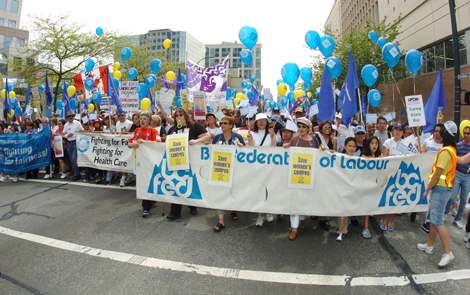
B.C. Federation of Labour Rally

Photo by Joshua Berson.

What does British Columbia's labour movement have to feel good about, and where does it go next?

Now seems a natural moment to pose the question to some people inside and outside the movement, given that the B.C. Federation of Labour, which may well be the province's largest democratically controlled organization, representing over half a million members, celebrates its 50th anniversary this year. Over 1,400 delegates will attend the B.C. Fed's annual convention starting today and running through Dec. 1 in Vancouver. (Full disclosure: The Tyee receives a small share of its funding from the B.C. Federation of Labour.)

The delegates will hear speeches from Fed officers, First Nations and student leaders, Carole James and Jack Layton from the NDP and representatives of the B.C. Persons with Aids Society and the Coalition of Child Care Advocates of B.C. They will consider a sheaf of resolutions proposed by members that runs over 80 pages and includes a move to guarantee representation on the federation's ruling body for those who speak for visible minorities, aboriginals, people with disabilities, gay/lesbian/bisexual and transgendered persons and young workers, and another that would change the current practice of holding a convention every year to a cycle of one federation gathering every two years. They will also debate resolutions that would call on the B.C. Fed to oppose the war in Iraq and call for withdrawal of Canadian troops from Afghanistan and a more proactive role from Canada in promoting peace in the Middle East.

Sinclair: 'Accomplished a lot'

"I've been looking at the minutes from our first convention in 1956, when the Trades and Labour Congress and the Canadian Congress of Labour united to form the B.C. Fed," president Jim Sinclair told The Tyee, "and what they show is that we're still trying today to achieve the same basic goals that were important for working people back then -- a decent pay cheque, safe work, good public education for kids, pension plans and public health care.

"Two things are striking. One, more than half the resolutions then were on issues that were society wide, things like welfare rates, nationalizing B.C. Electric, public insurance, affordable housing and bargaining rights for public workers. These were all issues that went far beyond the interests of our existing membership and spoke to big issues of social justice.

"The other thing that strikes me as I look at the minutes is how often we have achieved what we set out to do, as we did with public sector bargaining rights, hydro and public insurance. Sometimes we pass resolutions at these conventions and you think, 'We'll never get this.' But the only crime is to give up. We've accomplished a lot in the last decades, and working people need unions as much today as ever, with corporate power so dominant on a world scale and Gordon Campbell and his cronies in Victoria."

Climate change, homelessness on agenda

While some issues are the same as in 1956, Sinclair said, some things have changed. In 1956, a little over half of working people in the province belonged to unions. Today, only a third do, and the changes brought into provincial labour law by the current government have made organizing new workers more difficult. Numbers of newly organized workers have fallen under the new Liberal legislation from around 10,000 annually (the average in the 1990s) to around 2,500 most years this century (with the exception of 2005, when the new member count was up to about 4,500.)

"We have to get back even more to organizing, and we'll be talking about that at the convention," Sinclair said. "We need to address issues of globalization and climate change, log exports and workforce changes, minimum wage and welfare improvements, working alone and other safety issues. We're also meeting with groups in the Downtown Eastside, and we'll be taking action in the next few months on low wages and homelessness. We are a wealthy province. The kind of poverty you see down there is a black mark on all of us."

Sims: 'We are privileged'

Jinny Sims, president of the B.C. Teachers Federation, agrees with Sinclair about the need for more organizing and about the abiding commitment of the province's labour movement to social justice issues that go far beyond the contract demands of members.

"From its inception," she told The Tyee, "the union movement has been about justice for everyone. The movement was formed to take on employers who weren't treating workers well, but we're not just about job site issues. We must never stop fighting policies that create inequities, attacks on public health, education and the social safety net."

Sims said she got involved in union work as a newly arrived immigrant in Nanaimo, teaching in the public schools just before the BCTF was a union affiliated with the Fed.

"It's the injustices that got me involved. In our first contract discussions," she said, "it struck me that all the language about parental leave benefited men, not women. We worked on that and got a proper maternity leave top-up that year."

Sims emphasized the need for ongoing activism by the B.C. Fed, saying that workers are often told they are "too political" when they stand up for their rights.

"As union members, we are privileged," she said. "We need to address the needs of those who are not in unions, or who cannot work. We must demand that government address social issues. Working people have incredible strength and passion. When we work together we can build a better world, and that's what the B.C. Fed is all about."

Mair: Time for new tactics

Many observers outside the labour movement agree. Rafe Mair, talk show host, Tyee columnist and former Socred cabinet minister, told The Tyee:

"I had an epiphany when I got into politics. I had looked on labour as just what caused strikes, but I had an opportunity to learn. I saw that the B.C. Fed has improved wages and living standards in B.C. The Fed has kept us focused on issues of worker safety. When I ran in 1975," Mair said with obvious pride in his voice, "three unions supported me."

Mair said he thinks the B.C. Fed is facing big challenges in the future, including globalization and job transfer.

"The Fed has to concentrate," Mair said, "on new slogans and tactics, not the victories, defeats and rhetoric of the past. You can't just keep singing 'The Ballad of Joe Hill.'"

Persky, Klein: 'Protection'

Another longtime observer of the labour scene and frequent media commentator, Stan Persky, local author and Capilano College instructor, also had some positive things to say on the occasion of the Fed's anniversary.

"It's incredible what they've accomplished," he said. "For all the criticisms that can be made of organized labour, the Fed provides protection for members from arbitrary treatment by employers. There's a real dignity question here, and unions support the dignity of workers. There are some interesting and instructive differences between B.C. and the United States when you look at levels of unionization. I credit a different national ideology in Canada. No one accuses you of being a terrorist or an evil reptile for being in a union here."

Seth Klein, executive director of the Canadian Centre for Policy Alternatives, a progressive think-tank, credits the B.C. Fed with dramatic improvements in working conditions, minimum wage, employment standards and many other areas for the province's workers, both within and outside its membership.

"The Fed has a great track record, establishing a floor of minimum standards beneath which no one in the province can be forced. They've done great work on health and safety issues, and on protecting public health care," he said. "The Fed has also played an important role in funding broader social movements and advocates. The CCPA itself came into being because trade unions recognized the imperative for a progressive think-tank."

Davies: 'Beyond business unionism'

Libby Davies, MP for Vancouver East and NDP labour critic, also applauds the role the B.C. Fed has played as an ally in social justice and anti-poverty struggles over the years.

"The B.C. Fed has always understood the need to go beyond business unionism. They have always had a good relationship with community groups and struggles. The Fed has always been there for the important fights, and they provide important funding for local advocacy groups. They recognize, and this is very important, that they need not only to protect their members but also to stand up for all workers. The Fed and all unions have made tremendous advances, but right-wing governments like Gordon Campbell's Liberals will always try to roll them back and undermine unions. Look what the Liberals did to the employment standards act here in B.C."

Officers and members of unions and labour councils that belong to the Fed also saw the occasion of the upcoming convention and anniversary as an opportunity to criticize the current provincial government and to identify the challenges the Fed and organized labour in general face in the new century.

Heyman: Campbell years 'the worst'

"The Campbell years have been the worst years for workers," said George Heyman, president of the B.C. Government Employees Union. "I don't even want to imagine what conditions would be like in this province without the existence of the Fed and our unions. The Fed has made a huge difference in working peoples' lives. It's been an organized voice for workers' interests on social issues, wages, training, working conditions and poverty. In the last 20 years, the Fed has had an increasing focus on social issues beyond wages. We fight for the rights of the powerless and the voiceless."

Bill Saunders, president of the Vancouver and District Labour Council and a member of the B.C. Fed's executive council, predicts a better future through the efforts of the federation.

"The power of the Fed," he told The Tyee, "comes from us all giving up our narrow interests and accepting broader interests. We're all about making allies. In the future, to get out of our silos even more and reach across boundaries."

Wong: 'Colour blind' experience

Gary Wong, 2nd Vice President of Local 1-2171 of IWA/Steelworkers, told The Tyee about looking at old documents from mills where workers were paid different rates depending on their race. Wong, of Chinese extraction, said that unionization had put an end to that kind of structural racism.

"My experience in the labour movement has been colour blind," he said. "The movement has welcomed groups considered on the edge of society as full participants. In the future, our biggest problems will be political. We need a government in tune with working people."

Wong thinks the prospects for defeating the Campbell Liberals in the next election are good.

"If you told me we'd come within a hair's breadth of forming government last time, I'd have said you were dreaming. But we did."

'Can never back off'

Wayne Peppard, executive director of the B.C. and Yukon Territory Building and Construction Trades Council, agrees with Wong that the B.C. Fed has an important political role to play in electing people to government who will better serve workers' interests, and he credits the Fed with often succeeding in that task in the past.

"One of the Fed's great achievements," he told The Tyee, "has been to pull together the movement around issues, to lobby and be recognized as spokespeople for all working people. When the Fed does good work and speaks for labour, we all benefit. The Fed has been particularly effective in influencing local and provincial governments. It has created a stronger and more effective presence in government.

"But the Gordon Campbell government has thrown us back so far, and done so much damage. Even if we elect politicians we support, we'll still have to work hard to influence what they do. You have to work as hard with a government you worked to elect as one you opposed. We can never back off."

Gunaratna: 'We still have sweatshops'

Vas Gunaratna knows a lot about not backing off. The tireless organizer for Unite Here, a union organizing mainly immigrant workers in the garment and fabric industries, says the B.C. Fed has unfinished business in his sector.

"We still have sweatshops in Vancouver and we're working under a shitty labour code," Gunaratna told The Tyee. "The Fed has done a reasonably good job getting information out to workers on labour standards, but we need to do a lot more translation. Most of the information the Fed makes available is in English, and many of the workers we're organizing don't read English.

"We'd also like to see the Fed do more on ethical purchasing and more ESL training for immigrants. It's important, too, to open up the process and make it easier for immigrant workers to run for office. But all of this is better now than it was 30 years ago."

Kelliher: 'Card can make the difference'

Sister Elizabeth Kelliher agrees with Gunaratna's call for more work to open unions up to immigrants. Kelliher is a Franciscan nun who works feeding the homeless in the Downtown Eastside and sits as president of the Downtown Eastside Residents Association. Kelliher, now in her mid-eighties, has a long history of working with labour groups on peace and social justice issues both here and in the U.S. She says the B.C. Fed has been an important ally in many efforts to reduce misery in her neighbourhood, and spoke warmly of the participation of B.C. Fed officers in a recent forum on labour standards she attended.

"One of the men who eats with us has been working as a roofer: hard, dirty work for only eight dollars an hour. He works without gloves and comes back to us with his hands cut up and covered with tar. Union roofers do a lot better. A union card can make the difference between misery and a good life. I hope the union movement here will keep trying to open doors for immigrant and other poor workers so they can reap those benefits.

"I have been very impressed recently by the work the Fed has been doing to protest the way the B.C. government excludes Mexican farm workers brought in under federal programs from medical coverage."

Ongoing fight

Ed Lavalle, veteran labour studies academic and founder of Capilano College's labour studies program, strikes a similar note in commenting on the upcoming Fed anniversary:

"In reflecting on the 50th anniversary of the BCFL, my mind turns to what path it might take for the next half century. My hope for the next few decades is that the labour movement will increasingly take part in and lead a movement for social solidarity," Lavalle wrote in an e-mail.

Jim Sinclair and the other officers of the B.C. Fed will be hearing lots of advice during the weeklong Fed convention about how the organization should proceed in its second half century. He'll also be remembering the advice he received many years ago from labour pioneer Homer Stevens:

"Always remember this," Stevens said. "We never got anything we didn't fight for, and we never kept anything we didn't fight to protect."

Related Tyee stories:

 [Tyee]

40  Comments:

Login or register to post comments

  • anarcho

    5 years ago

    Comments on "Taking Stock as BC Fed Turns 50"

    I congratulate the Fed on its 50 years and for what it has accomplished in the past. However, it must not rest on its laurels, nor ignore its past mistakes. It must move on to new ideas suitable to a world where the moderating ability of social democracy has vanished, replaced by a corporate red of tooth and claw social darwinist class war against working people. The ideas are out there. People everywhere are demanding greater control over their lives. This means local control and direct democracy. Please reject business unionism for social unionism. Fedistas please check out the Alternative Union Movement in Europe or the APPO of Oaxaca. With new ideas, and in alliance with the social movements labour can be on a roll again and successfully fight for our rights and freedoms once more.

  • BC Mary

    5 years ago

    It's true of so many things in B.C. life, the good work that the B.C. Fed has done for others, goes largely unnoticed.

    Could B.C. Fed start a daily newspaper, please?

  • G West

    5 years ago

    Or at least a decent weekly.

  • Marysue

    5 years ago

    Yes, we sure need the BC Fed to put out a newspaper---but it needs people who can WRITE for it. Hopefully, not the people who write its insipid dispatches! Often, you hear BC Fed brass knuckleheads using corporate euphemisms-like "Labour Disputes" ILO "Management-Labour Disputes". You read where well-meaning union brass propagate corporate propaganda, by talking about the minimum wage, saying it is $8. Not true! What is the lowest wage you can pay in BC? It's $6. Ergo, that is the minimum wage. No euphemism should be allowed to water that sad fact down. Nationally, when you read CAW's economist Jim Stanford's stuff--well-written, to be sure-- you find that his writing is full of corporate crap from time to time. Alas, he and Buzz and Georghetti have all fallen prey to The Marketplace Myths--that there is such a thing as a "profit", that "capitalism creates wealth” and that it doesn't matter where we shop. They think we shouldn't care where or how foreign products are made, etc. These guys do not condemn WalMart, The Gap, Nike, etc. , but no thinking human should ever shop there, because of the slavery issue. It is a soul issue! Also, Jim Sinclair and others are often on the boards of directors of various working opportunity funds, where donations are made to the Liberals!!! Not only that, NO investments are made in companies with unionized employees, nor in worker-owned enterprises. The big unions put some of their pensions funds in terrible companies with terrible worker and environmental records. CEP is one of these careless unions who think that "profits” are all that matter, without once thinking about the environmental and national devastation that come with some kinds of "profit", not to mention the irreparable harm done to workers’ rights in the future. Myopia runs amok among the Union Brass. It is to puke!

  • Cycling Commuter

    5 years ago

    Credit Unions are one of the best things the union movement has ever created. I have mostly dealt with Credit Unions instead of banks for various reasons. When I bought my first house, I didn't have enough income to qualify for a bank mortgage, but I did qualify for a Credit Union mortgage. At one point, I opened an account at a Royal Bank branch that was 2 blocks away from my workplace because there was no credit union nearby. When somebody wrote me a rubber cheque, that caused a bunch of my own cheques to bounce. The Royal Bank even bounced my mortgage cheque when my account was a measly $2 short. I asked them why they didn't phone me at work and ask me to drop by at lunch time to deposit a few bucks to stop the cheques from bouncing. They said they were "too busy" for that sort of thing. Credit Unions have always phoned instead of bouncing cheques.

    I once dated an assistant bank manager who said it was the dream of every bank employee to someday work at a credit union because in addition to treating their customers better, they also treat their employees better.

    Too bad labour unions didn't maintain their momentum in the Credit Union direction by putting their money where their mouth is through investing union pension funds in beneficial local employee-owned businesses instead of investing on the basis of pure greed wherever they could make a fast buck.

    Unions bosses are always criticizing greedy corporations, but who owns the greedy corporations? In many cases, the union pension funds do! For example, the Ontario Teachers' Union Pension Fund alone is worth about $95 Billion. This is in the same ballpark as the entire Canada Pension Plan fund! Ontario Teachers' owns Billions of dollars worth of coal-burning power stations in the U.S. Mercury emissions from their power plants cross the border into Ontario, causing learning disabilities in the same young children Ontario Teachers are trying to teach! Also, it has been estimated that coal-burning power stations in the U.S. cause $100 Billion dollars per year in medical expenses for treatment of respiratory diseases. The Ontario Municipal Employees Retirement System (OMERS) has invested billions in extremely dangerous nuclear power plants. B.C. Union pension funds are used to finance similar destructive activities.

    Another deep and fundamental problem with the current union structure is that they are built from the ground up to profit from featherbedding. If they can get ten union members hired to do work that could easily be done by one person, that means the union bosses get to make ten times as much profit in the form of union dues. This is no small thing when you consider that each lifelong union member can expect to give the union bosses somewhere between $50,000 to $100,000 in union dues during their years of employment.

    Another area of hypocrisy is in the area of Union/NDP anti-Americanism. This is quite a flim-flam when you consider that some of the biggest, most powerful unions in B.C. are U.S.-based. For example, the International Woodworkers of AMERICA (IWA) was recently taken over by the United Steelworkers of AMERICA. The Teamsters are also a very powerful U.S.-based, mafia-connected union (remember Jimmy Hoffa) that has a stranglehold on B.C. There are also many other U.S.-controlled unions running our economy, thanks to the BC Fed and their NDP friends.

    When Pat McGeer was an MLA 33 years ago, he ripped-into the NDP over the way they helped U.S.-based union goons crush and destroy Canadian unions. See what McGeer had to say here: http://www.leg.bc.ca/Hansard/30th2nd/30p_02s_730315z.htm . The BC Fed and NDP haven't changed much at all in this area.

    Two of my brothers and our dad paid into U.S.-based union pension funds for a combined total of over 40 years. When the employers went out of business due to excessive union featherbedding, the workers didn't get one nickel of their money back from their union pension funds. The shop stewards said all that money had "somehow disappeared."

  • Alcibiades

    5 years ago

    The union movement did NOT create credit unions, sorry cycling commuter. Here's a quick precis of their genesis in this country:

    The first caisse populaire in North America was created in Lévis, Quebec, in December 1900 by Alphonse Desjardins. Its membership was organized along the boundaries of Roman Catholic parishes. Outside Quebec, the first financial co-operative was Ottawa's Civil Service Savings and Loan Society, established in 1908. Credit unions subsequently spread to the Prairie provinces, where they developed largely as a response to difficulties faced by farmers in obtaining financing during the Great Depression of the 1930s. Over the next three decades, credit unions, particularly in Ontario and British Columbia, enjoyed significant growth in response to strong demand for consumer financial services.

  • anarcho

    5 years ago

    A Fed supported newspaper, union pension funds invested in credit unions and cooperatives - all very good ideas folks! Keep 'em coming. I hope some Fedistas are reading these postings...

  • Cycling Commuter

    5 years ago

    Here's one of McGeer's quotes from Hansard at http://www.leg.bc.ca/Hansard/30th2nd/30p_02s_730315z.htm#01376 This link is slightly different from the one above in that it takes you directly to the appropriate section of the page.

    Quote:
    This disgraceful contract arranged for between the Teamsters Union, the Building Trades Council and the Heavy Construction Industry of British Columbia, guarantees that a Canadian worker belonging to a Canadian union will not be allowed on a construction site in the Province of British Columbia.

  • Coyote

    5 years ago

    I have never questioned the value of my having been a trade unionist for the better part of my life. It gave me and my family a quality of life we would have never otherwise had. (All past tense here.) But something has happened to such official labour manifestations as the BC Fed., which was first most dramatically revealed in relatively recent history by the betrayal of its members, the larger community and its courageous eatrly founding history, by the events of Operation Solidarity in 1983. And the consequences of that are still with us and continuing to onfold.

    It a singular "failure event" responsible yet for a continuing period of working class retreat and decline that is not ended yet.

    The trade union movement has fallen into the same failure of courage and principle malaise as has the NDP, of which the two for a long time now have been two heads of the same social democratic, opportunism and self-absorbed naval gazing creature. Both have drifted into virtual irrelevance to the lives of the working class and community at large, in these neoconservative ruling class dominated times.

    And that is regrettable, because such an institution of the working class is increasingly as sorely needed now as it was at its founding in the Industrial Revolution and the Great Depression of the 1930s.

    Only now they, like the NDP, are more "career" driven and less "working class interest" serving organizations, serving more as an institution that is tolerated on the margins of capitalist society, to act as "controllers" of the working class, rather than the means for their mobilization and liberation. And until this changes, they will continue to flounder about in their rub a dub dub, three men in a taking on water tub, on the troubled Sea of Dubious Value.

    And now, that is likely, unless there is something I can no longer see from my now outside vantage point, to take a rank and file revolution from within, or a serious challenge by another, outside, working class organizing force.

    That all said, they are all that is-, yet.

  • maestro

    5 years ago

    Cycling Commuter:

    Good comments and insight in the big picture.

    On one point I'll have to agree with Alciabides, at least by the example of a local credit union's quasi R.C. roots which ended up being merged into Coast Capital.

    I think the union movement is hitting a brick wall without a seemless transition of continuity...most of them with the old piss -and- vinegar passion had at least one foot in the relevant past when it meant something, now they are either passed on or moving on into retirement.

    That " my grandparents, parents and now me generational " union " continuity connection to the movement is dying off. Unless employed in the civil service, the private sector union job is no more guaranteed than any other.

    I find it rather ironic that the BCTF Prez. is mentioned, and they consider themselves social justice preachers, yet I bet the average student they actually teach has a major disconnect with the labour movement (ie 2 week BCTF strikes don't help) as well as other reasons.

    Unions have plundered each other, competing for workers no different than the neo -con "corporate" mergers. Is the worker served well , or simply dues etc. re-plundered ?

    Given mechanization and the ever "global" village we live in, they need to face these many harsh realities, work pro-actively to adapt to them, #1 is in their members best interests, and quit the King Kanute modus -operandi by much of their rhetoric - spewing leadership. That was then, this is NOW.

  • Alcibiades

    5 years ago

    Maestro,
    Are you looking for friends?
    It's not a question of agreeing. Those are the facts, period.

  • stan

    5 years ago

    Cycling commuter:

    You are out to lunch!

    Quote:
    Too bad labour unions didn't maintain their momentum in the Credit Union direction by putting their money where their mouth is through investing union pension funds in beneficial local employee-owned businesses instead of investing on the basis of pure greed wherever they could make a fast buck.

    So you expect them to invest, for example the $95 billion OTF pension money, into local or mom and pop operations? Give your head a shake. They can only invest in what is available and traded publically. Moreover, "union bosses" do not invest the money; that duty is overseen by trustees whose role it is to get good returns for the fund. Ultimately, it's all about the money. On the other hand, I'm sure you would be happy if your pension money disappeared because of bad investment.

    Quote:
    ...the current union structure is that they are built from the ground up to profit from featherbedding. If they can get ten union members hired to do work that could easily be done by one person, that means the union bosses get to make ten times as much profit...

    Unions do not hire, fire or disciple their own members. This is management's job. Nor do they decide unilaterally how many people it takes to do a particular task. That is something that is mutually agreed upon (ie. collective agreement).

    Quote:
    ...each lifelong union member can expect to give the union bosses somewhere between $50,000 to $100,000 in union dues during their years of employment.

    Where do you get these numbers? Most unions charge around 2 times the hourly rate for monthly dues. I make $30/hr so I pay $60/mo or $720/year. Multiply that by 35 years and you get $25200, not 50 to 100k.

    Quote:
    There are also many other U.S.-controlled unions running our economy, thanks to the BC Fed and their NDP friends.

    Yeah, right. Perhaps you can provide proof of this.

    Actually, the only thing you have proven is how ignorant you are. Unfortunately, you are not alone because I know of many people, some who belong to unions, who have similar views. Ultimately, that's where the problem lies when it comes to promoting organized labour: too many people filled with misinformation by the corporate media. Until more people learn the truth, the battle will be an uphill one for organized labour.

  • maestro

    5 years ago

    Alci:

    I see your personal satellite, albeit built offshore, if not in fact "just south of Texas" , is working just fine.

    If you want to play Ebert sans Siskel...join in. At least the "facts" have YOUR endorsement / blessing .

  • Working Man

    5 years ago

    Quote:
    disclosure: The Tyee receives a small share of its funding from the B.C. Federation of Labour

    Where do you get the rest?

  • Alcibiades

    5 years ago

    I thought it came from you working man.

  • Gerhardius

    5 years ago

    Re: Lefty Press

    I recently found (amazing what Powell's Books has on their shelves) Harry Rankin's 1975 autobiography "Rankins Law" printed by November Press. He mentions a few left wing papers, not sure how local any were, but "The Pacific Tribune" was one. I imagine the same forces that drove the collapse of many daily papers were involved: changing media consumption, concentration of editorial control etc.

  • anarcho

    5 years ago

    The "Trib", while it certainly did a fair job of covering labor and social issues, was a party paper, the Communist Party of Canada, to be exact. Those of us who are forever bringing up the need for a labor-social-enviro-movement paper, don't really have a party paper in mind. More of a general movement paper, the idea being to unite as many people as possible around issues that concern them and not ideology. This is not to say that the Trib, had it lasted the split in the CP, might not have become this kind of paper, the French CP's daily, Le Humanite, (Circulation 330,000, aren't you just green with envy!) has become in many respects a movement paper.

  • BC Mary

    5 years ago

    Gerhardius: It probably wasn't any force so benign as "changing media consumption, concentration of editorial control etc." which caused the collapse of many alternate newspapers. They're competition for big commercial media and, as such, they're not allowed to live.

    A friend of mine was a news editor with a big daily newspaper when, after an editorial disagreement, he quit and established a new newspaper in the same city.

    We watched in horror as the order of business rolled out, all perfectly legal, starting with the big, well-established daily cutting its ad. rates in half so that advertisers would have to be crazy to pay more to advertise in a new, unknown newspaper.

    There was more ... until my friend was bankrupt and stopped publishing. Both newspapers could easily have survived in that city but there are other factors involved in the big commercial media besides money.

    I think you're absolutely right, anarcho, in hoping for an issues-oriented news service which unites people of many political viewpoints. And not a party paper. It would need good financial backing and strong people to run it -- probably at a loss -- until it won its place in the market. Very strong people.

  • anarcho

    5 years ago

    Quote:
    strong people to run it -- probably at a loss

    Yes, very true. The Pacific Tribune used to have annual fund raising and sub-selling bees. A paper I worked on called Open Road used to have benefits to keep going, but then again it was just a quarterly, but it did go on for ten years. The Trib lasted from 1946 to 1992 which is pretty darn good...

  • Working Man

    5 years ago

    Where is the answer to my question:

    Who finances this site?

    How about some disclosure?

  • Stump

    5 years ago

    If you really want an answer I'd suggest contacting the editors (per the supplied contact info) directly rather than assuming they read and respond to postings in a story's comment thread.

    The Tyee Mailing Address:
    Suite 100 - 100 West Pender St.
    Vancouver, BC V6B 1R8

    Main telephone line: 604 689 7489
    Fax line: 866 237 5780

    For general inquiries:

  • Alcibiades

    5 years ago

    Who cares working man?

    It's a private business and it's none of your business.

    That's exactly what I'd expect from any business man like Beers to a similar question.

    Try finding out the financial details behind BC Ferries these days.

  • Working Man

    5 years ago

    testy, testy...

    After the Tyee admits it is partially bankrolled but the BC Fed, why can't they disclose where the rest of their funding comes from?

    What are they afraid of?

  • Alcibiades

    5 years ago

    Who cares?
    It's a private business and it's none of your business. Let's say, for example, that a US based foundation provides some of the Tyee's funding.

    Would it make a difference? You just have a hate on for anything associated with organized labour and it shows.

    As for testy, this is the same issue you've been harping on as long as I've been reading you. I think you should look in the mirror.

    If it were completely financed by Labour money would you go away?

  • Working Man

    5 years ago

    From what I understand, Beers is completely bankrolled but the BCFed, the NDP and various other labour organisations. He has been doing his best to distance himself from that since the May 2005 election defeat.

    Beers is trying to become more mainstream and influence his masters to do the same so they might actually hold a government for a change.

    The hard thing number to understand is you can't put your policies into place unless you hold government.

    Hard thing number two is you do not get elected preaching to the choir. This is lost on most of the left.

    Beers is smart. He knows these things. He is, however, not very upfront with the facts when it comes to who is bankrolling him.

  • Alcibiades

    5 years ago

    DO I have to post the same response again?

    You don't have a point do you?

    In fact, you're sounding more like Ron Erwin every day.

    Isn't it possible that Beers is just trying to run a new kind of journal and be successful? Why does he have to have a political agenda just because you do?

  • BC Mary

    5 years ago

    Question: why is it so alarming to some people if they think that working people might be supporting something like The Tyee?

    What are we, the enemy or something?

    This is not a rhetorical question and some replies would be much appreciated.

  • maestro

    5 years ago

    Actually, I think its great that THE TYEE is funded by different sources and from various portions of the political spectrum ...the TYEE on-line biography lists funding from BC Fed, " socially responsible venture capitalists" , etc.

    THE TYEE can't claim, nor be accussed of , any specific alliance, and thus provides a good forum for free speech. I originally heard about THE TYEE by links sent to me by a colleague.

    PS Hopefully , its not simply setting itself up for a ripe takeover by a bigger corporate fish ,..like YouTube etc. types have inevitably done.

  • Capitalism

    5 years ago

    maestro,

    i don't believe these guys are setting themselves up for anything. they probably receive a little bit of advertising revenue, but not much.

    i am not sure how many hits they receive per day, however most people in BC haven't heard of this site, let alone view it.

    this is designed for fringe members of the community. if there were any real money, they'd be mainstream.

  • Capitalism

    5 years ago

    The Fed is done. Sorry people. Union membership is declining (at least as a % of the workforce) and has been since the 80s.

    In this new age of globalization and technological advancements - unskilled labour is not really necessary.

    Nor do people want to spend! Look at Air Canada - I take their flights and have been for 20 years. 20 years ago, there was an attendant per row (or so it seemed). They had a pretty good union going and a monopoloy of the high skies.

    Along came WestJet, which followed the model that Southwest employed. No union, few attendants, no food, frills or gimmicks. They had lower fares and blew Air Canada out of the water.

    Now Air Canada is price competetive, but their service isn't what it used to be. Much like taxes, etc. People don't see value in expenses which really don't add all that much. People don't want to pay inflated wages to GM employees - not when machines can do what men used to do...

    The world is changing and the Fed doing as much as it can to squeeze the last few drops out of the orange. They have preserved as many jobs as they've could and should be commended. However, they don't have a whole lot of influence anymore.

    Most of their workforce is in its 50s or 40s and nearing retirement. As the boom passes, so will the Fed.

    Sayanora!

  • maestro

    5 years ago

    Cap:

    I just threw that YouTube comment out there to see if DeBeers ... oops....D. Beers (or anyone else) on the TYEE responds.

    I am also curious if THE TYEE authors/reporters ie Rafe et al are paid, or simply submit the stories gratis.

    ( Otherwise, keep it going as is, but one never knows).

  • Alcibiades

    5 years ago

    Cap
    Did Southwest steal Continental's schedule and seating data? West Jet is pretty good at lying and cheating – like someone else I know. A good idea is always enhanced by a little larceny on the side.

    Crooks do sometimes prosper - even when they agree to settle out of court. As to whether or not Tyee is a fringe publication - that's probably true.

    You and maestro are about as lunatic fringe as it gets

  • maestro

    5 years ago

    Cap:

    Careful...Alci is going to huff n' puff n' gather his support group and possibly have another mass hissy fit.

    (Not to worry, his class only goes to school for 1/2 a day).

  • BC Mary

    5 years ago

    Someone -- actually, it was an old-time favourite commentor here -- told me recently that he had quit coming to the Tyee web-site because if these jackass comments. Or, as he termed them, "rantings".

    It's a darn shame that an intelligent discussion is so often derailed by these wasted efforts.

  • maestro

    5 years ago

    Also....be careful if you use any/all words with vowels or consonants in them ,not to mention bad spelling/grammatical errors, OR Alci can and will use them against you, (though the ACTUAL impact is much on par with water off a ducks' back).

  • realisticman

    5 years ago

    I can't understand why BC has not taken control of the pensions of BC workers from the Federal Government, out of the Canada Pension Plan and into the BC Pension Plan, the way Quebec has.

    The Caisse (lacaisse.com) now manages around $150 billion dollars of assets with investments around the whole world. The heads of two of the top unions in Quebec are on the Board. Part of the mandate of the caisse is to nurture Quebec based small and medium sized businesses.

  • anarcho

    5 years ago

    Quote:
    I can't understand why BC has not taken control of the pensions of BC workers from the Federal Government, out of the Canada Pension Plan and into the BC Pension Plan, the way Quebec has.

    Exactly! BC governments seem to like the idea of bring toadies of multinational corporations, perhaps, rather than as Quebec has attempted to do, become "maitres chez nous".

  • Working Man

    5 years ago

    Quote:
    if [sic] these jackass comments

    It take it these are comments you do not agree with.

  • polanco

    5 years ago

    Just to set the record straight---Southwest Airlines is heavily unionized. Someone in Canada, presumably WestJet, kept telling the media for years that they were following the Southwest business model by staying nonunion. Not so.
    Most older airlines in the world are, like Air Canada, unionized. One of the least unionized in the US is Delta, based in Atlanta. They have been skirting with bankruptcy for a while, so we should be careful about blaming the problems of these companies on their employees or their unions.

  • Alcibiades

    5 years ago

    I think I knew that polanco but thanks for bringing it up. Clive Beddoe doesn't mention that when he talks about Southwest as his model.

    But then he denied that Westjet was into criminality too, even though, in the end they pled guilty and paid up.
    Of course, by then it had just become the cost of doing business.

    And poor old Mark Hill, the forgotten man in all of this. I wonder how big his golden parachute was?

    • No best comments selected by an editor for this story yet. To see all comments, click the All Comments tab, above.
    • The discussion for this story is closed. No more comments can be added.