Opinion

Can We Stop Walmartization?

Why a tough grocery strike in California matters to workers in British Columbia.

By Jim Sinclair, 6 Feb 2004, TheTyee.ca

holdtheline


"I look at our country and I look at where it's going. We're going to have only the very rich and the very poor. We're not going to have any middle class." -- Susan, a striking grocery worker   

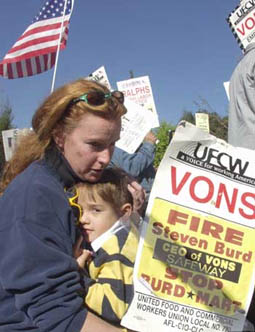
The eyes of organized labour are turning more and more to a strike by 70,000 grocery store workers in California where one of the nation's largest private sector unions is dug in against three of the largest grocery store chains in North America -- and hanging in the balance during this lengthy battle, is the future of health care for millions of workers.

The strike, which began more than four months ago, pits the United Food and Commercial Workers Union (UFCW) against Krogers, Safeway and Albertsons, whose combined profits reached $9.7 billion last year.  But the strike is not over how workers will increase their share of these huge profits, but whether or not they will be stripped of their health care coverage and if wages for new hires will be ratcheted back.  It's a struggle that is not only critical to these workers, but a loss in this strike will signal a major defeat to the labour movement facing increasing demands for massive cuts to health care protection.

More broadly, the strike is seen as a test of the labour movement's ability to turn back the nationwide slide in living and working standards that is creating an ever increasing pool of cheap labour on one hand and the wealthiest Americans in the history of the nation on the other.

A billion dollars in concessions

The roots of this strike run far deeper than this round of bargaining.  For the past decade and especially in the last three years, the entire U.S. health care system has been reeling from one crisis to the next.  Skyrocketing drug costs, a dwindling number of major providers and rising profits have combined to drive up private health care insurance premiums to more than $6,000 per worker annually.

The response of large companies has been swift and brutal.  Employee contributions have gone up an average of 170 percent, reaching an average of $2,700 annually.  The other result has been more dramatic.  Unlike Canada, where all citizens are covered through a single public system, U.S. workers rely heavily on company insurance.  Until a few years ago, 80 percent of employees at large companies had insurance.  Today this figure is down to 60 percent and continuing to drop.

With each new round of collective bargaining companies are demanding relief through passing along more costs to employees and restricting benefits.  In the U.S. steel industry, the burden of health care premiums and carrying costs for retirees has helped bankrupt major companies.  The picture is not pretty and the grocery store chains decided it was time to join the parade against decent health care benefits for American workers.  The companies came to the bargaining table with demands totaling more than $1 billion in concessions.  It didn't take long for others to see that this was a watershed battle for U.S. labour.

'Competing with Wal Mart'

"If these companies succeed in destroying affordable health care, all workers in America will be at risk of losing their health benefits." --  St Cecilia minister John McAndrew, one of many religious supporters of the strikers

Working in the grocery industry has never been a path to wealth, but after years of battles, workers in large unionized chains can earn an average of $17 dollars an hour with health care benefits after five years.  Many don't get more than 20 hours a week, but do receive benefits.  The companies want all this to change.

Key company demands include raising the employee share of health care premiums from $20 per month to more than $300, capping company contributions and freezing wages for existing employees. But the toughest medicine is aimed at the new employees who will be stripped of virtually all health care benefits no matter how long they work and have their wages permanently lowered between $3 and $4 dollars per hour (starting employees earn about $12 per hour).

Companies claim the drastic action is necessary to compete with the likes of Wal Mart where employees earn less than $10 an hour -- an average of $13,861 annually, well below the poverty level for a family of three.  More than 50 percent of Wal Mart employees have no health care coverage and the remainder scramble to pay high premiums from small pay cheques. 

Dubbed the "Walmartization of America," the trend to lower wages and no benefits now defines the so-called new economy.  But Wal Mart is a small player, with only one percent of the California grocery market, and the three main companies claimed revenues of $119 billion last year.  While workers are being asked to back up, the company executives are cleaning up.  Safeway head Steve Burd is leading the pack with $7 million in earnings and more than $20 million in stock option sales cashed in just days before the strike began.

Symbol of broken health system

"In the corporate drive to maximize profits, obtain tax advantages and reduce employee pay and benefits, our country is in grave danger of accelerating the already serious erosion of the middle class to the point where decent wages and health care will be a historical footnote to America's decline into Third World status." - Sonja S Marchand, former head of business and industry services at California State University, in an opinion piece on the strike

The old saying, that we can usually outwit them but out-waiting them is tough, is doubly true in this case. The UFCW is one of the largest unions in the country, but a strike of 70,000 members is draining $5 million per week from the union's strike fund.  Nonetheless, the union understands that backing down sets the pattern for the rest of the industry across the country, starting with 50,000 grocery workers in northern California who are heading to the bargaining table this summer. 

On the line workers are starting to feel the days drag on.  When the strike began, the companies moved quickly to train scabs to run the stores which for the most part remain open.  But business continues to drop.  Community support grows with local churches, city councils and national women's organizations coming onside.  And on Friday, January 30th, the big three faced a suit from the state's Attorney General, charging that by agreeing to share costs and revenue during the strike, the companies have broken anti-trust laws and have hurt consumers.  The strike has come to symbolize all that's wrong with America and its health care system.

With so much at stake, strike support donations continue to roll in from around the country and Canada.  Canadian UFCW locals have sent more than $5 million to their sisters and brothers in California and more is on the way.  And there's no doubt they'll need it. When the union offered potential savings of $300 to $500 million in early January in an attempt to solve the dispute, the companies walked away from the table.

Lessons for Canada

For Canadian workers, the lessons are clear. The public health care system we have won in Canada is critical to not only keeping ordinary Canadians healthy but maintaining decent wages and working conditions.  As right-of-centre governments push for more privatization and delist more services from provincial medicare plans, the pressure is growing at the bargaining table around health care issues. 

Here in B.C., the major increases in MSP premiums and delisting of services have become crucial issues at bargaining tables.  UFCW members in British Columbia met this challenge, settling a difficult dispute with Safeway this fall without concessions and cuts to benefits. 

It's not just workers who benefit.  Canadian employers should also beware of this trend away from publically funded health care.  All the studies show that our system, which unlike our southern neighbour doesn't leave 45 million people in dire straits without health care, provides Canadian business with a huge competitive advantage.  Our fight to save public health care is critical to the future economic well-being of working Canadians.

Aside from that, grocery store workers in California are standing up for all workers who want a decent wage and fair benefits, so let's give them all the support we can. Donations and statements of solidarity can be sent to UFCW Strike Hardship Fund, Attn: Secretary-Treasurer Joe Hansen, 1775 K St. NW, Washington, D.C., 20006.


Jim Sinclair is the President of the British Columbian Federation of Labour, which helps fund The Tyee.
 [Tyee]

15  Comments:

Login or register to post comments

  • Paul H. (not verified)

    8 years ago

    Excellent piece Jim. The vanishing middle class is beginning to ring true with many Americans, much to their dismay. I even saw Lou Dobbs on 'moneyline' bemoaning the loss of manufacturing jobs to offshore countries and he even went so far as to name names, listing several of America's blue chip stalwarts. He also ripped up some poor Harvard Biz school type who was defending globalization as a way to bring wealth to America. The economic tailspin the Republicans have driven the US into is indeed frightening for the powerless as the elite pass along the pain. At least through a union you have the ability to stand alongside your neighbours and speak for fairness and a society that nurtures and grows not opresses and exploits.

  • emeliot@myway.com (not verified)

    8 years ago

    I am not an enemy of Walmart. Socialized medicine is just writing blank check to the doctors and arrogant health workers. When there is no competition prices rise and services decline. Walmarts and Costcos are marketers of the future. Corner grocery stores will go the way of cotton pickers. Very rich will have a personal shoppers, smiles and mirrors in their stores, for the rest od us Walmart and Costco are just fine.

  • Steve F. (not verified)

    8 years ago

    More words from Mr. Sinclair. He sure talks the talk, but when it comes to actually doing something about the attacks on unionized workers in BC, he's suddenly silent. Just ask the HEU/CUPE workers at Sunset Lodge in Victoria how much actual support they got from the Fed when the Sally Ann was turfing them out. Jim showed up for the photo op though. And what has Jim done about the disgraceful state of affairs in the IWA, and the disgusting antics of local 1-3567 president Sonny Ghag? Mr. Sinclair should resign in shame for his inaction, but he won't. He lacks the integrity.

  • BrianC (not verified)

    8 years ago

    One of the problems we have in progressive politics in BC is the sectarian nature of the debate. Here is a good article talking about an important strike in California and what some of the reprecussions will be for Canadians and we get a personal attack on Jim Sinclair. I disagree wholeheartedly with the friend of Walmart but at least they're discussing the ISSUE.

  • Peter Lahay (not verified)

    8 years ago

    Hear hear BrianC. One of the things that some people don't understand is that the President of the Fed or the CLC or any other labour federation, international or even a local labour council is the fact that the President is the servant of his or her affiliates. If Jim Sinclair had the overwhelming support of his executive council to march the labour movement off a cliff then he would be obliged to do so. The fact is Sinclair doesn't have those instructions. What we have in BC is a very progressive Fed President. Bob White was a progressive and militant trade unionist until he got to the CLC. White didn't change, it is the nature of the position not the person. People ought to grow up start thinking rationally. Good article. I would think we need to broaden the discussion to include the role of China in the so-called Walmartization of North America.

  • Kim Morris (not verified)

    8 years ago

    Great article. Really appreciate seeing a thoughtful analysis of the larger issues Maybe small "c" classic capitialism in a mixed economy benefits citizens but not corporate capitalism. Getting more stuff cheaper produced and sold by workers who are not paid living wages (a la Walmart), is that our overall social purpose?

  • Will Hartman (not verified)

    8 years ago

    I really enjoyed the article on the UFCW strike in California.This is a strike where the repercussions will be felt across the continent.We need to support those workers any way we can.There are times when workers must stand up for their had won rights.Rights such as a decent wage,decent health care,and working conditions that mean you will coming home in one piece after your 8 hour shift.I believe that the time has come for workers in British Columbia to stand up to defend our hard won gains.The time has to send a loud and clear mesage to the BC liberals that workers are mad as hell and aren't going to take it anymore.I stood up at the BC Fed two years ago and supported the resolution calling for a general strike.This resolution was defeated.Here we are,some two years later,and Gordon Campbell has stepped up his vicious attacks on the poor,minorities,women,and just about everyone else that isn't a millionaire.Gordo has just over a year to go in his current mandate.What are we going to do to consign him and his evil government to the ash heap of history?

  • Frank (not verified)

    8 years ago

    EVERYONE can do something to stop the Walmart blitzkreig: NEVER shop there!! (Advice which I follow religiously)

  • Kaybertoss (not verified)

    8 years ago

    All fingers point to corporate Globalization being fed by an ever increasing, unsustainable, ravenous consumer driven society hell bent on saving a few nickels at the expense of others. We as a society have to start looking at what we value more, that third cheap DVD player for the washroom or fair wages and decent working conditions for others. From the third worlds environment to assembly line workers in China, or back to those very grocery workers on the picket line in the States. The pressures from Globalization and GREEDY corporations are having a huge ripple effect on everyone in the middle class and below. I would also suggest that you scrutinize everything that you buy, from the store you shop at, the corporation that manufactures it, to where and how the product is actually made. In our small way we boycott Walmart as well while trying to enlighten friends and family to do the same.

  • Steve (not verified)

    8 years ago

    This is proof that DEMOCRACY is dead

  • Sophie Fairchild (not verified)

    8 years ago

    Interesting article, but as a former employee of Overwaitea Food Group and member of the UFCW, I would be interested to hear the union defend the actions it took in 1997. It basically sold out all future members, to protect what it already had. New hires at Safeway and Save-On get paid the same non-living wages that the union decries elsewhere, with no hope of benefits or decent hours, so that the people who were lucky enough to get hired before the '97 contract dispute continue to get good wages and full benefits. The union paid lip-service to ending the two-tier system before the most recent contract negotiations, but when push came to shove, nothing really changed. I don't like Wal-Mart, or the management position, but the union is not lily-white in this either. Eventually, through attrition, the new hires will out-number the pre-97 employees, and the union may find itself out on its ear, as these minimum-wage earners ask themselves why they have been paying dues to a union that has never represented their interests with any ferocity.

  • allan (not verified)

    8 years ago

    Sophie; You are partially right, but the problem goes back even further to the 1980s when UFCW Local 777, (infamously known as Local 666) cut its first sweetheart deal for the new breed of retail grocers coming into the market, thereby starting the downward spiral that continues today. With that deal, the leadership put the need for a contract before the needs of the workers or their futures. But please, the issue is Walmart and the willingness of so many who are able to talk the good fight while at work, but won't let an ideology get in the way of saving a dime. One of the big problems seen in communities large and small if that there is really no industrial development occuring anymore. The only game in most towns is redividing the retail sector and when Walmart, hiding behind nominee development firms, apply for rezoning, city planners, politicians, chambers of commerce and, sadly, many citizens who should know better, line up to welcome these barons of retail with open arms. Unfortunately, little thought is given to the impact on other existing retail operations, community wage levels or impacts on whole sections of a community. In Kamloops, as an example, in the three or so years since Walmart was allowed to rezone and build despite strong community opposition, the city's downtown has been turned into a dead zone where coffee shop proprieters and other wishful thinkers dream of success while awaiting the near-monthly rotation of vacant shops along the same street. Kamloops city council opted to support Walmart's project even though it went against the city's Official Community Plan. What was it's ratonal? The only coherant statement from politicians is that it had approved a similar rezoning application one year earlier that also went against the OCP and public sentiment. So two wrongs make a right. The downtown is down and out, the city's north shore, with more than 30,000 residents is without a department store, unless your in to used clothing or army surplus gems. You see, all the retailers want to snuggle up beside Walmart so virtually the entire retail sector has shifted into an area that only three years ago was a no-go area for retail, based on the OCP. By the way, unless you drive a vehicle (from the north shore or many other areas of Kamloops), you can't get to these new palaces of cheap underwear unless you can hoof it five or six or more kilometres including a rise of about 300 metres in elevation and then return with your new possessions in arms as you try to avoid being run over by bargain hunters. You see, so many business have closed and workers laid off that Kamloops can't afford new sidewalks. Perhaps the problem is that some of us have had to too good over the past few decades, protected by good strong collective agreements and softened by that security. Over time, building RRSPs, hiring financial planners and other forms of personal money-counting, driving the latest and biggest SUVs and savouring other trappings of the new petite bourgeois have dumbed our revolutionairy zeal. If that's the case then we are right back at square one. See ya on the barricades.

  • I am but a fool (not verified)

    8 years ago

    UFCW has a program to so call "help" workers over 45 years of age to get access to job market, in New Westminster. They are connected to T.R.A.D.E.S. in Carnarvon street in New Westminster. All of these programs are paid with money from HRDC. I spend time and money going to their orientation and all the humiliating - yes and patronizing hoopla that these outfits spouses. I got nothing from them. Zilt. I got a job faster on my own. Then I went to the CLC convention here in Vancouver and found a brochure from the UFCW stating that they help 45 and over to find work. There was the picture of over fed white men. I called a couple of them to tell about my experienced and was verbally abused. So I am not surprised that UFCW has made deals with Safeway and Save on. Two tier unionized worker is not a surprise. The issue with union executives is that they do not identify with workers. They see themselves as part of the elite. They treat rank and file patronizingly. They have the interest of their economic class at heart and they see the rank and file members as below their station. See http://www.counterpunch.org/griffin02182004.html to realize how the inner works of unions. The only function unions have now a days are: to maintain some wage leverage in order to keep the average wages from dropping to 6 buks a hour. To be the gatekeepers of the working class (e.i. HEU and CAW and the anti war coalition, to sell oput its membership short or to raid other Unions (e.i. IWA raiding HEU and UFCW with two tier union members or IBEW that treats Fleggers differently than Hydro unionized workers). Outside of that, I see no reason why they exist. Unions have been so co-opted and so far away from the membership (try to call BCGEU and speak with any representative. You get a rude telephone operator, that sounds like the welfare receptionist, giving you a voice mail phone number to call, for someone that will call you 10 days later and the reason you called in the first place, is no longer addressable). Or CUPE and the TA strike at UBC and SFU. Or look at the funny story of BCGEU giving operating cost money to the Anty poverty Committee to fight Campbell and the welfare cuts, with money from members, that are welfare workers. So when you go to advocate and or organize in the offices of the Ministry you are actually fighting against the front line workers, that are as stresseded out and under paid(they are the worst paid of the provincial government services and they are obliged to carry out very psychologically damaging policies, to themselves and others, in order tio make a living. So as you all can see the union bosses have sold themselves to the higher bidder and, again, is the choice between two evils. If they are not there, the average wage is lower. If they are there they squander their opportunity and money from the membership and make sweet deals, against the workers. It is F* up. As far as emelio. It sounds to me that not only is he being mislead, I doubt he has dome some research on the effects of Walmartization of retailers on the local economies and the environment. I found out that Costco and other places like it are actually much more expensive than your small markets. You want to see how big chain operates see "Secret deals with Tesco cast shadow over town by Terry Brown" http://www.guardian.co.uk/uk_news/story/0,3604,1128386,00.html I did a comparison over a 3 week period and came back shocked, after I read the above article, in the Guardian. It doen's matter if you are in London or Vancouver. It is the same rip off. Supporting your local suppermarket is cheaper and the quality is greater.

  • anonymous (not verified)

    7 years ago

  • Dave A. (not verified)

    7 years ago

    right on, (Frank, 2/9/2004 3:26:08 PM) ...another way to stop WalMart, it seems, is to unionize them.

    • No best comments selected by an editor for this story yet. To see all comments, click the All Comments tab, above.
    • The discussion for this story is closed. No more comments can be added.