
Tyeenews

Designers Challenged to Get Creative About Housing Homeless

This Thursday, take part in Architecture For Humanity's 'superchallenge' to find quick, affordable and green housing solutions for the city's growing homeless population.

By Monte Paulsen, 14 Apr 2010, TheTyee.ca

drake3

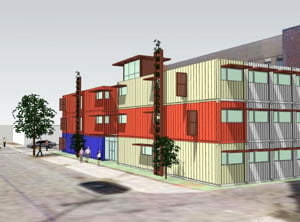
Shipping containers, used in this MC Quarters project proposal, are one form of modular housing that could provide quick and affordable shelter for people living on the streets.

Related

"I think we should start from the assumption that what homeless people need is a home, and a meal, and to be treated with dignity and respect."

That's part of the advice that housing manager Janice Abbott will share with architects, designers and planners at tonight's kickoff of the Quick Homes Superchallenge, organized by Architecture For Humanity/Vancouver.

Abbott, whose firm manages about 20 residential hotels in the Downtown Eastside, will be among more than a dozen experts offering advice to volunteer teams exploring how modular housing might be adapted to provide affordable green housing for Vancouver's growing homeless population. The design charette will consider the potential for housing crafted from reused shipping containers, such the projects described in The Tyee series, Green Homes, Out of The Box.

"Architecture For Humanity believes that adequate shelter is a basic human right, and that housing the least privileged provides an opportunity to demonstrate both creativity and social responsibility," said Linus Lam, who directs the international non-profit organization's Vancouver chapter.

The event begins tonight with a series of 10-minute presentations, and continues on Saturday with the design challenge.

Homeless need respect and security

"I think one of the big flaws in the system right now is that a lot of folks start from the assumption that people who are homeless are profoundly mentally ill, and profoundly addicted," explained Abbott, the CEO of Atira Property Management.

"I'm not saying that those two things aren't true, but I don't think that's where you start from. You start from assuming that people's situations and their mental health is directly related to the fact that they are homeless," she continued.

"You get them into a home. You get them a safe home that's their own, where they are treated with respect by the staff -- and hopefully by their neighbours -- where they feel like they are part of a community," Abbott said.

"Once those things are in place, then you'll know what the extent of their mental illness is, or their addition."

Abbott, who also directs the Atira Women's Resource Society also said that appropriate security is required in order for a respectful community to thrive.

The Quick Homes Superchallenge

Both events will take place at the InterUrban Gallery at 1 East Hastings St., in the heart of the Downtown Eastside. The Thursday night lectures start at 7 p.m. Admission is free, but due to space concerns the public is asked to RSVP.

"When you move someone in off the street in the Downtown Eastside, you definitely need staff in place to keep the predators out," Abbott said.

"There are a lot of predators down here. There are drug dealers. There are pimps. There are people who are not vulnerable making profit off people who are vulnerable," she said.

"These people will come in and take over peoples' rooms in order to conduct their business. You need staff to make sure those folks don't come in and take over the facility."

Inspiration sought

Other speakers on tonight's roster include Vancouver City Councillor Kerry Jang, Street to Home president Barbara Grantham, container home pioneer Keith Dewey, as well as architects including Michael Geller, Gregory Henriquez and Oliver Lang.

The Quick Homes Superchallenge has been organized by the Architecture For Humanity/Vancouver in association with the Design Foundation of British Columbia, and has been co-sponsored by the Tyee Solutions Society.

"I think the homelessness issue is not something we can simply throw money at even if we have it. It is a complex issue and requires constant effort from professionals, as well as periodic bursts of inspiration from the community," said organizer Linus Lam.  [Tyee]

20  Comments:

Login or register to post comments

  • cocean

    2 years ago

    Thank you for excellent series

    Monte, thank you very much for your great series on truly affordable housing alternatives. Now if only we get could the politicians to support these projects!

  • zalm

    2 years ago

    And onc e that's done...

    how about we find some land that these projects can go on.

    Good luck. This is the age-old question that nobody wants to take a stab at answering

  • Takuan

    2 years ago

    lot's of big lawns in

    Shaughnessy and Point Grey

  • freebear

    2 years ago

    I am sure the Premier's backyard has room

    Or Minister Coleman's backyard!

  • carfreecity

    2 years ago

    housing and automobiles

    Any look at housing, plans etc. must include automobiles.
    For decades we have designed our society and housing to accommodate the use of automobiles.
    Lots of pavement and land used for roads and parking.
    Carfree cities create more caring people and clean healthy environments.
    Crime is seriously reduced.
    Parking lots are no longer necessary.
    Green spaces and housing can easily be planned and built.
    Everyone is less stressed.

  • carfreecity

    2 years ago

    2 car garage

    part of the GM et al phenomena.
    Turn them into suites.
    All those layers of parking stalls can be used for housing too.
    Take action.
    Everybody enjoyed street closures to traffic during the Olympics.

  • alive

    2 years ago

    really?

    carfreecity are you for real?
    This entire country is built around vehicles.
    try living anyplace except downtown and you are stymied.
    try getting to a shopping mall if you do not have a car.

    try living 15 KM from any stores like I do.
    BC is more than downtown!

  • Chris Keam

    2 years ago

    15 km, eminently bikable my good man

    15 km is less than an hour by bike. For a fit rider on a path without stoplights and no traffic blocking his/her path, it's about a half hour. The more people that take advantage of this, the fewer cars on the street, the less need for road expansion, and of course, it also means more room for housing, more money for transit for those who can't cycle, and more room for those who require vehicles for work, such as tradespeople and delivery services.

    The entire country used to be built around horses, then rail, now cars. There's no reason the transportation grid can't continue to evolve.

  • alive

    2 years ago

    Evolution eh?

    Chris Keam:
    Thanks for the advice and I do bike, when weather permits.
    Now, try hauling a sack of fertilizer and some groceries home on your bike, eh?
    Forget the hill where many cars downshift or the storm off the water. I won't mention my age but I have been a senior for decades.
    Horses, rail, cars... and the next step forward is pedal power?
    Is that not close to where we began, by walking?
    True that is how we might end up, but hardly evolution.

  • Chris Keam

    2 years ago

    Evolution yes

    Alive:

    I don't think it's feasible for everyone all the time to cycle. I do think it's more feasible than yr extreme example might suggest. After all how many times do need to carry a sack of fertilizer in a year?

    I absolutely believe a stronger emphasis on walking, public transit, and cycling represents progress, both in cities and in suburbs, rural areas, etc. The question is one of individual choices regarding appropriate technologies and embracing a long range view of the solutions. As long as we have people using the most extreme situations to stand for the average it will remain difficult to get people to consider alternatives.

  • carfreecity

    2 years ago

    alive

    yes alive, i am for REAL.
    I just got my gold card.
    For the last 3 years I have used my elecric bike for personal mobility and public transit.
    In Montreal, all year round my daughter has firends, one a carpenter, and one an electrician who use their ebikes with a cart for their tools to get around all year.
    People who are accustomed to hopping into a vehicle to get about have a difficult time putting aside that automobile. Once you decide, like I did, that you don't want to contribute to the madness, like any addiction, you can conquer the habit and feel better, sort of.Breaking the auto habit may be one of the most difficult habits to break.
    I attended the World Ecocity Summit in San Francisco 2 years ago.
    Most inspiring conference I ever attended.
    We heard from people all around the world who are transitioning their places from car culture to other fabulous modes of transportation.A resolution was passed that the goal of an ecocity is to become carfree.
    I have lived in rural areas and did park and ride, taking a train to work and smirking at all the traffic jams as I rode in peace and comfort,enjoying a book, the scenery and a cappucino.
    It is horrid to live beside a road, a street with heavy traffic.
    Bringing this all back home,:without putting so much money from our tax dollars into support for the uses and abuses of automobiles, we can have billions, yes billions, freed up for housing projects .
    People will be less stressed. Our environment will be more peaceful and even mental health will improve.

  • realisticman

    2 years ago

    carfreecity

    The public automated rent-a-bike bicycle ranks in Montreal are presently still closed for the winter. Why? Well they get lots of snow and ice there and it does tend to get a bit cold sometimes. In fact, exposed flesh can freeze in a minute or two when the wind blows - much like about 98% of Canada.

    Off the shelf steel boxes made in Asia will not be replacing homes made with BC wood in the near future, except as a novelty. Anyway, a whole new building code for them would have to be written and trades people would have to learn how to run services within and amongst them - particularly electrics, plumbing, venting. Secondary exits to ground level would have be designed and created for emergency exits. If they were to be publicly owned they would have to be wheelchair accessible, so that means elevators and corridors. It's all possible, the corridors would probably be external on a steel based structure, so what you would essentially have is a steel framed structure, like the Travelodges in the earlier article, with the steel containers slotted into the framework.

    Right now BC needs a larger market for its well proved wood-frame industry.

  • alive

    2 years ago

    Dreamers

    OK, it is a nice to dream about how we could live without cars, and there are many benefits for sure.

    Unfortunately our country has developed around the personal car, and every neighbourhood is like the next, completely dependant on travel to get to anything.

    Now, the cities in Europe was built for pedestrians, the streets are narrow and there are stores on every corner.
    But even there, the public fail to use the public transit, the buses go empty so often that schedules are cut.

    Yes, maybe we all suffer from a car addiction, but it is real, because in many cases there are no real alternatives, and dreaming is not going to change it.

    Thinking that the average Joe is going to walk or bike to Tim Hortons is not realistic.

    Personally I dream of the day when the public will use their brains when they vote, and my dream unfortunately is not realistic either.

  • Chris Keam

    2 years ago

    I'll take the dream over the despair thx

    "dreaming is not going to change it"

    Dreaming is just the beginning. Most everything we've ever achieved began as a dream. I'll bet the Tyee founders had a dream and nothing else, and here we are.

    Realisticman:

    With regard to Montreal's Bixi program, please refer to my earlier comment about people taking the extreme and using it to apply to all situations. By your reasoning, we'd throw away the road network because it's totally congested twice a day during rush hour and not operating properly.

  • RickW

    2 years ago

    Eaarth : making a life on a tough new planet

    Excerpt:
    We've created, in very short order, a new planet, still recognizable but fundamentally different. We may as well call it Eaarth.

    That new planet is filled with new binds and traps. A changing world costs large sums to defend—think of the money that went to repair New Orleans, or the trillions it will take to transform our energy systems. But the endless economic growth that could underwrite such largesse depends on the stable planet we've managed to damage and degrade. We can't rely on old habits any longer.

  • Chris Keam

    2 years ago

    The average Joe can do whatever they put their mind to

    "Thinking that the average Joe is going to walk or bike to Tim Hortons is not realistic."

    What nonsense. Average people ride and walk all the time. That's not an argument for or against anything, it's an easily dis-proven fallacy. You claim to ride your bike when it's appropriate... are you an 'average Joe'. I know I sure am.

    Let's talk about housing instead.

  • alive

    2 years ago

    lets change the subject, eh?

    Chris Keam, how many bikes have you seen parked outside a Tim Hortons?
    The fact is that many people have this craving to "go out" because they are bored and because their systems requires junkfood every two hours.
    Unfortunately that is a fact, and another fact is that there is no way they will walk or drive for their fix!
    So keep dreaming; I agree that you are on the right track, but it goes nowhere.

  • Chris Keam

    2 years ago

    No offense, but for the most

    No offense, but for the most part, trying to convince adults of the benefits of walking, cycling, transit, etc, doesn't interest me unless they decide to explore their options. I'm more interested in teaching young people about the choices they can make and the outcomes that result. So, while your generation, and my generation may be lost causes, the right track is working with young people, and it works very well. They want to be active. They want to be healthy. All they need are some role models. The tide is turning, we're just at that point where it seems the water isn't moving. So, fine, you don't think so. We get it. No need to belabour the point.

  • Takuan

    2 years ago

    make gas twenty bucks a gallon

    and people will ride bikes.

  • DNA

    2 years ago

    Boy people have gotten off track!

    The article was about housing, wasn't it?
    The real question, though, is where do you find (and pay for) the land for subsidized housing. that's the scarce resources. Once you have land you can house people in crates, boxes, containers, cardboard (not recommended) or whatever - though generally wood seems to work well in Vancouver. The question is, where?

    • The discussion for this story is closed. No more comments can be added.