

 SHARE:
Words and pictures by Christopher Grabowski
The Solh radio station is a pale yellow cube, two stories high. It is the last human-made structure on the northern edge of the Shomali Plains, about 80 km north of Kabul. Beyond it, the massive mountains of the Hindu Kush rise steeply and quickly reach 12,000 feet.
The cook and the engineer sleep downstairs in the meeting room. They get up early; eat flat bread and one hardboiled egg each for breakfast end clear the room before the rest of the radio crew arrive from town.
The station's director, Zakiya Zaki, comes around 9 a.m., takes off her blue burka and turns on the red radio powered by a car battery. She listens to several news broadcasts in Dari and makes notes. These notes, and the notes made by her deputy Ibrahim Kawish who listens to BBC and Voice of America at midnight, are the basis of the station's morning broadcast.
It is how the town of Jabal Saraj and surrounding villages learn about national Afghani affairs and the world beyond. In the rural communities of the Parvan province, illiteracy reaches 70 percent. There are no newspapers, no television and no telephones.
Radio Solh came into existence in October 2001 as the result of an agreement between the French organization, Droit de Parole (Right to Speak), and Ahmed Shah Massoud, a charismatic warlord of the Panjsheer Valley. It was the first independent radio station in the country, and still one of only a few in Afghanistan. Today, besides Zakiya, there are three other women among Radio Solh's staff: announcer Doshiza, who is also a nurse in the town's clinic, reporter Salma, and Muzda who prepares and reads daily English lessons on air.
In January 2002, two Canadians from the Vancouver-based nonprofit Institute for Media, Policy and Civil Society, Jane McElhone and John Keating, went to Jabal Saraj for ten days to provide journalistic training for the Radio Solh staff. Zakiya Zaki says this training gave her and her crew the necessary professional background for preparing the local news and reporting. Having such ability, Radio Solh became a truly functional community radio station.
Land mines the new harvest
Once a breadbasket of Afghanistan, the Shomali Plains are scarred by years of war. Thousands of landmines have made patches of the fertile land into no-go zones. The ancient but practical irrigation system was blasted over and again by retreating armies. Many settlements turned into ghost towns, as the land could no longer sustain life.
Jabal Saraj was the war-front town many times in the past two decades. The Taliban's rockets hit the town's small hydropower plant, with museum quality Siemens turbines from the beginning of the 20th century. A similar fate befell the cement factory and the textile factory with its machines build in England in 1941. This sums up most of the region's industry. At the entrance to the boy's school, an enormous wreck of a heavy Russian tank makes an unintended, intimidating monument of the Northern Alliance's last battle with the Taliban. Boys pay it as much attention as to a boulder, some sit in its shadow to review their homework after classes.
Station's dynamo producer
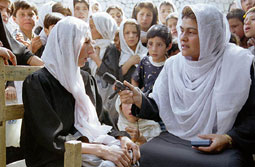
In Tajik dominated Parvan province, women are more socially active and independent than in the provinces to the South and West, where - Zakiya Zaki pointed out - "they still can't broadcast women singing on the radio." In Parvan she herself is a cultural and political force to reckon with. A one-time member of National Assembly Loya Jirga, she splits her time among being a mother of six, a headmistress of the girls' school and a radio producer.
When she recorded at the school a conversation with one of her students, 17 year-old Nazifa, about a hundred girls crowded around absorbing the unusual event. It was a sad interview. Nazifa, a victim of a land mine, talked about living in constant pain, being afraid that she will become a burden to her family, and her wish that she had died in the blast that took her legs. The tragedy only briefly registered in the expressions of the girls surrounding them, unable to hide their excitement, they quickly reverted to subdued chatting and giggling.
Radio Solh frequently accommodates kids in its broadcasts. A couple of times a week, groups of girls and boys climb the winding path to the top of the small hill above the town where the station sits. They sing and chant poetry to mark occasions like the anniversary of Massoud's death. The kids have no political agenda and their presence on the air does not upset the delicate balance between dozens of political and ethnic groups that the radio needs to consider in its programming.
Warlords told hands off
The station earns a little money from advertising local businesses like a new restaurant and a dress store. It charges about $2.50 Canadian per minute. More substantial support comes in occasionally from several non-governmental organizations like Aide Medicale Internationale that broadcasted basic health education announcements in cooperation with Radio Solh.
Radio Solh's staff volunteers most of the time. Their station is still a fragile experiment. Its independence is a function of support from the community. The elders of several clans repeatedly warned local warlords to leave the station alone. Along with some fuel for the generator, that's all the people are able to give to their radio station. In return, the community receives fresh local news and a sense of coherence resulting from being able to tell their own stories and have them broadcasted in a radius of about 50 km.
With a significant part of Afghanistan's infrastructure bombed and re-bombed, quite literally, into the Stone Age, and the political system in a good part of the country reverted to the middle-ages stage, with warlords of different rank holding the balance of power, one could regard Radio Solh as some sort of token independent media. Perhaps it's true.
It is also true that this little radio station transmitting voices of several women at the foot of the Hindu Kush is a testimony to the inherent ability of communities and clans in the mountain valleys and northern Shomali Plains to constantly find ways to build consensus at the village level - the trait that surely allowed them to survive and preserve their culture for hundreds of years.
Christopher Gabowski is organizing a documentary exhibition on Afghanistan by four Canadian photographers, planned for September. He publishes photo-stories in North American and European print media, and is a founding director of Narrative 360, a non-profit society for documentary arts. ![[Tyee]](/design-article.thetyee.ca/ui/img/yellowblob.png)




Tyee Commenting Guidelines
Comments that violate guidelines risk being deleted, and violations may result in a temporary or permanent user ban. Maintain the spirit of good conversation to stay in the discussion.
*Please note The Tyee is not a forum for spreading misinformation about COVID-19, denying its existence or minimizing its risk to public health.
Do:
Do not: