How hugely would LNG exports spike emissions impact? Infographic tells the stunning story.
SEE BOTTOM OF STORY FOR FULL INFOGRAPHIC: How will LNG plans affect BC's climate change goals?

-
Turning natural gas into liquid sucks electricity. Ratepayers, guard your wallets.
-
Both parties seem oblivious to the coming natural gas glut and its economic impact.
-
It will boost BC's carbon output three per cent, but cap-and-trade can offset, says Premier.
- Read more: Energy, Labour + Industry, Environment,
[Editor's note: See bottom of the story for large infographic developed by the David Suzuki Foundation to show the carbon impact of B.C.'s proposed LNG plan.]
The National Energy Board and B.C. government are both backing a major fossil fuel development plan that would have more than twice the greenhouse gas emissions impact as the Northern Gateway pipeline project. A proposal to extract and export liquefied natural gas (LNG) to Asia from B.C.'s unconventional natural gas reserves directly undermines the province's climate targets for 2020. This increase in emission exports will be so significant that British Columbia, once a champion of climate change policy, will become second only to Alberta in terms of export emissions.
That's a staggering reversal.
The government's climate change goal is to reduce emissions to roughly where they were in 1990 by the year 2020. This will not be possible under an LNG export scenario. Natural gas industry emissions would rise to 30 megatonnes (up from 16 now) and, all else being equal, B.C.'s energy emissions would increase from 60 to just under 90 megatonnes. The province will become one of Canada's major greenhouse gas producers and exporters. (All figures in this article and infographic, see below, were developed using the CanESS energy simulator from Whatif Technologies)
Adopting the policy of rapid LNG exports contradicts this government's previous climate initiatives and calls into question its sincerity with regard to implementing measures under the Western Climate Initiative, The Climate Registry http://www.theclimateregistry.org/, the International Carbon Action Partnership and the Pacific Coast Collaborative, as well as the province's own Climate Action Plan.
But the environmental impacts don't stop there. All of this new production to satisfy exports would be from shale gas. There would be a significant land-use footprint associated with meeting the LNG export target. Drilling new well pads, building access roads and installing new pipelines would affect and fragment an area nearly three times the size of Metro Vancouver. Shale gas extraction has raised additional concerns regarding the composition of chemicals that are pumped underground, impact on local air quality and triggering of small earthquakes.
Shale gas developments also consume enormous amounts of water. Although the amount of water differs by project, a conservative estimate would be 120 million litres per day for B.C.'s proposed export LNG projects -- or enough water for a city of 160,000 people.
What about the broader systemic impacts to our energy system? Producing natural gas is energy-intensive in both the extraction process and conversion to LNG. Meeting the LNG target would require the province's electricity production to increase by more than 30 per cent. New power projects would be required at a time when B.C.'s electricity system is in need of costly refurbishment. Is creating new power generation in B.C. to enable the export of fossil fuels a sound use of taxpayers' money?
One common claim, included in the government's LNG strategy, is that exporting natural gas to Asia will reduce global emissions by reducing coal dependence. That would make sense if natural gas were used to displace fuels like coal, but there's little evidence to suggest that it would. China's consumption of all fossil fuels is increasing and the supply of gas (110 Mt of GHG emissions annually) from B.C. would add to the country's growing carbon footprint. Japan is another target market. Its energy needs have changed following the loss of much of its nuclear capacity after the 2011 earthquake. Replacing nuclear power with natural gas will cause a net increase in emissions. So the argument that an increase in B.C.'s emissions will be offset by emission reductions abroad does not hold water.
Rapid development of LNG would shift B.C. from a climate leader to a petro-province. To get a sense of how profound this change is, let's consider how B.C.'s role as a fossil fuel producer and exporter would change.
By 2020, more than one-third of B.C.'s emissions would be associated with natural gas exports. This is a significant shift, as fossil fuel exports now account for 20 per cent of emissions.
How would B.C. compare as a fossil fuel exporter to the rest of Canada? We know that Alberta, Saskatchewan and Newfoundland are important producers and exporters of fossil fuels while B.C. has traditionally been a leader in clean-power production.
In the LNG export future, B.C. would become the second-most important fossil fuel-exporting province, next to Alberta. B.C.'s emissions from producing fossil fuel exports would be greater than emissions from the rest of Canada combined, growing 275 per cent between now and 2020. With such a stark reversal in B.C.'s emissions profile and industrial composition, the province would come to depend on fossil fuel exports and their associated GHG emissions to achieve its jobs and growth agenda.
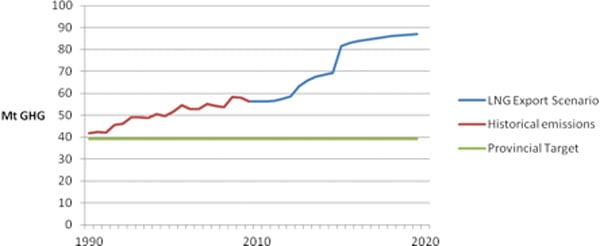
B.C.'s projected GHG emissions from the production and use of energy under the LNG export scenario
What's most concerning is the lack of political debate. The B.C. government has enthusiastically supported the industry while reducing its environmental commitment. The government has removed the 93 per cent clean energy standard for LNG facilities and has opened the door for those facilities to be powered entirely with "clean" natural gas, which would add another 12 per cent of GHG emissions to B.C.'s current inventory.
B.C. Energy and Mines Minister Rich Coleman has stated, "Our government is committed to ensuring British Columbia is well positioned to compete in the race to supply an increasing world demand for LNG." At the same time, the provincial NDP has also expressed support for the LNG agenda. Energy Critic John Horgan said, "A natural-gas proposal makes sense...because it's a product from British Columbia, so the royalties would stay here, the jobs would be created here. And gas vents; it doesn't stick." The political alignment and lack of debate on this issue is startling considering the significant environmental and social impacts.
While some form of environmentally responsible LNG development may be possible, there is no way to implement this government's current natural gas strategy and maintain British Columbia's long standing leadership on climate change. Current plans would undercut the necessity of transitioning to a green and renewable energy economy, and would relegate B.C. to an antiquated form of energy production and consumption. Are the B.C. government and official Opposition abandoning B.C.'s environmental goals and clean technology brand in an effort to transform the province into a major hydrocarbon and global warming pollution exporter? If so, they may want to explain to the 73 per cent of British Columbians that recently said they are concerned about global warming and believe B.C. should do more to promote solutions to climate change that their values are out of step with B.C.'s political elite.
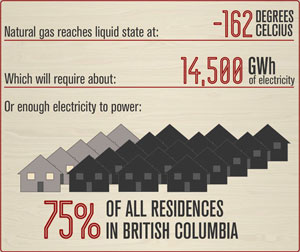
See below for LNG infographic.

The'Cost of Exporting Liquid Natural Gas' infographic shows the environmental risks associated with B.C.'s LNG Plan. Source: David Suzuki Foundation.
Tyler Bryant is energy policy analyst for the David Suzuki Foundation in Vancouver, B.C.
23
Login or register to post comments
Fiat lux
24 weeks ago
Wealth is the temporary
Wealth is the temporary control of energy.
Wealth can not be created, only taken from others, the environment and future generations.
These crazy plans are the best example and the result of the ongoing and growing "free trade" rackets, designed to remove any degree of versatility, self sufficiency and variety of employment chances from societies to make them slaves to a criminal system controlled by imaginary monetary figures, used as weapons for enslavement.
Ed Deak.
Noggy
24 weeks ago
Is natural gas a good investment
I thought there is a glut of stored natural gas and around the world much more LNG has been found. Are BC politicians dreaming they will have a dynamic market for LNG?
A Voice
24 weeks ago
Yet
Yet what do you think the chances of the carbon tax being eliminated are, for the people of BC?
I love having my natural gas taxed at 50% right now!!!
Have a look at your next monthly natural gas bill....I wonder..will we charge the companys exporting the natural gas a 50% carbon tax?
dave0ferg
24 weeks ago
Pushers
Who should suffer the greatest blame, the buyer or the seller—the addict or the pusher?
Will BC’s lust for virtual wealth end up like an abandoned grow-op—uninhabitable?
snert
24 weeks ago
Time to put in Site C
That way we'll have enough clean energy to process the gas.
Van Isle
24 weeks ago
I wonder if the powers in all
I wonder if the powers in all of our political parties have read this article. This article just shows what a stupid idea to export our natural gas is, never mind fracking. I read about 6 months ago that if we export our gas as has been proposed, we'll be importing gas in about 20 years cuzz we would have run out. Just a footnote, I see that some American firm is suing the Government of Canada, under the NAFTA agreement, cuzz Quebec has banned fracking.
burbster
24 weeks ago
Then keep sending cheap BC Nat Gas to the Tarsands
Lets just keep the status quo, and keep sending our natural gas to Alberta at 1/5 the world price. Subsidizing the Tarsands seems to be our best option according to this article. (rolls eyes)
burbster
24 weeks ago
Is the Green Party funded by Harper?
Seriously, this is a Conservative dream-
get BC to sell its non-renewable resources to Alberta at a deep discount to the world price, and split the left wing vote at the same time. Win, win for Harper.
Terri Robson
24 weeks ago
loopholes
www.independentwatertesting.com/education-center/148-what-is-the-halliburton-loophole.html
hydrolic farcturing is not subject to the same standards as other industries when it comes to protecting underground sources of drinking water.
As for any N/S pipelines under an exec. order by shrub er I mean g bush jr. signed apr. 2004, the Sec. of State is responsible for approving pipelines that cross U.S. border, recently susan rice has been reported as the obama pick for sec of state, her and her husband stand to make a stack of cash from those decisions.
www.alternet.org/environment
Sec. of State candidate susan rice
pwlg
24 weeks ago
LNG process and the meaning of insatiable
Most LNG plants use natural gas to fire the boilers needed to produce steam generated electricity. What percentage of the fracked product will be used to generate electricity?
Wonder just how thirsty China is for energy resources?
The final turbine generating electricity for China's massive 3 Gorges Dam was put in place at the beginning of this year. It was conceived that the $30 billion 3 Gorges Dam would generate 10% of China's needs. It is now estimated that the all the electrical generating power from the dam will provide only 3% of China's current needs.
The 60 odd nuke plants China has and is building will provide less than 10% of its needs.
A new meaning of insatiable must be added to the Oxford dictionary.
pwlg
24 weeks ago
the dope on lng
As of June 2012 there were 29 LNG plants operating globally.
There were also another 11 under construction and 15 more planned.
What is interesting from the number of planned LNG plants is the 5 proposed LNG plants either recently suspended or cancelled. Reason? Prices of LNG are the lowest since the 1970's and the glut of LNG in the global market.
Governments worldwide eager for revenue have permitted an enormous amount of drilling rights and because of this have created an unnatural wide divide between supply and demand. The mad mad mad dash to the gas fields has become the modern day gold rush. Resembling the gold rush days of the 19th Century the modern day natural gas rush have made a few wealthy but many heading home battered and beaten.
What has BC got to show for their involvement in the gas rush? A $1.5 billion deficit. No wonder Little Lord Kevin Falcon left the sinking ship.
realdemocrat
24 weeks ago
The elephant in the article...
...is the lack of choice we, the public, have about fracking in BC. With both the Liberals and NDP dancing like drunken cheerleaders around the issue, the only hope for stopping the madness is the Green Party which, unfortunately, is unlikely to form the next government.
ModestyBlaise
24 weeks ago
Over the Top.
Cool Hand mentioned a number of heavy duty players (on the Mair story this week) in LNG. Here's another, and this is a Tyee writer's perennial favourite, Statoil of good, nice, clean, progressive, wealthy, civilized, Norway.
Japan is hungry. so, Ob River, come on down!
http://barentsobserver.com/en/arctic/hammerfest-lng-set-sails-japan-arctic-route-06-11
http://www.ship-technology.com/news/newsob-river-lng-carrier-to-become-first-ship-to-sail-across-arctic-in-winter
The idea that Asia will not buy LNG because it's nasty for Mother Earth is Pythonesque. Any idea that renewables could be used instead is also high comedy. Maybe not in a few decades or centuries. The conceit that pulling the plug on energy for Asia is necessary or nice is simply infantile and patronizing.
At 944,735 square kilometres BC is massive (about the size of France, Germany and the Netherlands combined. or, larger than Washington, Oregon and California combined).
The fantasy that British Columbia must remain a development-free camping site is imbecilic.
Fiat lux
24 weeks ago
The word "development"
The word "development" doesn't mean selling out and leaving nothing but destruction and pollution behind.
BC was doing very well with all kinds of industries before the present neocon, neolib, "free trade" rackets, wrecking large numbers of independent businesses and tens of thousands of well paying, productive, not parasitic, jobs.
Now we have to rely on products made in slave labour countries and paying for them by selling the land and resources from under our feet so that a criminal gang of multinationals can grow stronger and control the world, covering it with short lifespan garbage products.
Ed Deak.
Cool Hand
24 weeks ago
ModestyBlaise
In fact, Norway's Statoil has confirmed that they are looking at BC lng export. But still very preliminary and nothing much more from their end yet.
http://www.businessweek.com/news/2012-10-25/statoil-may-consider-canadian-liquified-natural-gas-business
jimmy_laroux
24 weeks ago
Say it ain't so!
Gosh Mr. Bryant, do you think they were lying? Could it be that they created this policy (in the wake of the 2007 IPCC report) in a cynical attempt to get pinhead enironmentalists like yourself to support them in the run-up to the 2009 election, and to gain votes amongst the well-meaning if politically naive environmentally-minded voter, with the certain knowledge that they would be long out of office before 2020 rolls around and they would have to be called to account? Heaven forfend!
John How
24 weeks ago
LNG or coal?
I fail to see how putting an embargo on natural gas, while continuing to send the oh-so-much dirtier northeast coal and, potentially, tarsands petrogoo to feed China's gradually moderating demand for BTU's makes ANY sense from a global perspective. Would you rather turn off the taps and let the ChiComs contain the resulting social chaos?
Jeffrey J.
24 weeks ago
Very Impressive
A very impressive article with a brilliant use of visual imagery.
It is extremely difficult to read the exact details of how our own province is contributing to the destruction of Mother Earth. Extremely difficult. All for tiny, temporary gains such as a few 'jobs' and 'money' (fiat currency which we print electronically).
Where is the NDP on this file???
Great coverage as always.
ModestyBlaise
24 weeks ago
Jeffery
The BC NDP is in full support of LNG exports. For frack's sakes, you must know that.
Not sure about the Greens.
Baws
24 weeks ago
Leader in clean energy?
I'm from the north country. Does flooding more land for hydro power count as clean? I've always found that funny. We are a leader in clean energy then are we? Lets flood more land to get clean energy. Wait, what about farm land? Lets clear some more forest area so we can get that too, since we just flooded an area where we used to grow food. Never mind how many animal habitats we just flushed out as well.
How is this process any cleaner than taking up land for natural gas exploration? The land mass I bet would be pretty much the same area as a new hydro electric dam when you account for the loss of land.
As for the natural gas side of things. It is the cleanest burning fossil fuel out there. The plan is to convert old archaic coal burning electric facilities into natural gas burning. Which would hugely reduce the amount of C02 emmissions there are currently generating!
Plus there are already plans in place to try and convert large scale commercial vehicles to natural gas as well. Which once again would lower C02 emmissions. Heck, even the city of Vancouver is investing in this technolgy. Last I heard the waste management group just put 10 new garbage trucks on the road that run strictly on compressed natural gas.
Also, I do have to agree that fracking is not a nice way to extract natural gas. But the government is mandating that the water that is pumped into the ground must be recovered (as much as possible, and can usually get back at least 75% of the volume used) for use at the next fracing site. Meaning the consumption of our water sources will be less strained. Of course i'm not happy about how much water these processes use. But at least the BC government is trying to implement laws that prevent an oil company from sucking all the lakes and rivers dry!
Maybe it's not as evil as you think when you put the "whole" picture into perspective?
Hugh
24 weeks ago
"Shale gas developments also
"Shale gas developments also consume enormous amounts of water."
It's ironic how Talisman Energy is getting their water from BC Hydro's Williston Reservoir:
http://www.cbc.ca/daybreaknorth/interviews/2011/07/29/talisman-energy-gets-20-year-water-license-for-williston-resevoir/
Dannyboy
24 weeks ago
I'll say one thing for the cons
At least Harper and C Clark are consistent with their message. Frack away, no apologies.
Then on the progressive front we have Mulcair saying one thing *Non!* while Dix says *We will frack "sustainably"*
http://www.bcndp.ca/newsroom/ndp-proposes-stronger-actions-sustainability-and-environmental-protection-fracking-expands-
so the first order of business under a new BC NDP government on fracking will be to:
*Appoint an Expert Panel*
doesn't everybody feel reassured now?
igbymac
23 weeks ago
The Elephant?
The Elephant is thinking we have a democracy where the people matter, or that a political Party of any stripe is going to be able to represent the will of the people.
Concentrating power in the hands of a few is a disaster in waiting, and that is precisely the congame our society has built itself upon. At its base is social Darwinism and manifest destiny.
The Green Party will do no better, and despite the misconceived intentions of May, she is impotent.