Opinion

Euro Treaty Would Give Harper More Power at Home

CETA will kill jobs, rob provinces of powers to steer own courses. Can it be stopped?

By Murray Dobbin, 24 Sep 2012, TheTyee.ca

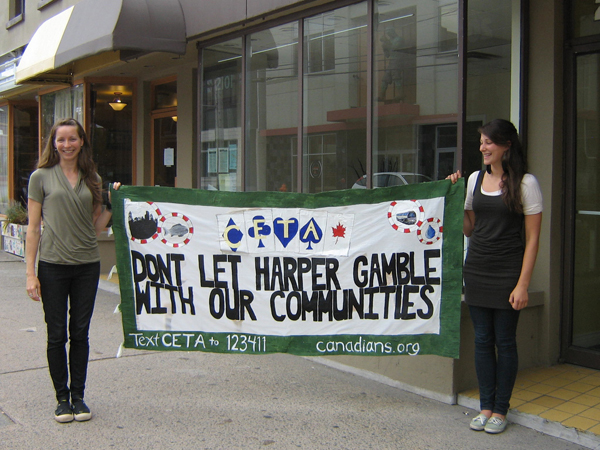
CETA protest sign

Opposition to secret trade deal mounting across Canada. Photo: Council of Canadians.

Related

Stephen Harper's no-longer-secret agenda to implement a revolution from the right and dismantle Canada has one major impediment that must really stick in his craw. He is constrained in what he can do by the constitutional division of powers which gives the provinces so much political authority.

The really big social items on the political agenda -- health, education, social services -- are matters of provincial jurisdiction. To be sure, he can severely damage all of these by destroying the decades old principle of universality and slashing federal funding. But he can't get rid of them. The provinces also have a mandate on protecting the environment. And regarding labour rights, most working Canadians are in sectors that come under provincial jurisdiction. Lastly, the third level of government is also a creature of the provinces. While municipalities depend on the federal government for financial help, Ottawa has no political authority over them.

These constraints may help to explain why Harper is so enthusiastic about the Canada-European Union Comprehensive Economic and Trade Agreement (CETA).

CETA, if Harper can persuade the provinces to accede to its provisions, does what Harper can't do by himself. Like other trade agreements, this one systematically weakens the democratic decision-making authority of all levels of government. As such, it is Harper's Trojan horse. In the guise of expanding "trade" with the EU, he makes progress in his goal of emasculating democratic governance.

Resistance to CETA building across Canada

The frantic rush to get CETA signed has opened up a new front in the stop-Harper movement. The Council of Canadians and others are focusing on a major vulnerability of the deal, its potential impact on provincial and municipal authority to make their own decisions. Two of the most egregious impacts have to do with Medicare and government purchasing. The Europeans are demanding that all government procurement be part of the deal -- meaning that any effort by any government to give preference to local or provincial firms would be deemed a violation of the agreement.

Like other "trade" agreements, this one is in fact a corporate rights agreement, giving the world's largest transnational companies ever-greater power to trump democratic authority. The deal would make the privatization of local services -- water, electricity and transit -- much easier. Privatization incursions into Medicare, education and even social services would increase as well.

The procurement provisions -- giving EU corporations unobstructed access to the public spending of municipalities, schools boards, hospitals, universities and Crown corporations -- is especially threatening given the critical role such public spending plays in a time of virtually zero private investment. The strategic use of public spending for economic development and support for local businesses or sectors (such as green energy) would also be effectively banned. Others worry that if the EU gets its procurement deal the U.S. will want similar treatment -- an even greater threat given its proximity to Canada.

Job killer: CCPA report

A report released just last week by the Canadian Centre for Policy Alternatives reveals the impact on manufacturing jobs. The report's author John Jacobs calculates that some 70,000 Ontario jobs would disappear, most of them in them manufacturing sector:

"CETA locks trade partners into their current pattern, which is imbalanced. It would box Ontario into exporting non-renewable resources such as gold, nickel and uranium -- privileging EU's current dominance of value-added exports to Ontario and leaving the province in a virtual straightjacket while bleeding jobs." 

Investor-state provisions, like those in NAFTA, would expose all governments to increased litigation producing the chill effect which has seen virtually no new environmental legislation in the country since NAFTA came into effect in 1994.

On the Medicare front, CETA would immediately add $3 billion to the provinces' drug plans as EU pharmaceutical companies are seeking to extend their patent rights by several years, delaying the introduction of cheaper generic drugs. This would also increase the cost for private company plans.

Rolling over at the table

An interesting twist to the negotiating position of the EU and Canada seems to reinforce the notion that Harper sees CETA more as a means to dismantle the activist state than as a means of enhancing trade and investment. The EU has negotiated a blanket exemption to protect their water, energy, and public services -- including health care -- while the Harper government has left those same elements completely vulnerable to privatization.

One of the most alarming aspects of the deal is the government's secretive effort to use CETA to push the Anti-Counterfeiting Trade Agreement (ACTA). Ostensibly aimed at patent-busting piracy, it is a draconian treaty that effectively criminalizes the normal use of the Internet, making Internet providers legally responsible for what their users do online. ACTA goes beyond the Internet and could also be used to stop generic drugs from competing with brand names and stop farmers from using certain seeds.

While it is not well known here, there has been a huge fight in the EU to stop ACTA. In July, the European Parliament voted against the treaty. European Parliament President Martin Schulz stated that "concern about its impact on consumers' privacy and civil liberties, on innovation and the free flow of information" caused the defeat. 

The Harper government has already signed ACTA, as has the U.S. and Japan, two of the EU's biggest trading partners, and is still trying to get it included in CETA. That has attracted the fierce anger of Internet activists in Europe -- and they could make passing CETA much more difficult.

Real goal: strangle government

Stephen Harper is hardly the first prime minister to fraudulently use trade agreements to accomplish the neo-liberal objective of hobbling government.

Mulroney ushered in this Trojan horse strategy with the FTA and NAFTA.

Jean Chrétien used Paul Martin to take great advantage of the new "free trade era" to implement his labour flexibility policies -- the most deliberate, and devastating attack on workers' power and standard of living ever undertaken by a modern government.

And just as with those regimes, the Harper cabal has to be fought vigorously on this front while there is still time. Once these deals are signed it is next to impossible to get out of them. Fighting CETA at the national level, however, may be fruitless. Parliament is effectively dead, its institutions assaulted and eroded at every turn by a prime minister openly contemptuous of democracy and willing to bend or break any rule to achieve his ends.

The key to defeating CETA now lies with the junior levels of government, the provinces and municipalities. The Council of Canadians campaign has been most successful at the municipal level where they have persuaded some 80 municipalities to either call for a complete exclusion (40 governments) or passed resolutions expressing concern. Most of these are in B.C. and Ontario and include some of the largest ones like Toronto, Hamilton, Mississauga and Victoria.

According to Postmedia news, Harper is worried about the growing opposition -- so worried that last April he dispatched 18 ministers on a propaganda blitz to sell a deal that was supposed to have been kept as secret as possible. As the list grows longer, EU negotiators may well wonder if the Canadian government can deliver even if it does sign.

The provinces are a harder nut to crack. Their governments -- whether Liberal, Conservative or NDP -- have all been far too willing to follow the policy advice of their trade bureaucrats, most of whom are more aggressive neo-liberals than most corporate CEOs. (The one exception was the Glen Clark government in B.C. which opposed and held public hearings into the MAI, the Multilateral Agreement on Investment.)

The Ontario government, despite dozens of municipal resolutions, has shown little concern and even the Ontario NDP, while sympathetic, doesn't see the issue as one that can gain them any traction with voters. The NDP governments of Nova Scotia and Manitoba continue to be captive of their trade departments partly because they have never faced a trade challenge under NAFTA.

Quebec, BC key to stopping CETA

With the PQ now in (precarious) power in Quebec, the provincial front may change. According to the council's trade campaigner Stuart Trew, the PQ in opposition was seeking greater transparency and a carve-out for Crown corporations (Hydro Quebec and their liquor board). But now that it is the government, some believe it will throw a wrench into the works. The Globe recently observed that the PQ's intention of favouring Quebec companies in public tendering for major procurement items like subways and power plants "strikes at the heart of the deal, [and] could be a big obstacle." 

The new government is also reportedly planning to create a new department of foreign affairs and international trade with the goal of signing its own trade deals. This befits the PQ view that Quebec is a nation with the right and obligation to deal with other nations as such. Beyond its nationalist and social democratic philosophy, the PQ will be fighting the Harper government on several fronts and it may be tempted to hold it to ransom on CETA if it doesn't make progress on other issues.

Having one of the country's largest provinces balk at the deal will at the very least make negotiations (allegedly "final" negotiations take place in mid-October) more difficult. Quebec's opposition might also get the attention of other provinces.

One of the biggest worries for Harper is that constitutionally there is little he can do if the provinces don't go along. According to Trew, "Harper can just sign the deal and it would apply to the provinces, but the provinces just don't have to cooperate. There is nothing in law that could force the provinces to comply. They just voluntarily bring themselves in line with whatever they promised Ottawa." In other words, they could break their promises with impunity.  

That means the country's third largest province, British Columbia, could be very close to reversing its promises. There will an election in May next year and virtually everyone expects the NDP's Adrian Dix to become premier. Dix is on record opposing CETA for all the reasons its critics have identified, saying the treaty "will block our access to less expensive generic drugs, restrict municipalities from purchasing services and goods from local businesses, and put at risk public control of the water supply."

So CETA, which looked like a sure thing when Harper got his majority, now looks increasingly iffy. While the October talks will be final, it will take many months for the EU to get all its member states to pass and implement it. Major provincial governments balking and more and more municipalities seeking exclusion could create a lot of skepticism and undermine support. 

If more provinces demand dropping the protection of drug patents, Harper might be forced to withdraw that provision -- a possible deal-breaker for the EU. Another potential deal killer could be the tar sands. If the EU decides to declare tar sands oil "dirty" (a decision is expected in the spring) and bans its importation, Harper himself might walk away from the deal.  [Tyee]

Read more: Local Economy, Politics,

20  Comments:

Login or register to post comments

  • Dan the socialist

    34 weeks ago

    It sucks but nothing we can

    It sucks but nothing we can do about it. he has a majority with 39%. If you protest you get hit with shaming language from many corners. Most people do not care or know about this anyway as they are too busy watching reality tv and not as if the lame stream media will say much about this. Heck the 6 pm news really shows very little news anymore.

  • Fiat lux

    34 weeks ago

    In our system any

    In our system any "democratically" elected government becomes a legal dictatorship for its term. Then either gets voted back for more, or another dictatorship takes over.

    The opposition and the public can jump up and down, but can't do a goddamn thing about it.

    I still say that Harper's insanity will force him out of office sometime next year, hopefully without any violence, but in the meantime he can sell off the country.

    A situation we, who have grown up and lived under dictatorships, have seen before and can now see it coming here, and all over the world, forced to submit to the demands of the corporate mafia by their pimp servants.

    Regardless whether they call themselves capitalists, or communists. The same gangs of crooks waving different flags to fool people, always with the word "freedom"

    Ed Deak.

  • Inotice

    34 weeks ago

    There is plenty we can do

    Dan, I have to disagree with your proclamation that we are captives of "Harper and his regime" and therefore we as citizens are helpless and without recourse. I honestly believe that a defeatist attitude like that is only another one of Harper's dogmas and he would have us believe it to be true.

    This country, (Canada) when it was a democracy achieved it's changes and new additions through a democratic vote and joint talks between government and the people. Harper is trying his level best to kill democracy in this Country by loading the senate, the courts, municipal Governments and the National Police Force (RCMP) with his own people so that his and only his will/vision can be implemented.

    We as a people must work outside of the Government/legal structure that has served us go well for many years if our word or will is to be heard and implemented to the degree that it will make a real difference.

    There are some that would call this, Civil Disobedience, and it may well be so. If there is blame to be cast around and if these measures are used so that the voice and will of the people can be heard, it is not the people who must carry the consequences of these actions it is the person that changed our land to the point where this must be so.

    Harper and his Government is the reason we are at the brink and only the dissolution of what he has/is put/putting in place can bring us back and keep us the independent people we once were.

  • Loke

    34 weeks ago

    Why are the municipalities having to fight...

    This article mentions the municipalities taking a stand but where is the provincial government who should be representing us.

    Clark has been signing over our provincial rights to the federal government and then announcing how she is taking a stand.

    Clark has also been hiring ex-federal high ranking staff to direct her policies and advise her.

    When will the provinces who have the financial power actually start using it instead of being controlled by the poor minority.

  • Talon

    34 weeks ago

    CETA and the rest of us.

    Thanks Inotice for your stand - there is plenty we can do and one has to want to do it before one will do it. By talking about it on this great Tyee forum the word spreads about how CETA will affect each and every one of us. If you want to join a team effort, the Council of Canadians has been fighting this trade deal since it was first announced. Get involved. Be part of democracy in action. I know that PM Harper is concerned about the economy but he should listen to Fiat Lux for good information about that issue and spend more time on dealing with the vital issues we are facing such as the rape and polluting of our planet by the profit hungry greedy-group. Where are the visionaries when they are needed because Mr. Harper is not a visionary, he is a strategy-savvy profiteer looking for a future career at the World Bank or other such body.

  • Fiat lux

    34 weeks ago

    There was a news item on CBC

    There was a news item on CBC TV that Christy Clark's Chief of Staff, Ken Boessenkool was forced to resign over some personal incident.

    But that's not the real story. According to the item, the guy used to be Harper's "astrologist"

    Anybody knows more about this? Harper's astrologist? What the hell is going on here?

    Ed Deak.

  • lynn

    34 weeks ago

    Full Moon Looney Tune Party

    I think he was Harper's strategist, Ed,....when it comes to the Reformatories it amounts to the same thing..

    He is definitely Stevie's soulmate.

  • alive

    34 weeks ago

    Any excuse will do for resigning

    Well Ed, you do not need to be an astrologist to foresee that Christy is going down in flames!
    We can hope that the almost daily bad news from the BC liberals,eventually will penetrate the thick skulls of the voters here.

  • Tankenka

    34 weeks ago

    Quebec-yes!

    Thank you Murray, for noting Quebec's pivotal position.

    I've been saying for some time that Quebec and First Nations are the country's best hope for tempering, if not being able to stop this treacherous Prime Sinister.
    And a PQ minority government is the best situation we can hope for.

    Besides having wonderful people and amazing culture, Quebec has a strong sense of self and to help preserve that, a deep hunger for autonomy. That province will always look out for number one, and having the PQ at the helm will ensure that. Having a lot of non-separatists, though, provides much protection against separation, ensuring that Quebec will remain part of Canada for likely a long time.

    This is wonderful news for the rest of us. Whatever harper does, it is likely NOT in Quebec's interest, and even if it could be argued otherwise, there is a tendency for Quebec to oppose him on principle.
    I feel a lot of relief to know that there is a formidable opposition PROVINCE to such a federal government as we have now, and one that won't be going away soon-leaving us and our feeble provincial governments totally vulnerable.

    Everyone in the rest of Canada should appreciate Quebec for this (as well as said fantastic people and culture!)

  • lynn

    34 weeks ago

    Excellent informative article by Murray Dobbin

    Should be required reading for every high school student.

    This, after all, is the country they will be inheriting.

    Maybe they'll go home and wake-up their slumbering parents.

    Also, very well said, Tankenka.

    You nailed it especially in regard to Quebec's strong sense of self, autonomy, and culture - equally true of First Nations I would add.

    However, ( and I know this was not your implication) we cannot expect First Nations and Quebec to do all the heavy lifting. We must openly stand with them in vigorous... and vocal opposition to the Harper regime.

  • North of Hope

    34 weeks ago

    astrologist?

    There is not much difference between an economic forecaster and an astrologist. Although the astrologist may have more reasoning to back her or him up.

  • DNA

    34 weeks ago

    A few more facts please...

    Rather than rhetoric, it would be nice if The Tyee would assign this story to someone who deals a bit less hysterically with CETA. Harper wants to "dismantle Canada"? I certainly am not a Harper supporter, and object to many specific Conservative parties, but I don't really think that sort of statement is enlightening. What do it mean? Likewise, why is there a discrepancy between Dobbin's figure about 70,000 jobs disappearing and the government's claim that the GDP will increase by $12 billion and 80,000 jobs? I would like a calm, cool analysis of what's going on. Dobbin's extreme rhetoric don't help. What I need is an analysis somewhat like Robyn Allan's excellent work on the Enbridge pipeline.

  • Fiat lux

    34 weeks ago

    Sent to me by a very good

    Sent to me by a very good science professor friend. It describes the situation very well.

    Ed Deak.

    Subject: Quote of the day

    Addressing the Harvard Club of New York on 19 September, Richard Fisher, a non-voting member of the Federal Opening Market Committee, stated on the policy of quantitative easing: “The truth ... is that nobody on the committee, nor on our staffs at the Board of Governors and the 12 Banks, really knows what is holding back the economy. Nobody knows what will work to get the economy back on course. And nobody—in fact, no central bank anywhere on the planet—has the experience of successfully navigating a return home from the place in which we now find ourselves. No central bank—not, at least, the Federal Reserve—has ever been on this cruise before.”

  • Fiat lux

    34 weeks ago

    Every so called "free trade

    Every so called "free trade agreement" and the deregulation of the banks have caused great damage and virtually destroyed our real economy.

    Canada had a thriving manufacturing sector, with thousands of small and large businesses and a million well paid workers producing all kinds of goods "Made in Canada". E.g. Clothes that lasted for years, instead filling our garbage dumps after a few weeks, or months.

    Before the free trade rackets we had no foodbanks, no homeless to speak of, people were making decent wages, could buy homes and businesses, the sickness, cancer, obesity rates were minimal, no long waiting periods for surgeries and other specialist services.

    Is it "hysteria" to remember and mention those days and question the present crime wave against our people and humanity in general ? In the wealthiest country on Earth even by World bank figures?

    What does the promised $12. billion really mean? Into whose pockets ? 500 mines in the North, and the whole country taken over by "foreign investors", like the communist Chinese government, as promised by Harper ?

    What kind of democracy do we have when foreign corporations can question and sue against decisions made by our governments?

    When they can dictate what and where we can buy, or work, and the decisions are made by a panel of 3, in secret, with no reports to the taxpayers, except demands for payments to the corporate mafia's carpetbaggers, and the public has to pay ? Is this "free trade", or a fraudulent, traitorous crime wave?

    When Mulroney's FTA racket was negotiated in 1988, the Economic Council of Canada predicted a loss of 188,000 jobs, then a gain of 439,000. I have it on record. What happened to those ridiculous predictions and the idiots who made them? Or to the idiots and crooks who are making them now ?

    The FTA was supposed to bring "higher paying jobs" in the manufacturing sector, as promised by "economists" and politicians. It destroyed it.

    Since when is the sale of resources an "income" to a country, instead of a liability? Except under the presently ruling neocon, fraudulent, monetary economic theory?

    Ed Deak.

  • Kootenay Coyote

    34 weeks ago

    Why not?

    ‘... health, education, social services, are matters of provincial jurisdiction.’
    If so, may not Provinces declare CETA legislation unconstitutional & then mutiny from it? Any Treaty takes precedence over provincial law, but not over a Constitution.

  • Kootenay Coyote

    34 weeks ago

    Why Not?

    ‘... health, education, social services, are matters of provincial jurisdiction.’
    If so, may not Provinces declare CETA legislation unconstitutional & then mutiny from it? Any Treaty takes precedence over provincial law, but not over a Constitution.

  • Conductor274

    34 weeks ago

    Separation

    I'm not at all surprised that Quebec wants to separate from Canada. Sometimes I think BC should separate as well.

  • anne cameron

    34 weeks ago

    Water

    They want our water!! This trade deal/treaty/corporate free-ticket-to-rule would privatize water; water rights, water distribution, water sale. Everywhere else, where water has been privatized, people wind up paying more, more, ever more. We have to resist this sell-out, there's really not much in it for us and it is going to degrade the few seeming-freedoms we have left. We'll wind up living in a techno-savvy version of the feudal system, and we'll be the serfs. Years ago I read a Science Fiction story about a future war where Coca-Cola was fighting Pepsi-Cola...a world war, massive destruction, high death count, and I thought wow, what a wild idea.

    Doesn't seem so fictional, after all.

  • nutsnbolts

    33 weeks ago

    Time for BC to separate.....

    the only way to rid BC of the treasonous Harpo/Campo/Chrissy BC Lieberals, the Harpo Feds goons and the municipal corporate gangsters.

  • tmoney

    33 weeks ago

    Time after time...

    The total erosion of democracy for profit beyond imagination:
    http://bcfreedom.wordpress.com/2012/10/01/smart-meters-energy-harvesting-data-sales-goldmine-spy-machines/

    • The discussion for this story is closed. No more comments can be added.