
Opinion

Please Stop Saying You're the 'Real' Vancouver

The riot sprang from our society; feeling smugly superior won't fix that.

By Jon Beasley-Murray, 24 Jun 2011, TheTyee.ca

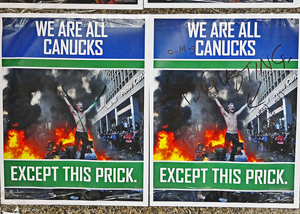
All Canucks poster

Who gets to belong? Photo courtesy popeye logic from Your BC: The Tyee's Photo Pool.

Related

Last week, a small group of people profoundly embarrassed some of us here in Vancouver. They behaved unthinkingly, in a sort of mob mentality, with their small-town ways and their hysteria fanned by the local media. They cheered on violence and gurned for the cameras. And before that, there was a riot.

Let us be clear: the riot was a pretty pointless affray, a needless and eminently avoidable commotion that deserves no celebration.

The riot was not started by anarchists -- though it's impressive that anarchism is still, apparently, in the 21st century the political scapegoat of choice, and that this should be the first stereotype to which the city mayor turned.

It was not political, except in the most indirect of ways. As my colleague Gastón Gordillo puts it, "the nihilism that fueled the riots is that of a popular culture that places victory in sports above anything else, in an expensive and corporatized city that does not offer its youth other sources of collective passions and identifications." Larry Gambone argues that the riot was the expression of anomie on the part of the disaffected young people who "have no future and somehow know that. Future means working in Walmart. Future means never being able to afford a dwelling in the Vancouver area even if they scored a halfway decent job." But this seems to be contradicted by the news that (for instance) one of the most high profile pictures, of a young kid trying to set light to a police car's gas tank, is in fact of a star athlete, son of a surgeon, headed to university on a scholarship.

No, the rioters were simply Vancouverites. As far as I could see, they were a fairly representative cross-section of people, men and women, of all races, all social classes, and a range of ages. They were psyched up by the occasion, much hyped by the media, and some of them had been drinking for hours.

Into the vacuum

Most importantly, at least by the time that the trouble spread to the Bay department store (focal point of the riot and now of the subsequent memorialization), the police had abandoned the streets and gone into full riot mode at blockades set up on the periphery. In the space carved out by this upping of the ante, things accelerated as people found that they could do what they wanted without any immediate repercussions. They were soon acting out fantasies engrained in popular culture and modeled by the millionaire sportsmen on the ice. For some, it must have felt like a carnivalesque moment in which anything was possible: an intoxicating notion, especially for the intoxicated.

The media, city council, and police had together constructed a temporary state of exception -- that, indeed, is what "reading the riot act" is all about -- in which the regular rules no longer held. Criminalized in advance, with the cops lobbing tear gas at them from some blocks away, plenty of young people (though still by far the minority of the crowd) took advantage of the situation to break windows, set fires, turn over a few cars, and loot a couple of downtown Vancouver's larger chain stores.

The main troublemakers -- or the people who most egregiously filled the vacuum left by the forces of law and order -- will no doubt be charged and prosecuted, and rightly so. I have no interest in defending the rioters. But it's worth looking at what they did, before all traces of the violence are swiftly swept away.

It's significant that almost all the crime was against property, rather than against people (apparently the majority of the personal injuries were caused by the police tear gas and pepper spray). Also that the damage was remarkably localized and selective: the Bay was a magnet for looting probably not only because it is an establishment icon (the former Hudson's Bay Company once had quasi-state powers under the British Empire, much as the East India Company did in the Orient), but also more banally because its ground floor show-rooms have easily-portable items of high value: perfumes, bags.

This wasn't a riot in which people were carting off consumer electronics or food. It wasn't a riot of professionals or of the poor. Again: it was an opportunistic riot of ordinary Vancouverites.

But almost all the immediate post-riot response aimed at denying this perhaps unsettling fact. And so the embarrassment begins.

Self-righteous lynch mob


The dominant post-riot response in the media and on the Internet has been that of a self-righteous lynch mob. And they have the cheek to call themselves the "real" Vancouver.

This "real" Vancouver cheers on violence. There have been those who have used the event as an excuse to call for state repression: "How about a total media blackout and we let the police REALLY do what should be done?" I have heard many arguing that the riot shows that Canadian society has become too liberal, too tolerant. This is no doubt music to Conservative Prime Minister Stephen Harper's ears. The headline on the front page of the Vancouver Province was "Let's Make Them Pay," encouraging the online vigilantes who have set up Facebook groups and and websites to post images of alleged rioters in a sort of dystopian social media society of surveillance. Big Brother meets the Wild West meets Mark Zuckerberg. Nobody talks of civil liberties or little principles such as the presumption of innocence. And this is from people who claim to uphold the rule of law. Their unthinking hypocrisy is breathtaking.


For hypocrisy is the order of the day among the upstanding citizens who are so keen to express their dismay, moral outrage, and embarrassment at the so-called thugs, idiots, morons, hooligans (choose your own pejorative) who supposedly conjured up the violence out of their back-pockets with a couple of cigarette lighters and a brick or two.

This "real" Vancouver carves the city up into an "us" versus a "them." The double standards are everywhere evident on the boarded-up windows of the Bay that have become an impromptu shrine to civic pride and social scapegoating. The same photos that circulate online are plastered up with the slogans "We Are All Canucks... Except this Prick." Or "We Are All Canucks... Except this Jerk." Graffiti claiming "We Love Vancouver" and "We are One Family" is unironically scrawled next to declarations that the rioters should "Get Out of Town and Stay There." The city is to be made whole again by banishing its undesirables and denying that they ever had anything to do with an "us" that is pure and virtuous thanks only to this knee-jerk demonization.

This "real" Vancouver pits downtown against the suburbs, "real" fans against supposed anarchists, heroes against hooligans, and actively undoes the social solidarity previously promoted through the ubiquitous propaganda that "We Are All Canucks." Frankly, though I've been following the team, I've never felt much like a Canuck; I'm not paid anything like their stratospheric salaries, for a start. The slogan was always an artificial imposition (already, Graham Lyons persuasively argues, a "mob mentality") that tried to deny any social differences, all the better to sell us a uniform of over-priced jerseys.

But those differences have been re-asserted, quite literally with a vengeance.

We now have Canucks and anti-Canucks, Vancouverites and anti-Vancouverites, angels and devils in a devastatingly simplistic (and violent) division between good and bad. And the "good," the "real" Vancouverites who set to work to clean up the post-riot debris pose for the cameras in a mirror image of those gurning in front of burning cars they so quickly replaced.

Let's get real about real

There's nothing particularly wrong with civic volunteerism, of course. Let's just hope that this is not simply a spectacular frenzy that is repeated only every 17 years. Let's just hope that these same people move on to volunteer in the Downtown Eastside, the neighbourhood that is Canada's poorest postcode, located just a few blocks from the site of this week's disturbances. Sadly, I doubt it.

Street-cleaning, moreover, is normally the preserve of municipal crews -- who were indeed already on the streets and in action while the violence was still going on, and long before any of the much-ballyhooed good citizens showed up. Those people deserve our gratitude, too, as much if not more than these once-a-decade volunteers; more so if anything, as they have to clear the debris after every drunken Saturday night in the Granville Entertainment district. But nobody seems to mention them. Again, it is no doubt music to Harper's ears, as he strips our public services, to hear the fantasy that trumpets volunteerism instead of properly-funded social programs as the cure to civic ills.

This "real" Vancouver depends upon fantasy: the fantasy that cheering for a professional sports team is some kind of noble cause rather than, as my colleague Alec Dawson sadly notes, complicity in "an endeavor devoted to turning public goods into private wealth." But above all the notion of a "real" Vancouver builds on the fantasy that violent exclusion will somehow make this a "world-class" city.

"World-class" cities prove their status mostly by not worrying about whether or not they are perceived to be world class. And for good or ill, it would be hard to name a major world city (Paris, London, Buenos Aires, Mexico City) that does not have its history of riots and social disturbances. Real cities, unlike this fantasy of a "real" Vancouver, have social tensions, divisions, disagreements, off-days and on-days, that sometimes erupt in violence, sometimes not. It's the dream of purity, of niceness untroubled by difficulty and difference, that reveals continued provincialism. We saw this already with the Olympics, and the effort to present an image of the city that erased its homelessness and drug problems in favor of the literally incredible myth of "Super Natural British Columbia."

All this should be obvious enough. A moment's reflection would reveal that the riots tell us something about the city, a city that is rather more real than the so-called "real" Vancouver. Fortunately, soberer voices are now emerging: some thoughtful and reflective blogposts and newspaper articles that are starting to question the myths that emerged in the first few days. And the mayor and the chief of police are having to backtrack from their initial claims that the violence was the work of an organized few. They admit that "most of the people that joined in the riot and that have now been charged represent a wider spectrum of young people, many of whom do not have criminal records."

The violence itself was not particularly novel, neither for this city (how many times had we been reminded about the riot of 1994?) nor for others like it. What is perhaps new, noteworthy, and ultimately most disturbing has been the virulence of the post-riot reaction, its hysterical attempt to protect Vancouver's fantasy image as the "best place on earth" by excluding undesirables, as well as its unholy alliance with social media. But for all its slightly sinister surrealism, this clamorous post-riot discourse also tells us something real about ourselves and our city. As UBC student Miriam Sabzevari eloquently observes, it tells us that there is a significant minority who "have a need to feel morally superior to others -- and when an opportunity comes to bask in our superiority, we actually become quite relentless in it."

These are people who really should know better. They are the ones who embarrass me.  [Tyee]

52  Comments:

Login or register to post comments

  • Luck

    1 year ago

    vancouver riot

    has anyone noticed that most of the people arrested are not from vancouver.

    no one with any brains would s--t in their own nest now would they??

  • Fish-counter

    1 year ago

    It is a generational thing, really

    The 2011 rioters were not the same as the 1994 rioters. Thery were their children. So it is a generational thing, and the 1994 rioters seem to have passed on their genes to the last lot.

    Perhaps we need some of the "Real Vancouver" people to do genetic research on the rioters to see if they can be identified by a marker that can be eliminated, so their kids don't riot too. It will probably be found in the "Y" chromosome.

    I am of course being sarcastic. The people of Vancouver definitely have a snotty-nosed approach to life and what they need is a good handkerchief.

    As I have said many, many times before, the problem is with the cops. They were not prepared and they did not act with sufficient urgency to quell the riot. This does not excuse the criminals who torched care etc. They need to be punished, and harshly.

    The thing with the riot is that this is not the first example, but the second. Vancouver did not learn a single thing from the 1994 riot, they just went to sleep for 17 years. The province of British Columbia needs a home-grown police force that is funded by us, and which answers to us. The RCMP are not up to it.

    [OFFENSIVE COMMENT REMOVED.]

  • Ramona777

    1 year ago

    Excellent Column Jon

    You hit the nail on the head with you astute observations, historical context and intelligence.

  • michisle

    1 year ago

    on the "real" Vancouver

    This sort of bickering, hate-mongering, and outright violence has long been the "real" Vancouver. The relentless pursuit of excessive wealth (which is largely unattainable by most of Vancouver's citizens) without investment in the counterbalancing forces of things like culture, green space, affordable housing, and quality education is what creates this shadow. Greed is ugly even when nestled among mountains and sea.

    Thank-you for an excellent article.

  • P

    1 year ago

    Around we go.

    I hate it when people with no legitimate claim to moral superiority use electronic media to shit on those they perceive as less righteous. It's so hypocritical! Those people are embarrassments!

    Oh wait. Woops.

  • Macb423

    1 year ago

    Good column, thanks

    One of the better columns on the subject, very thoughtful. Thanks. I particularly appreciate this reminder:

    "They were soon acting out fantasies engrained in popular culture and modeled by the millionaire sportsmen on the ice."

    ONe quibble, the rioters were NOT "a fairly representative cross-section of people, men and women, of all races, all social classes, and a range of ages." I'm 61. On Friday night, when they won, I was just trying to get home, and had to high-five dozens of people in their 20s. No problem, they were all happy and friendly. But when they lost, these same folks rioted. No one in the riot was my age. It was not a representative cross section of Vancouver.

  • Jymn

    1 year ago

    I'm with Luck

    Unless you count Maple Ridge, Coquitlam, Burnaby as Vancouver, perhaps Jon B-M needs to reassess.

  • jbmurray

    1 year ago

    age and location

    Mach423, you're right: the people downtown were not all ages, and the old and the very young were not represented. But they were a *range* of ages: they were not just kids, or not just early twenties.

    Luck and Jymn: Those arrested so far certainly include people from Vancouver, including people who live in the downtown core.

    And yes, also people from the suburbs: Coquitlam and Burnaby etc. I.e. the people you would normally find downtown Vancouver, working or socializing, on any given day or night.

    Ironically, given all the opprobrium thrown its way, I haven't yet seen anyone from Surrey arrested! (I'm sure that will change, but for now it's a nice irony.)

  • sebastian toombs

    1 year ago

    probably the best item ive

    probably the best item ive seen on this inconsequential event. the riot has been an excellent tool for drawing out those who want to delineate boundaries between "real" vancouver", which is a lifestyle- and speculation-driven playground totally given over to the rich, and "outsiders" or "losers", the young and the bridge-and-tunnel crowd. a favourite quote that ive seen was along the lines of "well, nobody who was actually at gm place for the game rioted." $$$$

  • middleclass

    1 year ago

    Rioters and looters not responsible - it's our society's fault?

    This article and much of the commentary is nuts. No personal responsibility for breaking the law? Not their fault because they can't afford to buy a house in Vancouver? Give your heads a shake and quit with the class-warfare meme. A relatively small number of people (tens?, hundreds?, more?) came prepared to riot well before the game even started - the riot was never about hockey. A large number of others decided to have a Lord of the Flies moment, again, nothing to do with hockey, nor with Vancouver. It was just regular folks who thought it was OK to remove their social conscience. That says more about individual peoples' characters and squat about society.

    Regarding the street cleaners - that's their job. We generally don't notice or celebrate people for just doing their jobs, because it's their job. When people volunteer to do something, that we notice. Again, quit with the class warfare.

  • Nogoodnik

    1 year ago

    well said

    well said JBM. i too find it both confounding and unfortunate that people can rise to righteous fury over some property being damaged when there are so many bigger problems in our city, country and world.

  • jbmurray

    1 year ago

    hypocrisy, responsibility, and people doing their jobs

    Thanks to you all for your thoughtful comments and feedback. Thanks especially for the kind words.

    A couple of replies to criticisms...

    P, I get your point. But there is a difference: I'm not saying that the people who cheered on the violence, scapegoated a minority, and so on, should in turn be ostracized and run out of town. They were unthinking and got caught up in the (online) mob, but most of them are surely fine people. Real people, anyhow, not bogeymen and women like the "anarchists." Some of them are my friends.

    We need to talk to them, work with them, get beyond the fantasy that suggests that we always have to agree. Real communities, real cities, always have to deal with differences and disagreements, as well as moments of madness. These people may embarrass me today, but they are Vancouverites too.

    middleclass, I don't say that the rioters have "no personal responsibility." I address this at more length in a reply on my previous article: http://thetyee.ca/Opinion/2011/06/16/AskForIt/.

    As for the street cleaners. They were indeed doing their job. But totally unheralded and ignored. Unlike, for instance, the police, who were also just doing their jobs (however ineffectually) and were cheered on from the sidelines and showered with praise ever since. And unlike the hockey stars, who were working for a wage, too. But do we only applaud those whose work is perceived as sexy and spectacular?

    Anyhow, I have nothing against congratulating and thanking those who do their jobs well: the Canucks for their fine season, the police for their restraint, and of course the street cleaners for dealing so soon with what was an awful mess.

  • Townie

    1 year ago

    Small Town Ways??

    In what way did they have "Small town ways"? Were they nice to their neighbours but a little too gossipy? Seems to me it's the Big City ways that were the problem, and this writer needs to not use "small town" as an insult, as BC consists of a whole lot more than just Vancouver.

  • jbmurray

    1 year ago

    small towns

    Townie, that's fair enough. That phrase anticipated a section of the original article that has been cut, in which I suggested that much of the post-riot reaction indicated what I called "this small-town worry about image, this all-too Canadian concern that people should like us."

    I have nothing against small towns. It is this city's boosters that have the problem. But their desperation to show Vancouver off as a "world-class" city reveals what is ultimately a rather provincial mindset, the fear that they are always going to fall short of Toronto or Montreal.

    Vancouver suffers from something of a "third-city syndrome." I recognize this in part because I also come from a "third city," and often saw how that could make the provincialism worse.

    Anyhow, this is a larger argument that I didn't develop, and so the phrase is rather stranded in the first paragraph. I can see why you called me on it.

  • moodyguy

    1 year ago

    Real "Vancouver"

    Excellent article and I agree with a number of the of the posters that this is one of the best and most thoughtful commentaries on this sorry episode that I have read. "Vancouver" for me is metro, not just the narrowly defined city of Vancouver and I do not condone, violence, rioting, looting or setting fire to cars but to say that it occurred because some undesirables ("anarchists?") hoodlums etc. etc. not only defies the facts of hundreds or thousands running wild, many of whom now appear to be otherwise the genial and model person next door, but it also avoids asking the deeper question and therefore leave the door open to this kind of thing happening again. The riot happened because the crowd accepted it and participated in it either actively or by attendance and tacit approval. This acceptance and encouragement is what needs to be questioned. The calls for stiff and swift reaction in both social media and in mainstream media are different presentations of the same phenomenon. Our society is built on accepted rules by which we live and laws including processes for prosecution under those laws for those who choose not to follow such rules. Mobs, like those involved in the riot or the social media vigilantes that followed remind us why this is so, to be thankful that it is so most of the time, and that social fabric can indeed be fragile.

  • leftofcentre

    1 year ago

    So the tyee supports the riot.

    That says it all.

  • lynn

    1 year ago

    Manipulating the insecurity of the masses

    Both the riot, and the even more disturbing response after the riot, stem in my humble opinion, from insecurity.

    The delusional concept of 'best' is what advertising, marketing and image depend on in an obsessive grand effort to create mass insecurity which both feeds corporate culture and which this desperately sick culture depends on. For its greedy fun and profit.

    And so the forces of control and greed are able to manipulate this convenient 'riot' moment in their never-ending, self-interested quest for stability and security. And more importantly - for predictability. The 'markets' depend on these qualities. Even more so, they depend on the creation of a desire for them in the masses.

    And the masses have never so easily acquiesced to the call.

    Which is telling stuff.

    Unfortunately, a state of stability, security, and predictability is just as delusional when it comes to the reality and notion of real life as is the notion of 'best'. All are obstacles to an enlightened and evolutionary process, and to the sense of aliveness that lights human existence.

    Only a dead world has permanent states of stability, security and predictability.

    While corporate culture lusts after this outcome, only a fool would desire this kind of world.

    Nature knows better, desires more, and is laughing its ass off at present over the audacity of these assumptions.

  • emile

    1 year ago

    what we mean by 'community'

    jon's article is 'right on target'. the response of a 'community' to 'disagreeable behaviours' on the part of some of its members, is basically no different to the situation a family finds itself in when it is embarrassed by the behaviours of some of its own members. Where we see ourselves as 'one community', it makes no sense to respond by redefining ourselves in terms which exclude those whose ideas and behaviours we do not approve of, rather than acknowledging that 'those are my crazy brothers'. it is the nature of 'community' to encompass diverse types. Living within the 'tension of opposites' is how social collectives evolve. Redefining community so as to split it into 'good' and 'bad' components converts natural forces of transformation into purification-based polarization; i.e. the 'good' component drives a stake in the ground representing their position and presents the 'other side' with the either/or ultimatum to be 'with them' or 'against them'. this is the core approach of religious fundamentalism [e.g. see http://usaguns.net/petition2/reagan/evil.html ] vancouver's leadership and the media can choose to go down the same purificationist road as religious fundamentalism or move to 'keep the community whole' by accepting it as one, not-always-happy-and-concordant, but never-a-dull-moment, family.

  • G West

    1 year ago

    @leftofcentre

    leftofcentre says, and I quote:

    Quote:
    So the tyee supports the riot.

    How on god's green earth can you draw that conclusion?

    Did you actually read the author's three pieces on the events of June 15?

  • elbillug

    1 year ago

    at least you practice recycling

    as evidenced by your 3 articles rehashing the same things.
    "For hypocrisy is the order of the day among the upstanding citizens who are so keen to express their dismay, moral outrage, and embarrassment at the so-called thugs, idiots, morons, hooligans (choose your own pejorative) who supposedly conjured up the violence out of their back-pockets with a couple of cigarette lighters and a brick or two."
    How about the upstanding citizens that that are so keen to express their dismay at the so-called small towners, lynch mobbers, histerical, embarassing people who supposedly conjured up the virtual violence out of their back pockets with a click or two of their keyboards?
    P had it bang-on. But what else can you do but blame everyone but the ones downtown that night? Or else you'd have to assume some degree of guilt too ! If only mirrors could help self-awareness too...

  • jbmurray

    1 year ago

    firm friends

    elbillug, I feel as though we're becoming firm friends thanks to your intense interest in and scrutiny of what I've written over the past week or so. ;)

    I refer you back to what I say above in response to P.

    And those downtown deserve their part of the blame, sure. It's just that it's too easy to lump them with all of it.

    And I'm happy to take my share, if not exactly in the way that you mean. As I say in a response to my previous piece:

    'I do think we need to join the dots, and not blame things on a minority of "morons," "anarchists," "suburbanites" or whomever. This is *our* problem, as residents of Vancouver, Canada, and the modern world. As such it is *our* responsibility.'

  • Ian Laval

    1 year ago

    Second-best is still pretty good, Canucks fans!

    You hit the nail on the head, Jon B-M. Do Canadians need to riot in the streets when they discover they don't always own the podium? Missing the Stanley cup by three games to four in the Stanley cup final was a great performance. What made anybody think otherwise?
    Where on earth does Canada's inferiority complex come from?

  • G West

    1 year ago

    Honestly

    Does anyone actually 'believe' that the events of June 15 were simply a consequence of the fact that the Canucks lost a hockey game that night?

    Could I direct your attention to the following article in the Globe and Mail:
    http://www.theglobeandmail.com/news/national/british-columbia/bc-politics/vancouver-police-reduced-budget-for-2011-nhl-playoffs/article2071270/

    And, when you've finished that one, Gary Mason also has some interesting things to say about Chief Chu and the way he responds to 'criticism'.

    Here's Mason's article:
    http://www.theglobeandmail.com/news/national/british-columbia/gary_mason/chus-critics-raise-valid-points-on-how-riots-were-handled/article2070065/

  • VivianLea Doubt

    1 year ago

    thoughtful comment, emile.

    Interesting that we can accept that the downtown Eastside is a part of Vancouver...but rioters either were anarchists, or from Surrey, or not real Vancouverites... It would make one laugh if it wasn't so pathetic.

    When people, or families, or cities simply attempt to cover up the dark side, it doesn't go away, and often simply festers.

  • elbillug

    1 year ago

    re: the so-called online mob

    I think that this ravenous online response is the best thing that could have happened.
    I moved to Vancouver 1 month before the 94 riots and, quite frankly, I can't remember any stories about the '94 rioters suffering the consequences of their actions (my feeling is that the city was just in stunned disbelief that time and took a 'if we don't talk about it, it will go away' attitude). And I think this is a huge part of what lead up to the feeling that this could be done unpunished - that the stories about the '94 riot were only about the riot - not about the punishment that the rioters got.
    This time around it seems that there will be lots of stories about the consequences (and yes, in large part because of the online response) to hold onto for the next time this comes up. I think everyone can make an assessment of the risk-reward of their behaviour no matter what (with some young male adults accepting the most risk for the least reward...). In the 2011 Stanley Cup run they saw no risk and potential rewards (not financial of course).
    In the next Stanley Cup run they will hear about the Canada polo player and how his life took a turn for the worse, and hear about how many people lost their jobs and did jail time - and hopefully that will be sufficient to dissuade enough so that any roughness (which will always be present on any public event) doesn't achieve critical mass to turn into something else.
    So, while I don't agree with some of the vicious remarks on the feedback, I do think that people that put themselves in that position should bear the full consequences of their actions (and social stigma can be a much deeper consequence to some than jail time). This will serve as a strong deterrent next time around. And as much as the author tries to victimize the rioters by shifting the blame to others through a deep misunderstanding of action-reaction (and the fact that the reaction is never to blame for the action) - the fact is that these people should be held as an example of why not to riot next time Stanley Cup comes to Vancouver.

  • emile

    1 year ago

    cities focus darkness like sharp edges focus static electricity

    vivienlea doubt, ... yes, cities are places of psychological conflict. on the one hand we tend to lay them out, no matter where they are, in rectangular grids that signal a driving, domination-demanding force of pure, uncompromising anthropocentric subjectivity, in spite of their being situated in natural settings of great power and beauty that never stop asking us to acknowledge that man is included in nature like an ant in a Giant's palm. the Eastside is an artefact of failed ant-pride, our society’s orientation to control and to make things happen exactly as we want them to, rather than letting our behaviours serve the cultivating of balance and harmony in a ceaselessly, innovatively unfolding mother-space. in the shadow of the high-rises, aesthetically situated adobe kivas and cedar long-houses acknowledge that man is included in the ‘dirt’ while our psycho-culturally inverted belief that ‘man is above the dirt’ puts us on a futile mission of purification driven by anthropocentric subjectivity [as in the blind profit-taking of ‘a free market economy’]. darkness derives from this ‘Oedipus complex’ of trying to dominate, enslave and ‘use’ for our pleasure, ‘She’ who engenders us.

  • bex0r

    1 year ago

    we are all responsible

    thanks for writing this. I fully agree and am just as embarrassed of the purveyors of this false dichotomy of citizenship in Vancouver presently.
    Before disowning these kids as spoiled suburbanites or surrey anarchists, etc. we must remember that they are ALL our children.
    We have a responsibility as a community for creating the context within which the riot was possible.

    we are all responsible for failing to raise children with a solid sense of ethics and self-identity. Parents alone cannot be blamed because in a sense we are all parents. we all contributed to making the riot possible in one way or another. to shift blame to any one scapegoat or contributing factor is really a refusal to take responsibility yourself.

  • jbmurray

    1 year ago

    link to a great article, public shaming, and losing beautifully

    Again, thanks to everyone for their feedback. I am heartened that the riots may have opened up the possibility for a proper discussion about our city and city life, beyond all the myopic boosterism of the good times, and the violent divisiveness we've seen when things have gone bad.

    For what it's worth, I think the following is the best article bar none so far provoked by the riots: http://www.themarknews.com/articles/5728-raging-against-the-machine. Written by someone with a real sense of history and the changing contours of urban space. It's simply brilliant.

    Meanwhile, to my buddy elbillug: should we bring back the stocks, pillory, and gibbett while we're at it?

    And a thought about losing (or coming second). On game day, I wasn't in fact wearing a Canucks jersey. I was wearing a t-shirt I had bought at a Leonard Cohen concert a year or so back, that says "BEAUTIFUL LOSERS." It seemed a rather more essentially Canadian way to look at the affair.

    Sadly, we weren't beautiful losers last week. The riots were ugly, and what followed on has for the most part been uglier still. But I'm hoping that we can get beyond this, and that the violence will prompt a reassessment of our collective responsibilities and our collective futures.

  • G West

    1 year ago

    Thanks to you jbmurray

    It has been especially gratifying to see how a new and important contributor to the Tyee (first as a commenter and then as a writer) has managed to sidestep the unfortunate tendency to indulge in a verbal slugfest (which often characterizes these threads) with anonymous posters and actually engage meaningfully with several interlocutors who have differing points of view.

    A pleasant and worthwhile change of pace. And a lesson for all of us – myself included. A little civility goes a long way.

    I hope you'll stick around and I hope David and the editors will be bringing more of your stuff to the Tyee in the future.

    Online news and comment sites have great potential - it's nice to see that potential become something of a reality instead of reverting into little more than a mud-slinging match.

    Cheers.

  • lynn

    1 year ago

    An unsubstantiated conclusion

    While the writer of the article in the link provided above by jbmurray to "themarknews.com", makes some astute insights about the changing face of Vancouver and the increasing costs of living there, his assumption that the drunken masses on the streets were angry members of the working class does not hold water nor is it substantiated by any concrete evidence.

  • jbmurray

    1 year ago

    agreement and thanks

    lynn, I agree that the rioters weren't angry members of the working class (as I say in my own piece). But I still think it's a great article, even if I don't subscribe to everything in it.

    And G West, thanks also to you! I feared that these pieces might inspire less productive responses. It has been great to see, by contrast, such a high level of discussion at the Tyee.

  • Happenings

    1 year ago

    the ongoing stories about the riot

    While there are some very good points noted here not addressed before, when are we going to stop making it the only news item out there. No wonder the US and others think that we now live in some kind of uncivilized area. Canada overall is still one of the safest and more civilized places to be and that includes the US, despite what they say about us.

    And "Vancouver" to the majority of us is the Lower Mainland. Vancouver proper is really very small - the rest of us in the Lower Mainland consider ourselves to be living in Vancouver as well, especially when we talk to others outside of the province. And not all the crimes are committed by people living in Surrey. There are crime-related areas in every single community here, just like the rest of the world.

    Bottom line: bad behaviour is simply bad behaviour and the police and the City of Vcr were either not prepared; naive enough to think 1994 would not reoccur or ? - Heaven knows we talked about it long enough that there were those who were going to try it just because.

  • Fish-counter

    1 year ago

    Vancouver: Canada's snob capital (second only to Victoria)

    This is the perfect example of a city so in love with itself that it denies everything unpleasant. Vancouver has about one murder per week, multiple race crimes, gangland slayings and a drug industry that out-grosses every other. Yet on the surface, the residents want to pretend everhything is peachy. Well it isn't, is it?

    The cops are corrupt and incompetent as follows (partial list only):
    Air India Flight 182 investigation
    Clifford Olsen's $100,000 payoff
    Robert Dzeikanski's death at VIA
    Monty Robinson's running over a motorcyclist
    The beating by cops of a newspaper delivery man
    The infamous surrey six invstigation, with one of the cops dipping his wick in the key witness (that must have felt good though. Banging a chick half your age is always good).
    Numerous drunk driving charges levelled against RCMP officers

    When exactly, will the people of Vancouver specifically, and BC in general wake up to the fact that the RCMP have ooutlived their usefulness?? For me it was when Kwesi Millington et al tried to argue that they were a federal force and that they did not nswer to a provinical court. Their plea was rejected, but the very fact that they tried it was evidence enough for me.

    BC is a great place to live, except for the people. If you can ignore them, it is indeed a paradise. The trick is to get as far away fr4om Vancouver is is possible, and to ignore all the whiners who live next door.

  • emile

    1 year ago

    there's gonna be a meter on your bed that will disclose, ...

    this discussion has trashed the city, trashed the province, trashed the sports-obsessed nation and trashed the world whose economic system hijacks the future of youth. ok, i agree. but i thought that jbm was on target with his initial remarks to the effect that we [as a society] are not who we pretend we are. hunter s. thompson said that our global social collective was becoming a bunch of celebrity-worshipping flag-suckers engaging in ‘society as spectacle’ where the spin-based value of 'image' has twisted off from its authentic-substance moorings and is in full free-float.

    as some have noted, official vancouver’s first action was not reflection of ‘who it really is’, but: “[Vancouver mayor Gregor] Robertson appointed Rick Antonson, CEO of Tourism Vancouver, and Olga Ilich, businesswoman and former politician, as co-chairs of the "Vancouver Brand Team."

    let's not be overly parochial. we’re not looking at a problem where just city, province and nation put ‘image-management' ahead of authenticity, its a global pandemic. health care product producers [pharmaceuticals] spend twice as much on advertising as on research and development. and if you plug the words – brand has been damaged – into google, you get 47 million hits starting off with anthony wiener, charlie sheen, tiger woods and vancouver.

    as leonard cohen's lyrics observe; 'everybody knows, ... what few are willing to voluntarily disclose'.

  • lizzers

    1 year ago

    I still am processing this article -

    I have some issues with assumed constructs in JB's article - mainly around what constitutes a "Vancouverite", Vancouver and a Canuck fan - and also that the city has tended to violently distance itself from itself to become a world-class city - but - I have decided not to try to write a mini-thesis on this - so I'll move on -

    I'm wondering what the response would be to this account?

    http://riot2011frontlines.tumblr.com/post/6860088383/please-stop-apologizing-a-police-officers-letter-to#notes

    I have my issues with this 'first-hand' account as well, but doesn't this person make a freaking point? Fine, there were online people that were doing online things... but isn't an action different than a word?

  • emile

    1 year ago

    the good news is the rich concentration of 'good' in authority

    the more ‘troubled’ the psyche of society, the more drugs and alcohol and ‘outbursts’, and the tougher the job of ‘peace-keepers’. the more the response by ‘authorities’ focuses on image-management and sweeping troubled psyche under the rug, the more difficult the job of police. the policeman who wrote the letter seems to believe that the problem is not ‘ours’ as a collective; i.e. that it does not come from ‘our society’ but that we have a few ‘bad apples’ in our midst that need to be ‘dealt with’. funny thing is, the more strenuously we rally the forces of good, here and around the world, to deal with ‘bad apples’, the more prisons, police and military we seem to need. we are indeed fortunate that fate has put a greater concentration of ‘good people’ in authority, so that we have the weapons to deal with the rising tides of evil that disproportionately infect the ‘unauthorized’ masses

  • SCR

    1 year ago

    repudiation and attraction

    What's the link between repudiation and attraction ?

    Do Hooligan and Vigilante share behaviors ?

  • Fish-counter

    1 year ago

    Forget the philosophy. The bottom line is:

    Millions of dollars-worth of property damage.
    Store staff terrorised by the mob.
    Vancouver's reputation trashed beyond recovery.
    Police shown to be incompetent, yet again.
    Legal system shown to be impotent.

    It would cost more to prosecute the rioters than the damage they did. The only winners would be the lawyers.

    A few video cameras are doing more to remedy the crimes than any Keystone Cop routine.
    There is no turning down the clock. It is time to stop using the word "alleged" when the evidence is captured on tape and becomes public knowledge. The rioters deserve retribution in kind and I for one hope they get it.

  • Fish-counter

    1 year ago

    Forget the philosophy. The bottom line is:

    Millions of dollars-worth of property damage.
    Store staff terrorised by the mob.
    Vancouver's reputation trashed beyond recovery.
    Police shown to be incompetent, yet again.
    Legal system shown to be impotent.

    It would cost more to prosecute the rioters than the damage they did. The only winners would be the lawyers.

    A few video cameras are doing more to remedy the crimes than any Keystone Cop routine.
    There is no turning down the clock. It is time to stop using the word "alleged" when the evidence is captured on tape and becomes public knowledge. The rioters deserve retribution in kind and I for one hope they get it.

  • LSC44

    1 year ago

    Please stop saying you're the real Vancouver

    Thank-you, thank-you, thank-you, a great article and so many perspectives I was pleased to see someone else noticed as well! The self-righteousness, lynch-mob mentality of the do-gooders, nice as they may, and so much of what erupted after was no better! I couldn't write everything else I agree with without re-writing your article.
    I'm a hockey fan to certain extent and I agree I don't like the "We're all Canucks" mob mentality anymore than the use of mob mentality to sell the Olympics.) Everything around the Olympics, except the athletes, showed me the hypocrisy of that fantasy Vancouver which has never existed.
    (One last thing, please don't suggest the self-righteous do-gooders inflict themselves no the DTES; it does not need nor deserve any more lack of humility and lack of respect directed towards it.)
    Again, thank you.

  • elbillug

    1 year ago

    people will condemn what they are against

    Is it really that difficult? Whenever a crime happens - there's a court case to decide based on current laws what to do, and public opinion is formed which affects how laws are written in the future.
    This is true in any situation. We can also discuss how to best avoid the crime from happening in the first place, but that is alongside, not in replacement of, the 2 things above.
    The author is clearly against public opinion in this, using the time-tested method of picking the most despicable responses from the public, and then painting all of public opinion with it, not unlike the actions of the very individuals he condemns. I remember hearing a politician once saying that the media was very good at picking the right grain of sand in the beach, and then convincing everyone that every grain of sand was just like that one. This is a prime example of a very partial opinion carefully choosing the pieces that corroborate the pre-formed opinion.
    So the author is clearly against all of the public opinion in this case, which begs the question: why? I can see possible 2 reasons, either he is against public opinion altogether, or he does not think that a crime happened in the first place.

  • edoherty

    1 year ago

    It was a conspiracy, and I hope it works

    You have it all wrong. This was just the first act in a conspiracy by a shadowy group of renters to drive property values and rents down to more reasonable levels.

    I just hope it works.

  • emile

    1 year ago

    the same action inspires opposite historical narratives

    the typical language usage is that ‘hooligans’ are those that ‘attack property’ while ‘vigilantes’ are those that attack people that attack property. but since property owners [land-Lords] hold the balance of power, and enjoy the protection of the police, the use of these terms pivots on whether the property-owner-power is seen as serving the interests of the FULL community or seen as being self-serving and manipulative. that is, the usage of these terms pivots on whether one’s view of ‘land-Lords’ is neutral or otherwise; e.g. this 2006 bulletin from Mohawk Nation News;

    "Aug. 23, 2006. Disturbing information has come to light. Canada, Ontario and the Ontario Provincial Police are coordinating plans for a vigilante-type assault on at least three Indigenous communities, Six Nations, Tyendinaga and Akwesasne. Six Nations/Mohawk people are being targeted for speaking out against Canada's theft of and encroachment on our land. The Ontario government and the cops are organizing the "brown shirts" (Heil Hitler!). ... In the 1930's Hitler organized the brown shirts to attack his enemies. He put uniforms on these roving gangs of thugs. These hooligans beat up and killed Hitler's enemies. Who are we Indigenous people the enemies of today? Big business and greedy developers, that's who!"

    the point is that ‘property’ and the power that it brings to the owners [bigtime property owners have bigtime power], and how that power is used, is pivotal to the defining of ‘hooligans’ and ‘vigilantes’. there is plenty of bad-mouthing of ‘big business’ in the mainstream of our society, implying that it is too self-serving and manipulative of the man on the street, and can be so 'with impunity' due to the protective police-shield that is paid for by all, and this encourages a mental flip towards the MNN usage.

    the action in the present is the same action, but historical narratives can be written from the opposite perspectives of 'dominator' and 'dominated'. alcohol can bring out pent-up feelings of powerlessness or humiliation by being dominated by the 'land-Lords'.

  • ddiamond

    1 year ago

    I agree - a riot is an expression of the living community

    There are few ways that “living communities” can express themselves in the culture in which we live. A demonstration is an example of a conscious and controlled way for a community to express itself. A riot is an uncontrolled expression of community; an expression of frustration, anger, bottled up aggression.

    The riot had very little to do with hockey. Yes, the Stanley Cup competition facilitated the build-up of the explosion of energy; and yes, there may have been a small group of people who “lit the match”. As we can see though, people who we would never expect would be engaged in flipping cars and burning them are in photos and videos doing so. Why?

    We are living in a moment in history when we cannot deny anymore that the climate has been pushed off-kilter and are doing very little to alter a violently disastrous outcome. This fear sits in the collective psyche of us all.

    We are living in one of the most desirable cities on the planet. In our midst is the most impoverished postal code in the country. From a position of privilege, we are confronted with the violence of people living and begging in the streets and all the social issues that are layered around this global embarrassment for Vancouver. We do a great deal of talking about these issues, but do not move to solve the problem by actually creating real, stable, affordable housing. This violence (and the poverty IS a form of violence) sits in the collective psyche of us all.

    We live in a world that is rife with violent conflict. This violence sits in the collective psyche of us all.

    We’ve been raised in a value system in which we learn that ownership of “things” (including a home) is a sign of success. And yet what used to be seen as a normal transition into responsible adulthood is now far out of reach for a growing majority of the population. This frustration sits in the collective psyche of us all.

    Education is a vital ingredient to success. And yet, like housing, the cost of a post-secondary education is spiraling out of reach of the average person. What kind of message is this to younger generations, and what does it mean to their futures? This fear and frustration sits in the collective psyche of us all. I could go on.

    And so the Canucks make it into the Stanley Cup Finals and there is a profound rallying of energy around that and that energy spirals and spirals and brings ALL the community’s hopes, fears, angers, desires (and psychoses) along with it. Eventually, some kind of expression becomes inevitable. Some of it is fun and some of it is deeply held frustration and violence. Should we be surprised?

    Of course the people who burned, looted etc., need to be held accountable for their actions. But if that is all we do we will have failed to recognize what the riot was, and the opportunity it presents. We need to confront and deal with core issues, or we will have accomplished nothing.

  • dionne

    1 year ago

    Finally, a voice of reason

    Thank you for expressing so eloquently what has been on my mind.

  • VivianLea Doubt

    1 year ago

    public opinion?

    Whether the author is going against public opinion is moot, since he is clearly on the side of the law. Some great points about 'vigilantes' and 'hooligans' there...but the law in Canada is administered by the courts, not the court of public opinion. It is hard for me to give a rat's ass about 'public opinion', since this is the same public that had been mouthing things like 'we are all Canucks now' and 'this is history!' (complete with exclamation mark) and any number of equally banal, tedious, and cliched remarks...

    The courts exist, in part, to guard against the frenzies of the public, and make no mistake, democracy depends on them.

  • sspooner

    1 year ago

    Small town ways?

    In the small town I live in, we are known and accountable to each other, and the notion of rioting is absurd. You make some interesting points, but you lost me when you conflated "small town ways" with rioting?

  • anarcho

    1 year ago

    Blind men and the elephant.

    So far we have described the rioters as hoodlums, young suburbanites, working class youth, and rich spoiled brats. (Forget about the "anarchists", that is just a vicious slander) Maybe we are doing a "blind men describing an elephant" routine, since none of us were there. Maybe the rioters include all of the above and are not exclusively of one type. (Though I suspect the suburbanites to be the biggest group)

  • Cates

    1 year ago

    Canucks

    FYI traditionally, a "Canuck" is a Canadian. So yes, the majority of us are Canucks and it has nothing to do with hockey.

  • VivianLea Doubt

    1 year ago

    small towns and Canucks...

    You may be a 'Canuck', Cates - I am not. I don't care to define myself that way, do you get it?

    In the small town where I live, we are accountable to each other only on the surface - but of course, statistically speaking we have our share of violence, criminal activity and business fraud, and pretty much every other human frailty and failure you can imagine that goes on under the surface. The police once described one large beach party here involving hundreds of high school grads as a 'riot'...but you know, we have 300 hundred homeless people in a town of 22,000.

    I don't see a lot of 'accountable to each other' going on in my small town.

  • emile

    1 year ago

    society and small towns

    there are two ways to look at the riots; (a) the problem starts and ends with the rioters , and (b) the problem starts with society and manifests in riots/rioters. and ddiamond makes some good arguments for putting (b) ahead of (a).

    as for cities and small towns, the cities give a great sense of anonymity and are thus the place to go to break free of small town pressures that suppress one’s baser instincts; e.g. men go to the city and engage openly on the street with the sex trade, and girls leave their small town families to work the city streets (small towns can be tough on females that want to earn a living in the sex trade, while in the city, the girls can belong to a subculture that ‘owns a whole district’). the perceived anonymity of the cities (cell phone cameras and internet are changing that) makes it a place where people go to ‘let it all hang out’, to get publicly drunk etc. etc. and do it in front of everyone (part of the ‘release’), and then walk down the same streets the next evening without anyone giving them a nasty look (unless their antics were caught on national tv).

    its not that small towns are populated with more virtuous people, necessarily, its more like the lack of anonymity in small towns keeps the lid on publicly unloading one’s repressions/frustrations there. and that suggests that city folk don't respect the others on the street as much (you don’t care what they think because they don’t care what you do). in the small town, your girl friend’s mother or someone whose sensitivity and caring you value will inevitably bear witness to your offensive behaviour.

    the extravagances of paris gives that city the ideal setting for 'paris riots'. if the quick-to-lose-it fringe is 3 strong in the small town, it is 300 strong in the city and they don't need a map and timetable for gravitating to the right place at the right time; critical mass is a real affect: i.e. its (b) not (a)

  • jbmurray

    1 year ago

    small towns

    sspooner, I explained the "small town" reference in a response a few days ago. In short: this is part of a larger argument that I didn't ultimately develop, and so the phrase is rather stranded in the first paragraph. I can see why you called me on it.

    • The discussion for this story is closed. No more comments can be added.