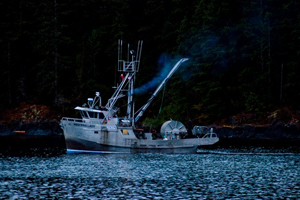
But try and learn how they 'stack' quotas to cut jobs and up profit, and DFO says it's secret.
Western Lady: One of the Canadian Fishing Company's fleet controlled by the Jim Pattison Group. Photo: Alan Haig-Brown.

-
-
As the climate and ocean conditions change, which salmon in BC waters are likely to come out on top? Bet on pinks and Harrison River sockeyes. First of two parts.
-
All of BC has a stake in better managing once massive salmon runs. Third in a series.
The answer I received, in so many words, was: none of your business.
"...There are very strict confidentiality rules that DFO must adhere to, and therefore we cannot release the names of vessels and their associated quota."
This was the reply that I got from Beth Pechter of the Canadian Department of Fisheries and Oceans after six months of requesting the number of quotas transferred amongst the 130 or so vessels that were eligible to take part in the spectacular 2010 return of sockeye salmon through Johnstone Straits.
I had originally requested the information for a number of articles that I was writing on the management of that fishery. In the articles, I had hoped to explain the privatization and corporate concentration that has occurred in the British Columbia commercial fishing fleet in recent years.
Naturally, then, I wanted to know who the federal government allows to catch fish and how the distribution of that privilege might be changing. Such information would seem to be not just my business but a legitimate concern for any British Columbian whose livelihood or identity is tied to commercial fishing off our coast.
But as I say, the DFO slammed the door in my face.
My question for federal managers of our fishery stemmed from the research for my 2010 book, Still Fishin'. In talking with leading B.C. fishermen for that book, I repeatedly heard the lament that the price of the fishing privilege in B.C. has been driven up and out of the reach of legitimate fishermen by the non-fishing investors.
Power concentrated into few hands
The management of a salmon fishery is a complex bit of guesswork. Last summer, as estimates of the returning Fraser River sockeye grew toward the 30 million mark, DFO was faced with some serious management issues. The purse seine boats licensed to fish the runs have huge catching power. Even with the large returns, it would be possible to catch too many fish. This would leave a shortage for the in-river native fisheries and the spawning grounds. If the fishery was conducted in an Olympic style opening of three or four days per week, there could be a glut of fish delivered to the much-reduced processing facilities.
The decision was made, wisely according to most observers, to spread the fishery out with a quota system. The estimated total allowable catch for the week was divided by the number of boats licensed to fish, and each boat was then allowed to catch that much fish. So far, so good; if bona fide fishermen owned the boats, the bounty would be spread evenly amongst the boats, their respective crews and homeports.
However, unlike Alaska, where the license to catch fish is held by a fisherman who must be onboard the boat when it is fishing, Canada has respected the capital investment in the boat over the rights of the citizen to make a living.
In Canada, fishermen do not necessarily own the boats, the licenses to fish them, nor the assigned quota. In fact, the majority of seine boats are owned by investor processors, most of who have never earned a dollar on the deck of a fishing boat. While this is a sad state of affairs for coastal fishing communities, since it concentrates power in two or three Vancouver-based companies, there was still worse to come. The DFO allowed the owners of boats and their quotas to "stack" or combine the quotas of any number of boats onto a single vessel.
For each stacked quota, five crewmembers are left on the beach and a boat is left tied to the dock.
The result, theoretically down the line, could be a relatively small number of vessels with crews who are simply wage-earning employees. Once proud and independent fishermen would be reduced to the equivalent of grocery store clerks working in a vertically integrated food corporation. Our coastal fishing culture would be further decimated, and we would lose the valuable eyes on the water that the fleet of independent commercial fishermen now provide. A few corporate owned boats catching all of the fish may be great economics, but it is lousy environmental protection.
Why quotas are crucial
The specific question I had asked DFO, therefore, was: How many quotas were stacked during the harvesting of 2010 return of sockeye salmon through Johnstone Straits?
And even though the feds refused to tell me, I found another way to get a general, and disturbing, picture. I spoke with dockside accountants and fishermen. According to these "reliable sources," the province's largest fishing company, owned by a billionaire investor, not only stacked quota but changed the long established system for sharing the catch amongst the crew and vessel owner. According to fishermen, here is how it was done.
The large corporation is reported to have stacked up to three licenses and their quota on a single boat. Only 60 per cent of the landed fish went into the established share system that apportions shares for the boat owner and crew. While this was more than the crew would have made with a single license, it allowed the investor-owner of the license to receive 40 per cent of the catch virtually for free.
One way of calculating this, based on $5 per fish and three stacked vessel quota of 35,000 fish each would generate a total of $525,000 if they caught all of their quota. Of this amount, $315,000 (60 per cent) would be divided under the traditional system to give the crew 7/11ths and the owner 5/11ths to divide after expenses. The quota owner would receive an additional $210,000 on the 40 per cent for which he doesn't pay the crew anything.
At the same time, stacking three quotas on a single boat left ten crew members without any fishing opportunity. While much of this is speculation, the lack of transparency by DFO around the distribution of this public fishery resource precludes more precise numbers.
BC's fish are a public resource
DFO has changed its responses while consistently refusing to share quota stacking information. At first I was told that the quotas were shifted from boat to boat on a daily basis. When I asked for a snap shot of one or two days I was told, again by Beth Pechter, "Picking certain dates in time to report vessels and the percentage of quota on each vessel effective that day is neither possible nor particularly useful to better understand the fishery; I cannot conceive how that might help your readers better understand the fishery."
Oft-suggested as B.C.'s most important fish, the sockeye has, in just over 100 years, gone from control by many First Nations groups to control by a limited number of corporations. Photo: Alan Haig-Brown
Given the above financial scenario, this information is all-important to assess the economic winners and losers. Many nations, in their fisheries management, are striving for ways that their citizens and coastal communities can benefit from a fishery. Interestingly, DFO is willing to hide behind the bona fide fishermen when it suits them. Even though the majority of quotas are held by corporations, the government managers are quick to reference the "fishers" as in the following quote, again from Ms. Pechter.
"DFO policy is to not release any confidential fisher's data; this includes, but is not limited to, vessel specific catch (which you requested) and vessel specific quota allocations once quota transfers have taken place (which you also requested). Further, I did speak with members of both the Area B Seine and the Area H Troll harvest committees and they were most emphatically in favour of this policy; they were clear that information DFO may have pertaining to their business decisions should not be made public (by DFO)."
I know, and have known for over 60 years, that the fish of British Columbia are a public resource. I know that the public is responsible for maintaining the health of the rivers and the seas on which they rely. I understand that we have assigned our civil service to manage this resource on our behalf. I accept that "fishers'" financial information should remain confidential between them and the taxman. I see no reason why even DFO should have such information. But quota assigned to a vessel is not necessarily caught. It remains in the sea, and it is the public's right and responsibility to know that. According to fishermen with whom I have talked, even knowing the quota caught by a vessel does not tell me what was paid for it or how those funds were divided.
In spite or repeated request for copy of the "confidentiality rules" referred to above, DFO has yet to make it available. If we are to maintain a healthy fishery on our coast, it is time for our civil servants to begin serving us in a civil fashion. If fish are to be caught, then each citizen must have the information to determine who should benefit when that fish is killed. ![[Tyee]](http://thetyee.cachefly.net/ui/img/ico_fishie.png)
Alan Haig-Brown, whose latest book is Still Fishin': The BC Fishing Industry Revisited, seined salmon and herring, and served for 11 years as coordinator of Indian education in the Cariboo-Chilcotin. Haig-Brown was editor of the West Coast Fisherman and founded The West Coast Mariner and The West Coast Logger. His award-winning books for Harbour Publishing include Fishing for a Living and The Fraser River.
17
Login or register to post comments
Van Isle
2 years ago
It has been known for years
It has been known for years that DFO is there to do the bidding for the 'Big boys'(Jimmy Pattison et all). Want to find out what's really going on in DFO? Find yourself a retired DFO Officer and he'll/she'll let you know.
blackie
2 years ago
great story
I wonder if any of those corporations are Norwegian.
puppyg
2 years ago
In recent years, the only
In recent years, the only salmon I felt good about buying was 'illegal' fish from a native fisher and his wife out of their van.
Since then, I have concluded that this was the most ethical of all the options to purchase salmon. Now, I have given up salmon completely.
With our provincial government seemingly hellbent on destroying the environment to protect corporate profits, the only solution I see is to chop the DFO and chuck that government for something better.
devils advocate
2 years ago
"..Once proud and
"..Once proud and independent fishermen would be reduced to the equivalent of grocery store clerks working in a vertically integrated food corporation."
Hey Allan,
Totally disagree with your whining.
Is commercial fishing not a business still? Or did it somewhere change to some socialist guaranteed right? Just because the actual fish are a common property resource, it doesnt mean fishermen have some 'right' to have their business/industry socialized.
Whining about 'grocery store clerks'...why not shut up and pony up the money to buy the boat and take the risk that the other investors do. There is no government program to ensure deckhands get a fair shake....nor should there be. Life is tough...Deal with it or shut up your whining.
jnewcomb
2 years ago
fish farms are future
So its not just the fish farms that are caught up in corporate enterprise? Wonder how many of the native fishers are also into this corporate enterprise too? In the future, fish farms are likely to prove no worse in ownership structure than all the hidden ownership issues in the fish-hunting industry.
themonsheshe
2 years ago
Im a commercial fisherman
Im a commercial fisherman who ventured farther North to Alaska to be able to stay realistically employed as a commercial fisher. The startup costs are a fraction of what they would be in B.C. and the bulk of this relates to the license itself. The lack bureaucracy up there is so refreshing. The DFO should take a collective field trip.
Why are the costs of these licenses so high? Because the regulations surrounding them are too loose and are easily monopolized by the wealthy. The real main differences between B.C. and Alaska licensing are:
Companies (processors) cannot own licences in general. (in some cases like bering sea crab rationalization they do)
Any individual cannot own more than 1 license in the same fishery.
State license holders are required to be onboard the vessel during fishing.
Leasing of licenses is restricted to medical transfers, which are only allowed 3 times, (you need a note from a doctor)
Information on license values, ex vessel prices, license holders is public record and very informative at the CFEC. http://www.cfec.state.ak.us/
I dont see people in AK getting these massive paydays, but way more people have an opportunity to earn a decent living as fishermen.
Its funny, but they're system is somehow more socialistic than ours, and it all comes down to a few regs regarding permits/licences.
Go figure.
Wendy Bradley
2 years ago
GOVERNMENT SECRECY: ANTITHETICAL TO DEMOCRACY
"BC's fish are a public resource... [ and yet] in spite of repeated requests for copy of the "confidentiality rules" referred to above, DFO has yet to make it available."
Any person, organization, or government agency needs a 'logic system' upon which to base decisions.
QUESTION: HOW CAN WE BEGIN TO DEMAND OUR GOVERNMENT LET US KNOW UPON WHAT JUSTIFIABLY REASONED LOGIC THEIR DECISIONS ARE BASED?
Beth Pechter sure isn't helping... and WE PAY HER to help US!
Thank you, Alan Haig-Brown, for this illuminating article and the huge amount of work it took you to personally research it. An election every few years does nothing to change the status quo of secrecy and corruption-creep.
I wonder, could anyone working with fisheries research at UBC (another public institution that receives taxpayers dollars) help to shed light on how these crucial government decisions regarding the management of our fisheries are made? And, could they perhaps proactively write more public articles to help root-out some clear answers? "A PLACE OF MIND" should spread the wealth!
Many thanks to everyone interested and willing to work toward discovering new ideas to demand and design HONEST PUBLIC GOVERNANCE. ...And BC's magnificent fisheries and hard working fishers too!
marine1941
2 years ago
Eliminating small private entrepreneurs....a function of DFO
DFO no longer has the staff or the funds to manage the detailed oversight now needed for fisheries management. By transferring the "ownership" of fish quotas outside of government, DFO has put those fish out of the reach of those independent vessel owners who were once the backbone of the industry.
Since DFO bought up the few remaining salmon licences and quota to hold for Interior First Nations commercial use,aboriginal and non-aboriginal vessel owners on the coast have been unable to lease sufficient access to fish to make ends meet.
This is starting to affect everyone who is a contract skipper for the big companies, since if they don't have some way of providing an "extra" licence or quota to sweeten the pot with the big companies, they probably wont get a seiner from the big guys either this year.
If you dont own it yourself, you will have to go and borrow money ....so you start 2011 ( which will not be a great sockeye season) with a debt to the bank....
Just another nail in the coffin for small communities in BC.
RickW
2 years ago
devils advocate
The marketplace has little to do with corporate takeovers. That is strictly politically-driven, in this case by both the Federal Cons & Libs, and by the past Socreds and present Liberals in BC.
The reason you may (or may not) ask? All of the above parties prefer large donation cheques from fewer donors, rather than have to actually do out and CONVINCE several thousand cranky small business owners and entrpreneurs for that which flows into their warchests. Then it is in their interest to ensure the prosperity of said few donors, as that is where their post-political incomes (for senior politicos at any rate) derive from.
devils advocate
2 years ago
"..A few corporate owned
"..A few corporate owned boats catching all of the fish may be great economics, but it is lousy environmental protection.."
Actually, the less boats boats on the water, the less harm to other fish species and stocks.
And as for commercial fishermen using more boats on the water equals better conservation...thats an absolute joke.
As for economics, arent quota fisheries open longer than regular free for all fisheries? So, whats the difference if a 1 boat/crew is working for 5 days versus 5 crews racing around for 1 day with meagre spoils spread over 5 boats?
The whole article is just an excuse for his anti big business rant (and to plug his similar book). More of the same old oppressed salt of the earth, commercial fisherman getting hosed by the mean old world...Times change, move on and get a real job.
Illahie
2 years ago
Good Article
The quota system has resulted in much better management of the fishery. Basically, every fish caught has to end up on someones quota. The mechanics of it may be somewhat mysterious, but every fish brought aboard a boat must be accounted for somewhere.
It is a much better system.
frank2
2 years ago
The Tories promote greater
The Tories promote greater "transparency." Is this an example?
Why is the article so cute about mentioning the big corporation which dominates this industry? Is it owned by the same outfit of which the President is an ex-NDP premier?
North of Hope
2 years ago
themonsheshe
Thank you for that information.
doggone
2 years ago
Way back when
There were lots of salmon many small boats were either towed to fishing areas and released to row about and catch what a couple of people could bring in to a small boat and transfer to a packer in a day. Then (still small) boats got their own (Easthope/Vivien?) power and went out on their own and delivered the catch to packers.
Canneries were generally fairly close to fishing areas.
Ah! Those were the days.
When some fish might get through the nets and lines to spawn.
With our technology now and capable vessels we can:
"KILL THEM ALL!"
What are we waiting for?
1) A more affective version of "Slice"
-so there will be no wild salmon to worry about
2)Enough PPP run of the river projects
- so there will be no functioning spawning rivers to return to
"We are a Lighthouse. Your call"
(U.S. Navy Radio Transcript: USS "Enterprise" orders "Approaching Vessel" to "alter course")
Fish-counter
2 years ago
I have done work for DFO for years and I wish I knew why the....
halibut quota was split 88%:12% in favour of the commercial fishery. That takes some believing, but it is like the capsising of the Cap rouge II.
When the Coast Guard arrived with five suited divers, they did a token rescue. The BC Ferry passengers were jeering at the rescue crew for their inaction.
Protecting and managing fish stocks requires more than a token effort. I have lost interest in trying to follow the logic of DFO managers; all their chains are yanked in Ottawa.
I would be happy with an explanation of why boat licencing application smust now be mailed to Fredericton N.B. instead of being handled locally.
themonsheshe
2 years ago
Fish Counter
If your worried about protecting and managing fish stocks, why would you want a larger % of the TAC for B.C. to be held by the commercial sport sector who have historically not accurately reported their catch.
Sport charter fish companies are big business, and are able to make money off these fish without having to buy into the fishery itself. The Halibut biomass has been in decline, and ifq's have been steadily dropping for the commercial fleet, so why wouldn't charter companies have to catch less too? At the end of the day I could care less about who spent what to catch the fish, or for that matter what its worth. The fish dies either way.
They are allowed the same % of the TAC as they have always had, so when that TAC drops, the decline should come out of the commercial sector, that had to buy the quota rights @ some astronomical price per pound?
If they want a bigger chunk of the pie, BUY QUOTA! then they'll be subjected to whether getting into the Halibut game is a feasible financial venture, just like anyone else.
bfearn
2 years ago
The DFO...
has had the power to control fishing in Canada for decades. Instead of maintaining sustainable fisheries for all Canadians for all time virtually everything is a mess. On the east coast the major fishery was destroyed under the DFO watch and not one DFO authority was ever held accountable. On the west coast most fisheries are mere shadows of their former abundance. Becoming a commercial fisherman today is next to impossible unless you are a millionaire first.
Like many bureaucracies in Canada the DFO objective is to protect people who have far too much while keeping the average Canadian out of the game.
It's a shame that so many Canadians are such wimps!