Opinion

What Is a Sacred Mountain Worth?

Vancouver mining company accused of 'War of Extermination' against Mexico's Huichol.

By Tim Harvey, 2 Mar 2011, TheTyee.ca

SantosHuichol

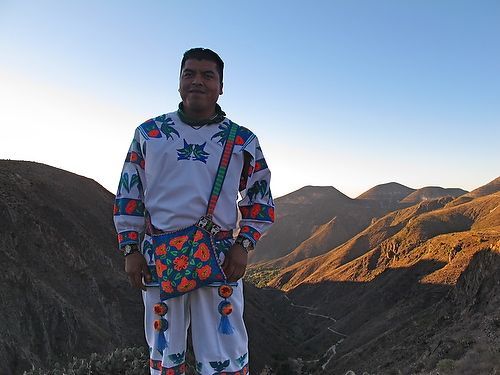
Santos Carillo de la Cruz, a Wixaritari leader, at Real de Catorce, Wirikuta.

Related

A Vancouver-based company, First Majestic Silver Corp, has ignited fierce controversy over plans to mine silver from a mountain considered by an indigenous nation to be the birthplace of the sun.

The Huichol called the Canadian mining project an "unlawful imposition" and part of a "a deepening war of extermination against our native peoples" in an October 2010 manifesto entitled Declaration in Defense of Wirikuta.

Nearly 70 per cent of First Majestic's mining rights fall within the Wirikuta Reserve, an area designated a Natural Sacred Site in 2001 by the state of San Luis de Potosí.

The Huichol believe a god appeared here in the form of a deer. With his antlers he first raised the sun into the heavens. So each year the Huichol trek across 800 kilometres of arid wilderness to their sacred summit Leunar. There they eat a sacred cactus and pray "that our ancient culture does not disappear. . . and the candles of life that give meaning to our identity are renewed."

The 6,327 hectares covered by First Majestic's mining rights contain an estimated $1.325 billion worth of silver.

As world views collide over the value of silver versus the sacred, the developing conflict is reminiscent of the hit movie Avatar.

First Majestic's mining claims overlap the Huichol's sacred mountain as well as the only underground water source in the Sierra de Catorce. The aquifer feeds 16 villages and an ecosystem recognized by the World Wildlife Fund as among the three most biodiverse deserts in the world.

"It's too early to comment on specifics [of the dispute]," said First Majestic's investment relations director Todd Anthony, when asked about the firestorm of controversy surrounding the proposed mine. "But we see nothing that could prevent the Real de Catorce mine from becoming fully operational."

'We will defend it'

The Huichol promise to use legal action as well as non-violent civil protest to stop the "devastating mining project," in their October declaration.

The town of Real de Catorce sits alongside La Veta Madre, a rich vein of silver that First Majestic intends to mine.

"Townspeople have united with the Huichol to protect our environment," said one woman who raised two children in the quiet mountain village. "We are not against mining in general -- we all use metal," she added, asking that she not be named out of concern for her safety. "But this is one of the energetic centres of the earth. And we will defend it."

In November First Majestic announced a $3 million acquisition of surface rights for land to build a silver refining facility. Anthony says the company will launch an "aggressive drilling and exploration program" in 2011, and build a fully operational underground mine by 2014.

The declaration provides a long list of state and federal laws the Huichol believe should prevent mining in Wirikuta. There is a Law for Consulting with Native Peoples, a Law for Ecological Balance and a Law for the Handling of Toxic Substances, among others, which reveal the idealism of Mexican law -- at least on paper.

"The application of law is pretty inconsistent in Mexico," said Jamie Kneen of Miningwatch Canada, an organization that monitors the activities of Canadian mining companies worldwide. "That applies to environmental and public health law violations as much as to public safety. Mexico has a serious law enforcement problem."

'Eco-friendly' promise met with skepticism

The record of Canadian mines in Mexico has sent a chill through Real de Catorce. In nearby Cerro de San Pedro, a mine owned by Vancouver's New Gold Inc. has led to widespread violence and environmental destruction. An immense slag heap leaches toxins into the water table and protestors have been beaten by supporters of the mine. In April 2010, Enrique Rivera was admitted as a refugee into Canada to escape the atmosphere of intimidation and fear.

Further south in Chiapas, Mariano Albarca was shot to death in November 2009. He was prominent in the resistance to a barite mine owned by Blackfire Exploration of Calgary. The two men arrested for his slaying were former Blackfire employees. The company is also under investigation by the RCMP for violating a law against corrupting foreign officials, according to Kneen.

The people of Real de Catorce worry that First Majestic's operation could bring similar violence, corruption and environmental destruction to their community.

First Majestic's publicity presents a rosy image of the projected mine. "All work carried out in the Real de Catorce area will. . . be eco-friendly," their corporate web site promised as of December 2010. They emphasize that "underground mining is totally undetectable by human settlements on the surface."

"That's not true," Kneen commented. "It's just a little less obvious [than open-pit mining]. There will still be tailings piled on the surface, as presumably there will be milling at the site. Typically gold and silver do their processing on the spot. One issue is the arsenic or cyanide used in the processing, and another is contaminants originating in the rocks themselves, as many of these rocks are being exposed to water for the first time."

"If there are not water problems now, there will be," he added.

There is already a scarcity of water in the Sierra de Catorce, where years sometimes pass between rains. Mines typically use large amounts of water to separate precious metals from rock, so residents fear that the mine is bound to consume much of a water resource currently shared between sixteen villages.

"First Majestic will have to de-water the mine," Kneen told me. "Presumably they will be digging below the water table, so they'll be pumping out a lot of water. This implies sucking water out of the aquifer."

The towns and villages of the sierra currently use the springs with the blessings of the Huichol. To the Huichol the water is a sacred, life-giving force. Aquino says that the Vancouver company's plans to use this water without consulting its ancient guardians shows a lack of respect for the indigenous world view.

A space seen as divine

A June 2001 entry in the Official Journal of the State of San Luis Potosí conveys a remarkable understanding of the divine nature of the Huichol world.

"Sacred Natural Sites are those natural areas which, in addition to their biodiversity importance, are sacred spaces for indigenous peoples, and where ceremonies with a divine character are performed. In these sites reality is seen and perceived under a magic, spiritual and natural perspective, and ritual offerings and ceremonies of the indigenous peoples take place."

For Huichol, who also call themselves the Wikárika People, annual ceremonies at sacred sites along the pilgrimage to Leunar are a timeless experience of connection with ancestral spirits. They access a dimension of consciousness that the Western mind is challenged to comprehend. It is the health and abundance of nature that makes this experience of ancient ceremony possible and powerfully felt.

The deserts of Wirikuta are home to a rich array of native species: 28 reptiles, 157 birds (including Mexico's symbol, the Golden Eagle), 65 mammals including deer and a few remnant black bear, and one of the highest diversities of cacti in the world. Among those in peril of extinction is hikuri, the Huichol's sacramental cactus, known in English as peyote.

To the people of Real de Catorce, the character of their town and the purity of their water and soil is at stake. For the Huichol, a mystical landscape that affects the survival of their culture hangs in the balance.

Whether First Majestic drills into the Huichol's cultural heritage may depend on whether the compassion of Canadians is strong enough to limit our own economic adventurism abroad.

First Majestic already has three silver mines in full production, and two others in development. Do they need one more, if it amounts to a war of extermination? Those to be affected feel that rare languages, sacred prayer sites and old-growth desert ecology hold far more value than lifeless bricks of silver.  [Tyee]

19  Comments:

Login or register to post comments

  • Fiat lux

    1 year ago

    "Wealth can not be created,

    "Wealth can not be created, only taken from others, the environment and future generations"

    Will humanity ever come to grips with the facts of physical realities, replaced by politicians of all parties with ideologies and so called "economic theories?" ?

    Ed Deak

  • oeanda

    1 year ago

    Ed:

    I'm gonna have to go with, "no."

    But that might just be the realist in me speaking, and no realist has ever helped to make the world a better place.

  • Fiat lux

    1 year ago

    Funny thing, we all learn

    Funny thing, we all learn the basic physical facts in highschools, all over the world, then spend years in universities, getting brainwashed with "faith conquers all" .

    Yes, especially logical thought.

    Ed Deak

  • Birch

    1 year ago

    Which is better to worship,

    mythical characters (magic deer), the sun (source of all life), water (essential for life), or lumps of metal?

  • pookycabo

    1 year ago

    NOT THE ONLY CANADIAN MINE FACING PROBLEMS IN MEXICO

    Near Los Cabos, Mexico, a place canadians love to visit and retire, 5 canadian gold mines are planning to open mega toxic mining proyects, in the only source of water in a desert region, Unesco´s Biosfere Reserve, La Sierra de la Laguna, and close to Sea of Cortez, Aquarium of the Americas. Do this titles matter to someone? not if money and power are involved. Please check www.soscabo.org if you wish to make a story. Toronto sun commented about it on jan 17th

  • dorothy

    1 year ago

    More information needed

    This story comes sort of out of the blue, with loose ends dangling in the wind. I have tried but cannot find out, why a site declared essentially untouchable by the state as both a sacred site and a nature reserve of sorts can end up with mining rights plastered all over it, which then override any other designation of the land. Surely, some folks and/or agencies must have been sleeping on the job here? Can anyone cast light on this?

  • freebear

    1 year ago

    What Is a Sacred Mountain Worth?

    Depends on persepective - whether you are an investor, or a local!

    Just try and remove a mountain at Whistler; or any other place where the CEO's have their 'log cabin'

  • 9fan4evr

    1 year ago

    Cerro San Pedro

    its too bad that comments like the onnes in this article are so incorrect. I worked at the project in San Luius Potosi Mexico where the Cerro San Pedro mine is loacted. The Canadian mining company did a huge modernization project for the locals in the area. This included biulding new housing with full utilities, providing jobs, healthcare and a school. The sad part is the so called protesters that were attacked werent even from the area and were being financed by a group that was trying to get pay offs from the mine operator. Canadian mining comapanies have made huge investments in Mexico and provided many needed jobs for those who otherwise would be living in extreme poverty. Mining when done irresponsibley can cause damage to the environment and shouldnt be allowed no matter what country it is taking place in!!! The mine in CSP is designed and operated with the indentical standards that we use in the US/Canada. The standards in several areas exceed US/Canadian enviromental standards as the history of the area required unique mining methods that are seldom used in the North as they arent many towns that have this type of history. Mining brings needed jobs for Mexicans need to get a better quality of life. The corrupt governments of the 3rd world countries in Latin America are far more dangerous to the people, environment, and history then the Candaian mining companies who are investing in these countries and their work force. Im writing this in support of the many fine workers at the CSP mining project in Mexico. Buena Suerte mi amigos y vaya con dios!!!!

  • greengreen

    1 year ago

    I would just like to second

    I would just like to second Dorothy's request. something just seem to make sense. It may have something to do with the Mexican justice system. Or, has there been some payoffs?

  • kootenay

    1 year ago

    Here's Some Other Information

    Here's a link to a Mining Watch article about the area in question. They report the opposite of what 9fan4evr is claiming. Have a look for yourself.

    http://www.miningwatch.ca/sites/miningwatch.ca/files/Boylan_MSX_article.pdf

    I've visited mine sites in Chile and Peru and can tell you first hand the conditions at some of these sites aren't fit for humans. Most of these small Canadian Mining Companies have nothing to be proud of with their operations in the South.

  • Fiat lux

    1 year ago

    Thanks for the propaganda,

    Thanks for the propaganda, friend. We sure need it, as we don't get enough of it here in Canada.

    The problem is the same in Mexico, Canada and anywhere on Earth. Mining for the use of making products is definitely necessary, but mining for the export of the resources is the sale of the ground from under the people's feet, till it lasts.

    The sale of resources is not an income, but a conversion, with nothing gained, but lost.

    Where is that ore supposed to go ? To China or India? So that local manufacturing and trades can be ruined ?

    As we have it here in Canada ?

    What happened to the Mexican productive and farming middleclass since NAFTA ? What are they doing now in mega city slums? Their children combing garbage dumps?

    Ed Deak.

  • memo

    1 year ago

    Mining at Cerro San Pedro good for the community?

    In response to another post about the benefits of the minging project at Cerro San Pedro bringing benefits to their community, I can only ask how someone with a good conscience can make such a statement? I have visited San Pedro out of curiosity since I own an apple orchard in Real de Catorce and wanted to see what the future may hold for my village. If completely destroying a mountain and contaminating the environs around a community is your idea of responsible, environmentally sound mining methods I would hate to see what you consider irresponsible methodologys. Can I personally hold you responsible when the water resources my orchard depends upon dry up when First Majestic pumps the aquifer dry or will you explain to me that I am mistaken and I and my neigbors have benefited from your robber baron mentality? I hope the money you made from the misery you have caused sours in your soul.

  • morechatter

    1 year ago

    "Breaking the Laws of the Land"

    The natives view the land with reverence and respect. The land is treated like a scared temple with the people taking only what is needed. The mountain is not a mere symbol but central to who the people are. The mountain shares it's powers with the people. Thanks is given through prayers, singing songs of gratitude and offering.

    This isn't like a church burning where another one can be built in it's place. If the mining company moves in and pollutes the mountain the spirits will leave and the people will lose their power. And the animals and plants will also leave and the waters will be polluted. The special relationship the Natives have with the mountain will be destroyed and the spirits gone.

  • morechatter

    1 year ago

    "Families First"

    Clark, the BC premier is all for opening up the mine and putting families first. Just not First Nation's families.

    http://www.ubcic.bc.ca/News_Releases/UBCICNews02111101.html

  • snert

    1 year ago

    morechatter

    Quote:
    Clark, the BC premier is all for opening up the mine and putting families first. Just not First Nation's families.

    I think FN families are included but some, not all, choose not to be.

  • pwlg

    1 year ago

    mining company investments

    "mining companies have made huge investments in Mexico."

    Investors make investments and rarely do the principals in a mining company invest their own money and if they do it is a very small portion of the investment.

    I wonder whether union pension funds, the BC Investment Management Corp and the Canadian Pension Plan managers are invested in these destructive projects?

    An average mine's life expectancy is 10 years. Investing in schools and medical centres in Mexico sounds nice but at the end of the mine's life these so called investments are not sustained and left to wither just like all of the thousands of other mining ghost towns in Canada.

  • OwlRol

    1 year ago

    Canadian mining, under reporting and greenwash.

    Canadian mining practices only came to my attention when I saw Mulroney and Bush Sr. walking out of Barrick Gold offices, arm in arm & grinning ear to ear, being involved in, amongst other things, support for providing weapons to the corrupt, Indonesian Suharto govt., at the height of the Briex fiasco, before East Timor was on the mainstream media radar.

    A few years later some of us heard of Talisman's involvement in the eradication of central Sudanese villages in those oil fields. Funny how after they left, the massacres stopped, the civil war between north and south ended, the south gained independence and control of oil revenue is now divided between them, in spite of Chinese interests taking over Talisman's. Likely oversimplified, but...

    In the meantime, those who paid attention, took note of the growing, poor and oppressive or environmentally destructive Canadian mining practices in the Amazon, Papua New Guinea, Spain and along the Danube river (not the most recent red spill, I think).

    Furthermore, Canadian mining interests in east Congo, mining for Coltan + are questionable and somewhat resemble former involvements in Sudan.

    Its not just the specifics in this article, but other sites in Mexico and throughout Latin America, be it Esquel in Argentina the Intag valley in Ecuador, Goldcorp,s Marlin mine or Skye Resources/Inco in Guatemala, Aura minerals in Honduras, and an ongoing extensive list, that is problematic. Their practices, though sometimes technically legal, or even if not, are well covered up and under-reported.

    David Suzuki's Nature of Things raised similar issues in The Real Avatar, how Peru's national parks and sacred or protected areas are now targets of oil and gold development and how the indigenous people are trying to push back for survival.

    Our own First Nations know this story all too well throughout their 500 year contact history. Fish Lake in B.C. is very much the exception not yet fully completed, while Fort Chip, Alberta and Sarnia, Ontario are much more the common situation.

    Many global corporate entities callously invade nearly every corner of the globe, essentially using or subverting locals and cash strapped governments to their purposes and profits, but Canadian mining companies surely lead the pack.

    So what is the Harpo govt. response (the Libs would likely do only slightly better)?

    An appointed Corporate Social Responsibility (CSR) counsellor can take complaints but has no power to investigate without the corporation in question giving it the OK. Victims have no voice. "Harper's "Canadian Advantage." What a sour joke. No wonder our Gov. Gen. was booed and told to go home on a trip to Mexico city.

    Harper's admonishments to the more socialist governments of Latin America surely look hypocritical. Perhaps he needs to look in his own back yard, notably the Tar Sands.

  • CF1

    1 year ago

    SACRED!

    Boy, I sure am getting tired of the tissue-thin tactic of calling some thing or place "sacred". It is an assertion of a claim of ownership or control without any rational basis. It comes from and is steeped in primitive superstition (aka nonsense) and is designed to emotionally manipulate the listener.

    Enough already! Argue for reasons of protecting clean water? Sure, I'm with you, but other reasons coming out of pre-scientific ignorance, and you lose me altogether.

  • David Beers

    1 year ago

    Administrator

    Sacred

    I think, CF2, the implication of the word sacred is that the place, for whatever reasons including its clean water or other natural aspects, has over a long period of time become very much treasured by a people who have inhabited it. Would that count for you as a reason to give pause in mining it?

    • The discussion for this story is closed. No more comments can be added.