
Opinion

Nikiforuk Pores Over Royal Society's Oil Sands Study

What the scientists got right, and missed, in their high-profile, largely damning report.

By Andrew Nikiforuk, 16 Dec 2010, TheTyee.ca

Alberta oil sands

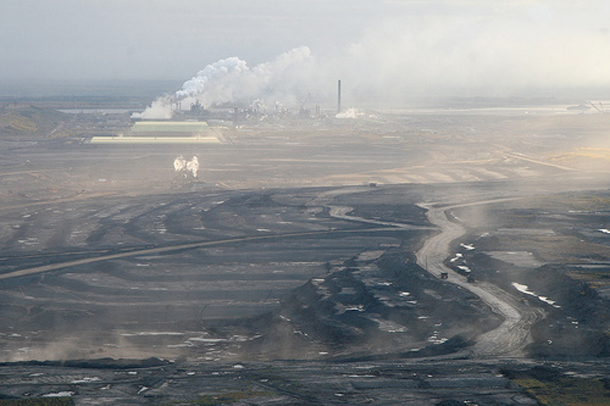
Syncrude mining in Alberta's oil sands. Photo David Dodge, CPAWS.

Related

Every now and then a group of respected scientists put on their nerdy rubber boots and then bravely wade into a swamp of scientific literature.

The goal, of course, is to shed some proverbial light on a highly contentious or viscous matter.

Seven members of the Royal Society did just that on the oil sands and their published efforts yesterday offered some important illumination as well as more murk.

But overall the expert panel solidly confirmed a damning long-term trend: government is generally doing a poor job monitoring the world's largest energy project, let alone keeping pace with development.

Bill Donahue, an independent Edmonton-based expert on water policy and science, clearly summed up the essence of the report: "It is a scathing indictment of the failure of Alberta to regulate." Period.

As discreet communicators, the scientists found, for example, that environmental assessment process had "serious deficiencies in relation to international best practice."

Moreover the capacity of Alberta regulators to protect the public interest with skilled scientific analysis remained a real "concern" while the federal government (and you guessed it) maintained "a very low profile" on oil sands development.

(Just last week the Commissioner of the Environment and Sustainable Development disclosed how low that profile has sunk: Ottawa has but one long-term monitoring station on the Athabasca River downstream of the oil sands, and as of June 2010 it wasn’t even measuring oil sands pollutants.)

As a consequence of such unseemly profiles, the expert panel squarely painted Ottawa as a salamander in the sand at a time when the country needs a wise owl overseeing things.

Land o' natural pollutants

Moreover the scientists weren't impressed with the shenanigans of petro politicians in Alberta where all pollution tends to be natural because all bitumen must be ethical.

Outrageous comments about dead ducks, for instance, "[raise] serious questions about the motivation of the cabinet ministers involved toward environmental responsibility."

The report also found it odd that two key regulators, Alberta Environment and Sustainable Development, no longer participate in public hearings on oil sands. In other words decisions are being made "without the benefit of the public input from Alberta's primary environmental regulators."

The expert panel, too, strongly echoed a growing and vocal chorus on the inadequate state of water monitoring on the Athabasca River. Valid concerns about the industry-funded Regional Aquatic Monitoring Program, say the report, "must be addressed." (Numerous reports, including a 2004 federal study, have squarely questioned the integrity of RAMP.)

Contrary to industry and government claims of no worries, the scientists found "considerable uncertainty" about water quality and recommended prompt action to deal "with the wide range of monitoring challenges that RAMP faces for identifying any impacts of oil sands development." The Department of Fisheries and Oceans has found nothing but uncertainties too.

Kelly and Schindler as catalysts

Not surprisingly the report highlighted the important findings of Erin Kelly and David Schindler, whose studies proved that pollution on the Athabasca River is no longer natural.

But the nerds acknowledged their work politically. These studies, "albeit based on sparse data and showing very little measurable impact on water quality for industrial developments of this scale, do support a hypothesis of measurable impact arising from oil sands developments."

Basically designed to disprove industrial claims of immaculate bitumen production and nothing more, the Kelly and Schindler studies have now forced two high-level scientific investigations on river monitoring and pollution.

On groundwater the expert panel smartly restated the findings of an excellent 2009 Council of Canadian Academies report on the same subject. Despite the extensive use of aquifers by industry and 30-year-old recommendations for proper studies, "The regional cumulative impact on groundwater quantity and quality has not been assessed."

No pass on GHG emissions

The Royal Society stuck to the basics on the GHG emissions. It concluded that bitumen is indeed dirty and that bitumen from steam plants has the highest emissions of all global crude sources. As a consequence oil sands expansion "creates a major challenge for Canada to meet our international commitments for overall GHG emissions reduction."

Moreover the report raises serious doubts about carbon capture and storage (CCS), the dismal art of burying pollution underground. Alberta's tax on carbon emissions can't raise enough money to build such a multi-billion system. Moreover CCS simply won't work for the oil sands because "the geology of northeastern Alberta is not a good candidate."

The panel also sets the record straight on the uncertain state of reclamation. "Contrary to popular belief the legislation and regulation do not require reclamation to boreal forest ecosystems."

Big questions remain about engineering boreal life as well as the ability of industry to remake wetlands or peatlands.

Moreover, Albertan taxpayers are on the bitumen hook too: "substantial improvements are needed to the current financial security arrangements to minimize the potential liability to the public purse."

Regulators underpowered

Last but not least the Royal Society also noted that regulators such as Alberta Environment and the Energy Resources Conservation Board don't have the manpower or expertise to really keep up with the scale of development.

Concluded the report, "These agencies need to seriously review whether they have and can effectively maintain the specialized technical expertise needed to regulate industrial development of this scope and sophistication, particularly in a preventive manner that demands detailed industry-specific technical knowledge by its regulatory personnel."

Although the 438-page document exposes the scale of government incompetence on scientific issues, it also solidly reflects the poor state of science research on the project. After telling readers how poor the quality of monitoring science is, the expert panel then takes the results of this same inadequate monitoring at face value.

Drawing on sketchy data from 15 air quality stations in the Wood Buffalo region (even industry insiders question the adequacy, location and number of the stations for an area the size of Tasmania), the scientists assume that air quality is somehow okay. It is not. The industry-funded air quality program needs a reality check as badly as the region's water measurements.

Moreover the report later notes another stunning observation about the general state of air quality monitoring in the province: "Alberta has never developed a high-standard infrastructure of research and air quality studies found in other jurisdictions." Now that's the truth.

Cancer concerns fumbled

The scientists also bungle the cancer story downstream. Their terse review of the 2009 Alberta Cancer Study, which notes that big oil projects do beget cancer problems, is grossly incomplete. That study highlighted a group of Fort Chip residents that worked in the mines and later died in Fort McMurray at the average age of 42. Unlike residents of Fort Chip, they died from totally different cancers.

The expert panel also errs in a major way by drawing upon an error-ridden report largely written and released by Health Canada officials to cast aspersions on Dr. John O'Connor, the doctor that boldly drew attention to cancers downstream.

Quoting an unreferenced and inaccurate document containing outright lies is not something a bunch of so-called experts should be doing.

Yet to the panel's credit, it did recognize that Fort McMurray has the worrisome public health profile of a boomtown (everything from drugs to STD's) or what it calls "obvious health indicator disparities."

While the scientists got seriously bogged down in at least two areas (and the oil sands are a veritable swamp), their report generally confirms that all is not well in the sands in terms of monitoring or basic research. They also get the big regulatory picture right and it's not comforting for citizens or investors.

Cause for shame

If we regulated hockey the same shoddy way we now regulate the oil sands and its impacts, here's how things might look:

Inadequate trained referees would govern hockey players on improperly maintained ice in arenas of varying sizes. Not only would the scoring records of players remain a state secret, but no one would be able to track cumulative team performance overtime.

In short, no one would watch let alone buy tickets.

Eventually, the Royal Society might write about these "serious deficiencies."  [Tyee]

32  Comments:

Login or register to post comments

  • G West

    1 year ago

    Thanks again Andrew

    One thing, please go back to the usage that made your book so memorable.

    TAR SANDS - Dirty Oil and the Future of a Continent.

    I'd hate to see you knuckling under to political correctness this late in the game.

  • pwlg

    1 year ago

    and in BC?

    I wish the Tyee would do a better job tying in comparisons between Tar Sand developments and BC's gas and oil field developments.

    Andrew did do an article on BC's rapid depletion of the Ladyfern gas field in BC which indicated our own regulators were as bad or even worse than Alberta's.

    "Gaslands" the US documentary on the practice of hydraulic fracturing or "fracking" is now out for rental and is an indictment on how the industry is able to use incredibly destructive and secretive methods to obtain gas within geological structures by injecting with force secret fluids into the earth polluting groundwater.

    The Oil and Gas regulator in BC is allowed to sidestep BC's water legislation allowing extraction companies to use and abuse water without the normal public oversight and regulations that all of the rest of BC residents must adhere to.

  • jwstewart

    1 year ago

    Weak analogy...

    comparing hockey to the Tar Sands. No one is watching the Tar Sands now!

    A more apt comparision would be that the Tar Sands will surpass the Sydney Tar Ponds as North America's largest industrial hazardous waste site.

    Just as the Sidney Tar Ponds did, the Tar Sands will require the provincial and federal governments to cover the costs of cleanup as the Multinational players will have exited quickly.

    I beleive Mr. Deak would refer to it as criminally externalizing costs.

  • hakaakah

    1 year ago

    Great piece but I think the

    Great piece but I think the time has come for less talk and more action. We all know darn well whats going on and whats not going on in our best interests. I for one am frustrated by all of this. The bs continues. Would the TYEE be so kind as to list any contacts we might voice our concerns with over this disgusting mess. Isnt it time we took back our rights to a fair existance?

  • speedo

    1 year ago

    Collapse!

    This article reads ominously similar to the first bit of Jared Diamond's "Collapse" which describes the cavalier approach to mining in Montana...

  • Holly Stick

    1 year ago

    RAMP and deformed fish

    And we have learned today that RAMP has been collected deformed fish but not rep[orting on them accurately:

    http://www.theglobeandmail.com/news/politics/ottawa-kept-in-dark-on-abnormal-fish-found-in-oil-sands-rivers/article1841714/comments/

  • Jerry Munro

    1 year ago

    What Ed Deak Would Say...

    "I beleive Mr. Deak would refer to it as criminally externalizing costs." jwstewart.

    He certainly would. And he would be entirely correct in this characterization of the game afoot.

    But then, I would add :-), "the system" is "organized theft", even where genteelly done and according to Rules of Ruling Class Sanctioned Law.

  • For a better world

    1 year ago

    Big Money is in control

    Thanks for the excellent critique.

    Big Money remains in control. Our governments will never step up to the plate to address this environmental degradation, nor will they collect reasonable royalties, unless they are somehow forced to meet their public responsibilites. This dilemma is just another of mankind's frontier attitude of rape and pillage. It is the latest gold rush to exploit another earthly resource and most members of our society are either oblivious or they don't care.

  • zalm

    1 year ago

    If one imagines Canada as a family...

    ... one might see Alberta as the unruly older teenager, having quit its day job, it spends its money going out at night playing hockey in pick-up games, getting drunk afterwards, fighting, getting patched upa at the local clinic, coming home and leaving its underwear on the floor of the family bathroom before staggering to bed, to arise late and do it all over again tomorrow.

    Mom and Dad are in despair, the other siblings are either frustrated or simply ignore Big Bro'. doubtless everyone wishes Big Bro would simply move out and disrupt his own life any way he wants without disturbing the others.

    Unfortunately, , he cannot leave, and the family cannot tolerate this kind of disruption - when he's drunk, Big Bro' shits in the drinking water of the tenants downstairs.

    If only someone would speak to him....

  • realisticman

    1 year ago

    They still haven't discovered any TAR

    There is lots of oil though. The biggest worry is a labour shortage.

    From Saturday's Globe and Mail

    "In a deal that reshapes the ownership of the oil sands and raises new worries about a looming Fort McMurray labour crunch, Suncor Energy and Total SA have agreed to jointly build two new mines and a bitumen upgrader.

    "Though the companies did not reveal specific costs, they disclosed ballpark figures that show they are contemplating a massive expenditure. The two mines will cost roughly $15.6-billion, while it will cost another $6-billion or so to complete Voyageur.

    Combined with what it has already spent to acquire an oil sands stake, that means Total alone will spend $20-billion on Canadian projects by 2020. The French oil giant will spend the next few years boosting its Alberta work force from its current 250 to 1,400.

    "Suncor expects ... It plans to spend between $8-billion and $9.5-billion between 2012 and 2014 as it builds new projects.

    “the biggest risk, the biggest challenge, is to get enough manpower on these projects.”

  • realisticman

    1 year ago

    Getting Dirty

    Some people like to get dirty. Maybe some of these people read Andrew's book on dirty oil and then decided to join in.

    "Money has come flooding back into the oil sands, with major projects either under construction or soon to begin from companies such as Imperial Oil Ltd., Husky Energy Inc., BP PLC, Syncrude Canada Ltd. and Canadian Natural Resources Ltd."

    Globe and Mail

    No wonder they don't have any HST.

  • Jeffrey J.

    1 year ago

    Keeping Us In the Loop

    It is fantastic that we continue to receive state-of-the art updates on the tar sands disaster. Thanks to some of the best independent news reporting, from Tyee and Mr. Nikiforuk.

    Because of this coverage, when I speak with elites who purport to "understand" what's going on, I am amazed how little they know. It's like speaking with a grade-schooler.

    It is very satisfying to know the truth, even though there appears to be little we can do to stop this mindless, destructive engine of extraction.

  • G West

    1 year ago

    Great place Alberta

    In the last provincial election only 41% of eligible Albertans voted - in Ft Mac it was only 21%.

    The Tar and the fumes from the dirty money seem to have gone to their heads. Albertans were pretty stupid to start with - witness decades of right wing governments (many of them little more than religious cults) - and you can see why the place is such a mess today.

    Mind you, BC isn't much better. We still have a premier with and MBA in dissembling.

  • G West

    1 year ago

    errata

    That should be:
    Mind you, BC isn't much better. We still have a premier with an MBA in dissembling.

  • realisticman

    1 year ago

    Second to None!

    Are they really stupid?

    Here's one opinion:

    "Coal, oil and gas have been Albertan’s trump cards since our province’s earliest days. These resources have provided employment, fueled our homes, businesses and vehicles. They have also provided a provincial revenue stream that has helped Albertans enjoy a quality of life second to none."

    There's also a call for more refineries in Alberta:

    "support a policy of upgrading all bitumen in Alberta. Our province fought hard to get control of our resources - now we need to take advantage of it."

    Do we support this?

  • G West

    1 year ago

    Yep!

    They're stupid...as is Canada. Putting all your eggs in one basket isn't the way to build a sustainable economy - it's simply a way to end up with a lot of broken egg shells and egg on one's face.

  • realisticman

    1 year ago

    As you wish.

    The above opinion quotes are from Brian Mason and the Alberta NDP.

    http://www.albertandp.ca/whereWeStand_tarsands.cfm

  • G West

    1 year ago

    I should care?

    The government of Alberta has been run by right-wing cliques and religious nutbars since the time of William Aberhart.

    The NDP in that mix is absolutely irrelevant - the whole province is nuttier than a fruit cake - why would the NDP be any different?

    At the same time, there is clearly an argument for refining the noxious crap as close to its source as possible.
    a) It forces Alberta to deal with its own messes rather than exporting them around the world, and
    b) It means more jobs for Canadians - and jobs that aren't just concentrated at the stupid end of the rope.

    However, real, sensible policy for the resource is to mine and refine locally only the absolute minimum of the Tar Sands necessary to achieve energy independence for Canada and not to export a single barrel of our poison to other jurisdictions.

    In fact the same thing is true of natural gas.

  • realisticman

    1 year ago

    So...

    When you say that the whole province is nuttier than a fruit cake and you include the Alberta NDP, we presume that must include Calgary based Andrew Nikiforuk too? N'est ce pas?

  • G West

    1 year ago

    Hardly

    In fact, if you'd understood what I wrote, you wouldn't have bothered making that post, would you?

    Sadly, an awful lot of the Alberta crazies have ended up undermining the situation here in B.C. as well.

    Still, if you're actually interested in learning something about the way your heroes have been behaving here in this province, you should have a look at this:
    http://alexgtsakumis.com/
    Don't say I've never given you good tip!

  • realisticman

    1 year ago

    I'm glad

    ...that you have finally found Alex. I do hope you've also been reading his interesting stories about Vancouver City Hall and his writings on the NDP implosion. Welcome.

    One thing you have to love about Alex is that he doesn't become giddy with anyone's Kool Aid. He runs a spin-free operation.

  • For a better world

    1 year ago

    Your correct as usual, Mr. West

    "Sadly, an awful lot of the Alberta crazies have ended up undermining the situation here in B.C. as well."

    Ralphie and his associates purged many Edmonton civic bureaucrats, utilizing his Libertarian downsizing strategy. Ironically many of those deposed bureaucrats came to BC and implemented Ralphie's modus operandi.

    To this day I can still visualize a guy by the name of Murgaroyd advising his audience they should not follow existing laws.

  • G West

    1 year ago

    Spin free - him?

    You must be joking. As for having 'found' him - hardly...I've simply never been in a position where I wanted to recommend anything he wrote prior to this.

    In fact, it isn't Alex I'm recommending that you read - Dave Basi's confessions is what I sent you there to see.

    Enjoy.

  • Yeoman

    1 year ago

    Petroleum "Upgraders"

    Shouldn't an upgrader actually be called a hydrogen downgrader? It takes cleaner low carbon methane and loads it up with excess carbon?

    As for tar vs oil sands, shouldn't they actually be the Bitumen sands, since they don't contain any "oil".

  • realisticman

    1 year ago

    Yeoman

    Quite right. In French they are known as Les sables bitumineux, certainly not les sables du goudron (tar). "Les sables bitumineux de l'Athabasca (maintenant désignés sous le nom des « sables d'huile d'Athabasca »)"

    A small group in Canada continue to use the incorrect term 'tar' and the industry and most of the world use the also incorrect 'oil' sands. The only excuse is that the resulting product, after processing, is indeed oil, not tar.

    The sticky black substance looks like many things including wood creosote, coal tar creosote or molasses. I guess they could be called the Molasses Sands but that would be as incorrect a misnomer as Tar Sands.

    "Tar Sands' is like baby talk as 'Yukkie Sands' would be. It's a bit like calling concrete cement.

  • G West

    1 year ago

    R/man

    The accurate and 'historical' term, which has been used since the damn things were first discovered a couple of centuries ago, is TAR SANDS: as you well know because I've posted the information and the links here at Tyee already.

    The only people engaging in childishness and 'baby talk' are people who believe that changing labels makes any difference to the fundamental question here. Like Minister Baird in Cancun, they seem to think that ranting and obfuscation are a suitable substitute for achievement and telling the truth.

    I would have thought that a 'realisticman' wouldn't be such a sucker for political manipulation.

    Andrew Nikiforuk's usage, and the title of his award winning book, are entirely appropriate.

    As far as that goes, the Brits are sometimes labelled 'limeys' because they like to lay claim to the efficacy of lime juice as a remedy for scurvy. In fact, they weren't the ones who discovered it at all...do you suppose there's a flaw in the British character when it comes to telling the truth?

  • realisticman

    1 year ago

    Accurate?

    Accurate in what regard G/est?

    We know you love the cuddly feeling you get using the colloquial misnomer because you perceive it as a derogative term, ergo it's a political tool to further criticism of the development of the Athabasca bitumen deposits even though it is inaccurate from a chemical perspective.

    Historically, some people thought that the earth was flat. Since that was later proved to be inaccurate the concept was changed. Historically, some people thought the deposits in Athabasca were tar but they are not.

    I wonder what Galileo would say to today's High Priests of Derogative Euphemisms.

  • G West

    1 year ago

    R/man

    That's simply baloney and you know it.

    As I said, I've provided the historical links before...and, if you'd read Nikiforuk's book you'd be familiar with who has been playing fast and loose for political and selfishly economic reasons.

    That’s no big surprise.

    But it isn’t those people who are willing to call a spade a spade…We’re not the ones into deception and disinformation.

    If you prefer to ignore reality then you need to find a way to square that with your handle, which, more and more lately, is a marked misnomer.

    But I guess that's a problem when someone tries to choose an alias that is at such a profound disconnect with his or her actual 'role' here at the Tyee.

  • Dan the socialist

    1 year ago

    "Tar Sands' is like baby

    "Tar Sands' is like baby talk as 'Yukkie Sands' would be. It's a bit like calling concrete cement.
    ==========

    So what?

    People still refer to Orca's as Whales when Killer Whales are not whales at all...

  • Dan the socialist

    1 year ago

    We all know at the end of

    We all know at the end of the day unfortunately nothing ever will be down. Big Oil runs Alberta and Canada, especially with so many low wage conservative governments in power (BC, Alta, SK, Federally etc) profits come before peoples or the environments well being.

  • Yeoman

    1 year ago

    Crude sands

    Coloquial terms are well understood and tar has, in the 20th century tar has effectively come to mean bitumen, not tree resin (to wit tar and gravel roof). If you really want them to reflect the petroleum aspect may I suggest "crude sands".

    As for calling them "molasses sands"...when molasses has carcinogenic PAH's and heavy metals in it, feel free to use that term.

  • realisticman

    1 year ago

    Let me know.

    When someone, anyone, discovers tar there.

    The French descriptive is still the most accurate, from a technical, scientific and chemical perspective.

    Les sables bitumineux.

    • The discussion for this story is closed. No more comments can be added.