Opinion

The New Class Warfare over Bicycles

Don Cherry and Rob Ford twist it backwards. The elitists are pro-car politicians, slowing up a better life for the working class.

By Yves Engler, 13 Dec 2010, TheTyee.ca

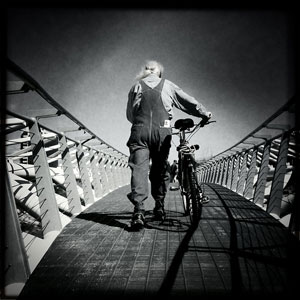
bikebridge.jpg

Photo courtesy of bhluebarber from the Tyee's Your BC photo pool.

Related

In Vancouver the pro-car crowd criticizes the Hornby bike lane by claiming to stand up for small business.

In Toronto, after being sworn in as new mayor, Rob Ford declares an end to the "war on cars." He plans to block a light-rail line and to abolish a $60 vehicle registration fee. Don Cherry congratulates him for rising up against the "elite" and slams "bike-riding pinkos" who supposedly once ran the city.

In Montréal a new political party that won office a year ago in the Plateau Mont-Royal borough begins to widen sidewalks, add bike paths and close some streets to traffic. For doing so, critics accuse them of engaging in class warfare.

In a much discussed La Presse opinion piece, Luc Chartrand denigrated the "supposedly enlightened urban planning" measures as "nothing but a strategy by the wealthy to grab territory in a centrally located district... to the detriment of the general interest of the City."

This is just one more example of the Big Lie. Call black white, say war is peace, claim the media is left wing and argue urban space dominated by cars is good for poor and working-class people.

The truth is that these Montreal "traffic calming" measures will make a relatively bike- and pedestrian-friendly neighbourhood more so, and they will make it more difficult for suburban commuters to use the area's smaller side streets to avoid the main north-south arteries. Over 650,000 cars travel through the eight square-kilometre district daily, with more than 80 per cent headed elsewhere.

Making life difficult for cars could be, in fact, described as a form of class war, but one that works in the long-term interests of the poor and working class.

Autos hailed as equalizers

Even superficially, the critics' argument makes little sense. While the Plateau is not Montréal's most affordable neighbourhood, it's far from its most expensive. Many students, artists and working-class people live in this hip, politically progressive, area.

Chartrand's claim, Don Cherry's diatribe and Hornby bike lane opponents share a common theme: Among North America's most extreme auto proponents, any move to curtail car domination is an attack against the little guy because automobiles give everyone equal access to mobility.

In a Wall Street Journal opinion article, Stephen Moore captured the essence of this argument. "The car allowed even the common working man total freedom of mobility -- the means to go anywhere, anytime, for any reason. In many ways, the automobile is the most egalitarian invention in history, dramatically bridging the quality-of-life gap between rich and poor."

The car's proponents invoke class even though all other forms of land transportation are eminently more accessible. Shoes, a bike, or a metro pass are all cheaper than a car with its gas, insurance and upkeep needs. According to the American Public Transportation Association, individuals who get around with a bus pass instead of a car can save a whopping $8,368 annually.

Cars eat up smaller incomes

When the automobile is used as the primary mode of mass transit, the poorest are hardest hit. In 2008, for instance, the poorest fifth of Americans spent 13 per cent of their income on gas. The top fifth spent 3 per cent. In Highway Robbery: Transportation, Racism and New Routes to Equity, Robert Bullard notes: "Those earning less than $14,000 per year, after taxes, spend approximately 40 per cent of their take-home pay on transportation expenditures. This compares to 22 per cent for families earning between $27,177 and $44,461 annually, and 13 per cent per year for families making more than $71,900 per year."

Nearly three-quarters of U.S. households earning less than $15,000 a year own a car, and in an extreme example of auto dependence, tens of thousands of "mobile homeless" live in their vehicles.

The poor purchase cars because there is no other option in a society built to serve the needs of the automobile. If you want to work, you need a car. If you want to visit your friends, you need a car.

Car-dominated transport eats up a disproportionate amount of working-class income. At the same time, the automobile is an important means for the wealthy to assert themselves socially. A luxury vehicle lets the whole world know that you have arrived, both literally and metaphorically. "The automobile's a credit card on wheels," writes Heathcote Williams. "It's pushy to tell people how much you make, so you tell 'em through your automobile.''

Over a century ago, cars grew to prominence as technological toys for the rich. By the turn of the 20th century, New York City's Automobile Club had more millionaires than any other social club in the world. "No American Sport," noted the Washington Post in 1902, "has ever enlisted so much power and money."

'Purse-proud crazy trespassers'

Those living at the dawn of the Auto Age often viewed it as an obtrusive and "particularly ostentatious display of wealth." Farmers and the working class were incensed by their presence. A 1904 edition of the U.S. farm magazine, Breeders Gazette, called automobile drivers "a reckless, bloodthirsty, villainous lot of purse-proud crazy trespassers."

In 1907, rioting broke out in a working class Lower Manhattan neighborhood after two-year-old Louis Camille was run down and killed. The automobile sparked dozens of other similarly violent protests.

One reason the car was popular among the wealthy was because it strengthened their dominance over mobility, which was slightly undermined by rail. Prior to the train's ascendance in the mid 1800s, the elite traveled by horse and buggy, but the train's technological superiority compromised the usefulness of the horse and buggy. Even for shorter commutes, streetcars became the preferred mode of transport by the late 1800s. With respect to mobility, the train and streetcar blurred class lines. Unlike the train and streetcar, which were more available to all classes of society, the automobile provided an exclusive form of travel.

The automobile's capacity to create social distance appealed to early car buyers. In a car, one could remain separate from perceived social inferiors (blue-collar workers, immigrants, blacks etc.) while in transit. Prominent auto historian, James J. Flink remarked that, "the automobile seemed to proponents of the innovation, to afford a simple solution to some of the more formidable problems of American life associated with the emergence of an urban industrial society."

The different ways in which the private car strengthened wealthy people's grip over culture and mobility have largely been forgotten. At the same time, the immense financial burden cars place on the working class seems of only passing importance to its critics.

The largest source of capitalist profit over the past century, the automobile has shaped landscapes, culture and the environment in a host of harmful ways.

It's time for a class-focused challenge to private automobility.  [Tyee]

66  Comments:

Login or register to post comments

  • Carmen1

    1 year ago

    Never mind the dinosaurs

    Brilliantly stated. But nevermind. The dinosaurs will sink into the muck still snarling, trying to defend a status quo that has long since died. The bicycles are winning.

  • leftofcentre

    1 year ago

    No class war?

    Hard to believe anyone who calls Israel an apartheid society isn't devoted to "class war".

  • i4detail

    1 year ago

    Cars are the new White Bread

    This is not the first time that perception of wealth has flip-flopped around an object. The classic example is white bread. Back in the old days, only the very rich could afford to get milled flour. But with modern production techniques, white bread became much easier to manufacture, leading to a rise in people of modest incomes to start buying it as a status symbol.

    Now, traditional whole grain breads are considered "artisan", and sell for a premium price, while white bread is the cheapest bread you can buy.

  • van-island

    1 year ago

    An excellent read

    This article covers many of the same points, but lays out in depth why cars are most definitely NOT a tool for freedom of movement of the masses...

    http://www.bikereader.com/contributors/misc/gorz.html

  • toquer

    1 year ago

    The well-wheeled bourgeoisie

    Judging from the attendees at critical mass events, 'bike culture' is entirely a phenomenon of the spoiled bourgeoisie: the 'working class' the author employs in rhetorical service curses them for a worsened rush hour jam, and finds their daily grind that much tougher for it. Try a critical mass action in Whalley and experience the full force of proletarian support, comrades.

  • Dan the socialist

    1 year ago

    Rob Ford = Dinosaur and is a

    Rob Ford = Dinosaur and is a small taste what the rest of us will get with a Harper majority.

    I dunno why Toronto would even elect a guy with a record of [EDITED FOR LEGAL CONCERNS HERE...], public drunkeness, drunken driving, and [...AND HERE. -MODERATOR.]?

  • alive

    1 year ago

    class war or not?

    People who do not own cars tend to spend their time in the same neighbourhood, as in the downtown eastside!

    People who have cars will at least drive through other areas and visit points of interest anywhere, public transit to there or not.

    That is in fact a good way to divide people into a class-system, where the poor will kindly stay in their own designated place, thank you.

  • carfreecity

    1 year ago

    cars

    I have become terribly disturbed and agitated by all he automobiles running about everywhere.
    NOISE, STINK, STRESS.
    It's just plain RUDE!

  • Jeffrey J.

    1 year ago

    Chris Hedges: The Death of Liberalism & the Rise of Intolerance

    The failure of "liberalism" is creating a huge backlash from working class folk, the unemployed and the poor. This is exactly reflected in the rise of angry speech from rich buffoons like Don Cherry and Rob Ford.

    But it is important to understand this dynamic, which is complicated (but only a little). As Chris Hedges explains very, very well, the liberal elite have totally failed our democracy.

    www.youtube.com/user/talkingsticktv#p/a/u/2/vteQnUmCj9U

    Too many liberal elite have used the language of social justice, only to capitulate to corporate and financial interests. The view from "the street" is grim. While the right wing appear to "tell it like it is", the namby-pamby liberal elites twist and turn and bend and flex so you don't know if they're coming or going. In the end, after all the rhetoric from "liberal" parties (including the NDP, sadly), wages are slashed, taxes cut, jobs exported.

    It's no wonder the general public embraces the repudiation of the entire system. A pox on all their houses.

    This is the urgency and insight of Hedges, and Chomsky, and Naomi Klein, and Linda McQuaig. The list goes on. And the liberal elite continue to sip lattes, collect their paychecks, and fail to stand up to power.

    I wish it weren't so.

    Great coverage as always.

  • RickOshea

    1 year ago

    The Road To Hell Is Paved With Lame Contentions.

    Bike lane bashing is a Tea Partyesque 'keep the status quo at any cost - no matter how badly it is broken' ploy.

    First Henry Ford proudly said - You can have any colour of car you want as long as it's black.

    Now Rob Ford is here to tell you "you can have any mode of transportation you want, as long as it's a car".

    I wonder how much Auto Dealers Association money went into his election campaign.

  • Chris Keam

    1 year ago

    traffic jams aren't caused by bikes

    "the 'working class' the author employs in rhetorical service curses them for a worsened rush hour jam, and finds their daily grind that much tougher for it."

    Even a cursory listen to traffic reports reveals a couple of things. Most traffic delays are caused by car accidents and systemic bottlenecks tend to occur in places where not only is there no Critical Mass, there are no bicycles, such as the Trans-Canada Freeway, various Fraser River bridge crossings, and suburban feeder routes. This myth that bikes cause traffic delays is as erroneous and counter-productive as the suggestion the City of Vancouver lacks road space. Once you start taking a closer look at major routes such as Broadway, Cambie, Granville, 12th Ave or any of the arterials, you see blocks and blocks of multi-lane roadway operating at a fraction of capacity except for a couple of peak hour periods.

    A quick visit to this website:

    http://www.gvrd.com/webcams/

    shows just how much roadspace sits empty for most of the day.

  • DNA

    1 year ago

    Class and Autos

    Really interesting article, thanks Yves. However I'm not sure what a"class-focused challenge" to the automobile's dominion would be. It seems, from your article and from observation, the relationship between class and automobiles is complicated. On the one hand, it does allow workers to live throughout a metropolitan area, if they choose to commute, and not confine them to ghettos (as read Alive points out); on the other, it does remove the "classlessness" of public transport, and leave the "loser cruisers" to the less affluent, as you point out.

    I think the attack on the automobile should be based more on the damage it does to the environment and to our health (in accidents, in pollution, in removing opportunities for exercise), and how it is often not the most appropriate transportation mode -- we need a mix.

  • dorothy

    1 year ago

    Oh. My. God.

    It's very simple: with feet in sneakers; with a backpack; with a bus pass - you can have a beautiful, carefree, 'autonomous' life. The crux is, if you REGULARLY have something big, heavy, pained, or otherwise abominable to transport, that runs completely beyond the boundaries of public transit and its flexibility limits - you need a car. The problem lies in the inability of 'others' to know the diff. Cutting all car owners with one cookie-cutter is simplistic, stupid, and counterproductive. I get reminded of a guy in an account from war-time Britain, who suffered from a chronic illness precluding military service. He said desperately: "All these mothers and sisters and girl-friends, who look at me with the big question in their eyes: WHY ARE YOU STILL HERE??. I can't, for Heaven's sake, pin the medical certificate to my lapel, but it would save me a lot of ugliness."

    We all need to know more about the other guy, before we judge. That's the problem with class wars. There's no room for looking deeper. Let's try to find our intelligence in this.

  • ghdghdghd

    1 year ago

    The REAL concern:

    I think discussion's concept should be based on what seems evident: Don Cherry et al buy into the notion, promoted by those who benefit, that having a car makes one independent when in truth it makes one totally dependent. There is no arguing that. When I get into my car I too have an initial, fleeting sense of independence but i know better, i'm not stupid.

    If those people could come to their senses and present their cases over the merits of dependence/independence, the 'battle' might not last very long. Or, maybe journalists should try harder to focus the 'debate'.

  • jcaputa

    1 year ago

    Bicycle Lanes - Waste of Money

    I say this as an avid cyclist - separated bicycle lanes are a total waste of money. It's perfectly fine to bicycle in traffic. Most cyclists are far too passive on the road, and thus get themselves hurt.

    You need to own the lane when there is no room for a car to safely pass! If there's enough cyclists on the road, a 'bike line' will evolve organically, as traffic will naturally move into lanes with no bicycles.

    I would have rather see this money put into more sensible mass transit options - like extending the SkyTrain into Surrey, PoCo and eventually to UBC. That way, the lower middle class people who must commute downtown, and have no option besides driving could have a car-free commute. A bicycle is fine if you're fortunate enough to live in the West End, Kits, or even Kerrisdale, but for people who can't afford 1,000,000+ for a house, what choice do they have besides driving?

  • Ariana

    1 year ago

    Who can afford a downtown condo?

    I think the answer of who the elite are is clear. Have you tried to commute on a bike from Surrey or New West? How about if you are not physically abled? What if you have kiddies who need to go to and be picked up at preschool? Using a bike for commuting makes sense for a narrow group of individuals. The idea that everyone could or - what comes out in the tone of these messages more stridently, should - use a bike (or walk) smacks of elitism in the highest.

  • bisquy

    1 year ago

    how is a car more egalitarian than a bike????

    I am a single mother with kids. I can afford bikes for all of us. I cannot afford a car, gas, insurance, parking for a car. So please explain to me how a car would be more egalitarian than a bike? Bike parking is free. License is free. I can go where I want when I want. Ferry travel by bike is much much cheaper than by car. And did I mention parking? Anyone notice the last time that a bike parking area had parking gates with guards and electronic gates? Do I have a chauffeur for my bike? Is that egalitarian? Hardly. Cars are the elitist instrument of travel, not bikes. Anyone who believes that is thinking only of driving to big box stores as 'freedom'. It ain't like that anymore, when your kids go to get a job one day, they will find out that affordable travel is not by car.

  • bisquy

    1 year ago

    travel by bus, a novel idea

    If you can't ride a bike, you can easily take a bus or carpool. Individual vehicles are a luxury, and ordinary people can't afford them. Why not suggest better transit if you live far from where you work? Either that or bring back unions and livable wages for everyone so that we can all have a car. Like that's going to happen.

  • Chris Keam

    1 year ago

    two rebuttals

    Jcaputa:

    avid cyclists aren't always the best arbiters of what makes cycling accessible. Your perspective is akin to an expert skier questioning the need for bunny hills.

    Ariana:

    No one is suggesting a bike is the whole answer for every person. In fact, Dorothy suggests the exact opposite just a few posts up. I think you're making some big assumptions that don't stand up to closer inspection.

  • edoherty

    1 year ago

    Class War in New West?

    Engler rightly focuses on transit, and walking as well as cycling. Add affordable car co-ops and taxis and you have a real alternative to car ownership.

    Look at what is happening in New Westminster, Gordon Campbell wants to spend a $ billion or so putting a freeway (or major arterial) through downtown as part of his Gateway scheme. Just the first overpass could cost $175 million. The sick part is that he wants our transit agency to pay for it. See http://thecanadian.org/k2/item/415-eric-doherty-3

  • Jerry Munro

    1 year ago

    Excellent... Jeffrey J.

    "Too many liberal elite have used the language of social justice, only to capitulate to corporate and financial interests. The view from "the street" is grim. While the right wing appear to "tell it like it is", the namby-pamby liberal elites twist and turn and bend and flex so you don't know if they're coming or going. In the end, after all the rhetoric from "liberal" parties (including the NDP, sadly), wages are slashed, taxes cut, jobs exported." Jeffrey J.

    Excellent analysis, brother. To which I would only add also, much of trade union leadership, as an example of these "liberal elites", which like the NDP of whom they are more often one and the same, as betrayers of the working class interest. (They all do know how to sound like working class heroes though.)

    In any case, and I am still a long time bike rider, this is not an entirely simple subject. Tending to much agree with jcaputa and shiver, even dorothy.

    But especially in urban landscapes, much needs to be done yet to improve "Free" transit systems, and to develop smaller, more complete and self-contained "communities" that minimize the need for travel across long and time consuming distances, if it is a serious attempt that is to be made to draw people out of feeling the need for autos. Bikes work best for a "select" group, more or less, amongst us in urbana. Many it will never, and certainly not further along in the ageing process... though even there, there are select exceptions no doubt.

    It's all this or serious, really serious population reductions to shrink Megaopolis consumption of space and time.

    Who among us, when I was young, and somebody in the hood bought the first "working class" owned car for blocks and blocks around, thought that it would ever explode into this monstrous creation? Not me. But then, who ever thought there would be so many people in cities either.

    It took the special greed of Endless Growth Capitalism, no doubt. More people need more stuff, more consumption and ever more growth in money wealth to the few at the top of the exploding food chain.

    Again Jeff, good analysis.

  • Louis Cyphre

    1 year ago

    bike lanes discriminate against the handicapped and elderly

    People here seem to be missing the point. Bike lanes do not discriminate against the poor, they discriminate against the handicapped and the elderly.

    They also discriminate against parents of children too small to ride bicycles too and from school in the rain and snow.

  • Sam Salmon

    1 year ago

    Lots of specious arguments

    Lots of specious arguments and hot air on both sides but it's the cyclists who are the most righteous and have their heads buried deepest in the dirt-I say this as a Vancouver cyclist since the mid 70's.

    Living on the Cypress St bikeway close to downtown I'm closer to the action than most-
    physically separated bike lanes are a waste of money and politically a grave mistake-as Gregor Robertson is soon to find out.

    The simple fact is that there are too many cars in Canada paying too much in taxes for bicycles ever to be more than a novel way for a small minority to deal with transportation challenges in densely populated places.

    Bike shops will always have their stock & parts delivered by trucks and bike shop owners /managers will still drive cars to/from work-I see this weekly.

    Small is the piece of furniture that can be delivered by bike and few are the groceries in bicycle panniers in winter.

  • Chris Keam

    1 year ago

    portrait of a cyclist

    Stephanie Baker, South Africa, 82 years old.

    http://www.dayonepublications.com/Bicycle_Portraits/Stephanie_Baker.html

  • Aurora

    1 year ago

    Defeatist Attitudes Aren't Helping

    Good article. Necessary debate - for sure.

    To Sam Salmon: You're kidding, right? I'm sorry, but attitudes like that are not taking us anywhere in this century.

    No one said there wasn't a time/place for the car. And for sure, the automobile ain't going anyway anytime soon - at least until those peak oil prices start kicking in. What Mayor Robertson & co. are trying to ATTEMPT to do are to exercise a bit of vision in this parochial, backwoods of a city and look to the FUTURE. Some form of segregated bike lane on some (NOT ALL-- so, please quit your panicking and ranting, car-drivers and businesses) key routes are a necessary addition to other non-segregated bike routes in the city. Implementing these, relatively SMALL bike travel improvements in the past two years, as the Robertson administration has done appear extreme only because for close to the past 20 years, ZERO additional bicycle infrastructure had been completed in the city. My god though - one would think he had struck down the sky on us!

    Yes, this is North America. And yes, undoubtedly, the blessed private automobile has lead supreme and defined ALL urban design for close to 100 years now. Any changes to this paradigm ARE (bizarrely, but are) going to seem 'extreme', 'excessive' and 'unecessary'. But, to deny they are needed is extremely short-sighted, and keeping one's head in the sand. The writing is on every scientific wall out there - the oil age WILL end at some point, likely this century. Why not accept that, and begin now to implement these minor shifts in transit accessibility. Other great cities are doing it - Vancouver has to move in this direction also. It is not the end of the world. Please, get a grip, nay-sayers. These are exciting, appealing things to happen to Vancouver. Celebrate them. You can still drive your car. No one is saying you can't - and won't. It will just take you a little longer, perhaps even slightly longer again to find a parking space, walk a block or two to your shop. Please. A little perspective. The future is NOT the car. The future is more design and implementation of all ALTERNATIVE modes of transit, one of them being the bicycle. The other (vastly) needed mode being public transit. And if we can get the present provincial gov't to ever get their heads out of Gateway - perhaps they and their federal counterparts will finally cough up the dough to start funding the 'big' transit projects in this region (light-rail, Fraser Valley rail line, harbour ferries, etc.) and expand the sorely inadequate bus supply - not pay for White Elephant, 'glory' projects that is/was the Olympic "RAV" Line.

  • Sam Salmon

    1 year ago

    Not joking No. My

    Not joking No.

    My experience in developing world countries tells me that public transportation infrastructure is the way to go-not expensive private corridors for a cozened & cosseted minority.

    BTW-I'll be cycling from Kits to East Van tomorrow-I expect to see no more than 20 other bicycles all day-this is simple fact.

  • Aurora

    1 year ago

    If one uses that argument..

    ..than quite possibly the automobile would never have been developed during its inceptive days. (Gee, I was out in my Model-T and only saw a couple others out there. Had to watch out for all those darn horse carriages.) Salmon, your own arguments are and I persist, just not valid as a reason to instate no further bike infrastructure in this city - segrated and non-segrated.

    However, we do agree on one point - the huge need for more, much more, public transit on all fronts in this region - rail, boat, bus. On that count, you will get zero argument from me.

  • Aurora

    1 year ago

    post-script..

    That was "segregated and non-segregated."

    And for the record, because I think it, too, is valid and pertinent to this argument. I possess no car, never have, am a fair-weather rider only (apprx 6-8 mos of year) and ride public transit and walk remainder of year, and do NOT live in the city core, for those suburbanites taking note.

  • Sam Salmon

    1 year ago

    Aurora-may your hair shirt

    Aurora-may your hair shirt keep you warm all winter.

  • Chris Keam

    1 year ago

    Cycling numbers

    "BTW-I'll be cycling from Kits to East Van tomorrow-I expect to see no more than 20 other bicycles all day-this is simple fact."

    You can see 20 cyclists in about five minutes (or less) along the Tenth Ave bike way during the morning and evening commute periods. Both those predictions (quantity/time) are conservative in nature.

  • Chris Keam

    1 year ago

    Bicycles in developing countries

    Bicycles are considered one of the best ways to empower women and children in developing countries.

    http://www.unicef.org/infobycountry/ghana_40559.html

  • Aurora

    1 year ago

    What's that?

    Sam Salmon: Your argument is going the way of the real 'salmon'. Presume your last comment was an insult. That's the trouble with you pro-car, anti-anything for the bike, you have to resort to name-calling to carry your argument.

    That would be fine if we weren't facing the kinds of crucial, pressing decisions and choices at the start of this new millenium. I hardly think I'm Luddite in nature, merely defending the true visionaries who are actually trying to affect some needed change in this city before it's too late - change that looks ahead to the next 100 years, not the last.

  • harriethedgehog

    1 year ago

    "Cutting all car owners with

    "Cutting all car owners with one cookie-cutter is simplistic, stupid, and counterproductive"
    Thanks Dorothy for your sensible comment. Many of us cannot ride bikes, take transit or walk to complete all our daily chores within the time we have or with the physical abilities we possess. We do have a bit of a war going on, certainly in Vancouver, between the "spoiled bourgeoisie" and the working class. Many folks live in RV's, cars, campers, on the streets. We are planning our own critical mass in protest against these bourgeois yuppies, overpriced housing and the liberal twats who brought this whole financial blight upon our heads - get your bikes and butts out of our way!

  • onanov

    1 year ago

    Egalitarian transit?

    What the people who see cars as the great equalizers have forgotten just how often the poor are kept poor by either owning automobiles or by the fact that car ownership is required now for even limited participation in the economy. Urban land use policies have conspired to keep workplaces and residential areas far from each other--and jobs have moved out of urban areas into suburbs where the poor cannot reach employment without individual transportation. The idea that cars level the playing field is just one of those illusions conservatives like to fool poor people into thinking they're middle class.

    --Donald Baxter, Iowa City, IA

  • TtfnJohn

    1 year ago

    Another Point Grey Socialist Speaks

    You know, there comes a time when I do get weary of those who do not belong to the "working class", however they choose to define it, take it upon themselves to speak for those who do.

    While I would love to see more people cycling I don't see that fiddling with downtown Vancouver by adding bike lanes is going to accomplish that. The majority of the "working class" no longer toils there because the industrial areas in Vancouver have moved to the north side of the Fraser or places like Annacis Island, New West, Richmond, Surrey and further up both the north and south sides of the Valley.

    Yes, there are minimum wage workers toiling in stores in the downtown malls, the West End and elsewhere but they're a long way from the majority.

    For now, though, there really isn't much of an option for the working class but to have a car. The places they live aren't planned for much, if any, retail so even to get the groceries it's necessary to climb into the gas guzzler for those, to get to Wal-Mart for a lot of other things, to get to Home Depot or Rona to do repairs to the home or flat, to get the kids to school, sports and other events. Those places aren't even zoned for places of worship for those so inclined so it's another run in the car.

    None of this makes much difference to the nobless-oblige like Mr Engler because working class folks like that just don't fit the sort of pattern they want us to assume. In short, do our work, fix thier homes, cycles and, yes, autos and be almost invisible doing so. Oh yes, and keep the dirty stuff, like operating and working in the Port of Vancouver quiet and out of their ears as the Wall Street area is gentrified.

    Pushing the working class out and up the valley where the commute is a bit lengthy for a bike and where transit is often nearly non-existent.

    Oh yeah, and let's ignore those car owning buffons who prefer a rural life. They don't count either.

    My backrgound is work floor union activist and rep for 30+ years, formerly urban and now semi-rural.

    And please, please, someone tell me what a priviledged 82 year old white woman from South Africa has to do with this debate? She's working class or poor?????

    Cycling, as it is currently practised, will remain a solidly middle class mostly upper middle class preserve. The working class and the poor just can't afford it or, for that matter, earn a living by ditching the auto for a obscenely expensive cycle.

    As nice as this article is as an academic exercise it has absolutely no relationship to the real life of lower middle class, working class or poor people.

    We can speak for ourselves Mr Engler. Butt out.

  • Snowrunner

    1 year ago

    Come again?

    "People here seem to be missing the point. Bike lanes do not discriminate against the poor, they discriminate against the handicapped and the elderly.

    They also discriminate against parents of children too small to ride bicycles too and from school in the rain and snow."

    Seriously? A bike lane is discriminatory because it allows people to ride their bicycles in safety?

    Let me guess, you think the only viable option for people to move around is on four wheel powered by a combustion engine?

    How the heck did people ever manage to get around before the car became readily available during the late 60s to the majority of people? How did we ever get anything done.

    Bike lanes do not discriminate against anyone. If you think they do you should single out sidewalks too, after all, not everybody can walk, if we take the sidewalks away and make all stores and apartments "drive through" then your elderly and parents with children will have it so much easier still.

    Stop the discrimination, rip out the sidewalks. All hail the car.

  • Snowrunner

    1 year ago

    So the solution...

    "Pushing the working class out and up the valley where the commute is a bit lengthy for a bike and where transit is often nearly non-existent."

    .... is to keep the Status Quo? Instead of installing public transit and encourage cycling your solution is to say: "Oh those poor things. Look, they have no other choice because past planning has screwed them over. So please, let's not try and change things, they have it hard enough as it is."?

    Or did I get the wrong take away from your long posting about how anything that improves cycling is automatically an attack on the working class?

    BTW, if you're right and they are all NOT in downtown, then why do so many seem to want to tell us that a bike lane downtown is to the detriment of the working class that needs to use their car to go everywhere? There's a bit of a disconnect. I live in the West End, I do have a car and only really use it when I go out of town or on the occasion where I have to move a lot of stuff / people. Why do I keep it? Because it's a '69 Mercedes I like the car for it's design etc. But truth be told I could save myself a lot of money by simply selling it and renting one whenever I need / want one.

  • Greg in Calgary

    1 year ago

    Previous generations are smirking in their graves...

    Snowrunner: "How the heck did people ever manage to get around before the car became readily available during the late 60s to the majority of people? How did we ever get anything done."

    This is my perspective as well. It's like we'll all melt if we go outside and get wet or something on the way to work.

    And the answer to the question is: Horses (Caution - bad words ahead!).

  • Greg in Calgary

    1 year ago

    Better link:

    This is just for a laugh:
    http://www.youtube.com/watch?v=ljPFZrRD3J8

  • jcaputa

    1 year ago

    Rebuttals

    @Snowrunner: How did people get around before cars? Well for one thing, prior to the 60s and 70s, Vancouver as well as most other North American cities had a street car system that ran all over the city.

    @Chris: Yes, bikes are wonderful and will solve all of the worlds problems. We get it, you're a bike fetishist. Very trendy these days.

    The problem of 20-30 km commutes, which many working class and lower-middle class people face in the lower mainland is not bicycle lanes in downtown. It's decent, regular and reliable transit. Transit that goes not only to downtown, but also to the other major employers - the industrial parks, the ports, the universities and colleges. That means heavy investment in LRT and SkyTrain; not 3.5 million dollars for a few blocks of separated bike lane.

  • Pieter16

    1 year ago

    Perhaps a solution

    As will be most evident implicitly, I hold that investment into such costly personalized automotive infrastructure is detrimental in much more than economic matters mainly just to the urban centres of which something around 80 percent of the population resides.

    By investing in public infrastructure which decreases the need to use such costly devices as vehicles actually empowers those who do not have the money to afford to be able to travel an hours drive downtown to work. What if you simply moved VERY close to where you work so that you actually use your body, which is built for phyical activity through evolution, to get you to work in less time and with less stress than with a vehicle.

    Why not incur a cost on drivers of this ridiculous car crazy culture in the environments where it is completely unnecessary and actually costlier than other public transit and much more affordable personal vehicles, such as bikes, rollerskates and shoes.

    Not only this but why not re-invest this money back into the publics interest for transportation and "enlightened" urban planning such as is common in Scandanavia. Of which I might mention has weather exemplary of that of Canada in most parts. The re-investment, all of which should be beneficial to everyone living in the urban environment, should prove to be more beneficial to everyone in, again, more than just economic means.

    As for the argument that the "enlightenment" urbanized planning going on in Montréal and other cities around Canada, it is perposterous to be as short sited as that argument. Even if the rich are taking advantage of the new planning and opening of bikes lanes etc., the benefits and everything that goes with it will eventually make it to the not as well off. This has occurred throughout history over many many so called staple items, namely household sugar and coffee. Of which I might mention is also incurring the same wealth perspective flip flop as that mentioned by i4detail in the comments. Basically, even though the rich have the ability and money to take advantage of the new methods employed everyone else will soon follow, hopefully.

    I guess the hard part is the in between phase, when it is still necessary for the not as well off to use vehicles in order to keep their jobs and finances stable. However again, moving much close would be an idealized position to take or again simply find another job that is closer to where you live.

  • Louis Cyphre

    1 year ago

    bike lanes discriminate against the handicapped and elderly, etc

    >Seriously? A bike lane is discriminatory
    >because it allows people to ride their
    >bicycles in safety?

    It takes away road space from cars, cars that are accessible to the handicapped and the elderly and gives it to cyclists who cannot be the handicapped and most of the elderly. I suppose one could organize a "critical handi-mass" event once a month with grey panthers aggressively threatening bike couriers but it would have to be in nice weather or someone could get pneumonia and die.

    >Let me guess, you think the only viable
    >option for people to move around is on four
    >wheel powered by a combustion engine?

    You guess wrong of course. Getting around on foot or on bikes is great but not always practical in Vancouver's weather.

    Personally I don't like road space being taken away on the bridges but I can appreciate that there's a safety issue involved and accept this on one or two bridges. It is good to remember of course that a viaduct does not cross over water.

    But Hornby street? Yeah there are no side streets that cyclists can go down there! That one is pretty much just political grandstanding and I expect to see a lot more in the future from Mayor "Oh yeah sorry I don't really obey rules of the road when I am on my bike" Gregor.

    It's really tough to respect bike riders when they drive in traffic without regard to the same rules that drivers are expected to obey. And don't get me going about parents who put their children in trailers and then drive in traffic as if having the right of way means their child is safe. This is far more unsafe than putting a child in a car unrestrained. Shouldn't someone take their kids away from them?

    >How the heck did people ever manage to get
    >around before the car became readily
    >available

    The fact of the matter is most "Vancouverites" live in the suburbs. Vancouver city may not get a Rob Ford but maybe it deserves one.

    I would be quite happy to pay an extra 25 or even 50 cents tax on gas to pay for a decent transit system that doesn't pack people on buses in the rain and doesn't basically shut down an hour before the bars do.

    Car users are subsidized now more than transit users anyway. I'd also extend such a tax province wide as rural residents are also over subsidized (and get twice the voting power).

    I think too many bike riders are jerks. Maybe if more of them started acting like adults that might change.

    >Bike lanes do not discriminate against
    >anyone. If you think they do you should
    >single out sidewalks too, after all, not
    >everybody can walk, if we take the
    >sidewalks away and make all stores and
    >apartments "drive through" then your
    >elderly and parents with children will have
    >it so much easier still.

    Actually a lot of resources have gone to making sidewalks accessible. For wheelchairs, scooters and baby buggies. There's no problem there. Good luck getting zoning for a business or apartment without handicapped access in the last 40 years!

  • Chris Keam

    1 year ago

    @jcaputa

    No, you really, clearly don't get it. Not only are you resorting to mis-characterizing my comments, your numbers are off, and your rationale is wanting.

  • bicycleboy

    1 year ago

    Class or no class - it's time!

    What am I? Working class or bourgoisie? Well, I grew up poor as dirt and never got to drive because we had a car that only mom could drive as it was an ancient thing that only she knew how to cajole through another mile. So I rode a bike. Sometimes when the hand-me-downs broke I shared a bike with my brother, and when we had a day off (we both had to slave at our family's financially doomed restaurant) we would fight over who got to use the bike to see friends. We lived at a rural cross-roads, so the nearest town (pop. 2000) was 2.5 miles away and the nearest town with anything to do was 18. I rode to that town to visit my buddies.

    Flash forward several government handouts later (nice thing about being poor in those days was getting grants and not loans for post-secondary education), and there I was still riding a bike for everything I had to do, including working summers on farms and warehouses many miles from home.

    Flash forward a few more years and here I am living in a $1,000 a month apartment in Vancouver's downtown, still riding a bike, still never owned a car, and finally, thankfully earning more than $50,000. I guess most people wouldn't think that's a lot of money, huh? Well it isn't! I could no more afford a car than I can afford to buy the Canucks (or tickets to the Canucks!)

    I'm sure at some point, owing to my superior taste in the lively and fine arts and foreign cuisine, I must have passed from working class to bourgois snob, so I guess these bike lanes were indeed built just for me and my fancy friends.

  • TtfnJohn

    1 year ago

    @Snowrunner

    Actually you completely missed the point.

    I'm not saying that planning and encouraging the use of bicycles is, in and of itself, a bad thing. Though I fail to see how a few poorly planned bike lanes in downtown Vancouver does that or helps the "working class" Mr Engler so glowingly speaks of one tiny bit.

    In fact the whole tenor of his argument is that the "working class" and the poor are mere sheeple waiting and wanting to be influenced by the wealthy and upper classes to be nothing short of insulting.

    Mind you as he appears to be upper middle class himself I can see why he'd want to see that as he tries to convince these demograhpics to abandon the car and cycle in from Abbotsford and Langely and Chilliwack to do their work. The Guilty White Liberal is easy to spot and he's showing all the symtoms.

    Hence the title of my post.

    I, for one, would applaud things like the expansion of the West Coast Express, the initiation of light rail transit on existing right of way south of the Fraser and many other proposals, mostly ignored over the years, as a way of getting people out of thier one passenger cars.

    Hell, I'd even applaud the common sense request to schedule Vancouver Island's Dayliner to accomodate the rush of people headng south from Nanaimo and points south to thier day jobs in Victoria. That is constantly ignored too. But never mind. Not even as remotely likely as light rail south of the Fraser.

    In case you missed it we live a long, long way from Scandinavia and, contrary to popular belief the Lower Mainland's weather isn't at all like Scandiava's nor is BC's topography so let's drop that one, shall we?

    Metro Vancouver is, in fact, held in high esteem for it's "enlightened" planning, particularly the city of Vancouver and is studied world wide now. Even in Europe and Scandinavia!!!!!

    At the end of it all, I have three main points being --

    1) The bicycle is not the answer to transportation problems in Vancouver or anywhere else. Part of it, yes, but to have it's near worshipping cast of admirers is just a bit over the top.

    2) A few rushed installations of "temporary bike lanes" in downtown Vancouver isn't going to do much in that regard anyway.

    3) The working class and the poor do NOT need Mr Engler or you or Pieter to speak for us or make our decisions for us. Thanks for the suggestions. Well, marching orders 'cause we are sheeple after all. And I think most will, with complete justification ignore them. We have daily realities to deal with, thank you kindly and until you walk a few kilometres in our shoes for a lifetime or two please don't have the arrogance to tell us how to live or behave.

  • TtfnJohn

    1 year ago

    @Pieter16

    "What if you simply moved VERY close to where you work so that you actually use your body, which is built for phyical activity through evolution, to get you to work in less time and with less stress than with a vehicle"

    In principle you're right but I do need to point out the obscene cost of housing in Metro Vancouver that kind of makes that difficult.

    And, as I've already pointed out the places where these people work aren't concentrated in downwtown Vancouver but scattered across the region so just where, that's possibly affordable should they/we move? It's a practical question that just doesn't seem to have a practical answer.

    That, my friend, is the problem. And nothing you've suggested comes close to a practical solution short of coming perilously close to "blame the victim" syndrome.

  • TtfnJohn

    1 year ago

    @bicycleboy

    "I'm sure at some point, owing to my superior taste in the lively and fine arts and foreign cuisine, I must have passed from working class to bourgois snob, so I guess these bike lanes were indeed built just for me and my fancy friends."

    I think the correct expression is petit bourgoise, actually. ;-)

    And good for you, without sarcasm. You've found a way up in the world.

    Congratulations.

    Still, it misses the point. And you've developed some "cultured" tastes but as for superior they sound remarkably like mine.

    Do you do your own "foreign cuisine" cooking? Seriously, I do and its fun. That and I'm not so aware that there is such a thing as "foreign cuisine" in Metro Vancouver or southern Vancouver Island anymore. Mostly we seem in the early stages of developing our own.

  • editingfool

    1 year ago

    loser-cruiser-user

    i guess because i am not crazy about cyclists being on the sidewalk and making their own rules, i am considered a 'pro-car elitist.' give me a break.
    never had a car, probably never will.
    there is a huge number of people who don't drive cars or bikes. we are the, 'loser-cruiser users.'
    get a bit creative and call us transit users something else please.
    and perhaps there should be a maximum of times you can enter a comment. commenting every couple of minutes makes the comment page heavy slogging.
    ps..did anyone hear anything more about the elderly asian-canadian man that was struck and killed by a cyclist? it was in frances beula's blog.

  • RickW

    1 year ago

    Sam Salmon

    Quote:
    The simple fact is that there are too many cars in Canada paying too much in taxes for bicycles ever to be more than a novel way for a small minority to deal with transportation challenges in densely populated places

    That's only because we are fifty years behind the times.......jamming in a half-century of modernization is going to be painful.

  • MacKenna

    1 year ago

    Not to be looksist, but try picturing Ford and Cherry on bikes..

    Ford could be Rush Limbaugh's brother. He's Jabba the Hutt. That man couldn't manage to bicycle a single block much less run for a bus. He probably drives to the corner store for his junk food fix. And Cherry is all sequins and plaid. An idiot who couldn't manage a single sport, not even an easy one.

  • Chris Keam

    1 year ago

    pedestrian fatality

    "ps..did anyone hear anything more about the elderly asian-canadian man that was struck and killed by a cyclist? it was in frances beula's blog."

    Is there something specific you are hoping to find out? I can tell you that the cyclist is cooperating with the investigation and as far as I know, there aren't any charges being contemplated.

  • Sam Salmon

    1 year ago

    Well my estimate was

    Well my estimate was optimistic, on a leisurely 2 hour ride from 1st/Cypress to Clark/Venables & back with time for a few stops I spotted a grand total of twelve other bicycles.

    So much for dragging the city kicking and screaming into the 21st century.

    The fact is that weather and limited daylight are much more of a factor in determining ridership than political stunts involving countless trucks full of cement and cyber chest pounding from 98 pound weaklings.

  • charlesjustice

    1 year ago

    cycling has made Vancouver a more liveable city

    I grew up in Vancouver in the 50's and 60's, then moved away in the seventies. One thing I notice when I visit is how the number of cars has increased enormously. One of the saving graces is how many more bicycles there are on the roads since the bike paths and designated bike lanes.
    seeing more and more automobiles on the road does not make for a pleasant experience for pedestrians or for drivers. More bicycles, on the other hand, means a quieter, slower pace. Seeing cyclists and pedestrians has a calming effect compared to watching traffic. Vancouver has become a more liveable city because of it.
    Cities like Seattle, Atlanta, and Los Angeles, that were built exclusively around the automobile are more stressful and dehumanizing places. Cities like Portland, Eugene, Arcata, and Davis are more pleasant because there are more cyclists.

  • rac

    1 year ago

    Bicycle Lanes are Inclusive

    @Louis Cyphre

    Parents with children too small to ride a bicycle can carry their children in trailers or bicycle seats.

    I have often seen people in mobility devices such as electric wheelchairs use the separated bicycle lanes. Cycling is also a good form of exercise for older people as it is easy on the joins. In countries that have safe bicycle routes, people often cycle into their 80's.

    Your contention that separated bike lanes are discriminatory just does not hold up to the facts.

  • Rhea

    1 year ago

    not black or white

    The bike vs. car debate seems to be like the work outside the home/stay at home parent debate - instant warfare. I think a lot of people who are rabid cyclists in the Vancouver area fail to see the very real barriers that face the people who can't commute by bike.

    Barrier #1: Distance from work. And for the people saying "well, move closer in", this has been pointed out already, but your average to lower income family can't afford to live in even the inner ring suburbs (Burnaby, North Shore, Tri-Cities), let alone Vancouver, due to ridiculous housing costs. If you're single or a couple, a basement apartment or $1000 for a one or two bedroom might work for you. Not so great if you have 2 kids or pets, if you can even find a place (ever counted the kid and pet restricted rentals in Vancouver?). If you're living in Maple Ridge, Langley or Surrey and working in that inner ring, it's going to take you up to 2 hours to get to and from work. That's time that people don't have.

    Barrier #2: Physical ability. Lots of people physically can't cycle the distance or terrain to their workplace. There is also the fact that people trip chain. If you pick up the kids, the groceries and run errands on your way home, that adds maybe an extra 5-10k to your trip, plus a load that you can't haul in your bike.

    Barrier #3: Safety. Probably one of the biggest issues. Safe cycling routes are a good thing, but there just aren't safe routes from where most drivers are coming from. Yeah, city bike lanes are nice, but what happens if you have to come from somewhere out highway 1? The moral high ground doesn't do you any good when you're dead or injured.

    Barrier #4: Time. I used to commute by bike from Burnaby to downtown Vancouver. Took me about 65 minutes, and I quit for the winter when it got dark and rainy for safety and comfort reasons. I lived in Maple Ridge for 6 years, and it would have taken me over 2.5 hours one way to commute to Vancouver, time that I didn't have due to trivial things like having to earn a living and take care of family. I took the West Coast Express and loved it, and let me tell you, I am a HUGE supporter of Rail for the Valley, who are working to bring similar service to the south side of the river.

  • Rhea

    1 year ago

    ...continued

    Barrier #5: Weather. No, you won't melt if you get wet. However, in Metro Vancouver, you will get *very* cold and dirty and miserable. I've lived this. Add to that the fact that most workplaces don't have shower or change facilities, plus time to change and if you need to arrive clean and presentable for work, this is a dealbreaker.

    Increasing cycling is a good thing, but if we are really serious about facing the transport challenges and peak oil, we need to invest seriously in *region wide* public transportation. Forget building roads and 10 blocks of bike lanes. We need to reinstate the interurban rail service out the valley as a viable alternative to driving from Chilliwack, Langley or Surrey. We need the Evergreen line from the Tri-Cities. We need Translink to get their heads out of their butts and become an elected body again rather than a bloated sinecure for failed politicians. And most of all, we need to enshrine in employment law the ability to telecommute where job duties permit. That would quite likely take 30%-40% of the regular commuters off our roads at least part time. There is no reason for most knowledge workers to have to work at a distant office, and many many jobs can be done easily from home. The big barrier to this is the dinosaur management who value face time over productivity.

    You want to encourage cycling? Start by eliminating the urban sprawl caused by uncontrolled, unplanned development. Rezone existing communities to allow work/live housing and get rid of the miles of strip malls that you have to drive to and from. Build homes and workplaces around transit hubs. When people spend more time in a smaller area, cycling and walking makes more sense.

  • BDD63

    1 year ago

    Once Upon A Time

    the Interurban Railway ran between downtown Vancouver and Hope. Yes Hope. That was of course until a consortium of car dealers bought it up and shut it down just as they did in Seattle and LA. No one needed a car otherwise.

  • Chris Keam

    1 year ago

    another perspective

    "I think a lot of people who are rabid cyclists in the Vancouver area fail to see the very real barriers that face the people who can't commute by bike."

    As one who many people consider a 'rabid' cyclist, even though I walk and bus more than I bike, I think we all understand that there are circumstances that make cycling problematic for some, just as transit doesn't work for some, and for people like me, car ownership doesn't make sense. The thorny issue, at least to my mind, is why improvements to the road system that make cycling safer and more accessible are connected to the fact some people can't make cycling a part of their daily travel? Whether they choose to accept it or not, the people who live in the suburbs have their travel and lifestyle choices subsidized far more than anyone who chooses to live near downtown and commute by bicycle. That's fine, but it's certainly not true to suggest cyclists are getting a bigger piece of the pie or some kind of special treatment by comparison.

  • Fii

    1 year ago

    Louis- nice try on the "old

    Louis- nice try on the "old people don't ride bikes" and "Vancouver weather isn't conducive to bike riding". I'd say half the people I see riding bikes- in the rain- are over the age of 50. I have a 68 yr old family friend in Vancouver who only gets around by bike and has done so for about 30 yrs. She calls me up if she needs me to help her out with my car (once every couple of months). Vancouver is pretty mild yr round- it's intense heat and cold/snow/ice that make it brutal to ride a bike in; Vancouver has neither. Granted, it takes a psychological shift to get to the point where you're riding in the rain, but that's it. Once you have your head around it, with the wet weather gear available it's not much of a problem.

    Having said that, and as someone who commuted by bike year-round for about 8 yrs, but now uses a car for commuting (due to my job), it's expensive/not entirely convenient transit that is more of a problem than the expense of owning a car. My car is 24 yrs old and has over 350,000 km. It costs me about $80/mth in gas and $85/mth in insurance. I've been super lucky with repairs. Compare that cost to a two-zone transit pass and it's still cheaper, faster and far more convenient for me to use my car. I never pay for parking. I'll park 6 blocks away in a free area and walk to where I have to get. Once you've eliminted the waste of monthly car payments, the "cars are for the elite" doesn't cut it, (and my car is not a reflection of my social status; to be sure that is what people are paying for).

  • Louis Cyphre

    1 year ago

    grandpa getting pneumonia

    You bike radicals really want this to happen?

  • Chris Keam

    1 year ago

    Compared to joining the

    Compared to joining the virus of the week club on the germ incubator that is public transit, there's probably less chance of catching pneumonia when cycling.

  • Get Real

    1 year ago

    As amusing as it is to read

    As amusing as it is to read all the self-congratulatory cyclist backslapping here, the truth is the push back against the elites such as yourselves has begun. Toronto is just the beachhead. The very tone of the article with its veiled sneers about "suburbanites" and how stupid they are to be enslaved by car is very telling. The Left always thinks it knows best. And they rarely ever do.

  • pwlg

    1 year ago

    bravo

    Sincere congrats to Vancouver for its future thinking.

    When a barrel of oil returns to triple digit prices even the Hornby and Dunsmuir bike lanes will be inadequate.

    There will be no need for critical mass rides as every day there will be a critical mass ride in Vancouver.

    Due to work commitments I know live in the burbs and encounter dangerous roadways where motorists are unfamiliar with bicycles.

    Ever wonder who those auto lane jumpers and tailgaters come from? They are my new neighbours here in the burbs.

    It will be awhile until pedestrians and cyclists reclaim their rights here in the burbs.

  • bicycleboy

    1 year ago

    Re: working class, bourgois or petit bourgois

    Thanks TtfnJohn for the pat on the back. My comment was, unfortunately sarcastic, and I seem to be paying a price for employing the "lowest form of humour". In fact my tastes in art and cuisine are probably a bit pedestrian (hee hee), but the point I was trying to make is simply that bike lanes are, for me, a way to get to work. And when I get there I am not by any means shouting "Buy! Sell! Buy!" into a blue-tooth. In fact, I am often to be found shlepping heavy boxes, counting stock, and similar non-elitist activities. Yes, I do have a good education, a decent income and a nicely culturally-enhanced urban lifestyle, but don't anyone dare point at me and say I'm part of some silver-spoon sector that's trying to ram bike lanes down the throats of the proletariat. I AM the freakin' proletariat, and these bike lanes suit me just fine.

  • dabido

    1 year ago

    The Stupid Ages

    "...this period, roughly between 1945-2020 is known as "The Stupid Ages". It's main characteristic was people's determination to create a society that would make cars happy, at any cost..."
    --Encyclopedia Galactica, 36th ed. Jun, 2997.

  • stocialist

    1 year ago

    Electric Trains!

    Bicycles are all well and good for the young and healthy, and those not going up to UBC. At the end of the day, electric trains are the most accommodating, energy efficient, low maintenance, rational form of transportation, whether urban or interurban. you can't completely get rid of autos, but the more we rely on trains the less accidents, deaths, traffic, traffic lights, roadwork, pollution, expenses, and noise we'll all be subjected to.

    • The discussion for this story is closed. No more comments can be added.