Opinion

Something's Fishy about this Eco-Stamp of Approval

Scooping up wild fish to feed to farm animals just doesn't make sense.

By Daniel Pauly and Jennifer Jacquet, 14 Sep 2009, TheTyee.ca

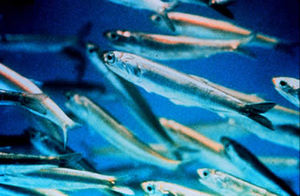
fishfeedsardines.jpg

Anchovies: What is Marine Stewardship Council thinking?

Related

Nobody likes to waste good food. Turning perfectly good herring, sardines, anchovies, and other fish into animal feed is wasteful, because those fish can be food themselves.

Fifty years ago, less than ten per cent of fish caught were used to make into fishmeal. Pigs and chickens were fed mostly grains and fish farming was a cottage industry.

Fast forward to the 21st century. In the throes of a perverse industrial food system that favors cheap protein and quick growth, we now feed farm animals lots of small, tasty fish.

Each year 30 million tonnes of small wild-caught fish -- one third of the global declared catch -- are ground up to feed industrially farmed fish, chicken, and pigs. In light of widespread overfishing and malnutrition, is it ethical to turn one out of every three marine fish into powdered pig feed?

We were dismayed when we heard that the Marine Stewardship Council (MSC) announced recently that the process has begun which could lead to the certification of Peruvian anchovies -- a fish which contributes to about a third of the world's fishmeal production.

The MSC is making a mistake. This issue is not whether the fishery is 'well-managed' but what we do with the fish.

Evolution of the Marine Stewardship Council

Like the organic food label, the MSC is a certification scheme. It was founded in 1997 as a joint project between WWF, one of the world's largest environmental organizations, and Unilever, one of the world's largest seafood retailers. They wanted to source all of their fish from sustainable sources by 2005.

It seemed like a good idea at the time. The MSC designed a set of ecological criteria for certification, which earned approval from a wide audience of scientists around the world. However, after a roaring start, the MSC ran into problems of governance that stalled its progress. Only a few small fisheries were certified (because small-scale fisheries are more likely to be sustainable) and the MSC came to be seen as parochial.

When the MSC re-emerged under new dynamic and well-intentioned leadership in 2005, it had to catch up, and the percentage of tonnage certified became the sole criterion for success. As of the end of 2007, about seven per cent (~5.25 million tonnes) of the annual global landings of marine fisheries were MSC-certified, although not without contention from some environmental groups.

In 2006, the MSC came under even greater pressure to certify more fisheries after it teamed up with Wal-Mart, which unrealistically pledged to source all of its captured fish from the MSC by 2010. This partnership had the perverse effect of shifting the MSC's mission from certifying good fisheries to certifying big fisheries.

Why not feed people?

Enter Peruvian anchovy.

Peru catches five to ten million tonnes of anchovies each year -- which it exports as fishmeal, a product which is price-competitive with soymeal and other grain feeds, in part because poor countries like Peru are willing to take low prices for the fish.

Meanwhile, half of Peru's population (15 million people) lives under conditions of critical poverty and one-quarter of infants are malnourished. Anchovies could eradicate this problem and similar ones in other countries, but we currently waste this protein on animals. In fact, this led to a major campaign in 2006 involving conservationists, chefs and politicians to remake the image of the anchovy.

The goal was to develop local and export markets for human consumption of anchovy, and to make investing in freezing and canning facilities attractive so that Peru could afford to shift away from turning perfectly edible fish into fishmeal. During the week dedicated to promoting the anchovy, over 18,000 Peruvians tasted the small fish at more than 30 restaurants in Lima, the nation's capital. By late 2007, one year after the campaign began, demand for fresh, frozen and canned anchovies had grown many-fold.

But the MSC certification threatens to subvert these efforts.

Propping up salmon farming status quo

If the MSC certifies the Peruvian anchovy, it will look good in terms of tonnage certified -- but this comes at an immense price. An MSC certification would open the door to certifying other fisheries for animal feed and indicate that feeding these fish to animals poses no ethical concerns.

The certification would also undermine efforts to reform salmon farming. The bulk of Peruvian anchovies go to the Norwegian-owned salmon farms in Chile, which consume more fish than they produce. Both agriculture and fish farming need to revert back to less intensive systems which require only plant-based inputs.

No fishery that catches fish for the production of animal or feed fish oil should be eco-certified. Instead, there should be efforts to celebrate these tasty fish, like Oliver Sacks' homage to herring in the New Yorker.  [Tyee]

7  Comments:

Login or register to post comments

  • pmajluf

    3 years ago

    MSC and the anchoveta fishery

    Dear Daniel and Jenniffer: Straight to the jugular, as usual. I agree with you both that the idea of MSC certification of the anchoveta fishery is something we need to look at very carefully. It is happening and soon (the pre-assessment begins at the end of the month), but fortunately, in a first for the MSC, with the agreement by the industry to allow external observers throughout the process.
    Do we worry?, certainly. The MSC certifies the fishery management - before landing - without worrying what happens during landing or what the fish are used for. As the person behind the main push to promote the use of anchovetas as food in Peru, obviously I worry greatly that this will affect the important changes in the use of this key marine resource that have been happening in the last 3-4 years here. But, we need to consider that if it's not MSC, the industry will pursue certification, "no matter what" - as I have been told repeatedly by key people in the industry.
    It's definitely not perfect, by any means, but at least MSC has explicit criteria for the certification and is closely watched as it goes about certifying fisheries all over the world. We saw with great worry what has happened just recently with the Krill fishery, where, against expert advice, the MSC has certified the Aker Biomarine Antarctic krill fishery, with important potential impacts for the unique wildlife aggregations in the Antarctic.
    What we hope to achieve here in Peru is to closely observe the process and make sure the MSC principles are followed to the letter, perhaps even following the special criteria for feed fish that will be discussed in DC in a couple of weeks with the MSC, before certification is even remotely considered. As is, there are still a number of key issues that are still to be solved before MSC certification is possible: ecosystemic impacts of removing critical biomasses of the main forage spp in the Humboldt system, lack of legal mechanisms for transparency in the management system, pollution during landing, etc. We hope that the MSC process will help us push for long needed legal reforms that will help improve this situation, while at the same time keep on pushing for the continuing increase in the use of anchovetas for food for humans.
    An MSC certified can or bag of frozen anchovetas are very desirable. They can help us push this improved and better use of this wonderful fish around the world. If MSC also helps achieve improved fishery legislation, then, while still fishy, we avoid other less reliable certification schemes (the rotten fish...) and at the same time achieve important improvements in this, the largest fishery on earth.

  • rangergord

    3 years ago

    wasted fish

    From a sustainability perspective fish should feed humans directly rather than be fed to fish and livestock. There should be exceptions for fish processing waste and bycatch that is unsuitable for human consumption. With as much as 90% of the world fish stocks fished out there is no room for overuse of the fisheries. As far as cerification goes, it is a fascist substitute for government regulation and enforcement. Governments have decided it is too expensive and ineffective to rely on regulation and so industry regulates itself through the bureaucratic BS of certification that glosses over of ignores the real issues while offering the public false assurances that every thing is okay. A close examination of forest certification here in BC is all that is needed to understand just how woefully inadequate certification is. Cerification allows companies to proceed with business without having to change their attitudes. Just add more policies and procedures to manual and advertise that you are now certified eco friendly and get those profits flowing again.

  • roady

    3 years ago

    farm fish...ya gotta be kidding

    i live on the west coast, why would i want to eat a fish raised in a pen fed prawn bait!! that be like eating the whales in stanley park!! go any where there are fish farms and you can see pollution and the damage it does... GOOD ON YOU RAFE TO TELL THE TRUTH!!!

  • Fish-counter

    3 years ago

    Fisheries management; the very definition of the word "oxymoron"

    We Canadians are SO good at managing our fisheries that of the 10 million-plus Sockeye expected up the Fraser this year, just over one million fish returned. Calling this "science" is an insult to the word "science" and to the intelligence of the audience.

    Like every fishery on Earth, the Peruvian anchovies are under stress. I hope the Peruvians are better fisheries managers than Canadians. We are right to be concerned, but maybe we should just keep quiet to avoid embarrassing ourselves. If we start to criticise the Peruvians, perhaps they will ask about our Atlantic cod and salmon stocks.

    What we THINK doesn't matter a jot; it is what we DO that counts. What Canadians have DONE is to drive Atlantic salmon and cod stocks down and the Pacific salmon are going the same route.

    The cities of Vancouver and Victoria puke raw sewage into the sea and the resident Orcas are the most polluted marine mammals on earth. Still we "study" the problem.

    We need to look in the mirror before we criticise other people. The only test that matters is history. In ten years we will know if the Peruvians are as stupid and deceitful as Canadians have proven themselves to be. Certification doesn't matter one iota; it is a red herring.

  • sicntired

    3 years ago

    Wild salmon just don't have a chance

    These fish are part of the food chain that sustains our Pacific eco system.They also sustain Natives lifestyles but as this is just another assault on the pacific salmons life cycle the point will be moot in another few years.We were warned that wild salmon had 8 years unless something was done about salmon farming.The disappearance of 11.5 million salmon from the Frazer river this year comes as no surprise to those of us following the situation with horror.That the fisheries minister was in Norway working on bringing more farms here eliminates any doubt that the blame can be placed squarely on the shoulders of both levels of government.This kind of ill thought out program is just another in a series of decisions that have spelled the end of the Frazer river runsw unless action is taken now.

  • ME2

    3 years ago

    forage fish

    In my opinion, the harvest of small fish such as the Anchovy should be rapidly phased out. These fish are most aptly known as "forage fish", which includes the Herring on the West Coast, the Menhaden on the East Coast, the Sandlance in the North Sea, the Sardine off the US West Coast, and so on through all the world's oceans and seas.

    Virtually all life is derived from the Sun's energy. On land it is firt captured by plants, and in our waters, it's the algae and the phytoplankton that do the job of photosynthesizing.

    In our oceans and seas, the phytoplankton, and the zooplankton (krill being the largest) which feed upon them, are the origin of virtually all other life forms, and only a few of the ocean's creatures are capable of feeding upon them in turn. Some of these are the Corals, the clams, some whales, the forage fishes......and the jellyfish.

    In turn, the forage fish are the primary feedstock of those larger, valuable fish we really prize, such as Tuna, Salmon, and Cod. The equation is simple....harvest more forage fish, harvest less of the others. Because this connection is difficult to quantify, it is conveniently ignored.

    Also conveniently ignored is the fact that since there isn't another plankton feeder at the scale of the forage feeders, the progresive loss of these fish means the progresive loss of energy input into the whole of oceanic life systems.

    Well, not quite, the other major feeder on the plankton is the jellyfish, ready to expand in numbers to fill the vacated niche. On the US East Coast, jellyfih swarms are becoming common, particularly in the Gulf of Mexico, where stinging jellyfish are rendering beaches unusable. Last month a awarm of jellyfish wiped out Scotland's larget fish farm, a first-ever event. As i recall, a few years earlier, the Black Sea became devoid of virtually all marine life except jellyfish.

    At present, many European beaches are also becoming infested with stinging jellyfish, and the biologists, in common with commercial fisheries biologists everywhere, are shifting the blame away from managemnt to Global Warming of the oceans.

    But it's the age-old story... "There ain't no free lunch". If we don't stop harveting forage fish, we'll pay for it in othe ways.

  • ME2

    3 years ago

    Correction

    A friend has advised me that my account above of the jellyfish and the fish farm was in error inasmuch as the event occurred in Northern Ireland's (not Scotland's) only fish farm, in 2007 - not last August.

    My apologies for not checking this out firrt. For a very quick read, check out:

    http://articles.latimes.com/2007/nov/22/world/fg-fish22

    • The discussion for this story is closed. No more comments can be added.