Why BC's Fish Farms Threaten Patagonia's Penguins
We're stealing their food.
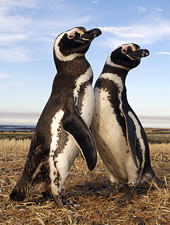
Magellanic penguins
Let me pose a question that no government has dared ask the fish farm industry, so I'll do it for them:
"What is the connection between farmed salmon and the Magellanic Penguin?"
It's been proved that fish farms attract hundreds of thousands of sea lice, so many that they are slaughtering wild salmon smolts in the hundreds of thousands.
We know that the farms dump all manner of dangerous crud (forgive the technical term) on the ocean bed including excrement, antibiotics, dyes used to give their fish the customers the colour they wish as well as highly toxic chemicals to get rid of the sea lice they deny having in the first place. Farmed salmon escape and have taken to breeding in our streams and rivers pushing wild salmon off the spawning beds … and they are bad for your health.
A fish has to eat
But I digress. Back to those pesky penguins.
In the January 5 edition of Science magazine there is an article which should raise troubling questions. I'm grateful to Craig Orr, Ph.D., Executive Director of Watershed Watch Salmon Society for the article.
Let's start with a fundamental fact: Atlantic salmon must eat. Farmers know that and have found that anchovies work nicely to keep their charges happy. It is, to the farmers and our governments, irrelevant that it takes five kilograms of fish like anchovy to make the feed necessary to produce one kilogram of farmed salmon.
Before we go further, well you might ask why the hell are farmers using somebody else's protein -- five pounds of protein in the form of anchovies for one pound of protein in farmed fish? David Suzuki has been asking that question, in vain, for many years.
The anchovies have been fished to a highly dangerous level for off the Peruvian and Chilean coast and now the fish farmers are turning more and more to Argentina.
Heavy on the anchovies
Here's what four prominent scientists have to say in Science:
"The Patagonian coast is famous for its charismatic megafauna—Magellanic penguins, southern right whales, southern elephant seals, and southern sea lions— but the small, less charismatic southwest Atlantic anchovy is a key trophic link in the ecosystem. Overfishing anchovy could disrupt energy flows in the southwest Atlantic ecosystem, harm other fisheries and wildlife, and damage the valuable ecotourism sector....
Rising global demand for fish meal could fuel unsustainable anchovy fishery expansion on the Patagonian coast. Global aquaculture, which uses feeds manufactured from fish meal, increased by 50% between 1998 and 2004, and will likely continue to grow. Uruguay recently approved a Chilean-financed factory to process 200,000 tons of anchovy into fish meal. An increasing human population will create even greater demand for protein and nutrients derived from harvest of forage fish like anchovy.
The southwest Atlantic anchovy (Engraulis anchoita) is a crucial intermediate step in the flow of energy through the food web, dominating the level between tiny plankton and much of the wildlife of the Patagonian shelf. Commercially important fish and cephalopods, penguins, cormorants, terns, sea lions, and dolphins prey on the anchovy. Anchovy compose more than half the Magellanic penguin diet in the province of Chubut. The penguins also eat Argentine hake (Merluccius hubbsi), one of the commercially important fish species that prey on anchovy.
Anchovy populations are naturally quite variable, and longer-lived predators are able to cope with this variability -- as long as good years follow bad ones."
Local is global
The point?
First, the anchovy population is critical to many species in the region's eco-system.
Secondly, the Atlantic Farming industry in British Columbia is a dirty industry no less than a coal fired energy plant is.
And, finally, when you eat that farmed salmon remember that you're munching on anchovies that should be in the beaks of those Magellanic penguins.
Unhappily we tend to look upon farming Atlantic salmon only in terms of our own environment whereas the fish farmer's footprint pops up half way around the world.
As long as our environmental attention is keyed in on Kyoto, the day to day despoiler of our environment will pollute away and seldom, if ever, be called to account. And until enough of us understand this, fish farmers and other abusers of the environment will continue to get away with it.
By all means, look to Kyoto. But we must also keep our eyes on local stuff that we can and must do something about. For as we move to save our wild salmon from execution from fish cages we're helping to save a lot of critters who live a long way away. ![]()


38
Login or register to post comments
seanorr
5 years ago
not so Happy Feet
not so Happy Feet
Right to Bear
5 years ago
..for the future of our children and the earth
Thanks again Rafe,
The impact of our species is felt all around the world. The cascade effect of farming salmon on many species, including us, is mind-boggling, and it is astonishing Gordon Campbell is allowing for the application of MORE open net farming. Every time I look around he is promoting this deplorable industry. Campbell clearly has no thought for the future of our children and the earth. Most FN's on the coast will have nothing to do with fish farming, and those that have implemented it on their territories, live to regret it, as do their neighbors who live on the surrounding territories...
We need people being more “vocal”, however they define that, to stop the spread of fish farms here on the B.C. coast...
Thanks Rafe for your voice on this issue,
Peace,
Bear
Grumpy
5 years ago
This is the end
When we destroy our ocean food supplies then the four horsemen of the apocolypse will come. and we are doing it. Food farms where we convert 10 lbs of eatable fish for 1 lbs of eatable farm fish is utter and complete lunacy.
When countries who depend on the sea life for food, find there is none will fight for it.
Example North Korea, with a starving population, and no food, would not hesitate in launching a nuclear war.
With farmed fish we are destroying the environment.
Chris H
5 years ago
Don't be part of the problem!
Don't be part of the problem! Don't eat farmed fish.
BC Mary
5 years ago
Even anchovies depend upon an enlightened media
Rafe:
How true it is, that an enlightened society is utterly dependent upon an enlightened media.
Otherwise, how would we have known what you've just explained?
Thanks immensely.
Jeffrey J.
5 years ago
Thank you Rafe
Thank you Rafe for doing what you do. We NEED independent and critical voices like this. And of course, THANKS as always to the Tyee. The science in this area has been conclusive. The consequences of this man-made intermeddling with nature are pretty clear. We now need some leadership. With more and more people turning to websites like the Tyee and turning off the mainstream media, hopefully that day will come soon.
Burgess
5 years ago
Our Coast
The abuse of the Ocean's biomass is nothing short of criminal. It is almost as if industrial capitalism wants to squeeze the last dollar from the fish just for the sake of their shareholders. (Make that overpaid greedy ceos and managers.) 'Get it now and bedamned about future generations' seems to be the credo with these folks. It is also time to have DFO do something about the contracts with the Russian and Polish draggers scooping up tonnes of fish off our coast and throwing back two thirds of the catch in their nets. (Each of the factory boats also have BC fishermen dragging for them as well.) Take a cruise off Tofino and follow one of these ships and see for yourself the waste. It is going to be interesting to see some of the comments from the Rafe bashers on this thread.
eight
5 years ago
Getting Gordo's Attention
It is very apparent that Campbell and his band of sycophants don't care a fiddler's about wild salmon, let alone Magellanic penguins. But they have a long evidenced history of not really caring much for trade unions or the First Nations either, yet recently began to pretend that they do.
The reason for this is simple. The trade unions and the First Nations have the ability to give Gordo two big black eyes in front of the international community during the Olympics. So contrary to his previous stance, he now bends over backwards to assuage them.
One would hope that we, and sufficient high-profile environmental organizations can let Campbell and his minions know that their despicable fish-farm policies will be loudly and consistently communicated to those focused on BC before, during, and after the 2010 Olympics. Who knows, he might then at least pretend to give a damn about the environment.
Grumpy
5 years ago
Mad cow disease and farmed fish
I will not eat farmed fish for one reason - mad cow disease. The fish farmers feed the fish rendered protien from dead and diseased cows and this is how mad cow disease spread so rapidly in the UK.
Eat a farmed fish and chances are you may catch mad cow disease!
murdock
5 years ago
Remember the environment when you vote
It is yours to loose.
Just finishing your thought Rafe.
doggone
5 years ago
as a tourist
I have visited both the Broughton fish farms and the Penguin Rookeries in Tiera Del Fuego. I did not (until now) see any such connection between them. That needed to be pointed out to me clearly even though I suffered over the years from a disease named "Whole Systemitis"
(look up "Whole Earth Catalogue").
Discussing this article and thetyee in general just now with a friend. He suggested that we short circuit the problem by eating penguin before they loose too much weight
MJK
5 years ago
Something's fishy
The Big Problem is that there are far too many of us and not enough protein to go around.
Factory farming of red meat or fish carries a lot of baggage. Soy and other veggie proteins will soon be prime sources for bio-fuels and will be far too expensive to eat.
Maybe penguins are the answer. Maybe WE are the question.
clubofrome
5 years ago
What's for Dinner?
In 2012, the number of humans asking that question will be 7 billion. Raping the oceans for first run protein is bad enough, raping for a 5:1 loss of protein to feed farm salmon? Lets not only accelerate the loss of wild salmon with fish farms, lets drive other species to extinction too! That way soon all the wild fish will be gone and there will be nothing to feed to the farmed fish, thus eliminating the farmed salmon. Makes perfect sense to me. Kill your own industry but not until you have killed the others around you. When is someone going to court to stop this insanity?
doggone
5 years ago
Beyond Soylent
Watched a Danish movie the other night called "The Green Butcher": We could become the solution given the right marinade. Like that Serpent eating it's tail.
The only problem I see looming is what lottery will determine "who will (be) serve(ed) and who will eat" Apologies to Leonard
Fish-counter
5 years ago
Anchovies for Farmed Atlantics?
This has bothered me for years, too. We have fished out 90% of the large marine fish, and are scraping the barrel to the bottom. Aquaculture feeds millions, but not for long if we keep this up.
We should be fishing for Asian carp in the Mississippi. There are lots of them, and they feed themselves very well on indigenous fishes.
alive
5 years ago
thanks Rafe, happy to have
thanks Rafe, happy to have you to dig up these calamities.
Seems that Campbell has allowed the farming of "gooeyducks" around the Campbell river area, without any research on the implications.
But who is surprised that he will let the nature get raped for a few dollar$?
Kano
5 years ago
taste is the difference
I still find the bland taste and mushy texture of farmed salmon to be the strongest argument for wild salmon.
It's not well-publicized that commercial prices for some salmon species are incredibly low. The premium stuff (sockeye and chinook/king/spring salmon) commands decent prices, though much less than you'd see at the fishmonger/supermarket. I think last time I was out in the summer of 2005, round (undressed) gillnet-caught sockeye was going for around $1.50/lb.
But other wild salmon, still quite delicious, is ridiculously cheap and therefore abundant. Chum salmon was worth $0.15-$0.25/lb at the time. The price on these fish is higher for round than dressed, because their value is in their eggs! The females will have the eggs removed and those will be sent to Japan (where people are actually willing to pay for them). The meat has very little value.
I couldn't find BC commercial prices, but here are some exvessel Alaska commercial prices ($US) . Chum salmon is good eating! And pink is inferior to the other wild Pacific salmon, but certainly at $0.02/lb a healthy protein source which damages the environment less than toxic farm salmon.
Kano
5 years ago
Sorry, here's the Alaska
Sorry, here's the Alaska commercial price link.
http://www.cf.adfg.state.ak.us/region2/finfish/salmon/bbay/brbpos05.php
benalbanach
5 years ago
fish farms
I seem to remember that Save-on-Foods,or whatever it was called then,once took a moral leap forward (?) in banning Playboy Magazine.In the so-doing I guess it could be argued that many a male adolescent mind was saved from the polluting influence of the photographically altered human female body.
Perhaps it's time for a more easily justified removal of polluted material,that of the farmed Atlantic salmon.Sure it may cut back on profits to some extent but hey...profits are not everything...Sacrifices have to be made.Remember the centre-fold.
sdgreen
5 years ago
Fish Farms
open sea (coastal etc) fish farms should be banned.
Exception, Oyster farms.
No doubt about it.
eight
5 years ago
Taste Test
"I still find the bland taste and mushy texture of farmed salmon to be the strongest argument for wild salmon."
Kano, you might be interested to know that I have an e-mail message from Barry Penner, our illustrious Environment Minister (who isn't allowed to delve into the fish-farm issue,)actually stating that he prefers the taste of farmed salmon over wild.
japander
5 years ago
Modest Proposal
Feed them soylent green. Poetic and environmentally friendly!
DPL
5 years ago
If Penner likes farm fish
If Penner likes farm fish its one more reason not to like farm fish. The guy stumbles around on many subjects. Wasn't it him a couple of days ago speaking for the health minister when the Lower mainland health ahtority decided to shut a few operating room till end of the fiscal year. He said the government would pick up the costs, only to tell us a few hours later, the hospital auhtorities found the money. Anyone believing that fellow should give their heads a shake. The idea of eating that stuff and saying it beats in the wild salmon is someone trying to sell us something. They sell a great majority offshore so just don't buy it, like a lot of us, we don't buy fish that do drugs.
maestro
5 years ago
Kano: Re salmon prices
Kano:
FYI
When I purchase wild salmon off the docks from the fishermen ...I find Sockeye goes for $5- $6 lb,
Chum about $2 lb.
Pink about $2 per lb.
Best price I have gotten for sockeye (in season ) is approx $3.50 lb./volume purchase
bawalker
5 years ago
Fish farms also threaten Falkland Island Johnny Rook
The Johnny Rook is one of the rarest birds in the world. Overfishing around the Falkland Islands could cause seabirds, whose diet is the same anchovies used for fish farms and whose eggs the Johnny Rook needs as a food source, to nest elsewhere or to disappear altogether, leaving the Johnny Rook to perish.
doggone
5 years ago
um hum
And the rest of us?
I am accepting that the "Johnny Rook" and the Megalanic Penguin are threatened. What about me?
I feel somewhat threatened too!
I fish occassionaly out of Bamfield. feel bad every salmon (or cod) I club. But I sure like to eat them.
as far as Broughton lice goes: No I won't eat that farmed fish. but I have done that
Way back in the '90s a Liberian general assured me that it would be ok for me to eat the stew he was also about to chow down on. I trusted "J.R." so I ate the stew - it was just fine thank you.
Months later our team was warned not to eat with the local army. Cannibalism - you know
DJT
5 years ago
DPL on Penner
I agree 100%, DPL. This is the same guy who busies himself trying to build high end hotels in our provincial parks while the Environment Minister. Same reason as he tells us farmed salmon is good- 'cuz he's toeing Gordie's line. An obsequious sycophant, plain and simple.
Dave Shishkoff
5 years ago
The solution is easy.
Or, how about this: stop eating fishes, period.
We have no physiological need to eat fishes.
Virtually ALL of us are getting MORE protein than we need (~7% of our daily calories from protein according to the USDA, and they recommend no more than 10%.) There are INFINITELY more cases of illness associated with an excess consumption of protein than not eating enough here in Canada.
So do yourself, the fishes, oceans and rest of the planet a favor if you actually care about this issue - stop eating fishes.
clubofrome
5 years ago
Second that....
I'll second that motion.....
Charlie the Tuna
freebear
5 years ago
Old News for a Tired Soul
Thanks Rafe but I am already aware of the rapacious appetite of fish farms and how they need to find their fish food somewhere!
What do you expect from a scoiety that only 'listens' to positive feedback loops and ignores nature's negative feedback loops.
Making us all (in general) fuit loops!!!
freebear
5 years ago
Darn Typos!
Try again!
Thanks Rafe but I am already aware of the rapacious appetite of fish farms and how they need to find their fish food somewhere!
What do you expect from a society that only 'listens' to positive feedback loops and ignores nature's negative feedback loops.
Making us all (in general) fruit loops!!!
There that is better typing!
skumeek
5 years ago
Why are there still fish
Why are there still fish farms?
DJT
5 years ago
Why?
Why are there still fish farms, skumeek? Because there are people who will buy the fish and as long as there is a buck to be made by someone, it will be condoned by our provincial government. Like Shishkoff said, stop eating fishes.
Jen
5 years ago
Protein requirements
Having been trained as an aquaculturist (and working in a tilapia farm), I can't understand why recirculation tlapia farming hasn't taken off more. You don't have to waste water because it is filtered and re-used for the most part, they can be successfully reared in even the coldest Canadian climates (indoors of course) in very "dirty" water (then purged in a small amount of clean water before eating to remove muddy flavours- hence the loving nickname mud trout), they can grow on a low protein, vegetable based diet (30% protein more than enough for adult Tilapia and good growth rates compared to salmon's 49% and up requirements)- no more need for penguin's food fish to feed them- soy, corn, leftover vegetables? Makes great tilapia food. Not ONLY all of that, but you don't need to use medications on them when they are housed in a bio-secure environment, which is easily attainable, and their waste is rich in already soluble nitrogenous compounds which grow the sweetest tasting peppers and tomatoes you will ever have. It takes talent to be a good aquaponic farmer, but it can be done, has been done, and if people are willing to pay a little more for these guys to heat the small amount of make-up water coming into their farms (nevermind the fact that with a bit more money put into their startup cost, they could heat water in a greenhouse environment using solar-power WHILE growing the veggies in aquaponic troughs), it can be done everywhere from desert Africa to suburban Toronto.
There is virtually NO risk of introducing exotics into the local landscape if the surrounding water is too cold for them, and if it isn't, then don't build the farm on a flood plain. No more nasty net pens killing invertebrate fauna and breeding sea lice. This could really go somewhere. If anyone wants to support this venture, go down to the nearest T&T and have them fillet you a nice live tilapia for a price that can't be beat. Just don't buy any other seafood while you're there (it ain't all ocean-friendly). It is sweet tasting white meat and does have Omega 3's in it though not in the quantities of cold water marine fish. And if you must have marine fish, buy canned pink salmon, or just get the darn sardines already (they really are good with mayonnaise). At least you need 1/5th the amount of them to get your omega 3's. Or just eat walnuts.
As for stopping eating fish, that isn't realistically gonna happen till their gone. The reason for this is because every health book in the world is emphasizing the benefits of a mediterranean style diet rich in fish, veggies, legumes, etc, and the Okinawans who eat fish at least once a day have the highest proportion of centarians in the world. We just need to be responsible.
Mmmm, tilapia... it could fix everything!
freebear
5 years ago
Tilapia
When I was at the University of Calgary, Faculty of Environmental Design, a professor was doing just what you described Jen.
For me, a sustainable community would have fish farming just as you describe, locally raised, locally owned, locally consumed; with any suplus being traded or sold to less local markets.
Again, I think we need more crises before people will get the urgency to act now, as opposed to mortgaging their kids and grandkids future!
stinkysalmon
5 years ago
Excellent review of a
Excellent review of a talapia farm Jen.
Just a few things to add: These farms you have talked about I wonder how energy efficient are they. Could apply some green building concepts I'm sure and garner some environmental support.
freebear: I like the idea of the local fish farms. There are plenty of excellent farm sites around Victoria. Maybe the enviros should start there own fish farm co-op (show those fish farmers how to do it).
Cheers.
G West
5 years ago
Tilapia
I think there's a farming operation in upstate New York that's doing exactly what you describe although they also produce trout.
The water is recycled through several intermediate stages and the organic material is used to fertilaze greens and other vegetables for local restaurants.
The results seem very positive and, while not smashingly so, profitable too.
G West
5 years ago
errata
should be 'fertilize'
The spelling and grammar police have not been vigilant.