- Ms Kaye is a Tyee Builder. You can be, too.
- Mary Carlisle is a Tyee Builder. You can be, too.
- Prem Gill is a Tyee Builder. You can be, too.
- Nancy Flight is a Tyee Builder. You can be, too.
- Justin Everett is a Tyee Builder. You can be, too.
- John Westover is a Tyee Builder. You can be, too.
- Nora Etches is a Tyee Builder. You can be, too.
- Edward Henderson is a Tyee Builder. You can be, too.
- Bharadwaj Chandramouli is a Tyee Builder. You can be, too.
- Dean Chatterson is a Tyee Builder. You can be, too.
- Marius Scurtescu is a Tyee Builder. You can be, too.
- Robert Parkes is a Tyee Builder. You can be, too.
- James Murton is a Tyee Builder. You can be, too.
- Susan Doyle is a Tyee Builder. You can be, too.
- Vincent Strgar is a Tyee Builder. You can be, too.
- Helen Spiegelman is a Tyee Builder. You can be, too.
- Subir Guin is a Tyee Builder. You can be, too.
- Kimball Finigan is a Tyee Builder. You can be, too.
- Joanne Manley is a Tyee Builder. You can be, too.
- David Leach is a Tyee Builder. You can be, too.
In Defence of the HST
This is good tax policy for consumers, say two UBC economists, and I agree.
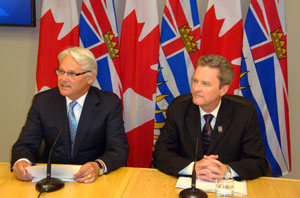
Premier Gordon Campbell and Finance Minister Colin Hansen.
Don't shoot me. I've come to believe that the Harmonized Sales Tax (HST) introduced by British Columbia's Liberal government was the right thing to do.
It's hard not to think so, if you take the time to speak with tax policy experts, look at the results of HST in other jurisdictions (most notably Atlantic Canada), and consider that most other provinces are following Ontario's example by moving to HST.
The opposition can muddy the waters, and consumers can complain that they are getting the short end of the stick, but the truth of the matter is very simple -- HST was a good policy move by the B.C. government.
Is it perfect? Of course not -- no government policy decision ever is. Are there going to be losers, especially in the short-term? Of course there are, there always are. Is this a policy that makes so much sense for the government that it belongs in the 'no brainer' category? Absolutely!
And it isn't just the government that believes so. Professor Kevin Milligan from the Department of Economics at the University of British Columbia is an enthusiastic supporter of the new tax policy and gave it high praise when I spoke with him last week. "HST isn't a left-right issue, and it isn't ideological as far as economists are concerned. It is just good policy," said Milligan. He went on to point out that "It isn't pro-business and anti-consumer. It is the necessary modernization of tax policy."
Over time, consumers will benefit
After I spoke with Milligan, The Tyee published a column highly critical of the HST for B.C., written by former NDP MLA David Schreck, who is a trained economist. Milligan fired back in the comments below the article, Schreck responded in turn, and a spirited back and forth ensued with economist Stephen Gordon jumping in. No doubt the debate is a hot one.
What seems to be lost in the HST argument, however, is that in the long-run, switching to a value-added tax instead of a retail sales tax is hugely beneficial to consumers. The current PST is an embedded cost in most of the good and services we purchase. Just because we don't see PST on the receipt doesn’t mean we didn't pay it. Businesses paid the PST and passed it right on to us as consumers. What is worse is that the current PST is a cascading tax, which means that often the embedded PST was paid multiple times depending on the supply chain of the good. B.C. consumers are often paying double or even triple PST as an embedded cost without even knowing it.
By implementing the HST system, the government is cutting the cost of doing business. It is reducing the marginal effective tax rate (METR) by 40 per cent. This makes business investment cheaper and will help the entire B.C. economy recover from the economic crisis. The METR is one of the most important drivers of productivity and the 40 per cent reduction will be worth $1.9 billion to businesses in B.C.
While some are clearly content to argue that this shows a pro-business bias on the part of Gordon Campbell's Liberal Government, such an argument is very precarious. Individuals rely on a strong business environment to drive the growth of our economy. I know it is akin to blasphemy in some circles to concede such a point, but like it or not, we are all hurt by a weak business environment.
What matters is the ‘passthrough effect’
However, it is indisputable that in the short-term the burden of this reform will fall on the shoulders of consumers. The magnitude of this burden will be dictated by what is known in economic terms as the 'pass-through effect'. This is the idea that in a competitive environment, businesses will pass their savings on to consumers in an attempt to increase market share. Simply put, HST will save businesses money and these businesses will in turn pass these savings through to consumers, which should balance out the seven per cent hike on the price of many goods from the HST.
This point is a little more contentious. There is a great deal of economic analysis about the passthrough effect and some disagreement about the speed and magnitude of the effect. Professor James Brander from the Sauder School of Business at UBC has some concerns about the scope of the passthrough effect in regards to HST in B.C. According to Brander, "There is a mountain of evidence showing that the pass-through effect will not be 100 per cent, and it is difficult to know how long it will take for some of the savings to reach consumers."
This point is supported by the government's position; they hope to see a 75 per cent pass-through rate within the first year as in Atlantic Canada. This number is not just pulled out of thin air. The Finance Ministry's position is based on the C.D. Howe Institute's July 2007 study of HST in Atlantic Canada. The paper, entitled 'Lessons in Harmony: What Experience in the Atlantic Provinces Shows About the Benefits of a Harmonized Sales Tax', supports the government's calculations in regards to the pass-through.
David Schreck attacked that study in his Tyee article. But Professor Milligan agrees with the government's assessment, saying that "There is some rigidity in pricing, but competition is strong in BC and should facilitate a strong pass-though effect." Milligan went on to point out that "We can see evidence of this overtime with other taxes, including the GST.”
Watch September's budget closely
However, the pass-through effect was not the only concern raised by Professor Brander. He suggested that his preliminary back-of-the-envelope calculations led him to believe that dropping the aggregate tax rate of the HST from 12 per cent to 10 per cent would have been a viable option for the government. During a phone conversation last week Brander told me that "A two per cent cut to the total would be a net tax reduction -- at 12 per cent I worry that HST is a slight tax increase."
We will not know the answer to this until the next budget is released in September and we are able to see the details of the government's calculations regarding the revenue-neutrality of the HST.
Milligan did not agree with his fellow UBC professor, pointing out that "I have not done the calculation yet, but it is likely that the tax credits, rebates and exemptions built into HST will make it revenue-neutral at 12 per cent." Milligan also seemed keen to give the government some latitude, pointing out that "Revenue neutrality is more of a range and hard to guess at, it is never an exact science."
Low earners will get tax credit
The tax credits, rebates and exemptions mentioned by Milligan are all important parts of the new tax policy. The government has indicated that part of the burden on low-income earners will be mitigated by a tax credit. According to the government's website: "The maximum amount of the credit would be $230 for individuals with income up to $20,000, and $230 per family member for families with incomes up to $25,000."
There are also point of sale exemptions on good such as fuel, children's clothes, and books. The HST will also maintain the current GST exemptions -- meaning that goods which are currently exempt from GST, like basic groceries, are also exempt from HST.
Furthermore, the HST will include a new housing rebate. Again the government's website makes the rebate very clear:
"B.C. is therefore proposing to provide a partial rebate for new housing equal to five per cent of the purchase price up to a maximum rebate of $20,000. Since purchasers currently pay on average the equivalent of a two per cent tax through embedded PST, there will not be a tax increase for new housing valued up to $400,000."
Government saves red tape costs
Another point in favour of HST is that it saves the government a lot of money -- an estimated $30 million in administrative costs annually -- as well as injecting $1.6 billion in federal funds into the B.C. economy. The position of the federal government in regards to HST was also an important catalyst behind the decision to adopt HST for July 2010. The government's decision to support a rate of 12 per cent, allow the point of sale exemptions, and permit the B.C. government to phase in the import tax credit over five years made HST even more appealing to the B.C. Liberals.
A possible downside of HST is that by increasing the tax rate from five per cent to 12 per cent on certain goods, the government could be increasing the incentive for tax evasion or avoidance. Brander worries this will be the case. Milligan believes that HST will be more of an incentive not to cheat, especially from the perspective of businesses, because they will have to pay HST on their inputs and will need to report their sales. Furthermore, from the government's perspective it is actually easier to police HST because they only need to be concerned with the final point of sale.
What was the premier thinking?
In the end, what both Brander and Milligan agree on is that HST is good policy.
Despite the support for HST from such tax policy experts, the detractors continue to adamantly oppose HST. What is most striking is the narrative that has emerged since July 23rd when HST was announced -- that somehow the B.C. Liberals, led by Premier Campbell, are out to 'screw over' low-income earners, consumers, restaurants, and other services industries in favour of big business. The image they are trying to present is one of Premier Campbell sitting in his office months ago (well before the election) hatching a plan to ruin the lives of anyone and everyone who is not big business. This can't be true.
Of course the Premier was considering HST before the election. The BC Liberals have been considering HST as a policy option since 2001 when Gary Collins was Finance Minister. Any discussions about HST before the election was simply due diligence by the government. It would have been neglectful of them not to discuss HST as a policy option.
The timing of the decision was dictated by practical policy reasons related to the incentives offered by the federal government, and by Ontario's decision to move forward with the HST. As far as the B.C. government was concerned, Ontario's decision made HST in B.C. a matter of 'when', not 'if'. As is often the case with new policy, even really good policy, there is never the perfect time to introduce it -- and rarely will the government be able to make everyone happy. There are often cases where good policy meets tough political realities.
This latest move fits in with a broader approach by the B.C. Liberals. Since this government came into office it has cut 37 per cent from personal income taxes. They have shown a consistent propensity for the shifting of taxes from income tax to consumptions taxes over the long-term.
The merits of that shift can and should be debated.
Still, it should also be noted that the NDP government of Manitoba, led by Premier Gary Doer, is likely to get on board the HST express. Every day he delays is damaging to the Manitoba economy. One has to wonder what Carole James is going to do when a fellow NDPer announces that HST is the future of tax policy in his province. ![]()


344
Login or register to post comments
Grania
2 years ago
In Defense of HST
I am with David Schreck on this one. I am highly suspicious of Calyn Shaw's motives ... personal business advantages perhaps? We are very tired of being told how good things will be for us if we just cooperate while we are nailed to the wall. That old "there will be pie in the sky before you die" promise. Besides, integrity is in alarmingly short supply with our current, appalling, government.
DSchreck
2 years ago
Shaw (part 1 of 3)
Contrary to the assertion in Calyn Shaw’s opinion piece, other provinces are not “following Ontario’s example” in implementing the HST. New Brunswick, Nova Scotia and Newfoundland and Labrador implemented the HST in 1997. Quebec adopted a value added tax in 1991 at the same time the GST took effect, although it is not administered as part of the GST. To date the only province “following Ontario” is BC which announced it will implement the HST next July, but enabling legislation has yet to be adopted. Recall that Saskatchewan once harmonized its sales tax with the GST only to have the taxes separated again after the conservative government that did the deed in 1991 was defeated in November of that year. Shaw speculated on whether Manitoba will adopt an HST and what Carole James would say if it did. The implementation of the HST is polarizing, but it is not political in a partisan sense. People from all walks of life are upset that the tax was announced with no public process. The NDP has a No HST petition, but so do dozens of others of all political stripes. Liberal supporters are not getting behind the tax in reaction to the NDP opposing it; they are launching their own protests.
If the HST (generically value added tax or VAT) is “just good policy”, then we should be able to understand why that is. Shaw is correct to argue that reducing taxes on investments will increase investment because reducing prices on anything generally results in more of it being purchased and increasing prices does the opposite. That is why restaurants are so upset with the HST. The question on investment is “by how much will it increase and when”? How does the HST incentive compare to what would happen if prices recovered in commodity markets?
It is important to have a realistic estimate of alleged benefits in order to determine whether the price that B.C. families will pay through increased taxes will be worth it. The government can tell us how much each industry is expected to save but it has not provided estimates of how much each will in turn invest. It is not as if the Campbell government doesn’t have experience in creating tax incentives for investment in machinery and equipment. One of its first tax measures was to amend Section 13.2(4) of the Social Service Tax Act Regulations so as to exempt “machinery or equipment for use primarily and directly in the manufacture of qualifying tangible personal property” from the PST.
DSchreck
2 years ago
Shaw (part 2 of 3)
Eight years ago, in July 2001 when the exemption of production machinery and equipment from the PST was announced in the budget, the budget documents reported that the cost (for three quarters of the year that remained) of both exempting machinery and equipment and raising the threshold where vehicles were subject to a higher tax would result in a reduction of $134 million in revenue. Table A1.1 in the February 2009 budget documents is titled “Social and Income Programs – Tax Expenditure”. It reports that excluding food, both basic food purchased at grocery stores and meals purchased at restaurants, resulted in a loss of $991 million in PST revenue. Estimates are also provided for lost revenue due to the exclusion of various other consumer goods (some of which will be taxed with the HST), but no figure is given for what revenue is lost as a result of the 2001 exclusion of production machinery or equipment.
If the government is betting that switching to the HST will be justified because it stimulates investment, shouldn’t it be able to demonstrate both the cost and benefits of the 2001 tax change on equipment and investment, and shouldn’t it be able to say why it has opted for the HST rather than an extension of the exemption it made 8 years ago?
It is simple arithmetic that if government’s revenue is to remain the same after businesses save $1.9 billion, then B.C. families will pay that much more through taxes on most things that currently attract only the 5% GST, an average per person tax shift of $428. Where is the evidence that the benefits from increased investment exceed the costs to B.C. families?
The B.C. economy will recover from the economic crisis when commodity markets recover, but until then implementing the HST could postpone economic recovery. Politicians frequently point to small business as the engine of economic growth. It is clear that the restaurant and tourism sectors, which are very price sensitive, will lose business as a result of the HST. In the past government has pointed to tourism as an industry that could pick up the slack in depressed resource communities. An HST rebate isn’t going to cause a mill to open; that will take much higher prices for lumber.
DSchreck
2 years ago
Shaw (part 3 of 3)
We would all like to help business. The issue is what are the consequences of the various policy options that are available? Government has provided a variety of types of tax relief for businesses over the years, but never before has it engaged in such a large shift in taxes from businesses to families.
Shaw discussed whether business tax savings will be passed through to consumers in the form of lower prices. The evidence on that point is inconclusive. Claims about a 75% pass-though effect in Atlantic Canada are based on statistically insignificant results, but it isn’t necessary to get involved with complicated statistics to see the flaw in the argument. Tax savings received by export industries aren’t going to be seen in the form of lower prices for B.C. families.
Shaw is only half right when he says that the PST is a cascading tax that results in a tax being levied on a tax. Don’t confuse that with the GST tax-on-tax at the gas pump. When the PST is levied on a pencil, it is true that part of the cost of the pencil is reflected in the cost of any computers the merchant purchased and on which the merchant had to pay PST, but it would be impossible to determine what impact that has in the price of the pencil. Furthermore, since price is determined by both supply and demand the ability to pass-through costs depends on how price sensitive demand is; the greater the response to price changes, the less able businesses are to pass-through costs. It is not true that all business costs are ultimately paid by consumers; they also affect profits and dividends.
Many people haven’t come to grips with what the HST will do to them. It will take several months after it is implemented before anger spreads. If you think over 100,000 members in Tieleman’s No BC HST facebook group is a big protest, wait until July 2010 to see what happens.
Camero409
2 years ago
HST
Here's what I think of this article. HAHAHAHAHAHAHAHA! What a JOKE! This is a joke right?
Fiat lux
2 years ago
Businesses don't pay PST on
Businesses don't pay PST on goods for resale, because they have tax numbers they can quote.
My SS&MA number, as a custom manufacturer, in Vancouver was 242 224 , here in my present location I have another, which is still applicable, so I won't publish it.
I've been supplying all the major department stores and interior decorators tax free for 35 years.
Where does this nonsense that businesses pay the PST and pass it on to customers, come from ?
As far economists are concerned, the neoclassical theory has been and is the biggest crime wave in human history, based on the fraudulent definition of economic efficiency, the GDP, growth and productivity figures. It can be proven very easily that it is destroying the environment and humanity, yet it is still being taught in our universities.
Since this garbage theory was forced on the world our living costs inflated by over 1,000% and growing every day, while Stats Can reports yearly 2-3% inflation.
Anybody who teaches this fraud should be in jail and anybody who absorbes it is damaged for life.
Ed Deak, Big Lake.
sunshine coast girl
2 years ago
Calyn Shaw has missed the point...
This is the kind of discussion that SHOULD have taken place during the election campaign. The point is not whether the HST is a good move or bad move. The point is that our government straight-out lied to us about implementing the HST because they knew it would cost them the election. What kind of democracy is that? We are not children who need our Premier to decide what is good for us. We are intelligent, reasoning adults who have the right to decide for ourselves what to do!!! It was the BC Liberals job to convince us that this is in our best interests. How dare they make that decision on my behalf!!!
loveavocados
2 years ago
HST
All I know is that, as a hair stylist, my prices jump from $52.50 ($50+GST) to $56. Psychologically, that's a hard pill to swallow for my clients, as they've told me. So I'll be making less AND as a frequenter of pubs/restaurants I'll be spending less, especially since my bar bill will be higher now.
I could care less for "business" and how this benefits them. I think all these government and economy types should spend a bit more time at street-level and a little less in their fancy-schmancy offices with big business whispering in their ears and their noses stuck in text books.
freebear
2 years ago
Tax government lies and misleading statements!
I am sure such a policy would be a revenue windfall!
Good for the consumer?
Argument sounds the same as trickle down economic theory!
All I know is things will cost more and so I will spend less in the economy and reduce spending!
As if business will pass on the savings when they can 'pad' their bottom line with it!
KWD
2 years ago
manufacturing consent
Despite the mental gymnastics entertaining both pro and con sides of the HST argument, what seems to be lost is the fact that the pro-growth folks are railroading society out of sight of the fact we are developing ourselves to death.
On one side of the picture we see the marginal effective tax rate as one of the most important drivers of productivity, individuals reling on a strong business environment to drive the growth of our economy, and a plethora of statistics (I prefer the term sadistics) telling us how we all benefit in the long run. But we really aren’t being given the full story.
What about the other side of the growth picture? “Our rivers and fish face premeditated murder”, developments like the tar sandsands are poisoning our environment and our global climate is changing at an alarming rate.
True benefit/cost analysis employing full cost accounting, that would provide society with a bigger picture, are (not surprisingly) noticeable by their absence.
shaffer
2 years ago
hsat
Agreed -- the hst is a much better tax than the pst. But as Schreck pointed out it is not revenue neutral for households -- it is a massive tax shift. So here is a suggestion. Why not reduce the hst to a rate that would be revenue neutral for households -- say 8% -- and make up for the tax revenue loss by imposing more higher water rentals , natural gas royalties and other unecessarily low resource taxes. Make the business sector (not households) make up for the business sector gains on the hst!
biscotti
2 years ago
examples missing in article
1) Could the author please provide some specific examples to back up his claim that "B.C. consumers are often paying double or even triple PST as an embedded cost without even knowing it"? And how typical these examples are (or are not) in most people's lives?
seth
2 years ago
Replace sales tax with income tax on the rich
When Mulroney's fascists introduced GST there was a lot of analysis that showed an increase in income tax by 2% would have eliminated the need for a GST. In fact there are numerous studies to show that income tax is a far superior tax structure than sales tax.
Of course, just like with our fascist governments today big business told Mulroney what to do and here we are.
Unfortunately simple minded journalists like Shaw here get overwhelmed with the bafflegab from fascist lobbyists and lose their wits in the process.
If we want efficiency, lets eliminate all sales tax and a la Obama put a 10% tax increase on incomes over 250K to pay for it. After all the rich are the ones that want US to pay for tax efficiency. Let them put THEIR money where their mouth is!!!
Karen D.
2 years ago
Scapegoats
I'm no economist, but I'm not stupid and I did take a couple years of economics in college and I still can't fathom how we are ALL going to benifit from this HST. That $1.9 million in savings has to come from somewhere. Campbell isn't out to destroy the little guy - all he is doing is trying to keep his head above water in this cesspool he created partly himself (through big tax breaks) and we are the scapegoats. Big business would never stand to have their profits jeopardized and the average citizen hasn't the power to defend themselves. So we lose again, not only through cuts to health, education, libraries and on and on...but through more taxes. It is getting harder and harder to maintain an acceptable standard of living because they just keep chipping away at what little we have.
onthebay
2 years ago
my 7 cents PART 1
I think my duckies are slowly getting in a row regarding the impact of the HST on my pocketbook. Please enlighten me if my duckies are lost or wandering!
Thank you to Fiat lux for pointing out that PST is not paid by retailers when they buy items for resale. It puts into question the scope of the “cascading PST” argument. Do you know of any products that might actually contain cascading PST costs? I know I have asked this question before, and have tried to research it, but haven’t gotten closer to knowing if there are any.
The basics:
In BC, if GST and PST are both being charged on an item, or just GST is being charged, the HST will replace these taxes. If the PST is the only tax being charged on items they will have no HST at all, although probably only until new taxes are implemented to cover them - such as the private car sales tax that was quickly implemented by one of the provinces out East when it went with the HST.
The basics on the basics:
There probably aren’t many items that have only PST because GST is a pretty pervasive tax that applies to most goods and services in BC. Exceptions to GST taxes (straight from the federal website) are items such as: basic groceries such as milk, bread, and vegetables; agricultural products such as grain and raw wool; prescription drugs and drug-dispensing fees; medical devices such as hearing aids and artificial teeth; used residential housing; most health care and dental services; certain childcare services; and many educational services.
There are, however, a large number of PST exempt items that BC consumers will have to pay more taxes on when the HST comes into force. Some items that have made the news are things like taxis, ski passes, restaurant meals, haircuts, phone bills, movie tickets, internet bills, vet bills, hydro, new homes etc. Other items, such as processed food and frozen dinners haven’t really hit the media, nor has a listing of a myriad of everyday items. Just checking the BC Food and Drugstore list of items currently exempt from PST (note: the Ministry of Finance site states this is not a complete list) yields about 9 pages of items including such things as: acne preparations, rubbing alcohol, anti-nauseants, ASA tablets, baby bibs, bandages, barbeque briquettes, bark mulch, batteries, bedding plants, carbonated drinks, candy and confections, gift cards, coffee, crayons, crutches, flower seeds, fruit trees and plants, grass seed, gum, etc. The list is LONG, and if any of the items are currently charged GST, which most are judging from the federal government’s GST exemption list, they will be hit with the HST.
onthebay
2 years ago
my 7 cents PART 2
Under the HST the list of items that will be PST exempt for BC consumers becomes amazingly short: gasoline and diesel fuel for motor vehicles, books, children’s sized clothing and footwear, children’s car seats and car booster seats, and diapers and feminine hygiene products.
As many have already pointed out, there is a bit of global warming reduction hypocrisy in carbon taxing gas and diesel for motor vehicles and then exempting these products from the HST. One has to wonder whose angst this manoeuvre is meant to appease. Books will be exempt, but funding to libraries is being slashed. Mixed messages? Children’s sized clothing and footwear is exempt; however, adult sized clothing, whether purchased for a child or not, will no longer be exempt, which will mean increased costs on purchases of adult sized clothing for larger sized children and for many teens. Children’s car seats and car booster seats are mandatory, so one has to think there should be a lot more help to purchase these items, not just a tax exemption. I’m not sure why diapers and feminine hygiene products are exempt, although the benefit is probably enjoyed by many. Note: Currently only cloth diapers are PST exempt but there is no such qualifier in the new exemption list which may mean that disposable diapers might be exempt too?
I don’t know about the rest of you folks, but, unlike “investment/ business” accounting, (which is very well discussed in the article and in DSchreck’s replies - THANK YOU!), my household accounting is pretty straight forward. My budget is fixed. If I lose 7% to taxes on a whole lot of items I have 7% less to pay for goods. What products / business lose my dollars is up to me, but it will, of necessity, happen. I know I will never be able to see as straight a line to any savings that might be passed on from businesses, if there ever turns out to be any.
Van Isle
2 years ago
If this HST is going to be
If this HST is going to be good for us in the long run, how come the mantra by Liberal/Conservative idealogists is that all tax is bad? Oh, I see it now; Tax for most people is good and for some it's bad.
Hughes
2 years ago
Honesty is the best policy
“There are often cases where good policy meets tough political realities.” C.S.
“Good policy” is to always tell the truth, something this administration is want to do. Further more, if the HST is such a good idea and a certain boon to BC’s economic recovery, Campbell should have included it in his election campaign thereby providing the people of BC the opportunity to decide what the “tough political reality” would be. What with his $30 million per year Public Affairs Bureau with its 200 plus spin doctors, surely he could have convinced at least 40 percent of eligible voters that adopting the HST is the right thing to do. It’s called democracy; again, something this administration seems to have little respect for.
IMO it’s not so much the HST per se that has caused all the furor, but rather, it’s the chicanery employed by this administration that is the true bone of contention here. This quite simply should have been – could have been – an election issue and decided democratically.
EDITED FOR LEGAL CONCERNS -- TYEE EDITOR
Van Isle
2 years ago
With all the hot air that
With all the hot air that has been floating around since the Liberals announced this wonderful HST, how come no one has mentioned anything about a complete shake up in Canada's and B.C.'s tax collection system? Seth has a remark, which I do remember with the GST.
Skywalker
2 years ago
Some things are certain and some must be taken on faith.
It is certain that everyone will pay more on more things. After that you have to take on faith that Campbell, Hansen and all businesses are honest and will make sure that consumers get the savings that supposedly should eventually trickle down to them. But I'm not that naive. Campbell and Hansen have lied before and quite often and business at the very least has approved of those lies so my faith in these guys is finished.. Calyn might still have faith and that suggests she is very naive or there is another motive for her column. Nobody at the coffee circuit is buying it. Nobody has faith in the two in the accompanying photo above. The BC Rail lie, fudgit budget lie, HST lie to name just a few have done it. They might as well claim the NDP has WMD's it would be just as believable as the comment that the HST will cost you less or that it is revenue neutral.
Fiat lux
2 years ago
Letter in Williams Lake Tribune, Aug 20.
Erin Hitchcock, quoting MLA Barnett on the HST in the Aug 13, issue: “Businesses will recover the tax paid on their services, and prices of goods, and the prices are supposed to fall by the amount of tax they no longer have to pay on their purchases”.
This is nonsense. All businesses use tax numbers and never pay taxes on services and purchases for resale. I've been in the custom furniture business in Vancouver from 1957 to '79 and locally until my retirement. Still have the tax numbers that permitted me to buy the materials, and sell to other businesses tax free, provided they also possessed the necessary exemption numbers. The only time businesses have to pay PST taxes is when they buy products for their own use.
MLA Barnett :” It would help industry, it would help mining, it would help forestry, it would help manufacturing, and it would help the private sector industry move on a litle quicker”
It is easy to make such ridiculous claims, but where are the facts to prove them? What help is she talking about, when these industries are already tax exempt for goods and products for resale. There's never been a provincial tax on services, without resource inputs, only on goods produced and then only to users. The endorsements by the Business Council and the Chamber of Commerce are meaningless, as what they're selling is ideology, to bolster the government's lies.
Barnett:” When something comes through the doors of a manufacturing plant, for example, it has PST on it. There is only supposed to be PST on it at the end, so that would eliminate it, which should bring the consumer price down”. More nonsense. There's never been any provincial tax at any level except at the end, to the final users.
Mulroney used the same lies when he forced the GST on the public, raising costs, by claiming that the then existing 11 or 12 percent Manufacturers' Federal Sales Tax, or FST, made our exports less “competitive”. I have exported products to the USA, even to Hawaii, and there's never been any FST on goods exported. That whole racket, as Campbell's is now , has been designed to put more and more taxes on the general public, to permit the multinational corporations to take more wealth out of the country, based on the demands of the corporate PR agency by the name of the Fraser Institute, for the elimination of all taxes from businesses and transfer them on the public.
As far “more investments” are concerned, BC is already one of the worst overcapitalized places on Earth. Few people realize that overcapitalization with imaginary monies, created from the air, is a weapon used to expropriate our resources. In the past 35 years it has caused an over 1,000 percent inflation of our living costs, causing destruction and daily growing poverty, without any benefits. Do we really need more?
Ed Deak.
biscotti
2 years ago
remembering the GST
Let's not forget that the GST is a "free" trade tax, brought in by Mulroney as part of the Canada-US Free Trade deal to replace the manufacturers' tax that was supposedly crippling our productivity.
Does anyone believe that their GST tax credit makes up for the real additional amounts that they pay through this regressive tax? It's part of the shift from progressive income taxes to regressive taxes.
Sadly, many people (e.g. this author) have become so used to "value added taxes" that they have lost sight of this history of downloading more of the costs of government & services onto middle/lower income individuals and away from big businesses and the wealthy.
Once entrenched, the narcotic effect of revenues make them nearly impossible to get rid of, regardless of the political stripe of the government in power.
Matt T.
2 years ago
The Politics of It All
And that's all Carole James has to do. Promise BC'ers that once they are elected government they will rescind the HST just as the Saskatchewan NDP rescinded the HST in 1991.
Or will they flip-flop just like they did on the carbon tax after the election now claiming that they are in favour of it?
And the Manitoba NDP government is also now seriously looking at implementing the HST without telling voters during the last election. Just like the Ontario and BC Liberals.
Voting for a political party these days is like buying a pig in a poke!
G West
2 years ago
Absurd
The suggestion that an increase in a regressive consumption tax in a time of recession/depression is good public policy is purblind nonsense.
Anyone who says that the HST is not in increase in tax and costs for consumers is, to put it crudely, pissing into the wind.
In fact, we are currently entering what may be a period of significant deflation and rising job losses and unemployment in British Columbia.
A consumption tax increase - in an economy where increasing consumption and stimulating demand ought to be the central tenet of fiscal policy isn't just foolish - it's insane.
There is no shortage of jokes about economists...nice to see that current company will be providing material for funny stuff for the foreseeable future.
As some wag put it, economists are important to help rescue the reputation of astrologists.
kevinmilligan
2 years ago
some thoughts
Here are some thoughts.
1. David Schreck would like to understand why the HST is good policy. Here is a nice primer on GSTs, VATs, RSTs, and HSTs. That will help you get started. Here is the google scholar search on VATs--874,000 hits. We're not short on literature.
2. David Schreck is quite concerned about the restaurant industry. It's likely true that the restaurant industry will take a bit of a hit relative to other industries. However, the right question is: Why should the restaurant industry pay a different tax rate than purveyors of other goods and services? Why do they deserve an implicit subsidy? In my view, the best system of excise taxes is one that taxes good and services from all industries the same; a level playing field.
3. Tax incidence: "It is simple arithmetic that if government’s revenue is to remain the same after businesses save $1.9 billion, then B.C. families will pay that much more" Your arithmetic is right but your economics is wrong. In most ECO 100 textbooks, the subject of tax incidence is covered. The incidence of taxes is always on a person, not a thing. When you tax a business, either the owner, the employees, the suppliers, or the customers will take the brunt of the adjustment. What that means is that When you tax business by $1.9 billion, it is one possibility that business owners suck it up and reduce their profits by $1.9 billion. More likely, they pass on some of this through wage cuts to their employees and price increases to their customers. Same holds in reverse as taxes come off. If there is some competition, firms will pass through some (or all!) of their savings in order to keep some of their customers.
Imagine the following. You run a hammer store. One day, the government switches from an RST to a VAT. Now you get to deduct the RST you paid on your inputs (e.g. gas for your hammer delivery truck). You could a) pocket the savings or b) pass through the savings to your customer. If there is another hammer store right across the street, my contention is that some of (b) will be going on, so that the hammer store owner can keep his/her market share.
I don’t contend that the price savings will pass through 100%. That’s unlikely. I’m just pretty sure that it’s not 0%, as David Schreck’s arithmetic assumes.
kevinmilligan
2 years ago
More thoughts
4. Cascading of taxes.
A couple of people wondered about the cascading effect. David Schreck’s example of the PST on the cost of computers for the pencil company is correct. I agree with him that it is hard to nail down exactly how much PST is embedded in prices—and it varies greatly by which good you’re talking about. But, just because it is hard to estimate does not mean the effect isn’t there. There is a vast literature on the cascading effect. Have a look here.
5. The HST change is a big one, but let’s keep perspective here. Even taking the 1.9 billion number at face value, this is only 1% of BC GDP. Hundreds of countries have implemented VATs. In not one of them did clocks stop ticking or flowers stop blooming.
onthebay
2 years ago
Fiat lux
"The endorsements by the Business Council and the Chamber of Commerce are meaningless, as what they're selling is ideology, to bolster the government's lies."
You are being WAY too polite in calling what they are selling "ideology." :)
kevinmilligan
2 years ago
Recall there is a low income tax credit.
"The suggestion that an increase in a regressive consumption tax in a time of recession/depression is good public policy is purblind nonsense."
I would agree with you--if there were no low-income tax credit. A well designed tax credit can help out a lot. See Stephen Gordon on this point.
nechakogal
2 years ago
tax is good for the majority of middle and low income earners
...but it is real bad for a minority of wealth holders. That is the mantra I think.
Although I am not completely opposed to taxes, I think most of us are tired of the game. Everyone knows that NDP would only subject the tax to a review if they were given the opportunity to take the helm. I have been pleasantly surprised by some of the discussions coming out the HST debate. Perhaps there is hope for democracy in Canada after all.
http://www.opinion250.com/blog/view/13789/1/surprise+attacks
G West
2 years ago
No it won't kevin and you know it.
Consumption is down among all income groups (not just the poor and working poor) the economic levers aren’t working Kevin in fact, I’m surprised any of you still believe in them. A low income tax credit is simply a sop to the conscience of phony ‘liberals’ who pretend to care about their fellow man - it helps out not at all - in fact, the kinds of people who will be most hurt by the reduction in consumption in industries like retail, tourism and hospitality will lose far more in tips and foregone overtime than they will ever gain from a quarterly low income tax credit - many such people probably don't have sufficient income to be taxable in any case - as you well know.
In fact, the single thing which would stimulate demand and consumption in the appropriate sectors would be the thing Gordon Campbell and his idiot advisers have refused to support - how many times is it now? – would be to increase the minimum wage.
If you truly believed in an effective and payable low income tax credit program you'd support one that paid a living wage to every family and not an insulting pittance like of the GST credit or Campbell's most recent Campbell Gas Tax revenue neutral boondoggle.
Even the Americans under Clinton and Bush understood those facts – something the ‘experts’ designing tax policy in Victoria and Ottawa haven’t clued into yet.
What I can't understand Kevin is how you guys have the chutzpah to spout the same worthless nostrums after what's happened during the past decade.
offended
2 years ago
Pigs will fly
Farmers get PST exemptions under current legislation.
Farmer Offended raises a small number of pigs.
Farmer Offended pays no tax on pig feed. Now.
Farmer Offended will pay 12% tax on pig feed next July 1st.
Farmer Offended will not charge 12% more for pork products.
See? Simple. When pigs fly.
el chief
2 years ago
Let's not fool ourselves,
Let's not fool ourselves, this is a tax increase. The tax rate is the same, but more goods are now being taxed.
1. Raising taxes during a recession is a really bad idea. This is just a transfer of responsibility to the Feds to manage the economy.
2. If the government believes that raising taxes was a good idea, then they could have raised income taxes instead. Consumption taxes hurt the poor more (as they spend more of their money on goods), and income taxes hurt the rich more (as they make more income). This was an idealogical choice.
3. That being said, the rich in BC don't really earn any income. Our $5 billion a year drug industry doesn't pay a whole lotta of income tax. Taxing them at the cash register will at least get something out of them. As well, our resort-town millionaires live off capital gains, not earned income.
4. Despite all that I am in favour of moving from a sales tax to a value-added tax, however I think it would have been politically smarter to introduce it at 11% instead of 12.
5. BC is not that competitive. What do we spend most of our money on? Housing, food, transport, and entertainment.
How many construction/project management companies are there? A handful
How many food distributors? You can count them on one hand
How many car companies? Four sell most of the cars in this town
These people are not going to rush to give you a discount.
How many restaurants? Thousands! Yes, they will pass through the "savings". Too bad your restaurant meal tax just doubled!
Fluxone
2 years ago
terrible article
this opinion article can be classified as conjecture at best. It also appears he had his primary facts wrong as the author he critiques has published a three part rebuttal with a more rigorous argument.
I am also distressed at the continued defense of this tax with “pass-through-effect” argument which is essentially a re-branding of “regan-omics/voo-doo economics/trickle down/supply side theory” which has been widely criticised as an ineffective and regressive tax.
Come on - BC'rs may be apathetic voters but we arent stupid - since when has any large business passed on any savings to the consumer - its not in their DNA.
dave49
2 years ago
Sorry, but the timing is very suspect...
I agree that this should have been an election issue for the "never an unbroken promise" Liberals.
The timing is VERY suspect given the promised a half billion dollar deficit and a recent story suggesting up to a 2 billion revenue shortfall. Given that Federal finance minister Jim Flaherty is waving around his cheque book, the HST seems like a quick way to balance the books.
A friend who now lives in England warned me that a Campbell government would be clever and devious. Once again they can generate debate among the academics about the pros and cons of an HST, but damn the consensus, because there will be none. So, the government will step and make the decision they always wanted to make.
This is exactly why the carbon tax is such a brilliant policy: there is no academic consensus on the effectiveness of the tax we have and no widely-accepted way to prove or disprove that it works. Meanwhile, the carbon tax scooped the NDP and Greens at the polls, creates the illusion was are actually doing something and generates good PR outside of Canada.
Skywalker
2 years ago
That was a line worthy of note.
"clocks won't stop ticking if the HST is implemented." Of course not, no more than the sun won't come up next morning but that is hardly the point. Even if Campbell raised taxes by 50% the clock won't stop ticking. Life will go on but when is enough scamming of the public just plain enough. That is the point. If you believe Campbell everything is just rosy, but who does these days. This is a money grab by Campbell with just enough sharing with his friends to bring them on side. It is devious and dishonest. Thank goodness most people see through it.
wayfarer
2 years ago
BC Greens support HST
Amid all the NDP sky-is-falling hype, Jane Sterk offers what I feel is the most rational, sober position:
"Greens actually support combining the GST and PST but we also believe fundamental decisions like this ought to be made in the Legislature not by the Premier. ...
"We believe reducing red tape is a way for government to stimulate the economy and simplifying taxation systems represents a step in the right direction. We are concerned about the reduced tax exemptions that will result from harmonization.
"The current PST exemptions have rewarded people for buying energy efficient products and that has helped the green industry sector grow. The Green Party would like to see the current Liberal government work with the federal government to provide HST exemptions for products and services related to reducing greenhouse gases."
There is no doubt that the way the BC Liberals brought this tax in (after an election, no consultation, previous pledges not to bring it in) ranks among the most devious, odious moves in BC political history, but this does not mean the idea of an HST is bad for the economy.
As the current HST stands, I like the direction, but it needs work. BC's portion should be lowered, and this tax must have lots of green incentives built in to encourage emissions reductions.
I can understand why the NDP is more excited now than they were during the election campaign - because for the first time in 10 years, they have Campbell backed into a corner. But when the HST dust settles, what is the opposition left with? Tieleman's Facebook club?
I'd like to see the NDP calm down a bit, maintain composure and try and offer up more than the usual reactionary hyperbole. This anti-tax sentiment will not last. It never does. And what does the NDP offer as an alternative, other than excitable opposition for excitable opposition's sake. I think they can learn soemthing from Sterk and Greens on this one.
Hughes
2 years ago
RE: Honesty is the best policy.
Okay. Perhaps this would be less of a “legal concern” for you as a closing statement:
The tobacco companies had their medical “expert”s, big oil have their environmental “experts”, and this administration has its economic “experts”. Whatever the issue, it seems the power brokers can always find someone to substantiate their claims.
kevinmilligan
2 years ago
Hughes
Dear Hughes,
Why do you assume that if I disagree with you that I must be on someone's payroll? Is it not possible for two people to disagree on principle?
I carry water for no political party. I chose to speak out because I think this is a policy that is good for BC.
I opposed the Harper government's cutting of the GST on the same grounds. Interesting question: how many HST critics were big fans of the GST cut? If you don't like VATs, then the GST cut must have been a great thing since it decreased our reliance on a VAT. I propose that as a nice litmus test to see who is a partisan and who is not.
Kaz
2 years ago
I think it's very telling
I think it's very telling that Milligan, and Shaw, have refused to answer G West's final point. There is simply no conclusive proof that this tax will be a benefit to low income earners - that much is blindingly obvious to everyone, regardless of how well-versed they are in the "literature." As with nearly all economists, they are good at pointing out the lack of statistics backing up certain phrases in their opponents' arguments, but fall back on aphorisms like "good for business" when they want to make their own. A classic case, below:
"While some are clearly content to argue that this shows a pro-business bias on the part of Gordon Campbell's Liberal Government, such an argument is very precarious. Individuals rely on a strong business environment to drive the growth of our economy. I know it is akin to blasphemy in some circles to concede such a point, but like it or not, we are all hurt by a weak business environment."
My point is, which businesses specifically are likely to benefit the most? It certainly isn't small ones like restaurants. Consider how high the cost of restaurants already are - if you jack that up a bit, that has a meaningful impact on low income earners who work AND eat there. This is particularly galling in the light of the Campbell government's already patchy record on the treatment of small business (need I mention the Canada Line?). We "in certain circles" accept that people are going to take a hit from the recession; what is curious to us is why the more vulnerable have to take it on the nose rather than the rich.
Do we really need more subsidies to the environmentally backward big industries in this province? They're not exactly the way of the future, and as someone at UBC's Centre for Sustainability and Social Innovation ought to know.
Matt T.
2 years ago
kevinmilligan
This is actualy fair comment:
When the GST was at 7% and reduced to 5%, the federal opposition parties were against that reduction.
Otherwise, BC would now be looking at a 14% VAT as opposed to a 12% VAT.
The social democratic Nordic countries in Europe all have a 25% VAT!
And it's always important to remember that the PST is a "multi-incidence" tax as it is paid more than once during the provision of goods and services, whereas the GST is a "single-incidence" tax.
That said, human nature dictates that people don't like change and typically prefer the status quo.
kevinmilligan
2 years ago
Which business will benefit?
"which businesses specifically are likely to benefit the most?"
Any business that sells goods that used to be subject to the 7% PST and 5% GST and are now subject to 12% HST will be better off because they can claim a deduction for the taxes on their inputs.
So, service providers like restaurants likely won't benefit, but retail stores--big or small--selling taxable items will benefit. A good question is how much of this will they pass on through prices. But some combination of the business owners and its customers will clearly benefit.
kevinmilligan
2 years ago
Evidence on pass through
Ok, I was asked to provide empirical evidence on pass through. Here is a nice study from France. (It has been published in the top public economics field journal here.)
Here is a quote from the abstract of the published version:
"September 1st 1987, the VAT rate on car
sales went down from the luxury-rate of 33.33% to the full-rate of 18.6%. September 1st 1999, theVATrate on
housing repair services went down from the full-rate of 20.6% to the reduced-rate of 5.5%. The consumer
share of the sales tax burden is 57% in the new car sales market and 77% in the housing repair services market."
This means that 77% of the VAT cut on housing repair was passed on to consumers, and 57% of the tax cut for cars.
This isn't 100% pass through--but it sure isn't zero percent pass through.
Why, you may ask, do firms pass through the tax cut? Competition. They want to stay ahead of their competitors, so they pass through (some of the ) savings. The more competitive the industry, the more likely we will see substantial pass through.
G West
2 years ago
No they won't.
The amount of cynicism one attributes to the author of this article (and her economic fellow travellers) is in direct proportion to the distinct impression that, protestations to the contrary, supporters of increases in consumption tax (and lets not kid ourselves that's exactly what this effort is) are ignoring the fact that sales taxes structured the way the HST is aren't targeted to help anyone except businesses and finance departments desperate to balance their budgets at a time when that should be the 'least' of their concerns.
Consumers will not benefit, more workers will simply lose their jobs. They are doing it already and have been for months…hotel occupancy rates in Victoria in May and June are already at modern lows and restaurants are empty – even on the weekends.
I think the cynicism of this government and its economic farm team knows no bounds.
In fact, over drinks with some friends from the Finance Ministry on the weekend we discussed what Campbell will likely do - sometime before next July 1 - in order to regain the initiative on this file.
Because he’s lost it – no question.
I wonder if Professor Milligan and his colleagues have already come to the same depressing conclusion we did.
The sad thing is that most citizens will, when the announcement comes, not even realize how badly they’ve been hoodwinked – again.
biscotti
2 years ago
el chief is correct
By encompassing more sectors, this is a tax increase. Actually, I'd call it a grab.
Those of us living marginally in the hinterland know that policies that affect front line businesses like restaurants will impact the willingness of visitors to drop a bit of money into the fragile local economy.
Milligan and Shaw can theorize all they like, but tourism is already down significantly in the north Cariboo and idiotic moves like this, together with axing Tourism BC, will only make it worse.
btw no one up here believes this is unrelated to Olympic overspending.
biscotti
2 years ago
relevant empirical evidence please
I am still waiting for examples of goods or services here in BC that have had PST levied on them up to three times...
kevinmilligan
2 years ago
Lecture notes on incidence and pass-through
Here are some lecture notes on tax incidence from a course I taught this summer.
The first paper covered in the lecture shows that when welfare payments go up, about 2/3rd of that increase get eaten up by rent increases.
The second paper is the Carbonnier paper on the French VAT.
Both of these papers show quite convincingly that a big proportion of taxes (or subsidies) can be passed on.
The third paper shows that sometimes people don't behave as rationally as economists think they should. Which is fine, but it doesn't negate the case for a VAT over an RST!
Wilfred Laurier
2 years ago
Get Used to it
The HST makes sense, which is why it is being adopted but jurisdictions all over the world. But it doesn't matter. This is pure partisan politics on a site like here. If the NDP had implemented the HST, it would have been "A vehicle of social justice." When the government does it, "the are out to screw the poor."
It is really laughable when I see articles stating "the HST will raise rents" which is nonsense since the property owner can claim an input tax credit for any HST he pays, whereas before he could not on PST.
Shreck is equally absurd when he claims that the HST is not becoming universal in Canada. Clearly it is.
So in the end, the lefites will blow their smoke of indignation, as they are wont to do. Blow away, the HST is coming and it is here to stay. Even in the unlikely event Carole becomes premier (along with Ken Shields, the real power in the NDP party) she is not going to repeal the HST.
So get used to it. Besides, I doubt that most Tyee readers even know what an input tax credit is.
kevinmilligan
2 years ago
biscotti
Think of the production chain for any item you see in a store. Think about how it got to where it sits, and ask yourself if any of the many companies involved in producing it paid any PST. There is a maze of exemptions for business inputs, but a good chunk of inputs are still going to be taxed. (e.g. PST on the phone bill. And the phone company pays PST on some of its inputs. And the companies supplying the phone company pay PST on some of their inputs. Etc.).
The amount of PST embedded in prices depends on the shape of the supply chain--this is exactly why an RST can be damaging as it distorts supply chain decisions to take a different and less efficient path than it would under a neutral VAT.
Wilfred Laurier
2 years ago
Point Well Made.....
>Farmer Offended will pay 12% tax on pig feed next July 1st.
No, he won't. He will pay NO tax on feed next month. He can claim it back on an input tax credit. He now pays 7% PST on all capital costs. He will not as of July 1.
>Farmer Offended will not charge 12% more for pork products.
Food is exempt from HST so this is correct. His cost of production has gone down.
Ignorance is bliss.
kevinmilligan
2 years ago
input tax credits
"By encompassing more sectors, this is a tax increase. Actually, I'd call it a grab."
This is an error. Applying the 7% rate to the new covered goods/services does lead to an increase in revenue. HOWEVER, the government now has to pay input tax credits (refunds to account for taxes paid) to all of the other industries. This costs money.
Whether the new revenue from the newly covered industries is the same as the lost revenue from paying out ITCs, I don't know for sure. But with a well chosen rate, these things can be made to be the same, making the tax change revenue neutral. I don't know that 12% is the exact right rate, but I know that it is possible. I'm not wedded to 12%--if you can show me that 11% or 10% is revenue neutral than I'd go with that.
kevinmilligan
2 years ago
Example
Kevin's hammer store.
Hammers sold =$100
PST charged on sales = $7
PST paid on inputs = $2
When this is an RST, I must remit 7$ to the government. When the RST is transformed into a VAT, I just remit the $5. So, for my little hammer store, the government loses $2 of revenue. They might make that up by charging a new 7% on the haircuts next door, but that depends on how many hammer stores vs barbers there are in town.
Wilfred Laurier
2 years ago
Kevin.....
Don' confuse the issues with facts. This is a partisan political issue, not one of what tax makes more sense administratively or economically.
kevinmilligan
2 years ago
Example continued
The fun part is to figure out how much of that $2 in savings that my hammer store receives gets passed on to consumers. I could pocket the full $2. But what if Maxwell's Hammer Store across the street decides to pass on 50 cents? Kevin's hammer store will lose business! So I pass on 75 cents. Maxwell responds with $1. And so on.
Evidence suggests that in competitive industries, the majority of the tax change gets passed on.
freebear
2 years ago
Flim Flam Shalamam Oogey Boogy!
A good for purchase that had no pst in the past (e.g. bicycle) will have a 7% tax added (plus gst) July 2010.
How is that not a new tax (grab!)?
And yet, gasoline will be exempt?
Green BC?
Watch after the HST is implemented how much consumer spending goes down. Look forward to recession no. 2 next year!
G West
2 years ago
First decent point you've made Professor Milligan
A VAT program is very different from a simple sales tax - unfortunately you haven't addressed the fact that countries where VAT is an important part of public and social policy don't pretend their taxes are revenue neutral.
In fact, as you well know, countries with high value added taxes usually have the highest rates of marginal tax as well….
When I see Professor Milligan supporting the kind of marginal tax rates on high income earners that obtain in Denmark, Norway, Finland and Sweden and proposing that British Columbia use its tax revenues from whatever source to provide the kinds of health and social services that the citizens of those countries get then I'll hop onto the HST bandwagon too. As long as Gordon Campbell continues to pretend to the trickle-down economics that have proved such a disaster in North America during the past 30 – 40 years things will not get any better…in fact, they’ll get worse.
Let's compare apples to apples - Gordon Campbell is not in the business of raising taxes to actually address the problems in this province and it's entirely disingenuous to suggest otherwise.
Denmark - 63.1%; Finland - 57.8%; Sweden - 56.1%;
Norway - 49.3%; even France's highest marginal rate is 40.8%.
Furthermore, I'd suggest a hammer store would be a pretty stupid idea since another bright bulb in the Premier's office just shut down the Live-Smart program to help people pay for renovations and upgrades to their homes.
A program that was actually working.
Idiots!
onthebay
2 years ago
Ouch!
So small town and rural folks who will pay higher taxes because the goods are already higher priced than in large urban areas will bite it even more because of a lack of competition. Talk about biting the resource based communities hand that feeds you.
Frank
2 years ago
Kevin's Hammer store
Although Kevin's chain of hammer stores have their taxes reduced by 1.9 billion dollars the government says everyone else will have to shoulder more of what was Kevin's burden because the change will be revenue neutral for the government.
I'll try to make this simple Wilf, you see, the government is not expecting their tax revenue to fall by 1.9 billion dollars in spite of all the lost revenue from hammer stores.
I have an alternative. 25% of the population voted for this, those 25% should pay what Hammers R Us will no longer be paying.
And, I don't want to hear over the next 4 years Kevin demanding any more services such as an off ramp to his new Hammer Mega Store.
Frank
2 years ago
Kevin?
"Here is the google scholar search on VATs--874,000 hits."
I'm looking forward to taking the next 10 years off and reading those 874,000 links.
In the meantime it would be great if you read over my previous 7,000 posts on here and got back to me with your thoughts on a few issues such as child poverty which I don't recall ever seeing anyone with your handle discuss here.
kevinmilligan
2 years ago
But
"everyone else will have to shoulder more of what was Kevin's burden "
Was it my burden? Or did I charge $100 for my hammers BECAUSE of the embedded PST I had to pay? I like my hammer customers a lot, but ole Kevin has a mortgage to pay and I wasn't paying that 1.9 billion. I was passing it on to my customers.
Anyway. I don't need an offramp--I'm doing fine because my hammers are made of silver--not like that Maxwell.
kevinmilligan
2 years ago
Frank
The claim was that there was no research basis for the move to a VAT. The google link was to rebut that claim.
You're right that I haven't commented on here before. There are in fact millions of topics on thousands of blogs which I have never commented. On how many topics must I have commented before I am allowed to speak about the HST?
I normally don't spend much time posting on blogs and websites, because I prefer to spend my time with teaching and research. But in this case the gap between public discourse and expert consensus was so large I decided to leap in.
Hermans Hermit
2 years ago
G West is Right
Carole James and the BC NDP should make it part of party policy to follow the European social democatic model.
That is a 25% VAT and a high marginal tax rate on the rich and corporations so that there will be no more homelessness, no more poverty and a high level of social services so that everyone will have a decent standard of living.
Frank
2 years ago
My condolences
"but ole Kevin has a mortgage to pay and I wasn't paying that 1.9 billion. I was passing it on to my customers."
I sympathize with your plight Kevin but apparently the government believes you really were paying that 1.9 billion. Something is going to hit the fan if you now start claiming that that 1.9 extra billion in the government coffers every year was all a simple mistake caused by a bug in your Quick Tax software.
Would that be imported silver?
nechakogal
2 years ago
Oh yea in glass houses should keep your stones to yourself...
">Farmer Offended will pay 12% tax on pig feed next July 1st".
"No, he won't. He will pay NO tax on feed next month. He can claim it back on an input tax credit. He now pays 7% PST on all capital costs. He will not as of July 1".
I am pretty certain the farmer will have to pay the tax - I think the only food exemptions from GST are limited to food that has been is grown or has been processed for human consumption and isn't served in a restaurant.
Frank
2 years ago
Kevin
"You're right that I haven't commented on here before. There are in fact millions of topics on thousands of blogs which I have never commented. On how many topics must I have commented before I am allowed to speak about the HST?"
I believe the answer is 42. You are probably looking at an old form and thought you could skip right past the introductions without so much as a "by your leave".
"But in this case the gap between public discourse and expert consensus was so large I decided to leap in."
Understood, its the same reason that forces me to go to the Canucks forum now and then and lay down the law.
So shall I assume your past silence on issues like child poverty is because you agree with the resident hoi poloi?
kevinmilligan
2 years ago
Frank
You're right that I REMIT 1.9 billion in your example. But if I increased my prices by 1.9 billion than I am not actually PAYING the 1.9 billion; my customers are. I'm simply collecting the taxes on the govt's behalf; my hammer profits are untouched.
Here is the example:
No tax world:
price charged=98$
With PST: Charge $100 + 7% PST. (Why $100 and not $98? Because I have to pay $2 of PST for new tires on my hammer delivery truck, my electricity bill, etc.)
With VAT: Charge $98<=x<=$100 + 7% VAT. (If I lower my price back to $98, I pass along all the savings to the customers. If I don't lower my price, I might get higher profits, but I risk losing market share to Maxwell's Hammers across the street.)
biscotti
2 years ago
Did you ever really sell hammers?
1) When the author says "...the current PST is a cascading tax, which means that often the embedded PST was paid multiple times depending on the supply chain of the good. B.C. consumers are often paying double or even triple PST as an embedded cost without even knowing it," he is making it sound as if someone is paying the full PST three times on some items.
I'm not talking about PST plus a small percentage of overhead. This is poorly written, as well as poorly thought out. Please show me the triple PST!
2) Is Kevin's hammer store real or just another academic pipe dream? A real hardware store will be buying their hammers from a supplier, perhaps a mother company that gets them from China or wherever. They will not be paying PST on these hammers unless they are idiots.
Maybe they pay some PST on their cash registers when they buy them, and on their monthly phone bill, etc., but I have a very hard time believing that this amount of PST paid on inputs would amount to $2 for every $100 of retail sales.
In my case, operating a small gallery, desktop design and screen printing shop, on our gross annual revenues of, say, $40K, we paid 0 PST on any inks, frames, paper, etc.
On "hidden" items, we paid just under $60 in PST on our annual phone bill, so yes, of course there's a small impact on our overhead, but it's not on a mathematically significant scale.
3) Any one who has a PST and GST number knows that the credits on inputs are not "neutral".
4) Here's the bottom line:
Kevin's restaurant before HST:
$5 burger
Kevin's restaurant after HST:
$5.35
kevinmilligan
2 years ago
Nechako
Most farm products are zero rated for the GST. I don't know how the HST will work there, but I suspect it will be the same.
Zero-rated means that you don't have to charge GST on your output, but you get to claim ITCs on any GST you spend on your input.
The net effect of which is that the government sends out GST cheques to farmers based on how much GST they spend.
Funny true story. 12 years ago I worked for a summer for the CRA (Then called RevCan). There was a kennel that kept on asking for cheques because it was paying more GST than it was collecting. We puzzled over how this could be true, since kennel operations are taxable. One guy suggested with a wink that maybe they were selling the dogs for food, and thus the output was zero-rated! Well, that's a funny story if you're a tax nerd. Maybe you had to be there. But it does illustrate the point, I think.
Frank
2 years ago
Blaming Maxwell's
But if you increased your prices your customers would still be paying the same amount for hammers, the government would still be out 1.9 billion and your hammer stores would be a great investment.
The problem here is that the government is still short 1.9 billion at the end of the day unless it starts collecting more tax from somewhere else.
And as you've said above, the flow through isn't 100%, your hammer stores are going to pocket some of that money and increase your profits.
kevinmilligan
2 years ago
Biscotti
You're right that industries with more labour and with fewer within-BC supply chain steps will have less embedded PST. But there are other industries with more steps that have more PST embedded. You are right that few companies would have paid PST on 100% of their inputs. But with multiple steps on the supply chain, these taxes can add up.
For the record, I do not own a hammer store. It was an example, which in my view means that I simplify things and strip out reality to make a point. So, by definition my example was in fact not fully representative of reality.
Rubber stamp
2 years ago
The arguments of HST is voodoo economics,period
The article writer Calyn Shaw makes a CRITICAL error very early in her column..err spin....She talks about the Atlantic Canada when they went HST....
Well Atlantic Canada had a PST on 11.7% in Nova Scotia and New Foundland had a PST of 12% plus they had,like we all had,the GST which was 7% ------So when the feds convinced Atlantic Canada to harmonize taxes to a HST they threw in a major carrot,the combined tax level was 15%,that`s right,Atlantic Canada had 4 percentage points knocked off their taxes,,,,,Let me repeat that,Atlantac Canada had the taxes LOWERED by 4%.
And what happened with taxes lowered by 4%...Housing prices rose and over time some prices to the consumer went down in price....But,they had their taxes lowered by 4% and prices on some consumer goods dropped by 1%.....
That`s right,4% drop in taxes and prices dribbled down by 1%
read it here http://www.timescolonist.com/travel/tale+HST+different/1875177/story.html
Almost all house wears are made in Asia,no imbedded tax-electronics made in Asia,no embedded tax....and I hear the fibber Colin Hansen say all the time about embedded tax,he also goes on to say that business doesn`t pay tax,they pass it on to the consumer,so how can you shift taxes onto the consumer when the taxes are already there?
Last point,Ecana Gas made 300 million in the second quarter this year,down from the 1.2 billion they made in the second quarter last year.
Teck Cominco made 177 million for the second quarter this year(after aquisition debt servicing)and had 750 million in cash reserves...
By cutting these big players slack does anyone think they are going to lower the price of gas? or gold/zinc/copper?
No bloody way,are reward from these companies if the economy(worldwide) recovers will be EXPENSIVE GAS/Expensive commodities,they won`t lower prices,just a scam.....voodoo economics
kevinmilligan
2 years ago
Frank
"And as you've said above, the flow through isn't 100%, your hammer stores are going to pocket some of that money and increase your profits."
That is correct. I don't think I have claimed that pass through is 100%. I have only claimed it is not 0%. The claim that the full $1.9 billion previously paid by companies will now be paid by consumers embodies the assumption that pass through is 0%.
Some good empirical evidence from France (linked above) suggests that for the industries studied there, pass through is between 57 and 77%. That seems like a reasonable range to expect for most industries.
kevinmilligan
2 years ago
So why are supply chains in BC so short?
Let's take as true the contention that all supply chains in BC are very short, so little PST is embedded in prices.
A) if this were true, then businesses would not be saving $1.9 billion in remittances. The fact that they are saving $1.9 billion tells me that there are $1.9 billion embedded in prices.
B) Maybe one reason why supply chains are so short is BECAUSE of embedded PST. Why would you manufacture here if you have to pay PST at every step of the way. Surely not the only reason manufacturing isn't here, but this explanation goes in the right direction.
Frank
2 years ago
Kevin
So where will the money come from to make up the shortfall? After all, even using your hoped-for example, we're still short several hundred million dollars.
Frank
2 years ago
Tax me, I'm Liberal
Based on the stellar example of the empty Golden Calf bridge its time we start taxing Liberals for voting for Campbell.
It would be easy to administer as the tax would be collected at the polling stations. This means businesses would not even have to adjust their cash registers nor would their tax forms become more complicated. I expect Phil Hochstein to get on board any day now.
Easy, simple, efficient. In fact, if you type "tax me, I'm Liberal" into google you will get 2,690,000 hits.
Which apparently means there's a lot of literature out there on this topic that I would like to refer people to.
kevinmilligan
2 years ago
If VATs are Voodoo, then bring on the Voodoo
VATs are used with success in almost every developed and developing country in the world. Europe, Asia, wherever. Some of the only hold outs are the US and a few Canadian provinces.
Maybe the rest of the world is doing this because of some kind of weird voodoo trance. I guess that's possible.
But me, I'll stick with the explanation that the rest of the world has chosen VATs because VATs are a more productive way to raise tax revenue than clunky inefficient RSTs.
Frank
2 years ago
Kevin
"Maybe one reason why supply chains are so short is BECAUSE of embedded PST"
I doubt that, I think its more likely a case could be made that its Liberal policy never to build at home anything that can be built somewhere else.
There are real world examples available for discussion .
Rubber stamp
2 years ago
Voodoo economic/Horse and sparrow theory
Ethan Baron has the best take on the HST
http://www.theprovince.com/opinion/will+taxed+voodoo+economics/1882724/story.html
Frank
2 years ago
Kevin
"I'll stick with the explanation that the rest of the world has chosen VATs because VATs are a more productive way to raise tax revenue than clunky inefficient RSTs."
And because it lightens the tax load on wealthy people when you increase the burden on low income people.
Governments and economists both like that.
One thing is for sure, if Campbell had proposed increasing taxation on the wealthy the screams of bloody murder would be deafening.
Frank
2 years ago
Appropos nothing
Does anyone here know today's totals for how many kids the Liberals removed from their parents and handed back 4 homes and several disabilities later?
I was just curious as I'm trying to keep a tally.
G West
2 years ago
You're right about that too - this line, I mean:
You certainly are 'stripping out' the reality!
Sadly, you don’t seem to have much of a point.
Your remarks about the HST and your ignorance about what it is going to do to consumer demand in the next few months - even before the additional tax actually gets charged - strips out so much of the reality of the marketplace that your support for Campbell's latest life preserver isn't reality either - it's just plain nonsense.
I remembered who made that remark about academic economists, their predictions, and astrologers.
It was John Kenneth Galbraith - one of the few practitioners of the dismal science for whom intelligent people still have some respect.
Unlike Allan Greenspan, he never had to apologize for his purblind mistakes in front of a government hearing.
Sadly, Mr. Campbell's advisors still seem to think that the fact they teach a course in neo-classical economics means something. Good luck with that.
Norman Farrell
2 years ago
Ignorance begets ignorance
I presume Calyn Shaw did not understand this statement and that is was peeled off a pro-HST document prepared by someone else.
". . . [Government] is reducing the marginal effective tax rate (METR) by 40 per cent. This makes business investment cheaper and will help the entire B.C. economy recover from the economic crisis. . ."
It sounds good and I might even support a move to shift tax from business to consumers if only I could understand the significance as Calyn Shaw does. What METR are you talking about and what reduction?
Skywalker
2 years ago
Have you noticed.
Aside from Kevin Milligan and Wifred there isn't anyone who agrees with Calyn on this piece. Oh wayfarer plays the usual "the NDP is also wrong because I'm Green" and then there is Matt who says it is only the "method of implementation used by the Liberals but where are all the supporters of the tax. Tells you something doesn't it.
Norman Farrell
2 years ago
Illiberal apologists
The NW apologists today were saying the only thing wrong with the HST is the Illiberal's poor selling job. As Spector would say, Campbell and friends couldn't tell us about HST before the election because that would have affected the vote.
Rubber stamp
2 years ago
It`s a fraud
En Cana gas made almost 300 million for the second quarter this year,down from a whopping 1.2 billion for the second quarter last year....Wow are they hurting
Teck Cominco made 177 million for the second quarter this year,and that`s after major debt servicing from their various acquisitions!
If the world economies pick up our reward will be massive gas price increases and massive increase in commodities,which will raise construction and manufacturing costs.....And Campbell thinks they need a tax break at the consumers expense...just a joke.
Here are the links....
http://www.calgaryherald.com/business/EnCana+profit+hurt/1820454/story.html
http://www.wikinvest.com/stock/Teck_Cominco_(TCK)/News/184216/Teck_Reports_Second_Quarter_Results_for_2009
Cheers-Eyes Wide Open
Fiat lux
2 years ago
Kevin......Retailers don't
Kevin......Retailers don't pass on any "imbedded PST", because they don't pay any on anything for resale.
Typical "economist" thinking by using partial information and figures to come up with the ideologically preconceived answers.
Like the fraudulent definitions of "efficiency" and the GDP.
Ed Deak.
Rubber stamp
2 years ago
Here is that second link
http://www.wikinvest.com/stock/Teck_Cominco_(TCK)/News/184216/Teck_Reports_Second_Quarter_Results_for_2009
And it`s crazy to surrender our taxes to Ottawa--eventualy because Canada is going broke the GST will go up,The federal Liberals have been whining about the revenue loss from lowering the GST...If that GST gets raised it will drag our taxes up with it...including all the items that were once exempt,and of course big industry is going to rah rah the HST....who wouldn`t rah rah if your taxes were eliminated...How many people would parade in the streets if they were told no more tax? EVERYONE
ceyles
2 years ago
HST Hurts
I don't believe in trickle down economics. I have not seen any real proof that it works. I do know that with HST it will cost me more to get my hair cut, more to buy a pizza, more to go out for coffee with friends. Any low-income tax break will be long after the fact and negligible. I also know that as a result of the economic downturn my pension plan is claiming to be unable to continue indexing my pension. It is only 2% but every little bit helps. With HST every little bit hurts.
Norman Farrell
2 years ago
Prof earns failing grade
Professor Milligan agrees with the government's assessment, saying that "There is some rigidity in pricing, but competition is strong in BC and should facilitate a strong pass-though effect."
Competition strong? BC? Canada? Is that the reason we pay more for less in, say, communications - cell phones, internet, cable, radio advertising, newspapers? Most everything government does - for example licensing, patent and copyright protection - is aimed at minimizing competition. What fantasy land does the professor refer to it. Not the real world.
Rubber stamp
2 years ago
Your right Ed Deak
I have put together lists of some of the thousands of tax exempt items they already enjoy..HST fraud..mining-edition-oil n gas edition-and logging edition
Check out these links to see how many exemptions these industry already enjoy
http://powellriverpersuader.blogspot.com/2009/08/hst-fraud-exposedmining-edition-since.html
http://powellriverpersuader.blogspot.com/2009/08/hst-fraudoil-and-gas-edition-straight-straight.html
http://powellriverpersuader.blogspot.com/2009/09/hst-fraud-exposedlogging-edition-here.html
Cheers-Eyes Wide Open
Jeffrey J.
2 years ago
More Right Wing Spin
Calyn Shaw is certainly entitled to his/her opinion. But thus far, that's mostly what it is, short on facts and heavy on the typical right wing, corporate spin. What other jurisdictions do or not do has no bearing on whether such actions are in the public good. Indeed, MOST jurisdictions are falling into line with disaster capitalism, which Naomi Klein has documented so well in her book by the same name. Just because others do it means nothing.
HST is completely a pro-business tax. Prices will not drop, because most businesses are tied together in oligarchy/monopolies. Tax policy is eschewed by this government, as it is by most of North America's governments. They really don't care about tax policy as they do kowtowing to corporate interests. The same interests that are systematically destroying civil society and the gains made since the 1930's. The Wrecking Crew, by the inestimable Thomas Frank, explains exactly how this is being done.
HST good for citizens? I think not.
Skywalker
2 years ago
Campbell and his corporate handler getting desperate.
Today's press conference with the BC business elite all lined up to say what a good deal the HST is for BC speaks volumes. A phot opportunity for Campbell by his buddies and as predictable as the sun rising. They're all there worried about what might happen to their government if the people keep opposing it. You can almost see the strings moving in behind while they parrot the lines from the spin doctors in the Premier's bunker. Here's a bunch of guys making a quarter million a year and more all telling us what a great deal it is. Once more promising that if we just pay more the economy will be great and more jobs will be created. That old worn out line from the first round of massive cuts in 2001. Another promise, a repeat of the Campbell Hansen promise, and It sounds no better from these guys. It makes it pretty clear which side this harmonizing is intended to benefit.
kevinmilligan
2 years ago
You're right
"Kevin......Retailers don't pass on any "embedded PST", because they don't pay any on anything for resale."
You're right that retailers don't pay PST on things intended for resale. But they do pay PST on many other things.
Someone above noted that this PST might add up to a trivially small amount. That might be correct for some industries. In others, where the supply chain is longer, it would not be trivial.
If Ed Deak were right that there were no embedded costs, then a switch from the RST to the VAT would entail no net change in the corporate/personal burden. However, we have estimates that there will be a $1.9 billion change.
This tells me that there are $1.9 billion in embedded costs. Some portion of this cost will be paid by consumers; some portion by business. Good estimates of pass through are in the 50-70% range.
Norman Farrell
2 years ago
Back to the economics of maternity leave compensation
Associate Professor Milligan's CV doesn't suggest particular expertise in taxation so it may be understandable that he is unable to be convincing here.
Calyn Shaw writes "HST will save businesses money and these businesses will in turn pass these savings through to consumers.
So when Terasen saves hugely on its distribution costs, my natural gas price will fall. Or, if Shell Oil reclaims the sales tax paid on machinery for its refinery parts, the price for Shell gasoline will decline. Or, if the private power producers save tens of millions on the sales taxes they would have paid on new installations, the electricity price charged consumers will decline. Or lumber will decline in price because of tax savings.
Oh, wait a moment. Those prices are not set here in BC.
kevinmilligan
2 years ago
On politics
In Ontario, the HST is a vast left wing conspiracy by Dalton McGuinty, according to the Provincial PCs. In BC, we're told it's a vast right wing conspiracy. I wonder what they'll say if Manitoba's NDP follows through with harmonization?
Believe it or not, I really don't follow provincial politics too much. I don't have a horse in that race. I care about good policy, no matter who proposes it.
If you must believe that I am 'on the take' because I like VATs, then I doubt there is little I can do to change that belief.
I do wonder, if I'm doing this for a 'payoff', what would I be getting? I'm curious--do you seriously think I'm angling for a job with the provincial government in Victoria? Or a job with some big corporation? Please. I'm a pointy-headed ivory tower academic. I like teaching and doing self-directed research. I'd rather scrape out my eyeballs with a razor blade than take some other job.
kevinmilligan
2 years ago
Mr Farrell
Thank you for the chance to talk about my CV. I'd be happy to compare my CV and expertise on tax policy to yours. I don't actually see your name on this list; must be an oversight.
Norman Farrell
2 years ago
A question
"I don't think I have claimed that pass through is 100%. I have only claimed it is not 0%. The claim that the full $1.9 billion previously paid by companies will now be paid by consumers embodies the assumption that pass through is 0%.
Some good empirical evidence from France (linked above) suggests that for the industries studied there, pass through is between 57 and 77%. That seems like a reasonable range to expect for most industries."
Can you honestly defend that last sentence in applying a study in France to BC. Do you believe that we should make a major tax shift without knowing the pass through reality?
Rubber stamp
2 years ago
When and if the world economies ever recover
Right now oil is at 74$ per barrel,remember what we were paying at the pump when oil was 150$ per barrel?
Remember how high commodity prices were,mining companies,gas companies,they were all rolling in dough,they had full coffers and they didn`t care,no big business talked about helping out the consumer.
Whenever there is a good news story from wallstreet oil and commodity prices head upwards,when energy rises so does food and manfactured goods...
So here Campbell wants to whack everyone with the HST...Tolls...municipal taxes are up...Translink has a car levy coming along with fuel taxes and fare increases,they are also talking about road pricing.
Housing costs in BC are through the roof.
So if the HST goes through,what happens if and when oil goes back to 150$ per barrel,the consumers will be so cash strapped paying a 1.50$ to 2.00$ per litre they won`t have any spending power left,thousands of businesses will close,people will hunker down and only buy the essentials,towns along the Alberta border will be traveling to buy stuff in Alberta,others will shop in the USA.
6.00$ training wage and 8.00$ minimum wage,the lowest in Canada,there will be a massive increase in the underground economy,a barber doesn`t need to give you a receipt,or the local diner,hair stylist,this is just bad policy,it`s about the 1.6 billion bribe.
The only positive thing about the HST is it will be the end of the BC Liberals in this province,but it will come at a very high price.
Cheers-Eyes Wide Open
Cynic
2 years ago
The debate rages on.
The debate rages on. Meanwhile, the people who control the money supply are above it all, shaking their heads at our futile exertions, astounded that we never ask the simple question "where does money come from?" Too bad for us, because if we did the jig would be up and the tax/money/banking scam would end. But then so too would this debate and then what would we do with ourselves?
Talking about the hidden costs in a price, not just taxes. Dr. Margrit Kennedy has calculated that an average 45%(!) of the cost of anything is due to... interest. Here you go:
http://issuu.com/margritkennedy/docs/pre_finstab?mode=embed&documentId=090123213223-526dc05718a84c068d65790257ab22e2
apollyon
2 years ago
Shaw misses the Mark
The problem with HST is not the HST. In this regard, the debate and Shaw are completely missing the mark and they tumble over various economic questions regarding how the implementation will work and whether or not it will benefit consumers, etc.
The problem, a perennial one in BC, is that this decision has completely circumvented the legislature and the general public. Shaw's claims that this benefits the public, even against their own will, is more of the same patronizing attitude that politicians hand down time and time again.
If the HST is so beneficial to the people, the Liberals should have opened it up for discussion. Hell, if its as good as I read above, it would be a great election issue! Instead, not a word was mentioned until after the fact and even then there could be no debate because of an Ottawa imposed deadline. What kind of good deal requires a bribe from Ottawa and a deadline? Whether its used car salesmanship or not, the fact of the matter is this issue is being debated after-the-fact.
Lets stop being blinded by the technical points and remember that in a democracy its not about the "best" or most economically-sensible decision, its about the general will. You know, that thing pesky thing you need to woo every four years in order to turn-around and break your promises. But always, of course, for our benefit!
kevinmilligan
2 years ago
Mr. Farrell
If the question is: "Do businesses ever pass on tax savings to consumers?" then I think the evidence from France is supportive of a yes answer to the question.
If the question is: "What proportion of the tax change will be passed on to consumers when the HST is introduced in 2010" then I have to say that we will not know for sure until 2010. If you want to know with certainty what will happen, then I guess we cannot change any policies since we can't measure what happens until it happens.
But, in advance, we can take a fairly good guess, gathering on theory, evidence (yes, even from places like France), and the experiences of other provinces (e.g. from Michael Smart's study). Theory and evidence suggest that pass-through will not be 100% and it will not be 0%. Somewhere between 50 and 70% seems reasonable. But this depends on the industrial mix of a particular jurisdiction.
Rubber stamp
2 years ago
@ the exalted Kevinmilligan
Oh mr.award winner,are we not worthy,us mere peasents know nothing,how could anyone doubt an expert on taxation and business,please forgive us mr.awardwhiner
lets just look at the experts track records,the great Kenneth Lay from Enron(the expert) those rocket scientists at Bear Stearns,and Lehman brothers,lets not forget the best and the brightest in the world who worked for AIG
And what about those wizards at Auther Anderson accounting that facilitated the Enron Scam...and those banking oversight gurus who let the housing boom happen and implode with ARM mortgages nothing down and all the wallstreet firms that peddled those mortgages as Triple AAA securities....
And lets not let the scholars at the rating agencies that gave all these derivatives and securities the 2 thumbs up.
I will listen to Ed Deak,I will read and decipher that facts,facts without spin.....I will listen to the likes of David Ingram who deals with real business and is 100% against the HST.
So Kevin Milligan,you take your tax award,and stuff it up Campbell`s and Flaherty`s arrss
Cheers-Eyes Wide Open
Matt T.
2 years ago
kevinmilligan
They are all "liberal" in one form or another with different shades of orange to blue and the Manitoba NDP government acts as de facto Liberals in any event.
For most posters here it's about the politics anyway, not rational taxation analysis.
Most posters here probably aren't even aware of the 25% VAT's in Europe under social democratic governments.
That said, I do appreciate your input and posts in this thread, which provides another PoV.
mary jane
2 years ago
there is no defence
Maybe the debate will end is something At least some are trying to stop the stupidity
Rubber stamp
2 years ago
Oh Matt T
We are aware,I am quite aware of the VAT(value added tax) in Europe....And for your imformation the underground economy in Europe is a pervasive problem,Iatly..25% of their economy is underground because of the VAT TAX,the UK,same thing,Russia,even worse,the goverments are worse off with the VAT tax because is made the underground economy flourish....
EDITED FOR PERSONAL INSULTS, -- TYEE MODERATOR
http://www.ncpa.org/pub/ba278
ME2
2 years ago
Lernin is cool, but
Thems a whole bunch of stuff to read just to find out what regressive and tax grab means
Norman Farrell
2 years ago
Change the question to fit the answer you want to give
"If you want to know with certainty what will happen, then I guess we cannot change any policies since we can't measure what happens until it happens...
Somewhere between 50 and 70% seems reasonable. But this depends on the industrial mix of a particular jurisdiction."
You changed the query by adding "with certainty." Surely academics can forecast with a reasonable degree of accuracy what the impact of this proposed change will be in a small economy such as this. If the bureaucracy has been studying this for years, don't we have valid information.
Minister Hansen offered the belief that retail prices of shoes (his example) could decline by 2.9% through removal of PST. You would fail a first year student who tried to sell you that story in a paper. How do we have 2.9% PST content in products almost entirely imported? I'm naive but I wish that large policy decision be made on carefully examined policy, not a sudden whim or justifications unsuited to our resource based economy.
Apollyon makes the most important point above. Tax policy would be a good issue for an election if we had honest politicians. it may be perfectly appropriate to shift tax from businesses to consumers but it should be talked about.
Dr. M, why don't you write a lengthy well thought out defense that relates to BC's present economy. Tyee would publish that and your non-political perspective would add to the debate with specifics instead of generalities.
G West
2 years ago
Thanks for this
"I'm a pointy-headed ivory tower academic..."
We never would have guessed.
Could you please take some time and explain how Denmark ends up having the world's happiest people and also what's likely the highest marginal tax rates too.
The facts are pretty plain in the North American context that tax reductions on earnings and tax increases on consumption haven't brought us to the best of all possible worlds now have they.
I think you pointy headed academics may be wearing the same rose-coloured glasses that Allan Greenspan was wearing for much of his tenure - I just hope you heve 'tenure' at your 'institution of higher learning' and that you'll stay the hell out of government. I'd say you're doing enough damage there just perpetuating the claptrap of neo classical economics as it is...
G West
2 years ago
erratum
that should be 'have' tenure...
frank2
2 years ago
G West has it exactly right.
G West has it exactly right. Whatever the increase in efficiency (and it exists), it also increases the regressivity of the tax structure. (Tax credits for the lowest income folks don't hack it.) If HST were accompanied by much higher marginal income tax rates on higher incomes, stopping all the current cutting of social programs, etc., the whole electorate (except the fat cats -- and excepting even the fat cats with some social conscience, a la uber fat cats Warren Buffet or Bill gates)would applaud. But no, Our premier doesn't take such a simple step, but has his whole government nickel and diming all sorts of programs which bring some light into many blighted lives
Wilfred Laurier
2 years ago
Kevin
You are using fact and knowledge in an argument that is based on emotion and partisan politics.
This crowd will hate anything a non-NDP government does and love anything an NDP government does. That is, however, that NDP government is not NDP enough.
If an NDP government were to introduce an HST it would be the salvation of social democracy.
In that vein, then, if the HST is a bad policy, I wonder of Nova Scotia's newly elected NDP government is planning to return to an RST system?
onthebay
2 years ago
Business duckies are lining up, but slowly
I'm slowly beginning to understand the bare basics of what the HST might mean for businesses, but some things are still pretty shaky - so feel free to straighten me out if needed, or add to my list.
1. Businesses get to claim back the HST they have paid on anything they need to run their businesses, such as desks, computers, delivery vans, front end loaders, paper, chairs, phone, internet, etc.
2. These savings go to any business operating in BC, whether they make something to sell in BC or whether they export something that never sees BC again, or whether they are owned by foreign companies or by the local folk.
3. If there are any savings to be passed to customers it will be via the BC business consumers purchase from, which may not be any sizeable portion of the businesses actually saving money.
4. If the savings are passed on to customers via these businesses the estimate is 50-70% of the money the particular business saves.
5. There is no mechanism to ensure that any savings be passed on to consumers - except for competition.
5. There is no mechanism to ensure that any savings be passed on to consumers - except for competition perhaps.
onthebay
2 years ago
re: politics
I don't care if it is the tooth fairy who is touting the HST. I just want to understand it and form opinions on its dearth of merits or its abundance of merits.
Rubber stamp
2 years ago
Whats the rush for HST?
Just like Bernake in the USA...They have no ammo left,interest rates can`t go any lower,there is nothing left to offer big business,he`s fired all his bullets,if the economy doesn`t turn around then what?
The same thing here in Canada,the auto sector got a ton of money,CTV and Global are getting money,pulp and paper are getting massive black liquor subsidies,Campbell gave the banks and oil n gas 400 million 2 years ago
He has cut their school tax in half,he`s given forest companies vast tracts of land for developement and re-sale,he`s cut down enviromental assessments for IPPS,he`s...
Given IPPs guaranteed hydro rates backstopped by the taxpayer,he`s given oil n gas a 2% royalty rate for a year.....
Lets see what what happens in Ontario,lets give Ontario a year and see what happens,if Ontario flourishes so be it,why should we be like buffalo and all stampede over the cliff?
Because the consequences of doing this can`t be easily turned back,how will you give business the tax load back if it fails,what bullets would we have left if the HST causes the consumer to pull back and goverment revenues fall? Then What,the province broke,you can`t tax business if they don`t have any,you can`t raise taxes when people aren`t working,we would be hooped......
We have the olympics,it should give a little booost....
and lastly,the low income HST credit,how much more proof do you need that the HST is regressive....And Roubini,you should know who he is kevinmilligan....Roubini is predicting a double curve recession,in other words we haven`t even got to the start of round 2 of this recession.
Cheers-Eyes Wide Open
kevinmilligan
2 years ago
Good work onthebay
Hi onthebay,
I admire that you are trying, slowly and with thought, to figure out the mechanics.
I think you pretty much have it right. Exported goods under the GST are zero-rated, meaning that companies can claim back GST that is paid but do not have to charge GST to foreign customers.
AS for (5), you're right that the mechanism is competition. If you think that firms have a lot of price-setting power, then they likely won't pass on the savings. If firms are facing a lot of competition, they will pass it on out of fear that if they don't their competitors will.
Many seem very skeptical of the competition mechanism. There is absolutely no law saying that a shoestore cannot charge $100 for a simple pair of shoelaces. What stops the store owner from charging such a high price? The fact that customers will go somewhere else if the price is not competitive.
If you don't believe that competitive pressures affect prices, then what limits producers from setting infinitely high prices? Since I don't see infinitely high prices, I deduce that competitive pressures must affect prices. And this gives me some confidence that some of the tax savings will be passed on.
Frank
2 years ago
Wilfred Laurier
Is a 100% Liberal supporter. He opposed the cut to the GST because the Liberal party sent him a memo telling him they weren't onside. He supports the HST because its a Liberal idea.
biscotti
2 years ago
fact and knowledge or experience and insight?
If the NDP introduced or - once in power - refrained from repealing the HST as proposed, I would still oppose it.
Sorry, Wilfred Laurier, I may be part of "this crowd" at the Tyee, but speaking as a small (more like micro) business person and member of a local chamber of commerce, I don't think your generalizations hold up.
Sure, if the HST simply amalgamated the existing PST with the existing GST, sure, it would be less bookkeeping (except for the idiocy of introducing it in the middle of my fiscal year, which means I will need to run twice the number of formulas in Excel next year to track my expenses and income).
But that's not what's happening. We are witnessing an *expansion* of regressive taxation, and no matter how many shell games these well-paid economists who live in an academic bubble zone spin, it means the people at the bottom pay more proportionally than those at the top.
Send them to the dead pine clear cuts for a year or two and let's see what theories they come home with.
Frank
2 years ago
Matt T.
"and the Manitoba NDP government acts as de facto Liberals in any event. "
Of course there is that little reality problem but then again I've noticed you like to make things up.
Jeffrey J.
2 years ago
onthebay is right on point
Great summary. Points 1 to 4 are right on. Point 5 is even more timely: competition and its lack thereof. North American "capitalism" has never been about competition, and will likely never be. It has always been about monopolism and oligarchs. Banks, insurance companies, big oil, big pharma, big media all know that. They spend millions of dollars ensuring government policies benefit big business. Which is why the lobby industry is a multi billion dollar industry, and why we have so many democratic deficits. This reality is quite plain to the majority of citizens, but obscured by deliberate, systematic biased information provided by business and media, which have no interest in educating the public. The public are supposed to sit back, consume stuff, watch mainstream TV and go shopping.
They are NOT supposed to question or challenge corporate or political elites. Those who do face a variety of constraints. This is all really basic information, and can be obtained by a reading of any number of authors. Examples include New Media Monopoly by B. Bagdikian, Holding the Bully's Coat by L. McQuaig, or Asper Nation by M. Edge.
The HST is likely no more punitive to citizens than, say, Campbell's $1 billion tax cut in 2001 (x 8 years = $8 billion transferred to the wealthy). Rather, the HST is perfectly symbolic of the Campbell regime: he sandbagged the electorate by hiding this until after the election; he refuses to submit this to the legislature; he needs the $1.5 billion to 'rescue' the 2010 Olympics; business likes it; if it was such a good idea, why didn't he do it 8 years ago.
Regimes like this historically often fail for committing the same mistake: overtaxing a population. Its a classic example of too much power and too little connection with your citizens. Pride goeth before fall.
G West
2 years ago
Oh and that bit about the value of 'competition'
It's crap too Kevin, as you well know...in fact you don't 'need' to worry much about competition because it only exists among the small businessmen and women who are simply trying to survive by cutting each other's throats.
The HST will do bugger all for the people who need help - just like the phony low income tax credit you started this argument with.
Not good enough.
The price setters - the ones who are Campbell's friends and the ones who pull his strings are the same guys that Greenspan counted on to make the system work properly and we all know how that turned out.
Cheers dude and good luck with all those impressionable undergraduates - they may still drink your academic bathwater for a while but, given a few more years of the current medicine, even they'll grow up one day and realize what you're selling.
Don’t take it personally… many of us were 'true believers' too - but we left that ivory tower and moved on....
Norman Farrell
2 years ago
Competition
Good example. Those $100 shoelaces.
We can keep it in mind when paying the next cell phone bill, or paying the ISP, or buying cheese, eggs, milk, butter, chicken, liquor, gasoline, natural gas, ferry fares, auto parts, auto insurance, bank services, etc. All those things with low prices, kept down by the magic of competition.
Good thing that Canada has all those strict laws ensuring that competition is untrammeled and corporate crime is treated with severity not seen in other developed countries. Or, did I get that part wrong?
Wilfred Laurier
2 years ago
Frank
Frank, the cuts to the GST were silly simply because a VAT is the most effective way for government to raise revenue. Cutting the GST when the economy was good was just bad policy. Now the country is paying the price because that lost revenue is a major part of the huge deficit our borrow and spend "conservatives" have run up.
As for the usual suspects here, there is no point trying to make them accept any policy that is not made by a hard left NDP government. The two NDP governments in Canada are actually quite moderate and therefore even more hated. They spout their bile and conspircacies but in the end they are just bitter, loony lefties. Since there is no hard NDP government in Canada and the two NDP governments in Canada make up only a tiny fraction of Canada's population, the loony left can spout whatever it wants because it knows it will never govern. Governing is a much more difficult business that simply opposing everything.
The HST is here to stay. When is Dexter in Nova Scotia going to replace their HST with an RST Frank?
donntarris
2 years ago
Taxes are flawed
Why tax? To have the citizens pay for mutually beneficial amenities, sometimes according to use thereof, or according to ability to pay. At least this is what many believe.
Where does the tax money come from? People working at jobs, most not created by the government.
Where does money come from? Unfortunately, also not from the government, but from private banks. The government got out of the "business" of issuing 100% of our currency quite some time ago, so now we pay private bankers to do it for us. We either pay them directly when we've borrowed directly, or we pay through our taxes when our government borrows from the private bankers on our behalf - instead of doing what the government should be doing and issuing money interest free into the economy.
Why tax (revised)? Because it's easier for the government to tax than take away the "rights" given to private banks to issue our currency with usury.
Why are all taxes not a good thing? Because the government, in our case through the Bank of Canada, should be monitoring the money supply to ensure jobs and production are in abundance. The money supply must balance the needs and desires of the consumers with the abilities of the producers to deliver. Taxes would be a good way to help balance the supply of money in circulation.
Unfortunately, with the government not issuing money, and the banks taking back more than they issue, there really isn't anything in our monetary system to pay taxes with AND have a healthy society.
It may also be true that this government promised during the last election NOT to bring in the HST. But, drunkards and thieves rarely keep to the same story for long...
Norman Farrell
2 years ago
Professional precision
"And this gives me some confidence that some of the tax savings will be passed on."
And I predict it will probably rain, sometime.
Frank
2 years ago
Wilf
"As for the usual suspects here"
If anyone here is a "usual suspect" it would be you. I haven't read every article since I left in June but its pretty obvious you didn't take a break from the place.
VivianLea Doubt
2 years ago
Frank
I am enjoying the colour of your sky...
DSchreck
2 years ago
French VAT Reforms
Kevin has provided some interesting links during this little debate. His reference to research based on French VAT reforms overlooked an important article by the same researcher: "Is Tax Shifting Asymmetric ? Evidence from French VAT reforms, 1995-2000" by Cl´ement Carbonnier. See http://www.pse.ens.fr/document/wp200534.pdf
Unfortunately, that work looks primarily at services rather than goods, but it makes the point that tax shifting is different for increases than for decreases. We can think of ourselves as guinea pigs in the major tax shift that is planned for B.C. In a few years, someone may research what happened to us. Unfortuantely, Canadian data are not as useful. The Canada Revenue website has
GST/HST statistics, but the most recent are for fiscal 2003-2004. I don't know if I will live long enough for data to become available that will allow an analysis of the July 1, 2010 change in B.C.
Frank
2 years ago
Wilf
"Frank, the cuts to the GST were silly simply because a VAT is the most effective way for government to raise revenue."
Of course, no government can resist taxing low income people, they make less noise than the rich and no one cares if they don't make their $10 donation to the party.
"Cutting the GST when the economy was good was just bad policy."
I liked it. A good man that Stephen Harper. Here's hoping he cuts it by another 5%. Liberals like Paul Martin on the other hand preferred corporate tax cuts.
"The two NDP governments in Canada are actually quite moderate and therefore even more hated."
The Manitoba and Nova Scotia NDP are hated??? Try and reduce the dosage on your meds.
"because it knows it will never govern."
We're governing two provinces and in 5 years it'll probably be 3. Not much different than your Liberals but again reality is probably a tough thing for you to face.
"Governing is a much more difficult business that simply opposing everything"
Which explains why Campbell has such a hard time with it.
"there is no point trying to make them accept any policy that is not made by a hard left NDP government."
And there is no reason to believe you will ever like any policy that isn't enacted by a Liberal government.
Frank
2 years ago
Wilf
"Frank, the cuts to the GST were silly simply because a VAT is the most effective way for government to raise revenue."
Of course, no government can resist taxing low income people, they make less noise than the rich and no one cares if they don't make their $10 donation to the party.
"Cutting the GST when the economy was good was just bad policy."
I liked it. A good man that Stephen Harper. Here's hoping he cuts it by another 5%. Liberals like Paul Martin on the other hand preferred corporate tax cuts.
"The two NDP governments in Canada are actually quite moderate and therefore even more hated."
The Manitoba and Nova Scotia NDP are hated??? Try and reduce the dosage on your meds.
"because it knows it will never govern."
We're governing two provinces and in 5 years it'll probably be 3. Not much different than your Liberals but again reality is probably a tough thing for you to face.
"Governing is a much more difficult business that simply opposing everything"
Which explains why Campbell has such a hard time with it.
"there is no point trying to make them accept any policy that is not made by a hard left NDP government."
And there is no reason to believe you will ever like any policy that isn't enacted by a Liberal government.
Frank
2 years ago
Wilf
"Frank, the cuts to the GST were silly simply because a VAT is the most effective way for government to raise revenue."
Of course, no government can resist taxing low income people, they make less noise than the rich and no one cares if they don't make their $10 donation to the party.
"Cutting the GST when the economy was good was just bad policy."
I liked it. A good man that Stephen Harper. Here's hoping he cuts it by another 5%. Liberals like Paul Martin on the other hand preferred corporate tax cuts.
"The two NDP governments in Canada are actually quite moderate and therefore even more hated."
The Manitoba and Nova Scotia NDP are hated??? Try and reduce the dosage on your meds.
"because it knows it will never govern."
We're governing two provinces and in 5 years it'll probably be 3. Not much different than your Liberals but again reality is probably a tough thing for you to face.
"Governing is a much more difficult business that simply opposing everything"
Which explains why Campbell has such a hard time with it.
"there is no point trying to make them accept any policy that is not made by a hard left NDP government."
And there is no reason to believe you will ever like any policy that isn't enacted by a Liberal government.
Frank
2 years ago
VivianLea
Thank you, nice to see you again, hope you had a great summer!
vegguy
2 years ago
Wrong Group Consulted
The Friedman Economic System has failed.
Economists who are essentially the astrologers and soothsayers of the economic class should hardly be consulted on this topic.
This highly unscientific vocation of predicting what will happen with economics is totally dependent on sustaining the current (not really capitalism) system.
THe BC HST is just a last desperate attempt for GC to kkep things together until after the Olympics.
Economists have nothing to offer.
This vocation has become pointless and useless faster than any other in history.
Regretably for them, unlike the blacksmiths, who at least had recreational horses to shoe. There is no-one who needs economists for anything.
The wisest one are those like the Premier's brother who found employment writing the economic WAGs in the paper. Kind of like a farmer's almanac, if one makes enough predictions, one may get a lucky guess that will enhance ones reputation. These columns will likely continue for some time although they will disappear from the business section of newspapers to reappear next to the horoscope on the comic pages.
Don't ask economists - unless you can find one who predicted the total meltdown of the Friedman greed dogma.
TYRONE
2 years ago
HST - a benefit?
It is obvious, that this government is very short on credibility. If, and that's a big IF, they are 'saving' a lot of money, why not drop the 7% to 5% and give the taxpayers a break? SEE:
("Another point in favour of HST is that it saves the government a lot of money -- an estimated $30 million in administrative costs annually").
This would go a long way to smooth the waves of protest, in my opinion.
But given our collective experiences, when it comes to governments, I think we are not only losers in the short term, but ultimately losers forever!!!
I think we, the people, should find a more permanent solution to 'ruling' parties.
kevinmilligan
2 years ago
Thanks for the link, David
Hi David,
thanks for that link to the other Carbonnier study.
Two comments.
1) If you read the *whole* abstract, the demand side assymetry outweighs the supply side asymmetry, leading to larger price changes for a tax cut.
2) You remdinded me of an important point. Basic tax incidence analysis tells us that the amount of pass through depends critically on how price sensitive customers are. When customers are very price sensitive, pass through is higher. Moreover, when competition is not so intense but customers are price sensitive, you can (in theory) have pass through of MORE than 100%. In fact, Carbonnier on page 2 notes that he finds shifting of 130% for tax cuts because of this effect.
Now, people here thought I was extreme for arguing that pass through was >0%. Along comes Mr. Schreck, pointing us to a study that finds shifting >100%.
Thanks again for that link.
kevinmilligan
2 years ago
On VATs and redistribution
I was looking at this table of VAT rates around the world.
I note that in France the rate is 19.6%. In Sweden it is 25%. We know that these are two of the most equal countries in the world, with respect to incomes.
So, how is it that these countries have this huge VAT and yet have a very equal income distribution? My guess would be that the pre-tax income distribution is less extreme in those countries (e.g. executive pay is much less) and that their income tax systems are more distributive.
So, it strikes me, looking at that VAT table, that the barrier to a more equal society is not avoiding a large VAT, it is having progressive tax rates and less pre-tax income inequality.
VATs present no barrier to having more equal economic outcomes.
RickW
2 years ago
GWest
In a radio interview on CBC a couple of days ago, with a representative of (pardon me if I get this wrong) the retail merhants association of BC, the flak stated that HST would result in an increase in workers' wages.
We do however, have to take this as gospel, as he provided no "trail" from the one to the other......
kevinmilligan
2 years ago
connecting the dots for Rick
I'll connect the dots for you RickW:
The HST lowers business cost. This makes each unit of labour more valuable to them. This shifts out the demand curve for labour. This results in some combination of wage increase and employment increase. The diagram is here.
You can reject the logic and justification if you like. I don't care. But it is incorrect to state that there exists no logic or justification for that claim.
G West
2 years ago
Kevin - start reading - please
You clearly haven't been paying attention - I made that point (about VAT and high marginal tax) yesterday and you (apparently) ignored it.
That's the problem with the way you and your buddy Jock Finlayson are stumping for Campbell on this file. As I wrote here yesterday, bring on a high VAT and higher marginal rates of tax on high incomes - use all the money generated to provide the kind of public and social services that British Columbia doesn't have and other countries like Denmark and Sweden do and I'll support the HST.
But not now – all this is about is another $2 billion tax ‘cut’ for Campbell’s friends taken out of the pockets of British Columbia consumers and small businesses – we all know how his previous tax cuts have worked out for the average BC worker, senior or student – not to mention mother and child. And we know what’s happened to the quality of education and health services.
But that's not what's going on and that's precisely why you're wrong to suggest that the HST will help anyone but 'business' in the BC context.
This isn't a supply and demand problem, it's a real world public policy problem.
The Campbell government doesn't have a rational and humane public policy so the only thing Hansen can think of is some kind of bullshit 'revenue neutrality'...and that's the problem.
The solution?
It sure isn't Pee Wee's HST or Campbell's business and investment stimulus boondoggle.
And even YOU must recognize it's not some picayune low income tax credit...Jeez!
If it had been, BC might be the 'best place on earth' - instead, it's just the stupidest!
There is no logic and no justification for this insanity. Not that that's surprising.
Hughes
2 years ago
Hmm! Cake
Rubber Stamp,
Your link doesn’t get me to where it’s supposed to so I’ve included the link I had for Baron's story. I thought Baron’s concluding paragraphs summed it up quite nicely.
“A more informative comment on the results of that approach comes from U.S. economist Douglas Hibbs, who writes that "Reagan achieved a dramatic redistribution of the federal tax burden from corporations and high-income classes to moderate- and low-income groups." Translate that statement from the U.S.-government realm to B.C.'s provincial politics, and you have a perfect projection of the effects of the HST.
Marie Antoinette was said to have declared of the masses in France: "Let them eat cake."
Campbell, by imposing on us his updated manifestation of the horse-and-sparrow theory, is proposing we all eat something else.”
Ethan Barron, The Province, August 12, 2009
http://www.theprovince.com/story_print.html?id=1883724&sponsor=
Kevin Milligan,
Let’s say you’re greedy or the interest rate on your mortgage increases and you decide to keep the whole $2.00. Maxwell sees that you can sell hammers for $2.00 more than he is, so he jacks up the price of his hammers as well. Or, you are an enterprising hammer monger and Maxwell’s heart just isn’t into hocking hammers anymore, so you buy Maxwell’s Hammer Emporium and corner the hammer market, so now you can keep the $2.00 and tack on another $0.50 for good measure.
I’m not so sure that competition always does what you claim it should do in the market place. Why is it that our local supermarkets can charge considerably more for produce than the green grocer a couple of km down the street? It’s convenience. Where are the savings if you drive about in your automobile, stopping here ‘n’ there and everywhere to realize any savings? And some people are simply willing to pay more if they “think” they are getting better quality, or they’re all about branding (which doesn’t necessarily equate to quality).
And why is it a certain coffee chain can charge $5.00 for a cup of coffee? And it would seem to me that they have effectively driven up the price of a cup of coffee throughout North America. And don’t even get me started on the price of razor blades. Does anyone really know what a pack of 10 name brand razor blades actually costs to manufacture (excluding the outrageous advertising costs of course)? It would seem to me, that razor companies, coffee companies, oil ‘n’ gas companies, and even hammer stores can operate outside of and contrary to the theory of competitive forces on the market place.
Cake anyone? Or perhaps you’d like some of what Campbell and his apologists are serving up.
kevinmilligan
2 years ago
I'm for that
"As I wrote here yesterday, bring on a high VAT and higher marginal tax rates"
Good. I'm for that.
(I'm sorry to deflate your 'Milligan is a shill for the BC Liberals' balloon. You do seem to enjoy that angle.)
kevinmilligan
2 years ago
GWest
And, my apologies for not reading each of your posts in great detail. In my experience, I have often found that people are more willing to read things that I write when I don't lard them down with over-the-top gratuitous accusations and insults. But you can write how you want.
Frank
2 years ago
Kevin
Except that Campbell is not going to bring in higher marginal tax rates.
You'll notice in your Denmark and Sweden example that there is already higher marginal tax rates and a better social safety net than in BC.
In fact I'm sure Swedes also call their country the "best place on earth".
Grania
2 years ago
Jock Finlaysen
He appears to be heading a group of businessmen touting HST as a good thing. I would like the Tyee to get a list of CEOs supporting his statements...and a list of their yearly salary over past 4 years...and a list of bonus payments over past 4 years. I will be asking everyone, before I purchase any service, if they are willing to deal under the table. So will every other consumer in BC. Lovely to read your posts Schreck....still as wise as the old Vancouver Resources Board Days...good for you!
G West
2 years ago
I call 'em like I see 'em Kevin
The point is, this is a BC Liberal policy - the conclusion that someone shilling for it (and pretending it will help an economy reeling with the biggest increases in unemployment in a generation) is supporting the policy is both justified and logical.
It's not an angle - it's an observation of fact...If you don't like the tag, then you shouldn't have taken up the tocsin. Remember, you didn't write this article but you sure have provided backup ever since it appeared – remember?
The fact the truth hurts isn't my problem - it's yours.
If you support Denmark's rates of marginal tax then come right out and say you do....
If you agree that social and public services have suffered under Campbell's tax cutting regime - come out and say so.
Instead, you made a facile argument for an economic 'theory' that has little credence outside the classroom – like all ‘economic theories’ they fail to factor in the irrational and the real. In that sense I say you ARE a Campbell supporter whether you like the label or not.
You chose the company - not me. Either climb down and make a more nuanced argument or live with the gang you came with.
Cheers.
G West
2 years ago
I accused you of being what?
Please, take a moment and actually read what I wrote - I think you'll find there wasn't much lard and even less gratuitous insult.
You work at a university - a lot of other people do (or have done) too. Count the words - you'll find I wrote a lot fewer ones than you did..
Rubber stamp
2 years ago
Sorry about that link MR.HUGHES
Ethan Baron Column,plain,simple,accurate.....
And a great quote from John Kenneth Glabraith THE ECONOMIST
Here is the right link
http://www.theprovince.com/opinion/will+taxed+voodoo+economics/1883734/story.html
A must read
Cheers
G West
2 years ago
Furthermore - this is what you said.....
I'll use your own words to make the final point about what you've been up to Kevin....
HST isn't a left-right issue, and it isn't ideological as far as economists are concerned. It is just good policy," said Milligan. He went on to point out that "It isn't pro-business and anti-consumer. It is the necessary modernization of tax policy.
You had an opportunity to speak to the whole of the tax/services/business/public policy issue and that - those words quoted above - is what you gave your interlocutor.
I'm not surprised you feel a bit embarrassed.
Matt T.
2 years ago
frank
And it looks like Kevin Milligan agrees with your PoV in his statement to the House of Commons Standing Committee on Finance.
"A dual income tax combines a progressive schedule for the taxation of labour with a separate flat schedule for capital income. Corporate income, capital gains, interest, and dividend income could all be taxed at the exact same rate."
"A dual income tax has been in place in Sweden and other Nordic countries since the early 1990s."
"If it is good enough for a progressive, small, open resource-based economy like Sweden, it might be good enough for Canada."
http://www2.parl.gc.ca/HousePublications/Publication.aspx?DocId=3410961&Language=E&Mode=1&Parl=39&Ses=2
Svenska anyone?
gsarahs
2 years ago
Who is missing the big picture?
We the voters made a decision based on the governing party's platform and the pledges made by Gordo. We didn't vote for the HST as he denied that it was even being contemplated, so Campbell does not have the mandate to do what he is doing. Whether the HST is good or bad for BC is not the point!
If he has had an epiphany and now wants to change his mind and bring in the HST, reduce funding for Health Care, Education or whatever else he has up his sleeve, then he should call another election based on an honest platform!
This government has been quite sneaky and dishonest over the last decade, yet for some peculiar reason they keep on being re-elected. If this premier was the leader of the Opposition, he would be screaming “blue murder” over what this government has done.
There is a reason why my parents left England in the 1960s and why the Beatles came out with the song "Taxman", and that is why a number of people I know are wondering where else to move to. Gordo & Co. are in my opinion taking this province in a very unfortunate direction on numerous fronts that is not going to be easily reversed.
And if we have been riding a wave of prosperity all because of the so-called “Liberals”, then why don’t they have money socked away for a rainy day?.... oh yes, they have been spending it like crazy on a way over budget convention center, the Canada Line, and the Olympics. And of course those of us in the North East sector continue to be passed over in regards to transit.
Frank
2 years ago
Matt T
"And it looks like Kevin Milligan agrees with your PoV in his statement to the House of Commons Standing Committee on Finance."
Thank you for that link! I appreciate it.
Rubber stamp
2 years ago
Let me try this one more time Mr. HUGHES
Boy I`m bad,I am always messing up the links....
Forgive me for mistakes,been concentrating on proper spelling,I don`t want to get another F prom proffesor WILFURD
The Ethan Baron Link
http://www.theprovince.com/opinion/will+taxed+voodoo+economics/1883724/story.html
Frank
2 years ago
Kevin, regarding Matt T's link
Are you of the belief that income from capital should be taxed at a lower rate than income from labour?
onthebay
2 years ago
a questions, again :)
Hughes - thanks for bringing up the other side of the competition coin - I suspect it is closer to what might happen in my community than any benefit from a trickle down effect.
Regardless of politics, or even whether the HST may or may not be a good thing, one thing is becoming clear: there appears to be little consumer confidence regarding the HST. Considering consumer confidence was such a high priority a very brief time ago in the height of bailing out big business, why is it being so overlooked in relation to the HST?
Rubber stamp
2 years ago
Don`t be so convinced about the HST coming to BC
The political winds of change are blowing a full gale.
The HST legislation is being put on the shelf until the spring,Mr Gordon Pinnochio Campbell is hoping us BCers will be so enthralled by the olympic experience that we will gladly except the HST after watching some curling or hockey games....
NOT LIKELY......
Kevin Milligan....as for the HST leading to higher wages,your right,the CEOs and vice president and CFOs are bound to get a nice bonus and increased wage package....
As for minimum wage,I don`t your buddies as the Fraser institute would like that....
After all,according to the Fraser institute,that would cost business 400 million $$$ dollars and a loss of 61.579 jobs in BC.......I love that kind of forecast,accurate BULLSHIT
Cheers
DavidScoones
2 years ago
Restaurant beef
I think that restaurants do have a legitimate complaint. As Kevin Milligan points out it is unreasonable that this one line of work should be implicitly subsidized. However, the problem is that one of a restaurant's principal inputs is untaxed until it is incorporated into their product. So they must charge tax on the food they sell, as well as their own "value added". This is a distortion, and no doubt will affect restaurant sales. (How it compares with the distortion from not taxing restaurants is hard to say.)
Contrast this with, for example, someone who does minor renovations. A homeowner decided whether to hire her to rebuild a deck or do it himself will factor out the HST on the portion of the bill due to materials, since this must be paid no matter who goes to the lumber store.
To make the world fair for restaurants the solution is to apply HST to all food. (I am aware that consumption taxes are regressive: despite what you might think, that can be addressed separately, and good policy suggests that it should be.)
Rubber stamp
2 years ago
Kevin Milligan was just on CKNW for a half hour and....
He got slammed by every caller,Kevin talked for 5 minutes(And he`s a lousy speaker)with Bill Good......
Billy boy opens up the phone lines and....budda bing,budda boom....The callers slapped him down......Many of the callers raised the nominal savings/just costs scenario to Milligan,a few callers raised the argument of NO COMPETITION in...
Oil n gas--mining-forestry...Let me put this to MILLY....
If you can`t convince the callers on CKNW`s Bill good(Rush Limbaugh of the north)show,you can`t convince no one...
Do you need fresh ice cubes for your Koolaid Milly?
Cheers
DavidScoones
2 years ago
PST on food: never, you say?
Notice that any PST paid by food producers or retailers is passed along as part of food cost to consumers. So we do charge PST on food. (And restaurants cannot deduct these costs as they would with a proper VAT, so they charge tax on tax.)
When calculating a fair low income HST rebate, many people might well overlook this embedded tax, and simply assume that the food portion of the budget is untaxed.
Of course, income tax and many other government charges also add to the price of food. Clearly taxing food is not heresy. The present system simply reflects a popular preference for hidden taxation. Now that's something neoclassical economics struggles to explain.
crh
2 years ago
ahhh, ahhhh, aHHHH
Oooh, Gordo, do it to me. Just a little harder. Ooooh...Faster. More, I want more....
Our dictator just wants you all to lie down and think of BC!
Nest Builder
2 years ago
No savings here
I was keen to read this article hoping that it would convince me that the threatened HST was actually a good idea--but it didn't. In fact, it's credibility went straight down the spout when the author talked about the pass-through effect when there really isn't one worth mentioning. Retailers do not pay PST on goods they purchase for resale, so no savings to be had there. They do, and will continue to, pay all taxes on the costs of doing business but that doesn't change what happens at the till.
lemonheart
2 years ago
2nd to last paragraph....
Quote : " Since this government came into office it has cut 37 per cent from personal income taxes."
This is pure BS. Has anyone else noticed that they now have 37% more money????
Am I missing something here?
The HST is a hose job. Period.
I'll bet my life that if this happened anywhere in mainland Europe there would be riots in the streets.
We can debate economics all we want but the truth is the current system is doomed and needs a complete rebuild and if you believe otherwise well, you're blind.
Human stupidity dictates that we'll ride the "economy" down to the very last tree and fish as long as some Swine is making a profit and someone has a "job".
This is the same BS that has been going on for the last 500 yrs.
What does history tell us of over taxed citizens and their appropriate reactions?
Tithes X 50 = unrest.
Unrest = change.
Grow some balls BC.
kevinmilligan
2 years ago
Europe, you say?
I'll bet my life that if this happened anywhere in mainland Europe there would be riots in the streets.
Rubber stamp
2 years ago
Kevinmilligan
Looks like your radio performance had but one supporter....Bill Good,Campbell`s personal pimp!
Looks like your 5 minute spiel convinced no one...
Like I said,others have said,like the public knows...
There is NO COMPETITION in utilities,oil n gas,mining,forestry,the big boys have no competition,and WOW....did you ever waffle on the restaurant questions,you mumbled and moved on,a very clumsy retreat into obfuscation.....
No answers for the service industry,no answers to small business....
I`m sure you have your followers,bright eyed easy to influence students,but my take on your performance on cknw was....You were the one schooled by the public!
How about a refill on your Koolaid
Cheers-Ears Wide Open
sunshine coast girl
2 years ago
Rubber Stamp...
where'd you hear the HST legislation is being put on the shelf? That will have a huge impact on the anti-HST plans currently underway.
Hermans Hermit
2 years ago
HST - Where Do the Parties Stand?
The Libs - No to HST before election and yes after;
Greens - Yes to HST but decrease it from 12% to 10%;
http://thetyee.ca/Blogs/TheHook/BC-Politics/2009/08/21/TenPercent/
Cons - Yes to HST in their election platform. Now that we will have HST their deputy leader is coming out against it;
http://nbcdipper.ca/2009/08/04/before-the-bc-conservatives-were-against-the-hst-they-were-for-it/
NDP - Against HST. But Con deputy leader Delaney says NDP likes HST. Carole James won't reverse HST if elected like Saskatchewan NDP did in 1991. Manitoba NDP gov. also looking at HST.
http://cfax1070.com/newsstory.php?newsId=10027
Frankly, I don't believe any of them. Viva la BC Visionistas!
Rubber stamp
2 years ago
Sunshinecoast girl
Straight from the horse`s mouth.....
Keith Baldrey on Global news last night said That the Campbell administration will not be bringing in the HST until the spring session,after the olympics..
The question is why...I believe I know the answer as to why,when they bring in legislation they have to supply the opposition with all the facts and figures in estimate debates and....
If the facts and figures are gobbily goop the opposition will beat them down,the public will beat them down....
By delaying,Campbell can avoid the false assumptions from getting to the public,and,this is the big one........
Remember when Campbell brought in the carbon/gas tax......
Let me refresh your memory,it was a spring session 2008....Campbell brought in many bills and acts,they were discussed and debated,but he didn`t bring in the carbon tax bill until the last hour of the last day of the legislative session along with some other contentious bills,and.....
He rammed through,I think 5 bills in one hour,all without debate.....
And it is my belief that democracy will be thwarted again in the same fashion....
I read Campbell like a book,it`s a horror book but Campbell is a CREATURE of habit...
The Straight goods
Cheers-Eyes Wide Open
sunshine coast girl
2 years ago
But I thought...
he said that the reason there was no public consultation on the HST was because they had no time. Another lie!! When will this stop?
sunshine coast girl
2 years ago
and Herman's Hermit
Carole James has not once said that she WOULDN'T reverse the HST. She said it would be very, very difficult to and that's why it needs to be stopped now. Huge difference in meaning!
Skywalker
2 years ago
Well Herman's Hermit.
The only thing wrong with your account is that you state all the parties position but when you come to the NDP position and (so far so good) but then you followit up with give Delaney's opinion about what the NDP will do. That seems terribly lame. You don't give the Vision BC position but you conclude we should all support them. You really must fine tune your powers of deduction. Unless, you are trying to be a comedian.
Rubber stamp
2 years ago
Herman....
It will be difficult to undo,because when Atlantic Canada and Quebec harmonized they didn`t get a 1.6 billion dollar bribe,so....We would have to payback the 1.6 billion,write new legislation,all those items would take a year to accomplish......
Carole didn`t rule out not scapping the legislation,she said it would be difficult,like trying to put back a organ after you had it removed.....
But,like some posters have mentioned,this is more than the HST....This is about democracy,honesty,integrity,dictatorship...
This tax is going to be stopped and the Liberals are finished,period!
Metamorphian
2 years ago
The big picture?
A first-timer here, I'm surprised to see that Mr. Shaw is not an economist. I'm also sad that anyone with his amateur analysis is a Research Fellow in anything to do with "Sustainability." Two matters stand out from his article and the posts thus far - from the perspective not of an pretend economist but of Sustainability, the subject of my graduate degree in Environmental Studies and of a quarter century of ensuing research and practise.
1. As long ago as 1987 the world's nations signed a UN document calling for "a global system of economic cooperation," the "Brundtland Report" having shown that economic practises creating Wealth and Poverty, and the method claiming to reduce the distance between them called Development, ALL cause ecological destruction. Resolution of the dilemma could only come from a structural metamorphosis/transformation of what, how, and why for the global economy. Ecololgical effects since 1987 have made a metamorphosis of economic thinking and practise increasingly urgent if our kids are to have much of a future. A useful metaphor and general aim for human creativity and ambition might be toward 'better instead of more;' certainly unending growth cannot help.
2. In the context of his research fellowship Mr. Shaw's 'analysis' dances merrily on the head of a pin. To take it seriously means to take seriously the drinking needs of the band while the ship sinks. Many have pointed out here and elsewhere that the HST is a tax grab from families to replace billions from business, an inescapable fact important to many (but not all) of us in the immediate term. One conceptual level removed, neo-conservative governments strangle society purposefully by a) raising costs and closing services, b) giving profitable crown corporations to private interests, c) spending huge sums on megaprojects, and d) shrinking the ability of governent to do anything about it, to make their changes permanent. It is all in the service of an approach to the world that Nietzsche and Ayn Rand and Thatcher ("there is no such thing as society") trumpeted, that Harper and Campbell believe in: that a very few humans are 'deserving' while the rest of the world can go ahead and suffer. I suppose they may think that certain members of our living family are 'cute,' but crucially (aside from the moral and other philosophical black-holes in their views) they have missed the plain fact that we're all, humans, critters, and natural systems, basically in the same boat.
Defending the ongoing impoverishment of the BC citizen through the HST is not a 'Sustainable' idea by any known definition of that word. I hope that Mr. Harris gets a wake-up call through his local research adventure - and please goddess don't let him be teaching anybody until he does.
Norman Farrell
2 years ago
Take the minister's example, please
Colin Hansen, in explaining the pass through savings to be realized by consumers, said shoe prices should decline by 2.9% through removal of embedded PST.
Track the shoes from China, Italy, USA or wherever the point of manufacture to the retailer and demonstrate how much PST is embedded. By my calculation, about 0.5% at most.
Of course, Kevin Milligan suggests that is too complex a subject to examine accurately. Better to search the world for studies that may not apply but can be said to prove the desired point.
The impact of HST in BC in 2010 will be specific to this province's economic mix, not that of France, Germany or even of Ontario where secondary manufacturing is much greater.
K.M., if you are not a shill for Campbell, then don't behave like one. A stable tabletop requires that each support complements the others. You are arguing that one can be modified without regard to the form of the others. HST may well have a place in BC tax policy but not in isolation.
But you know that so what is the point of your argument unless it is to shill for this policy.
Jeffrey J.
2 years ago
Too Many UBC Profs in the room?
The participants in this column have all the hallmarks of an orchestrated campaign. We begin with UBC Prof. Milligan, supporter and member of the right wing CD Howe Institute (yeah, the one that wants to tax people for access to health care etc etc), who is an "enthusiastic" supporter of HST, but claims it isn't a left or right issue (gimme a break). Then we have the second UBC Prof. supporting the Campbell HST initiative. Then Calyn Shaw shows up, from, you guessed it, UBC again. Supporting the others.
I'd like to propose bringing in a more progressive voice. Such as UBC Prof. Chris Shaw, author of Five Ring Circus, who might provide a fresh view of what is obviously a well organized effort to derail the massive public outrage over Campbell's latest fiasco.
Just a thought.
Fiat lux
2 years ago
These arguments are little
These arguments are little more than discussing the performance of the band playing on the deck of the sinking Titanic.
All the world's major problems, the climate change, millions starving to death, the daily growing worldwide poverty, homelessness, the cancer/diabetes/H1N1 etc.etc.epidemics, the incredible garbage disposals problems, the permanent wars, etc. etc, etc. are all caused by the fraudulent calculations and statistics used by a criminal economic theory forced on the world by big business.
Just another slightly refined version of Stalin's collectivization of the economy, the destruction of real private enterprise into collectivization and multinational kolkhozes now controlling the global food supplies and just about all economic activities. Stalin did it with bayonets, the new politbureaus, the "boards of directors", are doing it, with the perceived power of imaginary money, eagerly sanctified by the pseudo priesthood of neoclassical economists.
The HST is just another, relatively minor side issue of this overall problem.
Which means that unless this criminal system is removed, and changed, it will destroy the Earth and humanity.
And this is what the debate really should be about.
I started reading economics textbooks in 1982 and by 1985 realized that the whole "science" was a fraud, built on the false definitions of economic efficiecncy, GDP etc. figures, the distorted words of Adam Smith's "self interest and invisible hand" theory, used by Friedman and the rest of the phonies to justify exploitation and extorsion, now the biggest crime wave in human history.
The really astonishing part is that they can get away with it. How long will this racket be permitted to carry on before humanity wakes up, as they finally did under the Soviets?
Ed Deak, Big Lake
North of Hope
2 years ago
Econ 100
In Econ 100, students are asked to define up and down. When one is standing, space beyond the body away from the surface you are standing on is "up." The opposite direction is "down." Then the prof gets students to hold a student on his or her head. This student has an "epiphany moment" and says "Up is down and down is up."
The prof says "Very good and when you can stand on your head on your own, you will get your BA in Economics."
PWB
2 years ago
Economics bunk.
If you want your economy to flourish, go out and consume! Retail sales figures and GDP are the measurements for a healthy vibrant economy. (Although some pretty intelligent people would argue that growing consumption and GDP as such, is unsustainable). Explain to me Mr. Milligan how taxing consumption is good for the current economic model? The excuse that many countries have introduced VAT's is simply that, an excuse. The trend towards increasing VAT's and decreasing income tax is a major mistake. This situation has resulted because governments have been unwilling to deal with the real problem. Income taxes are being applied unfairly and there are too many approved ways to avoid them. So the VAT is the lazy tax. It inflates the value of goods and services which incidentally you economists think we should be purchasing more of. Oh, and by the way, even though income taxes have been reduced, they still exist. So Mr. Milligan, I think you should seriously sit down and calculate just how this tax increase (and believe me it is one) is going to cut into your own personal lettuce. Then look up the definition of hypocrisy.
Norman Farrell
2 years ago
Somes taxes are definitely easier to collect than others
A 2008 report to Congress, “Tax Haven Banks and U.S. Tax Compliance,” said the U.S. loses $100 billion in tax revenue every year due to “offshore tax abuses.”
That suggests $1 billion or so in BC, each year. What the heck, it's easier to get money from the dumb middle class.
http://northerninsights.blogspot.com/2009/08/underground-economy-meet-overseas.html
Fiat lux
2 years ago
The GDP figures can go to
The GDP figures can go to the heavens, while people are starving in the streets.
NAFTA has ruined the Mexican economy, forcing millions off their lands, the middleclass wiped out, 70% below poverty levels, 50 million surviving on less than $3/day, yet their GDP is up, and all this is claimed as a great "success story of free trade", that has nothing to do with trade, but with collectivization into capitalist kolkhozes with the free movement of imaginary capital.
The more disasters and more accidents we have the higher the GDP. And there's nothing for debits in its accounting system.
Even the Soviet era couldn't ruin Poland's family farm system, now the EU "free enterprise" gangs are forcing 3 million farmers of their lands and into the hands of the Western multinational agribiz mafia.
All in the name of "efficiency", of course.
Ed Deak, Big Lake.
zorya
2 years ago
the weak link
this argument could make sense if it weren't for the fact that business rarely if ever passes savings on to customers; the money they save from this change won't result in lower prices; customers will continue to pay the same retail prices, plus tax; it will be revenue-neutral for government and a windfall for business
none of this should surprise anyone, though, since the Emperor has repeatedly made it clear that business and industry are his constituency
Fiat lux
2 years ago
Just watched a doctor on the
Just watched a doctor on the 6 o'clock news explaining how the HSP will hit the medical profession
with highly increased costs to the practitioners.
Which means more cuts in services to the public.
Ed Deak.
Dessident
2 years ago
WTH?
Calyn EDITED FOR PERSONAL INSULT -- TYEE MODERATOR
switek
2 years ago
about time we tax the wealthy !
I have been trying to figure out how the HST will affect me. I cannot afford fancy dining as it is. I can’t afford airfare or going to the movie or theatre. I don’t golf or ski so no HST for me there. Can’t afford an accountant or a lawyer. Basically I am not a rich person but I never knew the rich people got away with not paying PST on so many things before. Why do the rich always get off easy ?
I figure I get my haircut 6 times a year at 20 bucks each time and my internet and power bill will go up $7 a moth. I am thinking it might cost me an extra $ 100 when the dust clears. Maybe a bit more. I think maybe I get a credit back for some of it. I hear rich people saying it will cost them something like $ 2,000 a year. To me it’s almost worth my $ 100 just to hear the rich people whine because they have to pay too like the rest of us poor stiffs do.
Ronald Pagan
2 years ago
VATs are good policy
As compared to the PST, a harmonized VAT ends up being much better for B.C.
All it takes is look up research on the efficiency gains of VATs as compared to general sales taxes like the PST.
As per usual though, there is a multitude of people here complaining about its economics when they have little to no understanding of it.
DavidScoones
2 years ago
Fiat Lux
"All the world's major problems, the climate change, millions starving to death, the daily growing worldwide poverty, homelessness, the cancer/diabetes/H1N1 etc.etc.epidemics, the incredible garbage disposals problems, the permanent wars, etc. etc, etc. are all caused by the fraudulent calculations and statistics used by a criminal economic theory forced on the world by big business."
Do you seriously believe this? Cancer is caused by economic theory?
G West
2 years ago
Maybe actually 'read' what Ed wrote David
This is what he said:
"...the cancer/diabetes/H1N1 etc.etc.epidemics..."
I think it's pretty hard to avoid the implication that the economic principle which judges and evaluates all things in terms of growth in the GDP has a great deal to do with the epidemic proportions of the diseases Ed mentions.
He never said what you're suggesting he did. He simply underlined the connection between the 'epidemics' (which are unqestionable) in certain diseases and the kinds of unhealthy lifestyles modern life involves largely as a result of placing far too much emphasis upon one kind of measure and ignoring the 'costs' of that kind of approach.
You might want to read a little Galbraith, for one, if you don't think that the 'benefits' brought to us by international business and globalization haven't also increased the manifold problems we now seem unable to respond to in effective ways.
You might be interested to know that, for all the productive capacity of modern agriculture we've failed to produce enough grain to meet world needs in 6 out of the last 8 years...because you can 'believe' that, or not, as you like...it's still a fact - just like the connection between the 'implementation' of a false set of economic values and principles and our current state or collective health.
Because, you need to understand that the so-called analytic benchmark ‘economists’ use in their studies is one in which all individuals are assumed to be ‘rational’, fully informed (educated) and have access to what’s know as ‘complete’ and competitive ‘markets’…
That may be the kind of la-la land you live in – I assure it’s not the case for the vast majority of this province’s (let alone this country’s) people…
That’s why, when, as Milligan says above here in one of his comments, when you strip out the reality to make the ‘examples’ work you can come to the conclusions most economists live by. Ed just puts the ‘reality’ back in…and you, and the rest of us should too – before it’s too late.
Fiat lux
2 years ago
David, theories do not
David, theories do not cause any illnesses or anything, but the people who follow them do. Look at the terrible damages caused in history by all major religions and the theories of Smith, Ricardo, Marx, von Hayek, Friedman in the hands of criminal, self interest gangs.
The neoclassical theory, combined with bank deregulation became a licence for the control of energy, issued by a special interest sector for its own benefit.
The incredible amounts of imaginary monies "created" from the air by the banks are worthless unless they can be converted into resources. he more monies available, the bigger the damage and waste to enrich the holders and the issuers, regardless of the consequences.
Physical efficiency means the most work done with the least resource/energy inputs.
The presently used fraudulent definition of economic efficiency overrules all physical laws and realities and not only permits, but demands
any amount of wasteful inputs if they can be expressed in devalued monetary terms.
We now have production systems where overcapitalization replaced the half horsepower of a worker with dozens, or even hundreds of hp. of other forms of energy, like oil, or electricity, causing great environmental damage.
Locally based, self sustaining economic systems have been destroyed and replaced by a hundred thousand ships and millions of trucks carting products around that could be made locally without any environmental damage, now polluting the world to make profits for the middlemen mafia.
50 years ago we only heard of a few cases of cancers, diabetes. etc, none in children, never heard of breast cancers in women and no pollution, or garbage to speak of.
Now, licenced by imaginary money, our air, waters foods and our whole human race is poisoned with dozens of lethal poisons in our blood and bodies.
We now have, 30-40%, including myself, diagnosed with cancers. Everywhere we look we meet people with diabetes that didn't exist before. When the first stats on autism started, the condition inflicted 1 in 40,000 births, now it is 1 in a few hundred and growing, and nobody knows the reasons.
Economic activities are not running on perceived monetary values, but on strict physical laws and anybody, or any society in history who broke them self destructed, as ours is self destructing now, caused mainly by a criminal theory taught in our universities as a "science" at the intellectual level of the Rosenberg religion or Stalin's "dialectics".
In short, all economic activities follow 4 well known and unbreakable physical laws: The first and second laws of thermodynamics and Newton'laws on reaction and speed.
There are no "bottom lines" in economics, only endless, continuous lines and the use of monetary costs in economic calculations is not only stupid, but criminal, leading to economic and ecological disasters as we're experiencing them now.
Look up: http://www.hartford-hwp.com/archives/25/034.html
Ed Deak.
Dr Alexander
2 years ago
Ah Yes. The old "My c.v. is bigger than yours" Routine
And so, Dr. Milligan evokes the age-old "keep them in their place" tactic on Mr. Farrell. Experts here, experts there, experts everywhere. Funny thing is, that none of those Tax Experts on Dr. Miligans linked National Tax Association site stand out as having made any prescient public statement warning us about the financial calamity that has hit us and was, in fact, foreseen by so many non-experts. Perhaps there is a difference between a tax expert and financial expert. Or banking expert. Or derivatives expert. By Gosh! Are there no end to these experts!?
At any rate, in real life, when you are losing an argument and you are too proud or vain to stand down, you give your opponent the statement of last resort: "Well,..... F**k You".
In academia, you tell them how many more awards you have than they do.
Skywalker
2 years ago
Enjoyed that Dr. Alexander!
A nice summation.
DavidScoones
2 years ago
Ed and G West
I do think that modern economies have produced a huge amount of "wealth", stuff if you prefer a less loaded term, and no doubt the sorts of recommendations touted by economists played some role in setting the stage for this accumulation. Fair enough.
But what about all this stuff? A lot of it is wonderful, but some is less wonderful than at first is seems, and anyway, there is always too much packaging for my taste. Where really does it come from? Why don't we glance across the academy towards Chemistry, say, where many of the toxins were created and sent out into the world with claims of benefit attached? No one seems to mention the chemists, or the geneticists: you'd think it was Milton Friedman not David Suzuki who worked in the discipline that really gave the world GMOs.
Then there is the physicists, who among other things predicted a world of free energy as they laid the foundations for Chernobyl and Three Mile Island. Most economists were very likely sceptical (there's no such thing as a free(ly heated) lunch! to paraphrase Mr Friedman). I don't know, but I expect that the engineers measuring concrete slabs in the Ukraine were entirely innocent of microeconomic theory.
Are all these scientists evil? I don't think so. Limited in their understanding, certainly. As are economists. Would we be better off without physicists? Impossible to say, but those on the waitlists for isotopes are unlikely to think so. And for all I or they know, their condition was caused by some by-product of a "harmless test".
Overaccumulation and collectively destructive acts are hardly new with neo-classical theory. The Easter Islanders botched things pretty badly without even a glancing acquaintance with Marshall's textbook.
What theoretical system would you prefer? Is it really as simple as getting lecturers in economics to tell people to be less greedy and love the planet?
I think if you read a bit further in the textbooks, you'd see that many policies you like are prefectly consistent with neoclassical theory. Some may even have originated in the head of an economist.
These ideas of economists surely don't explain everything, and when used incorrectly they can be quite damaging: but that is largely because government policy can be damaging. Suggesting policies is inherently dangerous and we never really know what will happen if policy makers listen. On balance, I prefer the suggestions that are based in well defined concepts and whatever evidence is available.
DavidScoones
2 years ago
Economic Efficiency
Ed, economic efficiency is simply a statement about using resources wisely to satisfy desires. It requires work to be done efficiently in the sense you prefer, or the "wasted" energy could be used for some other purpose.
It also asks us to avoid other mistakes, like using a gallon of gasoline to get the "most work" done producing the physically largest pile of objects, Tamagotchis, let's say, independently of whether anyone has any use for them. Which I take it they no longer do.
Contrary to the caricature, economists really do believe that resources are finite, and choices always must me made. I think you and I agree that there is no shortage of desires, such as the desire to eat, that are unmet in too many cases.
Weak, and often useless for making the really hard choices we face, the concept of economic efficiency does not require money nor does it violate any laws of physics. It simply asks us to not waste our precious resources.
Skywalker
2 years ago
Experts not.
In theory everything will work out and most experts including economic experts are great at explaining how things shake down in theory. In theory one tax is better than two. In theory you could design one tax to take no more than what you take in two. In theory etc. etc. But we are dealing with changing from an existing tax system to another. From two which tax different commodities and services to one that taxes completely different (red more) goods and services. I submit that any expert who is going to suggest that for the average person this change is better, he/she is just looking through the entrails of a dead chicken. You have no idea how this change will distill in the practical application of the HST. You are just guessing and have faith that the current government is honest and will not take more. Period. None of those methods make you an expert. They make you a shill for the Campbell government.
It is not rocket science for any reasonably intelligent person to see what is happening here. Any expert would admit just how many variables are at play here and just how easy it is for political manipulation. Campbell wants more money, he wants to give some to business, he wants the average person to pay more and he wants to smoke screen the whole process so no one will ever be able to figure out just how much they were screwed over. Save us from experts please!
Bailey
2 years ago
I'm not so sure theories don't do all those things
We are creatures of meaning on some very fundamental level. The economic theories of the last couple of hundred years have been the proximate cause of several hundred million deaths, one way and another.
Diseases are caused by the people who hold these theories, as Mr Deak suggests, but most people who act in these ways, chemists or product designers or whomever are entirely influenced by the false theories Mr. Deak continually points to with such effect.
Unless you subscribe to the view that humans are simply violent and evil, for which there is precious little evidence, then you must accept that it is the theory that is the cause.
As an example, I point to the many cases of war criminals exposed many years later, most of whom, freed from the theory that drove them, created perfectly ordinary lives for themselves. They had jobs, raised families, paid their taxes and so on, just like everybody else.
Not a likelyhood if it was they who were the authors of the evil they did, and if it wasn't them, what else but the theory they were enmeshed in? Slowly, step by step. One small conclusion leads to another, the falseness grows hidden in the logic. It becomes easy to believe the most obsurd lies, when you've been led through the internal logic of a theory.
Ourselves, we are about halfway through a total abandonment of all human responsibility for our elders, our children, the sick and the damaged. So we can assign the money these ones cost to those who already have far more than they could ever need if they lived five hundred years.
Based on a false economic theory.
Fiat lux
2 years ago
David, I fully agree with
David, I fully agree with your last paragraph. As I have no scientific background, but lots of connections, between 1985 and 1991 I've spent 6 years consulting with genuine, independent, and not "bought" scientist friends before copyrighting my "Principle for the application of physical efficiency to economics".
Not for monetary reasons, anybody is welcome to use it, but to establish the date, as I expected that sooner or later some clever professor will stumble on the facts. Now, some are beginning to nibble at the edges.
The textbook definition of economics is: "The science for the management and distribution of scarce resources".
No economic theory in history has come even near this ideal. Students read this on the first pages of their textbooks, then spend years in writing endless papers on how to ignore and wreck it.
When I was on the ecol econ list of the U of Colorado about 12-14 years ago, I received a number of offlist emails from students, claiming that they knew that what they had to write into their term papers and finals was wrong and garbage, but were forced to do it if they wanted to pass.
An instructor at a Canadian university wrote that they had to test students on whether they were ready to accept the theory, before they were accepted and the teaching staff also had to comply with the crap if they wanted to keep their jobs.
I know and could quote the fancy words of the presently used definition of economic efficiency, but what they all boil down to is the simple: "The biggest profits for the least monetary inputs"
So, now we have incredible energy inputs into systems for the sole purpose of firing a few workers, while calling it "productivity".
E.g. A couple of guys can make a good living with a low investment, portable sawmill and about 50 truckloads of logs per year.
In the automated mills the investment per worker reaches 50-60 wage years and a waste to up to 400 loads per year to cover the costs of the energy inputs and the servicing of the millions of dollars of investment per job, yet economists call this "efficiency" and GDP, when, in reality, it is nothing less than criminal waste.
We either get off this silly and self destructive monetary bandwagon, or kiss the Earth and the human race goodbye.
At 82, having lived in 4 countries and under every known ideological system burped up by the big name "prophets", I don't have any future to worry about and we're self sufficient to the highest degree in any case. But I've spent 45 years of my life fighting communism and intend to spend whatever I have left fighting its idiot twin, this criminal version of capitalism.
Ed Deak, Big Lake.
G West
2 years ago
David
It's not simple and it has little to do with rationality or collective 'desires'...
Much of the problem rests in the units of measure - in my view - of whatever one calls economic efficiency.
When a natural disaster like a tsunami or an earthquake, a pandemic or a war, can end up being a positive GDP-increasing event then you know you’re dealing with a con game.
That's Ed's bailiwick and I'll let him deal with it.
Economics isn't science - it can't reduce human or natural costs and relationships to formulas and algorithms... A couple of Nobel Prize winners tried to do that in the 80s and the 90s and they had to be bailed out by the US treasury – perhaps some readers have forgotten.
Economists, like physicists, have been searching for a theory of everything. If there were to be such an economic theory, there is really only one candidate, based on extreme rationality and market efficiency – and that’s the kind of thinking most academic economists indulge in – but to make it work in the real world they (and he) must throw out the reality: Any other theory would have to account for the evolution of individual beliefs and the advance of human knowledge, and no one imagines that there could be a single theory of all human behaviour – so there’s no reliable theory of economics. AND never will be – although Ed’s proposition comes a lot closer than most. What there is is the value of rational humane public policy and it’s that which is missing from Milligan’s analysis – He’s very good at devising models and he’s had a lot to say about the dangers of government provided child care - why do you think he’s so popular with the C D Howe Institute and the BC Liberal Government?
G West
2 years ago
conclusion
When pressed, if you’ve read the material above, he ‘says’ he supports VATs AND much higher rates of marginal tax on high income earners. If he’d made that argument and not the one he does in this article; if he’d stated that the one won’t work effectively without the other and that together they might approach a rational public policy then I wouldn’t have attacked him.
What he’s written and what he’s tried to defend is simply another tax shift from businesses onto working people, small enterprises and the middle class; a shift which the Campbell government is contemplating at the worst possible time. It has nothing to do with efficiency – however you might like to define it.
People do respond rationally to incentives and market prices do manage to subsume some ‘real’ information about our world. I don’t think those are false assumptions. But they’re not exactly the gospel truth either – no matter what your econ 101 prof tries to tell you either. We’ve just seen a pretty ignoble example that a great deal of the ‘business’ and theory which creates profits and profit opportunities also causes instability and want in the global and local economy. Those ‘universal’ economic assumptions are only universal in the sense that they always fail….Whether because of herd behavior, improperly priced assets (that’s one of Ed’s big bugbears) or just simple ignorance about the way ‘reality’ works that’s why we’re in the mess we are today.
And that’s why, when folks like Kevin tell you it’s just a matter of – how did he put it – recognizing… “the necessary modernization of tax policy” and they ‘ignore the reality of the rest of this government’s tax and social policy you can be absolutely confident in saying that they ‘don’t have a clue’.
There may be some fine academic economists out there since Galbraith died – but not a lot of them.
Rubber stamp
2 years ago
Thanks Ed Deak
Your bang on about industrial efficiency and it`s distoted measuring instruments...
And that was some pretty heady stuff Mr. West,a good read.
Let me have the honour of dumbing it down little.
The middle class is going the way of the dodo bird,the underclass are are going to be permanent features under this taxation.
Let me take it down one more level so Wilfurd can understand it.
THE PEOPLE ARE BROKE,IN DEBT,THEY CAN`T AFFORD MORE TAXES,BIG INDUSTRY CAN LEARN TO LIVE WITH LESS,SUCK IT UP.
Yea I know,no quite a graceful as Big Ed or G West
Just the Straight Goods
Cheers
RickW
2 years ago
Ed Deaks' Principle -- "dumbed" down:
http://www.hartford-hwp.com/archives/25/034.html
http://www.walrusmagazine.com/articles/2009.06-energy-an-inconvenient-talk/
From "An Inconvenient Talk":
Candians consume approximately .07 barrels of oil per day, which is 233 times the boe above. In other words, we use 233 times the energy we as individuals are capable of generating. So, when the supply (and/or the price) becomes so restrictive, what will we do?
VivianLea Doubt
2 years ago
hmmmm...might as well weigh in
Economic efficiency asks us not to waste our precious resources? Why then, is it that this is exactly what is happening?Wanton destruction of the ecosphere virtually everywhere one turns...massive hunger, and people dying of it...death from easily treatable disease...the list is too ghastly to reiterate further. Oh, but not in BC, of course.
No, no I'm confused ...only in some other countries. Here we spent our efforts and waste some fine academic minds on simply tinkering with little bits of 'tax shifting' that address no real problems and have little substantive outcome.It's been brought up in various ways by several commenters, but the point of economics, and tax policy, is SHARING the resources.Otherwise the strongest could simply take it all.We are much more civilized; we allow the richest to take most of the resources - what could be fairer?
Economics theory and tax policy reflect a society, and the point is much too important to merely pay lip service to. What kind of society does not care for children, the elderly, the ill, the disadvantaged? Why does the plight of the homeless, or substance abusers, or workers at minimum wage apparently not register for some? Is it rocket science? We can argue abstrusely about what the HST will effect, but we cannot find the collective will to build social housing? raise the minimum wage? You can finish the list for yourself, I am sure.Or change the list...it matters little.
It matters little, because if we had the collective will to solve problems, we would change policies and abandon those that weren't working and use our academic institutions as non-partisan think tanks...but bit by bit, we would solve the problems. For sure, though, we will never accomplish that as long as we continue to write and teach and tinker and ponder as if real lives and real people were not at stake.
zalm
2 years ago
GAWD this is a good thread
Brilliant work Ed, GWest and RickW.
I wish I had a chance to put my oar in the water, but I've so little time this month. Otherwise I'd say that contrary to economic theory, a VAT is the one of more regressive taxes to apply, if you consider a primary function of taxation to redistribute wealth in order to return a more normal distribution of wealth to an economy in which inputs and opportunity are unequal.
Look at the basket of goods and services that a poverty-line single-income two-kid household pays 100% (or even more at times) of its income for, and see where the HST will ease or increase the burden.
Rent - 46% of living wage, taxable 100%
food - 21% of living wage, taxable 67% est.
transportation - auto, including fuel - 12% of living wage, taxable 83% est.
clothing - 4% of living wage, taxable 100%
health - 4% of living wage, unsure
personal care, household care - 8% of living wage, taxable 100%
communication - 2% of living wage , taxable 100%
insurance - 3% of living wage, taxable 100%
Based on First Call's study of living wages in the Capital Region.
http://livingwageforfamilies.ca/
Damned few of these will be exempt from HST. This is a tax on the poor, the overwhelming bulk of whose expenditures are necessities, not optional extras.
(You'll notice I even used the Fraser Institute list of needs for poverty line living! It's even worse if I don't. And there's nothing for entertainment - that would also make it worse.)
In July 2010, the poor will be taxed an additional 6.7% simply for being poor. I'd give quite a bit to see Calyn Shaw and his defenders explain their societal benefits to this hypothetical single mother who now has too little month left at the end of her money. I think the benefits of trickle-down business wealth are too nebulous to be worth the price we pay societally.
Norman Farrell
2 years ago
"Now is not the time . . . "
From the February Speech from the Throne, written by Premier Deceiver's office:
-- Now is not the time to take more money out of our economy through higher taxes. --
From:
http://northerninsights.blogspot.com/2009/08/deceitful-voices-trash-democracy.html
Chuck Dickens
2 years ago
All smoke, no mirrors
I love Caylyn Shaw's expose of her personal bias. She dismisses the NDP for "muddying the waters" and newly gored groups for yelling about being screwed, and then goes on to say that they are right but that Gord knows best after all. And that after an indeterminate period of being screwed the minor classes will be far better off.
To buttress her point of view she introduced Prof Milligan who gets right to the point of denial; "HST isn't a left-right issue, and it isn't ideological as far as economists are concerned." Well certainly not now that "Communism" is as dead as Capitalist Economist's Theories about Competition. How much of an edge does BC need, we already have the second lowest minimum wage in the nation?
What a Great way of dismissing the Political ugliness of the move, lets just forget the lie, it is for our own good.
Dr Alexander
2 years ago
G West, may I remind you of something you already know...
there is no such thing as a Nobel Prize in Economics.
Dr Alexander
2 years ago
G West.. it was meant to be a polite reminder
No insult intended
DavidScoones
2 years ago
Bailey
How exactly is economic theory the"proximate" (i.e. nearest) cause of millions of deaths? This sort of hyperbole achieves nothing except to drive away everyone but the cheering section and trolls. I'm surprised anyone is still reading.
Of course people are driven in part by ideas, which often form an unconcious frame for their thoughts and actions. By writing down theories an attempt is made to clarify these relationships, maybe even deduce a few "testable" statements that can be used to validate the framework. We are much more likely to be lead by theories when we don't do this hard, and sometimes uncomfortable work.
You present no evidence that economic theory is in the heads of any of the people you suggest it is, or that these theories are related in any way to their choices. War criminals lead sadly banal, "ordinary", lives even when they are committing atrocities.
You can speak for yourself as to regard for seniors. Economic theory requires no particular believe about the value of seniors or poor people. Economist hold as a working hypothesis the idea that the elderly and the poor have some insight into their own situation, and their choices should be respected and valued. It also lists a few reasons to restrict these choices.
G West
2 years ago
You're right about that Dr Alexander
And you're also right about my knowing it...Long Term Capital Management was founded in 1994 by John Meriwether, the former vice-chairman and head of bond trading at Salomon Brothers. On the Board of directors were Myron Scholes and Robert C. Merton, who shared the 1997 "Nobel" Memorial Prize in Economic Sciences. The fund folded in early 2000.
Roger Lowenstein's book When Genius Failed: The Rise and Fall of Long-Term Capital Management, should be required reading for anyone who thinks economists are going to solve the world's problems.
No offence taken.
DavidScoones
2 years ago
Value
I totally agree that defining value is the very hardest part. Economists punt on this one and let value be whatever people want it to mean, and worry about how to satisfy more of those desires.
RickW cuts the knot, thankfully, and tells us that he's (or rather Dave) has found the true measure of value: the phsyical output of a minimum wage Albertan on a treadmill. (Somehow the "value" of the treadmill itself, its maintenence or replacment during those long years, and the rest of the capital is ignored in this.)
Ok, so how long before this MWAOTM can produce lets say, a bowl of chicken soup? The we presumably need a different scale, and so on and so on.
Or maybe not. Remember at halloween when you used to trade candy with your sister? Somehow a price was established, so that it took three caramels to get a single Rocket. These depended on the preferences of you and your trading partners.
The really deviant among you might even think of seeing if this year was better than last or if your family's haul was better than your neighbours', by using these trade prices to reduce everything to caramel equivalents.
The you could call it GDP, and brag about your productivity (total value/time spent trick or treating). You could ask why productivity is higher in Kits than in Surrey. Factors such as lot size and neighbourhood income (here acting as endowments of natural resources) would explain part of the differences. Does education play a role? Conferences could be held.
When you show me this happening, then I'll believe that economists are corrupting the minds of our nation's youth.
DavidScoones
2 years ago
Fiat Lux
I wonder of economics students feel any more pressure to conform to professor's demands than those in other fields.
You judge the professors to be wrong, so these demands seem outrageous. Maybe you forgive it in
other fields.
I suspect that in all fields best students master the ideas then move on; the weak try to memorize and failing that, and complain about relevance. Many thoughtless and over comforable professors spout nonsense. Would lessening their job security to do so make them more humble and honest?
You say you fought communism and now have turned your sights on our current system. Good for you on both counts: complacency is a decided evil.
But I hardly think the world's poor will be fed and housed if we recourse to 19th century technology. If handmills were the solution to homelessness it wouldn't exist. (We also need to build the portable mills, the trucks to get the 50 loads of logs, etc, etc.)
Of course, we could also forget modern medical technology and let the infant morality rate to rise, let those hand mills kill a swath, and lower life expectancy a bit. That clears some room for the strong.
What system do you folks want? Do you ever worry about consistency?
DavidScoones
2 years ago
GDP and earthquakes
I did try to "read" what you wrote G, and noted that you only claimed
"an earthquake...can END UP up being a positive GDP-increasing event"
But I confess this looks very close to the tired old saw that earthquakes, car accidents, etc increase GDP (and so this measure must be meaningless or downright evil).
In each case no one mentions the process that really *leads to* GDP growth.
FACT: Earthquakes do not increase GDP. Nor do car accidents. No one from Statistics Canada calls mother nature and asks how's it going, and records her unusual earth movement in any tally of economic output. It doesn't happen. No one walks into a store and orders up an earthquake, grumbling about that damn HST raising the cost of living.
REALITY: Earthquakes destroy lives and property. They reduce economic output by killing trained workers and productive capital.
What about GDP? Well, it measures trades, and so AFTER an earthquake, what with all the wanton destruction, there are lots of opportunity for trades. Making repairs add to GDP: we like repairs, don't we, aka housing the homeless.
But there very well might have been plenty of opportunities around without the earthquake, so this activity simply displaces it. Then the destruction really doesn't increase GDP over what it would have been otherwise (which is unknowable). Then there's the negatives I mentioned, so again GDP is reduced, not increased.
You can imagine a scenario in which the existence of some potential disastre leads people to plan and develop skills and technology that eventually have other benefits, and increase GDP (think staving off hunger and Italian home cooking). But the destructive event itself is never good, and no economist ever believed it was.
pbobberly
2 years ago
hst with cheese over 10,000 views on youtube
http://www.youtube.com/watch?v=0QseiGxp1p8&feature=player_embedded
G West
2 years ago
But David
THAT'S the problem with classical economics - it doesn't take the kinds of things YOU mention into account and it only 'measures' monetary value.
That's the problem - the problem Kevin 'ignores' when he 'reduces' his examples by factoring out the 'reality'.
As for people dying because of and for 'ideas'!
You can't be seriously suggesting that isn't the case and has been all through history.
Economics and its various precursors is, and has been, behind an awful lot of it and practitioners of the 'dismal' science have been providing 'excuses' and theories for all manner of mischief - exactly as Ed and Bailey have so clearly pointed out.
Nowhere did I ever suggest that earthquakes and disasters were good - I simply wrote that a analysis which primarily looks upon the GDP increasing potential of such events is, fundamentally, evil....
Also, it isn't particularly helpful to use someone else's words out of context.
This is the whole passage from which you cut the words YOU wanted to use:
It's not simple and it has little to do with rationality or collective 'desires'...
Much of the problem rests in the units of measure - in my view - of whatever one calls economic efficiency.
When a natural disaster like a tsunami or an earthquake, a pandemic or a war, can end up being a positive GDP-increasing event then you know you’re dealing with a con game.
That's Ed's bailiwick and I'll let him deal with it.
Economics isn't science - it can't reduce human or natural costs and relationships to formulas and algorithms... A couple of 'Nobel'(sic) prize winners tried to do that in the 80s and the 90s and they had to be bailed out by the US treasury – perhaps some readers have forgotten.
It's nothing like the so-called tired old saw you accused me of using.
Perhaps you should read the rest of what I wrote again too.
Cheers.
G West
2 years ago
That point about the potential for feeding the world's poor
You might want to re-evaluate that one too - the world as a whole has failed to produce enough grains to meet world needs for 6 of the past 8 years...a period when, according to conventional economic indications, the power of globalization, industrial agriculture and technology should have reached a productive zenith...instead, as the last two or three years have shown there is every possibility that (all things considered) we may very well be moving downward toward its nadir.
If the world's poor are going to be fed, in my view, it will be because local people in their own communities find a way to reverse the holocaust that global economic theory, greed, waste and violence in the name of cash have unleashed upon the earth.
Given (among other things) the fact that the biggest human migration in world history is now depopulating the vastness of rural China and stuffing the better part of a billion people into a few score of megalopolises I don't think our chances are all that great.
Frank
2 years ago
Why aren't there left and right wing mathematicians?
According to classical economics there is no intrinsic value in having trees, wildlife habitat and rivers.
These things only contribute to the GDP, ie the wealth of the nation, when consumed.
Someone who feeds his family by subsistence farming doesn't show up on the GDP. Yet if he moved the same family into a ghetto and they all worked delivering newspapers or selling oranges to pay their rent they would be contributing to the GDP and the country would be "richer" than if they had stayed subsistence farming.
Fiat lux
2 years ago
The uselessness of the GDP
The uselessness of the GDP has been known for many years and there have been and are plans for many other systems to replace it with realities, for many years.
One of them is the GPI, or Genuine Progress Indicator.
http://www.rprogress.org/sustainability_indicators/genuine_progress_indicator.htm
This is only one of many and I'm not suggesting that it should be accepted, only to point out that a lot of people around the world have known for a long time that the GDP is worthless and used only to mislead the public.
In any case, natural disasters and accidents do increase the GDP, because the value of the losses is not deducted.
This is exactly how I got into economics, after having read an interview with one of the real brains in the field, Herman Daly, about 30 years ago.
He made a statement in condemnation of the present system "Everything goes on, nothing comes off", that remained with me and I had to find out what was going on.
It would have been very nice if I could have accounted all my sales as income during my business years, without having to worry about the debits and liabilities.
There's a lot of talk that a country should be run like a business, but no business could survive if they'd use the accounting systems used by the presently accepted economic theory.
But where are our professors to defend the system?
I think, they got cold feet and locked themselves up in their crumbling ivory towers, divorced from the realities of the world.
Ed Deak.
Ronald Pagan
2 years ago
economics as a heuristic
It's really easy to bash economics for all its supposed faults. All it is though is a tool for us to evaluate resources are distributed across a society. The study of economics has lead to many important findings in how to distribute resources more effectively in the attempt to create more opportunities for more people to access resources.
Economics is an easy lightning rod for critcism because it is seen as the theoretical basis and justificant for our current economic system. However, there are economists across the spectrum that use the basic tools of evaluating the allocation of resources for all types of political purposes, not just the neo-liberal agenda.
Once again though, it is a heuristic allowing you to understand the concepts and decisions that go into resource allocation. How you decide to use those tools is up to you. However, an understanding of the tools predisposes many to fall to similar conclusions, in that resources should be allocated to realize their optimal use. Almost all economists, from Marx to Friedmann believe this.
And to suggest that economics does not put any value on instrinsic qualities is just baseless. All present day economists recognize the instrisic value of resources and compensate for this when conducting their studies.
Also to suggest that modern economic theory is leading to a global holocaust against the poor is fully plunged in tin-foil hat territory. If you would bother to brush up on the data, economics in the past 20 years has lead to a discernible improvement for the world's poor. The poor are better off now then they were.
The counter-argument is that the rich are alot better off. But that has less to do with economics and more to do with politics. Economics does not state that high inequality is a good thing, the nature of our democratic institutions is what is the problem, not economics.
Frank
2 years ago
Ronald Pagan
"Economics is an easy lightning rod for critcism because it is seen as the theoretical basis and justificant for our current economic system."
That may be true but the reason economics is targeted is because it is used as a proverbial hammer on society. Whether its the HST, the loss of salmon, rampant pollution, cuts to healthcare, the refusal to address child poverty, the answer is always the same which is that "economists say we have to do it this way".
The old "there is no alternative" argument.
If economists weren't always trying to shape society the way they'd like and act as shills for the business class then nobody would argue with them that their theories make things worse, are unsustainable or that they are divorced from reality.
"If you would bother to brush up on the data, economics in the past 20 years has lead to a discernible improvement for the world's poor. The poor are better off now then they were."
Actually the absolute numbers of poor are increasing and the environment is worse off.
Is it your belief that our present civilization could continue as it is doing now for the next 10,000 years? I don't, I don't see any chance how a "we must have more people and more growth" mantra is sustainable.
Ronald Pagan
2 years ago
Frank, you are categorically
Frank, you are categorically wrong on the state of the world's poor. According to the World Bank the absolute numbers show that 25% of the World's population live in extreme poverty as opposed to 42% in 1990. Significant improvement.
Also, the belief that economists are shaping society and being shills for business is just bordering on paranoid. What must be a startling realization for you, is that Economists deeply care about society, not just the business class. Infact, that's all Economists care about, improving society. Aggregate social benefits. It's usually the end output of any macro level economic study. What economists realize and what you don't is that business is actually good for society. They give people jobs, money and goods to use.
To assert then economists don't care about sustainability or environmental degradation is just delusional. Most economists I know care deeply about this and are using their tools to properly value what the environment provides and its intrisic value.
I suggest you actually become more familiar with the topic you seem so passionate about discrediting.
DavidScoones
2 years ago
tired old saws...
G: really, you think the context saves your claim? I don't see that.
And anyway, I certainly don't get the idea that you think earthquakes are good. On the contrary that's what you chastise economists for thinking. I don't think they do either. For two reasons: first because they don't think that GDP is anywhere near a true measure of good versus evil, and second because they don't think that earthquakes increase GDP.
Do you or do you not believe that earthquakes increase GDP?
Frank
2 years ago
Ronald, are you aware of the
Ronald, are you aware of the difference between absolute numbers and percentages? As an example, the NDP gained in the share of the popular vote during the 2009 election but actually had less absolute votes than it did in the 2005 election.
Dictionary.com will explain to you the difference between absolute and percentage.
The world's population has increased by 2.3 billion people since 1981 (when it was 4.5 billion).
The World Bank defines poverty as having less than $1.25 a day. As if $1.35 makes you comfortable. its ludicrous.
Anyway, with the recent downturn and the increasing population I'm quite sure there are more poor people in the world today than there were in 1981. Of course you won't count people that make $1.26 a day whereas I would.
"Also, the belief that economists are shaping society and being shills for business is just bordering on paranoid. "
This from a guy posting on blogs because he's so very upset that people aren't showing the right amount of respect for economists? But that's not paranoid? Consistency not one of your strong suits?
"They give people jobs, money and goods to use."
Really? And where do they get all of this? Out of thin air or do they import it from Saturn? Or perhaps they instead sign sweetheart deals with governments they donate money to and promise positions to post-politics in order to take over public resources at a fraction of their cost.
As for economists, most of them, including Kevin are collecting a public payroll as they spend their time denouncing public childcare and calling for lower taxes on business.
Frank
2 years ago
And...
I noted you also didn't argue the environment was worse off because after all economists don't measure it.
And I'll repeat my other question:
Is it your belief that our present civilization could continue as it is doing now for the next 10,000 years?
After all, if neoclassical economics is so gosh darn perfect then it should stand the test of time shouldn't it?
Frank
2 years ago
Please sir
I have one more question, why are all you economists only showing up here to sell a new right-wing tax? Why haven't you guys been around all those other topics over the years covering issues like child poverty, Olympic costs, environmental degradation and so on?
Since you claim to be spending all your time worrying about that sort of thing and not shilling for right-wing governments and their corporate backers...
G West
2 years ago
No Ronald
That's where you're wrong - economics provides the excuses and justifications politicians use - as for the state of the world's poor - that simply isn't true and can't be borne out by any data.
I don't believe the poor are better off - especially in relative terms where small elites have done better, they are much worse off than they were even 20 years ago.
Furthermore, poverty is always a 'relative' measure when starvation isn't involved and the relative position of the poor in Africa and India hasn't changed one bit. In fact, virtually all the world wide reductions in poverty some people are excited about have occured in China - factor the Chinese out of the equation and poverty is either stable or worse than it was in 1981. You can look it up...
The World Bank says that “the incidence of poverty in the world is higher than past estimates have suggested. The main reason is that our data implicitly underestimated the cost of living in most developing countries.”
The data also does not reflect the recent global food crisis and rising cost of energy, which is threatening to bring another 100 million into poverty.
When optimal use is only measured in economic (value) terms there will always be a problem - exactly as Ed has pointed out.
People are 'poor' when their income, even if it remains adequate for basic survival, falls radically behind that of the community they are a part of. Poverty is founded in the methods we employ to allocate resources and the growth of extreme affluence has created a functional underclass in nations all around the world.
Academic economists provide those methodological 'levers' and they must share the responsibility for their employment, in my view...
Using levers like the HST without also employing other changes in the tax system is worse than doing nothing – In fact, Kevin Milligan practically admitted that in his comments to the above column just before he retired from the lists.
Without resorting to name calling, which seems to be a theme among those who are trying to defend the HST, I'd suggest you don't know much about the state of the world, the economy, the environment or what's actually going on in the so-called under-developed world....
Suggesting that economists don't share responsibility for the fact that we are less than half a century away from what may well be the point of no return for mass civilization is inexplicable - even a few 'economists' have lately begun to acknowledge that reality...I'm sure the others, like Kevin Milligan and whoever else Premier Campbell gets his “advice” from, will be glad that someone is still waving the flag for them.
G West
2 years ago
David
Please read again. I choose my words very carefully.
Ronald Pagan
2 years ago
Nice try Frank. This is my
Nice try Frank. This is my last response to you because you are incapable of proving a point through either math or reasoning and rely on conjecture and personal attacks.
If the world's population was 4.5 billion and 50% (conservative estimate) were living in extreme poverty then that means 2.25 billion people. The world population is now 6.7 billion and 25% are living in extreme poverty meaning 1.6 billion people.
The point that I made that alot more people are doing better off now than before, a stark refutation of the point that the poor are worse off now than before. You still haven't disproved it. And yes it could mean $1.5 a day. But that all matters, especially when incomes are that low to begin with. Can we do better, yes absolutely, but we are making inroads even with this hopelessly flawed economic order that you seem to believe in.
As to your other 'points' you do your arguments and yourself disservice. You rely on wild conjecture and conspiracy theories. When you are willing to engage without spewing dogma let me know. I'm always up to discuss ideas.
Oh, and I'm not upset at all. Believe what you want, I just thought I'd argue some counterpoints to the idealogical glad-handing based in complete fantasy on this blog.
Frank
2 years ago
Ron
"This is my last response to you because you are incapable of proving a point through either math or reasoning and rely on conjecture and personal attacks."
Riiight. I'm sure your labelling everyone that disagrees with you a "paranoid" doesn't count as a personal attack at the economics club does it?
And yes I assumed you would declare that if in 1981 there were 2.25 billion people living on less than $1.25 a day and now, almost 30 years later, there's only 1.6 billion doing so that that would be a huge success worth trumpeting from the rooftops. But as I said before, I don't buy it, I think the World Bank is ignoring a lot of poor people but the $1.25 cutoff makes things look better.
"even with this hopelessly flawed economic order that you seem to believe in."
But I don't believe in it. You do. I thought we were both aware of that?
"As to your other 'points' you do your arguments and yourself disservice. You rely on wild conjecture and conspiracy theories."
Examples?
"When you are willing to engage without spewing dogma let me know. I'm always up to discuss ideas."
You're the only one spewing dogma around here. Well that and talking about "paranoids", "conspiracy theories" and "tin-hats".
"Oh, and I'm not upset at all. Believe what you want, I just thought I'd argue some counterpoints to the idealogical glad-handing based in complete fantasy on this blog."
Yes, you're such a rational person. I'm sure there's a glowing aura of light around that must keep your parents awake at night.
Frank
2 years ago
And because I can't resist
If I had an NHL team for every time someone claimed they weren't going to argue with me anymore and then did just that 10 minutes later I'd own a lot of NHL teams.
DavidScoones
2 years ago
Fiat Lux
"In any case, natural disasters and accidents do increase the GDP, because the value of the losses is not deducted."
Really it doesn't: it is recovery from disastres that is measured.
As for the other indexes of welfare: these seem like an excellent idea. Who could object?
But remember when GNP was first invented, it was in a world with no adequate measures of social welfare at all. It was an approximation, and I this was understood by those who undertook the hard work defining the various components and worrying about proper accounting.
It's not worthless: changes in GDP are correlated with many things we care about, including health measures, suicide, violence and crime. It's an index.
Maybe we can and should move beyond this now, based on what we have learned from less than a century of experience with this measures. Remember this will be an index too, and so "monetize" (or do something similar to) all these "intrinsic" values we see around us. I will warn you that some people get upset when you try to do this.
But that comes back to what do we *really* mean by value. Many people seem to object to a system of values centered on humans, and then in the next breath say that a better approach is needed to ensure the sustainabilty of human society. Why should be care if society is sustained? Do bacteria have moral standing, or only whales? How about athlete foot, or is it just fir trees?
I am not trying to trivialize the problems "we" face. A bit of honesty as to how complex the problems are, the painfulness of the choices faced by individuals and the difficulty of reconciling collective and individual benefits would be nice. Start thinking this way, and you'll quickly see that economists have something useful to add to the conversation. Not a book with the Truth, but some useful ideas and techniques.
I do wonder how the search for answers is helped by rhetoric like GDP being "used only to mislead the public"?
DavidScoones
2 years ago
How do people live on $1.25 a day
Answer: they don't. That's per capita GDP, and as people have so forcefully pointed out it overlooks many things. Things like home production.
Are these people poor? Of course, as all manner of measures will indicate.
Do note that you are using GDP in exactly the right way: when one group is way behind in terms of the value of goods they trade they are likely to be doing poorly on another front. Is it evil to use this number? Does it tell us nothing?
G West
2 years ago
Choices
I don't think so, that's just another polite fiction that people like Stephen Harper and Gordon Campbell use to permit them to do what they wanted to do in the first place...and that's where academic economics provides the enabling justification.
And THAT, as they say, is the nub of the problem.
G West
2 years ago
Whoa!
You can't have it both ways David. That's precisely the point - when you throw everything into the same basket and use phony measures like GDP to support your politics and your 'choices' you fall into that trap.
As I pointed out, the only reason it looks as if poverty is down - world wide - from what it was in 1981 is because of what's happened in China and because of the phony way we measure it...and the condition of the poor in rural China is still abyssmal - that's why they're all migrating to the big industrial and commercial centres where, if I don't miss my guess, the vast majority of them will not improve their state of relative wealth one iota..
And, more problematically, they'll be less able to produce the food they need to sustain themselves and their fellow citizens when they get there.
DavidScoones
2 years ago
G West
I agree that economists can be a pretty depressing lot. Their ideas can be painful to listen to. (Just on a historical note you might be interested that when Carlyle coined this phrase he was referring to the outrageous proposition that slaves on sugar plantations were individuals who had preferences, value and the same right to self-determination as white Englishmen. Oh, and these radicals were economists.)
Ideas do matter; I never suggested they don't. (I only asked for a shred of evidence the it is neoclassical economic theory in the heads of "evildoers", as you might call them.)
If I were to rank them, I'd put neoclassical theory pretty low on the list of dangerous ideas. Religion and honour are much harder. And even these, for all their downsides may have been on balance beneficial.
I still don't understand what your well chosen words mean, if it's not that earthquakes increase GDP. I did try. Really, I don't think we disagree nearly to the extent you think we do. I am quite depressed by the knee-jerk "you're either fer us or agin us" line that sometimes seem to dominate here. It's as bad as a slow harbour cruise with a boatload of economists.
Ronald Pagan
2 years ago
China drove alot of the
China drove alot of the anti-poverty growth no doubt. But ALL other regions, especially latin american are better off with respect to poverty.
Most development experts believe that more economic freedom is crucial to climbing out of poverty further as evidenced in China. Amartya Sen is a leader on this issue. He shares many of the same apprehensions that GDP offers but all it is a general indication of growth. Everyone understands that. Pointing to GDP as some sort of flawed indicator and then reason that therefore the entire cannon of economic theory is useless is a logical fallacy.
You are passionate GWest I'll give you that. But your views are pretty lonely in the discourse of development policy. Most people agree that market principles are crucial in development. Microfinance and extending property rights as advocated by the UN council on development is an example of these principles at work.
With respect to your other points, sure, poverty is relative and there are hidden costs to the poor that aren't reflected in GDP per capita. But because the data is so disaggregated you have to look at trends and trends show improvement which still refutes your claim. Inequality is a problem, but once again you can have a firmly market oriented economy and significantly improve the conditions of the poor. The question isn't an economic one but a political one. Botswana is an excellent example of market principles working on teh development end. What does Botswana have that other African countries don't? Good governance.
Once again, beyond all the hot air you are just making broad accusations but providing nothing substantive to chew on.
Frank
2 years ago
Good times
Once again, the idea that poverty is going away is based on a measuring stick (GDP) that many of us don't believe in.
If a natural habitat is destroyed and the average level of wealth in that area rises from $1.00 a day to $1.50 the World Bank declares that poverty is being eradicated yet in actual fact no one feels any richer and the surrounding environment has been degraded which makes long term survival less likely. In other words the people in the area are worse off.
Are BCers poorer because 9 million salmon don't show up? Not according to economists because all that is measured is some lost income among fishers.
Are BCers richer when local streams are diverted so as to provide power for export to California? According to economists and the people that have the licenses to use that stream, yes. To everyone else, no.
The fact is even the World Bank admits there are a lot of poor people in the world but they can make the numbers look better by ignoring environmental costs and instead using only GDP figures.
Strangely, if you make the poverty line $10 a day then suddenly 80% of the planet, over 5 billion people, are living in poverty.
GDP as a measure of wealth and sustainability is misleading at best. Economists using it to sell lower business taxes to a doubting public is even worse.
Frank
2 years ago
David
"Do note that you are using GDP in exactly the right way: when one group is way behind in terms of the value of goods they trade they are likely to be doing poorly on another front. Is it evil to use this number?"
Apparently yes, Ron uses it to sell classical economics and right-wing policies.
G West
2 years ago
No Ron, they aren't
Go and check those world bank figures again - no matter what cut-off you use ($10/day or $1.25/day or some other constant dollar measure) the graph of poverty is flat when you take China out of the mix - passion has nothing to do with it.
And, as I already explained, China is on the verge of an enormous food crisis so even their people haven't made much in terms of permanent gains...oh and while you're at it, check out where China ranks on the per capita world development scale - last time I looked I think they were either ahead or behind Albania....
All these facts, unfortunate though they are for someone like yourself, are readily available and extremely substantive.
Once again, as I and others have observed before, you do your argument no good by resorting to being personally offensive.
In fact, quite the contrary - again as others have noted.
I am pleased you brought up Amaryta Sen though - it gives me a very nice opportunity to insert a quote from something he wrote about the current state of capitalism and academic economic interpretation.
I don't suppose you'd mind my pasting it in here - or would that be too 'passionate' for your tastes?
The present economic crisis is partly generated by a huge overestimation of the wisdom of market processes, and the crisis is now being exacerbated by anxiety and lack of trust in the financial market and in businesses in general—responses that have been evident in the market reactions to the sequence of stimulus plans, including the $787 billion plan signed into law in February by the new Obama administration. As it happens, these problems were already identified in the eighteenth century by Smith, even though they have been neglected by those who have been in authority in recent years, especially in the United States, and who have been busy citing Adam Smith in support of the unfettered market.
Funny how that sounds an awful lot like something Ed might have written here at Tyee....
Passionately yours,
Cheers.
G West
2 years ago
errata
apologies to Professor Sen though - for having mis-spelled his name...
Ronald Pagan
2 years ago
Once again the proof is in
Once again the proof is in the pudding. If you dont' want to use GDP then look at the UN Human Development Index which shows steady improvement between 1980 and now even correcting for China and India which shouldn't be ignored in this analysis in the first place. Further refuting your point that things are getting worse for the world's poor.
With respect to your Sen quote, that's nice. I don't know how it applies to my point that economics is a useful tool and that by harnessing it we will make ourselves better off in whatever definition of better off we use. Sen would be one of the first people to agree with me on that point as well and your quote has little or nothing to do with the point being discussed.
Finally it's downright laughable to suggest that the HST is a right wing policy. It's right wing if you think that trying to do this more efficiently is right wing. But if that's the case why have some of the world's most left-wing governments adopted VATs? Oops I guess that argument doesn't hold water either.
Frank
2 years ago
Ronald
"Further refuting your point that things are getting worse for the world's poor. "
80% of the planet (5.6 billion people) lives on less than $10 a day but that's not a problem according to you.
Which of course means you think everything is rosy because you believe all the trends are good. You keep saying over and over that poverty is being eradicated around the world and that we therefore have to stay the course. The course being classical economic policies.
"If you dont' want to use GDP then look at the UN Human Development Index "
Its also based on GDP and doesn't take the environment or long-term sustainability into account.
"Finally it's downright laughable to suggest that the HST is a right wing policy."
I guess you missed the Vancouver Sun's list of business supporters.
"It's right wing if you think that trying to do this more efficiently is right wing."
Its right-wing because its taxing the poor to help business.
"But if that's the case why have some of the world's most left-wing governments adopted VATs? Oops I guess that argument doesn't hold water either.""
Why call those governments left-wing? Could it be because of the excellent social programs and guaranteed incomes those governments provide?
Just because Campbell gives $500 a month to welfare recipients doesn't mean he's a communist and just because a social democratic government has a VAT doesn't mean it agrees with right-wing economics. You have to look at the whole picture.
Frank
2 years ago
Ron
Are you right-wing?
Norman Farrell
2 years ago
Labels are like stereotypes, often true and accurate
"Finally it's downright laughable to suggest that the HST is a right wing policy."
It is in the absence of other measures. As proposed, HST moves spending capacity from consumers to businesses in an unbalanced and uncompetitive economy. I agree it is an efficient way of doing this, particularly for builders of power generators and such stuff.
Dr. Milligan says there are no $100 shoelaces as if that is proof we live in a free competitive market.
It is understandable why some academics want a position at the public trough. It is lucrative, as demonstrated by the three esteemed citizens paid $75,000 each for 3 months of part time effort to examine remuneration for the politicians gifting those princely sums.
DavidScoones
2 years ago
G West
Nice job quoting Sen: who of course is a "Nobel Prize" winning and widely cited and praised economist. His appointment is in one of the finest departments in the US.
In the quote you provide he points out that those that have been in power are missing the lessons for economics known at least since the time of Adam Smith.
I know that Sen is not a huge fan of measuring progess in terms of GDP, and his view has carried a lot of weight with other mainstream economists. He prefers to talk about capabilities. Clearly he has made important contributions, many of which are cogent critiques of standard theory. That's the way it works; he doesn't influence the world by claiming that economists from Smith on down have been enablers of mass killings.
Thanks for bringing up a noted economists.
DavidScoones
2 years ago
G West again
And no, it doesn't sound like something Ed Deak would say.
I don't think there is any doubt that mainstream macroeconomics missed a chance for relevence by failing to decry the bad policies that lead to the recent financial collapse. Of course, there has always been debate and there were certainly warnings from some economists. Dismal Scientists they were dismissed as. Always trying to rain on the parade.
Finding the right amount of regulation is hard. Some people here seem to think it is easy. As Sen points out, therecent administration down south (and the one before that) was clearly too lax on financial regulation. I'm sorry for that.
But if the whole "money hoax" line were true, and if financial markets were really as irrelevant as some here claim, this whole meltdown would have torn the veil from our eyes, revealing a perfectly functioning economy standing.
The fact the a banking collapse leads to such widespread problems suggest banks do play some role, doesn't it? To put it another way, this crisis that economists are accused of creating might be part of a deeply hidden game on their part to give us all a chance to activate those nice little local barter style economies some here pine for. What's stopping us? Barter doesn't even qualify for the HST!
Norman Farrell
2 years ago
Barter doesn't even qualify for the HST!
Oh yeah?
G West
2 years ago
Ron
It doesn't.
It simply underlines the fact, from somebody YOU cited, that the current way we use economics and the market is totally fucked up...which is the point I'VE been making - and Ed's been making for much longer - for ages.
As a good friend puts it: You seem like a new guy who's never been here before who comes on claiming vast knowledge; can't convey any of it; blames that on other posters; gets his shorts in a knot; makes personal attacks but claims it's everyone else making personal attacks and quits the discussion.
Seen it once, seen it a hundred times.
The point simply is, in the context of this article - which has as its subtitle "This is good tax policy for consumers"...since you're back to that:
IT isn't.
It's a tax revenue shift from corporations and business onto the poor, the working class and the middle class and Milligan essentially admits that himself.
I'd say that's pretty much the definition of right wing economic policy - without a much larger increase in marginal tax rates it isn't going to do anything for anyone but Campbell's friends and it will make the consumers' lot worse - especially in a time of high and increasing unemployment.
Only ideologues like Gordon Campbell and Pee Wee Harper would believe such rot!
If you took the time actually follow the narrative in the comments above here you'd probably understand why Milligan left the contest more than a day ago.
He knows when he's beaten - you, apparently, don't.
David - guess you missed that exchange about Nobel prizes for economists above me here - check it out, it's a prize given by a Swedish bank in memory of Nobel - it is NOT A NOBEL prize.
I understand exactly what Professor Sen is saying - why do you think I used the quotation?
Cheers.
Frank
2 years ago
David
You're exaggerating the criticisms of your opponents.
No one is demanding that economists be put in some gulag, that studies of economic activity cease or that economics no longer be taught in university.
The basis of much of the criticism is that current economic thinking has failed to a degree (by how much is debatable) and changes are necessary. Yet change is resisted.
Its not that GDP is used as a measuring tool, its used as the pre-eminent measuring tool that is the problem. Or worse, as the only tool.
Credibility is lost when decade after decade the policies that gave us end results where the rich get richer and the poor got poorer are still being defended and enhanced.
Credibility is lost when we're told repeatedly that taxation to pay for better social services and health care is terribly bad but then in the next breath increased taxes are good if they lead to lower business taxes.
Credibility is lost when economists on the public payroll or economists at banks, "think tanks" and finance companies that accept public bailout money tell the general population not to look for public solutions to their many problems and instead trust in the markets that have already failed them and which many economists don't trust to pay their own mortgages.
At one time, back in the days of people like Keynes and Galbraith, economists had a higher level of credibility because the policies they advocated made sense to the guy on the street. The gap between rich and poor was narrowing and the middle class was expanding.
Somewhere along the way those goals were dismissed as no longer being relevant and it was to be expected a loss of trust would follow.
lynn
2 years ago
Moving your focus
The real success of the HST for the Campbell government is that, sorry, it has kept all of you here, and all of the fawning media, and the Opposition solely focused on it... rather than on the stunning developments in the biggest corruption trial in BC history - The BBV/The BC Rail case....on the "surprise,surprise", parachuting of a new judge into the case.... and on the strong stench of collusion and corruption that has permeated this case since day one.
Breathe it in - from BC Rail to BC Hydro, to run-of-river to BC Ferries - that same strong stench of corruption seeps through the intentional dismantling of all our public assets and resources.
This one historic case tells more than one story and They know it.
So while a growing sense of deja vu marches on in the almost amusing HST debate as to the various individual understandings of the complexities of meaning in "pass through effect", "revenue-neutral" etc. it is increasingly clear that like all new taxes, this one has nothing to do with real economics.
It is not so complex as it appears despite all the terminology conveniently embedded in this new tax to wonder and ponder over.
It is much simpler -
No, it is more about the thieves in the People's House, who now that they have stolen all our stuff, the heritage furniture, the silver, the crown jewels, your children's inheritance and future, have noticed that even though they have stripped us down to our bare bones there are still a few gold teeth yet to be stolen.
That's the HST.
The guys in Ottawa who like to say they don't "believe" in centralized government ( meaning they don't believe in one that works for the benefit of all of its citizens), plan with the help of the provinces and premiers like Gordo to give us the biggest centrally-controlled monopoly yet. They will control and tax us all with one big dictatorial hand - for the benefit of their chosen few: the corporations...largely foreign ones.
And that is the same corruption at work, the same link, between the HST and the BC Rail case that exposes the collusion between the provincial and federal powers, powers intent on derailing us all of our rights and our autonomy - all to help corporations steal our public wealth with increasing ease.
lynn
2 years ago
should read: "like all new
should read: "like all new taxes 'lately' "....I've got nothing against taxes when they benefit our social system.
Norman Farrell
2 years ago
Repost please
Lynn, I love the passion. Would you do this or something similar as a guest post here:
http://northerninsights.blogspot.com/
Fiat lux
2 years ago
Back in 1955 I was
Back in 1955 I was apprenticing in Vancouver at a starting minimum wage of .75 cents/hr. My wife was making about the same in various odd jobs.
Our rent was $35./month, our weekly foodbill well under $20. and we could afford to drive a 1948 Hillman Minx car. Even in the early 70s we could feed our family of 5 from $25/wk. In 1975 I bought a new Dodge Tradesman 200 van for my business, with all kinds of extras for $5,600.
People were making living wages and there were thousands of small manufacturing plants all over the country, now wiped out by the NAFTA. We now have well over 1000% inflation of our living costs, thanks to the "globally competitive market economy", with whole sectors, like foods, controlled by a multinational oligopolic and monopolic mafia, enhanced and enforced by the WTO, the IMF and the WB.
Our standard of life is nowhere near of what it was even 35 years ago, before this criminal theory was forced on the Earth. There were no foodbanks in Canada until about 30 years ago and no homelessness to speak of.
An interesting article and book on what is happening in Mexico, duplicated and multiplied all over the world.
http://www.ucpress.edu/books/pages/9989.php
The Children of NAFTA
Labor Wars on the U.S./Mexico Border
348 pages, 6 x 9 inches, 24 b/w photographs
About 10 or 12 years ago I was on a worldwide economic forum organized by the WB. I'll never forget the words of the ambassador to Taiwan of one of the impoverished African countries, commenting on WB policies that devastated his country: "We were always very poor, but we always had something. Now we have nothing"
The multinational corporate mafia strips them bare and steals them blind, while jacking up their GDP and making huge profits. The president of the Royal Bank took home over $42. million last year, or over $23,000/hr. from the creation of imaginary money .
Our economists singing the praises of this crime wave, while the foodbank lines grow every day.
We'll be selling our calves within the next couple of weeks, expecting to lose on every pound. The Canadian market is controlled by a single corporation that fixes prices down to about 50 to 70% of what we were getting 10 years ago, in the name of competition of course.
Ranchers are going broke all over BC, while our economists and politicians are singing the praises of the system, quoting worthless figures justifying the grand theft wrecking us.
Ed Deak.
lynn
2 years ago
Thanks Norman,
Thanks Norman,
Yes, feel free to re-post my comment, or part of it, (if that suits better) on your blog.
Just checked out your blog - it's a great one, by the way.
Cheers,
lynn
DavidScoones
2 years ago
Frank
I was quoting the criticisms of people commenting here. I am sure that trust of all so-called experts had declined, but see little evidence that economists are special in that respect.
Do you have any evidence to support your contentions?
DavidScoones
2 years ago
G West
I put "Nobel Prize" in scare quotes for your benefit, and disappointingly you missed it entirely. Instead you lecture me on how it's not a "real" Nobel Prize, as I would of course know if I'd read the above more carefully. I am aware of its history.
So the fact that it wasn't sanctioned by a multibillionaire industrialist who'd invented a particularly lethal concotion (which, one must admit, also had its benefits; like so many things neither purely good nor purely evil) is now a bad thing? I thought people here would prefer to disassociate themselves from Alfred and his ilk.
Anyway I don't care about Nobel Prizes in economics or elsewhere. It might be worth noting that it is selected in much the same way as the other prizes, so in some sense carries as much significance. I guess y'all scoff at the Field Medal too...(just try to win one of those!)
My point is that Sen is through and through and economist. He cites Smith, hardly an unknown in the field. No doubt he criticizes making a fetish of unfettered markets. But this is hardly a fringe opinion in the discipline. How to draw the boundary around appropriate policy is a hard question, and subject to constant debate. Volumes have been written on regulation taxation, and public provision, much of it concerned with what fetters should be applied to markets.
No one would ever suspect that from reading the comments here you are so eager to educate me with. (Which is NOT to say I don't learn things here.) I find that disappointing (though I suspect it's only you, me and Frank who are still reading this.)
To deny that markets are important social institutions and are responsible for much good is as silly as saying that markets are always and everywhere right.
Economists know this, and even though you can cite cases on both fringes, the mainstream position understands this.
DavidScoones
2 years ago
Chinese urbanisation.
I too worry about urbanisation in China. Who wouldn't? Do you think it was better when free mobility for a Chinese peasant underclass was outlawed? Some here would say these people are dupes of capitalism, falling for the clever rhetoric designed by the capitalists pet shills, the economists. I say you underestimate their intellegence and the dire situation that they are coming from. They were not born into this world to ensure my food security. (Here we touch on that old dismal science....)
These are exceedingly hard questions: how do we raise the vast bulk of humanity from (even relative) poverty, allow everyone to live a full and healthy life, have 2.3 children, and not consume the planet's resources within 2 generations? Do you really think taxing a handful of wealthy people will do this? Or getting rid of Gordon Campbell?
I believe that markets, private enterprise and governments are all needed, and even then it is a long shot. I believe that most economists agree. I think economics can make a valuable contribution to the hard work of solving social and envrironmental problems. It has done so in the past and will do so in the future. Carping about "killing millions" is a distraction.
DavidScoones
2 years ago
Fiat Lux
You've got to admit that cars are now cheaper. $5600 was a whack of dough in the mid-seventies. Any you can buy a much better (cleaner running, safer, more fuel efficient) truck for way way fewer hours work (at the Alberta minimum wage, to use a popular benchmark.)
And no economist says that price fixing by a monopoly buyer is competition. In fact a drone of them (or whatever is the collective noun) work out in the Competition Bureau in Ottawa day and night to fine this kind of exploitation. Yes, economists, many trained in those schools you decry.
I would appreciate some quotes from economists singing praises.
G West
2 years ago
David - Sen is a human being.
Maybe you should actually 'read' Adam Smith...very few people have - you'd find it an eye opener.
Increasing the marginal rate of tax on high incomes to a level approaching 60%, eliminating different tax treatments for different kinds of earnings; ending the 50% tax holiday for capital gains and reforming the corporate law would go a long way to fixing the problem here. We should also restrict foreign ownership of Canadian land and other property.
And yes, getting rid of Neanderthals like Gordon Campbell will certainly help....we can only solve our own problems and we're failing to do that in any kind of an adequate way.
I can't solve China's problems and I wouldn't even pretend to try - I do know that a continued move toward globalization and corporatization will make things worse - both here and there - not better.
You'll also notice - if you read what I've written more carefully - that I haven't 'carped' about anyone 'killing millions'.
I'll await your apology...as for the 'value' of prizes for economics I'll see your Sen and raise you a Friedman...for all the good Amartya Sen might do - Friedman and his evil have more than cancelled it out.
It won't be markets and private enterprise and economists who save the world - if it's savable - it will be community.
G West
2 years ago
Oh and that thing about 'scare' quotes
That's just childish - if you'd read the narrative you'd see that Dr Alexander already pointed out the problem with the self-promotion of the Bank Prize for economics piggy-backing on the fame of the Nobel...I thought you were interested in a serious discussion.
Apparently not.
As for Alfred, what's the problem with the fact that one scumbag capitalist warmonger actually 'did' something good with his fortune - he's certainly the exception in that department...but, if the choice were possible, I'd rather he and his evil invention had never lived at all. The world would have been better for it since at least some governments might have been restrained from using their 'economic' power to crush and murder scores of millions of innocent people.
G West
2 years ago
You're joking
The competition bureau has an absolutely abyssmal reputation for enforcing inadequate law and its practice of hiring corporate lawyers from the same firms that represent the corporate clients they're meant to discipline is a joke in every public advocacy body in the country.
Perhaps I can quote some lines written by Duff Conacher about just how ineffective Canada's competition legislation is in the vital area of Canadian banking (something else Ed mentions from time to time).
"The (Harper) Conservatives seem to believe that there is healthy competition in banking service, lending and investment across Canada, and that the government should not do anything to require Canada's big banks to charge fair prices, to treat borrowers fairly, nor to lend and invest responsibly.
Mr. Flaherty seems so committed to this hands-off approach that a few weeks ago he made the false claim that the government "does not regulate the day-to-day transactions of financial institutions with respect to fees and services."
In fact, through the Bank Act and many related regulations and agreements, the federal government regulates all areas of banking, including fees and services.
So while the growing pressure on the federal Conservatives to do something to decrease at least some banking fees has caused federal Finance Minister Jim Flaherty to urge the banks to consider giving breaks to lower-income Canadians, seniors and students and persons with disabilities, both he and Prime Minister Stephen Harper have so far indicated that, in the end, they believe letting the banks do whatever they want will produce a solution."
Nice reputation!
All Canadians should be concerned by this attitude and should push the federal Conservatives to face the reality that the Act and regulations are not strong enough to counter the lack of competition in most areas of banking and the related power of the big banks, and press them to take effective action as the U.S. did 30 years ago to solve clearly identified, long-standing banking problems.
About the only thing the competition bureau has managed to do lately is slap some businesses' wrists for phony rebates.
Why not check with my friend Duff Conacher about how effective Ottawa's coporate watchdogs are, please.
Frank
2 years ago
David
"I am sure that trust of all so-called experts had declined, but see little evidence that economists are special in that respect."
No, I guess you wouldn't. Can-West thinks everyone believes its a trusted news source too. Wilful blindness is a common malady.
DavidScoones
2 years ago
I think we can agree on that!
Sen is definitely human. He is also and economist, appointed at an entirely mainstream -- indeed highly influential-- economics department. He has won the discipline's highest honour, whatever you may feel about the status of its label.
I do find it puzzling then when he is cited favourably in a column consisting mainly of accusations of malfeasence directed at economists. Or at least I think he was cited favourably; let's say it looked that way to me.
As for the status of that prize, it matters not to me. Its a prize: my view is it is simply the larger finacial value that makes it newsworthy in the first place, but it does as a result get chosen carefully and most of the recipients (in all fields) are chosen carefully for thier contribution. They are hardly an exhaustive list of valuable humans. I am quite confident that the outfit with oversees the whole operation is perfectly okay with economists "piggy-backing" on the glory wagon of the other prizes. Think of it like adding a sport to the olympics.
G you are confident that I am ignorant of the origin and status of these prizes. To instruct me you refer, I think, to the enlightening comment from one Dr Alexander:
"G West, may I remind you of something you already know...
there is no such thing as a Nobel Prize in Economics."
I guess its okay to read you mail here, but really, this seems pretty uninstructive. I have also been told with confidence that there is no such thing as seagulls and that orcas are not whales.
Ronald Pagan
2 years ago
Markets are community.
Ronald Pagan
2 years ago
"As a good friend puts it:
"As a good friend puts it: You seem like a new guy who's never been here before who comes on claiming vast knowledge; can't convey any of it; blames that on other posters; gets his shorts in a knot; makes personal attacks but claims it's everyone else making personal attacks and quits the discussion."
I don't claim anything, you seem righteously indignant that your worldview is being challenged by sound arguments. You have yet to address any of my points that economics is valuable beyond broad accusations and conjecture. Furthermore you have not conceded points that I have made regarding your views that economics have been disastrous to the world's poor.
When argumentation runs afoul your method is obfuscation quoting articles out of context or shifting the topic.
I welcome debate, informed debate, in the absence of idealogues.
My point is still standing, a VAT is a much better tax for everyone than the old PST is. You have not done anything to prove otherwise beyond saying that it will shift taxation from businesses to the poor. Those arguments have already been well gone over. All taxes will move down to the end consumer as taxes are, in a way, an input cost. This VAT will lead to lower prices overall as evidenced in journal articles cited in this thread.
I have challenged you in The Hook article to come up with quantifiable proof that cost savings to business don't lead to lower prices to consumers in a competitive market. Please prove it to me. And no, reliance on your beliefs that our world is in broad collusion with a global business elite and the government does not further your point.
Ante up here, give me something.
DavidScoones
2 years ago
About "reading" and apologies
I do seem to have trouble 'reading', don't I? I am truly sorry if I misrepresented you. But I assure you it was unintentional: I never meant to suggest that you. G West, were carping.
And I used the scare quotes to entertain you, not to belittle you. Perhaps you really do think that the "reality" of that prize matters at all. I overestimated you. Its sole meaning is as an indicator of status within economics: that's why I mentioned it at all.
As for Smith being an eye-opener, I don't suggest you put those exact words in your review. After the pithy quotes in the first 50 or so pages of that more famous of his books, many readers are quite likely to find the endless discussions of the price of wheat in the middle ages a wee bit soporific. Stick with though, I say, stick with him.
While we're playing book club, have you found that old out of print title by T Carlyle? Here's a hint if the reference is escaping you: it's a book you'd be unconfortable carrying on public transit. There's probably no point: and anyway, his target might be one of those economists who everyone here likes (despite their brush with the dark side.)
Or try Shooting Niagra: and After to get a sense of what he thought of levelers, like those hideous economists.
Let's just agree not to use disparaging labels.
DavidScoones
2 years ago
I'll see your Friedman and raise you a Tobin
Choose wisely: I still have a stack of chips.
Ronald Pagan
2 years ago
Agreed about the Wealth of
Agreed about the Wealth of Nations. I know many people, myself included, who have a reformed view on economics after reading Smith.
DavidScoones
2 years ago
Community
As Ronald succinctly points out, markets are indeed a critical component of a healthy community. There might be ways to allocate goods within a community, but too very often these communities look like cults. Count me out.
Anyway "community" is a total cop out. It's not defined here, so really meaningless. Defined as a group of people the whole task of disciplines like economics is to enquire into how these complex organisms can make wise choices. It is not a unitary entity with a clearly defined self interest in which it infallibly acts.
Fiat lux
2 years ago
David, the van I bought in
David, the van I bought in 1975 would cost something like $50-60,000 today. At that time people were making around $10-12/hr and could still work on their vehicles, but now they have to take them for any reason to a mechanic at $80 to 100/hr., because of computerization.
Vehicles used to have bumpers and headlights that could be changed for under $20. Today's headlights cost into the hundreds and with no bumpers the slightest bump or scratch around a thousand. The price of vehicles doubled between 1955 and 75. In the next 20 years went up about 1,000%. The same with living costs, but I haven't seen any 1,000% increase in wages and incomes, with the exception of a few executives, who steal millions from the public every year.
We do our shopping twice a month as see the price increases every time, blamed on rising costs, in some cases doubling in the past few months, while at the same time the wages of the employees and the suppliers have not increased, but went down. All the job ads we can see in the supermarkets are for minimum wage part timers.
This whole argument brings back a letter I received in the late 60s from a very good friend and former classmate of mine, who became a Marxist economist. He predicted that they'll take over the world in about 20 years.
The whole pile of garbage collapsed around their necks right on schedule and my friend, now retired, became a red hot capitalist economist. Which is typical for the pseudo priesthood of the faith, changing theories and systems like their shirts.
The same will happen and is happening now to the present neoclassical racket, when people get fed up with their lies and fraud.
As a dedicated private enterpriser and business owner myself, all I could see in the past 30 years is the planned destruction of real private enterprise and its replacement with multinational mega corporations, who are exploiting, blackmailing and extorting from the world, forcing people into capitalist kolkhozes.
Look up the powers and the profits of the Cargill and Monsanto gangs in control of the world's food supply. What I'll get for my calves next month has long been decided in the offices of Cargill.
So much for the "competitive market economy.
Ed Deak.
Ronald Pagan
2 years ago
Markets are a loaded term
Markets are a loaded term because fringe organizations like the Fraser Institute extol them as a normative good.
Markets aren't normative at all. Infact it's a term used to describe one of the most basic aspects of human interaction, trade. Markets in their most basic sense is a aggregate of human interaction and decision making based on the idea that we're trying to make informed decisions that will help us out.
Any successful community will have a successful market mechanism.
DavidScoones
2 years ago
On competition
The fact that the Competition Bureau is imperfect is not surprising to me. The objective of the economists involved are clearer, and contrary to the assertions about the discipline here, it is not to bolster the monopoly power of multinationals.
Advocacy groups are disappointed. And good for them; that's what keeps the whole political system responsive. You quote a lawyer (how much havoc are they responsible for?) who thinks banking fees are exploitative. He represents a group, Democracy Watch, that is suspicious of concentrated politcal power in governments, and seeks to empower individuals to have more voice and control in the choices that affect their lives. They set out a benchmark set of conditions that they believe would represent a better system. (They don't articulate exactly why "democracy" is good, so far as I can see, but no matter.) They even list some problems that might make formal rights hard to sustain. All and all, this sounds pretty much like the benchmark model in economics.
Like many lawyers, this group puts a lot of confidence in written constitutions protecting rights. They clearly understand incentives. I personally am less thrilled with a "let's all vote on everything system", but that's me.
Constitutions and legal rights make work for lawyers, but hardly satisfy the general public at all times. The balance between individual rights and democratic control is precarious.
Good for Democracy Watch to work for improvements. Let's imagine that most their proposals were implemented. Then there'd be elections on many issues, but still or even increased voter apathy, and criminal subversion of the system. Among other things, many resources would flow to running the system. The enviroment might well be ignored, as trees and fishes have no voting power.
They'd say, but we knew this wouldn't be perfect: we just think this system is better than the alternative. They'd be accused of being out of touch, and fixed on some totally unrealistic benchmark model. No one would feel obliged to suggest alternatives, but would attribute all ills to law professors who teach a criminally irresponsible theories that people have and can act on legal rights. Or so the experience of economists would suggest.
Some people here seem to imagine that all these issues are clear cut and easily solved. That "rich people" and "corporate criminals" are easily identified and taking steps to control or extract resources from them can have no possible negative consequences. Radical action is needed, and the path is clear. Call me a dupe, call me a shill, but I doubt this is the case. These are hard questions, and all easy solutions are suspect.
Ronald Pagan
2 years ago
David, please don't
David, please don't complexify what is obviously a very simple problem that the business elite and megacorporations of this world are conspiring against citizens and workers to remove their democratic rights and force them into subservience in a political and economic system that is clearly not to our benefit. They will not rest until their capitalist boot is firmly placed on all of our throats. This simple view of the world gives me comfort with a clearly identified enemy and acts as a scapegoat whenever I fall on hard luck or someone else succeeds and I don't.
G West
2 years ago
David
The point was simply this - I mentioned two Nobel Prize winning economists who were at the bottom of a hedge fund scandal (both of whom I'll suggest up your Tobin ante by a factor of 10) - without accurately pointing out the fact that the Swedish Bank Prize in Economics isn't much of an indicator of anything. I thought it was still worth mentioning it for the ironic impact.
Dr Alexander politely pointed out that, as is so often the case, irony doesn't work on discussion boards.
I assume you'll understand why I make the point again with regard to your own failed irony...at this stage it's a bit redundant.
There is ample evidence that, without a thoroughgoing program of tax reform, the imposition of increases in consumer taxation (a method recognized as regressive by most authorities) harm consumers, reduce consumption and lead to unemployment.
Those are the points I've made substantively in the discussion above here.(you can check for yourself)..the Campbell program is a farce and exactly the wrong thing to do under the current circumstances.
Instead of fretting about the size of the deficit the Premier should be working to stimulate the economy - he's doing just the opposite and he’s doing it by helping the upper echelon of business who have too much now…
I've said enough about the rest of this - Kevin Milligan himself, apparently also devoid of irony, has said he agrees with what I've said and that he supports a complete revision of the tax structure. I hope he’s sincere but I wonder if the CD Howe Institute will be as happy to pay for that research publication.
I take little comfort in this since Mr Milligan appears to be willing to say whatever he thinks will make him popular...sadly, his justification for his performance on this file is a little lame.
Economists aren't going to save the world and neither is globalization - in fact, quite the contrary and no - markets are NOT community Ronald...and Ronald, I didn't see any sound arguments - I did see a lot of empty hyperbole and offensive personal references - in fact I'm still seeing them - why do you think I quoted those words?
In the end, arguing on the internet is like competing in the special olympics - even if you win, you're still retarded.
Cheers.
Fiat lux
2 years ago
"The purpose of competition
"The purpose of competition is to eliminate competition" JK Galbraith
....who has seen the present collectivization racket coming decades ago.
In any case, all forms of competition increase energy demands, or the real costs, which in turn also increase monetary costs, as we've been experiencing it in the last 35-40 years.
There always was and will always be some healthy competition for excellence, but monetary competition is a crime wave to collectivize and steal the whole world blind.
Ed Deak.
Dr Alexander
2 years ago
G West.. On one or two issues we are diametrically opposed
However
Your ability to dissect and distill an argument, and unabashed ability to make a statement like:
"In the end, arguing on the internet is like competing in the special olympics - even if you win, you're still retarded."
shows us that you have a pair.
Now, to get back to economics, perhaps you can tell us why the mantra of how the Smoot-Hawley Tariff Act made the Great Depression worse may be misguided.
DavidScoones
2 years ago
Ed
I really do think we would agree on so many points, that you'd be very surprised. I just have trouble attributing the woes of the world to economists. Especially the teaching of academics who teach whole courses on market failure and efficiency improving government actions.
Or for that matter exclusively to corporate CEOs and their pay packets, as much as this group can insprire well deserved outrage. Sadly, the problems we face are tracable to more widespread human failings.
As for economists, some things are clear:
Economists like trade. Even international trade. Sometimes that involves big corporations, but often not. It certainly doesn't have to. They would as a group extol a system that would allow you to raise calfs and sell them at a reasonable rate of return, provided that the resulting food satsified some desire of an end consumer as well and any other alternative available. That is efficiency. (Aside of course from the vegan economists: probably there are as many vegan economists and vegan nurses, say.)
People who dislike trade and markets rarely advocate shutting down markets and cutting off trade. Should Vancouver Island, for example, go it alone, refuse to trade with Vancouver and disallow property ownership from outsiders? What about Saltspring? Or Horsefly?
Economists do not like monopoly power: that Cargil or Monsanto controls the market a not going to be a positive in any model written down by an economists, unless it also contains a benevolent government regulator to ensure an outcome as close as possible to that suggested by the reviled competitive model. They do puzzle however, why for example, farmers would choose to buy patented seeds literally putting out of business traditional sources, when they could save their own seed. Economists explore this issue starting from the assumption that farmers are not idiots, that the know their business, and likely have a reason for their choice.
I know what you mean about zealots changing shirts. I worry about the future of some of the youngsters here, now so hot and certain that they hold total solutions, if only they were in charge. What shirt will they wear next?
I am more a pragmatic incrementalist. I am not happy with the trend against people who describe themselves as you do. I believe that policy must take a realistic view of people, and like laws against murder, not assume everyone will abstain from harming others, simply because most people won't. As a working hypothesis I am pretty comfortable with humans being self-interested. If they're not, so much the better.
DavidScoones
2 years ago
Ed's truck
As for the truck, that must have been a heck of a vehicle. But it likely got c. 8 mi/gal and produced enough greenhouse gasses to keep your carbon neutral balance efforts planting trees for a very long time. I haven't looked for trucks lately, I confess, so the price you quote might be fair. I stand corrected. (However, quality adjustments make these comparisons between hard and meaningless.)
I'm with you on the repairs costs. I have learned to like dents. Really though many of these cost increases are due to increased resource costs: in fact, recognition of resource costs is a better term. In those often fondly remembered years of 1946-74, we made a heck of a mess of things environmentally. Run of river power projects wouldn't have even made the paper. Orcas were shot with impunity. 100 years worth of beach logs drifted away from shabbily constructed booms. (Try to find a beach log without a saw cut, or one that looks like it died of natural causes, and dropped into to ocean. Now look for a new one. Efficiency has increased in log transport.) Women were all but forced out of the labour force, and minorities treated even worse. First Nation's rights were sytematically ignored.
The quality of all manner of goods and services were highly inferior. Sure there were a couple of newspapers (and thousands of acres of attendent deforestation, stream destruction, and harsh and dangerous employment), but most people read only one. Medical costs have risen only if you beleive a treatment that was infinitely costly (i.e. totally unknown) is cheaper than one that is very costly. Elections were also stolen and governments in the pocket of the wealthy.
Were there really ever good old days? Is there a perfect society on the horizon? Can we improve on the current situation?
I'd say no, no, yes. But only if we are realistic about the nature of the problems we face.
To come back full circle, I'd say the HST might even be a step in the right direction. It is certainly worth trying.
How do you people find time to commune like this? I am way to slow a typist, and can't spell at all.I say about one half of what I'd like to, and apolgise if it is the wrong half.
DavidScoones
2 years ago
G West
I do seem to frustrate you. I can't imagine your highly distasteful comment about the Special Olympics would slip out were you in a calmer mood. Another apology.
I am pretty content now that we've moved the discussion from economists are evil to they won't save the world. That point I think everyone will concede. But neither will lawyers, tree-sitters, or people growing their own lettuce. Would you have us all give up? (I say we as I sit here in my protest treehouse watering lettuce.)
We really do have a failure to communicate. The Nobel Prize has indeed meaning: it represents standing in the discipline. If you think Black Scholes trumps Tobin's Q, and the mean-variance models, very good for you. Despite their apparance failure to run a hedge fund the work of economists like the ones you so hate has actually produces some real knowledge about how to price uncertain future contracts. This in turn has opened markets that allow farmers to sell their own products on organised exchanges, circumventing the market power of intermediaries.
And you don't exactly do a stellar job of reading my admittedly at time rambling comments. You haven't anwered any direct questions.
As for the HST: I like it, really I do. Yes, I know it will harm some people. Some of these people should be paying more (on my subjective scale of social welfare), others not. An increase in the low income transfer is pretty much the key thing needed to offset most of my concerns: hardly a thoroughgoing reform.
A sales tax increase now is not so badly times as you believe. Contrary to an earlier assertion you made it works against deflation. The Feds are kicking in a whack of cash (I know, this is a transfer, not a gain, but from BCs perspective, the one GC is hired to look out for, it is helpful). Really in terms of running the system it makes sense, since the GST already requires the same fixed costs are met.
I feel some sympathy for restaurants, for reasons already stated. But hey, if it cuts tips, just think about it as income tax for undeclared income. Barbers similarly. Not that I have any idea that these people are tax cheats. Really, it's the home renovators who dominate that category. I know we should pity the downtrodded waitresses making the same income as nurses. Afterall, we like them, and deal directly with them: that's why we give them tips! Think of this protest as another tip for your favourite hair cutter.
VivianLea Doubt
2 years ago
communing
Just wanted to let everyone know I'm still reading this thread...would hazard a guess a great many others are too...
So what's the problem with economics, and by association, economists? In a nutshell, ideas such as markets are communities: sorry, only people can make community. A community is when a farmer selling at the market sets aside some produce for the family down the street who have fallen on hard times. This may or may not be good for her and/or the market...but it's great for people and their relationship with each other and the trust and confidence that is thus engendered in a community. Some (generally not economists) have argued that these intangibles are of vital essence to human beings, and that without them we wither and die, psychologically speaking.The very intangibles that are neccessary for human life are not accounted for by 'economics'...and that is why the discipline needs to change.
We spend time 'communing' at the Tyee because we are a community...
DavidScoones
2 years ago
Fiat Lux
I love that Galbraith quote. His use of language is magnificient, and we are all richer for his contributions.
I'd add that the purpose of competition policy is to not let that happen.
Think of professional sports: teams would like to totally dominate, beating everyone always. That's what the try to do. But it one team achieved this, the sport would die. So they try salary caps, revenue sharing etc.
I remain unconvinced that either energy is the key (it used to be gold) or that money the root of all evil.
Ronald Pagan
2 years ago
Markets are people making
Markets are people making decisions, that is all they are.
Fiat lux
2 years ago
David, our lives depend on
David, our lives depend on energy. Every movement we make, every breath or food we take, all the activities of our lives, work, etc. Monetary terms, are nothing but temporary perceptions, therefore all our economic activities should be measured only within the the limits of physical laws.
Money as an absolute necessity for survival, but not in its present forms, under the control of a special interest sector creating it from the air.
We've lived in a moneyless, blackmarket trading society for 3 years after WW2 and it was sheer hell.
Certain ruling sectors have always bought, or developed criminal ideals and then forced their subjects to climb the scaling ladders in their service.
Trade is very important, what in what forms? Is trade the same thing as commerce? I don't think so.
Trade should be between equal partners and for the exchange of resources. The marketplace is the ideal, but where is it now with multinationals controlling every aspect of it?.
I remember going with my mother to the real marketplaces, where farmers and trades brought their products and the exchange was between human beings, as most of my customers have been during my own business years.
Today the concept of the so called market place has been destroyed by middlemen, who control every aspect of trade, destroying producers, like the family farm, and exploiting both sides for their own personal benefit.
Economists are the guilty inventors of the legalization of this, what usually is called a "robber economy" in several European languages (Rauberwirtschaft in German, rablogazdalkodas in Magyar, etc) because their calculations can not distinguish between the beneficiaries, leaving whole sectors exploited. Which is the whole purpose, because "Wealth can not be created, only taken from other sectors, the environment and the future" (One of my laws, based on the reality of thermodynamics)
Such excuses, to legalize crimes, have been the trademarks of all priesthoods in history, as they are now used by the Priesthood of the Money God, whitewashing colonizations as the "spreading of the faith", to the point of genocide and mass murder. 30 million children will die of starvation and easily preventable illnesses on lands that could feed and house them easily, but are prevented by pimp governments in the pay and service of the corporate mafia.
The way the neoclassicists, like Friedman and his followers, have falsified Adam Smith, continuing with the fraudulent Nobel Prize for Economics, set up by the bank of Sweden in 1968 to give respectability to the coming crime wave, and then continuing with the false GDP, growth and productivity figures that mean absolutely nothing and capping it with the deregulated money creation rights of the banks, we can see the basic, hidden intent to defraud and enslave the whole world in the name of "globalization" separating the producers from the users while screwing both sides.
Ed Deak
Fiat lux
2 years ago
Just received this
Just received this interesting article in the Harvard Business Review.
Doing Business in a Postgrowth Society
by James Gustave Speth
Fiat lux
2 years ago
Didn't go through the first
Didn't go through the first time , Cheers, Ed.
Doing Business in a Postgrowth Society
by James Gustave Speth
Corporate leaders by and large seem to assume that economic activity in affluent countries can (indeed, must) continue to expand, the more the better-despite mounting evidence of growth's negative effects on the environment and much more. They need to get used to the idea of a postgrowth society.
Just as unlimited population expansion is untenable, so is unlimited GDP growth. Yet the open-ended commitment to economic growth persists, and it is now creating more problems than it is solving. It undermines jobs, communities, the environment, a sense of place and continuity, and even mental health. It fuels a ruthless international search for energy and other resources, and it rests on a consumerism that is manufactured by marketers and failing to meet the deepest human needs.
G West
2 years ago
Dr Alexander
Send me an email - as I said above, I'm finished with this -
G West
2 years ago
Oh and David
For about the third time, I don't support the HST for several reasons - as clearly spelled out above:
1) Consumption tax increases during a recession/depression will reduce consumption, create unemployment and make the recession worse;
2) VAT programs, properly designed and instituted along with a complete revision of the tax structure and corporation law are quite another thing - let me know when Pee Wee and Campbell start proposing to do that and I'll climb on board;
3) In the current circumstances a further transfer of tax revenues from workers to corporations is insane - especially given the current state of the social infrastructure in this province;
4) The idea of revenue neutrality is completely bogus and the suggestion that a low income tax credit to people who aren't taxable in many cases anyway is nothing but smoke and mirrors - the kinds of employees that will be hurt by the HST first are exactly the kinds of people who need help - not an increase in their monthly bills and a threat to their low wage jobs;
5) Countries with a decent social infrastructure, proper public education and a rational graduated income tax 'can' use VAT as another policy lever - countries have done that successfully - in the absence of the whole program the HST is nothing more than another giveaway to Campbell's friends.
6) Those who support the HST are welcome to do so - but to pretend that it's good policy is simply nonsense - in my view - the adoption of the notion of 'choice', another biggie in economic terminology these days, is a purblind insult to the people who have NO CHOICE whatsoever about the shit the system is dumping on them now.
The only people with choice are the wealthy and their response to the HST will NOT be to spend more - in fact, as Galbraith never tired of pointing out, what the wealthy will do is reduce their spending.
The people hurt by the Gordon Campbells and the Allan Greenspans of the world are not the people with choices.
My remarks about arguing on the internet stand – it is a pointless waste of time.
DavidScoones
2 years ago
VivianLee
I'm glad to see that you are still reading. I really don't think that the charity you describe is ruled out by economic theory. I do think that assuming this behaviour to be the norm is unlikely to result in theories that can help explain or address the significant problems we face.
I don't think that a farmer who helps out a neighbour in any way endangers any market either.
On the other hand, back in the day when governments felt no responsibility for public welfare, and these supports were seen to be the province of individual charity and religion things weren't always so very rosey. Land owners used their ability to feed neighbours fallen on hard times to gain sexual access to young daughters, to name an extreme example. Even in the more pleasant instances many givers of charity were more motivated by concern for thier own salvation than the welfare of the recipients.
The system we have with governments taking over this role, as imperfect as it is, is not necessarily so bad. Meanwhile, the community values you mention can and hopefully will continue to flourish.
Of course, there is a species of highly anti-government economists who describe solutions in much the terms you do, and worry that the growth of government has destroyed this happy situation.
Vancouver Liz
2 years ago
I'm impressed ...
with the level of debate here, although I still don't know what to think about the HST. Despite all the anti-economist slurs, I think the professor just might know what he's talking about. But only time will tell.
Till then, I'll be sitting on this barbed-wire fence, very uncomfortably!
DavidScoones
2 years ago
G West
Arguing in person seems pretty pointless too! I am not here to argue, though. Just to offer another perspective. One informed, I think, by a bit more familiarity with economics that some of the other posters. I have never suggested that economists are plugged into god, that they have found some formula for a perfect world, or that some mistakes made by economists haven't caused harm in some cases.
I am inclined to point out that some of the crude caricatures painted in these pages are both inaccurate and damaging. Many of the very points made by those hyper-critcal of economics would not only be endorsed by mainstream economics, but probably originated there.
You make some good points about the HST. Redistribution is an issue. One that can be analysed quite calmly. Don't confuse a calm look at the facts for an uncaring attitude. Passionate speach isn't everything.
I believe you are wrong on several points. In particular, the Consumption Tax + Income Dependent Transfer system can be fair, easy to run, and allow maximal autonomy to low income families. Credits are payable to everyone, even those with no taxable income.
This system resembles a modest form of guaranteed annual income, and could easily morph into a full blown version of this system. Many economists like these programs, because rather than assuming that poor people need Social Workers and to have their closets checked for mens clothing, it assumes that poor people need money. It respects their ability to make choices.
Those who wish to disempower people and try to convince them that they are victims of some grand conspiracy are doing harm, in my opinion. No one, and certainly not economists or their models, believes that leaving people stranded without resources to "trade" leads anywhere near an optimal solution in any meaning of the word. Critics of economics have no moral highground to "argue" from.
Economists on the whole would agree that it is better to give people a loaf of bread than let them starve, money rather than bread, and education and access to economic opportunities rather than money. Why? Because the latter options all work towards letting people control their own lives and make their own choices.
DavidScoones
2 years ago
Fiat Lux
You contiue to amaze me. I'm with you and with you, then boom we go around a corner, and I'm mystified.
You point out that money is necessary yet a monetary economy is dependent in crucial ways on beliefs and expectations (which I would add are subject to error as well as you note rapid revision). This makes you want to measure things in what eonomists would call "real" terms.
Damn straight. So let me add a couple of things. First, this desire to measure in real terms while the economy is in fact dependent on monetary values is widespread in economics. In can be done, probably, but ignoring the role of money and fincance in economic models might be in part responsible for the fact that many of today's leading macroeconomists were so blindsided by the effects of the finacial collapse. I say maybe, but claim no special insight.
Second, the monetary authorities live in this world. Monetary policy works with long and variable lags is the way Milton Friedman put it. He shared you view of the danger of hocus pocus money, by the way. It makes it easy to criticize with the benefit of hindsight, but really hard to decide on the right thing to do today. Even trying to decide what to look at when deciding what to do is hard (Should you focus on the total amount of bank deposits, the interest rate, the exchange rate, the ease of getting a loan, the unemployment rate (and if so, which one)??)
So right now, we have the Bank of Canada hoping to instill confidence by promising stable interest rates (on one little, but theoretically important, corner of the huge galaxy of possible rates). They are historically low. Should they be raised now? That could totally destroy hopes of recovery. But what if they are too low: then inflation and, yes yet another bubble could be brewing. This will need higher rates later. And anyway, who knows if its a bubble until it bursts? By then it's too late.
(Who wants this job? Of course, some here may say these motives are entirely fiction, and I'm a shill for the banks. The central bank is always and everywhere worrying only about the profits of the rich. Oh well.)
Third: the blackmarkets you describe are thankfully not a part of my experience. I can't resist pointing out that their very existence, and attendent difficulties in the absence of property rights and information, are perfectly consistent with economic theory.
Anyway, then you recourse to the criminal economist enablers...you lose me there. Oh, and there's that dang Prize everyone is so excited about.
Ronald Pagan
2 years ago
"1) Consumption tax
"1) Consumption tax increases during a recession/depression will reduce consumption, create unemployment and make the recession worse;"
Funny how you use economic theory to bolster your argument but then refute the theories when They doesn't support your predetermined worldview.
In either case, you application of economics in this sense is once again faulty. Consumption taxes with offseting business or income taxes may actually spur more investment and jobs. For your argument to make sense there would have to be significant new incremental taxes for their to be a net effect on employment. The only incremental taxes are on the sectors that were previously exempt however you would have to prove that the lack of consumption and subsequent employment in these sectors would more than offset the new investment in all of the other sectors, specifically resource sectors who will now benefit under a VAT. These sectors will likely see an increase in total employment due to lower overall costs. So yes, if you only look at one half of the equation then maybe employment will go down, but you need to look at the entire scenario.
Besides, restaurants in Ontario were never exempt from the PST and that has hardly lead to a crippling of the industry which is just as vibrant as it is in BC.
"3) In the current circumstances a further transfer of tax revenues from workers to corporations is insane - especially given the current state of the social infrastructure in this province;"
I think you mean tax incidence. What you say is inaccurate. Tax revenues from workers will not go to support corporations. The idea with taxation is that you tax where it is most efficient to to raise the same amount of revenue. It shouldn't really matter if its business or individuals, VAT or income. Tax efficiently to raise revenues, consumers, producers, businesses, workers are all in a relatively closed system, the point of taxation is therefore not as big of a problem as you seem to imply. Can our tax system be made more equitable and fair? Certainly. Many would argue that this HST is a step in that direction.
Tax efficiently means you have more economic activity, which means you have more jobs, which means you have more income. Yes that's a terrible situation for the poor.
G West
2 years ago
Alright David
Let's assume this isn't an argument ..you may not think it's a grand conspiracy and I don't either....but I'm going to paint a quick nasty picture for you about why you shouldn't accept so naively the idea that disempowerment isn't the objective of both economists and the people they get their advice from...
The very same provincial government that is increasing consumption taxes on everything that rich and poor have to buy has also sent out a directive to their welfare officers that every single request for emergency voucher funds (including amounts as small as the $20 minimum) will ALL BE REJECTED as a matter of policy. These may be funds that the applicant has a charter or human right to obtain and it may be for something as simple as a hot meal - your government - Gordon Campbell's government has directed that all such requests will be turned down.
There is a small army of volunteers who try to help these desperate people to appeal these decisions but time and circumstances mean that even in the cases we win - we still are losing.
At the same time the Federal and Provincial governments are operating a program called Eco-energy retrofits and Live-Smart. Under the terms of these programs participants are entitled to fixed sum grants for certain things like new windows and upgraded insulation.
In the area of insulation the amount of the provincial and federal grants can exceed, by as much as 20 or 30 % the actual funds expended to buy the insulation and install it - even when the work is done by a contactor.
Doesn't matter - you still get the whole grant...
In one example I've seen several homeowners who paid $500 or less for the required upgrade and got a rebate of $790...nice to see your tax dollars at work eh?
Now, you tell me who's disempowered and who's doing it?
To suggest that the HST has anything to do with empowering people and giving them choices is the most awful sophistry. I can give you literally hundreds of examples like the ones I've described above and every fuckin' one of them favours the rich over the poor; the wealthy over the working class; business over consumers.
So let's not play silly games - the HST is a crock and I know what it's full of.
G' Bye.
DavidScoones
2 years ago
That dang Prize again
I am sure you are all quite exhausted with thinking about the so-called Nobel Prize in Economics. Just for fun, here's a local connection:
William Vickery who won that prize a decade or so ago did so in part for his work on auctions. The key contribution was ostensibly about, as I recall, defeating blackmarketeers. It contained ideas that founded the formal study of auction design, and lead eventually to actions being designed that make large wealthy corporations pay for the right to use public resources, such as airwaves. These rights were previously simply given away. Most observers were astonished as the sums paid for these rights, indicating the scale of the former corporate give away.
Vickery also worked on tax systems that would make people pay for the harm to others inflicted by their decisions.
But, anyway I mention him instead for the fact that he was born in Victoria. His childhood home, if my memory serves me, is now the Art Gallery on Moss St.
Frank
2 years ago
Ronald and David
Do either of you run a business? Or have ever run a business?
Just wondering whether your income is derived from the public or the private sector...
Frank
2 years ago
David
What are you arguing?
What is your actual point? That all economists aren't evil?
Frank
2 years ago
Ron and David
Is classical economics sustainable over a long period of time? Will we probably still be following the economic policies you claim to support hundreds of years from now?
Being as Ron claims that 80% of the planet living on less than $10 a day is a good thing I'd like to know if in your opinion can 5.4 billion people reach the same standard of living as the top 60% of Canadians? And is that environmentally possible?
Frank
2 years ago
Ron
"Tax efficiently means you have more economic activity, which means you have more jobs, which means you have more income. Yes that's a terrible situation for the poor."
That's nothing more than ideology.
DavidScoones
2 years ago
Frank
Yes, I've run a business, but not for a long time. I've done other things too. My income is these days, you will no doubt be distressed to learn, entirely from your tax dollars.
(For the record, I consider myself exceedingly fortunate in many respects. The source of my income is one, as is the beauty and intelligence of my wife, the kindness of my children, and the fact that I can bicycle to work. Luck has played a major role in securing my well being, just as ill fortune is responsible for the situation of many others.)
As for my point: must I choose one? That's very parsimonious of you. Well, if I had to choose, I'll take that *most* economists aren't evil. That economic theory is not a system to brainwash people into knee-jerk support of some international capitalist conspiracy to run most of the world population into poverty and dispair. It is demanding, but open to ideas and information. That many of its central tenets are quite conformable to the sorts of criticism of the status quo held by those attacking it here.
Rats: I knew I couldn't do it in one.
Oh ya, and I think the HST rocks. Ok, not really, just that for all its many faults and huge inability to solve all social problems, it is a step in the right direction. I think. At least I think we should try it despite the risks that it will be harmful on balance, which is real, but outweighed by the chance that a simpler system which to some extent avoids taxing taxes is better than a more complex system that doesn't do that. And anyway, if it does turn out poorly, there are ways to address that. Time will tell, and I might be totally wrong. I admit that.
Like arguing, nuance plays poorly on the internets.
Frank
2 years ago
David
"Yes, I've run a business, but not for a long time."
As long as it wasn't selling chocolate bars in the dorms 30 years ago that's fine.
"My income is these days, you will no doubt be distressed to learn, entirely from your tax dollars."
You're right, that does distress me.
"Well, if I had to choose, I'll take that *most* economists aren't evil. "
"Most"? I'll accept "many".
"That economic theory is not a system to brainwash people into knee-jerk support of some international capitalist conspiracy to run most of the world population into poverty and dispair."
So it happened by accident?
"It is demanding, but open to ideas and information."
And yet it only ever comes up with the same prescription... that the poor have too much money and the rich not enough. Why is that do you think?
"Oh ya, and I think the HST rocks. Ok, not really, just that for all its many faults and huge inability to solve all social problems, it is a step in the right direction. I think."
I accept that you think that and that you're sincere in doing so. I think you're wrong but your side won the election so its here and the future will let us know how it all turns out.
DavidScoones
2 years ago
Frank
"Is classical economics sustainable over a long period of time? Will we probably still be following the economic policies you claim to support hundreds of years from now?
Being as Ron claims that 80% of the planet living on less than $10 a day is a good thing I'd like to know if in your opinion can 5.4 billion people reach the same standard of living as the top 60% of Canadians? And is that environmentally possible?"
All these questions. I really should check my email like I planned to do when I looked again at this page.
1. Policies? Seems unlikely, but who knows. I plan to be dead. I find it hard to imagine that people will be much different, so policies will likely reflect that.
2. Depend on what you mean by standard of living. I think simple arithmatic will rule out acting just as Canadians do. Of course, we could isolate ourselves and hope for the best, ignoring the rest of the world as some might advocate.
On the other hand, I think I could contrive to live quite happily without the so-called stanard of living of wealthy Canadians. For one, I can't abide spending that much time in traffic. Or heating my living room with a 60 inch TV.
It's a serious problem you raise Frank. One many economists struggle with. One thing I do know is that wasting time and resources collecting a fully redudant and inefficient tax is not going to help us out here. We need to be very careful, and wasteful policies don't help.
G West
2 years ago
David
I've reconsidered - I will post one more short message - if you're on the provincial payroll and you're getting paid now to make this facile defence of Campbell's latest tax shift then I have a message for you:
It isn't an example of 'economic efficiency' but it is a pretty good example of why this is the worst government this province has ever had.
No nuance can make up for such dishonesty.
DavidScoones
2 years ago
Frank Frank Frank
David
"Yes, I've run a business, but not for a long time."
As long as it wasn't selling chocolate bars in the dorms 30 years ago that's fine.
Weird, we did sell chocolate I think. But we also had pony rides: is that okay?
"My income is these days, you will no doubt be distressed to learn, entirely from your tax dollars."
You're right, that does distress me.
Sorry. You're not alone.
"Well, if I had to choose, I'll take that *most* economists aren't evil. "
"Most"? I'll accept "many".
But how many do you know? And anyway, many could be more than most, I suppose, so let's go with that.
"That economic theory is not a system to brainwash people into knee-jerk support of some international capitalist conspiracy to run most of the world population into poverty and dispair."
So it happened by accident?
No, it didn't happen. And you have no evidence it did. You can't as it didn't. You, frankly, don't know what you are talking about. You have passion, which some might mistake for knowledge. I hope they ignore you and learn for themselves.
"It is demanding, but open to ideas and information."
And yet it only ever comes up with the same prescription... that the poor have too much money and the rich not enough. Why is that do you think?
It doesn't and I don't.
"Oh ya, and I think the HST rocks. Ok, not really, just that for all its many faults and huge inability to solve all social problems, it is a step in the right direction. I think."
I accept that you think that and that you're sincere in doing so. I think you're wrong but your side won the election so its here and the future will let us know how it all turns out.
I am pleased that you don't think I'm lying. On the other hand, you are wrong if you think my side of anything has ever won an election. If you refer to the recent provincial election, I hardly think the matter was raised, so to say the HST won is peculiar.
Frank
2 years ago
David
Thank you for the attempt
"1. Policies? Seems unlikely, but who knows. I plan to be dead. I find it hard to imagine that people will be much different, so policies will likely reflect that."
That's not quite what I asked so I'll reword the question. If the world did choose the same path as you, Ron and Kevin advocate would it be sustainable in your opinion?
"2. Depend on what you mean by standard of living. I think simple arithmatic will rule out acting just as Canadians do. Of course, we could isolate ourselves and hope for the best, ignoring the rest of the world as some might advocate."
What "arithmetic" are you referring to that would hinder the world all living as the top 60% of Canadians do? And if you believe there is some "arithmetic" involved that makes that outcome unlikely then are you not doing what you're accusing us of doing, which is "hoping for the best"?
Dr Alexander
2 years ago
That dang Prize again V 2.0
David, Williams Vickrey's contribution is no more or less important based on any award that was given or not. The contribution is the contribution and the its merits are measured in how it has helped or harmed humanity.
It seems, however, in order for people or their efforts to be recognized, they require an award of recognition. The bigger the cache of the award, then the bigger the contribution of the individual(s) and their respective professional class. Ergo, more media time, more salary etc etc.
That, in part, is undoubtedly why those in economics have longed to be included in the Medicine, Peace, Literature, Chemistry and Physics Prizes that were set up by Alfred Nobel. As Alfred did not include Economics, the economists made up their own "Nobel Prize".
Regrettably, it serves only to direct the observer to understand that the Nobel Prize in Economics is not *really* a Nobel Prize. This leads one to wonder if economists are willing to twist the image of the Nobel Prize to their liking, then perhaps the idea the the discipline of economics is not really a serious science, but perhaps more of a something else. Part science, part art. Part historian, part astrologer. Part religion or philosophy for some.
Just to get back to "the Nobel Prize winner" Vickrey, just how has his tax system for making people pay for the harm they inflicted upon others panned out for "proteced persons" such as Prime Ministers and Presidents that have invaded other countries?
To get back to the gist of that "dang Prize", the use of the term "Nobel Prize in Economics" is factually incorrect. Thus, it directs the reader to consider that other mistakes may have been similarly overlooked in the article, discussion or television presentation. That is why I have to take anything Joe Stiglitz says with a grain of salt as I have never heard him correct anyone on his being given The Sveriges Riksbank Prize in Economic Sciences in Memory of Alfred Nobel.
Dr Alexander
2 years ago
G West...
Say, you don't want me to email you just so we can duke it out over global warming do you?
DavidScoones
2 years ago
G West
As usual I find what you write hard to follow. What's dishonest?
Kind of you to care, and all, but if you think anything I've written is part of some campaign of disinformation you are wrong. Stikes me I hear a clip of GC just the other day saying he doesn't care what people think, so I suspect that the subversive infiltration of the internet was called off. Anyway, only an insane person would hire me for that job -- oh right, you think they're insane.
For some reason I find you comment really insulting. Strange isn't it.
I understand that you have sworn off this conversation, and only wish I had the willpower to do so also. So feel free to ignore this note; I for one will not assume you have left feeling defeated. Really, righteous indignation can carry you a long way, at least until its time to change the sweaty shirt, to borrow Ed Deaks metaphor.