

News

A Tyee Series

Planet Saving Brain Power: The Beijing-BC Connection

Can Canadian and Chinese cleantech researchers unite to stave off global warming? At UVic the experiment is underway. Last in a series.

By Geoff Dembicki, 30 Nov 2012, TheTyee.ca

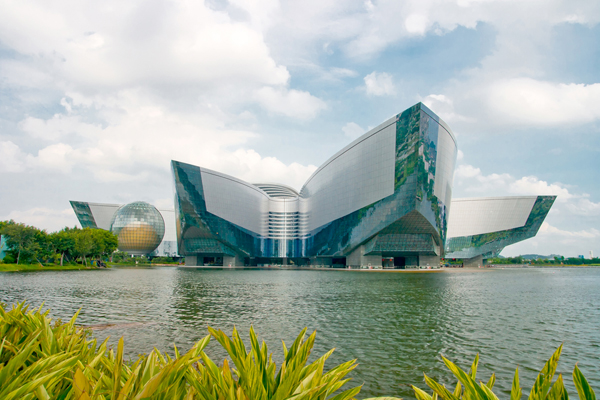
Guangdong Science Center

Looking for linkages to Western innovation: Guangdong Science Center in Guangzhou, Asia's largest base for science and technology exchange. Image: Shutterstock.

I'm standing in the control room of one China's leading clean energy research labs. On the long tabletops hugging the perimeter sit rows of computer monitors, coils of thick cords, piles of circuit boards and a single tin of green tea. Professor Zhiping Qi and I proceed down three small steps onto the laboratory floor. It's a narrow room with high ceilings. Long windows at the back look out onto the Beijing campus of the Chinese Academy of Sciences. Zhiping is assistant director of the Academy's Institute of Electrical Engineering. Scientists are experimenting here with microgrid technology that could someday radically transform the way humankind powers its cities and communities.

We pass several rectangular structures about the size of filing cabinets. One has an English label that reads: "Supercapacitor Energy Storage Converter." Another is hooked up to a computer that simulates the energy of the sun. "In this way," Zhiping says, "we can test different kinds of power generation." The work Zhiping and her colleagues are doing in Beijing is being supported by researchers more than 8,600 kilometres away, in British Columbia. Zuomin Dong, professor and chair of the University of Victoria's mechanical engineering department, has known Zhiping for two decades. Several years ago he made a proposal: What if UVic's and China's leading clean energy researchers got together -- not for just another conference, but to brainstorm a wish-list of projects that could speed the global low carbon transition, and then set to work on them?

"I thought this was a great model," Dong said in a phone interview. The Canada-China Clean Energy Workshop will mark its fourth anniversary in Victoria next spring. "[The] initiative has passed its 'root establishment' period and is now starting to build its momentum and capacity," read a recent update. Research on six low-carbon projects remains very much in the early stages. Already though, proponents see a crucial alliance in the fight against global warming. "The work that you are doing," Dr. Howard Brunt, UVic’s vice-president of research, told a gathering of Canadian and Chinese scientists last year, "is absolutely critical to the future of this planet."

Odd couple

There's little in China's or Canada's past to suggest a shared worldview. One country's history stretches back millennia, a succession of rising and falling dynasties, marked by periods of grandeur, violence and revolution. The other country: born from compromise and handshakes, a land of rich natural resources, vast and thinly populated. This summer, a $15.1 billion bid by the China National Offshore Oil Corp. (CNOOC) to acquire Nexen, an Alberta oil sands producer, set off months of anxious debate. But in China, argued a recent Canadian International Council paper, "Canada is a distant speckle... occasionally referred to in conversations about relatives who emigrated to Vancouver or Toronto."

The global rise of clean technology -- an industry worth $1 trillion in 2010 -- is redefining traditional measures of influence. Power here derives from the most effective ideas and technology, less so geography or history. China's leadership is well aware of this fact, and has made clean energy "innovation" one of the key priorities of its latest five-year growth plan. The central government is also aware that many of the planet's most promising low-carbon solutions have originated in the liberal democracies of the West -- from places such as the University of Victoria's Institute for Integrated Energy Systems. That particular Institute was founded in 1989, with a mandate to figure out more sustainable ways of producing, storing and transmitting energy. Its research has helped advance the world's understanding of hydrogen systems and fuel cells, among other areas.
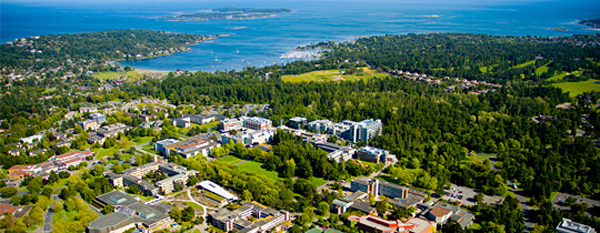
University of Victoria

Hub for collaboration: BC's University of Victoria, ranked fifth in world for scientific impact on energy and fuels by Science Watch.

In 2008, Science Watch ranked UVic fifth in the world for scientific impact on energy and fuels, alongside Princeton, Cornell and the U.S. National Renewable Energy Lab. No Chinese university made the list. The Communist government is spending $18 billion to break the deadlock. That's the amount it allocated between 2011 and 2015 for technology research, nearly half to emerging clean solutions. China is also actively seeking collaboration with researchers from North America and Europe. "We recognize that Western culture in some aspects is more advanced than Chinese culture for innovation," Zhiping told me.

'Like speed-dating'

The first delegation of UVic researchers flew to Beijing in the spring of 2010. There were six of them total, all from the Institute for Integrated Energy Systems, accompanied by the university's Dr. Brunt. They met with 18 researchers from nine of China's top universities and visited 10 clean energy laboratories. "A warm-up gathering," is how UVic's Dong described it. Dong is a recognized authority on fuel cell design, electric vehicles, and other ways of optimizing our society's use of energy. His Chinese background also made him the group's unofficial ambassador. Said Dong: "The first workshop was largely my connections."

It was a congenial introduction overall, brief but promising. Things started getting more serious during the second workshop. In May 2011, over two-dozen Chinese researchers traveled to the University of Victoria. The first day, organizers created an unusual seating arrangement. They set up two columns of chairs, one facing the other. Whoever sat down would be locked into an intimate conversation with the person sitting across. Each pair of scientists, one Canadian and one Chinese, had three minutes to get acquainted before the seating arrangements shifted. Business cards flew from hand to hand. Recalled one participant: "It's sort of like speed dating."

Participants then moved into small groups, four to a table. They were encouraged to think big: what research gaps are stalling our planet's low-carbon transition, and how could China and Canada begin to fill them? A wish-list 13 projects long was created. Workshop delegates narrowed that down to six, by voting anonymously on small pieces of pink paper, and dropping the slips into a cardboard box. They picked teams and developed research plans. As the workshop came to a close the next day, Dr. Brunt made a surprise announcement: UVic would provide $60,000 in research funding. "That's not a lot of money per project," Brunt told the group, "but it's enough hopefully to get things started."

Low-carbon society

Those six projects do not sound sexy on paper. They have painfully abstract names like "Reversible Solid Oxide Systems" and "Micro & Nanoscale Transport in Porous Media." Yet it is these types of technical advancements "that may very well change society," read a write-up of the workshop. Take for instance the research area of Dong and his Chinese colleague Zhiping: "Smart Micro‐grid with Integrated EV/PHEV." Making the switch to electric vehicles (EVs), or plug-in hybrid electric vehicles (PHEVs), would be great for the climate, so long as you could find a lot of clean energy to power them. Coal-fired electricity offers little benefit.

The problem with energy from wind turbines or solar panels is that it's often intermittent and not always reliable. You could address that by building a "smart" power grid. Such a system stores energy from many sources. Smart meters then calculate precisely how much energy each home or business consumes, and pull from the grid accordingly. Some scientists envision a radically decentralized power system run off a series of "micro-grids." A new subdivision, for instance, might be powered by its own rooftop wind turbines. Residents could monitor their personal electricity flow on an iPhone, and sell power they didn’t use back into a larger grid. "What we're talking about here," read a 2009 story from Fast Company Magazine, "is potentially a shift every bit as profound as the switch from mainframes to PCs, or from landlines to cellular."

Xing-rong Zhang of Peking University

Xing-rong Zhang, director of Center for New Energy Systems, Peking University: 'Clean energy is for our future. But it is not easy.'

There are very real technical problems preventing humankind from making that shift. Neither Canada nor China can resolve them on its own. Dong and his UVic team use computer models to figure out the most effective ways of designing and controlling a smart power grid. They don't have the same hands-on experience with electric grids as Zhiping and her colleagues. China is increasingly home to world-class research facilities, including an entire community about the size of Sidney, B.C., near the Great Wall, powered by renewable energy sources. "It's a very unique testing ground," Dong said. "There's nothing comparable in Canada." Canada's and China's research strengths may ultimately derive from fundamental differences of history and geography. Yet climate change has its own urgent logic. "If we collaborate," Zhiping said, "we can make technological progress go faster."

'Many possibilities'

On a bright afternoon this past September, I meet professor Xin-rong Zhang at the Delta Airport Hotel in Richmond, B.C. Zhang is director of the Center for New Energy Systems at Beijing's Peking University. He's in town for a conference on sustainable energy. We grab coffee and head to the Delta's small outdoor courtyard. Wind rustles the tree branches. There's a hollow, booming sound as airplanes descend above us. "Clean energy is for our future," Zhang tells me. "But it is not easy." Four months earlier, he attended the third Canada-China Clean Energy Workshop in Beijing. It was the biggest to date, attracting 27 Canadian researchers and 62 from China.

There was some sense among the delegates that the Workshop's roots were maturing. It was no longer, in the words of a report, just a "newly planted tree." Zhang describes his vision of the future as we sip our coffees. Nearly half of the energy released by burning coal escapes as low-level heat. If you were to develop the right technology, he says, that heat could be captured, transported, and used to warm people's homes.

"I think there are many possibilities," he says. "It just depends on what we think of and what we do in the future."

After our conversation finishes, Zhang walks with me to the hotel lobby. I wish him a safe flight back to China, and then push through the glass doors into the September sun.  [Tyee]

24  Comments:

Login or register to post comments

  • Fiat lux

    24 weeks ago

    Any furthering of human

    Any furthering of human knowledge can always be a benefit and welcome..... Or is it ?

    The problem is that every time humanity discovered new energy sources they've always been taken over and controlled by faith based, ideological/religious systems and misused for the benefit of a few and the enslavement/destruction of the most.

    We all learn in highschools that "every action causes equal reaction". Which means that the reactions cancel out the benefits.

    Supposing these scientists will discover clean energy sources, who will control those systems and for what purposes ? Will they be taken over by the same 1% ruling the world now, for further enslavement and ecological destruction we see now with the growth of their present energy control over humanity?

    Who and what is going to stop them to ensure
    that any energy will be used to the highest degree for the benefit of humanity and the survival of the Earth?

    Or would they be handed over to the stock and money markets to be used for control and destruction, because any limitation of the powers for energy misuse of the present ruling sectors would be "left wing, socialist" and hinder "wealth creation" ?

    Who is going to decide these simple questions under the present "free trade" rackets already destroying democratic decision making powers, and the planned FIPPA, CETA crime waves against the Earth and humanity?

    Ed Deak.

  • lynn

    24 weeks ago

    Abuse of power and intelligence

    That's the real question at the heart of this, Ed - 'power', in all its forms....what it does to human beings......and how human beings use that power to control others and to control energy, and thus control power itself.

  • Fiat lux

    24 weeks ago

    The answer is very simple,

    The answer is very simple, Lynn, since the beginning of history, the predators of humanity have always misused that power for their own "wealth creation", with the use of "faiths" and "beliefs" overruling science and logic.

    The three sectors who always conspired and cooperated for the misuse of power have always been and are:

    1. The MERCHANTS, now the multinational corporate mafia who invent the demands.

    2. The PRIESTHOODS, now the so called "economists", who invent the legalization and justification of the demands of the merchants, imprisoning minds with beliefs .

    3. The MILITARY, who do the dirty work hoping for absolution by the priests.

    We can see this trend and system, and its disastrous consequences right through history, with the Harper government the best example with a double whammy against logic, dictated by religious and economic "faiths", bringing on daily growing disaster.

    Ed Deak.

  • ModestyBlaise

    24 weeks ago

    Great!

    It's good to hear that the Harper government is funding this leading-edge planet-saving research through the Natural Sciences and Engineering Research Council of Canada.

    It's sure to be an important feature that Environment Minister Peter Kent will highlight at the UN Climate Talks in Qatar this week.

    Canada and China are leading the way.

  • Fiat lux

    24 weeks ago

    Canada and China , the great

    Canada and China , the great brotherhood of the idiot twins of communism and capitalism, are the worst ecological disasters on the planet right now.

    China may have some excuse by claiming gross overpopulation and trying to become "world leaders", but Canada has none, apart from being the victims of the disastrous loss of democracy and manufacturing through fraudulent economic treaties and forced to sell the country to the lowest bidder criminal sector, called the "wealth creating foreign investors".

    The "conservative" way !

    Ed Deak.

  • snert

    24 weeks ago

    Ed Deak

    Quote:
    We all learn in highschools that "every action causes equal reaction". Which means that the reactions cancel out the benefits.

    Methinks you'd better go back to highschool yourself, Ed. Newton's Third Law does not apply in the context you are trying to use it for. Further if what you said were true nothing would ever get done.

  • aDriftwood

    24 weeks ago

    Make your point

    Truth is I didn't even read the article. When I came to phrases like: "On the long tabletops hugging the perimeter sit rows of computer monitors, coils of thick cords, piles of circuit boards and a single tin of green tea." and: "Long windows at the back look out onto the Beijing campus of the Chinese Academy of Sciences."
    I knew I was in for a long ride. We here in the Internet age have a limited time to absorb and percolate masses of information. Make your point.

  • Conductor274

    24 weeks ago

    Climate change deniers

    Harper's government is mostly made up of climate change deniers and corporate shills so look forward to Harper trying his best to shut down this kind of research or at least obstruct it's progress. He won't let anything get in the way of his beloved tar sands development.

  • freewilly

    24 weeks ago

    @Ed

    For the most part I accept your reasoning. For all outward appearances and actions by those particular groups, they have thwarted progress and kept humans in the dark ages.

    But it seems almost anyone who gets elected to anything, a provicial, federal, or even onto strata council, allows power to go to their head. Many people simply are not mature enough to be in a position of power or leadership, and it doesnt matter what side of the political spectrum they come from.
    This universal tendency for people to bully others also goes into the private sphere as well....

  • NickS

    24 weeks ago

    Even the Harperites agree climate changes

    That "climate change denier" stupidity is really annoying because it is such mindless drivel.It is what causes the climate to change that the disagreement is about.

    After 16 years of no temperature increase,it should be apparent to even the echo chamber around here, that CO2 is not the instrument of the change.

    Create an imaginary problem so you can sell the destructive solution to it.

    Windmills kill birds and bats, bio-diesel production displaces and kills endangered species, and geo-engineering is a chemical/biological weapon deployed almost daily.
    http://www.marketoracle.co.uk/Article37721.html

    I just can't wait to see what wonderful "planet saving" tech these guy come up with.

  • Fiat lux

    24 weeks ago

    Free....There's the old

    Free....There's the old proverb that "Power corrupts and ultimate power corrupts ultimately"

    I have seen corruption by power under every ideology and society, which is a kind of human, psychological trait.

    But the real corruption by power is definitely caused by faith based theories, like religions and ideologies, without which the maniacs couldn't get anywhere, but people lap them up.

    The most incomprehensible part is that the biggest and most visible maniacs in history always had the backing and support of highly educated people to get and stay in power.

    Why ?

    It took 70 years for 2 world wars and the death camps of Stalin, Hitler and Mao to kill about 120 million people.

    Our present neoliberal, neoconservative, neoclassical economic system is killing the same number in 4-5 years and it is being taught in our universities as a "science", with Harper being one of the best examples of it.

    So where is the logic, what will it take to wake humanity up to the age old fraud of destruction by licence ?

    Ed Deak.

  • wvdk

    24 weeks ago

    burning issues

    "I just can't wait to see what wonderful "planet saving" tech these guy come up with."

    Whatever these "guy", aka 'smart,dedicated researchers spanning diverse cultures', come up with will be vastly less destructive than the dead end fossil burning tech we're using now. NickS, the problem is only imaginary in your mind.

    Ed Deak, the situation isn't that bleak. Living in the Interior maybe you have a woodstove. If so, you're part of the decentralized, renewable energy economy, less susceptible to control by our economic overlords. UVic's research in this regard could help us all move in that direction.

    Nice to see my, and now my sons' alma mater (no, not Beijing U) focusing on a key technical issue of our day - renewable, decentralized energy production. I don't agree with Ed's bleak view on this.

    Cheap energy powers the economy more than any other factor.

  • Fiat lux

    24 weeks ago

    wwdk...I'm the biggest

    wwdk...I'm the biggest optimist and am still waiting for and am absolutely certain of the awakening of humanity.

    The only thing we can do is working toward it.

    Yes, we have a wood furnace, cost about $7,300, we're strong environmentalists, organic producers, and have been working toward the highest degree of self sufficiency all our lives, by learning everything we could, trades, skills, etc.

    Our yearly OAP income is something over $25,000 and we're very very well on it, with money in the bank.

    Ed Deak.

  • wvdk

    24 weeks ago

    Me too

    Ed, you're like us then. Recycle, compost, cut back on frivolous energy use. Live humbly in terms of material things. What matters to me is the thought of being able to tell my grandchildren I was honest about the financial and environmental debt they've been saddled with and did what I could to offset the problem. At the same time, I think this is a truly Golden Age in arts, science and technology. A wonderful time to be alive.

    Here in the Lakes District we had a fair snowfall today. I'm off to shovel it by hand. The exercise keeps me healthy

  • OwlRol

    24 weeks ago

    Possibly promising

    NickS, please, not again, getting truly boring. It's time for you to move to Houston to join your Big Oil denyer friends. Even Stevie noticed the heat and drought in Ottawa this year.

    As to birds crashing into wind blades, yeah, but the number crashing each year into urban towers are exponentially far more numerous than with windmills, one for one. I suppose that you would try to prevent more of these towers from being built.

    Ed makes a good point. The scientists who worked on nuclear energy never dreemed of the atomic bomb at first, and while "Nanoscale Transport in Porous Media" may have very promising applications, nano technology also has serious risks, not all intentional, much like widespread pesticide use and genetic engineering in industrial agriculture.

    I don't think Stevie will "defund" this project the way he did the Experimental Lakes Project, at least not yet (maybe if he wins the next election), the blowback would be overwhelming.

    Had to chuckle at "The other country: born from compromise and handshakes". Not any longer with Stevie in charge. Seems that China is very, very slowly shifting toward a traditional democratic approach, whereas, mostly (not exclusively), thanks to the Harper Conservatives, Canada is moving in the opposite direction.

    "Such a system stores energy from many sources" On a few off-grid BC islands, a combination of solar panels, small wind and water turbines and numerous batteries (still the biggest problem) provide electricity fairly consistently

    "Some scientists envision a radically decentralized power system run off a series of "micro-grids." A new subdivision, for instance, might be powered by its own rooftop wind turbines." We still require the big grid but micro-grid development is badly needed, especially when those macro-systems go down.

    For some reason, the notion of selling excess power back to the grid at prices of "current" usage just doesn't appeal to BC Hydro, but a smart grid would allow for this, rather than the costly IPP contracts we have now, and it could provide incentives to conserve energy. A carrot, not just a stick. Seems to work well in various global jurisdictions.

    This is the type of partnership, rather than secret investment deals, that we need.

  • NickS

    24 weeks ago

    The "smart grid"

    Smart move for the folks who dig depopulation. For the rest of us "not so much"

    http://.www.globalresearch.ca/smart-meter-dangers-the-health-hazards-of-wireless-electromagnetic-radiation-exposure/31891

    Thanks for bring the smart grid up. I had neglected to mention we will be penetrated 24/7 by microwave radiation in order to prevent the production of a few parts per million more plant food.

    It is totally insane.

  • lynn

    24 weeks ago

    Insanity Inc.

    I always thought wind power seemed like a good idea, and then I watched a documentary from the maritimes and began to read more about it. It is the massiveness of the scale.....the industrialization of the wind that has real detrimental effects on birds and wildlife, including the nervous systems of human beings because of the vibrations that travel along the ground from these wind 'farms'. Think of how those massive wind vibrations affect the migratory and flight info of birds, indeed the migratory patterns of all wildlife. Now they are putting them in the sea.....not so great if you are a whale, dolphin, salmon ...on a water planet.

    Wind farms are as much a farm as the massive industrialized 'farms' that cruelly cage chickens and wild stock in inhumane death camps.

    It is the warped desire for massive profit that leads to massive industrialization, poisoning all potential for changing things for the good.....

    Anytime corporations market a product as 'smart'....eg. the smart meter.....you know their targets are those whose radar has been dimmed by the spell of excessive advertising. When hairs should stand on end as warning, the tamed buy the marketing, hook, line, and sinker. As well-trained smart lab rats their avoidance strategy is well-tuned to mindlessly weave and duck any contact with reality and the cautionary small print.

  • OwlRol

    24 weeks ago

    "Smart" and "wireless" are not the same

    Nick and Lynn, let's not confuse "smart" with "wireless".

    A smart system can be wired, as were landlines prior to the digital revolution, and so would produce an equal amount of radiation as these older systems.

    But for the same reason that citizens of developing nations have turned to cell phone technology, the wired systems are expensive and slow to put in place.

    In a world of tax and budget cuts, the more expensive system becomes a non-starter.

    Yup, radiation everywhere, the natural backround sort, old TVs and microwaves, satellite communications, notice all those cell towers rapidly going up, your TV and other remotes, your kids (and your) mobile phones, anything bluetooth, etc.

    These concentrations tend to be much higher in the urban or highly industrialized settings than say, the Great Bear rainforest, where, for now, one cannot make cell calls.

    Ed's neighbourhood is probably very low level for now. Likewise Alex Morton's locale.

    But the globe is changing for better or worse.

    As to wind turbines, you may have noticed that there are several varying models, some that produce much fewer "vibrations" than others.

    But once again, it all depends on purchasing priorities. Currently, cost and efficient electrical production take first place in shareholder and political minds, whereas "vibrations" are further down the list.

    It's much the same with the fossil fuel industry and even nuclear.

    Unfortunately, that's how centralized systems, state or private, operate. Ed has already many times said the rest.

    Producing energy close to where it is consumed is the most efficient.

    Given the choice between wind turbines or sour gas wells nearby, that choice should be obvious.

  • lynn

    24 weeks ago

    Privatizing the wind

    "Given the choice between wind turbines or sour gas wells nearby, that choice should be obvious." ~ OwlRol

    I've read too much on wind farms to ever agree with that, OwlRol. Hemlock and hemlock.

    As of yet we haven't been given a choice or say in energy options. In 2010 there were over 60 communities in Ontario alone calling for a moratorium on wind farms.

    "There are now at least 60 municipalities in Ontario demanding the provincial government impose a moratorium on future wind farm development until independent investigations are completed that prove beyond doubt that industrial wind turbines do not pose any health threat to anyone in communities living in the vicinity of wind farms.

    At least two such municipalities are initiating legal action against both wind energy companies and the government.

    In Wainfleet, a municipality with a council too intimidated and scared to even question either the wind energy companies or the province's Green Energy Act, we have two local companies who can't wait to build Wainfleet's first two wind farms.

    IPC Energy has already been awarded a contract by the province to build a wind farm in Wainfleet. Rankin Construction, having lost its bid to be the first, intends to ensure it will be awarded the second wind farm contract in Wainfleet.

    Neither has a problem with building wind farms in Wainfleet knowing that under the Green Energy Act, their Wainfleet friends and neighbours don't have the right to even express an opinion about whether or not they want wind turbines in their township."

  • Robercarter

    24 weeks ago

    Hydro power

    I don't see why we aren't turning to tidal power. It's reliable and has no emissions. And instead of the run of river projects that the Liberals promoted we need another WAC Bennett type damn. I know it would flood a huge area but its better than compromising the wilderness values in every stream and trickle that flows into the Pacific.
    Also, much still needs to be done on the conservation front. I see entire office buildings in Vancouver with the lights on all night long.

  • OwlRol

    24 weeks ago

    Tidal potential, energy efficiency, but...

    Robercarter, here in BC we have tremendous tidal energy potential in many of our deep inlets and passes, that require no flooding at all. Reversing turbines would produce variable energy for 4 periods in a 24 hour cycle. Pourier pass north of Galiano island might make a good sight.

    These move much more slowly than wind turbines, thus there is no "vibration" factor. And they need not block an entire or even 1/4 of a passage.

    Again, cost is huge and distance to the users along a rugged coast is problematic.

    Your second point is spot on. Passive geothermal, natural solar hot water heating (a few municipalities have passed bylaws that any new home construction must include proper facilities for the owner to install such if they choose to - big in China and Europe.), the natural breeze chimney effect of some tropical and Mediterranian architectures, there are many energy saving strategies available, but will cost and take time to implement.

    But even with ONGOING help from various levels of government, the up-front costs are prohibitive for many people. And then there's the strata council factor.

    At the other end, large homes, no matter how well built, are energy wasters compared to most of their smaller counterparts. Second homes, trophy homes or vacation homes that sit mostly empty are surely energy vampires, never mind 3rd. and 4th. homes. Consider all those empty, speculative city condos as well.

    Governments are not willing to touch these "wealth freedoms", especially given the property tax factor. Dark homes all over more desireable locales while many have to drive longer distances and contribute to urban sprawl. Think Port Mann expansion.

    And then there is big industry...

  • OwlRol

    24 weeks ago

    Political more than technological

    Lynn, the problem you are describing is not so much technological as political. As I mentioned earlier, this is an issue of centralized government decision making, in the case you describe, likely with a lot of corporate lobbying. Similar style decisions were made in the Soviet Union and in the USA, among others. Doesn't matter what political system.

    Wouldn't want to live in parts of Port Moody or Ioco, or downwind from a pulp mill or oil refinery (consider east Edmonton).

    Windmills are all over Germany (and offshore Denmark), but I haven't heard many complaints from friends there. Farmers are happy to have a few on their property that then provide income to help keep their operations going. (And their cows don't produce sour milk or even try to move away from the nearby fields.)

    Distance is likely a factor. These should not be placed close to homes, anymore than refineries, massive hog farms or cell towers.

    Just like all land use conflicts, it's difficult to resolve situations with as little harm as possible, especially when not local and community driven. Perhaps the corporate model, with little local input or benefit is much of the problem.

    And we'll always have the NIMBY factor. I have no sympathy with someone whining that a small, offshore wind farm 2 to 3 km. away may ruin their view (in one direction). Offshore oil derricks would be more worrysome.

    Essentially, that's what Northern Gateway is about, beyond the democratic political component. The magnitude of real and potential harm makes it very distasteful that PR won't clean.

    Some people always get evicted or otherwise hurt. Millions were forced off fertile lands when the 3 Gorges dam was built on the Yangtze river. Similar in India and here with some of our First Nations in Canada and BC.

    "We can never do just one thing", so how do we minimize our ecofootprint, especially given the dominant profit model of our centralized governments?

    Nova Edward Brunswick province?

  • lynn

    24 weeks ago

    Beyond politics, beyond technology....

    but a question of what makes life worth living....that, for me at least, must be the environmental core of our choices.

    http://windfallthemovie.com/index_1.html

    http://www.windturbinesyndrome.com/wind-turbine-syndrome/current-news-articles/

    I hear you, OwlRol, but I believe the magnitude of harm is larger than you perceive from these massive 'farms' to both humans and wildlife, and more complex...even info now surfacing that windmills increase the temperature in their vicinity causing meteorological changes and thus affecting the growing of crops etc.

    There have been protests in both Denmark and Germany and around the world.

    We'll have to disagree on this one.

    Thanks for the link to the reimagineCBC survey some weeks past....it was inventive in the questions it posed.

  • OwlRol

    24 weeks ago

    Local still needs...

    Lynn, I surely agree with you in most part. I too, don't like "these massive 'farms'". It's part of the "big is better" mantra, pushed since WW2. It's all about centralized decision making.

    The parts of Germany I visited didn't have any apparent wind farms, rather mills were scattered around the landscape, much as the old Dutch mills used to be, only larger.

    That's why I liked this article's notion of micro-grids. If not wind turbines, then photovoltaic, geothermal, tidal, wave or bio (algal) energy, whatever best suits the locale, not in terms of financeso much as what's best for health, environment and community cohesiveness.

    Nonetheless, there needs to be some overarching consensus building.

    As an example, on CBCs Almanac (radio 1), the topic of trying to understand accidents in pedestrian crosswalks, a school bus driver pointed out that the widely varying crosswalk signage and lighting in the greater Victoria region is extremely confusing and dangerous.

    We need logical and scientific coordination, not simply based on costs and profits, although these play a part. That's where the higher level of governing bodies come in.

    But when meetings and communications between corporate energy lobbyists and federal politicians exceed 360 per year, whereas only one environmental lobbying meeting took place in that same time frame, you know that the system is badly skewed. Likely the same in the Ontario situation you described.

    Some items require referenda, or as the Yanks call them, initiative proposals, rather than ramming unpalatable legislation through the house that infuriate so many. In that sense the US is far ahead of us.

    But you'll never get the BC Libs or federal Cons to sacrifice such power to "the people".

    • The discussion for this story is closed. No more comments can be added.