
News

Glaciers, BC Hydro's Melting 'Batteries'

Scientists are trying to figure out how rising temps will change the alpine run-off that helps power the province.

By Colleen Kimmett, 6 Feb 2012, TheTyee.ca

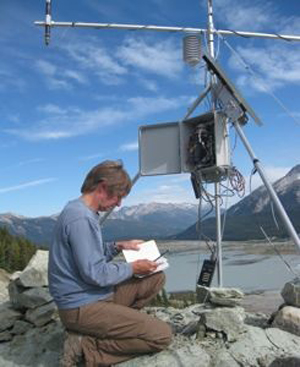
Dan Moore

Meter reader: UBC Geography professor Dan Moore gathering latest findings at Bridge Glacier. Photo by Colleen Kimmett.

It's only been two years since Dan Moore last visited Bridge Glacier, but things have changed.

As our float plane makes a pass over Bridge Lake -- a pool of meltwater that has formed just below the glacier -- Moore points out the window at a dock where he had hoped to unload our gear. It's half-submerged, and nowhere near the rocky shore. It didn't last long before it was taken out, likely by one of the many whale-sized chunks of floating ice that crowd this expanding body of water.

That's another thing that's changed. Satellite photos show the icebergs multiplying from year to year as the glacier shrinks and the lake becomes larger. Bridge Glacier is losing 200 metres of ice per year on average, making it one of the fastest-shrinking glaciers in the province.

Our pilot finds a clear section to land and gets us as close to the edge as possible. Lucy, one of Moore's students, makes a leap from the plane's right float and scrambles up the steep edge, anchoring us in place with a rope while we unload gear as quickly as possible.

As soon as we're done the plane is off again, and it's just us and the glacier; a large impressive, icy monolith looming in the distance. It suddenly feels very lonely up here, 1,394 metres above sea level in the Coast Mountains north of Pemberton.

Moore, on the other hand, is visibly excited to be here. The UBC geography professor specializes in hydrology -- the movement, distribution and quality of water -- but one of his major research interests is how melting glaciers will impact streamflows in the regions they inhabit. Which is good, because Moore happens to love glaciers.

Being near them, he says, "feels like being out in the real mountains."

Since 2005, he and members of his research team have been monitoring Bridge Glacier as part of their work with the Canada Cryospheric Network, a consortium of university, private and government scientists who are studying links between glacier change and climate change.

Scientists like Moore know that glaciers are melting as the climate warms; that much is clear. They also know that climate change will change the movement and distribution of water in glacial-fed areas, which is most of British Columbia. Because of this, glaciers play a significant role in keeping the province's hydroelectric system running.

The Bridge Glacier, in particular, is like a very big battery for an important hydro system.

From the mouth of the glacier, the Bridge River flows southeast through the Coast Mountains for about 100 kilometres, before hitting the first of three dams that make up the Bridge River hydroelectric complex. These dams, which control the water inflow to four generating stations, produce 492 megawatts per year (or six to eight per cent of the province's electrical supply), making the Bridge complex the third-largest power generator in the province.

It's not clear exactly how Bridge Glacier's retreat will impact the amount of electricity that can be generated downstream. But according to some scientists, it's becoming more apparent that we should start planning for less.

'Time release mechanisms'

Why are glaciers important to stream flow, and hydro, in the first place? Matthew Beedle, a PhD candidate at the University of Northern B.C. studying glaciers in relation to climate variability, describes glaciers as "nature's beautiful time release mechanisms."

During the long hot days of late summer and early fall -- just when precipitation drops off and after all the snow is already gone -- is when glaciers start to melt. The gush of icy water replenishes the glacial watershed.

"This is a critical time for salmon coming upstream, and it can also be a critical time for power demand," says Beedle. "And glaciers are there to contribute to streamflow."

In a stable climate, glaciers "recharge" each winter when they accumulate more snow and ice. "But unfortunately, in a warming climate, you don't get that recharge," says Beedle. "So we're just drawing from that reservoir."

Beedle, who is also a Pacific Institute for Climate fellow, created the website GlacierChange.org to try and make the issue of melting glaciers, and the implications thereof, accessible to a more mainstream audience.

There are about 15,000 glaciers in British Columbia. In 1985, they covered 28,800 square kilometers. By 2005, they covered 25,000, a loss of 3,000 square kilometers, or about 11 per cent.

It stands to reason that a more rapidly melting glacier would mean more water -- more streamflow -- coming down the mountains. For a while, that was the case.

In 2006, Moore and a colleague looked at the August stream flow from 236 hydrometric stations in B.C. that captured water from a range of glacialized regions, including the Coast-Bridge system where the Bridge Glacier is located. They were surprising to find that August stream flow was lower than in previous decades -- even though the glaciers were still losing mass.
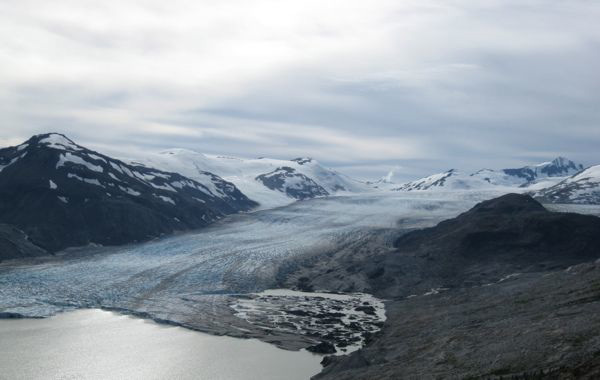
Bridge Glacier

One very big 'battery': Bridge Glacier, north of Pemberton, B.C.

Beedle explains that, as glaciers melt, they also lose surface area that is exposed to the sun. The melting slows, and at a certain point, the initial surge of water slows down. Moore's study is part of a body of research that all suggest the same thing, says Beedle: most watersheds in B.C. are already past this point. Though they continue to melt, the resulting runoff is less of a "surge" and more like a slow trickle.

Beedle says he and other scientists are just beginning to try and understand how this will impact hydroelectric generation. Modelling in this area is relatively new, says Beedle, and because no two watersheds are alike, models can't predict what's going to happen across the board anyway.

'Long term outlook not good'

So how is BC Hydro responding the issue?

In a 2009 BC Hydro blog post, author Rob Klovance writes that "the long-term outlook is not good" for the province's glaciers.

He quotes Sean Fleming, a hydrologic modeller working on BC Hydro's Runoff Forecasting Team, who says that water lost from shrinking glaciers could either be compensated or aggravated by other climactic changes -- like snow melt, temperature and precipitation.

"The question is how will these balance out to create a net impact on hydro power availability," stated Fleming.

BC Hydro's media relations department refused this reporter's repeated requests to interview a member of the Runoff Forecast Team about Bridge Glacier specifically. Neither senior media relations advisor Greg Alexis nor director Chris Brumwell would explain why.

Instead, they offered the following via email, to be attributed to Stephanie Smith, BC Hydro's manager of hydrology and technical services.

"BC Hydro is just beginning to understand the projected impacts to stream flows in the Columbia basin under climate change, where decreases in glacier melt are expected to be somewhat compensated by a projected increase in annual precipitation."

The email also states that "BC Hydro has commissioned research into glacier impacts primarily in the Columbia River basin... more research remains to be completed to assess the impacts on water supply to more heavily glaciated watersheds in the Cheakamus and Bridge River basins. Similarly, further analysis of impacts on electric generation also remains to be completed and we anticipate this will be starting in 2012."

Meanwhile, decreased glacial ice and mountain snowpack is already having a "critical" impact on hydropower in countries like Bolivia, Peru, Columbia and Ecuador, according to the U.N.'s Intergovernmental Panel on Climate Change.

A 2009 study by Lausanne's EPFL technical university forecasted a decline in Swiss hydro generation from 46 to 60 per cent by the year 2035 as precipitation declines and total energy use increases. And that's based on a forecast runoff decrease of just seven per cent by the year 2049, and includes forecasted precipitation changes.

How we manage our water resources as glaciers dwindle over the next 50 to 100 years is key, says Beedle.

"You've got a lot of ice up there that in all likelihood is going to come down, as water, within the next century. And that's a lot of potential energy," says Beedle.

"But it's kind of a one-way road."

[Tags: Energy.]  [Tyee]

41  Comments:

Login or register to post comments

  • judycross

    1 year ago

    The assumption is the warming trend of the 1990s will continue,

    when the actuality is it hasn't warmed since 1998 and there have been record snow falls this year.

    "The catastrophic (CAGW) theory is empirically a very lame theory
    Global warming is not rapid, accelerating or runaway

    Since 1850 the per century linear trend is +0.43°C (+0.34°C by 2100AD)
    Last 30 years, the per century linear trend is +1.58°C (+1.40°C by 2100AD)
    Last 15 years, the per century linear trend is +0.34°C (+0.29°C by 2100AD)
    Last 10 years, the per century linear trend is -0.72°C (-0.63°C by year 2100AD)"
    http://www.c3headlines.com/2012/02/the-great-wsj-climate-debate-alarmist-scientists-have-lost-the-debate-the-battle-the-war.html

  • bozomaniac

    1 year ago

    Hey judycross

    Data alone is not enough to draw conclusions and make predictions.

    Perform this simple experiment: Fill a sauce pan with ice cubes. Pour in some water. Add a thermometer. Put it on the stove, turn the heat on high, and stir well. Write the temperature down every 60 seconds, stirring all the while, until the temperature is around 20 degrees C. Plot it on a graph. See the part where the graph is flat for awhile around 0 degrees, even though the heat was still being added?

    Data alone is not enough to draw conclusions and make predictions. You have to look at the data and apply knowledge. For example, if you look at the flat part of the graph that you just made, you would say that the heating is having no effect. In the case of the above experiment, the knowledge bit is the part where the heat is being used to convert the ice into water: The conversion process absorbs heat; so much heat in fact, that there is none left over for warming the water. After the conversion is complete, the water temperature starts rising again.

    So when you're in the middle of the experiment and the graph is flat, you can't make any predictions about what's going to happen next if all you're doing is looking at the data. But if you apply your knowledge of physics, you can say that the graph will be flat for awhile, but should start rising soon. And the rise should coincide with the disappearance of the ice.

    So if you look at the global temperature graph, you can see that it sometimes goes up and it sometimes goes down. If all you do is look at the data, you can't make any predictions. It would be foolish to say something like "it's being going this way or that way for the last 20 years (or whatever) and therefore it's going to go this way or that way for the next 20 years". You can't look at a graph and then predict a warming or cooling future based simply on the shape of the graph. You have to look at the data, apply your knowledge of the physical world, and only then can you start thinking about predictions.

    In the case of global warming, the knowledge is that a) CO2 reflects heat back to the surface similar to the way that glass in a greenhouse reflects heat back into the greenhouse, b) CO2 gas is a forcing mechanism (that is, a change in its prevalence causes follow-on effects), and c) atmospheric CO2 is increasing. Add this knowledge to the data: since 1850 or so the global average temperature has been rising, despite dips here and there. Now you can make plausible predictions.

    In short, data is useless if you don't know what you're talking about.

  • Okanagan Orchardist

    1 year ago

    I actually got excited....

    I actually got excited (and that's saying something for a senior senior) when I read the following paragraph:
    Matthew Beedle, a PhD candidate at the University of Northern B.C. studying glaciers in relation to climate variability, describes glaciers as "nature's beautiful time release mechanisms."

    This was possibly the first time I had read someone else using the phrase "climate variability." I have been trying to promote this phrase rather than "climate change" for years now. "Change" denotes a certain degree of permanency. Like, things will never change back, although in the realm of human thoughtless that could well be the case with our climate. "Variability" allows for the possiblity of reversing change. As in, I hope to hell the electrical bill that I got because of that cold snap we had in January, will perhaps not be as high next January.
    Having said that, however, I don't think Bozomaniac will ever change the mind of someone like Judycross. Some people will never understand the basics of elementary science.

  • judycross

    1 year ago

    OMG

    Basic science, eh? Ever hear of the null hypothesis? Didn't think so!

    "The way that science works

    Climate change is self-evidently a natural process. Warmings, coolings, cyclones, floods, droughts and bushfires have been coming and going since long before human industrial processes started adding carbon dioxide to the atmosphere; and, indeed, since before there were humans at all.

    The appropriate question is therefore not whether climate change is “real”, but the more specific one of whether human-related greenhouse emissions are causing dangerous global warming.

    Scientists assess such speculative ideas against a norm called the null hypothesis, which, following long historical practice, is fashioned to be the simplest interpretation of any given set of material facts.

    The null hypothesis for today’s observed climate changes is therefore that they are of natural causation, unless and until specific evidence accrues otherwise.

    Contrary to prevailing political belief, and to the alarmist messages that come from the UN’s discredited Intergovernmental Panel on Climate Change (IPCC), much amplified by environmental organisations and a compliant media, scientists have searched for this accrual in vain.

    Instead, tens of thousands of scientific papers published in reputable journals delineate changes in climate and the environment, and ecological responses, that are entirely consistent with the null hypothesis of natural causation. In contrast, not a single paper exists that demonstrates an evidential cause-effect link between change in an environmental variable (be that more or less storms, floods, droughts, cyclones, honeyeaters or even polar bears) and warming caused by human-related carbon dioxide emissions.

    Given the astonishing amounts of money that are now poured into climate change research, it is no surprise that 2011 saw the publication of several thousand more scientific papers that contain data relevant to this problem. But it may perhaps be to some readers’ surprise that these papers simply added yet more evidence in favour of the validity of the null hypothesis."
    http://www.quadrant.org.au/blogs/doomed-planet/2012/02/climate-review-i

    Given that the smart meter agenda and geo-engineering is based on AGW, I would think rational people would be glad of valid reasons for abandoning the meme.
    http//:www.prisonplanet.com/bill-gates-pours-millions-into-geoengineering.html

  • lapogus

    1 year ago

    Interesting article. Of

    Interesting article. Of course there is very good evidence that Bridge Glacier has been expanding and receding for at least the last 3000 years http://www.geog.uvic.ca/dept/uvtrl/bridge2007.pdf irrespective of atmospheric CO2 concentrations.

    Okanagan - you are right about one thing; Bozomaniac will never change the mind of someone like Judycross, who evidently knows a little about the subject. Bozomaniac's glass greenhouse analogy is hilarious - I hope he doesn't teach courses in atmospheric physics. As for elementary science, the fact is that global temperatures have not risen in 15 years, despite ever increasing CO2 emissions, and the IPCC models are therefore suspect to say the least. The case for CO2 being responsible for the late 20th Century warming is far from proven. The IPCC accepts that CO2 had no role in warming prior to 1950. Yet look north at Glacier Bay where the loss of ice in the last 60 years is a tiny fraction compared to what melted between 1800 and 1960: http://soundwaves.usgs.gov/2001/07/glacierbaymap.gif

    Look south to Washington State and glaciers have been also been receding lately - but temperatures have not actually been rising - http://www.newsnet5.com/dpp/weather/weather_news/disappearing-glaciers-in-the-pacific-northwest-a-lesson-in-deception

    Glaciers are proxies for temperatures, and not always good ones. But on the evidence I I'll go with long term solar-magnetic, cloud-cover variability and changes to ocean currents rather than CO2 any day, thanks.

  • Fiat lux

    1 year ago

    We used to have -40 -45 for

    We used to have -40 -45 for weeks, here in the Cariboo that killed the pine beetle eggs and other bugs.

    We haven't have any since 1995 and are surrounded by millions of acres of dead trees. Luckily we didn't have too many pines on our land and are still green.

    So, what happened to our climate? 17 years of no -40 is not an up and down, but a long term trend that kills the glaciers and causes desertification all over.

    I have a very good professor friend, who's in the air much of his time, including to China several times a year, advising them on climate change and other forms of sustainability.

    Somehow I believe him and what I can see in the forests surrounding us, rather than "conservative" ideologues, who are afraid that any action against environmental destruction may cut into their precious GDP.

    I have yet to hear from, or meet, a climate change denier who wasn't a "conservative", which explains where , how and why their denials originate.

    Ed Deak.

  • Matt Beedle

    1 year ago

    Recent research

    In the piece Colleen refers to a limited body of knowledge/research regarding modelling glacier change and impacts on hydrology. Please refer to the following site to find a recent publication that does this for the glaciers and watersheds of the eastern slopes of the Canadian Rocky Mountains:

    http://glacierchange.org/2011/07/plain-english-summary-glacier-water-resources-on-the-eastern-slopes-of-the-canadian-rocky-mountains/

  • judycross

    1 year ago

    Sorry, Ed, but your noticing changes does not equate with AGW

    That climate changed is not the point. It is the cause that is in dispute, remember.
    And since nobody has managed to prove otherwise, the cause is natural. 30 years of money to climate modelers just brought us bad models that have no relationship to reality. Even though CO2 is supposed to be a record levels, there has been no warming since 1998. Explain!

    As for me being a "conservative"...yeah, but I vote NDP. I don't support Conservatives, because they like wars and mega-projects..

  • Fiat lux

    1 year ago

    Judy... sorry about the

    Judy... sorry about the "conservative"..

    The last time I flew in an airliner was in 1968, or so. It was in Bristol turboprop Britannia, coming into Vancouver at 16,000 feet.

    All we could see of Vancouver from around Hope was a large ball of grey smoke and pollution. And Vancouver is not an industrial city.I don't think it has improved anywhere on Earth, since then. Especially when we see pictures of Chinese cities, covered in grime.

    Anybody who denies that this kind of pollution has nothing to do with climate change, is dreaming. This is why my professor friend is invited to China by the govt. several times a year, trying to figure out what to do about it.? We can see the effects on our remote land even now, with no large cities anywhere near.

    And the vast majority of it is unnecessary, because the people, and manufacturing, could be done in localities, without millions commuting and more millions of trucks and ships carting resources and products around, only to please a ruling class enslaving the world to steal it blind.

    Ed Deak.

  • JohnTW

    1 year ago

    Not time to panic yet

    A good read thanks but IMO it is not time yet to panic, and the UNIPCC is NOT the reliable source that too many would like to assume it must be - it is merely one perspective that is especially atuned to politics, and UN politics are notoriously corrupt. The IPCC should not be ignored but neither should it be taken as gospel.

    I too like "climate variability" - it is much more accurate than "change", and similarly we should realize that 15 years or even 25 years is still a relatively short time period compared with the time needed to create such things as glaciers. I for one was interested to note the reference that the pace of melting has slowed because there is now less surface exposed to the sun.

    Too many people want to rush to judgement and blame human activity for all of the warming of the last few decades but they fail to acknowledge that for the last 10 years or so the planet has been relatively closer to the sun, which fortunately for us was also a period of relatively few solar flares - until the big one last week that caused those northern lights seen on TV.

    And speaking of January heating bills, be thankful we're not in Europe where people are dying by the dozens due to a prolonged cold snap. Global warming?? Not in Europe right now, though there IS variability there right now.

  • Okanagan Orchardist

    1 year ago

    To Matt Beedle ...

    Your website was a good example of the problems glacial recession is having in Alberta. What wasn't mentioned was the aquifer depletion that is happening right across the prairies. 70 years ago all we needed to do to get the best tasting water in the country was to dig down between 10 and 25 feet. Now, water wells have to go down 300+ feet, and then you get brackish, salt-tasting crap that even the cattle don't like. The retreat of glaciers is only part of the problem, of course, since continuous and heavy irrigation over time is significantly more responsible for water table depletion. The question for them is, how is all this going to end?
    I might add a note to Ed's comments about the beetle and lack of sufficient freezing weather. As an orchardist here in the Okanagan, I am now able to replant to varieties of apples and other fruit that require a slightly longer growing season which was not possible 40 years ago. I'm awaiting the introduction of Kiwi fruit here. :)

  • FatherTheo

    1 year ago

    "climate variability" vs climate change

    What's climate variability? Another term for weather. But climate is not about day-to-day weather, as anybody versed in the subject knows already, it's about weather averaged over long periods of time. The standard rule-of-thumb length of time used in climate is 30 years. So is 1998 relevant? Nope. Is the weather outside relevant? Nope. Is the average temperature in 2012 as compared to the average temperature in 1982 as compared to the average temperature in 1952 relevant? Yes. That's what climate is all about.

    And if you stretch your inquiry all the way back 1500 years or so and place it on a graph, what does climatology say the graph looks like?

    Think hockey stick.

  • bozomaniac

    1 year ago

    huh? no warming since 1998?

    Judycross, your statement "... there has been no warming since 1998" is provably false. The measurements taken since 1998 show that you are either lying, or have been misled and are parroting false beliefs. Can you produce a dataset that shows a temperature drop since 1998? NASA has shown a temperature increase since then: http://data.giss.nasa.gov/gistemp/2011 Or do you think that NASA has fabricated the data?

    Note: Simply stating "NASA is lying" is not proof of malfeasance. Please produce a credible source of temperature observations that disputes the measured rise. Linking to some dude who says the data are wrong is not good enough. Linking to measurements taken globally since 1998 is what I'm looking for, along with descriptions of the methodology used.

  • lapogus

    1 year ago

    GISS is a joke

    Hansens' GISS dataset is an international joke. Hansen is another who has let his eco-activisism run amok.
    He has been adjusting and statistically creating data for years (particularly in the Arctic where he uses 1200km grids) and he is still at it - http://www.real-science.com/new-giss-data-set-heating-arctic more detail at http://notalotofpeopleknowthat.wordpress.com/2012/01/24/giss-make-the-past-colder-in-reykjavik/

    The UK Met Office's HADcrut3 dataset is much better (but still not perfect). It shows an increase in global surface temperatures of 0.051C in the last 15 years. That's only 51 thousands of a degree and is not statistically significant. This issue has been extensively discussed at Bishop Hill and other good blogs: http://bishophill.squarespace.com/blog/2012/2/5/leake-on-the-temperature-plateau.html

  • Granville

    1 year ago

    If all the climate change deniers were laid end to end.....

    ...I wouldn't be a bit surprised.

    I first read about climate change in 1983 in the federal government's State of the Environment Reports. They were uncannily accurate for government work.

    We should round up all the AGW deniers and ship them to the Maldives; anywhere but here.

    The day could come when climate change has destroyed enough crops and our global food supply is threatened, that Soylent Green could be introduced. I hope the AGW deniers are the first to be put into the blender.

    I am just speculating and I like Science fiction, so imagine a world with very little gas, when gas-guzzlers are stopped and torched in the street, with the occupants inside. Don't laugh, it could happen in your lifetime. Wasting resources will become a crime. The Soylent Green Machine will always be an option.

  • judycross

    1 year ago

    CO2 is not some magical global thermostat

    The actual data is quite shocking
    Temperatures have been static since 1881. The seasonal changes in temperature have remained within +/- 0.25 C. During that time CO2 has risen anyway. Looking at the chart provided at the link below, there is no relationship between temperatures since 1881 and CO2. There is no cause and effect relationship.
    http://www.c3headlines.com/2012/01/noaas-climate-science-data-firmly-establishes-that-co2-is-not-earths-temperature-thermostat.html

  • OwlRol

    1 year ago

    Thanks Colleen K.

    Thanks Colleen K., glad to hear about some good research on what amounts to mostly glacial retreat over the past 30++ years, and how it may affect hydro energy in the not so distant future.

    Ed is not the only commenter who'se seen the multi-year and decadle changes in their own "back yards".

    Closest to home for most BC residents is Vancouver's North Shore. That's where nearly all the GVRD's fresh water comes from, never mind energy production.

    In the late 70s there were 18 glaciers up on the North Shore mountains. Today there is only the shrunken Coquitlam glacier remaining.

    Check in nearly any region with long time observers, some with very good scientific training, and they'll all repeat the same story, our glaciers are ablating, some more quickly than others (only a very small percentage of glaciers are stagnent or advancing), overall, they are retreating and have been, with a few hiccups, for some time. This is occuring on a global, not just local or regional scale.

    If you don't believe this, just go up and look at the "trim lines" on the mountainsides, where glacial ice has melted but most vegetation, especially trees, haven't had time to overgrow the bare rock).

    It's obvious that the ice that was there not so long ago, is gone.

    To say that the climate is not changing (in some mostly predictable, but also unusual and unexpected ways), simply cannot be all but blindly denied.

    Climate cycles, (only had 7 recorded and slightly understoood La Ninas so far), multi-decadal changes, solar flares, GHGs, CO2 being only one, and debate away.

    But the glaciers show no indication of slowing down their recession, rather the opposite.

    The new Seymour valley water treatment plant, that supports nearly all Lower Mainland drinking water, was also part of a larger plan to reinforce the dams against earthquakes and to increase their capacity to hold more winter precipitation.

    That's what this article is about, glacial meltwater discharge and energy production, not what causes climate change and variations to cycles.

    The glaciers are vanishing, in many cases faster than we expected.

    The reasons why can be debated as creation and evolution were.

    Makes no difference, we have to do more (costly) research and especially preparation. How to handle the coming water issues without that last, late season, water source?

    Drinking water, irrigation, forest drought and fire, electricity production, salmon spawning runs, all will be altered over a relatively short time and all are managed by BC Hydro at the watershed level.

    Won't be able to manage all the changes (never did believe that we could manage large scale events, think DFO, pine beetles, etc.), but we must prepare for those changes in much the same way that we prepare for earthquakes.

    Costs of adjustment are high, costs of ignorance are exponentially higher.Time for debate on this issue is over.

  • gomer

    1 year ago

    i still think aliens are

    i still think aliens are stealing the socks from the dryer and no amount of "null hypothesis" will disprove that

  • Fiat lux

    1 year ago

    Where the deniers are wrong

    Where the deniers are wrong is not counting the accumulating side effects of all kinds of other contributing effects and influences.

    Has anybody heard of anybody losing a leg to lice bites ? Impossible? Lice bites are not even close to the effects of mosquito bites, one can hardly feel them. Yet, I've almost lost my right leg to them when they infected a small shrapnel wound, not much more than a scratch, and my ankle blew up to the size of a football.

    Had I lost my leg, what would have been the cause ? The shrapnel, or the lice, or the bacteria carried by the lice, or the starvation we were suffering at the time ? These were all contributing factors.

    When I was in the hospital, people have lost their legs , months after they were wounded, because their wounds didn't heal because of the starvation diet we were getting. So what caused the amputations ? The wounds, or the lack of nourishment ?

    The same goes for climate change. There may be some natural changes, going on from the beginning, but to dismiss the addition of the present incredible pollution making it worse, is very shortsighted.

    75,000 years ago a volcano erupted in Indonesia, where now Lake Toba is, and the ashes, chemicals and other effects, cooled the oceans by 5 degrees, covered the Earth with a heavy chemical cloud for centuries and killed an estimated 60% of all living creatures, including whatever humanity that may have existed at the time.

    And that was caused by the pollution from the volcano. Literally overnight.

    Now we have hundreds of millions vehicles, coal, etc. etc. causing basically the same pollution, at lover levels and in longer time, but what exactly is the purpose of continuing with this unnecessary madness, falsely called "economics" when there's no need for it ?

    What is the point in defending it ?

    Ed Deak.

  • Joseph Shea

    1 year ago

    Bridge Glacier

    For those who are interested, an animation of the recent retreat of the terminus of Bridge Glacier (1976 - 2010) can be seen here:

    http://glacierchange.org/2011/09/animation-recession-of-bridge-glacier-british-columbia/

    Also, a 2008 study in Water Resources Research (Stahl et al.) examined the possible changes in glacier extent and future streamflow from the Bridge Glacier. Our results suggested that even if you assumed a steady-state climate (i.e. the observed average climate of the past 18 years were simply repeated), glacier retreat would occur for another century.

    http://www.agu.org/pubs/crossref/2008/2007WR005956.shtml

  • judycross

    1 year ago

    CO2 has nothing to do with whether glaciers grow or retreat

    The real deniers are the people who can't seem to get that they have been lied to and manipulated. It looks like the game is about to be over in Germany.
    http://notrickszone.com/2012/02/06/body-blow-to-german-global-warming-movement-major-media-outlets-unload-on-co2-lies/

  • Fiat lux

    1 year ago

    Judy....When we were taken to

    Judy....When we were taken to Germany in locked boxcars for military training in Dec 1944, we were examined by SS doctors for Jewish blood. One of the main points was the examination of the tops of our hands and wrists, that would have given away any hidden traces of Jewish origins.

    That too was a "science".

    We also have scientists who maintain that clearcuts are good for the forests, who try to cover the world with GM products. Etc. etc. because they're paid for it.

    When my wife had her first baby in Burnaby in 1958, the doctors and nurses were horrified that she wanted to breastfeed and there were all kinds of panic consultations etc. but she prevailed. Now it is exactly the opposite way. The same with many other health issues.

    I'll send this article to my sustainability prof friend and see what he and his PhD candidates say.

    In the meantime, we should have -40C here now, by old standards, but didn't have any since 1995. Yesterday was +1 and more to come.

    In the meantime I have no "faith", or believe in any theory, especially where monetary economics are involved, but know that every one of us has dozens of chemicals in our bodies and do my best to fight against more.

    Ed Deak.

  • dave49

    1 year ago

    What about all the dams where we are adding additional turbines?

    Judycross, it's not the most useful exercise to get into AGW debates. The trend toward declining precipitation and hence snowpack in the BC interior is well-established. This article is about the long-term viability of our present generating capacity. My question is about adding so many additional turbines at existing dams.

    About five years ago, I visited the Revelstoke dam. During the tour, I asked the guide about the work on turbine 5. It would only be for peaking power as there was not enough water behind the dam to run an additional turbine continuously. Then, look at the way BC Hydro communicates that new "firm capacity" to the public. They don't tell you it is 'firm peaking capacity' they are talking about. Mica is getting more turbines as well.

    I can see the building an extra turbine as that will allow refurbishment of other ones without the loss of power. One turbine at Revelstoke provides about 5.5% of BC's power needs. However, with the trend of declining rain and snow in the interior of BC, are we overbuilding by adding TWO turbines at existing plants that have four? These additional turbines can only provide peaking power.

    Hydro dams are 'energy-critcial', they must have water behind the dam. Thermal and gas turbine plants are "capacity-critical', meaning they must have the installed generating capacity to meet maximum demand.

    Is all this money for additional turbines being well spent? After all, we the ratepayers of BC will pay for all this.

  • judycross

    1 year ago

    Remember GIGO?

    The alarm about the glacier's retreat is based on computer modeling. So......

    "Can Climate Models Predict Snowfall? EU Researchers Ascertain Models Are Worthless For Snowfall"

    "Often climate models are utilized for specific regional climate forecasts - scientists determine that for regional snowfalls, the models are worthless"

    It is well established that climate models have been atrocious at predicting global warming and other climate attributes. This lack of predictive skill globally is compounded when these models attempt to make regional predictions such as snowfall in a specific region.

    EU scientists, Soncini and Bocchiola, analyzed snowfall predictions by two major climate models for the Italian Alps region. The models did not perform as advertised.

    "The authors write that "General Circulation Models (GCMs) are widely adopted tools to achieve future climate projections." They note, however, that "one needs to assess their accuracy, which is only possible by comparison of GCMs' control runs against past observed data,"...investigated the accuracy of simulations of snowfall throughout the Italian Alps that were provided by two GCMs...included within the family of models employed by the IPCC. This was done by comparing the models' output with a set of comprehensive ground data obtained from some 400 snow-gauging stations located within the region of interest for the period 1990-2009...determined that "the investigated GCMs provide poor depiction of the snowfall timing and amount upon the Italian Alps," noting, in fact, that the HadCM3 model actually "displays considerable snowfall during summer," which they indicate "is clearly not supported by ground data"..."given the poor depiction of snowfall by the GCMs here tested, we suggest that care should be taken when using their outputs for predictive purposes."" [A. Soncini, D. Bocchiola 2011: Cold Regions Science and Technology]

    http://www.c3headlines.com/2012/01/can-climate-models-predict-snowfall-eu-researchers-ascertain-models-are-worthless-for-snowfall.html

    Again, remember GIGO whenever presented with predictions based on computer modeling, especially when those making the predictions won't share the data they used in the model.
    http://wattsupwiththat.com/2011/11/30/hide-the-decline-worse-than-we-thought/

  • KWD

    1 year ago

    ice cubes for everyone

    Concerned about melting glaciers; keeping our hydroelectric system running; lack of adequate snow pack replenishment? The solution is easy: Counteract climate variability (warming/cooling) impacts on our glaciers with a few new “clean and green zero environmental footprint, zero pollution nuke plants”.

    Located near the glaciers that are responsible for nourishing and sustaining the planets diversity of flora and fauna, these plants can be used to power glacier-rebuilding snow and ice making machines, with the added benefit of feeding excess power into the grid to eliminate the need for more dams or run-of-river projects and other environmentally destructive forms of power generation.

    This, despite minor irritations like the impact of downstream radiation leaks and other complications arising from human error, would allow folks to carry on, oblivious to the myriad of real, less debatable roadblocks that are about to derail human activity on this planet.

  • OwlRol

    1 year ago

    judyc, please...

    "The alarm about the glacier's retreat is based on computer modeling. So......"

    No, The alarm about the glaciers' retreats are based on much more than computer modelling, these are only used to attempt analyses of future trends, much based on past shifts.

    There are many modelling attempts, some models provide better predictive capability than others. Which ones are selected as best (in some ways more significant than those that are most accurate, depending on beliefs and politics) varies, but put them all together and the trends become much clearer.

    Chaos theory demands that meteorologists run models with slight variations at least 30 times before making a weather prediction. Climatology has similar constraints.

    Anomalies occur, and despite probability, another variation of what we call "risk assessment", predictions are sometimes inaccurate, although much more often correct than not.

    The "alarm" (to wake us up, not to panic), is not only based on models, but also on first hand observation by many people who take the time to pay attention over decades, and perhaps now more importantly, by scientists, including glaciologists, who are right there on those glaciers and below, gathering empirical evidence, not just sitting in an office analyzing computer models.

    As stated before, we can debate models and theories for years and decades, while the glaciers continue to retreat, with only a small possibility of this trend reversing itself, in spite of a few data oddities, in the near term (let's suppose 50 years).

    But the evidence is there in our faces for anyone who really cares to look beyond their computer screens.

  • dave49

    1 year ago

    judycross, why do you keep bringing in irrelevant arguments?

    There is a well-established historical trend of declining snowpacks in the BC interior. This story is about the long-term reliability of the output of BC Hydro's system. Don't keep skewing the debate by being an anti-AGW web warrior!

  • judycross

    1 year ago

    Owl

    They are predicting the future with computer models. It is a sophisticated form of fortune telling. We have no idea what the glacier will do. We know it is receding now, but we also know it has receded to this point before. That's all we know for sure. The rest is just climate models based on junk science.

    In the meantime, since we do not know and there is a possibility that there will be less generation capacity in the future at that site, it is prudent to look for other opportunities.

    I refuse to be guilt-tripped over a false paradigm.

  • Fiat lux

    1 year ago

    I've sent the German article

    I've sent the German article to my sustainability professor friend and here's his answer I can go along with.

    Keep and open mind and room for retreat. From what we're experiencing here in the Cariboo, I don't give a hoot what's causing it, but something does and we feel the effects in a big way, even by seeing birds we've never seen before.

    Ed Deak.

    Hi Ed,

    I keep a open mind on climate change, but till now I haven't seen any credible proof that would refute the core ideas of the theory. I don't exclude the possibility something comes up, but it would need to provide clear evidence of how steadily rising GHG emissions won't matter.

  • judycross

    1 year ago

    Please Ed...your nameless "sustainability" person

    hasn't seen any "credible proof" because he hasn't looked and doesn't seem to understand the null hypothesis either. The appeal to authority is one thing, but appeal to an anonymous authority is beyond the pale.

    Unless the climate crazies come up with proof that CO2 can change climate, climate is the result of natural causes/cycles!

    But there already is proof that CO2 and present temperature is unrelated. Just look at the graphs here and pass it on to your anonymous friend. Looks like he could use some help.
    http://www.c3headlines.com/2012/02/the-great-wsj-climate-debate-alarmist-scientists-have-lost-the-debate-the-battle-the-war.html

  • Fiat lux

    1 year ago

    Judy...my nameless

    Judy...my nameless sustainability person is one of the top scientists in sustainability, adviser to governments all over the world, Senior fellow and associate of the International Inst for Sustainable Development etc. Good enough for me over the absolute deniers of visisble facts.

    Ed Deak.

    Affiliations

    Advisory Group, The Integrated Assessment Society (TIAS)
    Global Project on Measuring the Progress of Societies, the Organisation for Economic Co-operation and Development (OECD)
    Steering Committee, Winnipeg Community Indicator System Initiative (Co-Chair)
    Steering Committee, Canadian Sustainability Indicators Network (CSIN)
    International Network of Resource Information Centers, a.k.a Balaton Group
    Scientific and Technical Advisory Committee, Global Energy Sustainability Observatory / HELIO International

    Education

    PhD in Forestry and Natural Resources (2002): University of Minnesota.
    Master of Natural Resources Management (2002): University of Manitoba.
    Master of Science in Agronomy (1988): St. Stephen Gödöllõ University of Agricultural Sciences, Hungary.
    ... doctoral thesis “Making Global Integrated Environmental Assessment and Reporting Matter” focused on analyzing the factors that contribute to the effectiveness and influence of forward-looking, global, multi-sectoral integrated assessments, looking particularly at the case of UNEP’s Global Environment Outlook (GEO).

  • judycross

    1 year ago

    And he bought into the false paradigm

    So now you give me the fallacious Argument from Authority with credentials, but no name.

    With all of that, he should understand that AGW is a failed hypothesis. It was up to those who proposed it to prove it, not the other way around.

    Not only has the hypothesis failed to be proven, it has been shown to be invalid by
    present day temperatures themselves in their flatness in spite of supposedly catastrophic rising in CO2,but the foundation idea of the "greenhouse effect", has been shown to be non-existent.

    Here is a link to the peer-reviewed, never refuted, (side swipes from blogs don't count as refutation)paper.

    Falsification Of The Atmospheric CO2 Greenhouse Effects Within The Frame Of Physics.

    http://climateresearchnews.com/2009/03/new-peer-reviewed-study-falsification-of-the-atmospheric-co2-greenhouse-effects-within-the-frame-of-physics-by-gerlich-tscheuschner/

    Your smart, much credentialed anonymous friend should read it.

  • Fiat lux

    1 year ago

    Come now Judy, let's not get

    Come now Judy, let's not get too obnoxious, and when you accuse me of lying, that's the end of the line. My friend is a very busy man, right now in Europe, and a don't want any of the faithful bothering him. Under the circumstances I'm glad I wiped his name off the Wikipedia page, before I sent it out.

    And this is the end of all of my conversation with you, now and forever. If there's anything I've learned in my life it is never to argue with the faithful, because "faith conquers all", especially logical thought.

    I have absolutely no intention to forward anything to my friend from you.

    Cheers, have a good time. No hard feelings, Ed.

  • judycross

    1 year ago

    I did not accuse you of lying

    I only pointed out the fallacy of your appeal to authority, anonymous at that,even embroidered with credentials.
    http://.www.nizkor.org/features/fallacies/appeal-to-authority.html

    What I did not touch upon is the "Sustainability" meme. It is too broad to be meaningful and the international government agencies promoting the idea drink each others' bathwater.

    As I said, too bad you or your so very busy friend can't or won't revise your thinking in light of new evidence to the contrary. That, I submit, is the essence of a religious attitude, not what I propose.

    You are the one who exhibits faithfulness to an impossible scenario. CO2 changes climate the way wine turns to blood...you've got to believe for it to make sense.

    Oh, but I am bereft....to think I may never, ever be given the benefit of your timeless wisdom again. The pain is not to be born.

  • OwlRol

    1 year ago

    Thank you Joseph S.

    It's good to have commenters who have actually done field research and analysis on the specific Bridge glacier issue presented in this article.

    The animation/time lapse images are a bit difficult to interpret, given the changing colours and hues between the frames (eg. is the red beside several glacial images possible IR from lateral morraine?).

    The following images, including the topo map (not sure if the contours were feet or metres back in the 70s), certainly clarified the retreat of Bridge glacier.

    Of course, despite the meticulous work, I'm sure that certain skeptics here, who may follow up on the research, will jump all over "Where mass balance information is not available to assist with calibration, model-generated future scenarios will be subject to significant uncertainty."

    That statement is one of careful science. It does not deny a slew of possibilities, and it does not suggest what you and your colleagues think are the most likely scenarios, thus avoiding anything resembling bias.

    It is by the work of others who carefully produce and examine similar types of data in other glaciated regions, that a larger picture can be (and to some extent, has been) reasonably composed on empirical data.

    There will be anomalies that may cast some doubt, good, if it were initially 100%, it would probably have been rigged.

    Has there been any updated info on this early 2008, Bridge glacier publication, since that time?

    Once again, thanks for the detail, especially given the proactive move by some BC Hydro staff, not often seen with private IPP energy companies, in the public interest.

  • Okanagan Orchardist

    1 year ago

    You are forgetting about one of the biggest "glaciers" ..

    A comment from Wikipedia:
    "Ongoing changes in the climate of the Arctic include rising temperatures, loss of sea ice, and melting of the Greenland ice sheet. Projections of sea ice loss suggest that the Arctic ocean will likely be free of summer sea ice sometime between 2060 and 2080,[1] while another estimate puts this date at 2030. Because of the amplified response of the Arctic to global warming, it is often seen as a high-sensitivity indicator of climate change."

    The size of the retreat of the icecap has been likend to the size of Great Britain. Now I know this isn't exactly classified as a glacier, but in so far as climate change, this serves as a pretty good example.

  • judycross

    1 year ago

    Except Greenland isn't melting

    and wikipedia just isn't reliable.

    "In actuality, if Greenland was a casualty of unprecedented global warming, then its glaciers would be losing huge ice mass in unison, as predicted by the IPCC. Instead, as the new Chen et al. study finds, there is huge variability of ice loss among Greenland’s glaciers, which can’t be explained by AGW.

    For example, using the advanced technology of the GRACE satellites, scientists determined over the most recent years that:

    Greenland’s northwestern glaciers’ ice loss increased by: 100Gt/yr
    Greenland’s southeastern glaciers’ ice loss decreased by: 109Gt/yr

    This study’s scientists suggest that the gigantic variability (that wasn’t predicted) is likely to be a function of regional climate/weather conditions resulting from normal interannual variability."
    http://wattsupwiththat.com/2011/09/22/greenland-ice-not-responding-as-predicted/

  • news

    1 year ago

    judycross

    Who is paying you to write this rubbish?

  • igbymac

    1 year ago

    news

    No, seriously, there are people still denying AGW, much like the lot who denied for more than half a century that smoking caused cancer.

    I think GB Trudeau's Doonesbury cartoon has recently been smokin', and he nailed it yesterday with "myFACTS, privatizing the truth since 2003".

    I think if you bother to scroll back a day or three, there is a great one on global warming. ;)

    http://www.doonesbury.com/

  • judycross

    1 year ago

    It has been amazing to read the "denialism"

    There hasn't been any warming since the peak of 1998 and all the greenbots are still in denial that there is no longer the slightest correlation between levels of CO2 in the atmosphere and earthly temperatures. Then they have the nerve to ask who pays ME?

    Who pays you to keep up the barrage of nonsense, Tides or some other US funded source of disinfo disguised as a "charity"?

    Yes, smoking causes cancer...but so does the new source of microwave energy the Global Warming Agenda is foisting on us through the forced installation of "smart" meters.
    Microwave Technology - CORROSION + HEALTH PROBLEMS
    http://www.hese-project.org/uk_forum/index.php?id=300

    I don't need payment to fight for human rights against the NWO agenda. The Big Lie that a beneficial trace gas that we all exhale is detrimental to Earth has been exposed and is slowly fading everywhere as the evidence against it piles up.

    "New paper finds 20th century warming within range of natural variability
    A paper published this week in the journal Climate of the Past analyzes an "unprecedentally large network of temperature...proxy records" [a total of 120] and concludes that warming of the 20th century was "within the range of natural variability over the last 12 centuries." Only two of the eight types of temperature proxies analyzed indicate 20th century warming exceeded that of the Medieval Warming Period."
    http://hockeyschtick.blogspot.com/2012/02/new-paper-finds-20th-century-warming.html

  • Joseph Shea

    1 year ago

    OwlRol

    You're welcome. Most of the frames in the animation use a false-colour composite, so that vegetation appears red (brighter shades of red indicate more vigourous growth). Changing snow conditions and time of acquisition affect the hue and saturation of the images, which is why it appears jumpy. The main point of the animation was to illustrate both terminus retreat and surface lowering over the period of record - focus on either the southern or northern margins of the main glacier tongue and you'll get a sense of how the glacier is "downwasting" in addition to retreating.

    To my knowledge, there have been no more papers focused on Bridge Glacier since 2008, but stay tuned. As Matt Beedle pointed out above, there are other papers out on glaciers in western Canada.

    • The discussion for this story is closed. No more comments can be added.