
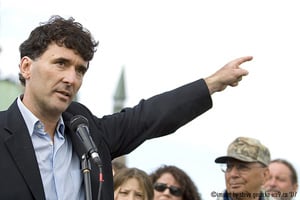
NDP leadership candidate Paul Dewar on the grassroots, fixing foreign policy, helping the poor, and more.
Dewar: 'Anyone who's serious about winning the leadership has to take B.C. seriously.'

-
-
New Democrat leadership candidate on taxes, energy, Parliamentary representation, and more.
-
New Dem leadership candidate Nathan Cullen on taxes, Enbridge, changing the voting system, and more.
-
Find more Tyee political reporting here.
Paul Dewar is direct when asked why he wants to lead Canada's New Democratic Party: "I think I'm the best person to take our party to the next level."
That kind of talk sounds audacious in a race where several of his competitors answered the same question by talking about how the party would rather not be having the leadership race at all, it having been made necessary by Jack Layton's death. There's a legacy to continue, and they are humbly offering to continue it, should members see fit to put their trust in them.
Having won official Opposition status in last May's election and moving past the Liberal party, the NDP is likely to mount the strongest challenge to Stephen Harper's Conservative government in the planned 2015 election.
That makes the NDP's leadership race key to Canada's future, said Dewar. "It's not just to be leader of the official Opposition. It's to be leader of our party and aspire to be prime minister of this country."
Profile foreign policy
The MP for Ottawa Centre, 48-year-old Dewar talks about building the party and preparing to form the government. "The history of our party is a grassroots party," he said. "We do best when we engage the grassroots."
At the same time, the former foreign affairs critic and teacher says there's a need to attend to policy areas that recent governments have neglected. He'd return Canada to being a leader on the international stage, address peace and security issues, and build a more compassionate country, he said.
CANDIDATE NIKI ASHTON: 'YOUNGEST VETERAN'
When Delta North MLA Guy Gentner introduced Niki Ashton, a candidate to lead the federal NDP, to the B.C. legislature in November, he stressed her youth.
"If all things go according to plan, she'll be the youngest prime minister, at the age of 33," he said.
Speaking with The Tyee, Ashton said she was the youngest woman in Parliament when she was first elected in 2008, but that changed in last spring's election. "I'm now old, officially," she said. "I'm the youngest veteran."
Asked about the issues Canadian youth face, she said, "A critical one right now is the economy. I mean young people are facing some of the highest rates of unemployment in decades."
The daughter of Manitoba cabinet minister and long time MLA Steve Ashton, she noted that work prospects are changing and young people are entering "increasingly, a labour market that is geared towards the short term contract, less stable than anything our parents were faced with."
They join that unstable job market with a record level of student debt, she said. "It's a pretty grim picture in terms of young people finding their economic footing and being able to start a life at the same or a more grand level than their parents."
Nor do housing prices allow young people to get established, she said. "Our parents would have been able to buy a house out of university with a job or getting on with whatever, university or not, but that's no longer the case."
The environment is another source of uncertainty for young people, especially with a federal government that appears not to care about it, she said. Noting financial security is impossible without environmental sustainability, she added, "Our generation will have the most to pay if we continue down that path, and that's what we're saying, we have to get off that path."
She said she'll release a housing plan later in the campaign that will include details on how to make home ownership more affordable.
On the economic front, she said she supports measures that allow Canadians to control their own economic destiny. There is a trend towards foreign ownership of companies that use Canada's natural resources. That needs to be reversed so jobs adding value can be kept in Canada and our resources can be used to create good paying jobs, she said. -- A.M.
"I want to see we have a coherent foreign policy that's in the best interest of our country and in line with our values," he said. "We are going to have a country, and I'd like to be a prime minister, who says we are going to take better care of each other and not apologize for that."
Whether it's the Middle East, Africa or climate change, Canada should get involved when other countries ask for help, he said. We have a strong tradition of participating in United Nations peace keeping missions, but are now 55 out of 108 countries in our contributions.
We should also be more active in international development, he said. "Canadians are thirsting for that." Canada needs to be a leader on foreign policy, not just take positions that echo those of other states, he said. "We need to promote that more and put it out there as something that's a priority for us as a government in waiting."
In March, Dewar championed a private member's bill to make it easier to provide low-cost generic drugs to Africa, which passed in the House of Commons.
National pharmacare
Too often the media and politicians themselves seem caught up in horserace politics, rather than issues, he said. The focus is on pocketbook issues, what politicians will do for individual voters, he said.
"I'm convinced the way we win is to open up the debate to other issues," he said. The NDP needs to give people more reasons to vote, in contrast to the Conservatives whose strategy in recent elections has been to suppress participation, he said.
Towards the end of the interview, however, he did acknowledge the last three stories about him had looked at his ideas. "When I've put ideas out there, they've been covered," he said.
Speaking to The Tyee, he said his chances in the race are "as good as anyone's," and covered a wide range of issues.
There needs to be more support for home care, and the health accord debate should go beyond a discussion of funding and look at what kind of system we want, he said.
He suggests creating a national pharmacare program. While that sounds big, it would be easy to begin coordinating drug purchases between all the provinces, which would provide economies of scale and save governments' money, he said. "That could be done right away."
Poverty is best fought by making sure people get the money and support they need, he said. He suggests taking all the benefits that are already provided for seniors, children and families and bundling them into one program.
"It would have an impact immediately," he said, noting it would require coordination with the provinces.
Asked if that amounts to a "guaranteed annual income," he said calling it that and presenting it as a new program would scare people. Reorganizing programs that already exist would be more likely to find support, he said.
Pipeline risks
The federal government could invest in projects to improve the value added to natural resources in sectors like forestry, Dewar said. One way would be to give tax advantages to companies that are creating and keeping jobs here. Tax cuts would be for the companies that are providing value, not given across the board, he said.
Asked about the Enbridge proposal to build twin pipelines between Alberta's tar sands and Kitimat and the Pacific Ocean shipping routes, Dewar said, "I think that's frightening when you consider there are concerns right now."
Human health, water contamination and Fort McMurray's air quality are all issues, he said. "We haven't figured out the balance," he said.
And the pipeline itself will have risks, he added. "Spills happen and problems occur."
The proposed addition of seats to the House of Commons rightly recognizes that B.C., Alberta and Ontario need more representation, Dewar said. It does not, however, address our electoral system's real shortcomings, he said. "I find what's more typical with people is not necessarily having more MPs in the house, but how MPs get there."
Dewar supports moving to a mixed member proportional system of representation, where the House of Commons better reflects parties' percentage of the popular vote, a position in keeping with the NDP's platform.
Harper's proposed changes to the Senate should be junked, he said. Even if senators are elected, they will still need to be appointed by the prime minister, and they will be serving in a system that's not representative.
"It's an entire mess," he said. B.C. in particular is underrepresented, with six of 105 Senate seats, despite having 13 per cent of the population.
The Reform Party, where Harper's roots are, wanted a "Triple E" Senate, Dewar pointed out. "There was the 'equal' part." The other two Es stand for "elected" and "effective."
Staying realistic
While in B.C. in November, Dewar's meetings included NDP MLAs Rob Fleming, Spencer Chandra-Herbert, Shane Simpson and Mike Farnworth.
"I think anyone who's serious about winning the leadership has to take B.C. seriously," he said.
None have so far endorsed him. Two The Tyee spoke with have said they are waiting until later in the race when they've heard from everyone to make a decision. Dewar did announce the support of two "prominent" British Columbians, former North Island MP Catherine Bell and a newly elected councillor from Cumberland, Roger Kishi.
With the vote scheduled for March 24, 2012, there's still a long way to go in the campaign.
It's important to keep the agenda realistic so it can be delivered on, said Dewar. "It's a matter of not taking on too much," he said. As either an oppostion or a government, "You can easily take on 50 different issues."
That does mean an NDP government won't be able to make all the change that's needed at once. "People understand that. People live their lives that way," he said.
[Tags: Politics.] ![[Tyee]](http://thetyee.cachefly.net/ui/img/ico_fishie.png)
Andrew MacLeod is The Tyee's Legislative Bureau Chief in Victoria. Reach him here.
13
Login or register to post comments
Fiat lux
1 year ago
None of these beautiful plans
None of these beautiful plans can be realized under the present economic theory, under a fraudulent definition of economic efficiency and where a special interest class is legally permitted to "create" money to be used as weapons of conquest and enslavement.
Yet, nobody dares to speak about this obvious crime wave. All we can hear are band-aid solutions to cover up compound fractures.
The real enemy are not the corporate mafia, but the universities, where the Priesthood of the Money God is being brainwashed to mislead the public into submission to criminals.
Why should economic decisions, controlling the lives of 7 billion human beings, be made in the gambling casinos of the stock and money markets, without any concern of people and environment being destroyed to satisfy the demands of disgusting greed?
Ed Deak.
Granville
1 year ago
"Poverty is best fought by making sure people get the money
they need", he said.
Yes and no. History proves over and over that:
When a person gets something for nothing, that is exactly what it is worth to them.
and
Everyone needs self-respect and this comes through working for your money, not by lining up for it with your hands held out.
Utopic ideas are often floated by would-be political leaders and they come back to haunt them. The biggest problem in my opinion is that most western governments have spent themselves into oblivion by pandering to the demands of an unrealistic and overly-demanding public.
Ever since the Trudeau days it has been common practice for Canadian governments to spend more and more on e.g. healthcare and arms than either really needs. The spending habits of successive governments have created a growth indstry of charities and causes, all begging for money.
Yesterday I was confronted with two charities outside my local grocery store, one was the Salvation Army and the other was Child Find. They Sally Ann guy was politely ringing his bell and the gal from Child Find was aggressively soliciting donations. It was an interesting moment to say the least.
Everyone, and I mean everyone, wants more and more money. The government wants more taxes and the charities want more donations. It takes a hard heart to turn down a sweet young lady with a good cause, but if one didn't, one would end up penniless.
There is a conspiracy afoot, folks, but not the one you are thinking of. The conspiracy I am afraid of is the one that includes you and me, all wanting more and more for our tax dollars. We end up paying everything we own to the government and it isn't sustainable.
That is the message potential political leaders should be delivering, not wishy-washy 19th century Fabian Socialism in 21st century Canada.
Fiat lux
1 year ago
Profits are also "tax
Profits are also "tax dollars"= "taxation without representation", even if our politicians and economists call them "earnings".
Profits are necessary for the survival of businesses, just as society needs "tax dollars" to survive, but there should be limits on how much some businesses and executives are permitted to take from the public and then out to slave labour Asia, under the "globalization" racket.
Harper was on TV yesterday, saying that he refuses to stay in Kyoto and send more jobs abroad.
While he's signing "free trade" rackets with the worst exploiters and insist on sending more resources and oil to his commie brothers in China to kill more jobs here.
Ed Deak
igbymac
1 year ago
Fiat lux
The real enemy are not the corporate mafia, but the universities, where the Priesthood of the Money God is being brainwashed to mislead the public into submission to criminals.
How true, as we generally behave according to what we think we know. There have been occupations of the universities in small pockets regarding this matter, but this neo-classical economic dogma has infected the majority of minds, professional and otherwise.
Face it Ed, collectively we will commit the most heinous of crimes and excuse ourselves from our conduct. Nikola Tesla had some great ideas and apparently even some solutions for providing free electric energy to the world. What truly became of those papers, if he ever recorded them to that level, remains a state secret at best. Certainly JP Morgan played a significant role in sabotaging this technological progress, but we all know the Banksters haven't changes their spots in centuries.
When money is our god, god help us all. How sad to have commodified our own humanity.
Cynic
1 year ago
I love the good ol' same old
I love the good ol' same old same old. Bravo Paul Dewar and Niki Ashton. Way to go, way to kinda sorta you know let's do this and that. Let's find that economic footing. Let's control our economic destiny. Let's let's.
Blah blah blah. Not a word about where money comes from, not a word about debt slavery, not a word about the growth imperative, not a word about elite rule. Same old useless piece of shit pseudointellectual toilet seat neanderthal pathetic futile kneejerk poppycock ordure garbage can jail cell putrescent septic gangrene bottom feeding nonsense. Limp. Flaccid. Zero.
igbymac
1 year ago
Cynic
ditto
Frank
1 year ago
Cynic
I guess you've read Paul Hellyer and have supported the Cdn Action Party?
The thing to remember is that even when the Bank of Canada was doing what Hellyer wants to see again, we still had poverty, debt, lack of social programs and so on.
rantnic
1 year ago
Frank
You are of course right about that. But you miss the point that the occupier's have been making. Those same old problems were not nearly as severe in the old days as the cost of living was lower and the survivability was higher. Especially for the poor and the marginal. In those same "good old days" the corporate profits were not nearly as obscene as they are today.
Cynic
1 year ago
Things were much better in
Things were much better in the postwar years when the BoC held more of the government's debt. But the BoC has never been used to its full potential. And as the banksters have gained more and more power over government it's been used less and less, to today where it isn't even close to fulfilling its mandate: "to control currency and credit in the best interests of the economic life of the nation." That's a bad joke now.
Frank
1 year ago
rantnic and cynic
I agree that the Bank of Canada's policies are partly to blame for the worsening economic conditions since 1979-1984 when the Right became dominant in Britain, the US and Canada. A dominance which has resulted in the current depression and which the Right laughingly claims is not their fault.
My only point is that the BoC's pandering to currency traders and holders of government debt is not the whole problem. Much of the current depression can also be blamed on the deregulation and Free trade chickens coming home to roost as well as the changes in Canada's domestic policies foisted on us by Michael Wilson and Paul Martin.
So I agree that the BoC's policies should be reversed but I also want to see our free trade agreements torn up, increased regulations, actual enforcement of all the feel-good laws that are currently ignored, protection of the environment, a change in who our economy is designed to enrich and so on.
So my only argument with your point was that focusing on the BoC is too narrow. Even if we successfully got the BoC to go back to its policies from the 40's and 50's we would still be mired in a multitude of problems that new BoC policies would barely affect. My own view is that free trade, globalization, has hit us harder than the change to BoC policies but I may be wrong about that.
One can only imagine how bad things will be in 10 to 20 years as Harper's policies trickle through the economy over that time.
igbymac
1 year ago
Frank says,
I would say the erosion of the sovereign control over the Bank of Canada and the expansion of globalization are part and parcel of the same macro-economic policy. They work in collusion, allowing money to roam unregulated and eventually completely unfettered.
The dismantling of this non-centralized neo-conservative model is going to be epic. But what is centralized is the monopolization of power in the Banking institutions and in the corporate holdings of capital. Both need to be, one way or another, taken apart then either destroyed or socialized.
Private dynasties of wealth simply cannot exist. At least not if we have any hope of building a stable and enriching environment for humanity.
The solution is not found in repeating what we have, tweaking it here and there. Our current Party politics, all desirous of further adventures with capitalism, can only exasperate the problems we have created. Thinking otherwise mis-construes the current dilemma entirely.
Granville
1 year ago
Profits are NOT a form of taxation, unless - you are drunk
Profit is what is left over when all the bills are paid. That includes the wages paid to the workers. Profits are the incentive for a business owner to create work for others, by offering a product or service.
Lots of BC residents seem to be on drugs most of the time. That is why they spout drug-induced idealism on the internet.
Whilst it might be unseasonally cynical to be so critical, we all need to get a life next year.
Granville
1 year ago
P.S. There are now 48 women claiming sexual harrasment by RCMP
Just a reality check to the idealistic commens of Paul Dewar. I think we can safely assume that the RCMP is rotten to the core with sexual abuse and other forms of corruption as well. So where do we stand on building a better society when the guardians of law and order are the worst offenders?
Some of those women are claiming they were raped by their fellow officers. How should we, the paying public, feel about that revelation, coming as it does, just before Christmas?
It kind of spoils the image of the Men in the Red Serge, doesn't it? Are they all bastards, then?