

Canada judged too quick to deplete fields; domestic demand to soar.
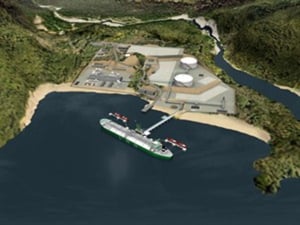
Artist's rendition of liquefied natural gas export terminal proposed for Kitimat, B.C.

-
ENERGY & EQUITY: Studies sweep away clean image of the blue flame.
-
Who finally tells us the nasty chemicals used for shale gas drilling in Western Canada? The US Congress.
-
Christy Clark picked the EnCana empire builder to guide her into power, and that says volumes about who's shaping BC's future. Part one of two.
One of Canada's top energy experts says the National Energy Board's (NEB) approval of British Columbian shale gas exports to Asia via the port of Kitimat last month will shortchange Canadian energy consumers and undermine national energy security.
"The National Energy Board does not seem to be an effective agency for holding up the long-term energy security interests of Canadians," says Dave Hughes, a long-term natural gas analyst and a former coal expert at Natural Resources Canada.
Even a long-term natural gas supply and demand forecast by Calgary-based Ziff Consultants that was paid for by the proponents of the $5-billion Kitimat Liquid Natural Gas terminal (Apache, EOG Resources and EnCana Corporation) warned that natural gas demand will outstrip supply by 2035 even without LNG exports, says Hughes.
At that point Canadians will have to import foreign gas from Africa or the Middle East at higher prices. Canada's share of the continent's natural gas supply will also fall from 25 per cent to just 14 per cent. Dramatic declines in conventional gas supplies combined with extreme consumption of natural gas for bitumen production in the tar sands accounts for the projected decline.
Despite an unlikely 17 fold increase in shale gas production from British Columbia, and the construction of the Mackenzie Valley Pipeline, Canada's natural gas supplies are projected to shrink from 17 billion cubic feet a day to 13 billion cubic feet a day predicts the Ziff report.
Nevertheless the National Energy Board granted an export license to export 200 million metric tonnes (approximately 9 trillion cubic feet) of mostly shale gas over a 20 year period through a proposed LNG terminal at the port of Kitimat last month.
Pushing domestic prices down
Shale gas, an extreme resource, requires more energy, water and hydraulic fracturing (high pressure blasts of sand and chemicals) to recover than conventional gas. It also depletes quickly.
But its rapid development over the last decade has abruptly flooded continental markets and driven down natural gas prices. As a result energy companies, supported by low royalties and other subsidies in B.C., want to sell the resource abroad.
Although Will Koop of the BC Water Tap Alliance raised the long-term supply issue at a public hearing, the NEB stated in its October decision that the proposed Kitimat export (up to 10 million tonnes a year) "is not expected to adversely affect the ability of Canadians to meet their energy requirements over the proposed license term."
In a critique published in Watershed Sentinel, Hughes finds that conclusion short-sighted: "In just 20 years from the opening of the Kitimat terminal Canada will experience a supply crunch even without LNG exports," says Hughes. "We won't have enough gas to meet consumer demand. The NEB paid no attention to this trend."
Except in BC, Canadian gas has peaked
The Ziff study isn't the only analysis predicting long-term decline in natural gas supplies. Alberta's Energy Resources Conservation Board predicts a 32 per cent decline by 2020 even with increased shale gas production in that province. B.C. is the only gas producing region in Canada that has not peaked in gas production.
"British Columbia has no comparable supply outlook to that of Alberta for its natural gas," adds Hughes. "The government now depends on corporations to tell them about future gas production which is considerably hyped. There is no independent science."
Environmental impacts not a factor for NEB
In approving the export license the NEB, which is 90 per cent funded by industry levies, said it wasn't interested in the environmental impacts of shale gas development in the Horn River Basin including the high CO2 content of its shale reserves (12 per cent or nine years worth of B.C.'s total carbon emissions) or earthquakes in Fort Nelson area and water contamination caused by controversial hydraulic fracturing. (Shale gas fracking issues are now the subject of moratoriums around the world.)
Even though an LNG terminal many well change the heavily subsidized economics of shale gas development "the Board does not find a necessary connection between the gas export licence and gas development activities in the Horn River Basin. Therefore, the Board will not consider potential environmental and socio-economic effects associated with gas development in that area." It said B.C.'s Oil and Gas Commission was now doing that.
But the province's Oil and Gas Commission, which was set up by a former member of the Canadian Association of Petroleum Producers, is entirely funded by industry levies. Its last director, Alex Ferguson, who lobbied for shale gas development in Europe, reluctantly introduced new water controls for shale gas in 2011, retreated from the media during the EnCana bombing campaign, rarely met with landowners. He just left the Commission to take up a senior paying job for Apache, one of the U.S. companies funding the LNG terminal.
"Exporting gas to Asia and growing shareholder portfolios is not in the best interest of Canada. This is a one time non-renewable resource. We should optimize its use for the long-term benefit of Canadians."
A full critique of the NEB's decision and its implications on natural gas supplies by Dave Hughes can be found here.
Prior to the deregulation of natural gas markets in Canada in the mid 1980's, the NEB could not approve exports unless Canadians had a guaranteed supply of natural gas for 25 years. That requirement, long abandoned, would have killed the Kitimat export licence, says Hughes. ![[Tyee]](http://thetyee.cachefly.net/ui/img/ico_fishie.png)
Andrew Nikiforuk is the author of the national bestseller, Tar Sands: Dirty Oil and the Future of a Continent. He has advocated for a slow down of the $200-billion project for economic, political and environmental reasons. Find his previous Tyee stories here.
26
Login or register to post comments
Jeffrey J.
1 year ago
Shades of Foreign Occupation
This is what it looks like when a dominant empire invades a weak country, appropriates their stuff and sells it abroad. Imperialism has been described as "the process whereby the dominant politico-economic interests of one nation expropriate for their own enrichment the land, labor, raw materials, and markets of another people."
Nikiforuk's research clearly confirms what many Canadians worry about: the take over of Canada's resources by transational corporations, with the complicity and collusion of right wing ideologues like Harper and Campbell/Christy Clark.
These collaborators are known as the 'comprador class' by occupiers, and are carefully cultivated to help give away our stuff.
As another great author, Michael Parenti, writes in Imperialism 101:
"A comprador class emerged or was installed as a first condition for independence. A comprador class is one that cooperates in turning its own country into a client state for foreign interests. A client state is one that is open to investments on terms that are decidedly favorable to the foreign investors. In a client state, corporate investors enjoy direct subsidies and land grants, access to raw materials and cheap labor, light or nonexistent taxes, few effective labor unions, no minimum wage or child labor or occupational safety laws, and no consumer or environmental protections to speak of. The protective laws that do exist go largely unenforced."
"Historically U.S. capitalist interests have been less interested in acquiring more colonies than in acquiring more wealth, preferring to make off with the treasure of other nations without bothering to own and administer the nations themselves. Under neoimperialism, the flag stays home, while the dollar goes everywhere—frequently assisted by the sword."
http://www.michaelparenti.org/Imperialism101.html
Sadly, it appears that the take over of Canada's sovereignty is nearly complete. Deeply tragic.
Van Isle
1 year ago
Oh well, when we run out of
Oh well, when we run out of natural gas then we all can back to using wood to keep warm. Think of all the money and Government stimulus to retro our homes; out with the old a clunky furnaces and in with brand new and shiney wood stoves.
Sask Resident
1 year ago
Van Isle
Or go back to coal, with BC exporting only 24 million tonnes a year.
Ignored are the natural gas potentials in Alaska, the St. Lawrence, across most of the continental US, Sask and around Norman Wells. 15 years ago, companies were planning to import LNG but technological break throughs have switched it. China also has vast shale gas and oil reserves but probably can't exploit them for 10 to 15 years, which is the time Canada will be exporting LNG to them.
For a little history, David Hughes a few years ago forecasted that shale and coal bed natural gases were unavailable. The technology has changed.
realisticman
1 year ago
Everyone is for it
"“This is huge. We embrace it. A lot of people are working,” says Ellis Ross, chief councillor of the Haisla Nation in Kitimaat Village across the channel from Bish Cove. “It’s going to be life-changing for us.”
...the support for gas drilling and exports is expansive. Nathan Cullen, NDP MP for the Kitimat region and a leadership candidate to succeed Jack Layton, backs LNG, as does John Horgan, an MLA on Vancouver Island and provincial NDP energy critic.
“We need to get going,” Mr. Horgan said.
Globe and Mail
Oct. 13, 2011
D Broten
1 year ago
Documents for story
You can find the Watershed Sentinel story, along with the graphs which illustrate these points about gas supply, at http://www.watershedsentinel.ca/content/canadian-gas-exports-threaten-energy-security
rockdoc
1 year ago
Sask Resident comments
Sask Resident - at least get your facts straight. David Hughes not only did not say that "coal bed gas was unavailable" he did the mapping and worked with companies to make it happen. As for shale gas if you read the article it is based on the assumption of a 17-fold ramp up from 2010 levels and,even without LNG exports,there is a supply shortfall by 2034. The Ziff forecasts on which this is based assume the Alaska gas pipeline and the Mackenzie valley pipeline will be built before 2030. They also include shale gas from the St. Lawrence lowlands and all other areas in eastern and western Canada and in the U.S. Please get your facts straight or don't comment.
motorcycleguy
1 year ago
everyone is not necessarily for it
Fracked gas that is....I believe those in favour of the LNG plant are speaking of conventional drilling for gas. It is non-conventional (fracked) gas that requires scrutiny....BC has 25% of conventional gas reserves in the Western Canada Sedimentary Basin. All gas is not fracked. However, just normal economic potential is not enough for some people, thus the quest for non-conventional (fracked) gas.
Regardless of fracked or not fracked, you bet it will run out much quicker than if somewhat conserved for BC use....and Van Isle wont' be able to get the logs he needs either, they will already have been sent to China.
frank2
1 year ago
Too bad that even the NDP
Too bad that even the NDP (Horgan) favours ramping up production as fast as possible, and spending the proceeds as we go, with no thought for mitigating the future impacts, not just environmental, but also the "adjustments" our children will face when the gas runs out, and with it the money to pay for all the goodies it now pays for. The improvidence and short-sightedness of the 1% are well known. Anyway, they figure they'll be able to buy themselves out of future shortages. That option ain't open to the 99%. It's time for the "centre-left" to wake up!!
Fiat lux
1 year ago
With the fraudulent free
With the fraudulent free trade rackets having destroyed Canada's manufacturing and economy, the only thing left is to sell the land and country from under the citizens' feet.
The brilliant "capitalist, conservative" minds haven't figured it out yet that the sale of resources is not an income, but the sale of capital.
Ed Deak.
igbymac
1 year ago
A clarification, perhaps, Ed Deak
Well, unless you are entailing the governmental institutions of oversight themselves as the 'country'.
Typically, after the land is sold off, there comes the privatization of the national corporations like PetroCanada or BC Hydro; and after the corporations are sold off, the government privatizes its military, police, hospitals and educational systems to fully gut the sovereign state. We emerge no less than inmates of a manufactured security state ruled by fascism.
Fish-counter
1 year ago
Since most Tyee readers don't want us to sell the gas....
What DO they want to do wih it?
Canada has an enormous wealth of natural resources and we have an obligaton to share them with the rest of the world. That is what trade is all about and it is how we buy our manufactured goods.
Selling our natural resources is not a crime, and it doesn't make us all slaves. We simply have to get the best price for them, or be the fools of the world.
Canadians also own significant bits of other countries. It is all fair trade, so get over it.
igbymac
1 year ago
Fish-counter
Fair trade, is it? What's 'fair' about it?
Corporations are handed the rights to the rich areas of the commons in exchange for some kickbacks, career promotions and golden parachutes?
I think a country like Canada has no legitimate reason to have to buy a bloody thing from another region on the planet. It is fully self- sustainable. But sovereignty ain't our bag, that has long be proven.
reallife
1 year ago
Motorcycle guy
Just to clarify the issue of fraccing (I like to use the traditional spelling), most conventional gas and oil wells have routinely been subjected to some form of stimulation before being put into production - the most common methods are acidizing and fraccing. The recent development is the increase in the size (amount of frac fluids and propents and the horsepower used) of the frac jobs that allow previously uneconomic tight reservoirs to be made productive.
Incidentally, did you catch the weird GlobalTV news item yesterday that linked BC shale gas development with gassy shallow water wells and sour gas odors - this in spite of the fact most shale gas is sweet and the BC projects are kilometres deep?
freewilly
1 year ago
Cleaner forms of energy
Cleaner forms of energy like geothermal, we can't sell, not in the conventional sense. If BCers embarked on geothermal, solar or wind technologies they might be able to sell expertise, but we cant do much if we don't get started asap. Experimental Fusion generators, particle accelerators should also be built and part of the plan. In 50 years maybe sooner the only thing energy companies will sell is "knowledge"
Maybe there should be a trade school that just specializes in alternative forms of energy. Even something as basic as an on-demand hotwater heater makes tradespeople roll their eyes. "You want to install what?!?"
in the meantime we should sell our natural gas, get a fair price, create work, put as much money into sutainable energy reseach as possible, and keep some of that resource for ourselves.
As far as canada becoming like the belgian congo as Ed and Igby elude to with posts about corporations and imperialistic powers taking over our country, well, I guess it has happened. Funny how some of the most resource rich countries end up being the poorest, well those in africa.
Question is, can we do something about it?
If I said no, I might as well give up altogether.
There will be a day when our dilemna about energy ends. It will be like the day the printing press was invented, or antibiotics were created. We got a sense of it when cold fusion was announced, a farce yeh probably... When it comes and it will, what a game changer and leveller that will be.
Cool Hand
1 year ago
Canada or BC?
Natural gas deliveries to the U.S. are declining due to the abundance of close-to-market U.S. ng in terms of the numerous new shale gas plays in the U.S.
Are current natural gas deliveries to the U.S. therefore also threatening Canada's energy security?
I'd rather receive a much higher price in Asia - ~3 times HIGHER - than what the U.S. is currently willing to pay for our ng.
The tight gas/shale gas plays in the Montney, Horn River, and Cordova Embayment are well above and beyond the requirement for BC's needs.
In fact, ~1,500 trillion cubic feet are estimated to be situate there alone, albeit only around 20% is recoverable with today's drilling technologies.
The Apache/Encana/EOG Reources LNG terminal in Kitimat will be sourced from their respective shale gas reserves.
The proposed Shell lng terminal will also be sourced from their $5.8 billion purchase of Duvernay and it's tight gas/shale plays.
The proposed Progress Energy/Petronas lng terminal will also be sourced from their vast shale gas plays.
BC's conventional gas is already contracted out to existing BC utilities as well as the TransCanada pipeline.
BC also has huge ng reserve potential in:
1. The Whitehorse Trough;
2. The Bowser Basin in NW BC;
3. The Nechako Basin in the Chilcotin;
4. The Offshore Basin in the Queen Charlottes;
5. The Georgia Basin in SW BC;
6. The Fernie Basin;
That's another 60 trillion+ feet of ng. BTW, at the turn of the century the streetlights in Steveston/Richmond were powered by locally drilled ng.
And then there's coal bed methane, another vast source in BC with the potential for over 90 trillion cubic feet of ng.
BC is awash in ng potential and very blessed in that regard. And BC is certainly entitled to receive the economic/financial benefits from the exploration, production, and export of same.
I certainly don't want any dictates from Ottawa to undermine BC's economic potential in this regard. The disasterous Trudeau National Energy Program from the early 1980's is a case in point.
Cool Hand
1 year ago
reallife
Yeah. Caught that. Poor investigative reporting IMHO. And yeah, what do shallow/sour gas wells drilled in far off central (?) Alberta have to do with deep/sweet gas in NE BC? haha
rockdoc
1 year ago
Cool Hand Comments
Cool Hand - Seems like you are smoking some high grade BC bud. The Whitehorse Trough is not even in BC. And where to you get your other wild resource estimates from - eg 1500 trillion cubic feet of shale gas in the Horn River, Montney and Cordorva Bay, of which 300 Tcf is recoverable? Certainly not from the realms of science and geology. The forecasts used to project the Canadian shortfall assumed production from these shale gas sources will grow 17-fold from 2010 levels by 2035. As for coalbed methane, there has been next to nothing produced despite a decade of trying. Wishful thinking does not put gas in a pipeline. Have another hoot.
Cool Hand
1 year ago
rockdoc
Yes it is. It extends down to Dease Lake, B.C. albeit it's a much smaller basin compared to the others I cited.
Industry estimates. Hell, even Chris Adams of the BC Ministry of Energy, Mines and Petroleum Resources has cited that figure.
Coalbed methane is still in its infancy stage in BC and from my understanding is not as financially viable as ng, esp. fracced wells, at the present time.
The only BC cbm project that I'm aware of is Shell's Klappan cbm drilling program and we all know the controversies swirling around same. BTW, the cbm at Klappan is estimated at over 8 trillion cubic feet alone.
RickW
1 year ago
Fish-counter
I suppose that, amongst all the seriousness that subjects such as resource exports generate, a little lightheartedness is a welcome diversion.
I mean, really now, just where is it written that we have an OBLIGATION??!!
rockdoc
1 year ago
Cool Hand Comments
Cool Hand - Could you send me a link to those "industry estimates that even Chris Adams of the BC Ministry of Energy, Mines and Petroleum Resources" has cited? Given the early stage of investigation, even if these estimates actually exist as you say, which I doubt, they would pure hype of the most wishful thinking variety at this stage - not uncommon for industry. If you care to read the NEB judgement on the Kitimat LNG approval you will see that the collective reserves of gas that Apache, Encana and EOG are bringing to the table are about 15 Tcf, of which they hope to export more than 9 Tcf. So as I said, have another hoot.
And by the way, not one mcf of gas has ever been been produced from
1. The Whitehorse Trough;
2. The Bowser Basin in NW BC;
3. The Nechako Basin in the Chilcotin;
4. The Offshore Basin in the Queen Charlottes;
6. The Fernie Basin;
Dream on.
And the vast majority of the Whitehorse Trough is in the Yukon.
igbymac
1 year ago
realisticman, a bit more info on the Haisla
http://fnfisheriescouncil.ca/index.php/news/fish-in-the-news/1137
However, from what I hear, "the word is that all members of kitimat village will receive $10,000 dollars every year for X amount of years, so a family of 5 will bring in $50k a season. How's that for a little incentive to look the other way?".
This is from a third-generation local to the area; just what he hears. It might be worth investigating, don't you think?
rockdoc
1 year ago
Cool Hand Comments
I was hoping to hear from you Cool Hand on those industry estimates. Commentary such as yours is extremely unhelpful, given its false content, to a rational debate on our energy future. I don't know if you are an industry or BC Gov't troll or just a misinformed bystander. A clear understanding of where we are going in liquidating our non-renewable resources (our capital) is crucial in ensuring a more sustainable energy future. For it is certain that eventually we will have to live on our interest.
Cool Hand
1 year ago
rockdoc
Firstly, the Horn River Basin is still in its infancy stage as is the Cordova Embayment, the neighbouring Liard Basin, and portions of the Montney.
Even Encana estimates that the Horn River Basin alone contains well over 500 trillion cubic feet of natural gas. What Encana et al brings to the table for the first lng plant is proven reserves in their initial exploratory drilling.
https://secure.globeadvisor.com/servlet/ArticleNews/story/gam/20110614/RBLNGGASVANDERKLIPPEATL
And Chris Adams of the BC Ministry of Energy, Mines, and Petroleum Resources presentation from last year corroborating virtually the same:
http://www.empr.gov.bc.ca/OG/oilandgas/petroleumgeology/UnconventionalGas/Documents/C%20Adams.pdf
Frankly, I have a higher level of confidence in technical staff from the ministry/ and or industry than some anonymous poster called "rockdoc". :P
That still doesn't preclude the estimated natural gas (and oil) reserves in these basins.
Canadian Hunter ran a high-risk exploratory drilling program in the Nechako basin circa 1984. A very high risk basin, due to the geological overlay, in terms of finding the "needle in the haystack" v. finding the "needle in the glass jar" in NE BC.
As ng prices will eventually increase, these basins will receive more attention over the coming decades (as well as the SW BC Georgia Basin). You can bank on that.
But when I read your statement:
It tells me all that I need to know. ;)
RickW
1 year ago
Cool Hand Ol' Sport
It's good to be "optimistic":
The eastern world, it is exploding
Violence flarin', bullets loadin'
You're old enough to kill, but not for votin'
You don't believe in war, but what's that gun you're totin'
And even the Jordan River has bodies floatin'
But you tell me
Over and over and over again, my friend
Ah, you don't believe
We're on the eve
of destruction.
- Barry McGuire
rockdoc
1 year ago
Cool Hand
Cool Hand - thanks for the links. Exactly as I suspected. Chris Adams quotes CSUG, the biggest hype artists on shale gas around, and Vanderklippe at the G&M quotes Adams (or CSUG). For those of you that don't know the acronym CSUG stands for the Canadian Society for Unconventional Gas - an industry lobby group. There is zero scientific analysis behind the CSUG numbers other than wishful thinking for its membership. Adams also makes other BS claims like 2000 Tcf of recoverable shale gas in the US (the US Potential Gas Committee says less than 700 tcf and the EIA a little over 800). The BC Ministry has not conducted any independent gas supply analysis for BC and as far as I know has zero scientific capability to do so (unlike Alberta which conducts highly credible supply forecasts). As for your claimed 300 tcf of recoverable shale gas I couldn't find it in the links you provided.
For your information, according to the National Energy Board, Canada's remaining marketable gas reserves amount to 473.6 tcf in 2009, and that includes the WCSB, the North, the Arctic, the East Coast, conventional, shale gas, tight gas and coalbed methane - all of it. You can access this at
http://www.neb-one.gc.ca/clf-nsi/rnrgynfmtn/nrgyrprt/nrgyftr/nrgyftr-eng.html#s4_2 see Table 4.1.
I wish the hype you believe in on wildly optimistic gas resources were true, but it isn't. Hence the need to get real on future energy planning.
Best have a couple more hoots.
igbymac
1 year ago
RickW, thanks
I've heard this song first as a young boy, and it rings louder today than it did in the 1960s.
It's hard to listen to and not to shed a few tears.
http://www.youtube.com/watch?v=ntLsElbW9Xo&feature=player_embedded