

News

A Tyee Series

Biggest Free Trade Deal Since NAFTA, Ghost Issue of 2011 Election

Canada is on verge of pact with Europe affecting farmers, local industries. It's invisible on campaign trail.

By Katie Hyslop and Colleen Kimmett, 28 Apr 2011, TheTyee.ca

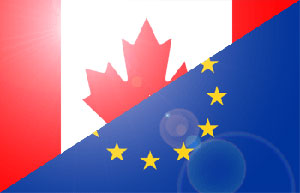
Canada and EU flags

Heard about the Canada-European Union Enhanced Trade Agreement (CETA)?

Related

Most Canadians don't know it, but our country is currently negotiating the biggest free trade contract since the North American Free Trade Agreement, a deal that could significantly increase drug prices, privatize our water, and outsource jobs easily done by Canadians to foreign multinational corporations. And none of the parties are talking about it.

The Conservative government has been involved in private negotiations with the European Union over the Canada-European Union Enhanced Trade Agreement (CETA) since 2009, with the most recent round of talks taking place earlier this month -- during the campaign.

There's been little coverage of the deal, with only Parliamentary reports from last fall and leaked reports from private negotiations to go on. Yet Stephen Harper says he hopes to wrap up negotiations by the end of 2012.

"The first thing to know about CETA is really it's not mainly about trade: genuine trade barriers between Canada and the European Union are already very low," says Scott Sinclair, a senior research fellow for the Canadian Centre for Policy Alternatives, and a former senior trade policy advisor with the B.C. government.

"My concern is that the agreement's more about limiting democratic policy options and enhancing corporate power, really, than enhancing trade."

Cashing in on provinces

Unlike past trade agreements, including the failed Trade and Investment Enhancement Agreement negotiated with the E.U. under the Liberal government in 2005-06, this agreement involves areas of provincial and municipal jurisdiction. 

"The provinces are right now in the process of compiling a list of services including public services and government measures; crown corporations, including in Ontario the liquor board; and municipal governments, that they're willing to basically put on the chopping block, that they're willing to throw into this deal, and we haven't seen this list," says Stuart Trew, trade campaigner with the Council of Canadians.

The main reason for opening up the provinces and municipalities, says Trew, is for procurement of public contracts, encompassing everything from constructing hospitals, to supplying bus fleets, to privatizing our water and sewer systems. Trew estimates Canada spends as much as $200 billion on such contracts a year.

"The European Union is itself a highly privatized area which I think most Canadians don't realize," he told The Tyee.

"If you look at transit, energy, and definitely postal services, these are highly privatized in the European Union. Water is still, like Canada, mostly in public hands. And so they see in CETA a way to one, open up Canada's public services to privatization, and also to kind of set a global example for where they can push other countries to include these same services and procurement rules with the E.U."

But just because water is public in Europe doesn't mean it will remain so in Canada, warns Paul Moist, president of the Canadian Union of Public Employees.

"I know from first-hand experience they're extremely interested in all water infrastructure in Canada: waste water treatment, water treatment, etc., because at the annual [Federation of Canadian Municipalities] convention [European corporations are] there in droves with their trade show materials," he told The Tyee. 

The end of local?

In the past municipalities and provincial governments have opted to give their contracts to local businesses only. For example, when the City of Toronto needed new streetcars, they decided without a public tendering process to give the contract to Bombardier, who have a plant in Thunder Bay, Ontario. That won't be possible under CETA because of a clause similar to NAFTA's Chapter 11, which allows corporations to sue governments for compensation if they believe they've stood in the way of profits.

The province of Newfoundland and Labrador learned what Chapter 11 was all about when pulp and paper giant AbitibiBowater shut down their pulp and paper mill in Grand Falls-Windsor and the province responded by taking back the company's rights to water and wood in the province. AbitibiBowater sued the province for violating NAFTA, and the federal government stepped in and settled the dispute by giving AbitibiBowater $130 million. 

"[That] made Newfoundland angry; they thought the water and timber rights belonged to the people of Newfoundland and they were only given to AbitibiBowater so long as they lived up to their end of the agreement, which they ceased to do when they closed down the operation," says Moist.

"So you had a national government, in our case the federal government, signing international trade deals that affect matters that come under the purview of the province, in this case water and timber rights in Newfoundland."

Terry Boehm, president of the National Farmers' Union, worries that the procurement piece of the agreement will have a chilling effect on a burgeoning local food movement, particularly in what's known as the MUSH sector -- municipalities, universities, schools and hospitals.

This sector feeds millions of people every day, and its collective buying power is an important lever in supporting the local food economies. Already, institutions like the University of Toronto and City of Markham have adopted local food procurement policies.

Under the new agreement, giving preference to these local suppliers would be prohibited. It would also prohibit these public sector institutions from breaking up contracts so that they fall under the dollar threshold to which the trade agreement applies.

"So it really, in our minds, hinders the potential for local food systems," says Boehm. "And I think it is significant not just for Canadian agriculture, but Canadians in general. It's a fundamental shift in the philosophical view of what government is. It shifts away from government being a creature of citizens to act in the public interest to being a creature that acts in the corporate interest."

Specter of driven up drug prices

Medicare and the state of the country's health system is a talking point during this election, but according to Moist the biggest cost driver of our health system is the cost of drugs, and thanks to extensive demands on intellectual property rights, CETA will only increase the costs of generic drugs.

"Drug costs will sky rocket according to evidence we have because of the demands of Europe on the intellectual property side of the equation. They want to extend patent protection," he says.

"A study by two of Canada's top academics on pharmaceutical policy concluded that Canadian payers such as the federal government, provincial governments, businesses and patients would face substantially higher drug costs, with the annual increase in costs likely to be approximately $2.8 billion per year."

The NFU and other food security advocates have concerns about intellectual property rights as they pertain to patented seed varieties.

Monsanto has already demonstrated its legal right under NAFTA to go after farmers for patent infringement. Perhaps the most high profile case was Saskatchewan farmer Percy Schmeiser, who was sued by Monsanto after its Roundup Ready strain of canola was found growing on his fields.

"Schmeiser has claimed all along that the Monsanto canola must have blown onto his field, or fallen from passing trucks. Monsanto accused Schmeiser of stealing its seeds and sued him for illegally using its patented, genetically modified canola," reads an in-depth CBC report on the case.

"This [CTEA] makes it worse in that, not only does it go after the person for alleged infringement, it allows these precautionary and enforcement measures to be undertaken... seizure of property, even going after third parties who are deemed to have allegedly assisted the farmer," says Boehm. "It sends up a chill throughout the entire seed system."

Boehm says that the NFU has been scheduled numerous times to appear before the standing committee on agriculture to voice its concerns, but so far have been unable to due to cancellations, changes of scheduling, and then the election.

Saving the supply-management market

However, the organization that lobbies on behalf of dairy producers in Canada has sent its message to the government loud and clear.

Dairy (along with poultry and eggs) is a supply-managed market, which means domestic supply is controlled by federal and provincial marketing boards, and protected with very small import quotas and extremely high tariffs on anything that exceeds those quotas.

The E.U., a major producer of cheese, is pushing the Canadian government for increased access to this country's cheese markets under the new agreement.

It is also pushing to expand the number of products protected under its Geographic Indicator system, which would impact the industry by forbidding the marketing of Canadian-made cheese under names that indicate style originally developed in specific European regions, like mozzarella or feta, for example.

The Canadian government so far has been clear that the supply-managed market remains a sacred cow for better, or for worse, as Jeffrey Simpson argued in a recent Globe and Mail column, calling Canada a "double-dealer in world trade."

For now all the federal leaders on the campaign trail, even Stephen Harper, "once a fierce opponent of agricultural protectionism," reports Postmedia News, are touting their parties as defenders of this country's supply-managed markets.

The Canadian Dairy Association has been watching the negotiations closely, says Therese Beaulieu, the association's assistant director of strategic communications. "And reminding the government that that is their position and that's the commitment they made in their electoral platforms. The Liberals kept saying that they are the party of supply management, the Bloc as well. All the parties are committed to this position and that's what we expect to see."

However, the Canadian agricultural sector is a divided one, points out Grace Skogstad, a political science professor at the University of Toronto who specializes in agricultural and food policy.

"Our cattle and pork producers depend on export markets to absorb surplus product. If Canada could negotiate lower tariffs on pork going into the E.U., for example, it would help the industry here," says Skogstad.

"My own view of this, from what I've been able to gather, there would be some wins and some losses on both sides. I think it's always important for farmers to get organized and lay their concerns out. It is a very big deal, this agreement, it's a comprehensive economic agreement."

Fighting from the bottom up

Yet, aside from the issue of supply management, a relatively arcane topic for most Canadians, there's been little discussion from any of the other parties about the agreement during the election. The Trade Justice Network, a conglomeration of groups concerned about CETA including the Council of Canadians, has sent a questionnaire to each of the leaders asking them where they stand on the agreement with hopes of getting the results by later this week.

"We know that the NDP is very concerned, more broadly concerned about the agreement than some of the other parties. The Liberals are supportive in principle, but they have some issues around making sure there's a cultural exception built into CETA as there was in NAFTA that will protect Canada's cultural industries," says Trew.

"Bloc Quebecois is looking for a good deal, they're looking for reciprocity, at least that's what they said the last time the Trade Justice network met with them last summer. The Green Party is opposed to these kinds of trade deals, always has been; they would like to see a more fair trade agenda, much in the same way the NDP would."

Moist acknowledges that it might be too late to make CETA an election issue, but it isn't too late for Canadians to take action. This Friday, April 29, CUPE and the Council of Canadians kick off their Canadian Communities Not For Sale speaking tour about CETA in Calgary, where they are already expecting an audience of 500.

"We've had communication with most towns and all cities across Canada because we represent people in those municipalities, and I think some of those municipalities are hearing about this for the first time from us, and many of them are adopting motions similar to the [Union of British Columbia Municipalities] resolution that was adopted last September at their annual conference," says Moist.

"If Harper is re-elected I'm sure he won't change his stance and he won't have public hearings, but bringing pressure to bear through provincial and municipal arms is a good thing to do. And you need to educate citizens before that will happen."  [Tyee]

27  Comments:

Login or register to post comments

  • EcoCollectivist

    2 years ago

    Psychotic

    This is psychotic and only seeks to centralize wealth towards the corporate aristocracy. This allows them to move capital more freely and and centralize our realities into a coproatized one. And we are ment to become the nice little happy workers for the corproate aristocracy. I would just like to give a big middle finger to the corporate aristocracy right now!!

    We need decentralization and localization. We need diversity NOT homogenization of "free" trade. This will destroy entrepreneurship, small and medium sized business further corporatize our society.

    And no one is talking about this. WTF!!!

    http://ecocollectivism.wordpress.com

  • Dan the socialist

    2 years ago

    The big mainstream media as

    The big mainstream media as usual is failing the people by keeping this quiet.

    Were finished if this goes through. Sold out yet again by the con party. Jobs will be gone but corporate profits will rise...

  • ron wilton

    2 years ago

    I wonder if

    edited for offensive comment

  • danneau

    2 years ago

    Mulroney Redux

    This looks like the same process whereby we got the original FTA and the GST. If none of the other parties are discussing this item, is it through ignorance, or is it because they're all in it together? Or could it be that there is discussion, but that it's being cloaked by media conglomerates, along with the North American Security Perimeter, the flood of GMO approvals, and the clamping down on anything that isn't corporate agriculture? Welcome to a more complete dystopia.

  • caber1

    2 years ago

    Gotta love mainstream

    Gotta love mainstream media.
    I know nothing about these talks, but I know everything there ever was to know about the royal wedding.
    It used to be that I could only hear the rattle of the handle, but lately I hear the flushing. There is only one way to go now and that is down.

  • alive

    2 years ago

    NDP or revolution!

    Yep, you are right caber1, one of the parasites in England has been told to go forth and procreate!
    Consquently the media here goes nuts thinking that anyone cares?

    I notice here, that the NDP at least has shown "some concern" about this proposed trade deal; but the main media once again hides whatever news that might reflect badly on their lords and masters!

    Let us hope for a NDP win and an end to this parody of information the neocons have created!

  • Greg in Calgary

    2 years ago

    Does Hyperbole Fall Under This Agreement?

    Because there's quite a bit of it in this article. Maybe we could figure out how to convert it into useful energy and WIN.

    Seriously, while these are important issues, screaming that trans-border water sales are right around the corner!*, "drug prices will skyrocket!" and the local food sector will be chilled! is counter-productive. This type of rhetoric is what we see almost daily on fund-raising material from Canadian "Left-wing" institutions (I'm looking at you, Council of Canadians, Friends of Medicare and Friends of CBC).

    Frankly, I'm sympathetic to all of these organizations and their social policy objectives. But I don't understand why the public has to be goaded into giving money or voting intelligently by incessant whining and outlandish claims, rather than calm explanations and realistic estimates. I think it's patronizing, and it gives people the clear impression that money I donate will be used for fundraising instead of activism. (Wait, maybe fundraising IS activism?)

    Or is this is just the style of the Left, and I just need to buckle down and donate?

    "bringing pressure to bare through provincial and municipal arms is a good thing to do."

    Is it? I like to see bare municipal arms as much as the next person, but in this case I'm don't think it's the real issue.

    *Ok, I stole that one from Maude Barlow

  • rollandmiller

    2 years ago

    Free Trade with the EU

    No agreement can be allowed until we have the election and the deal is fully vetted in Parliament

    All free trade has done so far is lower our incomes, and threaten the middle class.

  • Colleen K

    2 years ago

    Hyperbole?

    Greg in Calgary - I understand where you're coming from.

    However, I imagine that 20 years ago, it would have seemed like hyperbole to warn of a case like Monsanto vs. Percy Schmeiser.

    Some of details of the case - which you can read by clicking on the link to the CBC report - are pretty unbelievable. Yet it's true, and was made possible by way of the provisions in Canada's last free trade agreement.

  • VivianLea Doubt

    2 years ago

    Remember the MAI?

    And do you remember when a draft document of that proposed 'trade deal' was leaked? Canadians were horrified to learn that government employees were negotiating that in private, with no input from citizens. Of course, the excuse then (and now) was/is that 'confidentiality' is needed.

    It is absolutely beyond the pale that such agreements would be hammered out in back rooms by representatives of modern democracies.(In actuality they aren't representative, of course, because they are not negotiated by elected people.) At the very least, the electorate ought to be able to vote in a referendum on such issues. The federal, provincial, and municipal governments all across the country were surprised at the outcry over the MAI - and without a doubt it was real. Here in my little town for example, several hundred people came out to hear various speakers discuss the MAI...
    Governments at all levels that continue to operate in secrecy and with contempt for the wishes of the Canadian public will sooner or later sign their own death warrants... we can only hope it is sooner.

  • warbler

    2 years ago

    All issues ghosting

    A case could be made that all important policy issues are ghost issues. And the closer we get to voting day the more the focus becomes polls, personalities and gaffes. Even the good parties and politicians get caught up in the circus because the electoral system and sound-bite driven MSM force them to do so.

    If Jack Layton did 30 minute infomercials on trade policy and food security, his numbers would plummet as fast as they've risen in the last week.

    The job of voters of to probe platforms and vote accordingly, and then hold MPs feet to fire. That's the unfortunate reality. Work with it and keep fighting for electoral reform so that campaigns don't always devolve into FPTP horse races.

  • Fiat lux

    2 years ago

    Regardless of government,

    Regardless of government, this and other so called "trade deals" in reality, international treaties to restrict the decision making powers of citizens, must be forced into public referendum for acceptance, and not by some paid off politicians.

    These sellout rackets are now being negotiated in secret, because the details of Mulroney's FTA were in the media every day and have been rejected by 57% of the public.

    Mulroney was re-elected and got a majority with 43% of the votes, forced the FTA on us and the rest is history.

    The first company to leave Canada was Gillette. I threw out all their products and never bought any again, even if they're now being made in communist China to help our "great trading partners" with our, now, "resource based economy", selling the ground from under our feet and calling in GDP.

    What the EU wants are our resources, because they have nothing. We had tons of money after the war, but were starving and running around in rags, because there was nothing to eat and to make things from. Since then their population increased by 50% so they're getting desperate and looking for suckers to colonize.

    Ed Deak.

  • MacKenna

    2 years ago

    So much for the economic prosperity Harper promises

    But by that he means increased profits for corporations while wages and jobs at home get dumbed down or eliminated along with our democratic institutions.

    It's time for reform alright. Canadians will have to revolt against a dysfunctional system that enables autocrats to do as they please.

  • kmorgen1

    2 years ago

    Greg is right about hyperbole

    A lot of the issues dissussed have little to do with free trade.

    I spent several years at universities in Canada and Germany and I can tell you that despite European Union being a "highly privatized area" German universities are doing a much better job at feeding their students. University restaurants sell subsidized meals to everyone and exclusive deals for CocaCola on vending machines are unheard of. The reason is not free trade but the fact that univesities in Germany are actually funded properly through taxes.

    Again, despite the European Union being a "highly privatized area" G.M.O.s are much less wide spread in Germany. People just don't want them and if food is properly labelled they will not buy it. Despite all the free trade, fortunately the EU also comes with a nice bureaucracy that attends to these issues.

    And just for the fun of it lets add some hyperbole:

    A couple of years back, B.C. Ferries bought two vessels from a German shipyard. Those could have been built in B.C. but the Germans were doing a better and cheaper job and the people of B.C. were too busy mining all their pretty resources. Oh, and nobody over here wants that tar-sands-oil, thank you very much.

  • KHyslop

    2 years ago

    Kmorgen1

    Yes, a lot of these issues do have very little to do with free trade. That's outlined in the first quote of this article from Scott Sinclair:

    "The first thing to know about CETA is really it's not mainly about trade: genuine trade barriers between Canada and the European Union are already very low.

    "My concern is that the agreement's more about limiting democratic policy options and enhancing corporate power, really, than enhancing trade."

    This is part of the reason why people like Mr. Sinclair want these negotiations made public.

  • Clint

    2 years ago

    Sanitized news from the mainstream media

    Sanitized news from the mainstream media telling us what we do and do not want or need to know. Like there's a wedding in London. Big surprise we've heard nothing about this.

  • Fiat lux

    2 years ago

    It is supposed to be very

    It is supposed to be very exciting to see the wedding of a couple who have been shacking up for ten years ?.

    Ed Deak.

  • crh

    2 years ago

    Why is it

    that every time something is 'good for us', it is a secret.

  • Driftwood

    2 years ago

    Just like to say

    That I very much wish that at least one wonder of BC; like for example the Queen Charlotte Islands, would declare themselves a 'Monsanto Free Zone'. They have it all in so far as they are isolated from the mainland and largely protected by treaty from the current government. Not saying it would go well for them, but as the government controlled ferry corp. has made even access to the Charlottes all but impossible for any but the rich, it would be poetic justice if they declared all genetically modified foods off limits and advertised themselves as a natural destination for people who wished to eschew Frankenfoods in their vacation from corporate reality. Great food, great natural surroundings; all grown here on the islands which time forgot. You haven't really enjoyed seafood until you have bought it live on the dock and cooked it yourself. Prawns, scallop, chicken halibut which you won't find anywhere else in the world. This isn't the good stuff; this is the BEST stuff.
    Ever been there? Quiet, peaceful, natural. Vistas to take your breath away! Ancient forests which you have to experience to believe. Hell, offer them magic mushrooms if that is what they want; the mushrooms grow everywhere. But stay on the main idea: These Islands are Unpolluted by Corporate Greed. It would sell.

  • Driftwood

    2 years ago

    to Greg in Calgary

    Since you're here and I'm here let's examine your points in detail. Starting at the top:
    "Does Hyperbole Fall Under This Agreement?"
    Looks like you made that one up as it is the first reference to hyperbole I have seen so far. But perhaps you have some to offer?

    "screaming that trans-border water sales are right around the corner!*, "drug prices will skyrocket!"

    Yes, that definitely looks like hyperbole, though of the negative sort. FYI, drug prices have already skyrocketed because our conservative government has given up any attempt to control them in its greedy itch for re-election under the 'globalist' banner. Water sales will be the last nail in the coffin for government control over corporations - give up our control over one of the few resources which we have left under our control and you will see maggot shylocks coming in and loading up; grabbing our natural right to our natural resource and leaving us paying for their 'magnanimity'. Sucks. In case you didn't get the message so cleverly written between the lines: It is OUR WATER and if you want what you can pay for, go back to Calgary or New York and make an offer on the water we don't consider vital to our ecology and economy. And take Encana with you - we won't miss them.

    "I'm looking at you, Council of Canadians... ": and I'm looking at you Greg.
    "Wait, maybe fundraising IS activism?"
    Yes dear, fundraising is activism - it is also known as people putting up their money to suport causes they believe in. Any problem with that, mein capitan?

    "Or is this is just the style of the Left, and I just need to buckle down and donate?"
    You have already donated Greg, and we all love you for it.

    "Is it? I like to see bare municipal arms as much as the next person, but in this case I'm don't think it's the real issue."
    So like a corporate rat; pounce on the crumbs, and ignore the feast within.

    Anytime Greg :)

  • Art the Green

    2 years ago

    CETA will cut both ways

    europe may have a mandatory GMO labeling law, but once CETA is in place, crop life canada could sue europe over their "unfair trade practice."

  • Jerry Munro

    2 years ago

    The NDP and Globalization

    "... notice here, that the NDP at least has shown "some concern" about this proposed trade deal; but the main media once again hides whatever news that might reflect badly on their lords and masters!" alive

    Even as globalization/globalized trade, as the centrepiece of economic activity, fails, along a broad economic and environmental front, all the major capitalist countries continue to push it. They have no choice. As worker/consumer incomes collapse in the relatively "advanced" countries, the only possibilities for private "wealth accumulation growth" exists through buying and selling product over a greater total mass. And if nothing else, capitalism's success, preoccupied with individual capitalist "return to share" or "wealth accumulation", as opposed to the "needs" of "the mass of people, hinges on endless growth of cheap labour availability and consumption. (Yes, these two pulls within capitalism do, over the long haul, work against each other. In the end, sooner or later, they tend to cancel each other out, (For the simple reason, the worker is the consumer.)leading to economic collapses such as we are still experiencing... regardless of assurances of a "fragile recovery" being underway.)

    We can hope of course, but I am not confident that the NDP first, because it is actually committed to capitalism, has the depth of analysis or secondly, the "ideas/ideological" cojones/ovaries commitment ability to challenge this.... especially continued globalization pressures coming from within capitalism. Which will be quick enough apparent, if I am correct.

    Again, which says to me, this is or near the time that a political/social development needs to begin to occur... on the "serious Left" of the NDP... To keep the pressure on them to act resolutely and not cave right, or if, when and as they fail, which I expect, is there to pick up the progressive standard and carry it through to the next levels and completion.

    Contrary to what is the failure of analysis, an inability to see through to the next stage of what is coming, and the simple timidity of some still, on the serious Left, I am of the view that now is already a new time to begin preparing the way for moving beyond "late stage" terminal capitalism. But, which again, is likely to be made plain enough... soon enough. :-) Even though, it should by now be plain enough already. :-) In my view.

  • Greg in Calgary

    2 years ago

    Well, there's an analysis

    "In case you didn't get the message so cleverly written between the lines: It is OUR WATER and if you want what you can pay for, go back to Calgary or New York and make an offer on the water we don't consider vital to our ecology and economy. And take Encana with you - we won't miss them."

    This has nothing to do with the point I'm making.

    I agree with you about this and several other issues. What I'm saying is that screaming "Water sales are right around the corner!" every few months makes the credibility of the screamer, and their motivations, suspect. I think more (all) Canadians should pay a lot more attention to these issues, instead of tuning out because they're tired of being fundraised at.

  • pwlg

    2 years ago

    bc ferries-german built

    In regards to the comment regarding the shipyard that built that last two BC ferries.

    In Europe several shipyards were closed to respond to the world market place. The EU forced the closure of many shipyards and chose the one used by BC Ferries in Germany to modernize and upgrade. This shipyard in Germany prior to the modernization was in dismal shape, much worse than the Vancouver-Victoria shipyards.

    However, with EU subsidies, this shipyard was given a new life using modern computerized design tools to make the shipyard more economical and efficient. In Canada we allowed most the shipyards to fail and provided no real dollars to upgrade to modern world standards.

    The EU subsidizes its food industry heavily and plans to reduce subsidies by 2013. Currently though subsidies are delivered as environmental subsidies to protect and improve farm lands in Europe. If you are conducting your farm enterprise with strong environmental practices you receive a subsidy. But just like in North America, indirect subsidies (drought, floods etc) are handed out mainly to industrial farm corporations and not to the small farm plot.

    I can say this about food in Europe, especially southern Europe, it is fresh, is not picked weeks before being delivered to the big box supermarkets, rarely is any of it tainted by Monsanto or the other Frankenstein rendering corporations...good food is widely available with farmers markets well attended by the public.

  • guystone

    2 years ago

    Trade

    Take the countries of the world and rank them from most amount of trade per capita to lowest amount of trade per capita

    Now take the countries of the world and rank them from highest standard of living to lowest standard of living

    Wow - same order. Just because you don't understand economics doesn't mean they are not true!

  • hkdfdk

    2 years ago

    accept paypal free shipping

    ====== http://www.clothes6.us ====

    you can find many cheap and fashion stuff

    30—39 USD jordan air max oakland raiders;

    17USD Ed Hardy AF JUICY Bikini

    38USD Handbags (Coach lv fendi d&g) $38

    16USD T shirts ( edhardy,lacoste) $16

    36USD Jean(True Religion,edhardy,co ogi) $36

    14USD Sunglasses (Oakey,coach,gucci,Armaini) $14

    12USD New era cap $9

    17USD Bikini (Ed hardy,) $17

    DELIVERY TO YOU DOOR TO DOOR

    we can offer NFL,NHL,MLB,NBA jerser,the NFL jersey 18usd each,

    the NHL jersey 38USD each.

    MLB jersey 18usd each,NAB jersey 18usd each.

    we have many jerseys of other players,

    accept paypal free shipping

    ====== http://www.clothes6.us ====

    ====== http://www.jordans2011.org ====

    ====== http://www.jordans2011.org ====

  • hkdfdk

    2 years ago

    accept paypal free shipping

    ====== http://www.clothes6.us ====

    you can find many cheap and fashion stuff

    30—39 USD jordan air max oakland raiders;

    17USD Ed Hardy AF JUICY Bikini

    38USD Handbags (Coach lv fendi d&g) $38

    16USD T shirts ( edhardy,lacoste) $16

    36USD Jean(True Religion,edhardy,co ogi) $36

    14USD Sunglasses (Oakey,coach,gucci,Armaini) $14

    12USD New era cap $9

    17USD Bikini (Ed hardy,) $17

    DELIVERY TO YOU DOOR TO DOOR

    we can offer NFL,NHL,MLB,NBA jerser,the NFL jersey 18usd each,

    the NHL jersey 38USD each.

    MLB jersey 18usd each,NAB jersey 18usd each.

    we have many jerseys of other players,

    accept paypal free shipping

    ====== http://www.clothes6.us ====

    ====== http://www.jordans2011.org ====

    ====== http://www.jordans2011.org ====

    • The discussion for this story is closed. No more comments can be added.