- Ms Kaye is a Tyee Builder. You can be, too.
- Mary Carlisle is a Tyee Builder. You can be, too.
- Prem Gill is a Tyee Builder. You can be, too.
- Nancy Flight is a Tyee Builder. You can be, too.
- Justin Everett is a Tyee Builder. You can be, too.
- John Westover is a Tyee Builder. You can be, too.
- Nora Etches is a Tyee Builder. You can be, too.
- Edward Henderson is a Tyee Builder. You can be, too.
- Bharadwaj Chandramouli is a Tyee Builder. You can be, too.
- Dean Chatterson is a Tyee Builder. You can be, too.
- Marius Scurtescu is a Tyee Builder. You can be, too.
- Robert Parkes is a Tyee Builder. You can be, too.
- James Murton is a Tyee Builder. You can be, too.
- Susan Doyle is a Tyee Builder. You can be, too.
- Vincent Strgar is a Tyee Builder. You can be, too.
- Helen Spiegelman is a Tyee Builder. You can be, too.
- Subir Guin is a Tyee Builder. You can be, too.
- Kimball Finigan is a Tyee Builder. You can be, too.
- Joanne Manley is a Tyee Builder. You can be, too.
- David Leach is a Tyee Builder. You can be, too.
Farmlands on the Brink
The fight over a farm in Delta raises the question of whether protecting agricultural land is a matter of all or none.
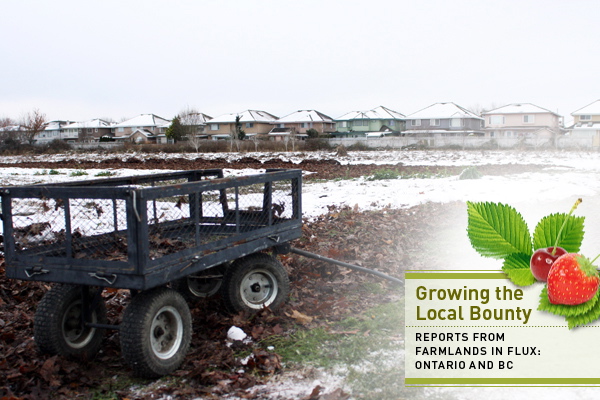
Tools of the trade await the hands of budding farmers at Terra Nova Rural Park, a hub of agricultural urbanism located on the border of Richmond suburbs. Photo: Justin Langille.
Growing the Local Bounty: Reports from Farmlands in Flux, Ontario and BC
- A Tale of Two Farmlands
- The Little Local Food Connector That Could
- How Mennonites Are Modernizing a Local Food Economy
- In Vancouver, a 'Crown Jewel' of Local Food Is in the Works
- Better Than a Food Bank
- Packed With Opportunities
- Plenty of Local Food, Few Local Food Products
- A Nursery For New Farmers
- Welcome to Farm School
- Eggsasperating!
- Farmlands on the Brink
- Farmers Harvesting the Sun's Rays
- How Bulk Buyers Can Save Local Farmers
- 'Farmpreneurs' Grow the Bounty
- Building up the 'Grain Chain'
- This Jar of Local Goodies Brought to You by 'Co-opetition'
- Secrets to Supporting Local Food
Hemmed in by Delta to the east, Point Roberts to the south and the Salish Sea to the west, Southlands is a 538-acre British Columbia farm that has been in the middle of a tug-of-war between developers and farmland defenders for nearly four decades.
The president of the development company that owns Southlands has proposed a plan that he says could serve both interests equally. Proponents argue that it could serve as a model for a new form of planning -- agricultural urbanism -- where people and farms can co-exist. Opponents fear it will only drive up the prices of already expensive, and scarce, farmland in the region.
Southlands' turbulent history
The first attempt to develop the Southlands property was in the early 1970s, when its previous owner, George Spetifore, unsuccessfully proposed a 3,500 home development on the property.
When the agricultural land reserve (ALR) was brought into existence a couple of years later, the farm became a part of the reserve, only to be controversially removed from the ALR in 1981. Another proposal for development on the property was defeated by a public outcry in 1989. The Century Group acquired the property shortly after when the landowner defaulted on their mortgage. In 2006, Century Group President Sean Hodgins proposed a new vision for the land that he hoped would serve the interest of the overall community.
"Seeing some farming happen, and not happen, on the property over the years, it was clear that there was some element of farming that could happen in the future," says Hodgins.
The plan that was eventually proposed would see one-third of the site developed for housing, one-third for community amenities including parkland and one-third for agriculture. "I was trying to cross the bridge, if you will, between our aspirations to develop something, without paving it over, and recognizing the stated community desire of 'Well, we don't want to lose farming in the equation here.'"
Despite Hodgins’s stated intent, opponents to the plan suggest that if the project were to go ahead that it would make farmland scarcer and less affordable for farmers. "Farmland is already expensive because of speculation that land might be removed from the ALR," says Harold Steves, founding director of the Farmland Defence League. "If the concept of developing one third of our farmland caught, prices would go up and no farmland would be safe." For the proposal to go ahead the Century Group needed an amendment to Delta's official community plan to change the zoning of the property from agricultural to mixed use. That request was denied, and the project stalled.
Agricultural Urbanism: a win-win?
Local Food Takeaway: Create a Farmland Trust
Since the Agricultural Land Reserve was established in 1972, 18 per cent of ALR lands in the Lower Mainland have been removed for development -- and as the population grows, pressure to develop further remains a constant threat. Solution? Like the public purchase of the remaining Terra Nova lands, Harold Steves proposes that one way to preserve farmland is to establish a farmland trust. Land in the trust will be set-aside in perpetuity as agricultural land, unlike ALR lands which can be removed. Steves says the trust would be financed by a levy on highway and port development that has already destroyed farmland, development cost charges on urban growth and private bequests and donations. To further enhance the trust Steves says that for every acre taken out of the ALR two acres should be returned. Surrey already requires developers to meet this requirement.
"We need to break the dialogue up between build, don't build," says Janine de la Salle, who worked as a planner on the project with mission-driven planning firm HB Lanarc. "The Southlands was the first kind of innovation and foray into that in-between dialogue. It was an experiment into how we could actually invest in agriculture through development capital."
Recently awarded the Young Planner of the year award by the Canadian Institute of Planners de la Salle has made it her raison d'etre to find innovative ways to incorporate food systems into all levels of planning. She, along with HB Lanarc senior planner Mark Holland, coined the phrase agricultural urbanism to define their food system work and published a book of the same name.
Citing influences ranging from permaculture guru Bill Mollison, writer Michael Pollan and philospher/farmer Wendell Berry to Bill Rees, Short History of Progress author Ronald Wright and Herb Barbolet, the grandfather of Vancouver's food security movement, it's clear that de la Salle and Holland are viewing the issues of our local food system with a wide and deep lens. Written as a "handbook for building sustainable food and agriculture systems in 21st century cities" Agricultural Urbanism was their response to the flood of books on alternative food systems that offered a snapshot of the burgeoning populist movement, but were short on suggestions for how to proceed. "It's about looking for new solutions because we're at a point where we need them," says de la Salle.
The short definition of what Agricultural Urbanism is about is "a way of building a place around food." Going deeper, the concept is meant to integrate everything from food access, the food economy, infrastructure needs, education, wildlife habitat, place-making (making food visible in the community), policy and how food systems can contribute to climate change solutions.
"Connecting food systems to planning is very new," says de la Salle.
After WWII and the rapid auto-centric development of North American cities, food was treated like any other commodity and many parts of the food system were centralized and consolidated to take advantage of economies of scale. There was uninterrupted abundance at the supermarket so nobody questioned the system. Agriculture and processing were dealt with by zoning, which was changed at the whims of elected officials and, presumably, the public will.
Lessons from Terra Nova
"There used to be beef cattle, cabbage growers, all kinds of things," says Arzeena Hamir.
Amid a chorus of birds, the crunch of frozen ground and a schizophrenic wind chime battered by an aggressive wind, the Richmond Food Security Society co-ordinator explains the history of the surrounding area and how the 63-acre Terra Nova Rural Park was established with an eastern boundary lined by the backyards of two-dozen monster homes.
Arzeena Hamir, coordinator of the Richmond Food Security Society, contemplates the challenges of keeping farmland from being paved over for housing development in Richmond, B.C.. Photo: Justin Langille.
When the owners of the Terra Nova lands applied to remove the property from the reserve, Richmond city council voted 5-4 in favor of the removal, but the agricultural land commission disagreed. The B.C. provincial government ignored the commission's ruling and removed it at the cabinet level. Public dissatisfaction with these backroom political dealings cost four of the five Richmond city councilors their jobs when the next civic election rolled around, but not before a good chunk of the neighbourhood was already built, paving over some of Richmond’s most fertile farmland.
"It's one of those neighbourhoods where the houses all look the same," says Hamir. The uniformity doesn't come cheap either. The MLS listings for the three houses closest to the park average a cool $1.5 million. But, in a round-about way it's the existence of this neighbourhood of 3000 square foot homes that made Terra Nova Rural Park possible.
"We stopped the development from going any further," says Harold Steves, who was on Richmond city council at the time. The city held a public referendum to spend $29 million to buy the remaining land with public money. Richmond residents responded with a strong majority favoring the plan and Terra Nova Rural Park was born.
Development a slippery slope: Steves
Despite a thin blanket of snow and the unfriendly wind it's easy to see the concepts of agricultural urbanism on display at Terra Nova Rural Park in Richmond. The 99-plot community garden is the biggest in Richmond. A sharing garden provides much needed fresh produce to the Richmond Food Bank and other service providers, the farm centre houses a community kitchen and students from local schools tend plots during less frigid weather.
Activity on the property is also tied to a bigger effort of urban growing in the city. "We know there's at least 100 acres in the city," says Hamir of land that has been inventoried for farming. Her hope is that these acres will be actively farmed and the food will be sold in the community. In agricultural urbanism jargon, Terra Nova will act as a hub, supporting the larger efforts in the community.
The example of Terra Nova can be both celebrated and lamented. Celebrated for their current success and innovation, but lamented because so much land was lost before the public outcry was heeded. The danger now in the Southlands is that future circumstances will allow a less scrupulous development than Hodgins’s (which at least has a vision of community benefit) to take place and the entire piece of property will be lost under pavement. But this is a chance that the farmland defenders are willing to take, believing that any further paving of farmland is unconscionable. In the short-term, plans for the Southlands look to be exactly what Steves, Hamir and their colleagues had hoped for.
"We don't have any definite plans," says Hodgins. "We will try to farm it, that's what we'll try to do." ![]()


13
Login or register to post comments
morechatter
1 year ago
Paving the way for the future
It is just so wrong to restrict the use of land because of someone's fears property prices will go up? The future isn't concrete and paved highways and Safeway trucks filled with over priced produce from the USA. It is about our connection with nature and the abundance we have all been given in instead of profit and environmential damage and corruption, you can have that any old day of the week.
It is a win, win but apparently the winning in this province is with real estate prices and that has just got homeowners way over their heads. Where organic produce isn't in the budget because they got no bread.
GlenValley
1 year ago
Compromise as middle ground?
I have trouble with the notion that trying to keep prime farmland in agricultural production -- not partly paved, partly farmed -- requires "in-between dialogue" or compromise. It's similar to arguments that governments make along the lines of "we won't invest in community programs unless the community allows developers in." Agriculture doesn't need developers to call the shots as to how land will be preserved.
The problem with Southlands is that the same battle happened years ago. The community didn't want development then and hasn't forgotten in the meantime. Using Terra Nova as an example seems like a backwards way of planning -- it was a mistake where cabinet overruled local decision-making and before the community organized a response, portions were already paved over. The current uses are fantastic, but the process it took to get there leaves much to be desired.
morechatter
1 year ago
Co operation
For a better word than compromise it always makes someone feel like they are losing when really its all about gain. Because if there ever was a truth man and soil have more incommon than you think. Not only is there the obvious health benefits and the economical but the environmential and working together and getting back the local decion-making to help pave the way is the place to start planting the seed of change.
snert
1 year ago
Buy the damned property from the developer
and turn it into a co-op farm that is marketing board quota exempt.
Developers should not be allowed to own ALR land.
offended
1 year ago
I am a farmer.
Developers that buy ALR lands, hoping to develop them, can do that if they wish; but they should not expect to have the lands removed from the ALR.
They know what they're buying when they buy these properties.
They gamble; they lose. Too bad.
No compromises on ALR lands; do you want more food production in the States? Bought a pork chop lately? Guess where it's from?
Not Canada, most likely.
ALR lands need to be preserved if we want to grow our own foods.
snert
1 year ago
offended
I agree with you except when this does occur the productive land will quite often sit fallow for years or in some cases decades, hence my suggestion.
pwlg
1 year ago
productive land sitting idle
There is a good rememdy for any land sitting idle...tax the hell out of it...if you are not farming the land then...create a new zone, undeveloped land, both commercial, residential and agricultural. Holding land for spec, allowing buildings to deteriorate, heavy tax.
End this era of speculation.
You buy ag land, like offended mentions, you farm it...not farming it then you pay tax between farm tax and areas residential tax.
Fiat lux
1 year ago
What this, and all other
What this, and all other articles, on the destruction of farmland never mention is that this crime wave is caused by "good economics", taught in our universities and sold to governments and the public by PR agencies like the Fraser Inst.
It is the fraudulent theory of monetary economics at work, slowly destroying the world and humanity with the perceived power of imaginary money, "created" from the air, used a weapon to colonize and enslave.
Global warming is destroying huge areas of once productive farmlands in the Southern region. Some real scientists are talking about a global population of 8 billion in the next few years, and what farmlands we still have our so called "economists" and politicians want to collectivize into agribiz kolkhozes and pave over.
Brilliant economic theories guiding the world into "wealth creation" and "prosperity"
The lords of the universe should try what it is like to starve for a few years, as many of us have, and perhaps it would teach them a lesson, or two.
The same for our stupid and bought politicians.
Ed Deak
samuidave (not verified)
1 year ago
Quants come clean
All financial creativity has always been bogus.
Fiat lux
1 year ago
We can't "create" anything,
We can't "create" anything, only transfer and transform resources into other forms and ultimately into garbage and pollution.
The more imaginary capital the banks "create", the more the destruction, licenced by that phony money.
With bank deregulation money has become a licence for the control of resources/energy, issued by a certain class for its own temporary benefit, while destroying the ecology and humanity.
Ed Deak.
oldisland
1 year ago
Agriculture urbanism is another word for development
Agricultural urbanism is a slick way for developers to peel off some more farmland - with the misguided premise that the residents will actually farm the land - but I heard Andre Duany, the father of the movement, state that the developments need to have affordable housing units built for the migrant and foreign labour needed to farm these properties for the residents........gated communities with their own private gardeners is a better description...Agricultural urbanism is not the same as urban agriculture, and should not be seen as the solution, when it is just one more variation of the problem.
For a better world
1 year ago
Erosion of ALR Lands
A common developer strategy is to squeeze farm lands by building settlements deeper into the agricultural base. An example of this occurred several years ago in Ladner. Under pressure to the pro-development Council, a Local Improvement was initiated well east of #17 Highway and south of #10. By allowing this residential development to take place, most of the land to the west then succumbed to residential construction. The Century Group became the primary developer in this land deal.
Although the Terra Nova development doesn't fall into this pattern, it was most likely the objective of the Progressive ownership. Terra Nova was first class farm land, and the City of Richmond has done a masterful job of paving over vast sections of its high quality agricultural acreages.
As pwlg suggests, "There is a good remedy for any land sitting idle...tax the hell out of it...if you are not farming the land...". Unless the legislation has changed recently, unoccupied farm land is supposed to be classified as "Business/Commercial". That means the unused farm land should be taxed using both a higher value and a higher tax rate. Also to qualify as farm land, the threshhold is minimal and it is in need of amendment. Criteria for farm classification probably hasn't changed in 30 years.
cboo44
1 year ago
ALR Is a joke
"ALR lands need to be preserved if we want to grow our own foods."
ONLY until some "ministerial aide" accepts a $50,000 bribe to get a chunk of dirt pulled OUT of the ALR.