

 SHARE:
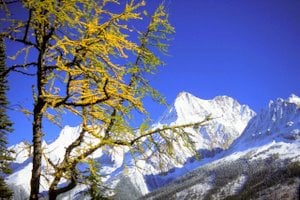
British Columbia's East Kootenay region is close to having a major, $450 million ski resort in its midst. The project is on its way to pioneering a new legal definition of a city as well -- a "mountain resort municipality" capable of existing for years without elected officials or even any residents.
This latest twist in the 18-year effort to build the Jumbo Glacier resort in the Purcell Mountains west of Invermere has added fuel to local anger towards the development, while raising new questions about democracy and accountability in local government.
On August 4 the Regional District of East Kootenay (RDEK) decided it doesn't want the final say in whether the Jumbo real estate development proposal will go ahead, asking the provincial government to take over instead. The RDEK also wants the province to turn Jumbo into a mountain resort municipality.
That decision followed a meeting about Jumbo earlier in the summer between the RDEK board and Bill Bennett, the minister of community services and rural development. Bennett is the MLA for Kootenay East and an avid Jumbo supporter. Several RDEK board members have declined to tell The Tyee what happened at that meeting with Bennett, saying the meeting was in-camera. And Bennett did not respond to a request for information about it.
Surprising twist in long saga
The RDEK's decision came as a big surprise to most Jumbo-watchers. They were expecting that the developer, Jumbo Glacier Resorts Ltd. of Vancouver, and the government would sign a Master Plan Agreement as soon as discussions with the Ktunaxa First Nation are complete. Then the developer would apply to the RDEK for land re-zoning, which would have required local public hearings.
East Kootenay residents have been waiting for those things since 2005, when then-minister of sustainable resource development George Abbot declared that "the decision will be made by those closest to the project and... it would not proceed without the approval of the RDEK."
The RDEK is governed by a 15-member board of representatives of the communities of Radium Hot Springs, Invermere, Elkford, Sparwood, Fernie, Kimberley, Cranbrook, Windermere, Canal Flats and six rural areas in the vicinity.
Some East Kootenay residents argue that, with this decision, the RDEK board has in fact made a land-use decision, but without the pre-requisite application from the developer and without the re-zoning hearing that would have ensued. The motion, which passed 8-7, reads:
THAT the Board of Directors of the Regional District of East Kootenay requests that, upon the signing of the Master Development Agreement between the Province and Glacier Resorts Ltd., the Minister responsible designate the Jumbo Glacier Resort a Mountain Resort Municipality and that such governance arrangement provides for the resort to be governed by a council of local citizens, supported by a locally based advisory group that includes First Nations.
According to B.C.'s Local Government Act, that council of local citizens would, at least for the first few years, be provincial government appointees, since the Jumbo Valley currently has no residents. One of the appointees could be the developer.
The completed real estate development and all-season ski resort, to be constructed on crown land, would consist of a village of condos, chalets, shops and hotels with thousands of guests and residents. It would provide 20 lifts for expensive year-round skiing on several nearby glaciers.
Since 1991 the Jumbo proposal has navigated a labyrinth of lobbying, debate, and significant public opposition, and it has passed through the provincial government's environmental assessment process.
What is a mountain resort municipality?
The Jumbo proposal is now in legally unmapped territory because the legislation that creates mountain resort municipalities is vague and untested.
A mountain resort municipality can be instantly created by the provincial government under Section 11 of the Local Government Act if there is a resort plan in place (which there is in this case). The new municipality would be governed by provincial government appointees until the general voting day for the first election of members to the municipal council. The legislation does not say how large the population must be for an election to be held, or how the physical boundaries of the new municipality would be determined. If the resort were built it is hard to say how many year-round residents it would have, or how soon. How would the priorities of the resort development plan already in place be reconciled with the priorities of an eventually elected council? The legislation gives the province a lot of leeway because it allows for the government to "make exceptions from statutory provisions."
Whistler is currently the only mountain resort municipality in the province. However, it provides no template for Jumbo because it was created before the current mountain resort legislation was passed, and it already had a resident population when it was formed.
Given the fact that Jumbo Glacier Resorts Ltd. did not apply to the RDEK for the re-zoning of the land, how did the issue end up on the RDEK agenda in August? It was put there by one of its own members, David Wilks, the mayor of Sparwood, who proposed the motion to ask the government to create a resort municipality.
Mayor Wilks told The Tyee he had three reasons for bringing the motion. First, the provincial government has been dealing with Jumbo since 1991 and the RDEK has had no involvement, so the proposed project should stay in its accustomed channels.
Second, dealing with a real estate development the size of Jumbo would be too much for the limited resources of the RDEK to handle. "It is a massive project," he said, "like the RDEK has never seen before. It's creating a new community. My concern was that we must look at the entire region and is it going to be handcuffed by one project, and as a result there may have been other projects that may have had to be put on the back burner or cancelled altogether."
Gerry Taft, an RDEK board member who spoke and voted against Wilks' motion, disagrees. He is the mayor of Invermere, the town closest to the proposed Jumbo site. "There are opportunities to have the developer pay for consultants and review of things of a technical nature, so it's not that difficult or expensive to review an application. A public hearing would go on for a while, but it is not impossible."
Bob Campsall, a third-term member of Invermere Village Council and a director of the Jumbo Creek Conservation Society, is a bit more blunt in his disagreement with Wilks' doubts about the ability of the RDEK to handle such a large application. "That is a bunch of baloney. The project at this stage would be nothing more than a land-zoning question -- it's what the Regional District was set up to do. They should resign if they can't to do it. Regional districts all over the province handle big projects."
Wilks' third reason for asking that the RDEK be relieved of the decision on Jumbo was that the board might be sued by the developer if they turned it down. Bob Campsall responds, "We're supposed to go along with this because we might get sued if we don't do what the developer wants? As long as a local government follows the rules, there is no fear of litigation."
Wilks said that in addition to the threat of being sued by the developer, the RDEK could also be open to injunctions or lawsuits from environmental groups if it approved Jumbo. "We would be in a lose-lose situation."
Local democracy threatened?
There has been a resounding response in the East Kootenay to the RDEK decision -- letters to the editors of local papers accusing the RDEK of ignoring or betraying its constituents by passing the buck to Victoria and relinquishing local control of a local issue, letters supporting the decision, new petitions started by environmental groups, and criticism from Columbia River-Revelstoke NDP MLA Norm Macdonald, in whose riding the Jumbo Valley is located. He calls the decision a disgrace.
The decision was democratic in the sense that 15 elected people voted on a motion that was legally presented. However, a number of polls (despite some variations in their validity and rigour) have shown that between 70 per cent and 95 per cent of respondents oppose the project for a range of economic and ecological reasons including the economic feasibility of the project, effects on grizzly populations, global warming and integrity of glaciers, fragmentation of wilderness, adequacy of groundwater supply, waste management, effects on a local heli-ski tenure and cost to taxpayers.
In the 60-day period in the spring of 2004 in which the public (both in and outside of the East Kootenay region) was asked by the provincial Environment Assessment Office (EAO) to comment on Glacier Resorts' project proposal, the EAO reported that 91 per cent of the 5,839 comments received were against the project.
MLA Macdonald says the reaction received by his office over the years has been about six to one against the project. Mayor Gerry Taft of Invermere, when asked for his estimate on the popularity of the project among the citizens of the East Kootenay, told The Tyee, "I would say about half are opposed, about 15 to 20 per cent are in favour, the rest don't know or don't care. This is a guess."
Of the eight RDEK board members who voted in favour of Wilks' motion to send the decision to the provincial government, seven are from Bill Bennett's riding in the southern part of the RDEK, representing most of the areas farthest from the Jumbo Valley. Of the seven who voted in favour of keeping the decision local, five are from Norm Macdonald's riding or from areas close to the proposed development.
Critics of the RDEK decision say elected members from far distant areas like Sparwood and Elkford should have followed the wishes of those living closer to Jumbo. "It is an unwritten rule," says Mayor Taft, "that there is a level of respect and trust for the local directors by those from outside the area, and the realization that they are the ones who have to live with the long-term impact. That was not followed in this case unfortunately."
Following the motion at the August meeting, it occurred to some RDEK members that with a mountain resort municipality at Jumbo, the RDEK could end up with an unelected government appointee voting on East Kootenay issues. So at its next meeting in September 2009, the RDEK unanimously passed a motion that "if a resort municipality is established in the Jumbo Valley, such a municipality should not be granted a seat on the RDEK Board until such time as there is population of sufficient number to elect a governing council."
Bill Bennett's involvement
As the province's minister of community services and rural development, Bill Bennett has significant influence over the project because it is his ministry that would designate Jumbo a mountain resort municipality.
"Good on the eight directors who had the courage to do the right thing, in the face of organized intimidation and bullying by (environmental group) Wildsight and the NDP," Bennett told the Kootenay News Advertiser on August 14. "The claim that the decision should be local is dishonest and hypocritical. Local government has had its say many times over the years... In the CORE (Commission on Resources and Environment) process, our land use planning exercise that happened between 1990 and 1992, Jumbo Valley was designated for resort development... The RDEK sat at the CORE table and supported the final report."
Kent Goodwin, a Kimberley resident who was one of the negotiators at the CORE table on behalf of one of the environmental sectors, says that "to go around saying that the CORE table supported a resort at Jumbo is not accurate."
"A final consensus was not reached at the negotiating table on the Jumbo Valley and Upper Horsethief Creek (area)," Goodwin continues. "Some sectors felt that the natural values in (that area) were high enough to warrant designating the area as a special management zone while many others felt that values only warranted an integrated management (business-as-usual) designation. As far as acceptable land use went, there was a fair amount of agreement. Everyone agreed that grazing, crop production, coal exploration, general industrial/commercial, oil and gas exploration, consumptive use watersheds, urban settlement and rural settlement should not be allowed. There was difference of opinion among sectors regarding one use (transportation and utility corridors) where some sectors supported it and some opposed it."
"The CORE table discussed a possible Jumbo resort but never made a clear decision on it," says Ellen Zimmerman of Golden who was also a negotiator at the table.
The CORE report, in its discussion of the Jumbo-Upper Horsethief area, specifically indicates that neither rural nor urban settlement are acceptable uses. "There was consensus on that part," says Zimmerman.
In 1994 the CORE report was sent to Commissioner Stephen Owen in Victoria who then wrote his recommendations in the form of the East Kootenay Land Use Plan. According to Zimmerman and Goodwin, because there was no clear consensus about Jumbo at the CORE table, Owen stepped in and wrote a compromise recommendation (recommendation #75 in the East Kootenay Land Use Plan) that if a resort was to be considered, there must be a provincial environmental assessment and local input.
Next Steps
It is too soon to say when, or whether, the Ministry of Community and Rural Development will accept the RDEK's request and form a new municipality in the Jumbo Valley. Is the current legislation (Section 11 of the Local Government Act) robust or detailed enough to accommodate it? What administrative hoops lie in wait? Will the legislation have to go back to the legislature to be fleshed out? What priority would the project have among members of cabinet other than Bill Bennett?
Nothing will happen until the government and Jumbo Glacier Resorts Ltd. sign a Master Development Agreement. This is a contract in which both parties agree to terms based on the developer's Resort Master Plan and the province's All Seasons Resort Policy.
The signing of the Master Development Agreement is waiting until the government and the developer have finished talks with the Ktunaxa Nation Council -- a conversation that has been going on for several years. The Ktunaxa, with four bands in Canada and two in the U.S., are opposed to Jumbo. Jumbo is supported by one small non-Ktunaxa group, the Shuswap Band, located near the Jumbo Valley.
Ktunaxa spokesperson Kathryn Teneese told The Tyee that the August 4 RDEK decision is premature. "We are not finished our work. It is a treaty issue, and it's hard to engage if, while you are sitting at a treaty table talking about something, pieces of it are falling off the table because of other processes."
For a project like Jumbo to proceed, the province is obliged to meaningfully consult with local First Nations, but lack of agreement from First Nations would not necessarily stop the project.
It's been a long haul -- nearly 20 years -- for local residents, the developer, First Nations, and the provincial government. It could take another few years for a final decision -- and in the meantime, the economy and the climate continue to change. ![[Tyee]](/design-article.thetyee.ca/ui/img/yellowblob.png)
Read more: Environment, Urban Planning + Architecture


Tyee Commenting Guidelines
Comments that violate guidelines risk being deleted, and violations may result in a temporary or permanent user ban. Maintain the spirit of good conversation to stay in the discussion.
*Please note The Tyee is not a forum for spreading misinformation about COVID-19, denying its existence or minimizing its risk to public health.
Do:
Do not: