News

Stalled Ambulance Strike: Anyone Got Jumper Cables?

What will it take for frustrated paramedics to get traction?

By Garrett Zehr, 28 Jul 2009, TheTyee.ca

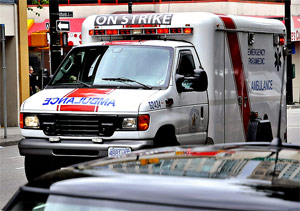
Ambulance On Strike

Headed for collision with legislature? Photo courtesy mordecai dangerfield from The Tyee photo pool.

Related

Canadians hoping to travel by train this past weekend quickly realized the two-day strike by the engineers' union at Via Rail had halted most passenger rail service across the country.

And Torontonians are all too aware of the city workers' five-week labour dispute that has seen garbage pile up on streets and shut down many municipal services.

But a strike by B.C.'s 3,500 paramedics and dispatchers -- soon entering its fifth month -- seems to have hardly made a bump on the public radar.

A large part of that is because though the union is officially on strike, employees are still on the job.

And while this has allowed the striking paramedics to collect a paycheque, it also means the pivotal weight of public discontent remains largely outside the paramedics' arsenal of strike tactics.

Where is that lever?

"Where is their leverage?" asked Mark Thompson, professor emeritus at UBC's Sauder School of Business and researcher of public sector industrial relations. "There is not a great public outcry because the basic level of service is being maintained," he said.

The union is under a strict Essential Services Order that dictates there can be no negative impact from strike actions on basic ambulance services. Emergency ambulance responses, dispatches and inter-facility patient transfers must be maintained at regular levels.

While regulations are normal for public service strikes deemed essential, union officials have argued the order is unfairly severe and has hampered any opportunity to carry out an effective strike.

"It certainly feels as if the cards have been stacked against the paramedics," said BJ Chute, director of public education for CUPE 873.

"The Labour Relations Board, through the Essential Services Order, has taken away our right to strike," he said.

Rumbles no one feels

Just over a month into the dispute, the B.C. Ambulance Service asked the board to file the order with the Supreme Court of B.C. The court ruling made the order enforceable by law and puts both the union and individual paramedics at risk of contempt charges and legal sanctions if they choose to break it.

With these threats, union officials have been advising members to abide by the order and instead have tried to negatively affect other work duties.

"We have withheld a variety of administrative tasks, the most recent one being the wearing of uniforms, as well as the scanning and record keeping of patient care records," Chute said.

But these disruptions are minimal, especially in the effect they have on the public. So with what it sees as few other strike options, the union has repeatedly asked for an independent party to settle the dispute.

"What it is that we're asking for is just a fair process and that fair process we believe is having an independent arbitrator," Chute said. "We're willing to live with the consequences of the decision, whatever that may be."

Where they broke down

The last set of talks between the union and employer broke down over a month ago, with the parties far apart on a number of issues, especially wages. The union wanted a three-year contract totalling a 13-per-cent wage increase, while the Ambulance Service offered a one-year deal at three per cent.

The employer has rejected the union's calls for a third-party appointment to settle the dispute.

"We've had a mediator in this dispute since before the strike," said Lee Doney, CEO of the Emergency and Health Services Commission, which oversees the ambulance service.

"I don't see the value of going to somebody else at this stage," he said.

Arbitration is too risky for the employer in this dispute, Doney said, compounded by the current difficult economic times. He said he worries an arbitrator could simply order a contract that splits down the middle between what he considers to be the unions' unreasonable monetary wage and benefit demands and a 'fair' offer from the employer.

"This dispute is best solved by the parties getting together and the union moderating its demands," Doney said.

'I'm not going to interfere': Falcon

After the last set of talks broke down on June 19, the union appealed to the province to intervene and assign an arbitrator. But newly-appointed Health Services Minister Kevin Falcon quickly ruled out any inclination that he would step in.

"I'm not going to interfere in this dispute between the BCAS and the paramedics' union," Falcon said in a written statement last month. "I firmly believe that there is no reason the two sides can't return to discussions and reach a fair agreement that addresses paramedics concerns, while recognizing the economic challenges we face in government."

While the union expressed much frustration with Falcon's response, Thompson said provincial intervention would have been highly unlikely.

"The government is reluctant to kind of see its bargaining authority essentially given to a third party," he said.

"In the last ten or 15 years I can't think of any government that was willing to arbitrate these things -- they just don't do that. They don't have to and they choose not to."

Appealing to the public

With arbitration off the table, the union has put a lot of focus on its public awareness campaign. Given the nature of the paramedic service, it faces an uphill battle, Thompson said.

"The problem with a group like this is... you really appreciate them when they're there but for most of us, happily that's a rare circumstance. So it doesn't grab the public attention," he said. "That's just in the nature of their work."

And without being able to negatively impact the public service, the striking paramedics are limited in the ways they can build this awareness about their dispute, he said.

"They can demonstrate some more and try to attract public attention... but I think that's about it."

Aside from picketing and 'On Strike' signage on ambulances, the union has been maintaining a website called saveourparamedics.ca. Most recently, it has appealed to British Columbians directly with radio, television and newspaper ads.

"We have stepped up the advertising part of our campaign," said Chute. "We're going to continue running ads throughout the entire province until this government wakes up and realizes it's time to start respecting paramedics," he said.

Meetings with MLAs

Alongside public support, the union is also hoping that direct appeals to elected representatives could yield some influence. Union officials said they will contact MLAs to try to build support and will inform the public about the results of these efforts through advertising in local media.

"We'll be seeking meetings with the MLAs over the summer and we're going to ensure that these MLAs are aware of all of the critical situations within their constituencies facing the Ambulance Service," said Chute.

The union has already received support from opposition members, he said, and B.C. New Democratic Party leader Carole James has called on the health minister to appoint an independent arbitrator.

But government intervention could also come in the form of back-to-work legislation.

"That may happen when the legislature comes back," said Thompson.

"The way public sector bargaining works across Canada is that the government makes an offer and kind of sits on it and there is very little movement off that and if people don't like it, then they get legislated back to work," he said.

"That's what happened in the first five years of the Campbell government -- there were like ten or 11 pieces of back-to-work legislation."

The union remains firmly opposed to legislation as a means of solving the dispute, Chute said.

Will resolution be legislated?

"I don't see that being taken very lightly by paramedics," he said. "I think that this government is mistaken if they think that legislation is the answer and if this government wishes to legislate paramedics, I think they do so at their own peril."

The BC Ambulance Service is more reserved in its opposition to back-to-work legislation.

"The employer would like to see this resolved at the bargaining table but if this continues to go on and there are patient safety concerns and the union will not moderate, we would certainly comply with whatever the legislature asks us to do," said Doney.

With the legislature set to resume in less than a month, the possibilities of a government role in solving the dispute will soon become clearer. At the same time, both parties have said they remain open to return to the bargaining table, though no further talks have been scheduled.

"It's got to end sooner or later, every strike does," said Thompson. "At some point a move will be made by one side or the other to bring it to conclusion."

This timeline remains unclear for now, he said, but one upcoming event is sure to put a deadline on resolving the dispute -- the Olympics.

"I can't believe this will be going on in February or even very close to February when you've got the eyes of the world and you've got picket lines," Thompson said.  [Tyee]

16  Comments:

Login or register to post comments

  • LeonelF

    2 years ago

    we need them

    I don’t know if thise ambulance strike will benefit its entire people. We all know that behind those ambulance paramedics are very helpful in saving lives of our love ones. But if this ambulances goes for continually strikes many of our people might be in great danger. I cannot blame them if they claim for some benefits or incentives since they also risk and dedicate their lives in saving people. But they should also consider those people who depends on them, remember that even quick payday loan [See: http://personalmoneystore.com/Payday-Loans/payday-Loan/quick-Payday/ ] isn’t enough to save people. And I know once they continuously go on strikes some of them will be our of cash and income to shoulder their family’s needs. So I hope government and people concern take some actions on this.

  • ME2

    2 years ago

    Back-to-work legislation ?

    "That's what happened in the first five years of the Campbell government -- there were like ten or 11 pieces of back-to-work legislation."

    Hmmmm. Isn't that what Dave Barret did - just once?

    Which caused union workers to vote Socred for 16 years?

  • Van Isle

    2 years ago

    Do ya think that we again

    Do ya think that we again should be having thoughts of a general strike? Hmm, just like the early 80's.

  • Skywalker

    2 years ago

    Yup ME2 and..

    ..they really punished themselves for it didn't they? Reminds me of the guy that points a gun to his head and says, "Stop or I shoot."

    I feel for these folks. They are on strike and nobody notices and the government ignores them. Then if something really went wrong, the government would be blaming the union.

  • happy

    2 years ago

    If I was in charge...

    Public Unions wouldn't be allowed to strike, period!

    In the Private sector when a Union goes on strike at Company A, customers are free to take their business to Company B, or C, thereby putting pressure on Company A to negotiate a settlement, or if Company A can hold out (think Telus) then the pressure is on the Union to settle.

    The Public sector is disfunctional is this respect - in my opinion - as Public Unions have something no Private Unions have - a Monopoly on their service.

    This leads to - again, in my opinion - a "we want our cake and eat it too' syndrome. In other words we want the right to strike, but no one else can provide the services we are witholding, at the same time.

    So, if the Paramedics are unhappy with being declared Essential Service, how would they feel if they had competition for their jobs instead when they were on Strike. Then they wouldn't be Essential, would they.

    Before I get slammed for slagging the Paramedics, (whom do a fine job as I would expect) my post is about the way ALL Public Union contracts are negotiated. There should be a mechanism whereby Public contracts are sent straight to an Independant body, of whatever sort is agreeable to both sides, and are final and binding on both parties, like an Arbitrator.

    Thats the way it would be if I was in charge.

  • ME2

    2 years ago

    Skywalker

    Only one correction, Skywalker. If something went wrong, EVERYBODY would be blaming the union, including unionists themselves.

    The problem is that unionism is no longer a movement, but just a series of competing businesses run on the business model by executives, and not by their memberships.

    Witness the TWU and its lockout of its CUPE staff.

    This just another of the malaises which have neutered our Democratic processes, and is the result of sixty years of clever Fascist propaganda having infected our Democracies.

    How many union workers today are aware that the union is a socialist device, and that it is for that reason - not the wages - the neocons hate them so much.

  • thirstydeer

    2 years ago

    Re: happy's thoughts

    I think you're wrong on some of your statements.

    First off, you touched on the issue of facing competition if they weren't declared an essential service. See, many years ago, ambulance services were provided by this-and-thats all over BC. Some communities were served by hospitals, some by first response units, some even by funeral homes. The concept of BCAs was "one service for all the province - equal service no matter where you live in BC".

    For a while, it was the benchmark that many other services were compard to, but as the years went by, the people appointed to run the service never kept up with the growing needs and demands it faced. BCAS went from a standard for others to meet to a broken down chain that has become an after thought.

    Truth be told, if there was competition, then those "companies" or "services" would have to fight each other to hire and retain paramedics. There is no choice in BC. If there was, you'd naturally go to the place that pays and treats you the best. If companies start falling behind, then they have to sweeten their offers in order to survive. The government faces no pressure. They know that with the ESO, they can (and have) sit back, and do nothing and spend all their time harrassing paramedics.

    I do agree with the fact that there should be legislation that allows for automatic independent arbitration to settle these disputes. In fact, there is such legislation, but it is restricted to police and fire fighters. Paramedics do not have access to this tool, and you can bet the Liberals will not amend this law to allow it.

  • North of Hope

    2 years ago

    'I'm not going to interfere.'

    'I'm not going to interfere': says Falcon.
    And there in lies the problem. He takes no responsibility to help solve this problem. Why are we paying him? He should try to solve it so that all parties will be happy. But he does not because he is getting the service anyway with complete disrespect for the workers. I wonder what would happen if they resigned en mass?

  • RickW

    2 years ago

    Falcon Won't Interfere....

    ...because he has the luxury of waiting at least 3 years before he has to address this "strike". Because the paramedics cannot withdraw services when they strike, there is NO pressure on the government to do anything.

    If the parmedics want action, they should all quit.....

  • happy

    2 years ago

    thirstydeer

    You're taking what I said slightly the wrong way. I specifically stated my post wasn't about the Paramedics per se, it was about the way Public Union negotiations are carried out.
    I don't expect the Paramedics, Nurses, Teachers, etc. to have to compete for their jobs in an open market. They have a Monopoly was my point, so the standard way of settling Union contracts just can't work the way it does in the Private sector.
    Since the Public Union can shut their industry down completely without even trying (Monopoly) then the government must apply Essential Service desiganation to balance the tables.
    To me thats completely disfunctional to the spirit of going on Strike.
    I'd like to see our pretend Independant body issue binding contracts that are based on similiar jobs in the Private sector, whereever possible. I know there aren't direct comparisons between all the Public service jobs with the Private sector, but there are many.
    As for the politics of it, as you pointed out the Liberals won't jump to change anything, but then what other government ever has?

  • cath

    2 years ago

    morale issued

    Seems to me that there are morale issues in many government workers. That won't be fixed by higher wages.

  • reallife

    2 years ago

    A bit of topic but

    does anyone know how many different jobs Lee Doney has with the provincial government? Seems like his name pops up quite frequently. I suspect his annual contracting bills are significant.

  • RickW

    2 years ago

    Campbell, Falcon, Avarice..........

    http://www.vancouversun.com/Health/Health+Minister+rejects+plea+place+paramedics+contract+dispute+before+arbitrator/1729104/story.html

    Quote:
    “The challenge is that in one of the most difficult economic times, the union is looking for a 40-per-cent increase over three years, when you take into account wage and benefits. It’s so far removed from the world we are in,” Falcon said.

    I don't suppose Falcon is re-considering his humongous raise in 2007(?) "in one of the most difficult economic times"........

  • RickW

    2 years ago

    PS

    What I mean is, what does he do that is in anyway nearing the importance of the average paramedic?

  • driftwolf

    2 years ago

    Nobody here seems to be

    Nobody here seems to be commenting on what kind of conditions the paramedics are being forced to work with.

    Many are "part time", not by choice but because that's the way the province set things up. Very few are "full time". So no benefits, no sick leave, no health insurance, no injury time. They get paid $2/hour for being "on call", which they can be forced to do. Which means no vacations during that time, no travelling outside immediate area, practically prisoner in their own homes waiting for a call. They only get paid their "hourly rate" DURING the call, but are expected to be available to work at all other times. For $2 per hour. Would you be willing to be a prisoner for $2 per hour and no benefits?

    All they want is to be treated like the other emergency services such as firefighters. Decent pay, recognition that what they do is important, stop the exploitation, full time positions rather than this fake "part time" bullshit, and so on.

    But of course, this government chose to impose strict work orders on them, and is now in a position they can just ignore the whole issue. And they have, and the press has been quite complicit by ignoring the issue as well.

  • driftwolf

    2 years ago

    not a career

    I know many paramedics. Most are either actively looking to leave, or are retraining as nurses or LPNs. They were promised a career. All they got was a part-time job that doesn't pay the bills, while the province ignores them completely because, well, they can do that.

    • The discussion for this story is closed. No more comments can be added.