
Death Lurks in an Empty Cupboard
In Canada's poorest neighbourhood, bad diets hasten illness and death.
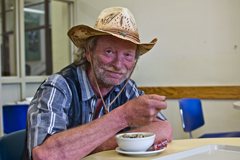
Ken, a regular patron at Carnegie Kitchen. Photo by Chrisopher Bevacqua-Fink.
[Editor's note: This is the second of two features on food security in Vancouver's Downtown Eastside. Yesterday we visited the nutrition-conscious chef of the Carnegie Kitchen.]
Why, in a country as wealthy as Canada, are people going hungry? When Dr. Graham Riches first looked into the issue of "food insecurity" in the early 1980s, he was interested in that question. Nearly three decades later, Riches, emeritus professor of social work at the University of British Columbia, is still trying to find the answer.
This much hasn't changed: For millions of low-income Canadians, finding -- and affording -- nutritious food is a daily battle.
And more and more, charities are expected to meet the need.
Vancouver with No Soup Lines?
Food charities feed the poor, and in so doing release potential pressure on political leaders to deal with hunger in a sustainable way by changing policies. Seen in this light, food charities might undermine true food security, as UBC's Dr. Graham Riches argues.
What is the view on this from the Vision team recently elected to run Vancouver's city hall? Though Mayor Gregor Robertson was unavailable for comment, City Councillor Kerry Jang, representing the city's homeless effort, said the city is not concerned by the proliferation of charitable food outlets in the Downtown Eastside.
"Charities will always exist," he said. "Even in the richest countries and the poorest countries you get as much charitable giving." The city's prerogative, explained Jang, is to ensure that charitable food served in the Downtown Eastside meets minimum nutritional standards -- something the city is not currently doing.
"Non-profits run themselves, and all we can do is help them ensure they get the right kind of food out to these people. We can't mandate it. It's impossible to enforce 'you have to give up potato chips,' right?"
When reminded that people in the Downtown Eastside have no choice but to stand in food lines, which can be said to undermine their right to food, Jang seemed to understand a lack of choice to mean a lack of variety. "I know that really what you're getting that day is what's available," he said. "I mean choice, it's really up to the operator to provide that kind of service... if you're feeding a lot, sometimes franks and beans is all you can provide. You got your good protein and your roughage; I know it's a pretty boring meal."
But should the Downtown Eastside have charitable food outlets at all? Jang laughed at the question.
"There will always be a role for charitable donations, for charitable food. It's just too much a part of our food supply, our food chain to be eradicated. Once we admit that to ourselves, we can say, ‘O.K., how can we manage that food chain better?'"
"What we've seen is the growth of public acceptance in Canada, that hunger is an issue for charity and not a matter of right," explains Riches. "It's complicated because obviously there are hungry people and there's a moral right to feed the hungry, but rights are also political, rights are also legal."
Most Canadians have plenty of healthy food to eat. In fact, Canada is one of the world's largest food exporters. Yet the HungerCount survey of food banks found 2.7 million Canadians -- more than the population of Metro Vancouver -- experienced food insecurity at some point during 2008.
In any given month, over 700,000 people, nearly 80,000 of them British Columbians, turn to food banks, and over three million meals are served in soup kitchens, emergency shelters and meal programs across the country.
Riches, who has spent much of his career pushing for the adoption of a rights-based approach to food security, says the proliferation of charitable food services in Vancouver's Downtown Eastside is a strong indication that the right to food is not being upheld in Canada.
"If you go to the Downtown Eastside," he says, "one of the most striking things is that there isn't really a normally functioning food economy like most of us participate in. It's what we call a food desert; there are no grocery stores and the local food economy is really made up of charitable food."
Riches and others see a dark irony in this. By taking on the growing task of feeding the hungry, they say, charitable food providers unwittingly have helped undermine the right to adequate food in Canada -- a right enshrined in a UN covenant ratified by Canada.
Riches says we're not living up to that agreement as a nation. And as a result, people may be dying in Vancouver. "You go into the Downtown Eastside and think, 'Oh, it's the drugs that are killing everyone.' Well what if it's not the drugs? What if it's the poor diet day after day after day that's slowly killing people? No doctor will sign that on the death certificate but maybe that's what's happening."
Addicted and on her own
When Stephanie walks through the door of The Lookout Emergency Aid Society on a rainy Thursday morning, it's as if a tornado has just spun in. "I'm getting the fuck out of here and moving in with my sister," she announces, looking around the room manically and rocking from foot to foot. I'm sitting with two outreach workers in the cramped office of Lookout's emergency shelter on Alexander Street, where three desks have been crammed into a space the size of a walk-in closet. Stacks of beige file folders haphazardly climb the walls.
The Lookout is just one of the 50 or so charitable organizations tending to the Downtown Eastside's ailing population. Life expectancy here is five to 10 years lower than the city's average -- for women and men respectively, and residents are considered senior citizens at 45. As a result of widespread deinstitutionalization beginning in the 1980s and steadily gaining momentum ever since, mental illness is prevalent throughout the neighbourhood, and addiction and infectious disease continue to plague a community where several thousand, including Stephanie, live with HIV and Hepatitis C.
Stephanie's hair is a short, muddy brown, and her blue, wide-set eyes are lined with black eyeliner, now smudged by the rain. Stephanie has agreed to sit and talk with me, but I can tell by the way she's fidgeting in her chair and biting at her chipped nail polish that our conversation is not destined to be a long one.
"I'm on disability for my HIV but it's still not enough money to eat, it's never enough," she says, picking listlessly at a handful of soggy cheezies.
The sores on Stephanie's face indicate possible formication, a common sign of crystal meth addiction. Also known as meth mites, formication is the tingling sensation likened to insects crawling under the skin, causing addicts to scratch themselves raw, which then breaks the skin and produces the familiar ugly, red sores. She is 21 years old.
'You never see a fresh vegetable'
Stephanie grew up in Surrey, but left home as a teen and eventually found herself living on the streets of downtown Vancouver. Like most people in the neighbourhood, Stephanie was drawn to the Downtown Eastside because of its close proximity to most of Vancouver's social services, including its charitable food providers.
For Stephanie, eating means standing in food lines everyday, so like her fellow Downtown Eastsiders, she "shops" around at the various food outlets; wandering from the Dugout on Powell Street for 7 a.m. soup and coffee, to the Harbour Light centre or the Franciscan Sisters of Atonement for lunch, and then the Union Gospel Mission for dinner. It's a well-beaten path between food providers and it certainly gets tiresome.
"I hate waiting," she says, swivelling back and forth in her chair. "And when you finally get your meal there's no nutrition in the food you get; it's just spoiled meat and white bread -- you never see a fresh vegetable."
Stephanie's frustration with poor food quality is something that is consistently echoed by both the recipients and the providers of charitable food alike. Though the food providers fail to keep records, spoiled donations are a common topic of discussion throughout the neighbourhood. The outreach workers at the Lookout shelter, which serves breakfast, lunch and dinner, voiced their concerns over the poor quality of donated food, though they seemed resigned to it.
"Virtually everything we get donated has expired," explained Heidi Klassen, Stephanie's outreach worker. "We'll get called to pick up a donation and the vegetables are literally blue."
Malnourished immune system
As a registered nurse and the director of Education and Care Evaluation at the BC Centre for Excellence in HIV/AIDS, Irene Goldstone argues that with aggressive nutrition, the immune system can support itself longer, postponing the need to start antiretroviral therapy. "We're putting all this money into a pharmaceutical response to HIV without meeting people's most basic needs," she explains. "There is such an emphasis on just getting the pills out to people, but we also need to recognize that the pills don't work if you're hungry."
Goldstone, who also teaches courses to health-care professionals, always includes the vital role played by good nutrition in her HIV course content. "We do this to try and increase awareness and responsiveness to patient needs in light of the realities of the Downtown Eastside," she explains.
Poor nutritional health is one of the major contributors to sickness in low-income neighbourhoods like the Downtown Eastside, and socio-economic status is among the most important factors associated with health disparities in Canada. For Stephanie, an unhealthy diet will soon take its toll. The Hepatitis C, which limits her liver's ability to absorb nutrients, will further rundown her immune system and reduce her body's ability to respond to HIV-related infections. This means increased hospital visits and additional strain on the public purse.
The financial cost is borne by every Canadian who pays taxes. Health-care spending in Canada is roughly $120 billion a year. According to a 2004 study by the Health Disparities Task Group, the poorest 20 per cent of the general public (people like Stephanie) accounts for 31 per cent of health spending on people who aren't institutionalized. That's double the average spent on the richest 20 per cent.
Because a fifth of health-care spending can be attributed to income disparities alone, the study maintains that big savings could be had by raising the health status of low-income Canadians to middle income levels.
Stephanie's HIV and Hep C mean she will undoubtedly incur significant health-care costs in the future. A Simon Fraser University study estimates that each HIV positive person will cost B.C. taxpayers $750,000 in treatment expenses over their lifetime. But good nutrition could go a long way to reduce those costs by keeping her healthy and out of the hospital.
Stephanie tells me she's moving home to Surrey to go back to school and become a youth care counsellor. Then she stands up. "Are we done here?" And without a backward glance she whirls out of the office. An outreach worker suddenly pokes his head in the door: "I hear Stephanie is moving to Surrey again. Are we actually believing her?"
Falling through the cracks
With wispy blonde hair and silver bangles lining her wrists, Ellie Schmidt's smile is casual, but her eyes are searching, daring you to look away. Schmidt is the nutritionist at the Downtown Community Health Centre, a primary care clinic for people in the Downtown Eastside. She tells me about patient she saw earlier that day.
Let's call him John. He is in his early 60s and according to Schmidt, is "falling through the cracks." Though he suffered two heart attacks in the past year, John is only eligible to receive basic income assistance, and according to the provincial government, falls under the "expected to work" category, which requires him to be actively seeking employment.
When the BC Liberals came into power in 2001, the number of people receiving income assistance in the province was already on the decline -- down 29 per cent from 1995. The Campbell government tightened restrictions further. Since 2002, over 107,000 British Columbians have dropped (or been pushed) off welfare rolls, though studies now show that rather than returning to the work force, many of these people have wound up on the streets.
John teeters on the edge of joining those homeless. He pays $450 a month to rent a room in a five-storey SRO with no elevator. With the help of two canes, he makes the slow climb to his fifth-floor room in "excruciating pain," says Schmidt.
For John, the $375 a month that the government provides for his shelter cost doesn't cover his $450 monthly rent, which means he diverts $75 from his $235 support allowance to pay rent each month. John is then left with just $160 for all his other monthly costs, including food.
Payments fall far short
Each year, the Dieticians of Canada estimate the cost of a healthy food basket in British Columbia. In 2007, the last year for which data is available, a man between the ages of 50 and 74 could expect to spend $196.56 a month on groceries, meaning that even if John had access to kitchen facilities in his building (which he doesn't), his $160 in support allowance would not even cover a healthy diet, to say nothing of his other monthly expenses.
Though John lives just a stone's throw away from most of Vancouver's free food outlets, his heart condition makes waiting in food lines impossible. "He's a huge, huge cardiac risk," says Schmidt. "He can barely make it up and down those stairs, he could have a heart attack at any time, and he simply cannot stand in food line-ups because he just can't stand to stand."
John, says Schmidt, "has no money to buy groceries, and even if he did have money he can't cook because he has no access to a kitchen. He's living with severe depression and suicidal ideations, and I would too if I were him."
Though she couldn't do much to help John, Schmidt did talk him through some of his, albeit limited, options. "I encouraged him to apply for disability or persons with multiple barriers, which would help immensely," she explains. "In a year from now he'll be 65 and get a pension, if he can live that long."
Get in line
John's story is a testament to B.C.'s income assistance levels are too low to allow many low-income Canadians to purchase adequate food.
Rich Coleman, the Minister of Housing and Social Development, was unavailable for an interview for this article, but he has made it clear that the province has no plans to raise income assistance rates, telling the Vancouver Sun, "We're the payer of last resort, we're not to be seen as an unemployment insurance program."
Other ministries with power to affect the food budgets of low-income British Columbians were shy about answering my questions as well.
The Ministry of Labour and Citizens Services, which maintains B.C.'s $8 an hour minimum wage despite protests by labour and poverty rights groups, repeatedly brushed off enquiries.
A spokesperson at the Ministry of Health Services told me that any questions related to food security should be directed to the Ministry of Healthy Living and Sport, who in turn told me that their ministry is about health promotion, and that I should call the Attorney General.
At the provincial level of government, the issue of food security for the British Columbia's poorest citizens would seem to be an orphan.
Related Tyee stories:
- Michael Pollan, Garden Fresh
Interview with In Defense of Food author Michael Pollan. - Crucible of Poverty (photo essay)
Duane Prentice spent five years documenting lives in Vancouver's Downtown Eastside. He urges "the courage to see things as they are." - Downtown Eastside Seeks Foreign Aid
Vancouver group asks UN to help homeless Canadians.


30
Login or register to post comments
sunshine coast girl
2 years ago
Well, you don't have to be a rocket scientist..
to figure that one out. I think the BC Liberals are hoping that these people will die quickly. Otherwise, it makes no sense whatsoever to have people in one of the richest countries of the world go hungry. If they live, they will end up costing ALL of us a whole lot more when they get to the point that they need expensive health care to manage the conditions brought on, in large part, by a crummy diet, regardless of their other problems. If the Liberals truly were "the best economic managers" you'd think they see that one coming a mile away.
Course, I guess some will just call it the "socialist" in me.
Wilfred Laurier
2 years ago
The hidden Truth
We can all focus on the DTES but the real story is on the First Nations reserves. While people gravitate to the DTES for various reasons, the great majority of the real poverty in this country is among First Nations who have the lowest life expectancy in the country. See here H1N1 is doing it's worst? Well, it is on the reserves. But we don't see the reserves because it isn't easy and convenient to take a TV crew to a remote place in Northern BC to see the tragedy that First Nations experience every day. At least the DTES has clean drinking water. The same cannot be said of many a reserve.
And what was the first thing Harper did? Cancel the Kelowna Accord.
bpither1
2 years ago
Well where I live I go to
Well where I live I go to the back of the local supermarket and either ask for the stuff they're going to throw out, or go into the bargain bin. I take the veggies and fruit no else wants and go home for my morning smoothie. Not many people have the brains to figure that one out. I live on next to nothing AND it's nutritious. In Chinatown you'll find that once you make a relationship with a shop owner they'll remember to save something for you.
nechakogal
2 years ago
Wilfred Laurier
Here, here. I don't want to minimize the problem in urban centres, however, the north is home to people as poor, if not poorer, than people who reside in the downtown eastside and the majority are living in or nearby aborigial communities. These folks don't have the availability (I don't use access, because most vulnerable populations have trouble getting access no matter the availability of services)of services and supports that can be found in Vancouver or Victoria.
Rural and north always get token mention, but is never the full story when it comes its significant socioeconomic challenges. Might have something to do the lack of readily available data from within these communities and the fact that some who live here get very rich and contribute to skewing the data masking the reality of very significant disparities.
NicS
2 years ago
Wilfred Laurier
What did Campbell have to do with the Kelowna Accord?
Wilfred Laurier
2 years ago
Kewlona Accord
"What did Campbell have to do with the Kelowna Accord?"
He helped negotiate it with Paul Martin in 2006. Harper, as his opening act, tore it up, thus beating on the poorest people in Canada, the largest number of whom live in British Columbia and are a federal responsibility.
Janie Jones
2 years ago
Hunger is not a race-based issue in BC.
By all means. lets narrow this issue down to poor little first nations again. Where I live, they are certainly all fat and happy with many extra services and benefits denied the rest of us.
For someone who is a so-called expert, Riches seems to have poor knowledge of the downtown eastside. Although it's main grocery store was lost when Woodwards shut down (but new Nester's opening soon!) there are grocery stores there - Chinatown markets, the A&N, the Sunrise Market on Powell and T&T Supermarket on Keefer for a start.
In general the shopping on the eastside is excellent especially around Hastings & Nanaimo and on Commercial Drive. I know people who bus there from other parts of the city to shop. Not only are the prices and variety excellent, there are lots of organics and you can support Mom & Pop shops rather than Pattison.
G West
2 years ago
Wrong again WilFRED
The province with the highest aboriginal population is Ontario, not BC.
On a percentage basis you're even further from discovering the truth - Alberta, Saskatchewan and Manitoba have a far higher percentage of the population who are First Nations than British Columbia does.
In BC it is only 7.3%....
What else is new?
G West
2 years ago
And, if you care for a little more enlightenment
http://www12.statcan.ca/english/census01/Products/Analytic/companion/abor/pdf/96F0030XIE2001007.pdf
G West
2 years ago
erratum
That 7.3% figure is incorrect WilF.
Wouldn't want you to get the wrong idea - 7.3% is the proportion of BC children who are First Nations... the population is far higher than that - but Ontario has the greatest Aboriginal population - not BC.
And the proportional numbers are much higher in the prairie provinces than in BC.
NicS
2 years ago
Response to BC's poor the same
Wil L., Your response to Amy's article is the same as other responses I've read elsewhere, exactly the same, like you are reading from a script?
Its an excellent response too. Shift the focus to far reaching native villages, pretend like DTES is overblown and give the BC Liberals credit for supporting the Kelowna Accord. Problem solved! Except that your response is a twisted and distorted story as amply demonstrated by "G West".
It is clear that this type of pat answer to BC's poverty issues is actually coming from your masters, time to change your tact and your username.
VivianLea Doubt
2 years ago
politics, more politics
"If the public assumes that food banks are taking care of the need; that between social assistance and food banks people are not going hungry, then food banks are doing a long term disservice to the very people that they are providing short term assistance to. Their very existence allows individuals and governments to believe everything is under control, but food bank workers and recipients know how increasingly difficult it is for some Canadians to acquire food. And, increasingly, how out of control is the ability of food banks to meet the forever growing demand."
Nothing remarkable about these words, except that they were written in 1985 in a book on the then recent phenomenomal rise of food banks. One can only conclude that 'John' and 'Stephanie' are not as important as other citizens. Why not? When will it change? Who will change it?
For what its worth, I believe it will change when people take in the story and shed a few tears...yes, really. When we begin to recognize that these people are our neighbours, our children, our parents... that they are part of the community we are all responsible for. Perhaps we've been too busy creating that illusary circle of "shiny, happy people".
sunshine coast girl
2 years ago
Poor, is poor...
I don't care if they live in the DTES, on a reserve, somewhere in Northern BC or Mars. The DTES just happens to be where this particular study occurred. The fact remains that we should be ashamed as a people that we have let charities assume the responsibility of keeping these people alive. I said it during the 80's (70's?) when food banks started popping up all over the place. And as I said before, if the BC Liberals were sincere about cutting costs they would recognize that ultimately it's much cheaper to look after our poor and disadvantaged, rather than picking up the pieces when they fall apart. Besides that, it's the only decent, human thing to do. Unfortunately, decent and human seems to be in short supply in Victoria.
Rhea
2 years ago
eastside groceries
Janie, while you accurately point out that there are existing grocery stores in East Vancouver:
"Although it's main grocery store was lost when Woodwards shut down (but new Nester's opening soon!) there are grocery stores there - Chinatown markets, the A&N, the Sunrise Market on Powell and T&T Supermarket on Keefer for a start."
...I can't see a single one of these places allowing the average DTES resident described in this story past the front door. Flat, unpalatable truth. Your average downtown store would call security the second they saw somebody like Stephanie walk in. Not to mention that most of these people have no access to cooking facilities, even if they could get this food.
A lot of these people need not just available, affordable nutritious food, but support in preparing it as well while. Some form of supervised communal or shared kitchen where residents could all access the facilities and learn basic cooking and nutrition would be a first step here. Communal kitchens work for co-ops, why not here?
Perry
2 years ago
Who are the real welfare hogs?
"Filthy" Rich Coleman, and other politicians of his ilk, such as Campbell and those that refused to speak to the writer of this article, have no idea what suffering from real hunger, homelessness and poverty are like.
Those piggy politicians fill their snouts from the public trough even as they deny access to that same trough to the most vulnerable and needy. And even after they've had their fill and crapped all over the poor, they will continue to suck at the public teat thanks to their golden pensions. So who are the real welfare hogs?
alive
2 years ago
Barnes did
Emery Barnes comes to mind, when talking about politicians trying to understand powerty.
He spent a month living the life of a poor person, learning I am sure a lesson the Campbell bunch will never being to understand
Yeah he was NDP
morechatter
2 years ago
Anyone who lives on a fixed income
Has to be facing some real hardships as there is little money for a healthy diet if none at all. It also doesn't help when agencies who assist the working and disabled poor with food handouts often end up being fit for the garbage. When a Store has food that is garbage it is then shipped out to Quest who in turn sells it to the poor. Ministry sends its clients there with government vouchers to fill up with food that should have been disposed of. As once Quest picks up the food it no longer is considered food and poor children and the sick are not protected from posioning which is an on going occurence. As food is being sold that one would consider uneatable. As dates and boxes are ripped off the products sold to the poor and unsuspecting. Along with food bank handouts which also often reached a long overdue date.
Its going to show up as today's children end up being tomorrow's amputees as health problems surmount along with social promblens.
Obviously Health Care is a thing of the past because it certainly wouldn't be considered responsible by Governemnt to let this occur. So kiss your health care good-bye as it moves over to private health care as coverage is sold in bundles to employers.
Janie Jones
2 years ago
The Morality of Food
Who do you think their customers are Rhea?
I've stood in line behind Stephanies in all of the listed businesses before but, in general, crystal meth and crack cocaine don't do much for the appetite and security doesn't eject until there's a scene. Most of the health issues homeless addicts have do stem from lack of nutrition coupled with sleeplessness, communicable disease and exposure, not the drugs themselves.
I agree that the government needs to be doing more to address the issues of poverty and homelessness that have turned the downtown eastside into the third world especially as it's main cause was the Liberal gutting of the welfare system which SRO or not, at least allowed people a roof over their head and the means to prepare a simple diet.
Most people on welfare are not unemployed. They are also busy doing whatever it takes to survive - picking up deposit bottles, going through scrap heaps, doing odd jobs, panhandling and busking, whatever it takes.
Bad nutrition is not limited to the underclass, it is also a factor of the international food industry which, on examination, is as evil as can be imagined.
Unless you eat organic now, you're eating GMO.
RickW
2 years ago
more chatter
When I was on the farm in my childhood, the "rotten" food would go to the hogs. I don't recall the hogs becoming ill over this, and those pork chops and hams tasted mighty good!
Because we have these prissy laws in place that virtually prohibit the raising of livestock in the urban areas, it aborts any scheme in which the urban "disadvantaged" can take part in some program to use "rotten food" as compost and/or as feed to grow their own vegetables and meat stocks.
Bob Watts
2 years ago
Food Banks
Food banks started as a well-intentioned gesture of kindness but it has gradually become a way for the province to off load welfare payments and redirect cash flow to a few large corporations. Here is how it now works. In 1975 the poor had the funds to purchase their own food. Stores in 1975 that had dented cans, out of date breads and dairy products, meats and over ripe vegetables, and would depose of these items in dumpsters. Today these once waste items are literally turning into gold. Waste is now sorted by trained employees and are scanned at the cash registers, and 80% of the value of every item is now considered as a tax-exempt donation, valued in the multi millions of dollars.
realisticman
2 years ago
Why, in a country as wealthy as Canada, are people going hungry?
Well they're not, are they?
Nothing in this article refers to anyone going hungry and nowhere is it actually stated that anyone does. Why? Because they don't. As someone who spends lots of time in the downtown East side of Vancouver I can tell you that there isn't anyone hungry. The police often park a van and give out food boxes and there are shops that place free food on ledges for anyone to take, free. Many people look like they need to bulk up a bit and that's just because they're spaced out on smack, crack or meth.
Has any story ever come forward with a tale of malnutrition? Maybe, but only because that person wasn't shoving the right grub down their gullet and there are many rich and poor both that fall into that category.
This is not a story about food shortages.
What's next, government paid nutritionists sorting food at the food banks?
VivianLea Doubt
2 years ago
hunger
has been a fact of life in Canada for some decades. The fact that both rich and poor suffer from nutritional deficiencies is immaterial, as the rich have the ability to make choices which the poor do not.
There are huge costs to Canadian taxpayers for perpetuating this: the children who go to school with no breakfast, the effects of 'hunger week' -the last week of the month when welfare money is gone (and now extended in BC to 2 weeks), the babies whose brain development never reachs full potential due to inedequate food, the endless refrain of countless others enumerated in the endless studies and academic literature. But even more importantly, there are the social costs of humans living side by side with other humans who don't get enough to eat.
Welcome to the "Best Place on Earth".
BarbaraW
2 years ago
Welfare
Congrats to Amy for an excellent piece of investigative journalism!
There is still a perception out there of people taking advantage of the welfare rates. I like to point out to them that studies have been done that show less than 2% of recipients do so. Even if you up that number to an undiscovered 5%, that still means that 95% of the welfare population is deserving. So why penalize 95% for the faults of 5%.
The welfare rate is a scandal, particularly in a high-cost city such as Vancouver. And nothing - no publicity or revelations - seems to make an impact. When they raised the rate recently, the amount was so minor that I doubt it helped very much. I hope that your article makes a difference, Amy. Good for you for bringing to light an under-reported area of this complex problem.
G West
2 years ago
Blindness
The suggestion that no one goes hungry in British Columbia is an offensive slur against reality.
I challenge the r/man or anyone else who believes that to be the case to spend a month on welfare living in an SRO in the DTES.
ShortSummer
2 years ago
Neo-Conservatism
Those who deserve an education can afford it. Those who deserve medical care can afford it. Those who can afford good food, get it.
Those who can't, well they live outside the gates.
What the Neo-Con's haven't figured is the logical end to this - when the great unwashed have finally lost enough. Then the gates and private security forces will never be high enough. Name a civilization that taught us this lesson! Name a civilization that learned the lesson!
This isn't about anything other than a planned social re-engineering. Yes, shorter lives, less tax money to help the less fortunate.... travel the world and see it in action everywhere.
Broken glass on your fences. bars on your windows, don't go out at night.... guard dogs that kill.... I have seen the enemy, and it is us.
realisticman
2 years ago
Shortsightedness
Sorry GWest but from your exclusive Island perch you might be a bit out of touch. Try and offer food to a panhandler down on the Downtown EastSide, subject of which this is, and you will see as others and I have brutally experienced; either it is thrown back at you or money is demanded in lieu of food. Food is neither required nor desired because it is available. Cash is wanted. Surmise as you will, for what.
By the way ShortySummer, I don't know where you're writing from but here in Canada we have a civilized society that takes very good care of its people. Education and health care is available free to all comers and no-one starves. This is partly why we are consistently deemed to be the best place on earth to live, both by our left-wing politicians and the international community and, within Canada, British Columbia and Vancouver in particular are repeatedly selected as the best, within that best.
RickW
2 years ago
R/M old man....
They are practicing Food Safe, for heaven's sake! Who knows where said food has been, how it was prepared, how it was handled. Better safe than sorry -- that's what our hospitals do, after all.
G West
2 years ago
Baloney
And lately, as a result of an apparently secret 'protocol' by the Vancouver police, there have been a great many more former residents of the DTES on the streets of the Capital Regional District. They come here, courtesy of the police as a way of dealing with one or another of the 'nuisance' tickets the Vancouver boys in blue have been handing out for such things as not wearing a helmet or having no bell on your bike.
I give food to street people all the time - never once have any of those offerings been received with anything but thanks and sincere appreciation.
Take up the challenge. Live for one month on nothing but the welfare allowance from our 'dear leader' and come back and tell me whether you're hungry or not. And remember, you only get to spend any money on food after you've paid the standard fee for housing and the costs of that 'cell phone' you wrote about here not long ago as being ‘essential’ to modern life in the city.
We do not have a civilized society in this country - we have a society where idiots like Gordon Campbell and Ralph Klein throw money at problems, treat people like means rather than ends and would really rather all of them just go away. Where and how they couldn’t care less.
We live in a society of mean-spirited, selfish, self-important snobs and conceited snobs.
realisticman
2 years ago
Hey! Keep your hat on!
The Vancouver police are only trying to save lives. What are you suggesting? If they ignored this law you'd be saying that by doing so were hoping more people are killed.
Statistics from New York City.
New York issued a statement on their bicycle safety study including these numbers:
Bicycle lanes and helmets may reduce the risk of death.
Almost three-quarters of fatal crashes (74%) involved a head injury.
Nearly all bicyclists who died (97%) were not wearing a helmet.
Helmet use among those bicyclists with serious injuries was low (13%), but it was even lower among bicyclists killed (3%).
Only one fatal crash with a motor vehicle occurred when a bicyclist was in a marked bike lane.
What sort of food are you giving away all the time, anyway? I hope it's not overly processed or imported.
G West
2 years ago
Baloney
What the Vancouver Police is doing has nothing to do with the law; they've been giving out nuisance tickets to homeless people - then offering them a choice between due process and a ticket to Victoria.
You may think that qualifies as the rule of law - I call it thuggery - how many matrons riding their bikes in Pt Grey get tickets for no helmets R/man?
How many for not having a bell on their bike?
How many get deported to Victoria and sent away from their homes because they can’t afford a lawyer?
I give them good nutritious food.
You might want to try it sometime.
And I believe in the rule of law and the ethical treatment of all citizens.
I'm sorry you don't.