
Another Olympic Cost: Your Privacy
Concerns about spy cameras, random searches and $1 billion in security measures.
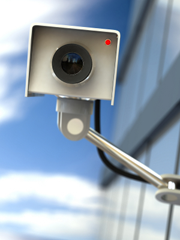
After 2010, surveillance cameras likely will stay operating.
Last spring, close to 200 citizens from Vancouver's Commercial Drive area packed a high school auditorium to voice concerns about plans to turn Britannia's ice rink into a training facility for the 2010 Games.
How would security perimeters impact use of the grounds? Would CSIS step up its monitoring of social justice groups in the area? What about security cameras? Would those stay after the Games were over?
Michael Vonn, policy director for the British Columbia Civil Liberties Association, sat among them. Though the board of directors for the Britannia community centre voted in a secret ballot to give VANOC use of the rink last fall, she said the outpouring of opposition raised an important question: How do issues of personal privacy fit into the goal of hosting a secure Olympics?
Vonn shared her story at an Olympics-themed privacy and security workshop in Victoria yesterday afternoon. With a ballooning security budget that some reports have pegged at $1 billion and the Games less than a year away, she said issues of privacy weigh heavier than ever.
"People are concerned about what that billion dollars in security is actually going to mean to them and their children and their neighbourhoods," Vonn said.
What's at stake?
David Loukidelis, B.C.'s privacy commissioner, told the workshop that mega-events such as the Olympics bring special security needs and concerns. One need only think, he said, of the Israeli athletes held hostage and murdered during the 1972 Munich Games or the fatal bombings at the 1996 Atlanta Olympics.
But he said that security preparations cannot take precedence over provincial and federal laws that protect the privacy of Canadian citizens.
"There is no free pass," Loukidelis said. "Regardless of what the risks are, we have to make sure that the laws are obeyed."
Speaking after the privacy commissioner, Vonn flagged several areas where the RCMP-led Integrated Security Unit for the 2010 Games and Vancouver police were at risk of violating civil liberties.
Over the coming weeks, the ISU plans to set up "voluntary" pedestrian and vehicle screening stations at the Four Continents Figure Skating Championships in Vancouver and the Bobsleigh and Skeleton World Cup in Whistler.
"They are optional," assistant RCMP commissioner Bud Mercer told reporters during a Q & A session on Monday. "We do encourage spectators to participate."
Random vehicle searches?
Vonn pointed out that people who submit themselves to such searches likely don't know that if they're caught with an illegal substance or weapons, they could be arrested or charged.
But she said the bigger issue is whether the searches remain voluntary during the actual Winter Games.
"What is not obvious to me is on what authority the police could use to conduct mandatory vehicle searches of this kind without any individualized suspicion," she said.
Vonn noted that many citizens accept a loss of civil rights during mega-events with the assumption that such a sacrifice is needed to ensure public safety. But she said she's not aware of any Canadian laws that give police authority to conduct random vehicle searches.
"It's possible that in the future the courts may clarify that not only is this privacy invasive but it may be declared illegal in certain contexts," she said.
Downtown crack down
Vonn also voiced concerns about the effects police security plans might have on residents of the Downtown Eastside in the run-up to the Games. The Vancouver Police Department concluded in its recently unveiled draft 2009 Business Plan that it intends to crack down on street disorder -- which could include minor offenses such as panhandling and loitering -- over the next year. To achieve the goal, the VPD's plan sets a target of four street checks per beat enforcement officer per block.
Vonn said the procedure involves running a person's name through a police database and is usually accompanied by a physical search. According to her "ballpark" calculations, four officers per team working about 20 blocks of the Downtown Eastside -- where she says most police activity is likely to be concentrated -- would result in street checks of 300 people there a day.
In addition to violating privacy rights, she suggested that the VPD's targets could discourage people from using safe injection sites because they'll be worried about getting caught with drugs purchased on the streets.
"This will have a disproportionate impact on populations that are extremely vulnerable," she said.
Cameras may stay on after 2010
Echoing concerns he raised during last Monday's security and privacy workshop in Victoria, Loukidelis said he was worried that any closed circuit cameras set up around downtown Vancouver or around Games venues could be retained indefinitely.
"Just because the surveillance infrastructure is there doesn't mean that it should stay there," he said.
Today, representatives from B.C.'s Office of the Information and Privacy Commissioner and its federal counterpart are meeting with the ISU to discuss the issue, among several others. Loukidelis said he wants to know where and how cameras will be set up, how images are stored and what they're used for.
Colin Bennett, a professor of political science at the University of Victoria, told yesterday's workshop that it's unlikely any cameras utilized for Games-time purposes will be taken down once the event wraps up. After the 2004 Olympics in Athens, the city converted cameras into a permanent surveillance network. He said examples such as Athens highlight a growing trend.
Security keeps ratcheting up
Over the years, mega events have seen ballooning security budgets and the increased use of advanced technologies such as biometrics and x-rays, along with cameras, Bennett said.
The reason for the pattern is that organizers typically take cues from past events, which leads to a cycle of escalating security demands.
"These exceptional events can become the trends for what we consider normal," he said.
For the 2010 Games, the chance to present a positive face for Canada to a post 9-11 world means that no chances are being taken, which helps explain the massive security budget, Bennett said. But he added that it's essential the rights of private citizens aren't waylaid in the process.
"I hope that we can run an Olympic games in this province which shows the rest of the world that Vancouver and British Columbia and Canada are places where civil liberties privacy is truly respected."
Related Tyee stories:
- Latest Olympics Updates
Get the latest info on the 2010 games in this section of The Tyee's political blog, The Hook. - RCMP seeks rent-a-cops for 2010 security
- Olympics Spending a Shot in the Arm for British Columbia
But economists differ on its power to inoculate us from a recession.


yasmar
05-02-2009
Surveillance
Last night, while riding the B-Line to UBC, I noticed a sticker that read something like: "Attention: visual and sound recording equipment may be in use on this bus." I was shocked to realise that Translink would go so far as to equip busses with not only visual recording devices, but sound recording equipment as well. Just wait until you go to court for something and the prosecutor says to the judge, "Oh, but we can prove so and so perpetrated the crime because he said so last night on the bus."
This is a bad sign. We're headed for some interesting times, for sure.
IranianDude
05-02-2009
Police state
Slowly but surely our nation is marching towards full blown police state like our brethrens down south.
Viva capitalism, viva Fraser Institute and long live our collective stupidity.
freebear
05-02-2009
Terrorist Success & Security Industry Success too!
How much money on security?
So that some pot smoking elite athelete will not be abducted/harmed during their brief visit to BC?
Who's making money over the terrorist threat? Who is profitting from these games?
Is it all worth it?
Can we (RCMP/CSIS/CIA/MI6 or is it MI5?) really do anything to stop something from happening?
Could we, say, prevent the bombing of a pipeline or well, or two?
Oops, we still have some work to do!!!!
Obviously civilization is progressing-security is an ever increasing expense, and threats and actions of terrorism are ever increasing!
alive
05-02-2009
you were asking for this!
All the people who worked so hard to: "Put Vancouver on the map" can now take credit for making the city into a police state.
Like, Thanks a lot guys!
Did you not learn anything from Expo 86?
The promotion then, as now, is to get people of the world to see how "great" a place this is, and hurry up to overbid on housing so the original inhabitants have to move elsewhere. Good stuff!
Well no loss for me, I had to leave shortly after Expo when we were blessed with a mass invasion of people with more money than I.
monty
05-02-2009
Just wait
until the Homeland Security Department arrives and takes over the entire security operation. Then you'll see costs soar and what a real police state is like.
Remember, it was Jack Poole, Gordo and their real estate and developer friends who brought this escapade to us.
Best advice, leave town.
snert
05-02-2009
Freedom
For the most part freedom is a state of mind. I feel sorry for those who live in fear of security cameras rather than what those cameras are attempting to mitigate.
Sorry but the potential for harm from those who commit crimes is much greater than that for the cameras. I think there should be many more of them in places where there is no reasonable expectation of privacy.
For the most part people seem to think they are invisible when their actions can actually followed by any near by observer. Having a camera do it is not much different.
cboo44
05-02-2009
Police State? Civil Liberties?
1. Since when is anything a person does in PUBLIC, private? Don't want to be on camera, behave yourself.
2. Police State? As opposed to the Crime State we have now? 3 shot dead in greater Vancouver in 2 days? IN PUBLIC !!
Is it against someone' s civil liberties to video them killing someone? Grow up!
3."Remember, it was Jack Poole, Gordo and their real estate and developer friends who brought this escapade to us."
Nice rewrite of history for political purposes. IT WAS GLEN CLARK WENT AFTER THE OLYMPICS.
Guy Radical
05-02-2009
How To Remove Human Rights, Fairly and Honestly
"Over the coming weeks, the ISU plans to set up "voluntary" pedestrian and vehicle screening stations"
Voluntary? I highly doubt it. If you deny permission, you will be deemed suspicious, which gives them reason to search you.
You are free to be searched against your own will. Enjoy your games.
Cynic
05-02-2009
After the cameras are in,
After the cameras are in, let's bring on the rfid chips. What could be safer and more secure than a microchipped population? After all, if you're honest and have nothing to hide, what's the problem? Freedom is a state of mind.
The best slave is the one who has no idea he's a slave.
IranianDude
05-02-2009
cboo44
"1. Since when is anything a person does in PUBLIC, private? Don't want to be on camera, behave yourself"
EDITED FOR INSULTS -- MODERATOR
Police cameras are symptom of a greater malice. We are debating about the cause not the symptoms. EDITED FOR INSULTS
snert
05-02-2009
IranianDude
Not even close. Nobody is going to give a rats ass what you do until such time as you start attracting attention to yourself. Even big brother has better things to do.
North of Hope
05-02-2009
Upcoming disaster
cboo44, said " IT WAS GLEN CLARK WENT AFTER THE OLYMPICS."Yes he did but the BC Liberals are the ones that are making it into a disaster wrt freedom and financially.
G West
05-02-2009
Sorry folks - it's not only expensive and offensive
It doesn't work:
http://www.homeoffice.gov.uk/rds/pdfs05/rdsolr1505.pdf
Spend the money on housing, education and effective social services.
Fish-counter
06-02-2009
Surveillance could be a good thing.
If it records the kind of police brutality that was used against Robert Dzeikanski, I am all for surveillance. The trick is to take control of it away from the police, so they can't manipulate it to bury evidence. Even with police control of the surveillance we know, a priori, that organised crime will also have access to the material, don't we?
I am more interested in knowing exactly how the cost of security went from $175 million to $1 billion. Was that meeting videotaped?
What I suspect the surveillance will be used for is to catch drivers who are not wearing seatbelts. The reason is simple; this is a reliable revenue source and it asserts police control over the populous.
Thwarting real crime takes effort, and as we know from the Videotape of Mr Dzeikanski's death, the RCMP are lazy, and they will use any excuse to cut corners. Using Tasers on helpless people is basically, fun. It gives the user a sense of power and if that is what your life is about, you will keep using Tasers on innocent people until they take away your toy.
Canadians need protection from our own police force. How many Vancouver cops are up for drunk driving charges? How many newspaper delivery drivers have to get beat up before we recognise the need for change?
Consider the asymmetry; the RCMP spent millions of dollars nailing the two guys who gave Roszko the rifle with which he shot those four cops in Mayerthorpe. They did not pull a trigger, and they weren't even at the crime scene, but they got 15 years.
The four cops who murdered Robert Dzeikanski walk away scott free. The people who sank the Queen of the North are scott free, and so are the people who blew up air India flight 182.
Does anyone doubt that the RCMP are screwed up? My disgust and disrespect for the RCMP could not be any lower than it is today. I don't think I am alone.
Dr Alexander
06-02-2009
The problem is in the us vs. them attitude
Surveillance divides people into the observers (with power) and the observed (without power). Those doing the observing do so with the benefit of anonymity (just like riot police with no badge number or identification). After a while they start feeling like they are not of us, but something superior to us because they are "entrusted with keeping us safe with their surveillance".
My remedy is this: All operators of public space security cameras are to be themselves under video camera observation. The images and audio are to be beamed in real time on a downtown storefront, by a major bus stop for example, so that those being observed, can do some observing of the observers.
I spent enough time in the UK to tell you first hand, that being under constant video surveillance gnaws at you after a while.
snert
06-02-2009
Sorry G West
Doesn't mean it can't.
G West
06-02-2009
If it were going to work
It would have worked in England, it hasn't; despite the fact that authorities have drunk and drunk deeply from the same kool ade that says whe need armed guards on BC Ferries to combat an imaginary terrorist threat.
And, even if it could work, the costs in a free and democratic society are simply too great.
Bobby Peru
07-02-2009
BC Needs Public Surveillance
How bad does BC crime have to hurt before soft liberal pundits decide that serious steps like public surveillance cameras are needed? Yes, they do work in alot of cases in London- like in leading to the apprehension of the subway terrorists, but yes, their effectiveness is uncertain in others. But, why do they or any policy have to be perfect before some of the critics on this site accept them? Setting such impossible standards is only a disingenuous way to kill useful ideas.
If public surveillance cameras can be successfully used in London, which remains a democracy, and if I must add (since I spend time there) a far more creative, hip, vibrant culture than Vancouver could ever be. I don't see London cameras destroying individual comfort, freedom or fun. In fact, I can't find many people who'd say London is more fun than 'no fun' Vancouver.
A combination of public and private surveillance cameras might have recorded some evidence of recent murders and gang killings. Who knows? And it'd probably help with convicting crime along Granville Street and Downtown Eastside.
Simply feeling 'uncomfortable' with it isn't good enough. Like, you're in public so what do you have to hide? We should be taking preventative and aggressive law enforcement methods before crime and gang warfare overtake our ability to maintain civility.
Although BC is not approaching 1980s Miami drug killing levels, the current rate of murder this year is alarming when compared to previous years. Gangs are running around with impunity. It won't belong before innocent bystanders are caught in the crossfire. And the response of soft liberals is so standard: oppose any assistance to law enforcement and hope that moral piety will win the day. No, I'm not talking about imposing martial law, but when I hear opposition against tasers despite their proven effectiveness I wonder how many of the soft left have to be beat up and left for dead by muggers before they understand the situation. While they are against tasers and surveillance, they offer no logical alternatives.
While Vancouver certainly isn't Bogota or 80s Miami, it does feature characteristics of a narco-economy. Just look at where all the narc money is going; it's so plain. And don't forget that gangs were emboldened enough to kill lawyers and judges in Quebec. If BC doesn't take serious measures it won't be long before BC gangs attack our civil institutions.
I'm happy the upcoming Olympics will open the door to widespread surveillance. It's about time.
Stump
07-02-2009
And then what?
Oh Bob, if this were an NDP idea you'd be screaming Big Brother.
As to the cameras themselves and the London terrorists, which suspected terrorists are you referring to... not the young Brazilian shot five times in the head due to mistaken identity via video feed I suppose?
As to the Gang-problem... arrests come from long-term surveillance by humans, not robot eyes. They (arrests) happen when manpower is used to monitor and infitrate the groups, not when some drone is watching 20 tvs at a time and paying more attention to the short skirts and the couples coupling in back alleys. Which is pretty much what the data so far suggests.
As for the cameras themselves, how long before organized crime knows exactly where the cameras are anyway... probably about the same time the contract is awarded to install them.
As to the drug problem, take away the huge profits of a black market, stop making Nature illegal because you smoke a little grass to relax (not unlike more than a few cops and politicians to be sure) and we might have the money and resources to deal with the consequences of truly dangerous drugs like crack, and meth, and alcohol and tobacco.
I don't like surveillance cameras very much for idealogical reasons and my lack of desire to belong to a surveilled society, but even if that part didn't rub me the wrong way, the obvious fact they won't work as advertised would convince me they are a waste of money.
alive
07-02-2009
what is the alternative?
sounds to me as if some posters would like to live in Singapore?
SharingIsGood
07-02-2009
the alternative
Just don't go to the games. I won't!