News

Behind the Bear Mountain Blockade

The Takla helped defeat the $8 billion Kemess mine. Now they're fighting Imperial Metals' big plans.

By James Steidle, 21 Aug 2008, TheTyee.ca

Takla Blockade

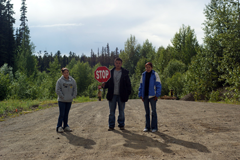
The Takla have blockaded Driftwood Valley since June 18.

Plans for a large open pit copper mine at the headwaters of the Driftwood and Bear Rivers have run into early opposition from the same First Nations band that recently helped overturn plans for the Kemess North mine in northeastern B.C., a project its backers expected to unearth $8 billion in metals.

The Takla Lake First Nation, in whose traditional territory the mine would be located, has spent the last two months blockading all access to the area, which is about 200 kilometres northwest of Fort St. James.

The 24-hour-a-day blockade restricts all mining and logging operations, in addition to hunters and fishermen. But there is one project in particular that is on the band's mind: Imperial Metals' exploration work at Bear Mountain.

First discovered in 1972, the Bear Mountain deposit contains a rich mineralization of copper and molybdenum that is likely big enough to run a several-hundred-employee operation the size of Imperial's Huckleberry Mine, near Houston.

Victor West, a band councillor, said he is worried about the risk such a mine would pose to the two watersheds -- the Driftwood and Bear -- that originate on the mountain's slopes. The Driftwood flows through Takla Lake into the Fraser River, while the Bear flows through Bear Lake to the Skeena; both are headwaters for endangered salmon runs.

"Bear Lake is more important than Kemess to us," said Victor West, a band councillor, referring to his community's successful campaign against Northgate Minerals' proposed Kemess North mine. "We'll protect it with all our might."

'We are not going to pollute anything'

Brian Kynoch, head of Imperial Metals , told The Tyee he doesn't understand the opposition to a mine that is only in preliminary stages of development. Any mine would have to go through an environmental assessment process and comply with all federal and provincial environmental and fisheries regulations.

"The rules we have to mine are amongst the toughest in the world," he said. "That's the burden on us, to show that we are not going to pollute anything."

But West believes there are already enough mine sites in the area that need to be cleaned up. The region has witnessed more than a century of mining, beginning with the Omineca gold rush of the 1870s, and has been left with a collection of contaminated and failed mining sites. West points to the Tse Ta Bun berm failure of 2005, when a retaining wall burst and spilled the contents of a tailings pond, destroying an entire riverine estuary along the Omineca River.

"They should clean up old sites before creating new ones," West said.

'Bear Mountain is sacred'

The Takla attach spiritual significance to Bear Mountain. It looks out over a historical village that Takla Lake band members have occupied for thousands of years. The mountain has been a significant source of traditional medicines and plays an important role in local legends.

"I remind you that in our previous letter, we warned that Bear Mountain is sacred," wrote former chief John Allan French to Energy and Mines Minister Bill Bennett in 2006, when their opposition to the mine was first made clear.

Finally, there is concern about the development a mine in this location would spur. Roads and a 50-kilometre power line to the mine would turn a once relatively pristine and untouched area into a place where further exploration, recreational and industrial activity could be easily facilitated. The snowballing effect of such activity would irreversibly spoil a wilderness and damage important habitat.

Kynoch said he understands the Takla's concerns, but asked, "What part of B.C. isn't beautiful?"

Ownership in dispute

For now, Imperial would just like to get on with exploration. Kynoch said he is growing frustrated with the Takla band's demands for a greater role in land-use planning in the area.

"We've done the work with the understanding the province granted us the mineral rights," he said. He likened the blockade to someone illegally preventing you from getting into your house.

"Are the resources all of British Columbians'?" Kynoch asked, "Or a select 150 people that live closest?"

The Takla Lake band, having never signed a treaty giving up their rights and title, claims the mountain is theirs. At a minimum, they say, the government should properly consult with them over plans that affect areas of such high importance to their way of life, something that has not yet been done.

"Consultation does not consist of sending a letter," said lawyer Murray Browne, who works for the band. "Consultation is a process that requires consideration of First Nations rights and titles and interests before going ahead with mining."

The solution, said Browne, is to sit down with the band, identify places you can and cannot mine, and go on from there, avoiding confrontations over sensitive areas like Bear Mountain in the first place.

Government on sidelines

So far, the government has not stepped in to resolve the dispute. Calls to the ministries of Energy and Mines and Aboriginal Affairs were not returned.

As far as Imperial Metals is concerned, the government has given them the green light, and it's just a matter of time before they get started.

"Politicians come and go. It's the same with bands," Kynoch said. "We're patient. At the end of the day, either the province owns the mineral rights or they don't. I'll wait and find out who does."

Related Tyee stories:

 [Tyee]

22  Comments:

  • Gary

    21-08-2008

    Talking out of both sides of his mouth

    First we have:

    "Brian Kynoch, head of Imperial Metals , told The Tyee he doesn't understand the opposition to a mine that is only in preliminary stages of development. Any mine would have to go through an environmental assessment process and comply with all federal and provincial environmental and fisheries regulations."

    And then:

    "As far as Imperial Metals is concerned, the government has given them the green light, and it's just a matter of time before they get started."

    So first they say they no comprende then they say oh we'll just wait.

    What this tells me is that Imperial Metals doesn't give a damn about the process. It's the end result and they will wait for the government to legislate their way to a mine.
    And I think the natives know what's going on and that's why they are blocking them up front. The government and the mine had best rethink their attitudes and start to consult with these bands.
    They whine about being effectively barred from their house. What a croc. They're trying to steal someones elses house.

  • Yammer

    21-08-2008

    Extortion as environmentalism

    If the mine is on legal Takla territory, then they should sue for ownership in the courts.

    If the mine is not within their jurisdiction, but it will affect the use and enjoyment of their property, they should sue for an injunction in the courts to protect their rights.

    If they have a concern for environmental fallout outside their jurisdiction, they should alert the responsible bodies and the media.

    Blocking access and demanding consultation and compensation (which is the only possible interpretation of the weasel phrase "and go from there") smacks merely of greed and opportunism.

    An investigative journalist ought to ask: are the Takla prepared to compensate the mining company for losses incurred during this unscheduled delay, in the event that they are ultimately found to have no lawful basis for their civil disobedience?

  • Moonbug

    21-08-2008

    The real question

    "Are the resources all of British Columbians'?" Kynoch asked, "Or a select 150 people that live closest?"

    He should have asked

    "Are the resources all of British Columbians'? Or the property of an international mining consortium that paid a pittance to a corrupt government?"

    How does letting a corporation kill a couple of vital watersheds show ownership of the site by all British Columbians? Is the company going to send us each our monthly share of the profits? Of course not.

    This is a disingenious argument. It is time to stop the rape of northern BC. We get zilch from these deals, even though the mess is in our backyard. Yeah, I do think that the people who are closest to a project should have the most say. That is like asking whether a mining company wanting to dig up your backyard should have to ask first. Of course they should.

    How do British Columbians benefit from having our resources ripped out of the ground? We don't. They will probably send the ore to China. The jobs and wealth that stays here will be minimal. It is a scam. A complete scam, and today's new imperialism. Exactly. Imperial Metals. The name says it all.

    This first nation gets their food and their medicine from this land, and they have to live on it. If the water gets poisoned, what are they going to drink?

    You can be sure they won't get most of the jobs. From what I understand most of the people that work at the original Kemess site don't live in the area, they are flown in. It wouldn't be any different for this mine, I am sure.

  • touchwood

    21-08-2008

    kynoch question

    Amazingly Imperial Metals boss Kynoch finally hits it in on the head when in frustration he asks, whether the resources belong to all British Columbians or just to a select 150 people who live closest to them? Let's rephrase the question like this: If BC resources belong "equally" to all British Columbians, then to whom do mining profits belong and to whom do the social and environmental consequences of mining belong? We see the profits are concentrated in the hands of distant capital and the consequences and liabilities are concentrated in the lands, environment and people closest to where the mining occurred. Three cheers for Kynoch for figuring it out and asking the right question. Now, a better question for him is what can be done to mitigate and reverse the concentration of consequences? If he gets it right he could find himself with some properly mitigated environmental mining opportunities, otherwise he can winge about how people are unfair to exploitation.

    Cheers,
    Michael\\

  • G West

    21-08-2008

    Sorry yammer

    First Nations' claims predate Imperial Metals, Gordon Campbell, the Queen and anyone else you care to name.

    That's the problem and First Nations have a couple hundred years back rent to collect.

    Get out your chequebook because the courts have already spoken.

  • bob the cat

    21-08-2008

    scared sacred

    Quote:
    "I remind you that in our previous letter, we warned that Bear Mountain is sacred," wrote former chief John Allan French to Energy and Mines Minister Bill Bennett in 2006, when their opposition to the mine was first made clear.

    Quote:
    Disillusioned words like bullets bark
    As human gods aim for their mark
    Made everything from toy guns that spark
    To flesh-colored Christs that glow in the dark
    It's easy to see without looking too far
    That not much
    Is really sacred.

    Bob Dylan

    Umm...Heard Arundhati Roy on the radio..
    In India an International Mining consortium will level a mountain for its bauxite content...store the bauxite in the arid outback of Australia and then play the market game, speculation etc....some making fortunes.

  • Luke Skywalker

    21-08-2008

    First Nations and Mining, etc.

    Sheesh, mining has been part of BC's economy for well over one hundred years starting with the gold rush.

    It's an important part of BC's economy.

    The problem I see here is that the Takla Lake First Nation are "outsiders" on a project being developed by "outsiders" in their own backyard. I can understand their suspicions.

    Other First Nations have been brought on board as part of development projects located elsewhere in BC, namely FN's have both a financial interest as well as employment opportunities enabling FN's to lift them out of poverty.

    Many Run of the River micro hydro projects throughout BC as well as the major sand/gravel operation on northern Vancouver Island comes to mind in terms of FN's having financial and employment stakes in these developments.

    Imperial Metals and other mining companies should take heed and learn how to properly "bring-on-board" First Nations into these projects.

    Imperial Metals seems to have the same problem that a couple of other mining proposals are currently having with FN's, which are currently in environmental assessment...

    1. Terrane Metal Corporation’s Mount Milligan gold/copper deposit situate just ~50 km from the story subject;

    http://a100.gov.bc.ca/appsdata/epic/html/deploy/epic_project_doc_index_285.html

    2. Taseko Mines' gold/copper deposit situate 125 km SW of Williams Lake;

    http://a100.gov.bc.ca/appsdata/epic/html/deploy/epic_project_home_6.html

    Both of these projects are facing similar problems with First Nations opposition for the reasons listed herein.

    I believe that the Takla Lake First Nations legal counsel somewhat lays out what I have hinted at:

    Quote:
    "Consultation does not consist of sending a letter," said lawyer Murray Browne, who works for the band.

    "Consultation is a process that requires consideration of First Nations rights and titles and interests before going ahead with mining."

    The solution, said Browne, is to sit down with the band, identify places you can and cannot mine, and go on from there, avoiding confrontations over sensitive areas like Bear Mountain in the first place.

    In other words, if Imperial Metals had a co-operative financial/employment arrangement with the Takla Lake First Nation akin to other mining/micro hydro projects in BC, things just might be different.

    The spiritual significance of Bear Mountain and the economic opportunities of Bear Mountain might just be able to co-exist.

    That's how the real world works.

  • Luke Skywalker

    21-08-2008

    It's Good To See...

    Quote:
    First Nations have a couple hundred years back rent to collect.

    It's certainly good to see that you have come around to support First Nations in their BC economic opportunities.

    First Nations involvement in Run of the River projects is endemic here in BC.

    First Nations Hydro might soon become competitive with BC Hydro. Well... not quite yet.

    Here's a good read on BC First Nations and Run-of-River miicro hydro projects:

    http://www.canada.com/vancouversun/news/editorial/story.html?id=a906af88-6dd2-478e-8469-1cbd21ac76ef

  • Fiat lux

    22-08-2008

    The sale of resources is not

    The sale of resources is not an income, but the sale of capital in all business practice, except when it comes to "economics", where "everything goes on, nothing comes off".

    In other words, it is bloody stupid economics.

    Mining is an important economic activity if the resource is used for the local production of necessary goods. But when the resources are sold abroad, except in exchange, or real trade, of resources we don't have, it becomes an economic crime.

    We have the ore trucks from the Polley Mtn. mine breaking up our roads, without repairs, taking our real capital to Japan.

    Last year the lines were painted on the Likely road in Sept. ready to be covered up with snow, this year they haven't been painted yet by the low bidder contractor..

    This is what's called "wealth creation" by our morally corrupt and braindead politicians and so called "economists"

    I hope the band succeeds stopping this crime wave, and the same goes for the much touted Prosperity mine.

    Ed Deak. Big Lake.

  • AlexPeacemaker

    22-08-2008

    Respect to the Tyee for

    Respect to the Tyee for reporting on that which few other media has the ethics and guts to do.

    According to the laws of Canada the Delgamuukw Supreme Court decision verifies this: With very few exceptions everyone who has settled in BC is illegaly squatting on Indian land.

    Unfortunately this fact, and the swirl of issues surrounding Aboriginal title are little understood by both the dominant settler society and corrupt Native Indian politicians.

    Tradition Native Indians say: The issues are greater than one particular land claim. This is about the surviveability of life as we know it for all the peoples of this planet.

    The choice is this: We the human race continue to rush headlong over the precipice of warfare, human exploitation and unsustainable enviroment degradation or we the human race return to the Creator's way of living in balance with nature, sharing, love and reciprocity.

    To those who care to step outside the box, the wisdom and generosity of Traditional Native Indian peoples is readily accesable. Aha! - but where to find it?

    Traditional Native Indian peoples do not recruit, knock on doors or stand on street corners passing out religious pamphlets. Nor will find them advertising in the pages of new-age magazines for seminars, sweats or ceremonies with a pay-by-admission ticket price.

    To find this ancient unbroken lineage with pre-history you must turn on your God given paradise-homing-beacon and seek them out. They will know you are coming before you arrive and welcome you with joy.
    <><><><>
    kinship with all life
    Alex
    reporting from the Sinixt Shwan'ix'qa

  • The discussion for this story is closed. No more comments can be added.