News

Canada Throws Ecuador into Reverse

When a little nation reined in big miners, our ambassador got very political.

By Jennifer Moore, 11 Jul 2008, TheTyee.ca

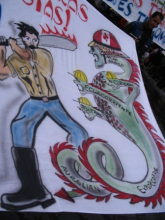
Canadian Mining Protest Sign in Ecuador

Ecuadoreans' protest banner portrays Canada as head of mining 'dragon.' Photo by J. Moore.

Canada is "re-engaging with the Americas." That's what Minister of International Trade David Emerson told the Canada Council for the Americas in Vancouver this past February, elaborating that Canada wants to play "a positive role" to "help citizens throughout the region thrive in the world."

"You can count on Canada and Canadians," Emerson assured.

But in Ecuador, a small Andean nation a quarter the size of British Columbia, Canada's government has aligned itself with powerful Canadian mining interests to undo a recently passed decree crafted to strengthen protection for human rights and the environment.

The government decree, hailed as a momentous victory by a grassroots movement fighting big mining projects in Ecuador, would halt what critics call a pell-mell method of granting mining concessions heedless of communities' wishes or damage to nature.

Canada is a top investor in Ecuador and Canada's ambassador to Ecuador is Christian Lapointe. Lately, he has been very busy helping to put Canadian mining companies in good stead with the Ecuadorian government. Two companies have projects suspended and have been involved in violent confrontations with protesters. These and more than 20 others have had the constitutionality and, in some cases, legality of their mineral rights challenged.

The ambassador would seem to be simply carrying out his mandate. On the embassy website it is written: "to promote Canada's economic interests in Ecuador to support the efforts of Canadian companies who have selected Ecuador as a target market."

Salvador Quishpe, a former Ecuadorian congressman from the national indigenous movement, has a different view of how Lapointe should be spending his energies. "The ambassador should not act in service of the economic interests of his multinational companies, but in service of people's lives," proposes Quishpe.

"The ambassador needs to take responsibility. Not to just come and see where the gold and copper are, but to see what life is about here, in order to respect the lives of Ecuadorians."

Quishpe is also a spokesperson for a nationwide movement opposed to large scale mining in which Canadians -- with the aid of their ambassador -- are by far the most dominant players.

Ecuador's buried riches

Vancouver-based Dynasty Metals & Mining says that Ecuador's gold, copper and other ore deposits hold "tremendous potential."

Dynasty boasts on its website of being the "largest concession holder in southern Ecuador." It holds about 1,300 square kilometres in mineral rights, nearly the size of Glacier National Park.

One of the biggest recent gold discoveries was made by Toronto's Aurelian Resources. Its Fruta del Norte project in Salvador Quishpe's home province could become the second biggest gold mine on the continent. It has also attracted a handful of Canadian companies to buy nearby concessions.

Beyond healthy deposits, Dynasty also points out that "Ecuador has done much to foster and encourage foreign investment in its mining industry." Dynasty's website highlights Ecuador's adoption of the U.S. dollar in 2000 and neo-liberal mining law reforms around the same time.

Until this spring, Canadian firms were pleased to be operating in a country whose government had abolished a 3 per cent royalty on mineral production payable to the national treasury. By law, the government was prohibited from being able to take away mineral rights for reasons such as negative environmental or social impacts.

Bold new mining decree

But then, in late April, Ecuador's legislative body, the National Constituent Assembly, passed a sweeping new mining decree that seemed to spell doom for the industry and mining companies were shaken as stock prices tumbled.

Former assembly president Alberto Acosta, also past minister of Energy and Mines for President Rafael Correa, is an economist and environmentalist. Acosta has provided important support to the grassroots movement opposed to large scale mining.

During final debate over the decree, Acosta called the decision "historic," saying that it would bring an end to the "free for all" over mineral rights in the country. By this time over 5,000 mineral concessions had been granted or were in the process of application. Covering more than one fifth of Ecuador's national territory, 60 per cent were in the hands of only twelve concession holders.

Quishpe points out that "concessions don't pertain to any natural resource management plan," saying "they were granted without even verifying first what was there: a mountain, a valley, even an entire town."

The decree responded to such concerns. It suspends all large-scale mining activity and orders vast numbers of mineral concessions cancelled for reasons such as failure to consult with communities, proximity to headwaters and overlap with protected areas.

As the assembly broke into applause, Acosta said that whereas "companies have specialized in how to divide communities" leading to "near civil war" in parts of the country that "it is our responsibility to help recuperate the peace."

Quishpe was one of a number of protesters captured and treated cruelly during a confrontation with armed military and private security forces in the southern Amazon at the end of 2006. Concurrent with the election of President Correa's government, such conflicts flagged how important mining would be for this administration.

But there was a trap in the decree, says Jose Cueva, an environmentalist from the northwestern Valley of Intag: "One hundred and eighty days to rewrite the new mining law."

Getting in before the new constitution

Industry's timeline has taken over. Now only about 80 days following the mining decree, the Ministry of Mines and Petroleum has already handed a new mining law to the president. While also paying minimal attention to criteria for concession cancellations, such as community consultation or proximity to water supplies, the rush to write the law could override changes being made to the political constitution. The constitution is due to be completed by the assembly on July 26th.

Calling for a "national mining dialogue," Minister of Mines and Petroleum Galo Chiriboga kicked off discussions about the new mining law in a special meeting with industry leaders on April 28th. However, in January Chiriboga had already announced talks requested by companies such as Corriente and Aurelian that included such plans.

Not enough, Canadian companies received a personal invite to the launch from President Correa. Ambassador Lapointe helped set up the meeting.

Eight companies were represented together with the embassy, President Correa and his advisors, as well as the Minister Chiriboga and his advisors. Lapointe is reported to have "presented concerns of the Canadian government for a fair, stable and long-term investment environment in Ecuador."

Darryl Lindsay, president of the Mining Committee for the Ecuador-Canada Chamber of Commerce, says that companies followed up by forming a "Council of Responsible Mining Companies." It includes the eight companies with "a single representative that groups together a lot of the smaller companies." "Via the council," Lindsay says, "we have participation" at each of more than half a dozen meetings around the country with a representative at each of the working groups.

Invited, but hardly feeling welcome, grassroots groups that have been in ongoing conflicts with companies didn't find much room to participate. Lawyer and water activist Carlos Perez called the process "a mining monologue." The Federation of Campesino Organizations from the south-central province of Azuay, of which he is part, chose to present feedback about the new law after the dialogue was over.

Other groups simply refused to participate. "It's an anachronous process without any legitimacy," says Jose Cueva. "Once the new constitution is in place, then we can begin seriously working toward a new mining law."

In Cueva's mind, putting the law before the constitution means "that the advances achieved within the new constitution won't be binding. Like the right to water, the rights of nature, and [other changes] that aren't defined yet." Other changes could pertain to indigenous territorial rights and community right to consent.

Based upon a draft mining law, industry is already breathing a sigh of relief.

Prosperity and security

The new draft law promises to reinstate royalties competitive to the region and redistribute revenue to local authorities. That will be if companies can get a drill in the ground. People might still stand in the way.

"We didn't think that we could have a worse law. But now we see that we were wrong," says Carlos Perez. He is not referring to the absence of strong environmental protections. Nor is this a comment about how community consultation regulations have regressed, although he says these are issues too.

"When they included the public forces in order to control the communities, they managed to make a law worse than the last," states Perez. "Far from protecting the population, those that demand the right to live, the right to health, the right to life, far from protecting them, this protects the multinationals."

A draft of the new mining law "guarantees the continuity of mining activities through the intervention of the public forces at the petition of the mining contractor."

"If they approve this law as is," says human rights lawyer Wilton Guaranda, "it will mean that later on they will see much greater problems than those that exist." He notes how militarization in oil producing areas has deepened local conflicts, which occasionally become deadly.

The solution, he suggests, is greater respect for democracy. "It is a sensitive theme" Guaranda says, "that should be analyzed later with the utmost caution," indicating that the new law should wait. "The constitution should be the reference point for both communities and companies."

Last July, Prime Minister Harper traveled to Santiago, Chile and boasted of "Canada's foundational values of freedom, democracy, human rights and the rule of law" as he vowed to help expand "opportunities to all citizens" while spearheading Canada's "re-engagement in the Americas."

In Ecuador, those trying to rein in the ambitions of Canadian mining firms may wish Harper and his powerful friends could be less engaged with their small country. At least long enough to let citizens there democratically decide the fate of their mineral resources.

Related Tyee stories:

 [Tyee]

28  Comments:

Login or register to post comments

  • RickW

    3 years ago

    South Americans

    are not afraid to step up to the plate.
    http://www.thenation.com/doc/20050214/shultz

    I think Harper will get his wrist slapped over this.

  • biscotti

    3 years ago

    Canadian Company contacts

    Dynasty Metals & Mining
    http://www.dynastymining.com/

    Aurelian Resources
    http://www.aurelian.ca/

  • Frank

    3 years ago

    It figures

    Capitalism and democracy don't mix. Canada has no business being involved in Ecuador's political process.

  • ME2

    3 years ago

    Capitalism and democracy don't mix.

    Frank, I think you'd be wise to to rephrase that one.

  • Fiat lux

    3 years ago

    Good luck to Ecuador. Good

    Good luck to Ecuador. Good thing they don't have the rope of NAFTA like treaties around their necks and still have the hope to make decisions to help their own peoples.

    Mining is an important industry, provided they abide by the strictest environmental laws and the minerals and proceeds are used for the benefit of humanity and not enslavement for profits, especially when they're taken out of the country.

    These and most mining companies are parasites. The ambassador has no right to complain because their rights to steal the country blind may be hampered.

    Ed Deak.

  • alive

    3 years ago

    yup

    Multinational companies will steal any country blind!
    What happens in Equador also happens right here.
    It is the bottomline that counts for these parasites and people are merely another commodity.
    The problem is of course that the shareholders do not have to live in the devastated regions their greed leave behind!

  • Frank

    3 years ago

    ME2

    I take it you disagree? Examples of money subverting, or attempting to subvert, the democratic process abound.

    Corruption exists everywhere, the differences are only in degree. There's an organization that even attempts to track the levels of corruption in each country so as to compare them and I assume shame the worst ones.

    Its bad enough we have to put up with it at home, both the blatant (the Legislature Raids in BC) and the subtle (politicians taking plum corporate positions after their public service), we shouldn't export it to other countries as well.

    The idea of our ambassador endorsing a process whereby our mining companies will get Ecuadorean police and military support against Ecuadoreans that protest what they do there is ridiculous.

    Our ambassador should tell Ecuador and our mining companies that we are there only at the invitation of the people of Ecuador and like all good guests we aren't going to make the rules or piss on their rug.

  • kootenay

    3 years ago

    Ecuador is only the tip of

    Ecuador is only the tip of the iceberg when it comes to the rape and pilage of South American mining resouces.

    Chile and Peru have sold out thier resources to mining corporations and I assure you, neither the miners or local citizens of either country have seen much benefit.

    I've had the benefit of meeting with miners from South America on several occasions and have heard first hand about the lack of regard for workers safety, the environment and the well being of the local population.

    There have been many protests in both Chile and Peru recently, not surprisingly, our Canadian corporations are not listening. They continue to spout words about bring prosperity to all, but the only ones profitting are corportations.

    In some instances entire towns are moved to accomodate mining interests, and many water ways have been significantly damaged due to mercury poisioining.

    I'm not sure about Ecuador, but in Chile and Peru, miners are working at 15,000ft and suffering from high altitude sickness. Going from this level to sea level on a weekly basis is subjecting these men to illness and early death.

    Our government and their corporate bosses are totally dispicable and shame our nation.

  • DaneN

    3 years ago

    first the seal hunt, now gold mining

    Is it any surprise that the Canadian government, which has been travelling around Europe of late lobbying against the EU-wide ban on the inhumane and unsustainable commercial slaughter of seals for the luxury fur trade, is now lobbying for the luxury gold trade and opposing environmental protection and human rights in South America? Canada's reputation as a peace-loving and caring country is being diminished by the greed of its officials.

  • oddlots

    3 years ago

    Some food for thought

    Without meaning to cast any doubt on the good intentions of the commenters here I'd like to suggest that this article and the comments it received reflect a worldview that is almost completely wrong.

    Gold is not a luxury good: it's a form of currency. In the present environment it acts as the anti-dollar. It is a way for countries and individuals to at least partially escape the hegemony of the dollar standard, the system by which the world's economic surplus is returned to the US via purchase of dollar-denominated debt (mostly treasuries but also largely US mortgage debt.) Why do you think Cheney says (echoing Reagan) that deficits don't matter? It's because - net / net - the rest of the world is forced to swallow the extra debt created by US deficits or face rising currencies and falling exports. This means that, in effect, the rest of the world is paying for America's war to secure control over Iraq's oil! This is one of the reasons that the central banks of China and Russia among many others are adding to their gold stocks. A rising gold price and falling US dollar marks the gradual end of this system and is a particularly welcome development for world peace and shared prosperity in my honest opinion.

    I strongly recommend to anyone that doubts the above the work of Michael Hudson. His interviews at Counterpunch are here:

    http://tinyurl.com/5kkdqu

    His website here:

    http://www.michael-hudson.com/

  • oddlots

    3 years ago

    sorry... long post

    In a similar vein the coincidence of the rise of socialist movements in Latin America and the rise in commodity prices is linked. The power of these countries - Ecuador, Venezuela, Bolivia etc. - to renegotiate their terms of trade with the rest of the world so that they take an equitable share of the wealth has risen with commodity prices. This marks a large historical inflection point. The IMF used to be able to set terms of trade that heavily favoured the financial powers (read Anglo-world.) The ludicrous IMF-enforced mining policies that Ecuador is currently re-engineering are a good case in point. But the IMF is now basically broke. (Hurrah!) It only has a very small number of loans on its books to I think Turkey and Greece. It can't pay its operating expenses.

    My point is that an anti-mining stance predicated on the dominance of western finance enforced through the dollar standard is simply hopelessly out of date. Why do you think that Correa - Ecuador's socialist President - is pro mining? (The fact that this is not even mentioned in the article is I think very telling.) Its because he recognises that commodity producers like Ecuador have the upper hand and that resource development can become a huge positive for his country on terms that Ecuadorians can themselves dictate.

  • oddlots

    3 years ago

    sorry long post...

    The other things which seems suspect to me here are the assumption that all Canadian corporate involvement is necessarily exploitative in a meaning beyond profitable. Here's a company operating in Nicaragua that is developing the country's geothermal resources:

    http://tinyurl.com/56785j

    This promises to be a huge win-win for Nicargua: electricity costs will drop dramatically as will the country's dependance on bunker oil. Carbon credits alone will ammount to 40 million of taxed cah-flow coming in from more developed countries. The fact that this company can raise investment capital in Canada is a huge benefit to Nicaragua. The simplistic anti-corporate stance on display here is simply incoherent. If the terms under which companies invest in a country are equitable (via tax laws, royalties etc.) then the investment is a positive for everyone.

    I believe that, in the case of Dynasty Metals (mentioned in the article), this is also the case (as does Rafael Correa, presumably since he visited the site to reassure the local community and shareholders that he supported it after the mining moratorium was announced.)

    Finally, if I am right about the above then foreign-sponsored opposition to mining is at least potentially damaging to the interests of local people. This never seems to occur to anyone who supports anti-mining NGOs. If you accept that 1) some mining is necessary - try building a modern windmill without steel - then it follows that 2) not all projects should be opposed. If not all projects should be opposed then perhaps funding local opposition to a particular project might tip the scales too heavily against it and end up costing stakeholders an opportunity for much needed economic development. The certainty with which anti-mining views are expressed here suggests to me that this has never occurred to some of you. Are you sure you've earned that white hat gringo?

  • oddlots

    3 years ago

    Case in point

    http://tinyurl.com/5rbyzk

    ...and a really good blog about South American investments that's balanced, fair and well informed.

  • Fiat lux

    3 years ago

    Foreign investment is a

    Foreign investment is a fraud. Especially into a country, like Canada.

    It brings nothing to a country. Its purpose is of a loan, temporarily inflating the money supply of the country, then take, take and take forever, in some cases, hundreds of times the amount of the investment.

    It is not money that "creates jobs", but the resources and when you have resources, you have the necessary investment to develop them to the benefit of the country and not for some foreign, multinational corporate mafia.

    Money means nothing. The people of Europe and the businesses had tons of money after WW2, but no resources and so they were starving and running around in rags for years.

    Ed Deak.

  • doggone

    3 years ago

    I am ashamed of Canada

    And I do not say this flippantly! I worked in mineral exploration in B.C.
    If the folks whose land we trod upon raised any objection we simply went away.
    So Ecuadorian protesters now are showing a Canuck Dragon.
    GTFOut!
    And stay out till the locals ask for your help

  • ME2

    3 years ago

    oddlots

    Sorry, oddlots, I read both sites you offered above, but the first, re Nicaragua, spoke of FTAs etc and was too "Free Enterprise" oriented (allowing 100% foreign owned) to suit me when I consider the havoc that program has wreaked in the rest of Central America. It looks to me like Daniel Ortega is Nicargua's Gordon Campbell.

    While the Ecuadorian blog mentioned social pograms in passing, I saw nothing about environmental matters, and an awful lot about how Ecuador is now "safe" for foreign investors. (which was the thrust of the article we're discussing).I would have to know a whole lot more about Ecuador before I even conidered subscribing to the pro-investor tenor of that blog.

  • Fiat lux

    3 years ago

    Right now, here in BC,

    Right now, here in BC, claims can be recorded by email, without the knowledge, or approval of the owners of the land.

    We had a lot of discussion on this criminal action on this blog some time ago.

    So, how deep down do we own our lands? And if we own only the surface, what right do mining companies have to touch it ?

    Who owns the water in our wells, or the crap in our septic tanks?

    Ed Deak.

  • oddlots

    3 years ago

    Fiat Lux

    Hey Fiat Lux,

    I'm intrigued by your comments. Regarding the question of resources being equivalent to investment in some way:

    "It is not money that "creates jobs", but the resources and when you have resources, you have the necessary investment to develop them to the benefit of the country and not for some foreign, multinational corporate mafia."

    Well, doesn't it require both? The only sense that I can make of this is that you are arguing for a change in the dominant money system so that governments spend money into existence and break the hold over minting money that the world's (mostly private) central banks have had. It seems to me that only in this context and with nationalised industries do you have a situation where the difference between resources and the capital required to develop them can become unimportant enough that it can be almost disregarded. Is this what you mean?

  • oddlots

    3 years ago

    Ed Deak

    Regarding ownership, isn't the real question whether there is some limiting factor on individual ownership rights. Take a dam project. Let's assume for a second that the project is environmentally sound and that it is receives general support of the population. The individuals displaced in its construction obviously will be harmed and their individual ownership rights overidden if it goes forward. Is there not a large body of law that deals with this limiting of individual ownership if the case is compelling that its in the greater good? Is this not the basic situation with mineral rights? Now obviously you could say that government is acting as industries handmaiden here if the development is private. But wouldn't essentially the same issues arise with publically owned corporations or ministries?

  • oddlots

    3 years ago

    Dog-gone

    Which locals? Isn't that the question? If I told you that Dynasty Minerals enjoys strong community support would that constitute them "asking for our help?" Or if a government encourages mineral exploration because it believes they need foreign expertise and capital to develop the industry, doesn't this represent a local viewpoint. Granted it depends on how legitimate the government is. In the case of Correa's government I would say it is very legitimate as it has enjoyed enormous popular support. What makes you so certain that the environmental movement is more legitimate than either the locals around the Dynasty operations or the popularly elected government?

  • viptcruiser

    3 years ago

    The Creature From Jekyll Island

    You will find the cause of the global financial crisis in the book "The Creature From Jekyll Island" by G. Edward Griffin.
    I can only hope the "people" of South America do not let their leaders unilaterally push them over the economic precipice, as our leaders of late have done to Canadians (NAFTA). The national governments are bailing out their respective "private" central banks (FDIC). Due the steady production of fiat money, the taxpayers are ultimately going to be repaying the governments through taxes, and the hidden tax of inflation. Since money is no longer bases on gold. Oil, Gold, Groceries are not increasing in price, it is the continued devaluation of the dollar, by the Federal Reserve that hits us in the wallet.

  • Fiat lux

    3 years ago

    Oddlots....I'm a dedicated

    Oddlots....I'm a dedicated private enterpriser, self employed and a business owner in BC since 1957.

    But what I can see today is the destruction of real private enterprise by artificial capital, "created" by some bank from the air, for the purpose of forced collectivization and colonization all over the world, into the hands of a multinational carpetbagger mafia, out to steal the world blind.

    The dream of Stalin and Mao, who tried to do it with bayonets and who now are rolling in their graves for not having thought of this excellent racket, called "globally competitive free enterprise". Yes, free to screw anybody and I could tell you a bookful of stories on what I have seen and experienced on my own skin, by these goddamn crooks. Even now controlling the world's food supplies, stealing from producers and consumers alike. Look up the powers and actions of Cargill alone.

    The biggest problem and crime wave are the globally ruling neoclassical market economy theory, combined with the deregulated money creation power of the banks.

    All we'd need to start curing this are the return of regulated money creation we used to have before 1991 in Canada, the enforcement of the long existing anti cartel,trust, etc. laws controlling the size and powers of, especially, multinational corporations, the enforcement of strong environmental protection and getting the hell out of the NAFTA, WTO and IMF,all of them criminal organizations.

    Money may have been once but no longer capital. Wit deregulation it has become a licence for the control of energy and resources, now issued by a special interest sector for its own benefit and to enslave the world with.

    The real capital are the resources. As a businessman with some experience, I know that their sale is not an income, but the sale of capital, which is bloody stupid, even if brainwashed economists and bought politicians call it GDP.

    When you have resources, you have capital and I have used this fact for many years.

    We have a long string of Arrow Transfer trucks carrying BC's wealth from the Polley Mtn. copper/gold mine, to the ports, on a road, within 1 km from our house.

    Of course, the workers are happy to get good paychecks, but how much of that real capital is enriching others, called "investors" in some other country, who're sitting on their asses and blessing the stupidity of Canadians for allowing it.

    Of course, if Canadians want to rape other countries, they have no choice but to allow the rape of their own.

    Ed Deak.

  • sicntired

    3 years ago

    Legacy of poison

    How can you blame Equador?I don't understand the reversal.Don't they have a current lawsuit against Shell for destroying huge swaths of jungle and leaving?Mining for gold and copper is extremely damaging and as arsenic,amongst other things is present you can bet the situation will wind up equally as dire.It's exploitation of resources that has been the dominant policy these people judge us by.Small wonder they have such a low opinion of North Americans.

  • oddlots

    3 years ago

    I don't entirely disagree

    I don't entirely disagree Ed. I highlighted much of the same issues with regard to the IMF and the importance of the dollar standard in enforcing western dominance over developing economies. But two things: 1) I still can't get my head around what "legitimate" development would look like in your eyes. 2) My argument was that neo-classical market economics have been discredited in South America and you now have, in Ecuador's case, a socialist president trying to develop the country. Why doesn't that make a difference to you?
    With regard to 1) reading your comments it would almost seem like any development of a resource constitutes "rape." I think I know what you mean both about how easily we in Canada (or our government) is bought off with "economic development" (short term jobs) while depleting non-renewable resources. This tension exists to be exploited by "hard done-by" investors in any resource development question. Canada is particularly meek in this respect from what I've read (contrast Norway which has generous royalty provisions.) But my point would be, isn't this a difference of degree not of kind? There must be a percentage of revenue that would legitimise this process. Is it 100 %? What would that mean? Mining by a ministry? Aren't we better off keeping regulatory function hived off from operations and simply receiving as citizens a "fair percentage" of revenue as a no-risk, carried interest? If so, what is that percentage? If not, what would legitimate development mean? On another note, your comment about investors sitting on their ass trivialises the question. No doubt the "fat cats" exist. But what if you were to imagine instead a pension fund manager trying to earn a real inflation adjusted return on your monthly contributions so that whatever public or private plan you contribute to can make good on their commitments? Why does the "fat cat" issue de-legitimise the latter's efforts?

  • oddlots

    3 years ago

    Legacy of poison

    Who's blaming Ecuador? The question is does the world need copper and gold and under what conditions will mining these be both tolerable and beneficial to "locals" at the minesite level all the way up to the national level. This is the debate that is occurring in the country right now. There are big risks with mining such as depletion of water resources and potential groundwater contamination. This is enough to make the vast majority of people shy away from the issues. But the issues will return because the world needs these commodities. Russia recently announced that they were earmarking 30 billion of public funds for investment in a more efficient electrical grid. Is this a bad development? I would suggest that it isn't. Where is the millions of pounds of copper required going to come from? What is the least environmentally damaging way to source this supply? This is, in a sense, exactly the debate that is going on in Ecuador. The debate is highly strategic and politicised but at least all positions are represented, from investors through the pro-development government to the arch-environmentalists. The debate here seems to be about whether any resource exploitation is beneficial or legitimate which seems to me a little constrained in its outlook on the issues.

  • Fiat lux

    3 years ago

    odd.....I started reading

    odd.....I started reading economics in 1982 and by 1985 realized that the whole "science" was a bloody, criminal fraud. Spent the next 6 years on developing the correct definition of economic efficiency copyrighted in 1991, to establish the date, not for monetary purposes. Remains unbroken and unbreakable.

    The biggest problem facing humanity today are the fraudulent definitions of economic efficiency as "the biggest profits for the least monetary inputs", the GDP, Growth and Productivity figures, totally meaningless, faith based crap the lot.

    An economy should work like a road system where the safety and property of all users, regardless of size, is protected by laws and enforced by an independent authority.

    The present, neoclassical system is the biggest crime wave in human history that destroys more ecology and people on a long term, yearly basis, than both world wars and the death camps of Stalin, Hitler and Mao put together.

    WW2 killed 65 million in 6 years, mostly civilians, but the neoclassical system does it in 2 with destitution, starvation and easily preventable illnesses. And this is being taught in our universities as a "science" and "wealth creation".

    Economic efficiency must be defined the same way as physical efficiency: "The most work done with the least physical inputs", or by Funk and Wagnall:" The ratio of work done, or energy expended to the energy supplied in the form of food or fuel"

    "Monetary values are not realities, but often violence induced, temporary perceptions, therefore can not be used in economic calculations" My definition.

    As to what constitutes "legitimate development", again it must be based on physical inputs and what the development is used for?

    As I wrote in my 1991 definition:

    12. "Our economic system are based on the misuse of concepts, mathematics and accounting. No sane person wishes to go back to primitivism, or muscle power, but there must be new, democratically controlled determination of when, how far and for whose benefit convenience may, or must overrule the concepts of true efficiency within the recovery capacity of the environment and humanity"

    In short, you can not replace 50 humans with 1000 horsepower of electric, or oil energy and call it efficient, or GDP, just because somebody makes huge profits from it. And as we can see in the case of Ecuador and other places, people are beginning to wage up to the crimes committed against them in the name of economics and imaginary, monetary values.

    Let's hope, the people of Canada may also start waking up one day and do something about the robbery of our resources going on all around us.

    Now I have to go and build by new sorting corral for our cattle, so the "wealth creating multinational corporations" in charge of price fixing can steal them from us at .75 cents a pound, about half of what we were getting 10 years ago.

    Ed Deak, Big Lake.

  • ME2

    3 years ago

    Corporate Social Responsibility

    Oddlots, I've no idea how much time you've spent on Tyee threads, but we've already analysed the benefits and the efficiencies of what the neocons / Fascists promote through their so-called "Free Enterprise" system, from every possible perspective.

    In the end, they all prove out to simply be schemes to make the maximum amount of money with the minimum investment and effort possible. While doing so, their only real obligation is to their shareholders, and they hold that they are in no way obligated to the country or the people where they operate beyond what the law holds them to.

    These are exactly the wrong people to allow the wielding of the power their investments lend them, for they do not restrict themselves to simply obeying the laws, they buy politicians and arm-twist economies to ensure that the laws will allow them to avoid the proper environmental, social and economic practices necessary to protect the interests of the host country and its citizens.

    I'm sure you've heard and read all this before, just as we've already disussed all your platitudes.

    So may I respectfully suggest that if you have any proven examples of where the oft-promised CSR is actually working, or ideas of how investors can be induced to demand its implementation, I, for one, would be glad to read of them.

  • Syaoran

    3 years ago

    Another Reason

    I really hate what the Conservative government has done to Canada. It seems like every day there is a new reason to feel ashamed of what they are doing in the name of this country. Why must we be more like the U.S. in this?

    • The discussion for this story is closed. No more comments can be added.