
Private River Power Draws Diverse Foes
'Green' claims disputed.
'Run of river' project underway on Ashlu river.
Tom Rankin, president of Save Our Rivers Society, used to have to pester people to get his message out. Now he has plenty of citizens eager to listen.
A keystone of B.C.'s low-emissions energy strategy is power generated by private "run of river" plants driven by rushing water. But what's good for fighting global warming has raised various other fears for Rankin and a diverse range of groups opposed to the projects.
Rankin turned activist when he caught wind of a private hydro development planned for Ashlu creek, just north of Squamish where the rancher calls home. He went to meetings, got on the phone and formed the society to stop what he sees as the "theft of B.C.'s rivers."
One of his converts was Gwen Barlee of the Wilderness Committee, who says Rankin's persistent calls prompted her to look more closely at private hydro projects.
Barlee admits she was initially pleased about BC Hydro's first call for green power proposals in 2003, the year the contract for Ashlu creek was granted.
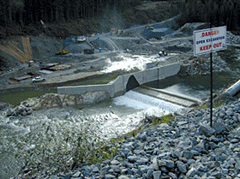
That changed when she actually saw the project construction site.
"I thought of a little turbine in a stream," she says. "They're called run-of-river projects . . . they should be called river diversion projects."
While environmental and conservation activists have criticized the touting of these projects as "green," a number of other interest groups are mobilizing against private power for other reasons.
"We're seeing a really diverse group of people," says Barlee. "It's indicative of the depth and breadth of private power producers across the province."
Too much, too fast?
Right now there are 35 private power projects up and running, another 45 have been granted contracts and more than 500 water licenses -- obtaining one of these is the first step for hydro project development -- have been bought.
This is too much, too quickly with too little consultation with stakeholders, say opponents. There have been four requests for moratoriums on private hydro development in the province.
In 2005, the Squamish-Lillooet regional district requested a moratorium on "high value" streams in the Sea-to-Sky corridor "until a consensus-based regional strategy is developed to predetermine which rivers are suitable for IPP [independent power producer] development . . ."
Last June, the Union of B.C. Indian Chiefs called for a moratorium on private hydro development until there was assurance of "transparent" consultation with First Nations and a review of the terms of existing water licenses.
Unions oppose privatization
The NDP, Wilderness Committee, Council of Canadians and Canadian Office and Professional Employees Union have also jointly called for moratoriums.
David Black, president of COPE local 378, says members have been rallying against BC Hydro privatization since 2002 when it launched BC Citizens for Public Power.
In 2003, one-third of BC Hydro jobs were outsourced to Accenture, an international management consulting, technology and outsourcing company.
Carleen Pickard, regional organizer for the Council of Canadians, says there is "widespread support" to stop the proliferation of privately owned hydro projects.
"This is the time for [a moratorium]," says Pickard. "The rubber is hitting the road. The call for a moratorium is not unachievable and it's entirely within the rights of citizens."
Power line would slice park
The latest battleground in this fight to halt private hydro development is a proposed project site approximately 100 kilometres from Vancouver, sandwiched between three provincial parks: Pinecone Burke to the north, Garibaldi to the east and Golden Ears the south.
Northwest Cascade Power Ltd., a subsidiary of Run of River Power Inc., is proposing a 161 MW hydro facility on eight tributaries of the Upper Pitt river.
The project proposal includes building a 43-kilometre transmission line that would cross the northern and southern tips of Pinecone Burke Provincial Park.
The park is designated class A, which allows for the least amount of disruption within its borders. Under the B.C. Parks Act, it's possible to move the borders of a park with a Park Boundary Adjustment Amendment. Run of River has requested such an amendment to allow for the transmission line.
"I anticipate that an amendment will come in some form in the spring session . . . and be debated in the legislature between Feb. 12 and the end of May," says Shane Simpson, Vancouver-Hastings MLA and the NDP critic for the environment and sustainable communities.
Run of River has scheduled the first of three open houses on Upper Pitt and the proposed park boundary adjustment for next Monday in Squamish.
Anyone can fill out a public comment application on the company's website.
Company: 'No feasible route alternative'
Jako Krushnisky, the president of Run of River Power Inc., didn't return calls from The Tyee.
The company's website states that if the amendment is approved, 52 acres would be removed from the park and designated a protected area, managed under a park-use permit.
The website also states that two transmission routes were considered, and "due to the project location and available BC Hydro interconnection points, there is no feasible route alternative that would avoid the need for crossing Pinecone Burke Provincial Park."
Both Simpson and Gwen Barlee of the Wildnerness Committee said they feel government will be watching public response to this project closely.
"We're hearing behind the scenes the government is getting nervous," says Barlee.
Minister: Citizens still own rivers
When asked for comment about public opposition to private hydro development, public affairs for the Ministry of Energy, Mines and Petroleum stated the government is not considering a moratorium and e-mailed The Tyee an opinion editorial from Minister Richard Neufeld about private electricity generation in B.C.
"IPPs may own their generating infrastructure but they do not own the rivers and streams. The people of British Columbia continue to own these water resources," states the letter.
"BC Hydro is currently looking at building and expanding electricity generation. It is moving to Stage 2 of reviewing the feasibility of the new Site C project on the Peace River. As well, BC Hydro has undertaken capital investments on several dam sites."
Irrigation worries
Stage two of Site C, which will consist of stakeholder consultation and project definition, will take two years. Construction -- if the project reaches that stage -- wouldn't begin for another seven, according the BC Hydro's website.
Harold Steves, a former NDP MLA who was integral in the creation of the Agricultural Land Reserve, lamented what he sees as the loss of the "best publicly-owned power system in North America."
Steves says he hears from farmers who are concerned about not having enough water to irrigate crops.
"I've got farmers contacting me saying that they're losing water rights," he says.
"They don't know how this could happen."
Water level concerns
Last September, a power project on Miller creek near Pemberton shut down and reduced the creek to a trickle. Alarm signals were re-routed to an office in Edmonton, but the incident went unchecked until local farmers alerted BC Hydro.
Andrea Barnett, communications coordinator for the B.C. Cattlemen's Association, said that although she receives many complaints about low water levels, none have been directly attributed to hydro projects.
People in the tourism and outdoor recreation sector are also worried about transmission lines, cleared construction sites and large pipes diverting water and spoiling wilderness destinations.
Chris Laustrup, a photographer, owns 120 acres on the Pitt River near Olsen creek. He, his wife Dianna and their young son moved there to "get away from society" and are currently building a wilderness retreat that will cater to other people looking for escape.
"I'm not an environmentalist, I'm a conservationist. I'm talking about a wise use of natural resources," he says.
Plea for land use plan
"My drive has always been to getting people up there, getting tourism up there," says Laustrop, who was the president of Tourism Pitt Meadows when the organization was in its infancy.
He says the area has the same natural attributes of Whistler and Squamish, but is worried the eco-tourism potential will be spoiled when private power producers move in without a land use plan in effect.
Laustrop says such a plan is necessary to ensure the area is developed appropriately -- and with no infringement on park land.
Jeremy McCall, executive director of the Outdoor Recreation Council of B.C. says he imagines public input on the Pinecone Burke proposal will be "deafening."
'Parks are supposed to be sacred'
The ORC represents about 100,000 direct and indirect members, says McCall. He says the organization is trying to be an "expert" source of information on the public consultation process for the Upper Pitt and other hydro projects.
"Really, parks are supposed to be sacred," he says.
"We're not trying to act politically, we're trying to make sure people know what's going . . . and do what they think they should do," says McCall.
First Nations see costs, benefits
There are certainly differing opinions among aboriginal leaders about what private hydro development means for their people.
Grand Chief Stewart Phillip says First Nations communities already in "dire straits" are particularly vulnerable to power companies that promise jobs, skills training and revenue sharing in exchange for land and water rights.
Last April, a 119 MW project on the East Toba river, north of Powell River, was approved after consultation with Klahoose Chief Ken Brown.
Brown said when the project proponent, Plutonic Power Corporation, expressed interest in developing Klahoose territory, it was like "the stars had aligned."
Plutonic is spending $34 million on an initiative to rebuild old logging roads and bridges that have been decommissioned for 20 years, something the Klahoose could never have afforded, says Brown.
"You sit around waiting for a treaty settlement or you step up to the plate," says Brown. "You interface with private business and create economic opportunities for people. I try not to focus on the divisiveness of it."
'Election issue' says grand chief
Phillip says private hydro development on rivers, streams and waterways "flies in the face of everything we consider important" and urged activist groups to reach "beyond the usual suspects" and let ordinary people know how privately owned power will affect them.
"We're 15 months out from the next election," says Phillip. "This issue has to become part of everyone's kitchen table talk."
Related Tyee stories:
- A 'Green' Threat to B.C.'s Rivers?
Touted by BCHydro as renewable electricity, the rush to install privatized 'micro-hydro' schemes may change the flow of 76 B.C. rivers. - BC's Billion-Dollar Wind Power Giveaway
We're heavily subsidizing private power developers. Will Californians profit big? - In Telkwa, Surviving Off the Grid
It's minus 34 tonight and the generator just quit. Why did we say no to Hydro?


snert
18-02-2008
Way better than dams
They may not look nice but much less damaging than a full fledged dam.
Luke Skywalker
18-02-2008
Nuclear power or coal-fired
Nuclear power or coal-fired plants anybody???
Sheesh, during the 1990's, BC Hydro didn't do anything except propose a greenhouse-gas spewing, gas-fired electrical plant on Duke Point on Vancouver Island, which was finally abandoned at a cost of $hundreds of millions.
The final cost of Site C on the Peace River will likely result in greater environmental degradation than these run-of-the-river ("ROTR") projects combined.
And the cost of such electrical generation from Site C will also likely be greater than any of these ROTR projects.
The environmental degradation both visually, on land, as well as to bird life is also high for wind-generating stations.
Apparently BC Hydro weas never interested in these smaller ROTR projects over the years and, as this article neglects to mention, many First Nations also have a financial stake in these projects.
Kudos to them!
Chris Bouris
18-02-2008
straight goods
where's the money going and who benefits? watch and listen carefully.
Grumpy
18-02-2008
Can't we just conserve?
One problem with power in BC is the profligate waste of power. I believe that inexpensive solar panels be used to power, some electrical outlets in houses that power clocks and alike. A $1000 solar panel & mains, is affordable for new houses and would certainly cut down in electric consumption.
We have to think 'out of the box' to solve the problem.
skeptikool
19-02-2008
Green power is pure motherhood
As gasoline and diesel fuel prices continue upward, the demand for plug-in electric vehicles and "green" power to supply them will grow. This should not be a license to rip off the consumer/taxpayer for any green-labeled project - as we have seen happening with ridiculously-priced, hydrogen fuel-cell buses, for instance, in my opinion.
I believe much of that power might come from the high tech burning of much of the Lower Mainland's garbage. The shipping of that trash that required an almost-700 kilometer round trip, with 35 diesel trucks, was insane from the start, in both financial and environmental costs.
kootcoot
19-02-2008
Glacier/Howser Creek Project
I would advise anyone interested in these so called "green" run of the river IPPs to look into the particulars of the proposed project on two creeks that currently flow into Duncan River and the Duncan Reservoir north of Kaslo BC. Actually it is hard (for me) to keep this project totally separate in one's mind from the Jumbo Glacier Resort.
This might be because part of the scheme involves building a High Voltage Transmission Line over Jumbo Pass to move the power east and south (most likely for easier export). The often touted "grid" already is accessible less than ten miles from the mouth of Glacier Creek, so it would suggest some hidden agenda is behind the need for 90+ kms of new hydro towers.
It hardly seems "green" to me when the plan involves diverting up to 80% of the flow from Glacier Creek (the creek flowing west from Jumbo Creek and Jumbo Pass) and sending it through a tunnel to add to Howser Creek which will then flow through the turbines. 50,000 tandem trucks of rock and muck will be dumped locally as a result of making the 16 km tunnel for diversion. The lower 10+ kms of both creeks will be virtually dry creek beds. Somehow this doesn't sound particularly green to me, or probably spawning kokanee either. As a downstream (of the diversion) user of Glacier Creek water said recently:
BTW, Duncan Lake itself is made by a dam built in the 1960's under the Columbia River Treaty for upstream storage. Currently there is NO power generation at all at Duncan Dam, though installing turbines on an already existant dam certainly seems like a more evironmentally friendly/more efficient way to generate power from the same streams and others that feed the Duncan River. Of course installing turbines at an already built dam goes counter to the Campbell governments radical privatization agenda.
City Person
19-02-2008
Damned if you do, Dammed if you don't
I am new to this board but I can say this. My dad worked for BC Hydro for years. He was always amazed that the huge amount of rapidly flowing water was rescource that was not being used. Now it is and I think it is a better alternative than a nuclear or coal plant. We all use electricity.
As for solar panels, perhaps they might be a useful soft energy scource in the future but now, especially on the coast, they are not going to be economical.
Conservation is of course the best route. I suggest everyone here turn off their computers 15 days a month.
Peter Dimitrov
19-02-2008
Where I stand
Prior to the BC Liberal election there was NOT a market for electrical energy use in British Columbia. Electrical power was, (and is) obstensibly produced by BC Hydro, and industrial, commercial and residential rates were set by a Utilities Commission as appointed and directed by the Minister responsible. BC Hydro was vertically integrated, generation of power, with distribtution via its own transmission lines. Exports were taken care of by Powerex which at that time had received a federal and provincial energy export certificate. BC Hydro had many assets in addition to the dams and transmission lines. It had intellectual property pertaining to know-how of its Power Smart program - which was unique throughout North America - as most US utilities had no such program, given that they wanted their consumers to consume more electricity, not less. Secondly, BC Hydro's intellectual property consisted of multi-million dollar research reports pertaining to the locations and capacities of all micro-hydro and wind potential sites in the province. Both of these significant intellectual property assets were paid for by you-the ratepayers.
The BC Liberals came along, and their first BC Energy Policy, obstensibly written by big corporate players, all of whom want to see an electrical market produced, yet wanted a virtually perpetual electrical rate/price guarantee from the cheap Heritage power of the Peace and Columbia rivers. They got their way, Campbell outsourced about 1/3 of BC Hydro to Accenture, that contract is still private, the cost/benefit analysis is still not released, despite Minister Neufeld promising to do so on CBC radio and in writing to me many years ago. Then, they told BC Hydro - they could not build new power generation facilities, only improve existing ones. They freely released the BC Hydro reports on micro energy and wind energy sites to the private energy corporations who were all geared up to 'stake' their claims on BC Rivers.Said companies, lined up to apply, at dirt cheap prices, for a water licence, on hundreds of rivers and creeks in BC- and thus we have a tumultous market.
Moat
19-02-2008
Rapidly Flowing Water
City Person wrote:
Your was father right to say that there is a lot of rapidly flowing water that we can use. Some of it bounds down cliffs and ledges, and we could probably harness it without people, fish, and other wildlife even noticing. Mind you, I am not an engineer, so I can make a solution sound easy.
The Ashlu creek project appears to have some pretty big impacts though. It is a river that flows on a valley bottom, and therefore, is cheap to develop. Seems that when "costs" are involved, nature always loses. What a theme here, eh?
I used to spend a lot of time up there (at Ashlu) several years ago. So close to the city, yet seemed so wild (even though logged to pieces). I miss that place.
villager
19-02-2008
ROR justified
People's biases are so obvious in this debate: unions are agaist private power because it goes against their bigger-is-better mentality, ecotourism folks are concerned about impacts to their bottom line, and conservationists are against anything that isn't old growth forest.
Of course, the IPP's have their own motivation as well: return on capital. But honestly, I can't think of a more justifiable enterprise than one that seeks to reduce our dependence on fossil fuels. The capitalists will get their loot, but for once it seems like a fair trade. I get clean air and an economy that's detached from the impending economic disaster of peak oil.
If we are really concerned about a tiny overall percentage of our rivers being harnessed for renewable electricity, then lets see a real, grassroots campaign in favour of conservation. The alternatives to either are much, much uglier.
Peter Dimitrov
19-02-2008
where I stand-Part 11
Dr. John Calvert's book "Liquid Gold: Energy Privatization in British Columbia" ( published by Fernwood Publishing) chronicles in great detail how we are losing a key public asset and to whom. Likewise the work of SFU's Dr. Martin Shaffer,"Lost in Transmission: A Comprehensive Critique of the BC Energy Plan" is highly informative (available at the COPE 378 website). Both of these reports expose the incredible stupidity of the BC energy policy and the virtually give-away, of scarce micro-hydro water licences to the private corporations. The private power produced is obstensibly not firm or reliable power, it is mosly produced during the spring freshet, when BC already has a surplus of power, and thus it is available at the wrong time of year. Of course, the private power producers want to store, at public subsidy their non-firm power behind our public dams, to somehow convert that non-firm power into more valuable firm power. The price to consumers of that power, especially when you add in the BC Transmission line inter-change costs that will be incurred by the BC Transmission line will be extremely costly- see recent headlines in the Vancouver Sun - of 25% of more rate increases coming. Worst of all, the public gets no ownership of the assets of the private energy corporation- it is privately owned not publicly owned. Then there are the environmental impacts. [b]Presently there are 128 approved licenses on 115 water courses in British Columbia. There are 435 licence applications on an additional 466 water courses. This implies there are a total of 563 current and potential licenses on up tp 581 water courses.
The environmental assessment process is deeply flawed. Check out my article on that at:
http://www.vivelecanada.ca/article.php/20080215012503208
Google ourrivers.ca --and see the CTV show called Blue Gold Rush, and the video called Power Play.
Peter Dimitrov
19-02-2008
Where I stand-Part 111
With a majority government there is nothing her Majesty's Loyal Opposition can do to halt, reverse or stop this. Perhaps, you, as a voter, can organize a group of people in each constituency, arrange an appointment with your MLA, and demand, accountabilty for why he or she votes to support this BC Energy Policy. Demand, indeed, instruct your MLA, that you want an immediate moratorium placed on the issuance of further water licences for power generation, and a cease work order in council order on all projects currently under construction. Demand a full public debate on BC Energy's Policy between the Minister responsible and people such as Dr.Calvert and Dr. Shaffer. Read my critique of the Environmental Assessment process to see how deeply flawed it is. In 2012 the new rates will kick in, along with the new power smart meters at you home...you wont' be singing or dancing when you pay for private energy's bill or the BC Liberals ill-considered Energy Plan. As for First Nations receiving benefit from Hydro-electrical generation, just like in Manitoba, I support the provision, of a 33% equity position in all public power projects provided they drop their support and equity involvement in private power projects.
City Person
19-02-2008
Tade offs
All rescource developmet requires a trade off. Do we want to keep our enviorment pristine or do we want to individually reduce our consumption? Do we, for example, want to use our computers only 10 days a month?
Ultimately, it is up to the individual.
Fiat lux
19-02-2008
What nobody dares to mention
What nobody dares to mention is that most of the power is already used to light up inefficient, waste producing cities and in industries, where dozens and hundreds of hp. are used to "become more efficient" by firing a few 1/2 hp. humans to steal their wages, while calling it "earnings".
Unless we turn to physical efficiency based economic systems, we can kiss the human race goodbye.
Ed Deak.
skeptikool
19-02-2008
There is a way
There is a benign way in which electrical power can be derived from swift-running rivers. If we imagine a tethered paddle-wheeler or stern-wheeler coupled to generators. Screens would be required to protect the blades from debris, though the winter months might present insurmountable icing problems.
If there was sufficient depth it could even work with a propellor and still be operative despite surface ice.
I much prefer the use of tide and wave however. There is incredible potential being ignored in those sources. The sad thing is that instead of Vancouver being self-sufficient in electricity production we have Mainland residents with EMF concerns disputing whether power lines to the Island, passing through residential neighborhoods, should be above ground or buried.
I hope a sane resolution is reached before more millions of consumer dollars are spent in more studies and legal fees. It is the consumer, after all, who will pay.
villager
19-02-2008
Massive Destruction?
Kootcoot:
If you think that a 3 metre diameter pipe is a 'massive diversion', or that an access road, electrical lines, and a 20 square-metre powerhouse is part of a 'massive environmental destruction', then I'd hate to hear what terms you'd use to describe oil and gas drilling, or a coal plant, or ... any one of the 30 huge B.C. Hydro dams.
These ROR projects will be considered a bargain 10 years down the road when the reality of peak oil sets in. B.C. stands to become a world leader in a carbon-neutral society as a result of our abundance of viable sites for renewable energy production.
If there are increases to our electricity cost, I think that most people would accept that. We've had some of the lowest electricity rates in Canada for a generation, and that certainly doesn't encourage conservation or efficiency.
Budd Campbell
19-02-2008
WHAT ABOUT DAVID STUPICH AND ROBERT WILLIAMS ?
Harold Steves, a former NDP MLA who was integral in the creation of the Agricultural Land Reserve, lamented what he sees as the loss of the "best publicly-owned power system in North America."
Steves says he hears from farmers who are concerned about not having enough water to irrigate crops.
"I've got farmers contacting me saying that they're losing water rights," he says.
"They don't know how this could happen."
Please correct me if I am wrong. The two individuals most clearly associated with the introduction and passage of the Agricultural Land Commission Act were David Stupich, the Minister of Agriculture, and Robert Williams, the Minister of Lands and Forests. Harold Steves was a backbencher who may have voted for the legislation, but he neither participated in the design of the act nor did he help to lead the floor strategy to get it passed in spite of violent opposition from the Social Credit Party and its contingent of Fraser and Okanagan Valley MLAs.
As to farmers losing "water rights", I have to agree that I don't know how this can happen. Perhaps these farmers had no legally authorized permits and were just casually using the water on a stream that had no competing users. Perhaps they were on some kind of year-to-year rental system and have now been displaced by a higher bidder.
Either way, the notion of a farmer with presumptively permanent water rights being pushed aside by a new applicant doesn't play in BC anymore than in Peioria. It may be a mistaken public policy if the farmer is contributing to provincial GDP more than the IPP would, but it's not going to be a case of one user's permit of many years'standing being cancelled to make way for another user's ambitions.
Luke Skywalker
19-02-2008
Quote:Currently there is NO
That's actually a good idea! Now whether this 1960's storage dam design will permit the installation of a powerhouse, turbines, and penstock is a technical question that I'm not familiar with.
BC Hydro was just granted an environmental certificate last June, 2007 for a fifth generating unit, after 12 years at the EAO, which will provide another 500Mw. The Revelstoke dam was also designed for a sixth generating unit, but I don't see any application for that additional power at the EAO.
BC Hydro's existing dam/transmission infrastructure is also approaching a mid-life crisis with turbines being replaced at the WAC Bennett dam, for instance, and an estimated $4 billion is required to bring the aging transmission/transformer system up to acceptable standards.
As for ROTR, wind, and geothermal IPP's, they also have to go through the same hoops at the EAO just as BC Hydro did for 12 years regarding the additional turbine at the Revelstoke dam.
http://www.eao.gov.bc.ca/epic/output/html/deploy/epic_project_index_report.html
happy
19-02-2008
what am I missing?
A portion of the water is diverted through the generator, then returned to the river in full downstream. I repeat, in full. How could that possibly affect farmers in the valleys. There is zero reduction in the water flow
jimmy_laroux
19-02-2008
Luke
Luke Skywalker:
The BC Liberals have not allowed BC Hydro to develop new power sources (except the proposed Site C).
jimmy_laroux
19-02-2008
villager: Quote:People's
villager:
Wow. That's a pretty ridiculous thing to write. I recommend reading this:
http://thetyee.ca/Views/2006/10/30/BCHydro/
So unless you steal your hydro, or are an investor in one of these private power companies, you too should be concerned.
jimmy_laroux
19-02-2008
happy: Quote:A portion of
happy:
I'm not sure, but I imagine that if water for irrigation (which is obviously not returned to the river) is removed upstream of the power facility it would have an impact on the volume of water flowing past the facility (and thus impact how much energy it can generate).
zalm
19-02-2008
solar
I wish $1000 would buy me a solar circuit for my house - I've got the perfect south-facing exposed roof. But $1000 won't even buy the power inverter for a 1500W (1 circuit) power supply to get the power to my house, never mind the cells or the storage or the....
Last time I checked, costs were closer to $6500 for a single circuit.
jimmy_laroux
19-02-2008
happy: Sorry, I realise I
happy:
Sorry, I realise I wasn't so clear. A "run of the river" power producer is interested in maximising the volume of water flowing past its facility. A farmer upstream irrigating their crops reduces that volume of water. I have no idea about the political/bureaucratic processes involved in securing or removing rights to water from a river, but it seems to me that the interests of the farmer and the interests of the producer are in conflict, and one party could try to block or reduce the other's access. Maybe some ROTR power producers are guaranteed sole rights to the water? I'm just guessing. The article doesn't explicitly say how this is happening or could happen.
Luke Skywalker
19-02-2008
Quote:A "run of the river"
One problem with that hypothesis though. ROTR projects are typically located in steep mountainous terrain, whereby there could not be any arable land "upstream".
In other words, most, if not all, of BC's arable land is in valley basins... "downstream" from where any ROTR project would be situate.
kootcoot
19-02-2008
What Happy is Missing
What you are missing in the case of Glacier/Howser is that the one creek is diverted through a mountain 16 km to the north and then the combined flows go into a penstock which flows through turbines near the creek mouth. Meanwhile the creeks are virtually dry as the flows of both are diverted. Hardly Run of the River, really.
I'm not familiar with every IPP in the province and as I have explained above it is the privatization/commoditizing of water flows that I am really opposed to. It is just another assault on our ability to be in control of our own destiny through so called "Free Trade" or what is in America's interests policies. Interestingly even the Mexicans were too smart to sign over their own rights over their own energy resources like the Canadians with The Evil Jaw in charge.
happy
19-02-2008
For the last time
How are farmers being short changed? That was the only item I commented on. If anyone wants to answer that, and only that, please do so.
Yeoman
19-02-2008
Are they really efficient?
A few things never get mentioned in this debate:
1. Generation is limited to high flow times such as October to June when North America wide demand is low.
2. The stability (eg debris torrents) of most of the locations is dubious at best. If a flood event happens, there goes the winter's energy.
3. Turbine blade erosion in such applications is significant.
4. The whole industry is one big TSX stock play.
5. "Green energy" is predicted to be the next bubble (check out iTulip.com)
Ronald Pagan
20-02-2008
We need to get our energy
We need to get our energy from somewhere.
Where would rather get it from, coal burning plants in Washington and Alberta or rivers in BC?
Too many people want their cake.
kootcoot
20-02-2008
How Can So Many Miss the Point
Ronald Pagan etc.
I don't recall anyone saying that using water (HYDRO) to generate power was in itself evil or evironmentally the worst option. What I question is the wholesale giveaway of what up until the ascension of Gordon Campbell were resources OWNED in common by the people of our fair province.
Certainly certain IPP projects also are "green" in the Orwellian sense only or in the "cash flow" to Coporate Interests.
But selling the furniture to foreigners to pay the rent or line the pockets of corporate cronies is WRONG, evironmentally sound or not!!!
Interestingly, a neighboring village, mayor and council, looked into developing alternative stream based back-up power, to insure being able to operate the pumping station etc. during power outages, like we experienced this summer due to fires. Low and behold the committee researching the issue came back to council with the new information that NONE of the local streams were available, as they had all been auctioned off (none to local interests). Of course no one locally knew they were even available until they were already sold, including local council and regional representatives. Even my small village could afford the $5000 or so license fee for a local stream of the size necessary.
Budd Campbell
20-02-2008
PINCONE - BURKE MTN PARK BOUNDARIES
The project proposal includes building a 43-kilometre transmission line that would cross the northern and southern tips of Pinecone Burke Provincial Park
If built it will be the second electric transmission line in this park. When the park was created, the southern boundary was drawn so as to included the main transmission line bringing power from the North and the Interior to Greater Vancouver. Also included is a large gravel quarry.
lynn
20-02-2008
The privatization of the natural world
This is just the BCLiberals' privatization of BC Hydro being deviously.... and cowardly hid behind a trendily pathetic PR mask of green.
As kootcoot notes, it's exactly the same old privatization scam we've seen many times before. First take a gem of a public asset and disable it ( through lack of funding etc., through a 990 year "lease" as in BC Rail, or in this case by legislating away all the power rights of BC Hydro.). Presto! the once powerful public energy giant is perceived as and turned into a weak-kneed eunuch so that those greenback droolin' private power companies can ride into town, buy up the power rights real cheap, reap the gargantuan profits for themselves, all the while posing as green saviors coming to the public's rescue. .
There is much green moolah to be made by these private companies and they know it and they can't hurry it all along fast enough....hoping it all hums along under the green guise/radar of a sleeping public.
The one up Toba Inlet is running twelve-hour work shifts, round the clock. 24/7. We have friends north of Kamloops that manage a motel - their motel is fully booked for the next year by those about to work on developing the IPP near by.
This is the new gold rush, you can feel the fever, the private power fever for easy profit - for which we, the public, will pay and pay and pay....all because of the ruthless castration of one of BC's great public energy resources, BC Hydro.
One important fact to note: the environmental assessment process is not applied to projects under 50 Megawatts in size, resulting in many IPPs being built at 49 megawatts to avoid even minimal scrutiny.
So when as this article says:
Note that 161 megawatts is on eight tributaries. Divide and do the math. Those tributaries under 50 megawatts escape the environmental assessment process, so when it comes to megawatts 49 is the magic number....to free a project from environmental oversight.
(Go the Council of Canadians web-site for more info. If you get a chance view the DVD "49 Megawatts".)
"The BC public will have to bear much higher costs as a result of these private power operators. IPP operators sign 20-40 year contracts with BC Hydro, locking us in to pay IPP power rates significantly above BC Hydro's current costs. Once these contracts run out, the private operator can sell electricity to the highest bidder, which could result in BC bidding against California for power produced by our own rivers and streams."
Ya think that's why American companies like GE have invested millions of dollars into IPP's like the Plutonic Power Toba River site?
kootcoot
20-02-2008
Reading Recommendation
I would recommend that people who are concerned about this sell off of our assets go back to the Tyee article by Professor Calvert from October 30, 2006. Amazingly some of the same people who now think the IPPs are such a good and green idea were able to understand what is really going on behind the curtain then. Maybe it is a sign that the manufactured energy "crisis" etc. campaign being waged by the government with the help of their media lackeys is working.
Doctor Calvert explains very clearly what is wrong with this program, and nothing has changed since then, everything he pointed out then is just as true today, if not more so.
See BC Hydro's Amazingly Bad Deal for Ratepayers
I would also suggest to the Tyee that they remove the http:// in the link blank generated with the tool above this text box. Most people copy and paste the links in and they already have that part in the added link, repeating that twice in the link is what makes so many of the URLs on this board malformed and thus non-functioning. I know one can just edit it and remove one or the other, but WHY bother? Everybody who participates on these boards isn't fluent in HTML.
kootcoot
20-02-2008
Correction
I accidentally provided the link for this very same article. The correct link is:
Bad Deal for BC
Sorry 'bout that.
Peter Dimitrov
20-02-2008
Re: Rates Increases
Kootcoot you ask:
Try to explain to me how that will translate into the 25% -30% increase in cost to users in BC, that is being bandied about in the PR "softening up" process currently underway in the Lamestream Media.
That is a pretty tough question to answer because the general public is kept in the dark. But, I think, Campbell' s plan is to continue to offer to very low cost electrical rates to heavy industrial and big commercial users - namely continued access to Heritage power (Peace & Columbia) rates, while shifting higher costs onto the residential and small commercial sector, a new rate structure that dilutes or offsets the high rates of private energy by 'blending' it with the Heritage power rates. That therefore, is another subsidy to IPP private energy, and causes a further dilution in the value of the public's ownership of the Columbia & Peace system. Another subsidy to private power, which also dilutes the asset value of the firm power produced by public dams on the Columbia and Peace, would be if the the private energy companies are allowed to use the dams to 'convert' their non-firm power into firm power - which is a more valuable commodity. Either way you look at it, the commons has been stolen by the goose which has produced so much 'gold' for BC over the past 50 plus years. Indeed as Lynn says so accurately "t's exactly the same old privatization scam we've seen many times before." What is going on is exactly how Argentina was destroyed by the neo-liberal agenda....see the DVD "Social Genocide". There are solutions to this 'taking' -which many, including myself, have been articulating over the years. Otherwise, British Columbia will but be a 'hollowed' empty shell of a province with a much poorer, emasculated people, with more conflicts and violence, far greater inequality and exclusion, and the majority of ordinary folks and their children and grandchildren, poor tenants in their own land, paying ransom fees to the corporate owners. As I see it, before we can design a range of 'solutions', we neeed not just reportage and reaction to what is happening, but analysis of how and why it is the way it is.