

 SHARE:
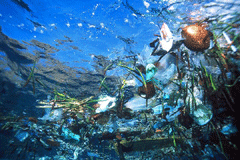
Located in the Pacific Ocean between California and Hawaii and measuring in at roughly twice the size of Texas, this elusive mass is home to hundreds of species of marine life and is constantly expanding. It has tripled in size since the middle of the 1990s and could grow tenfold in the next decade.
Although no official title has been given to the mass yet, a popular label thus far has been "The Great Pacific Garbage Patch."
As suggested by the name, the island is almost entirely comprises human-made trash. It currently weighs approximately 3.5 million tons with a concentration of 3.34 million pieces of garbage per square kilometer, 80 per cent of which is plastic.
Due to the Patch's location in the North Pacific Gyre, its growth is guaranteed to continue as this Africa-sized section of ocean spins in a vortex that effectively traps flotsam.
Few visitors
The cause for the Patch's relative lack of acknowledgment is that the portion of the Pacific it occupies is almost entirely unvisited. It lacks the wind to attract sailing vessels, the biology to encourage fishing, and is not in the path of major shipping lanes.
What little air movement there is blows inwards, further trapping the garbage.
According to an article in the San Francisco Chronicle, Marcus Eriksen, a director at the Algatita Marine Research Foundation, said that "with the winds blowing in and the currents in the gyre going circular, it's the perfect environment for trapping."
While the trash is in the ocean, it is doing what could be irreparable harm to sea life, the water it's in, and eventually humans.
Plastic resists biodegrading. Instead, a plastic shopping bag or pop bottle will photo-degrade over time, meaning that it will break down into smaller and smaller pieces but retain its original molecular composition.
The result is a great amount of fine plastic sand that resembles food to many creatures.
Unfortunately, the plastic cannot be digested, so sea birds or fish can eventually starve to death with a stomach full of plastic.
Even if the amount of plastic in a creature's body is not enough to block the passage of food, the small pellets act as sponges for several toxins, concentrating chemicals such as DDT to 1 million times the normal level.
This concentration then works its way up the food chain until a fish is served at our dinner table.
A deadly shining
Some birds, attracted to the shining in the ocean, approach the Great Pacific Garbage Patch in search of food. Marine researchers have commented that pelicans dissected in that area have stomachs so full of lighters that they resemble convenience stores. Sea turtles are also prone to mistaking plastic bags for jelly fish, which then cause their deaths or sit in their guts for the decades it takes the bags to break down.
In total, 267 species have been reported to have eaten from, or become entangled in, the Patch.
According to Chris Parry of the California Coastal Commission, regrettably little can be done to clean up the Patch, although many urge that a decreased reliance on plastic is the first step.
"At this point," said Parry, "cleaning it up isn't an option . . . it's just going to get bigger as our reliance on plastics continues."
"The long-term solution is to stop producing as much plastic products at home and change our consumption habits."
Cleaning up the Patch will likely cost billions of dollars and, as an approximation, be more difficult than vacuuming every inch of the United States. The plastic and garbage reach more than 30 metres down into the ocean and a great number of organisms would be destroyed in the process.
So far, no country has so much as proposed a solution, presumably because no nation wishes to claim responsibility.
Even if all plastic usage were to stop immediately, future geologists would be able to clearly mark the stratum designating the 20th and 21st century by an indelible layer of plastic coating the world's oceans.
Related Tyee stories:
- The Plastic Sea
An ocean awash in lethal bags, bottles, pellets, line, tarps and diapers. - How BC Killed All the Sharks
Excerpted: 'Basking Sharks: The Slaughter of B.C.'s Gentle Giants' - Whale Killing War Games
Enviro groups slam Canada's sonar in naval mock-up.
![[Tyee]](/design-article.thetyee.ca/ui/img/yellowblob.png)











Tyee Commenting Guidelines
Comments that violate guidelines risk being deleted, and violations may result in a temporary or permanent user ban. Maintain the spirit of good conversation to stay in the discussion.
*Please note The Tyee is not a forum for spreading misinformation about COVID-19, denying its existence or minimizing its risk to public health.
Do:
Do not: