


 SHARE:
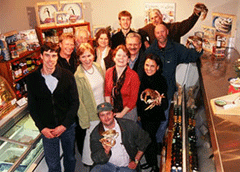
Simon Fraser University student Sean Peters saw first-hand the difference a small loan can make while making a documentary on microcredit in Mexico last summer.
He remembers a woman able to start her own tortilla business thanks to a micro loan, who was pleased to be her own boss, making her own money.
The notion that a little bit can go a long way is proving to be a powerful catalyst in the growth of microcredit around the world.
Peters' trip to Mexico was part of a fundraising endeavor that saw he and others bicycle some 3,000 kilometres south of the border for Agents of Change, a non-profit organization that engages youth to find solutions for global poverty.
Last week the group organized a competition among 13 teams of SFU and UBC students. The groups were given $100 to raise as much money as possible in one week. The winning team raffled off Canucks tickets and ran coat checks at other campus events to come up with $1,700.
All of the project's proceeds, $8,000 in total, are being donated to Kiva.org, a website that acts as a platform for connecting mostly North American lenders with microfinance institutions in the developing world. Lenders get to see who is receiving their money and what he or she is doing with it.
How micro the money?
The definition of what constitutes a micro loan varies depending on the individual person and the country's economy. Usually, it's between $20 to $200.
Microloans are based on character, not collateral, and the principal is to allow people, often women, with few assets or a poor credit history to access small loans for self-employment projects.
It's not a new concept; in 1967 Mohammed Yunis founded the Grameen Bank to provide micro loans to poor women in rural Bangladesh.
Though the Grameen bank wasn't the first institution to provide micro loans, it has since provided millions of loans to women across Bangladesh. Its growth and success earned Yunis the Nobel Peace Prize last year, in the shadow of the UN's first International Year of Microcredit 2005.
Ian Gill, president of Ecotrust Canada, a conservation organization that loans money to projects with an environmental bottom line, says microcredit is about socially responsible investment.
"The basic idea of microcredit is fantastic," he says. "What makes it work is that it's community based. Some people call it relationship-based lending, whites-of-your-eyes lending. It's not done by an anonymous form."
In 2005, for example, Ecotrust and other investors provided a loan to Tofino residents to purchase and upgrade Trilogy Fish Company, a small seafood processing plant supplied by local fishermen.
Kiva's Internet innovation
The power of the Internet has played a huge role in making people around the world aware of microcredit. Kiva.org has generated so much interest after just two years online that loans have now been capped at $25 per person. In other words, there are more people willing to give loans than there are people lined up to take them.
"It's important to maintain the balance between amount of money requested and amount of money funded," says Fiona Ramsey, Kiva's public relations director.
"All of the funds' placement is pre-approved. You choose where your money's going to go, and on the other side of the world, somebody's actually waiting for that money."
Ramsey says most people who lend through the site see it as a donation and 97 per cent of lenders re-invest their money in another project when they get it back (there is a 99.75 per cent repayment rate, according to the website).
The site has been run solely on operating on grants, donations and interest from loan float, but next year Kiva will begin charging a two per cent interest on loans to the micro finance institutions that it works with.
Limits to loans
Ramsey says Kiva staff members do research on the ground, and collect data and references to ensure those institutions are in fact operating legitimately, and in places where the loans can be effective.
"You do not want to work in areas where it's not going to be successful," says Ramsey. "In poor political situations, or war or famine, money's not going to help."
This is one of the criticisms of microcredit; it doesn't help some of the poorest of the poor who have no land, resources or personal security to establish any kind of business.
Some critics also are concerned that small loans will be made to seem a substitute for other important financial and basic services like property rights, infrastructure and education.
The lack of these basics is one of the biggest differences between microcredit in Canada and developing countries.
Micro loans to Canadians
Although microcredit is something that has always been practiced by credit unions in Canada, there haven't been defined microfinance institutions in this country, explains Catherine Ludgate, manager of community business programs with Vancity credit union.
Vancity provides micro loans and also has a peer lending program, in which six or seven people form a group and are loaned $1000 each for their business ventures. The point of the peer group is to provide a support system for borrowers, says Ludgate.
"It provides immediate, direct support of a network," she says. "It's a way for those individuals to support each other in a way that we just can't."
Ludgate says although the individuals aren't legally responsible for one another's loan payments, there is an element of moral suasion that works.
"The default rate is about four to five per cent. A 95 per cent return on investment is a huge success to us."
'If you can connect with someone'
Peters himself says though he's seen the success of microcredit on a small scale, he doesn't necessarily see it as the best solution for alleviating global poverty.
He says he questions his own efforts to try and work within a capitalist system with so many obstacles for a poor person trying to make headway. Others have criticized micro loans as a way to shift the burden of providing a social safety net from governments to individuals.
"It's not the solution to global poverty but a tool in helping solve it," says Peters. "Criticism aside, I thought results outweighed potential pitfalls. For me, a self-righteous holding out for the structure is just that, self-righteous. If you can connect with someone I think that's a good thing."
Related Tyee stories:
- The Student Loan Crush
How it got so heavy, and how to lighten it. - Incoming! KaosPilots!
Dane MBAs reinvent biz school in poorest Vancouver. - Let's Harness ICBC's Great Success
Rebates? Small thinking. How better to invest all that profit?
![[Tyee]](/design-article.thetyee.ca/ui/img/yellowblob.png)


Tyee Commenting Guidelines
Comments that violate guidelines risk being deleted, and violations may result in a temporary or permanent user ban. Maintain the spirit of good conversation to stay in the discussion.
*Please note The Tyee is not a forum for spreading misinformation about COVID-19, denying its existence or minimizing its risk to public health.
Do:
Do not: