News

Fraser Health Authority Said No to Private Approach

Chair, since resigned, was overruled in decision to reject P3 model for facility.

By Tom Sandborn, 1 Feb 2007, TheTyee.ca

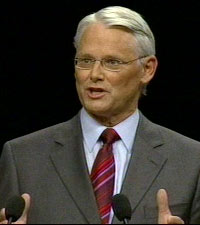
Gordon Campbell

Premier Campbell: Scuttled recommendation

Top officials at the Fraser Health Authority opposed the provincial government's preferred P3 form of privatization in health care this summer, only to have Premier Campbell overrule their recommendations, recently released documents show.

The chair of the Fraser Health Authority at the time, Keith Purchase, made headlines last week by resigning his post, a move said to be caused by his frustration at being "out of the loop" in the budget process.

The revelation that the Fraser Health Authority also was at odds with the premier's office over how to finance facilities may shed further light on Purchase's frustration.

Excerpts from minutes of the health authority's facilities committee meetings in February and June of 2006, obtained through a freedom of information request by the B.C. Health Coalition and released to the public Jan. 31, 2007, show that Purchase was directed to meet with deputy health minister Penny Ballem and deputy finance minister Tamara Vrooman to convey the view of the Authority's top officials that "P3s are not the first choice of the committee."

The opposition to P3 structure was expressed in the context of a discussion of the planned new Surrey Ambulatory Care Facility.

Premier Campbell told delegates at a Union of B.C. Municipalities convention last October that all provincially funded capital projects over $20 million must be considered as P3 projects.

"We know P3s save money, transfer risk and add great value through design innovations and private sector ingenuity," the premier told the convention.

P3s highly controversial

The controversial P3 "public-private partnership" model involves private for-profit firms taking a role in building and sometimes operating what would otherwise be government funded and controlled services ranging from highways to hospitals.

Fans of P3s argue that the "partnership" structure reduces cost to the taxpayer and imposes the discipline of the private sector into otherwise bloated public works projects. Critics say, in contrast, that the drive to maximize profit can corrupt safety and efficiency in public service delivery and drive up costs beyond those generated by government projects. The government's recently launched Conversation on Health Care is widely expected to hear many calls for more use of private sector money on public projects like the Surrey Ambulatory Care Facility.

Both Ballem and Purchase have since resigned from their positions, Ballem in June and Purchase last week. Ballem cited her disagreement with the direction B.C. was taking in health care as reason for her resignation, and Purchase's unexpected resignation last Friday was widely reported to be in response to the government's decision to fire Vancouver Coastal Health Care Authority chair Trevor Johnstone, a longtime friend and business colleague.

In another excerpt from committee minutes dated Feb. 13, 2006, the point is made that "...if we undertake the traditional partnerships strategy (P3) there is a lesser ability to control design, longer lead times and additional risk."

"We're pleased that the FHA is following the evidence and their own experience with the new Abbotsford P3 hospital and concluding that P3s are not a good option for health care," said Joyce Jones, co-chair of the B.C. Health Coalition.

Health Minister's response

B.C. Health Minister George Abbott told The Tyee the June meeting notes are out of date. "This information was taken from minutes of meetings early in the planning process. There have been many meetings and discussions since then." Abbott said the government is finishing a "full and detailed analysis of various models for the project" and will have an announcement soon about how the ambulatory care facility will be financed and constructed.

Colleen Fuller, an independent researcher and published author on issues of health care and pharmaceutical policy matters, told The Tyee in a telephone interview: "This government is creating chaos in the health system, with firings, resignations and its refusal to learn from the body of research, here in B.C. and internationally, that shows that P3s are the wrong way to go on health care."

Today's revelations come at a time when some observers say the administrative structures controlling B.C. health delivery are in serious disarray. Vaughn Palmer reported in a column in the Vancouver Sun Jan. 31, for example, that Purchase had explained his sudden resignation from the Fraser Health Authority in an e-mail to senior colleagues that said he was leaving in part because of Johnstone's firing, but also because of government demands that he follow "a budget process which compelled me to keep my board colleagues out of the loop."

Purchase went on to say "I feel that decisions beyond our control are about to take Fraser Health rapidly backwards and this has become an affront to my personal integrity."

Related Tyee stories:

 [Tyee]

31  Comments:

Login or register to post comments

  • Grumpy

    5 years ago

    P-3 Scandals

    In BC, P-3 means a political payoff to cronies, as the taxpayer pays more in the long term!

    P-3's, as practiced in BC, would be illegal elsewhere.

  • Fiat lux

    5 years ago

    One of these days the public

    One of these days the public may just realize that PPPs are fraud, because they do not reduce, but increase costs to the taxpayer. The public still has to pay, no matter who the directors, or owners are, but under PPPs, the public's rights for responsibility and accountability are lost.

    Worldwide precedents, and examples, show that PPPs are nothing more than Plundering the Public Purse. The facilities are of poor quality, the services minimal, to the point of criminal negligence, at much higher costs on the long run.

    In other words, Campbell's actions are based on Fraser Institute orders. What we now have is "Government by advertising agency"

    Ed Deak.

  • Cynic

    5 years ago

    I suspect P3s are a great

    I suspect P3s are a great way to launder drug money. Under the ndp the government introduced "alternative capital procurement guidelines" where the government accepts anonymous money from anonymous sources for its bonds. Given that some $700 billion in drug money needs to be laundered every year it's not a stretch to imagine some will get done this way in big government projects. Why else the secrecy?

    And the "conversation" is bogus. The Romanow Report tells us what is needed, too bad it doesn't fit in with the elite's agenda.

  • maestro

    5 years ago

    Laundered Loonie$$$

    Putting together Grumpy's Public Transit concerns...and others' comments of Casinos as prime Loonie $$$ Launderettes... and Cynic's comments,...the logic suggests that P - 3 's will be built near Public Transit on the way to the Casinos.

    PS the OLYMPICS are the ultimate P - 3,... are they not? if one sits and thinks about it ....if one has not already had that epiphany.

  • SharingIsGood

    5 years ago

    What private healthcare can bring for us

    The following MSN (moneycentral) quote is attributed as coming from a Emily Brandon U.S. News & World Report article: 5 ways to ease retirement worries on Feb. 1, 2007 at 10:00 AM(PT)

    Quote:
    Concerns about financial well-being in retirement keep many Americans awake at night.

    About 43% of employees at small and midsize businesses, as well as 26% of retirees, are so anxious about being able to afford medical care in retirement that they sometimes can't sleep, according to the Principal Financial Well-Being Index compiled in August 2006.

    link:
    http://articles.moneycentral.msn.com/RetirementandWills/CreateaPlan/5WaysToEaseRetirementWorries.aspx

  • DJT

    5 years ago

    Ed say's "One of these days

    Ed say's "One of these days the public may just realize that PPPs are fraud, because they do not reduce, but increase costs to the taxpayer".

    You are 100% correct, Ed. Unfortunately, CanWest is toeing Campbell's (or Asper's) line on the issue and all we hear from the Sun/ Province is how great P3's are. I have never yet read anything but propaganda , all one sided. Unfortunately, most of "the public" actually believe what they read in these papers, are not too bright and/ or do not look for other sources of information. Despite this, maybe one of these days the public "may just realize that PPPs are a fraud". Sadly, "one of these days" may be too late.

  • maestro

    5 years ago

    P-3's

    In my view, P-3's are nothing more than an effort by Gov't to bamboozle the Public that any given project will be built cheaper under this P3 format than simply put the project out to tender and make sole use of Public funds. The P -3 makes the project appear more fiscally viable and politically palatable in straw man meets fiscal relativity arguments.

    My understanding of the Local Gov't Act is that Capital Projects that require ANY borrowing by the Local Gov't must go to referendum for Voter approval .

    However, one wonders if the P - 3 process bypasses this normal referendum approval process.

    In addition, how many successful P - 3 ventures are there, that would certainly add more to the objective debate. I feel that all P - 3 's every really do is benefit the Private Sector in the Public Private Partnership..the Tax Payer plays the Bank...Gov't = US can't go broke...and our elected officials simply make us guarantor/cash -cows when things go wrong.

    The Private Company can fold...no security on that side of the equation...but the Gov't cannot fold...so who wins versus who ultimately loses ?

    We generally hire Private Companies if its going to be a Public Project either way , so why the P-3 ?

    To me it is either FIXED cost(non P -3) ....or Blank Cheque(P-3).

  • Grumpy

    5 years ago

    P - 3

    I'm not against a true P-3, where the private sector shares risk and profit, such as the Nottingham or Dublin LRT schemes, which currently are making a profit for the consortium made up of the operating authority; contractor and the banks.

    Not so in BC, where the banks and contractor share little risk and the taxpayer assumes all financial risk! RAV is a perfect example, SNC/Lavalin's risk is on paper only as they are using BC public sector pension plan money!

  • maestro

    5 years ago

    Unless mistaken....

    Unless mistaken ... even if they use the B.C. Public Sector pension plan as the main, or only $$$ source of funding for SkyTrain/RAV...WHO ultimately pays IF the Public Sector Pension Plan goes belly up , or cannot meet its fiscal obligations ?

    Answer:

    Unlike Private Pension Plans ,...who are far less guaranteed...it ultimately is
    Me..thou and thee...ALL of us...correct ?

  • Stuart Murray

    5 years ago

    P3s Are Ideology Over Evidence

    A decision by the Province to impose a P3 for the new Surrey Hospital against the wishes of Fraser Health Authority would be yet another example of ideology over evidence. The Province also imposed a P3 for the Abbotsford Hospital and made funding for the Canada Line conditional on the project being a P3.

    One of the main rationales for advancing P3s is that they save the government money. However, all P3s are more expensive in cash terms because private providers must pay a higher rate of interest on their debt than government would normally pay. The cost of the Abbotsford Hospital increased by over 90 percent during the planning and tendering process, and much of this cost increase is attributable to the decision to go P3.

    Governments use “Value for Money” reports that rely on questionable methods to show that P3s supposedly achieve better value than traditional procurement. Yet these “Value for Money” reports are produced at the wrong time (after the contract has been signed), by the wrong people (Partnerships BC, openly biased towards P3s), and with limited transparency.

    The evidence continues to mount that P3s are not a good option. It is time for the government to listen to the evidence, listen to its own advisors, and abandon its ideological insistence on P3s.

    Stuart Murray
    Researcher
    Canadian Centre for Policy Alternatives - BC Office

  • Lefty

    5 years ago

    P3 Fiasco

    Over in England they P3'd the hospitals, under the Maggie/Major regime. The practice has now been exposed for what it is, a waste of resources. They have very big problems now.

  • DPL

    5 years ago

    My Gosh,when even Gordo

    My Gosh,when even Gordo friendly Whistler says no thanks to PPP's, he keeps setting up these deals. And people actually vote for guys who do such shify deals. The mind boggles, and we keep getting to carry the costs.

  • Stuart Murray

    5 years ago

    Ideology Over Evidence

    A decision by the Province to impose a P3 for the new Surrey Hospital against the wishes of Fraser Health Authority would be yet another example of ideology over evidence. The Province also imposed a P3 for the Abbotsford Hospital and made funding for the Canada Line conditional on the project being a P3.

    One of the main rationales for advancing P3s is that they save the government money. However, all P3s are more expensive in cash terms because private providers must pay a higher rate of interest on their debt than government would normally pay. The cost of the Abbotsford Hospital increased by over 90 percent during the planning and tendering process, and much of this cost increase is attributable to the decision to go P3.

    Governments use “Value for Money” reports that rely on questionable methods to show that P3s supposedly achieve better value than traditional procurement. Yet these “Value for Money” reports are produced at the wrong time (after the contract has been signed), by the wrong people (Partnerships BC, openly biased towards P3s), and with limited transparency.

    The evidence continues to mount that P3s are not a good option. It is time for the government to listen to the evidence, listen to its own advisors, and abandon its ideological insistence on P3s.

    Stuart Murray
    Researcher
    Canadian Centre for Policy Alternatives - BC Office

  • Isabella2

    5 years ago

    P3s and the Fraser Health Authority

    Never mind, Folks, our "open and transparent" New Era Premier, is busy digging himself a big hole. The higher he piles the evidence for us, the harder he'll fall. When kids keep raiding the candy jar, one candy at a time, they think they're getting away with it, until one day the jar is empty, and the game is up. Our job is to keep track of the candies, and to make sure as many people as possible get to know about about each and every candy.

    Thanks, Tom Sandborn, for telling us about this one. Did anyone read about it in the Sun or Province? Did I miss it?

  • DJT

    5 years ago

    Who ultimately pays?

    All of us...Correct? Correctamundo, Maestro.

    As far as risk goes, Gord keeps pontificating that P3's "transfer" risk to the private sector. The private sector does not "assume" risk for the good of their health. Factored into these contracts is a hefty premium for assuming that risk. Also, these contracts are complicated and take a long time to negotiate. The cost of a project can increase significantly between the time a project is first conceived and when the contract is "sewn up", due to inflation, increased labor/ material costs, etc. in the interim.

    Private business folks are not in business to lose money, period. If this were going to be the case, they may simply "fold", as Maestro said above, or just stop work until the government (read us) kicks in more $$$. After all, Gord wouldn't want a delay in RAV line completion just prior to the Olympics, would he? (OH, sorry- I forgot the RAV line wasn't about the Olympics).

    Another drawback to P4's is that,sadly, we will never know what's happening with our money as these contracts are exempt, I believe, from the Freedom of Information Act. They don't call it the "private" sector for nothing.

    And that fourth P? Profit.

  • Booker

    5 years ago

    Global

    Global television has been blitzing us with the "health-care crisis" again, and you just know what they think the solution is. Thanks again to Tom and The Tyee for the great coverage they've given us on this issue. The Campbell government is trying to get the public to throw in the towel on our health care system, and most of the private news outlets are helping to spread the propaganda. Thank goodness there are alternatives to commercial radio and tv.

  • mjf

    5 years ago

    Transfer of wealth

    It would be interesting to make an inventory of the various actions of the present government that resulted or will result in a transfer of wealth or resources that belong or used to belong or should belong to the citizens of B.C., to the private sector either outright or through long term contracts.
    BC Rail?
    BC Gas?
    Parts of BC Hydro?
    P3s?
    Others?
    We are witnessing the privatization of the common wealth of the province. Actually there is another word for it.

  • no1important

    5 years ago

    Campbell cruelty

    My mother has been in the hospital 3 times in the last 6 weeks at Surrey Memorial and the Ambulance people are great, it is just when you get to the hospital, wait wait and wait and it took her 2 days the first time, 3 nights the second time and almost 3 days this last time before they could get her a bed and move her out of emergency.

    She is not alone either.

    I thought al the savings from contracting out support staff was suppose to go backinto health care? I thought Harper was going to improve things?

    It just goes to show how right wing politicians do not care as they can afford to go elsewhere or end up in the front of the line. I can't see Campbell or Harper waiting 3 days in the er to get a bed when they are very ill.

    Public/Private partnerships should not be allowed, especially in the Health sector as it is one step closer to private for profit care. Private companies do not get involved unless they are going to make money and a fair amount of it. Money before people is how they operate.

  • North of Hope

    5 years ago

    I believe this debacle will

    I believe this debacle will finally show the citizens of BC how incompetent Gordo and the BC Liberals are. They do not know how to run the health care system. They say they have increased spending but they still encounter all these problems. Where has the money gone. It appears to go to the administration and bureaucracy and not to treat patients. This is similar to the education ministry where the "increase" in spending has gone to administration and bureaucracy, not to the classroom to help students. When you political appointees, your "yes men" disagree with you, you are scrapping the bottom and this is what is happening to Gordo.
    When it is revealed that there is a shortfall in a health authority, one minister says the gov't will cover it. The next day, they health authority is told that is incorrect. It would be nice if the cabinet was on the same page with their lies. Vaughn Palmer wrote an interesting column about the secrecy involved in setting up the budgets for the health authorities. Even the directors of the health authorities were not privy to the discussion of their budgets. That is part of the reason as to the resignations.
    This column is great, but put it together with the other columns written in the past several days and we see we have a major disconnect between the BC Liberals and our public health system. The question is, "Is Gordo trying to destroy it so a private system will be needed?"
    David Schreck has written several articles about Carole Taylor and her doomsday announcements about our public heath system. They are at
    http://www.strategicthoughts.com/
    Last Friday, Jan. 24, Carole Taylor was interviewed on CBC Radio on BC Almanac. She was on after the 1 PM news. After the interview, the phone lines were opened up for the public. She was, as usual, very smooth. That is until one caller laid into her. This caller's surgery was cancelled due to cut backs and the caller lit into the beloved Ms. Taylor. The caller did not pull any punches and although Taylor tried to smooth things over, she was shaken. I tried to access the show but I was unable to do it. I think it is my old computer. However I believe it can be accessed if you go to the CNBC website. I believe to download the show you need RealPlayer. If you can, check it out and you will hear why the BC Liberals do not like to appear in public. I don't Expect Ms. Taylor to be on any more call-in shows.
    By the way, I like to call P3's, P4's for "Public Pays, Privates Profit." However I like Ed's P3, "Plundering the Public Purse."

  • Alcibiades

    5 years ago

    I heard that interview too

    You're absolutely right North of Hope, Ms Taylor was shaken down to her Gucci’s.

    She never really did recover I thought. Although she did manage, toward the end of the piece, to spin out what the Government is obviously leaning toward. A system where various health care providers 'compete' for the health care dollar in the guise of each unsuspecting patient. The president elect of the Canadian Medical Association (Dr Brian Day) was on the show yesterday and he was spouting exactly the same stupid mantra.

    That's what these characters have in store for us and it's a foregone conclusion that it will be the result of the 'conversation on health care.'

  • Spelling And Gr...

    5 years ago

    Test

    Test

  • DJT

    5 years ago

    North of Hope: I, and many

    North of Hope: I, and many I know are of the opinion that the government is indeed underfunding public health care in part to justify privatization. Regardless of whether or not it is true, the fact is that underfunding is causing people like "no!important"'s mother to suffer. It almost makes one wonder if some decision makers in the government are not therefore vicariously guilty of criminal negligence(?)

    I won't get into what I think about folks dying due to failure to fund the system adequately (and cutbacks to boot!!).

  • G West

    5 years ago

    Part of the problem

    Canada fails to measure up
    Provinces and Ottawa have not provided data essential to knowing whether care is getting better, safer and more timely
    February 01, 2007
    Jeanne Besner

    Four years after the First Ministers' Accord on Health Care Renewal, and after spending billions of dollars on this historic undertaking, what has been achieved? Are Canadians receiving better, safer, and more timely care? Are they benefiting from enhanced health-promotion and disease-prevention strategies?

    Are health disparities being erased? Is the system more streamlined and responsive to the people it serves?

    As interim chair of the Health Council of Canada, I'd like nothing better than to give you definitive answers to these important questions.

    After all, the council was established under the 2003 accord for the purposes of monitoring and reporting annually to the public on the progress of health-care renewal.

    Under the 10-Year Plan to Strengthen Health Care, the council was handed additional responsibilities to report on the health status and health outcomes of Canadians. The first ministers recognized that this enhanced accountability was "essential to reassuring Canadians that reforms are occurring."

    But to date, the best the council has been able to do is provide a general sense of direction regarding the performance of federal, provincial and territorial governments in meeting their accord commitments.

    Unfortunately, the jurisdictions simply do not have, or have not provided, the data needed to properly evaluate system-wide progress.

    For example, in our third annual report to Canadians released today, Health Care Renewal in Canada: Measuring Up?, we conclude that jurisdictions are progressing well on some initiatives, moving more slowly in other areas, and stalled on still other fronts.

    We find that there have been some solid gains in reducing wait times, increasing medical and nursing school enrolments, and implementing healthy living strategies. We note that jurisdictions continue to lag in the development and expansion of interprofessional teams and the adoption of the electronic health record in primary health-care settings.

    And we point to other initiatives that seem to be at a standstill, such as those contemplated in the 2005 Blueprint on Aboriginal Health and the Kelowna Accord, coverage for catastrophic drug costs, and the Integrated Strategy on Healthy Living and Chronic Disease.

    Beyond these broad observations, however, there is little more we can determine.

    Governments are not collecting and disseminating the data that would allow us to report in a more meaningful way. The information made available is often inconsistent, incomplete and cannot be compared across jurisdictions.

    It's not that there hasn't been a significant amount of work. The jurisdictions have implemented renewal programs and projects, and in the flurry of activity, measurement seems to have become a secondary consideration.

    Even where data collection occurs, jurisdictions measure results in different ways.

    So when Canadians ask what they have to show for those billions of dollars, how they are benefiting in terms of better health, and whether they are getting the best return on their investment, there is no clear accounting.

    The public is unable to determine if government efforts are measuring up.

    And that's just not good enough, not when the sustainability of the health-care system is at stake. According to a council-commissioned synthesis of public opinion polling from 2002 to 2006, Canadians clearly want to know what success their governments are having, how money is being spent, and whether investments are resulting in a healthier population.

    An overview by McGill University Professor Stuart Soroka, called Canadian Perceptions of the Health-Care System, found that people attach a high value to accountability.

    Without a more detailed and transparent reporting of these renewal efforts, governments will find it increasingly difficult to demonstrate that they are meeting their commitments.

    Accountability will be undermined and, with it, public confidence in medicare.

    In the absence of good data, health-care renewal will continue to be driven more by trial and error and less by informed decision-making.

    So you may understand our dismay when we discovered that the provinces and territories were not going to report to their residents this year on comparable health indicators, as they had agreed to do in the 2003 accord, and that the cross-jurisdictional committee that oversees this work has been disbanded.

    These developments are worrisome, suggesting that the promise and potential of greater accountability may be slipping.

    The council has, on a number of occasions in the past, called attention to the need for improved information. In our most recent report, we make this our central message.

    It is time now for governments to come together, to agree on what data to collect and how to report it, so that we have a clear picture of health-care renewal across the country

    We are urging the jurisdictions to make this a priority. Efforts should focus on identifying key population health outcomes for regular reporting; agreeing to comparable indicators; developing targets and monitoring progress; and creating one annual comparative report with national, provincial and territorial information presented in a consistent manner.

    There will be a cost to the development and implementation of this reporting system, but the investment will pay for itself many times over.

    We will know what's working, and what isn't, and we will able to share this information. We will be able to invest more efficiently and avoid costly mistakes.

    And instead of a question mark on the cover of its annual report, the Health Council will be able to provide answers, based on solid evidence – the kind of answers Canadians have every right to expect.

    Jeanne Besner is interim chair of the Health Council of Canada.

    from today's Toronto Star

  • IAMC

    5 years ago

    P3's

    Is it lot logical that 'private public partnerships' should be the way to achieve our goals of making life better for all of us?
    Is the alternative having the Government as a project manager, running the job?
    I don't think so!
    I only give the Govt. credit for setting policy and collecting taxes.
    They shouldn't be one of the P's.

  • G West

    5 years ago

    No it's not RON

    In the provision of public services, particularly ones concerned with universal goods like health, the idea of profit motivation should be anathema.

    I'll post you a little something from Ontario as regards the mess the Harris government made of Ontario Hydro. You might want to read it and remember that Gordon Campbell is doing the same disastrous dance with BC Hydro right now. Don't say I didn't warn you.

    Quote:
    Put Ontario Hydro together again
    Nothing has been gained from chopping it up into seven different agencies
    January 31, 2007
    Ian Urquhart

    In the ongoing debate over the province's electricity supply, maybe it is time to start thinking the unthinkable: bring back the old Ontario Hydro.

    Ontario Hydro was broken up into various bits and pieces in 1998 by the Conservative government of the day under Mike Harris. At the time, nobody rushed to the barricades to defend the Crown corporation, which had done battle with governments of all stripes and was widely seen as an out-of-control behemoth.

    But at least it kept Ontario's lights on.

    Back in 1998, the Harrisite neo-conservatives believed the marketplace would do that – and do it more cheaply and efficiently than the old Ontario Hydro. For the neo-cons, breaking up Ontario Hydro was merely a preface to privatization and deregulation of electricity in the province.

    But when Ernie Eves replaced Harris in the premier's office, he scrapped both the privatization and deregulation plans.

    And today, no political party in the Legislature favours either privatization or deregulation (although both moves are still supported by neo-con cranks, some of whom, interestingly, are employed by government agencies).

    What have we got instead? Some would say the worst of both worlds.

    Energy Minister Dwight Duncan never tires of telling audiences that the electricity system the Liberals inherited from the Conservatives was "a complete mess." But the Liberal solution to the problem has been to add on more bureaucracy.

    To do the work that Ontario Hydro once did all by itself, we now have under the government umbrella:

    # Ontario Power Generation. It produces most of the province's power.

    # Hydro One. It operates the transmission lines that distribute the power to industries and municipalities across the province.

    # Ontario Power Authority. It plans for new electricity supply and contracts with generating companies to provide it.

    # Conservation Bureau. Part of the power authority but quasi-independent, the bureau promotes and initiates demand management programs.

    # Independent Electricity System Operator. It oversees the reliability of the system and ensures enough power is available to meet demand, through importation if necessary.

    # Ontario Electricity Financial Corp. It manages the "stranded debt" from the old Ontario Hydro.

    # Ontario Energy Board. Previously toothless, it has been given expanded power to regulate electricity rates and approve expansion plans.

    Together, these agencies are costing hundreds of millions more than Ontario Hydro alone used to spend.

    And a sort of bureaucratic paralysis has set in. Yes, some 3,000 megawatts of new power have been introduced since the Liberals took office in 2003, but most of that comes from the refurbishing of mothballed reactors at existing nuclear plants.

    Meanwhile, an ambitious expansion plan is in a sort of limbo.

    The plan – including the construction of new nuclear plants – was published by the Ontario Power Authority back in December 2005.

    The government studied that plan for six months before ordering changes, including less reliance on nuclear power and more on conservation.

    The power authority has since been consulting various experts and interests and reworking its plan before taking it to the Ontario Energy Board for hearings. Those hearings aren't expected to begin until the spring and could take up to a year to conclude.

    In the old days, Ontario Hydro would have just done it.

    The government is clearly becoming impatient with the bureaucratic delays. That was evident earlier this week as Duncan set up a review panel, headed by former Molson Inc. CEO James Arnett.

    Media coverage of the panel focused on its mandate to review the pay of senior executives at the various and sundry agencies. While politically sexy, that is a relatively trivial matter.

    A potentially more significant part of the panel's mandate is a review of the multiplicity of agencies in the electricity field.

    "We have asked the panel to search for any areas of overlap, (and) duplication among these agencies that could be streamlined to save costs for ratepayers," said Duncan in announcing the review.

    He was not, however, prepared to go as far as rethinking the break-up of the old Ontario Hydro. "That's not even on the table here," said Duncan, adding that it would be "very debilitating and time-consuming" to try to put Ontario Hydro back together again.

    Nor are the other parties any more inclined to consider this option.

    "From what I've heard so far, I don't know that that's the appropriate route to follow," said Conservative Leader John Tory in an interview.

    "I don't think that's the issue that confronts and concerns the working people of Ontario," echoed NDP Leader Howard Hampton.

    Pity, because scrapping the alphabet soup of agencies we have now and putting Ontario Hydro back together again would be a worthy issue for debate in the coming provincial election campaign.

  • SharingIsGood

    5 years ago

    beyond hope

    North of Hope,

    I hope your mother is doing better. But as far as medical service and the direction of this government, I think we have to say that we are all beyond Hope, no matter where we live.

  • DPL

    5 years ago

    A good play on words

    A good play on words Sharingisgood. I have some ides on solving our medical problem. Vote to toss Gordo and crew out. It's not that difficult to take someone with you when you show up at the polling booth. People are hurting, the staff are mostly frazzled from over work. But I notice with some interest one GP writing in the local rag yesterday about doing his office stuff, then covering a few shifts at two different clinics. One wonders just how many office hours does he cover in his own practice? A walk in clinic can do little stuff, so the walk in folks get pushed through pretty quickly. A fast buck for the medical practitioner.

    I do note that the last MDs our family had did not have hospital priviages. Took one and a half hours for lunch. Started at 9 finished at 4 and that was Monday to Thursday. Never wrote a prescription that was for more than 30 days, and charged 40 bucks if renewal of a prescription over the phone. We dropped them pretty quickly. Our new ones works in a group of six. Always one on call, hospital priveleges of course. Renew prescriptions over the phone direct to the drug store. Cost zero. as they say, why waste your time and ours showing up to renew a prescription you will be on for a couple of years.

  • Isabella2

    5 years ago

    Health Budget

    I did not hear the CBC interview with Carole Taylor, although I don't have much problem guessing at her approach. The trick would be to get her to answer a couple of biting questions: Ms. Taylor, could you tell us, please: As a percentage of the provincial budget, what was the per capita expenditure on health care in 1989, in 2000 and in 2006? If she will not answer that question, and my guess is she will not, the next question should be: Relative to the GDP, what was the BC government healthcare expenditure in 1989, in 2000 and in 2006? Of course, she won't answer that either. Reason? Because by these parameters, a truthful answer would likely reveal that the health budget today either is lower, or no more than it was in 1989 at the end of the Social Credit regime, or in 2000 at the end of the NDP regime.
    I'd be interested and grateful if someone out there could verify this - or refute it.

  • Bailey

    5 years ago

    Dear IAMC,

    I've heard you make this argument before, that government are the wrong people to govern. I find it odd, and I have questions.

    If the government is incompetent to manage the public works that are paid for by taxpayers money, complete with auditing, diligent oversight and insuring performance from whoever is hired to provide work, they should resign.

    That's the job. They ran for it. If they couldn't damn well do it what the hell were they thinking to take it on?

    Alternatively, if they're too corrupt to be trusted with the job, which I must say is the only other explanation for your argument that I can think of, then they should be arrested. Tried. Convicted.(I know, I know, lots of them already have been convicted, The premier and his in law Doug Walls not the least)

    Then jailed. Political corruption is quite worthy of jail time, I think.

  • lynn

    5 years ago

    Hear hear, Bailey!

    Hear hear, Bailey!

    This is just part of a piece from a book written in 1955 by Milton Mayer, "They Thought They Were Free: Germany from 1933-1945" (Chicago Press).

    It is scarily familiar.

    "What happened here was the gradual habituation of the people, little by little, to being governed by surprise; to receiving decisions deliberated in secret; to believing that the situation was so complicated that the government had to act on information which the people could not understand, or so dangerous that, even if he people could understand it, it could not be released because of national security. And their sense of identification with Hitler, their trust in him, made it easier to widen this gap and reassured those who would otherwise have worried about it.

    "This separation of government from people, this widening of the gap, took place so gradually and so insensibly, each step disguised (perhaps not even intentionally) as a temporary emergency measure or associated with true patriotic allegiance or with real social purposes. And all the crises and reforms (real reforms, too) so occupied the people that they did not see the slow motion underneath, of the whole process of government growing remoter and remoter.

    .... the things in which one had to, was "expected to" participate that had not been there or had not been important before. It was all rigmarole, of course, but it consumed all one's energies, coming on top of the work one really wanted to do. You can see how easy it was, then, not to think about fundamental things. One had no time."

    "Those," I said, "are the words of my friend the baker. "One had no time to think. There was so much going on." "Your friend the baker was right," said my colleague. "The dictatorship, and the whole process of its coming into being, was above all diverting. It provided an excuse not to think for people who did not want to think anyway.

    ... Nazism gave us some dreadful, fundamental things to think about - we were decent people - and kept us so busy with continuous changes and "crises" and so fascinated, yes, fascinated, by the machinations of the "national enemies", without and within, that we had no time to think about these dreadful things that were growing, little by little, all around us. Unconsciously, I suppose, we were grateful. Who wants to think?

    "To live in this process is absolutely not to be able to notice it - please try to believe me - unless one has a much greater degree of political awareness, acuity, than most of us had ever had occasion to develop. Each step was so small, so inconsequential, so well explained or, on occasion, "regretted," that, unless one were detached from the whole process from the beginning, unless one understood what the whole thing was in principle, what all these "little measures" that no "patriotic German" could resent must some day lead to, one no more saw it developing from day to day than a farmer in his field sees the corn growing. One day it is over his head."

  • Tsolum

    5 years ago

    health care

    This push towards p3s and what only can be described as cuts to health care, has more to do with deep intergration with the USA than anything else. For deep intergration with the USA we need to loose our social safety net as we know it in this country and the Neo-Cons know this and that includes Campbell.

    • No best comments selected by an editor for this story yet. To see all comments, click the All Comments tab, above.
    • The discussion for this story is closed. No more comments can be added.