

 SHARE:
[Editor's note: This week we are reprinting the top five wildest Tyee stories of the year. This June 14 report caught the eye of producers at Jon Stewart’s Daily Show who couldn’t believe B.C. allows people to go on the Internet and pay 17 cents an acre to buy minerals beneath other people’s property, then dig whether the person living there likes it or not. Mining Minister Bill Bennett reportedly stonewalled the Daily Show on an interview.]
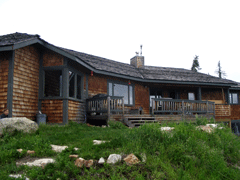
Bruce Essington lives in a tarp-covered bread truck on the side of Bluenose Mountain. Essington has been squatting on the same patch of land, not far from Vernon, for longer than any of his neighbours can remember. Sometimes he'd roam about toting a rifle and wearing night vision goggles. Recently he has begun to pay off his land in instalments.
And now Essington, who owns one faded set of clothes and an old leather miner's hat peppered with holes, has bought rights to about 150 acres of his neighbours' land. For $50.
He was able to do that because last year the province created an online staking system that allows anyone with Internet access and $25 to acquire a miner's license and then, at $0.17 an acre, buy mineral rights to land. It doesn't matter whether that land belongs to a neighbour, the Crown, or the "miner" himself. Once you own the mineral rights, you are free to "explore" your claims, wander the property, "poke at a few rocks," in the words of MP Tom Christensen. And once you decide to start drilling and digging, even the landowner's dwelling and buildings are at risk. That's the law under the Mineral Tenure Act as of 2002, when the section prohibiting miners from "obstruction or interference" with activities (or buildings) on private land was repealed.
Essington may have the law on his side for now, but his claim has helped spark a grassroots uprising by infuriated landowners on Bluenose Mountain and beyond. They call themselves the B.C. Landowners Rights Group (BCLOR) and say they are determined to fight the government until the balance of power swings back to those who live their lives on land they own, instead of anyone who comes along and wants to grab the minerals resting underground.
Free to traipse
Since Essington bought the mineral rights to his neighbours' property six months ago, he has spent a great deal of time exploring his new claims, sometimes with a spray paint canister to mark his territory on trees and rocks that his neighbours believed they bought when they purchased the land several years ago.
Trespassing, right? Or vandalism? Well, neither the government nor the RCMP was certain. Essington was not charged for repeatedly scrawling "free miners lic." in blue paint on private property and removing "for sale" signs at the entrance of Kurt Yakelashek's driveway, for snooping around the property at night, or for leaving piles of beer cans around the grounds. Essington owns the mineral rights under much of the property, and he is now legally above trespass laws. The spray painting might be a bit much, but RCMP Const. Tony Clack did not charge him, partly because the Mineral Tenure Act's clauses regarding "corner staking" and altering the property are, to use his word, "ambiguous." The act only specifies that "mechanized" alterations to the property require owner notification -- a paint can is not a machine, and Essington said he had marked the land in good faith.
The vagueness extends beyond Essington's right to traipse and paint -- the very fact of his claim is somewhat fuzzy. The Mineral Tenure Act has a clause forbidding "nuisance staking," preventing people from staking claims to other people's land for the sole purpose of aggravating them. But the onus is on the surface rights owners (the people who paid for the acreage, the house, the barn, the upkeep, the taxes, etc.) to prove a staked claim is just a nuisance. It's not enough to point to the fact that Essington has no mining history, or that he lacks the cash and experience to run a mining company.
For love or mining
Rob Westie, whose land is assessed at "well over $1,000 an acre" atop Essington's new claim, is incensed. He and his wife Auralie, with the help of their five children, built their house from the ground up. After months of logging and levelling the land, they gained a spectacular view of the mountains. By careful design, the full moon shines through the centre of the skylight in the master bedroom.
Westie says he cleared the pines by hand to preserve a favourite music. "There's this one tree, right over there," he points, "and it makes just the most amazing sound, like it's singing, when the wind blows through it."
Westie, four times a grandfather, worries that if someone wants to make a gravel pit out of the refuge he built for his family, there is absolutely nothing he can do. The best the law offers is an appeal option, whereby Westie can sue for more compensation for the house rendered invaluable by the time, love and energy that went into its construction.
Const. Clack worries, too. "I've got family, too, and I've told them to check into those laws." The idea that anybody can just "walk around on your property" or build a mine on it was "all news to me," he said.
B.C.'s Chief Gold Commissioner Gerald German is responsible for ensuring that mining is being conducted according to the laws set out for it. Reached by The Tyee, he insisted that "people are generally aware that surface rights and subsurface rights are two separate packages."
But B.C. Minister of Mining Bill Bennett acknowledged that for a "good share" of the general public "it probably comes as a big surprise to them that they don't own the rights under them." He argues, however, that it's up to the landowner to get educated.
"If they're moving up there then they are obligated to know what they're buying and what they're getting into," Bennett told The Tyee. Even if realtors, notaries and the mining industry are silent on the matter? "I can't help it," he continued, "if somebody moves up there with stars in his eyes and doesn't know what he's buying into."
"We spend a lot of your tax dollars on public education," Bennett said. He noted that pertinent texts on mining and sub-surface rights are shelved at the Access Centre in Cranbrook (which is about 550 kilometres from Bluenose Mountain).
Legal dead ends
Even if a mine isn't built, the Westies (and any B.C. landowner in a similar situation) have other concerns. If Essington injures himself while surveying his new mining claims, who is liable for the accident? If he harms the owners of surface rights while exploring his claims, who takes responsibility? Since trespassing laws are trumped by free miner rights, what will keep Essington from sporting his night-vision goggles to peruse his new territory as the Yakelasheks and Westies are eating dinner, or showering, or sleeping? They all live miles from town on plots 80 acres or larger, and when they moved in no one installed curtains.
Upon learning that he couldn't take Essington to court, Westie sought help from his MLA Tom Christensen, asking if the government could pull licenses from miners and bar them from entry on private property.
"We're the government," Westie recalls Christensen saying. "We can do anything that we want."
At their next meeting, Westie requested that the legislation be changed to preserve landowners' rights.
"Well, you can't do that." It takes time and legislative processes, Westie says Christensen told him.
"But you're the government. You can do anything you want," reminded Westie, who said Christensen "looked at me like some kind of a hell coming to ruin his life." Christensen did not respond to The Tyee's numerous requests for an interview.
News only got worse as Westie approached more government officials with questions. Could he sue a miner to reclaim mineral rights under private property? Or for being on private land? Or to deny a miner the right of entry? No, no and no, came the responses.
That left convincing the gold commissioner that Essington is a nuisance staker, which still may come to pass, though it has been five months since the authorities were first notified of the dispute.
Proving that Essington is a nuisance is proving difficult. Yakelashek observed that Essington bought the mineral rights just after Yakelashek put a 20-acre plot of his land up for sale. At one point, Yakelashek asked him why he had bought the mineral rights. "You said you'd never subdivide," Essington allegedly replied. But hearsay does not hold up in court -- no one has had a recorder handy when coming across him in the woods.
'A war brewing here'
So Westie assembled a group of angry landowners and neighbours -- including a teacher, farmer, developer, sawmill manager and retired cowboy -- and started a grassroots rebellion. From Westie's perspective, the government has declared war on him, and he's "just ready to start fighting back."
His B.C. Landowners Rights Group has drafted a letter explaining the lack of landowners' rights and the goals of the organization. The members are preparing to draft a faux-amendment, to be voted on at their website, and they're sending their message far and wide.
"We told the federal government 'There's a war brewing here.' These are Canadian citizens," who are facing "nothing short of an invasion." Westie's talk is direct, earnest, and ominous. He has considered the possibility that, if the government does nothing, "the next time we talk to the feds it might be when they're sending the army in."
Both German and Bennett insist that conflicts between landowners and miners are "localized" and "isolated."
But BCLOR's backcountry revolt may have a broader base than first meets the eye. Though the Westies and Yakelasheks have a unique situation with an aggressive bushman neighbour, the number of landowners whose rights have been threatened or obliterated has exploded in recent years, and environmental activists and environmental law groups have taken note. A few examples of B.C. properties recently affected by the Mineral Tenure Act's free entry policy:
- In 2003, a company that mines clay (diatomaceous soil) for kitty litter entered Kamloops property belonging to the Bepples family to begin mining. The Bepples lost their lawsuit, their land, and their peace of mind, and they gained a view of a kitty litter plant.
- Since May of 2005, the Sechelt Peninsula has been staked by aggregate miners who have already begun taking core samples in preparation of turning the upscale community into a gravel pit.
- September of 2005, a coal mining company staked the Yorstons' property, Australian Ranch, which had been in the family outside of Quesnels since 1903. The Yorstons have 300 beef cattle, a corn maze for the summer and a picture-perfect garden. The house was built in the 1920s and Lenore's daughter put a chicken coop out back. The land has been farmed since the 1870s; for all intents and purposes, it should be protected as "cultivated land," but Lenore is not confident in the ALR, which has removed vast swaths of land from the Agricultural Reserve, as The Tyee recently reported.
- As of February 2006, Joe Falkoski's 26-year-old farm near Rock Creek is the site of a barite mine owned by Zena Capital Corp. of Vancouver. There will be a 40,000-50,000 ton excavation and a 60-foot deep hole where Falkoski's hayfields used to be. Appeals to the gold commissioner and the arbitration board were unsuccessful.
Seeking signatures
Environmental lawyer Karen Campbell sees the situation on Bluenose Mountain as a microcosm for British Columbia, a province that still functions on laws dating back to frontier days. "The laws of free entry, which have been in this province for about 150 years, weren't a problem when they were created, but now people are living on these properties, and there's going to be more and more conflicts." Westie's case, she said, is just the "tip of the iceberg."
When Jan Williams of Sechelt learned of Westie's plans to face the government and rally support, she immediately declared, "I want to join them." The Yorstons have already added their name to BCLOR's supporters and are seeking out cases similar to their own, attempting to join forces. Joe Falkoski, who owns surface rights over a Barium deposit, has also joined ranks with Westie, having taken his case to the Gold Commissioner as well as the provincial Mediation and Arbitration Board (PDF).
"If we can get a half a million signatures on our web site, then the government will have to listen to us," urged Westie.
Money behind mining boom
But that would mean reversing B.C.'s full throttle race to attract more mining to the province, which has included streamlining mining regulations. Mining companies recently have poured big dollars into B.C. Liberal campaigns, giving them $1.3 million in the 2004 election year. Between 2004 and 2005, Teck Cominco gave $870,000 and Fording Coal donated $268,000 to the B.C. Liberals. Placer Dome Canada was close behind, donating $225,000. Most of these donations came in just months before the B.C. Government released its 2005 "Mining Plan."
In the past three years, the government has spent close to $100 million on mining exploration, providing infrastructure -- roads, electricity, and cut-rate energy bills -- to entice miners. Mining in B.C. is a $5 billion industry whose net income has grown more than six-fold since 2003, according to PricewaterhouseCooper. The industry brought in over $600 million to government this year.
The figure is projected to only grow, given rising prices for commodities like aggregate (gravel) and coal. As the average price of metallurgical coal nearly doubled in 2005, B.C.'s coal sales increased by almost $1 billion. Ministry of Mining's Pat Bell believes this "will be the biggest commodity boom that has ever occurred in the world."
Aggregate, too, has seen a resurgence due to pre-Olympics construction plus a recent increased demand for cement products in California and Japan.
Part of the mine-staking surge is speculative. The process of extracting methane from coal beds is seen by some miners and government officials to be the wave of the future in B.C. Though coal bed methane (CBM) has not yet been commercially produced in the province, the government and mining industry have staked out several areas "with a high potential for CBM" and is already making some PR efforts.
Environmentalists vigorously oppose the mining and producing of coal bed methane, noting the inherent environmental risks in the extraction process, particularly to water sources. But if energy prices continue to rise, so may demand for "natural gas" from coal. About $20 million has already been spent on CBM exploration in B.C. The Yorston property sits atop a coal seam. To Lenore's knowledge, no one has ever drilled it to test for CBM potential, but the mere possibility is "unthinkable" to her. "Once they drill down, your whole water source is ruined," she claimed, referring to the aquifer that sits below her ranch.
Online staking
Since 2002, the government has issued new legislation and eliminated old regulations and requirements, some of which were reported by The Tyee last year, including Bill-54, which exempted some mines from pollution laws.
As of January 2005, for example, anyone with an internet connection can become a 'free miner' according to the Mineral Titles Online system developed by the B.C. government. Beyond the small fee required, there is no background check or certification process. The ease of online staking has helped accelerate B.C.'s mining boom, said Mineral Titles Online spokesman Jake Jacobs. Pat Bell wrote in the 2005 B.C. Mining Plan: "mining exploration in British Columbia has more than tripled since 2001." That tripling is financial, including revenues from prospecting, surveying, mapping, drilling and evaluating the information, said Jacobs.
Jacobs did not specify how much of that exploration had been done on private property, but Lenore Yorston believes it is a substantial amount. She thinks there may be some advantages to mining private rather than crown land. Since there are already roads and electricity, miners have less work to do to start mining the coal on her property, she said.
'Matter of public awareness'
Changing the mining laws to protect landowners "is a matter of public awareness and numbers," said Karen Campbell.
"People aren't going to stand for this," agreed Yakelashek. "A person's home is their greatest investment," he elaborated. "We do not pay for the land and pay taxes for it yearly so that we can have our privacy destroyed by having to share it with a miner."
The law requires that miners must operate at least 75 metres from a dwelling on land for which they own the mineral rights. But that radius hardly protects residents from dust, fumes and sound pollution, says Yakelashek.
Imagine a similar situation in Vancouver or Victoria, he suggested, whereby backyards over a certain size were opened to mining claims. "You can't say that you want to keep your backyard for your kids, garden, etc."
The prospect of such intrusion may be already affecting people's futures on the Sunshine Coast, where Pan Pacific Mining has claimed almost 20,000 hectares of mineral rights. Property prices have begun declining, said resident Jan Williams, and Pan Pacific is still taking the core samples that precede a gravel pit that may soon displace some of the community.
Westie wonders whether politicians knew what they were getting into when they created the conditions for fast, cheap online staking and the rush to mine. He said MLA Christensen admitted to him that after setting up the online system the government was surprised because it "thought the miners would go north," rather than into British Columbia's more populous areas.
Bill Bennett wasn't surprised, though. As he pointed out to The Tyee, "The biggest mines the province has ever had were in the southern half of the province." ![[Tyee]](/design-article.thetyee.ca/ui/img/yellowblob.png)










Tyee Commenting Guidelines
Comments that violate guidelines risk being deleted, and violations may result in a temporary or permanent user ban. Maintain the spirit of good conversation to stay in the discussion.
*Please note The Tyee is not a forum for spreading misinformation about COVID-19, denying its existence or minimizing its risk to public health.
Do:
Do not: