An Island Called Insite
Clinic struggles to 'reduce harm' amidst a health disaster zone.
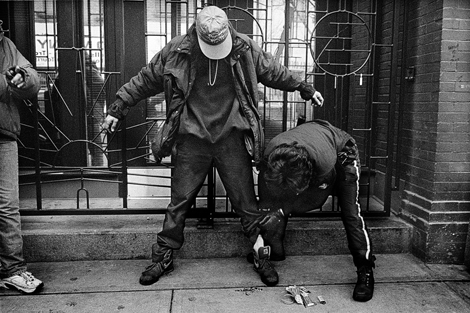
Arrests next door to Insite safe injection clinic. Photo Elaine Brière.
"The most explosive outbreak of HIV infection in the Western world." That is how Dr. Thomas Kerr, a research scientist with the B.C. Centre for Excellence in HIV/AIDS, describes the 19 per cent incidence rate that happened in Vancouver's Downtown Eastside in 1996-1997. The Vancouver Richmond Health Board declared the surge a public health emergency.
Today, of the 12,000 people living in the area, approximately 5,000 inject or inhale drugs daily. Estimates are that 90 per cent of drug users have hepatitis C and 35 per cent are HIV positive.
"Seventy per cent of the women who access our services are aboriginal¸" says Marcie Summers, director of the Positive Women's Network. "This is an epidemic. Recently the health officer for Northern B.C. declared it a health crisis. Only a small percentage of women with HIV are on meds."
Summers adds that domestic violence and a lack of stable housing are the two biggest barriers for women seeking treatment. Funding from the province has remained flat though the disease is spreading to many parts of B.C. There are long waiting lists and few places where women can go for treatment with their children.
Further frontiers
Vancouver Area Drug Users director Ann Livingston credits Insite, North America's only safe injection clinic for drug users, with reducing harm. But she would like to see the facility open up an inhalation room for crack smokers and do something about the problem of assisted injections. Many older users have badly scarred veins or injured limbs, and have a great deal of trouble injecting themselves. Present policy at Insite is for self-injection only. Many of the most vulnerable users, who are physically unable to inject themselves, cannot take advantage of the safer, more congenial atmosphere of Insite. And using in the alleys makes them easy prey for robbers and thugs.
Insite has saved lives. Because the drugs brought into the facility are obtained on the illegal market, they can be toxic and sometimes deadly. This past February Wayne almost died when he injected speed that he thought was cocaine. "I wouldn't be here today if it wasn't for Insite," he says. "Thank God they had the medical staff to supply oxygen and keep me breathing. I came close to dying. I had nine seizures in 20 minutes."
Compounding matters, prejudice abounds. As Marcie Summers puts it, "We see people with HIV/AIDS as marginal people, disposable people." Kerr's view is that from an ethical, legal and human-rights perspective, society has to do something.
Apart from offering a safe injection site, Insite refers on a daily basis about four clients to addiction treatment and an average of two clients to methadone treatment. But most of the assistance the facility gives to people involves essentials such as housing and food. "You can't even talk about detox until you have a home," says Sarah Evans, Insite co-ordinator.
Fear of arrest
The number of homeless on Vancouver streets has doubled in the past year, according to The Vancouver Regional District. And many are inhalation or injection drug users.
In an attempt to restore "public order," Vancouver's Police Chief Jamie Graham announced on February 22 that there would be a crackdown on open drug use in the Downtown Eastside.
David Eby, a lawyer with the Pivot Legal Society, whose mandate is to advance the interests of marginalized persons, calls this a step back to police practices of the past. "Since the big HIV outbreak in the area 10 years ago, the police backed off and quit arresting people for simple possession of narcotics," he says. "This seems to be part of a strategy to clean up the area before the 2010 Olympics...Everyone knows it's a joke because there is no way the police could arrest everyone using drugs openly and ever have a chance of processing them. The courts couldn't handle it, the judges couldn't handle it. It would bring the system to a standstill.
"But what is happening is that users are hiding themselves away in a little nook or cranny in the alley where they won't be found for hours if they overdose." Since people are afraid of having needles and rigs on them, Eby continues, they toss them away instead of bringing them into the needle exchange, increasing disposal problems and the risk of accidental infection.
Jail and stigma
Incarceration in the wake of crackdowns leads to additional serious problems for people with HIV/AIDS.
According to Kerr, "Being in jail is one reason people stop taking their meds. Appointments with physicians are posted in public places and everybody will know that you're HIV positive...Also, in jail a syringe is shared between 20 and 30 people. If you declare, you won't get access to the syringe that's going around."
Of course there are other reasons that half of those who are HIV positive and injection drug users discontinue treatment prematurely -- reasons such as side effects. "Injection drug users have so many health issues," Kerr says, "that adding antivirals can be too difficult to tolerate."
Still, the crackdown has got a lot of people worried, since police co-operation is fundamental to effective harm reduction. With the exception of the NAOMI project, a trial heroin prescription program in the area, the only place to inject besides Insite is in the alleys.
And the violence that accompanies the street drug trade is a daily occurrence in this part of town. In March, a 44-year-old aboriginal man was knifed to death on the corner of Hastings and Main over a $5 crack transaction. As well, the criminal nature of the global drug trade is a growing issue in Europe, the U.S., Australia, Canada and in many Third World countries where the drugs are produced.
Yet, in 2001, the auditor general's report on the problem of street drugs in Canada concluded that 94 per cent of all federal resources directed toward the drug problem were spent on enforcement and incarceration -- with no measurable benefits. Society can't afford "no measurable benefits" -- the costs are staggering: property crime, criminal gangs and the spread of bloodborne diseases like HIV and hepatitis C.
Million dollars a week for drugs
With an eye to combating all these costs, the Health Officers' Council of British Columbia and the City of Vancouver Prevention Report produced papers recommending experimenting with a regulated market for illegal drugs. This wouldn't be unprecedented. The countries most progressive in drug reform, such as Holland, Switzerland, Britain and Spain, are advancing harm reduction to include things like the sale and regulation of certain narcotics and soft drugs.
Mark Haden, an addictions expert who works for the Pacific Spirit Community Health Centre in upscale Kerrisdale, agrees. "If these drugs are available only on the black market, people become enormously engaged in the criminal system. They do a lot of crime to pay for the drugs...I think it is immoral of society to allow the existence of a black market that creates so many pathologies, criminalizes our youth and creates so many problems for society."
VANDU's Ann Livingston estimates that at least $150,000 a day is spent on illegal drugs in the 10-block area of the Downtown Eastside. The resulting expenses for society involve the police force, ambulances, medics and the like, she says. "The public needs to understand the cost to them, the risk that your children will get involved in injecting drugs. This risk is very high if you don't have a regulated market."
'You might make that change'
But it takes time for people to adjust their attitudes around prescription narcotics, particularly when Hollywood and the media reinforce the notion that abstinence is the only goal. And, as Livingston says, the public has to go at its own pace. "Harm reduction is a new idea that people often have to warm up to."
Still, it may well be an idea whose time has come. "I think that Vancouver is so ready for someone to do something really radical to deal with the problems of the Downtown Eastside, up to and including the legalizing of prescription heroin and cocaine," David Eby says. "To treat this as a health and social problem and not as a criminal problem."
Wayne and his partner Carla, like many other drug addicts, would both like to see more safe injection sites as well as market control and regulation of the drugs they use.
"Crime would decrease," Wayne says. "Death would decrease. A lot of people would get their humanity back, their self-respect...People wouldn't look down on you and you would have a little bit more self-esteem so you might make that change to go over to the other side of the room, to recovery."
The couple is thinking of going into detox through Insite.
"I don't want my legacy to be on a billboard with a body count in an alley," Carla says. "I'd like to change that."
This is the second of two parts. Read the first, 'Where Carla and Wayne Shoot Up,' here.
Elaine Brière is a Vancouver writer, documentary photographer and filmmaker. She was the last photographer to visit East Timor before the Indonesian invasion of 1975. Her book East Timor: Testimony was published by Between the Lines, Toronto, in 2004.
A treatment guide for HIV-positive injection drug users and their caregivers is available at www.catie.ca/pdf/Prefix/enprefix.pdf or by calling 1.800.263.1638. For more info on harm reduction, visit www.canadianharmreduction.com. ![]()


26
Login or register to post comments
murdock
5 years ago
Comments on "An Island Called Insite"
The spirit of Bill W is so needed now.
Ryu
5 years ago
In the business world if a company poured 94% of its budget into a business plan that yeilded no measurable benefits to its shareholders, the ceo and the board would all be sacked. If that company somehow continued to operate on the same strategy for years and years thanks steady inluxes of capital, it wouldn't be a company -- it would be our government's war on drugs.
Realist
5 years ago
If Smith and Wilson were alive today, they would not be heard as their message was about spirituality and not money. Sad but true reality
anarcho
5 years ago
What is missing from all these discussions is why the authorities - and their media shills - insist upon imposing a failed appproach to addiction. Treating addiction as a medical-social problem would mean a less profitable drug trade and less crime, which means less need for police and prisons. As they say "follow the money".
Ryu
5 years ago
Actually Canadian print media is largely supportive of InSite and harm reduction. In recent months newspaper editorial boards in most major centres have published lengthy editorials championing this approach.
The media, including online publications like The Tyee, will be instumental in driving this issue during the impending federal election campaign. We saw how Harper and his Ministers cowered before the outcry when InSite supporters from across all political lines came out to save InSite. Let's hope the media continues to do its part to keep this public debate simmering until election time.
anarcho
5 years ago
Ryu, I stand corrected, in reference to the newspaper editorials and am glad this is so. But I was thinking more of the right-wing "pundits", rather than editorials.
DPL
5 years ago
So it's down to abut two options. let tehm all shoot up in the streets, and many will die . Or we all agree that Insite is of value. Harper has put the decision on hold as he finally figured out, even sopme conservative supporters have freinds or addicts in the family, and by gosh they may not vote for him in his quest to get a maority. If he unfortuantly got a mandate Insite would be GONE. Right wing politicians don't like programs around the poor, the addicts or the old to work
dangrice.com
5 years ago
Insite is definately a positive thing and should be expanded, but there also needs to be some more $$ thrown into treatment in the area, so that there is more facilitation from safe injections to no injections in that moment of self realization.
Either way, I'd rather have people shooting up behind closed doors than in a park, or parkade stairway. (Yeah, trying to pass some one on the stairs with a needle in their arm is not one of the most pleasant experiences. Make the MPs funnel by that, and then ask them what they think of a contained shootup center). Personally, I think drug legalization is necessary as well, to cut out the proceeds of crime and to force people to pay for their high with cash rather than stolen goods.
Elliot
5 years ago
boy, there sure are a lot of people willing to make excuses for drug addicts around this town.
Truman Green
5 years ago
Jeez, Elliot, nobody's making excuses for anybody. Most commentors are just trying to envision a way to make drug addiction a bit less degrading, troublesome and fatal, and diminish the toxicity of the drugs and the role of organized crime in our society.
I think the problem is that there's just always a certain percentage of people like you in any population.
Elliot
5 years ago
right you are truman. no need to quit shooting herion into your body in vancouver. we'll just make it easier for you. may as well enable such behaviour. after all, it's not their fault that they're drug addicts.
Elliot
5 years ago
'I think the problem is that there's just always a certain percentage of people like you in any population.' you mean people that are productive members of society? guess what truman? i've met and known thousands of people in my life, all of whom were capable of managing not to shoot heroin into their veins. i don't have a lot of sympathy for the ones that did, and i don't want to support their disgusting habit.
Truman Green
5 years ago
I'll give you one thing, Elliot. You're certainly not trying to hide your true character.
But why don't you have sympathy? Have you ever walked up and down those alleys off Hastings at night? Do you really think these people are having fun?
I have sympathy for them. Other peoples' pain always causes me pain, too. Why not you, do you think?
dangrice.com
5 years ago
Elliot, maybe you should take a look at the meaning of "addiction".
Frankly, I know plenty of people who are drug users who are productive members of society. Who pick and choose their drugs, who mostly know when not to do drugs, and when its fine. Some of them are high at work, but work in atmosphere's where it doesn't hurt their performance.
I don't have statistics, but I'm sure the majority of drug users are hidden from view, and for the most part have control over their habits.
But there is a large segment of society, many of them with low IQs, often marginalized from birth, who have lost all of their support circles, have no friends out side of the DTES (friends, even then is probably the wrong word), never had education or aspirations, or who have had some personal tragedy that has thrown them over the edge, often are immigrants or first nations, or have severe mental illness, and that is who is down there.
Really, we have three options, turn a blind eye to them shooting up in alleys, spend 40K a year imprisoning them, or try to deal with the problem.
Take your choice, but "c" seems to be the most humane and least expensive. (Ask your insurers how much per year you would save if vandalism was greatly reduced)
Ryu
5 years ago
Elliot,
I am trying to understand your viewpoint that InSite is morally wrong because it enables addiction.
Two things come to mind:
I can relate to the frustration I think you feel that as a functioning, productive member of society why should your tax dollars go toward facilitating drug addicts. Fair enough. However, we are already chucking our $$$ at enforcing drug laws and incarcerating addicts and this clearly isn't working. The drug trade is booming, drug related crime is growing and drug use is still rampant. The war on drugs is a failure. We need to consider a new approach. According to data Insite is addressing some of the problems related addiction in the DTES. Let's give it a go.
Secondly, our society enables all sorts of addictions (alcohol, cigarettes, gambling, eating, television) each of which can destroy lives, families and communities just as heroin addiction can. The difference between state sanctioned vices and illegal ones is an arbitrary legal line. At least with the state sanctioned ones there are ways to salvage ones dignity should the addiction take over. Why not extend this same dignity to other types of addicts. InSite addresses this and creates the opportunity of addicts to rebuild their lives and become contributing members of society.
Finally, I would be interested in listening to any solutions you would like to propose.
Elliot
5 years ago
'InSite addresses this and creates the opportunity of addicts to rebuild their lives and become contributing members of society.' that would be wonderful ryu, but i have seen absolutely no data that supports this statement. the solution is simple. put the resources into comprehensive treatment facilities. not the mickey mouse half-assed joints we see now. if an addict wants help they can get it, if not, to hell with 'em.
zalm
5 years ago
I dunno Truman and Ryu.
My own personal experience with drug addicts is also unfavourable. I’ve a dear friend that I grew up with (39 years I’ve known him for, now) who has been in the DTES for about 15 of the last 22 years that he has been drug-addicted. John’s no poster-boy for addiction, but he’s still my friend. He has always been self-willed and impatient, despite parents and doctors who tried to help him, and I am now acutely aware that drug-addiction does not make a person evil all by itself. It takes a certain amount of narcissism and a bad attitude toward life in general and other people in particular to make a person as unpleasant, untrustworthy and unfeeling as John is. He had a couple of bad things happen to him as a young adult, but much as he tries to use that as an excuse for his current condition, I know the truth. All he got was angry, a lot of money in an inheritance that he spent in riotous living, and now all he wants more of the same. I was his friend through all of it - I saw it all. He’s hard to house and dual-diagnosis now, his health and behaviour are both bad, his rap-sheet is long, his health poor and I never know where I’ll find him. I now wait for him to call me and periodically I take him for a meal and a drink.
I would never invite him to my house or neighbourhood anymore. He has not met my wife. It wouldn’t be fair to me, my wife or my neighbours. John would find a way to come back and use them. He’s scammed me for money, stolen money and goods from me, he’s taken back half-eaten food that I’ve bought him, telling the clerk “It’s s**t†and shames the clerk into giving him the money back (that I paid), which he then uses on drugs or cigarettes. He’s shoplifted in front of me and then hit me when I made him give the item back. Every time I meet him he’s come up with a new way to try to scam or embarrass me into giving him money, which I haven’t done for more than 10 years. He is very persistent.
I’ve talked to other people whose lives he has made a hell of, who tell similar stories. I’ve met some of his “friendsâ€, the drug-addicted ones that he is currently hanging out with, (until he starts a war with one of them, and gets a whole new group). And they act the same as he does. Now that he’s dual-diagnosis, he has access to housing through Coast and other societies. He stays just long enough to confirm that everyone else there is a problem, everyone else is the devil or looks at him wrong or is too fat or too ugly or too noisy. But heaven help someone who wants him to turn his radio down at 3:00 am. He smashes toilets to see what’s inside. Then he moves out because “the place is a hole†and he can’t stand the people there. He’s been through at least six of the housing projects in the DTES that I know of, and I think he’s back at the Hazelwood for the third time right now.
This is my “sample of oneâ€. But I know enough addicts personally through work and through John to be quite sure he is not alone.
I may not agree with Elliot's attitude toward them, but his logic is inescapable.
zalm
5 years ago
And this is where Ryu is wrong. All those other addictions with the possible exception of gambling, do not involve the loss of volitional control for long periods of time. (As you can tell, I don't buy the "blind drunk" theory of alcoholism either, having been a fair way down that road in the past and used the same excuses). Only drug addiction does. That's why the only people who can treat drug addiction are trained counsellors and support staff in a fully controlled setting with no way out.
So if those things aren't in place, then Insite by very definition becomes an enabler in a dysfunctional relationship. For that alone, it should be shut down.
But Ryu is right on one count. Though we haven't incarcerated addicts for their addiction for more than fifteen years, back when we did, it didn't work. So let's try something else.
Let's try adding in the other Three Pillars - housing, detox and enforcement. because we have almost none of any of 'em right now. Then let's talk about whether Insite is appropriate and useful.
Truman Green
5 years ago
Zalm, I've known five drug addicts who were perfect embodiments of your characterization.
But I'm curious how the fact that many long-term addicts have infantile personalities relates to the value of Insite. In fact, wouldn't you think that such people are in need of intervention? Or does their mental conditioin disqualify them from eligibility for compassion?
I think if you re-read dangrice.com's paragraph beginning with, "But there is a large segment of society, many of them with low IQs..." you'll find some very useful information about some drug addicts, and probably a large percentage of those who are most visible.
I think you have to wonder: Would a sensible person really inject completely unreliable, often contaminated substances into his/her blood stream?
"Enabler," did you say, Zalm. I think enabling addicts to live is a fairly reputable accomplishment.
I think where you guys are having difficulty is that you can't quite envision finding yourself in a circumstance in which you wouldn't assume that you are primarily to blame, and from which you couldn't escape if you just put your mind to it.
Well, this is a nice thought, but some people have destroyed or incompetent personalities.
Ryu
5 years ago
True, I make assumptions about the nature of heroin addiction in comparison to other addictions. But I am unbiased in my compassion; they all deserve dignity and the support to necessary to rebuild their lives.
I wholeheartedly agree, Zalm and Elliot, as a stand-alone service InSite is insufficient. Where I differ is where you say it enables addiction. InSite enables them to live long enough to seek help should they desire. And this is where the other pillar in the four-pillar plan must be erected. Comprehensive treatment programs are needed urgently.
I also question the logic of opening InSite before those treatment programs are in place. My understanding is that if one shoots up at InSite now and suddenly decide to get clean they can get on a waiting list for detox, then in a few days get a bed. This is a failing of InSite that must be addressed. If people want help they should be able to get it NOW.
However, the danger of closing InSite after three years of operating could be devastating on the community. What message would it send to the people who use it? My hope is that the presence of this government-run health facility acts as a beacon of compassion, telling users that they are worthwhile human beings. To take this away would be to tell them that they are worthless.
Lets forget about the addicts for a moment, forget that InSite is saving lives and preventing the spread of disease. InSite has had a positive impact on public order and it saves taxpayers money. These reasons alone a worth keeping InSite open for.
DPL
5 years ago
We all want the addict, when she/he decides to go to detox should be able to get there right away. But the province isn't interested in setting up the beds, just as they arn't interested in doing much for the poor, sick or old. Hell we need the money for some new road to Whistler or other things that are attached to the 2010 show. So lets not dump on the addicted folks, dump on Gordo and Co.
bangbang
5 years ago
not only is the province not interested in setting up beds, but they are very interested in using 'tax dollars' and corporate welfare to spend millions on luxury items for the rich (i.e. the Olympus)it's always curious to see so many right wing comments lashing out at the pittance of their 'tax dollars'that get spent on social programs. it's definitely not surprising, yet don't these privileged who complain that they work so hard and whine about their lack of control of funds spent by gov't. realize they themselves are absolute suckers gullible to the manipulation of corporate media?
homelessinabbotsford
5 years ago
Just a few comments:
Enabaling: Just about anything you do short of executing them could be argued to be enabaling a drug user to use. I agree that you have to have a policy of keeping them alive to reach that point in their lives where they are ready to think about and attempt a lifestyle change that includes treatment for addiction.
Insite: Those who are against this seem to opppose it based on personal beliefs. Any objective evaluation shows that it is a positive to the communities - both the drug users and general public. It is a tragedy that only this one small piece of the complex puzzle that is the "big picture" of addressing drugs and addiction. It leaves Insite as a lightning rod of all those who have no real appreciation of the insanity that is addiction. In not having all the supporting pieces that it should have Insite cannot begin to reach its potential as what it should be able to do as a small piece of the range of services that should be being used to help those who suffer from addiction.
Capitalism: Ironically many of those who are against a rational drug policy based on knowledge of addiction would also consider themselves pro free enterprise. The illegal drug trade is, at its very core, the ultimate expresion of Capitalism.
More anon when I have another hour of computer time at our local library. One of the disadvantages of being homelssinabbotsford.com
DPL
5 years ago
A drug addicted person lives in or close to all our families. sue they screwed up by getting into the stuff. sure they are now a wasted shell of what they once were. Should we simply tell them to smarten up, get a job, and move to Kerrisdale, or other more upwardly motivated area.( hey some of the addicts live there now. None of that is going to happen anytime soon. so as compassionate humans we can help them and hopefully a percentage of those poor souls will make it back into society. If we can't help them are we any better than the addict, who really has to get a fix. She or he will sell anything including themselves, steal , break into your car for a few bits of change. are we not a more advanced society or are we a bunch of vindictive jerks?
zalm
5 years ago
That's crap. They know what they're doing, and they all wish they weren't doing it, but it doesn't stop them. That's because the behaviour they manifest is so powerful, so long-standing, that they are unable to alter it without significant assistance, not words from the well-meaning.
Tru and Ryu, you're missing the point. I'm not saying my friends isn't deserving of respect (especially after 39 years - how many of you can say you still have a friend after 39 years, especially one like this?) because he is - intrinsically and in friendship. So you shouldn't judge me as if I'm judging him, because I'm not. I've lived with him - I know what it's like when he's high-functioning and when he's low-functioning.
But his abusive behaviour doesn't stop when he enters Insite (he claims he was there "once" but they were all "a**holes" so he left). Nor does it go away when he leaves. He is completely incapable of making a decision in his own long-term interest - completely. So are most of his friends that I've met. In fact, ten seconds is pretty long-term for him, and that includes his genuine needs like food and shelter.
If he were a client at Insite, he might be shooting safe while there, but 12 hours later, Insite is closed and he's shooting risky again. All his other behaviour is risky too - dealing, sex, making money, and every risky act he does undoes the good work that Insite does.
That is also the one big caveat in the Insite report. While the clients are on-site, Insite helps. As soon as they walk out the door, most of 'em are back to risky living again, and Insite can't help. Addicts know that, citizens know that, the report-writers know that. The seriously drug-addicted don't have cognitive volition and the only thinkg I can think of to do with them is lock them up for their own safety, which is no solution at all. There's no treatment for them until they're ready to engage, and Insite is of marginal utility there.
That's why the initial report by Blatherwick a year or two ago was so revealing - that rates of HIV infection were unchanged or slightly higher after the free needle program was implemented, and he did not expect any change with the opening of Insite.
We need the whole package: housing and detox FIRST, then enforcement and harm reduction SECOND. I'm sorry that's the expensive way to do it, but anything else is just a sop to our collective bleeding-heart consciences and a useless tragedy to our least able. Even my drug-addicted friend dimly senses that.
OneWomanArmy
5 years ago
Elliot,
You're so totally right.
See, I'm a member of Mensa and I have an honours degree from SFU. I currently work as a researcher at BC Centre of Excellence for Women's Health. We are researching drug using women in the DTES and what kinds of experiences they have when they seek Primary Care. Plus, we are working hand in hand with VANDU.
God, you are so right Elliot. Drug user scum make no contributions to society and they're a fucking pain in the ass.
I know this because I'm part of the elite, the top 2 percent of the population who are designated as a 'genius.'I'm sick of those scum dragging the rest of us down. This neighbourhood is going to hell in a handbasket.
But I have a little secret to tell you Elliot:
I also use injectable opiates like Dilaudid and sometimes heroin, but that's my last choice.
Shit, we should get rid of me. Scum like me who've done nothing with my life.
Why don't you come to my office at the Centre of Excellence and we'll talk about all 'those' people who are just shit in your opinion.
Let's talk about how we can get rid of 'them.' And bring a gun too eh! The War on Drugs needs people like you Elliot.
I'm just doing nothing except wasting your tax dollars right? WRONG.
Insite nurses taught me how to shoot properly. If I didn't have their expertise I'd probably have Hep C, possibly HIV and a whole host of other problems relating to improper injection. Shit, that would mean more taxes out of your paycheque Elliot. Are you sure you can handle that?
I've never had an abcess or fucked up a vein. I've never gone down either. Shit, you save money every single time I shoot up properly at Insite.
But some of my brothers and sisters don't know how to shoot properly and cleanly. And so we need insite ya know? In fact, we need MORE Insites around BC!
And then you must know that I'm someone's daughter, granddaughter, lover, and sister. I'm a human being with rights. I deserve to be healthy. And I deserve to be free to make my own choices, educated choices like the ones I get at Insite.
Do you fucking get it now?
And after you digest that little ditty, just think about the real problem: Poverty and Social Inequality.
Last comments:
RYU- It's not Insite's fault that there are no beds available at Detox. That's the provincial govt's fault.
You can't house or detox a dead person. Harm Reduction first, Insite open 24/7. More Insite locations.
Oh, and quit blaming Insite for your friend's mental incapacities.
Fucks sake.