- Ms Kaye is a Tyee Builder. You can be, too.
- Mary Carlisle is a Tyee Builder. You can be, too.
- Prem Gill is a Tyee Builder. You can be, too.
- Nancy Flight is a Tyee Builder. You can be, too.
- Justin Everett is a Tyee Builder. You can be, too.
- John Westover is a Tyee Builder. You can be, too.
- Nora Etches is a Tyee Builder. You can be, too.
- Edward Henderson is a Tyee Builder. You can be, too.
- Bharadwaj Chandramouli is a Tyee Builder. You can be, too.
- Dean Chatterson is a Tyee Builder. You can be, too.
- Marius Scurtescu is a Tyee Builder. You can be, too.
- Robert Parkes is a Tyee Builder. You can be, too.
- James Murton is a Tyee Builder. You can be, too.
- Susan Doyle is a Tyee Builder. You can be, too.
- Vincent Strgar is a Tyee Builder. You can be, too.
- Helen Spiegelman is a Tyee Builder. You can be, too.
- Subir Guin is a Tyee Builder. You can be, too.
- Kimball Finigan is a Tyee Builder. You can be, too.
- Joanne Manley is a Tyee Builder. You can be, too.
- David Leach is a Tyee Builder. You can be, too.
Chief Leads Resurgent Homalco First Nation
Refusing to be ‘swept under the carpet, Chief Blaney won judgment against fish farming.
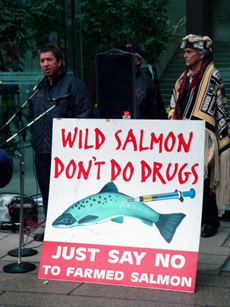
Blaney at microphone outside Law Courts
When Darren Blaney strode into downtown Vancouver’s courtroom 51 in January, he was thinking about Church House Bay, his birthplace near the head of Bute Inlet.
Though the clapboard church and houses of that abandoned native village sit vacant, slowly being reclaimed by the wind and rain, the site lies at the centre of a resurgent Homalco First Nation. Blaney, 46 years old and energetic, is the Homalco chief. He is taking on the B.C. government and one of the largest fish farming companies in the world, claiming that his people have been ignored when it comes to deciding where, when and how to site fish farms in their traditional waters.
The court proceedings that brought Blaney to Vancouver in January marked only the latest battleground in that fight. It began in 2002 when Marine Harvest, a subsidiary of Dutch multinational Nutreco, hashed out a deal with Blaney’s predecessor to farm Pacific Spring salmon in Church House Bay, promising jobs and economic opportunities for the Homalco.
According to Blaney, just one band member is currently employed at the farm.
Battled Atlantic salmon plan
From the outset, the deal was not popular among most Homalco who shared concerns about the threat of sea lice, pollution and disease to the wild salmon that ply their ancestral waterways from the Southgate, Orford and Homathko rivers in Bute Inlet out to the open ocean. Last April, claiming that it was unable to farm Spring salmon profitably, Marine Harvest applied to the provincial government for a license that would allow them to restock the farm with controversial Atlantic salmon. The Homalco first heard about the application on July 20, 2004. According to Blaney, they spent the fall trying without success to get more information about what if any specific “fish health management plan” the government and Marine Harvest had to mitigate fish escapes, the spread of sea lice and damage to the marine environment from fish waste.
On Dec.17, 2004, literally hours before the band office was to close for Christmas, the Homalco were blindsided with news from the government that Marine Harvest's application had been approved a week earlier. While band council members were making holiday plans, the farm was being re-stocked with Atlantics.
Blaney responded swiftly by asking the courts for an injunction to block Marine Harvest from introducing Atlantics to Church House claiming that the government had failed to adequately consult the Homalco and address concerns about the environmental impacts.
On December 24, in a landmark decision the B.C. Supreme Court granted an interim injunction, putting the brake’s on Marine Harvest’s plans for Church House Bay, and ordered a judicial review of the approval.
Marine Harvest dutifully appealed but the BC Court of Appeal upheld the decision. Now a microscope has been focused on how the Ministry of Agriculture, Food and Fisheries goes about approving controversial fish farms.
Injunction keyed off Haida decision
The injunction was significant for a couple of reasons. It was the first to be based on last November’s Supreme Court of Canada decision involving the Haida that said government’s must consult First Nations before allowing resource development that might impinge on aboriginal rights and title. But beyond legal matters, it was also a determined move by the Homalco people struggling to assert their interests and be heard by the mandarins in Victoria who are keen to promote fish farming as the economic saviour of the West Coast.
“I’ve been getting all kinds of calls from other First Nations who are having to deal with fish farms,” Blaney says. “A lot of our people remember fishing and clam digging around Church House. We had to ask do we want to risk our aboriginal rights so one band member can make $10/hour at the fish farm? This deal got arranged with the previous chief but there was no benefit to the band. I don’t want our youth to be just reading about the way things used to be.”
In many ways the band’s challenge to fish farms in Church House has marked a turning point for the Homalco as they attempt to rebuild a community still recovering from European contact and attempting to reconnect youth to their environment and culture.
Chief a product of residential school At age 13, Blaney left Church House Bay and was sent to residential school in Sechelt. He graduated in 1978, then went on to attend Langara College. After working for several years in the bush on tree spacing jobs, he signed on with the Native Court Workers and Counselling Association of B.C. in Vancouver. He says in his mid-20s he was drinking heavily, and risked descending into an alcoholic fog. But he remembered what his grandmother told him years before. “If you drink you won’t amount to anything.”
Blaney hasn’t touched a drop for 22 years.
After living in Vancouver for 18 years he decided to return to Vancouver Island with a clear idea that he wanted to do something to help his people. He served six years as a band councilor and was elected chief in 2002. It’s been a busy first term.
Though the fight for control of Church House Bay occupies much of his time these days, other fundamental problems tear at the fabric of Homalco culture years after the last residential school shut down, a dark legacy that still haunts the Homalco.
“Our people don’t know how to be parents, there’s a lot of drinking and drugs. The residential system spawned many abuses,” Blaney says.
“None of our kids have gone on to university and we had one kid in the last few years who graduated and he was illiterate. There was a grade 8 kid who couldn’t spell his name and it only had four letters,” Blaney says. “They’re pushing us through the system but we need role models.”
In an effort to address this education deficit, the Homalco want to create their own grade 1-7 school on the reserve on the outskirts of Campbell River.
The Homalco need educated and motivated people within their own ranks, says Blaney. Otherwise, a $10/hour job at a fish farm in Church House Bay may seem like an attractive opportunity, no matter the risk to wild food fisheries and the marine environment.
Victory under his belt
The judicial review ground along for two weeks as the judge heard submissions from lawyers representing the Homalco and the government. It quickly became clear that the Church House approval was fraught with procedural missteps and oversights. The Homalco have for two years claimed they were not adequately consulted when the fish farm license was first granted in 2002. Apparently the judge agreed.
On a sunny afternoon on March 3 Chief Blaney strode out of the same Vancouver courtroom with another victory under his belt. The Supreme Court of British Columbia had just announced its decision in favour of the Homalco, effectively halting fish farm operations at Church House until both Marine Harvest and the provincial government open meaningful dialogue with the band. The judgment was far from an outright condemnation of fish farming however it unequivocally acknowledged that the Homalco have a legitimate claim to Church House and that they must be involved in decisions affecting this territory. The judge went on to say that the ministry of agriculture, fisheries and food “has erred in failing to consult to the extent necessary” with the Homalco.
Just what form this future consultation will take it unknown and was not specified by the judge. Either way it’s a significant victory for the Homalco First Nation and one that could have ripple effects throughout B.C. as other First Nations assert their interests.
“The BC government must learn to listen and act upon, not ignore, the concerns of First Nations, local communities and stakeholders up and down the coast. It's unfortunate that after years of debate we find ourselves addressing the same issues and problems over and over again, essentially on a site by site basis,” says Eric Blueschke, of the conservation group Georgia Strait Alliance, which partnered with the Homalco last year in an effort to keep fish farms out of Bute Inlet.
‘They won’t sweep us under carpet’
As for Chief Blaney he says so far he’s had little contact or correspondence with government or industry since the decision came down a month ago.
“I don’t think government agencies will take us so lightly any more. They won’t be able to sweep us under the carpet,” Blaney says.
And that’s all the Homalco have been asking for since farmed fish first showed up in Church House back in 2002 – to be taken seriously – and the courts have sent a strong message in support of this demand.
Court battles are expensive, especially in light of the other social, education and economic challenges plaguing the Homalco that make demands on limited band resources. However the chief believes it’s worth it. Without asserting control and maintaining a connection to their traditional territory, the Homalco are like a rudderless ship.
Blaney says his people can’t afford to “subsidize companies to make money” if it means jeopardizing the resources that generations of his people have relied upon – the ocean and the wild fish that forms the nucleus of their coastal culture.
“I have no problems with trying to reduce pressure on our wild stocks but I’m not convinced that farmed fish don’t pose a risk to our environment,” Blaney says.
Courtenay-based Andrew Findlay is a regular contributor to The Tyee. ![]()


10
Login or register to post comments
BC Mary
7 years ago
Comments on "Chief Leads Resurgent Homalco First Nation&quo
That's leadership, Chief Blaney. Good luck.
Birch
7 years ago
Fish farming Atlantic salmon in open-net pens on the West Coast is such a discredited practice it's nearly astonishing that it's still an issue. However, it will remain so as long as the Liberal government is in power and is beholden to the fish-farming industry. One has to admire the courage and tenacity of First Nations' stakeholders in the industry who, with very little in the way of resources but a great deal at stake, are tenacious enough to put up a struggle against what seems to be manipulative and deceitful strategies pitted against them.
The Skeena region will see a large-scale public forum before the election devoted entirely to the fish farm issue. Guides, sportfishermen, commercial fishermen and many others are terrified at the damage planned fish farms may cause, and are angered by our governments' lack of sensible resolve on this issue, a resolve based on precautionary science rather than economic inducements. Watch for developments.
Meanwhile, go for it Chief Blaney. There are thousands of British Columbians behind you.
cmd
7 years ago
Andrew,
Interesting story, but I think you've overstated the extent of Chief Blaney's victory at the Supreme Court last month.
First, to clarify, the injunction granted in December only blocked Marine Harvest from introducing more Atlantic salmon to Church House Bay. By the time the injunction was issued MH had already placed 700,000 smolts (out of a possible 1 million) at CHB.
Second, in the hearing that started in late January, the Homalco sought more than just consultation. They also sought to have the minister's approval of the amendment quashed, the 700,000 fish removed and a permanent injunction barring MH from introducing without what is known as a HADD (short for harmful alteration, disruption or destruction of fish habitat) authorization from the federal Department of Fisheries and Oceans. The court declined to order any of these things. Instead, it adopted MH's proposal, which called for further consultation between the Homalco and the Crown (with the participation of MH). In short, the decision did not effectively halt fish farm operations at CHB
Third, the judge did not find that the Homalco had not been adequately consulted when the fish farm was authorized in 2002. Rather he found that further consulation is required as new information becomes available.
By the sounds of things, Chief Blaney would like to shut down the fish farm for good. Unfortunately, as much as you'd like to downplay the significance of the agreement reached by the last chief(who "hashed out a deal" with MH), he's bound by his predecessor's decision. Nor does he have a veto over the introduction of Atlantics at CHB. The Homalco have a right to be consulted and, to an extent, have their concerns accomodated. What the means in practice remains to be seen.
Justice Powers's decision can be found at the BC Courts website http://www.courts.gov.bc.ca. The decision number is 2005 BCSC 283. Or you can link here http://tinyurl.com/6k5lr
Jeffrey J.
7 years ago
The thrust of this article is that Blaney refused to be "swept under the carpet". CMD responds by suggesting the article overstates the impact of the judgment. Yet the Crown and the fish farm vehemently argued for 9 days in court that the Homalco had no right to an injunction nor a right to consultation. The court states that"The Ministry, supported by Marine Harvest, argue that in this case the scope and content of the consultation is at the low end of the scale.Â* They say that the obligation to consult relates only to the amendment to the license to substitute Atlantic salmon for Chinook salmon.Â* They argue that any issues regarding the existence or location of the fish farm have been resolved or dealt with when the license was initially granted.Â* They argue that the evidence submitted by the Homalco with regard to the potential harm against wild salmon stocks or marine life has already been considered when the Province conducted an extensive review of salmon aquaculture in the past.Â* They argue that any new evidence submitted by the Homalco has been considered by the Ministry and is inconsistent with other expert opinions known to the Ministry.Â* They argue that any risk to wild salmon or marine life from the introduction of Atlantic salmon to the Church House fish farm is low or non-existent. The court states that Â* The parties have submitted voluminous affidavits including opinions of various scientists to support their positions."
The judge listened to this evidence and submissions by extremely well prepared lawyers and ruled against them. This is big news and significant victory for the Homalco and other First Nations concerned about the abuse of the environment. Worthy of much press. Interestingly, we saw very little about this story in the Sun or Province. So I would support CMD's concern about misreporting news. And I would recommend he/she write the editors of the Sun and Province regarding their propensity for same.
Budd Campbell
7 years ago
Well, cmd, I don't know if you're a lawyer or not, but you have certainly given us all some informed commentary. It's really a shame that you just don't realize that this sort of thing is not the real purpose of the Internet. Just kidding, ... I think.
If you want to treat yourself some very unfunny material, try either the left wing rabble.ca/babble, or it's alter ego on the right, freedominion.ca.
The "moderator" of the right wing site, Connie Wilkins, has been said to be seeking a Tory nomination and I doubt it will be long before the "moderator" of the left wing site, one Audra Trouwer Williams, aka Audra Estrones Williams (as Jack Parr used to say, "I kid you not") will be seeking an NDP nomination. On the right, they seem to be able to more or less survive their extremists, but for Jack Layton the arrival of a lunatic like Audra would be serious damage below the waterline, kind of like having Svend return.
Budd Campbell
7 years ago
Jeffrey J, I don't understand what you're driving at.
dearpremier.ca
7 years ago
Budd - what you might not understand is that cmd is trying to tell you Indians didn't get what Jeffrey thinks they got. (there was no "significant victory").
You should read the judgements yourself to understand.
regards,
Jean Binette
Jeffrey J.
7 years ago
The Crown and the fish farm company spent 9 days (by my count) arguing against the Homalco's application. The Homalco were seeking an injunction, and an order for more consultation. They also sought to quash the Minister's permit. They didn't get everything they asked for. But if this isn't a significant victory, I don't know what is. It is certainly not a victory for the Crown. Had the Crown agreed that consultation was in order, but they only opposed the quashing application, then cmd and Jean Binette would have a point.
The Tyee's reporting of events that are so often ignored by the dominant media are clearly having an effect, given the barrage from critics that follow every article. Carry on, Tyee. Keep up the good work.
cmd
7 years ago
To clarify, I didn't say that the Homalco walked away from court with nothing. But if you measure what they asked for with what they got (and take into account the fact that the remedy adopted by the court was the one put forward by MH) the victory seems a little less impressive. I also thought it was important to correct Andrew's assertion that the initial injunction had blocked MH from introducing Atlantics at CHB.
Despite what Jeffery J suggests, the fact that it took a nine-day hearing to resolve this isn't really a measure of the merits of either side. Of course MH fought the application vigorously, since, according to the decision they said would be out anywhere between $300,000 (the cost of moving the salmon from CHB to somewhere else) to $15 million (the value of the mature salmon) if the Homalco got everything they asked for. There was also a difference on the level on consulation required. Jeffery noted that the court rejected the argument put forward by the Crown and MH that it was on the low end of the scale. But Judge Power also rejected the Homalco's argument that a deep level of consultation was required.
In other words, Jeffery, your comment that
applies to both sides. (I assume that the Homalco's lawyer, Peter Grant, was as well-prepared as anyone else there.)
As far as correcting the errors that appear in the Sun and Province? Please, there are only so many hours in a day.
anne cameron
7 years ago
The most important thing, for me, has little to do with the verdict, or with "who got what". For me, the hugely important thing is someone TRIED, stood up, and made the industry and the government which is complicit with that industry, slow down!
The second most important aspect, for me, is what Chief Blaney said about First Nations education. I have a vested interest in that; six of my grandchildren are registered or status First Nations. I am almost constantly frustrated by what I see as a condescending paternalistic attitude inflicted on them by the education system.
Frustrated, too, by the fact that as my grandchildren, particularly the boys, get out of elementary school and into middle school they lose interest and motivation. A kid who won an award for academic achievement quit after grade ten because , and I quote, "it's all such bullshit, grandma.". Already the kid who is on the honour roll is getting turned off. Mind you, how he got ON the honour roll is a puzzle, his reading comprehension skills are at what I consider to be a grade three level. He knows what each individual word means, he just hasn't yet learned how to read the entire sentence. Read it out loud to him and he's got it... and our school has no way to answer this boy's challenges. But he's on the honour roll, and he'll pass his grade and... Chief Blaney is absolutely correct, it's a "pity pass" because this racist society does not expect First Nations to "do" anything anyway.
More than twentyfive years ago the New York City school system established that a child gives what is expected of it. Set your expectations high and the kid will strive, set them low and the kid will give that, too. When society expects five times the square root of sweet fuck all from a kid...society gets exactly that.
Good on you, Chief Blaney!! The court decision may be flawed but you are an excellent role model for my grandchildren.
Kleko. Kleko.