Mediacheck

Why the War on Musicians Isn't Just about Copyright

Increasingly it's hard for bands to get paid for playing a gig. Blame the free download mentality.

By Darryl Greer, 15 Aug 2012, TheTyee.ca

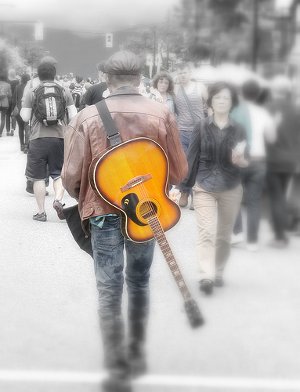
Guitar-Man.jpg

Guitar man on Vancouver's Commercial Drive in June. Photo by MikePearson.pics from Your BC: The Tyee's Photo Pool.

Have you heard? Stephen Harper is waging war on the music business. No, it has nothing to do with the stodgy Prime Minister's way of playing Beatles tunes, even when he's improbably singing about "getting high with a little help" from his friends. (Then again, might he be implying that his friends in the oil and gas industry have promised him all the gas he can huff?)

In fact, it's the new copyright bill that has companies such as ole, the country's largest music publisher, up in arms. Harper, according to ole, is messing with the autonomy of Canada's copyright board, appeasing large tech companies who are quietly funding the so-called free-culture movement in order to steal food from the cupboards of artists by wiping out their ability to collect digital royalties from public performances of their copyrighted works.

"This whole bizarre incident is further evidence that the Harper Government has declared war on the music industry and will go to extraordinary lengths to, once again, ensure that Canadian artists are not paid for their work. First, they drop the Bill C-11 bomb, which will likely wipe out $30 million a year in digital music royalties, and now they are destroying markets and interfering with the autonomy of the Copyright Board," according to ole president Michael McCarty.

A serious point of contention is the Harper government's refusal to levy a fee on microSD cards used to store digital content on smart phones. Like blank CDs before them, microSD cards are rightly seen as enablers of music pirates to steal and store copyrighted music for which artists and publishers receive no compensation. While blank CDs are subject to a levy, distributed by a copyright collective such as the Society of Composers, Authors and Music Publishers of Canada (Full disclosure: I'm a member of SOCAN, and it owes me about eight bucks last time I checked), microSD cards are not the subject of a similar levy, nor are iPods because the Conservatives vehemently opposed what they called an "iPod tax."

Surely the protection of intellectual property is important and entrenching that importance by passing laws is arguably the best way to deter theft of that intellectual property, even though technology these days has made theft so easy. Original and creative ideas should be protected so that those who come up with them have incentive to keep striving to come up with original and creative ideas. A well proven incentive is that creative people like to eat and pay their mortgage or rent.

But providing incentives for people to be creative in ways we can all enjoy isn't as simple as granting copyright protection to what they produce.

Royalties, and other dreams

A large chunk of "successful" musicians in this country, in fact, don't even necessarily rely upon sales, tours or royalties to keep their career in motion. They rely on loans and grants from organizations such as the Foundation to Assist Canadian Talent on Records, which receives money from government and private broadcasters. Just a cursory glance at the FACTOR website's "Approvals" section offers a glimpse into what kind of artists get the real money. For example, the bands Marianas Trench and Faber Drive, both on 604 Records, the label co-founded by Nickelback's Chad Kroeger, each received more than $25,000 towards sound recordings back in February. (While I don't envy them for their music or their cartoon-bubble-gum image, I really envy them for not needing advances on their credit cards to go into the studio, as I've had to in the past.)

And then there are people like me, your basic struggling independent music artist who happens to play bass in a few bands including, for seven years, one called Trophy Wife. Never heard of us? Don't worry, my feelings aren't hurt. But I do offer this first-hand perspective: Tilting copyright legislation in favour of music publishers won't make much difference to a lot of artists like me. Think for a moment how many musicians you know personally or even musicians with whom you're casually acquainted. How many of them are "professional" musicians? By professional, I mean people who rely on income from royalties, performing, recording, writing, teaching and touring and do nothing but music-related activity to make a living. Say you know 100 musicians. Of that 100, how many don't have day jobs? Likely, a very small percentage, and out of all the musicians you know, how many do you think rely upon back-end royalties from SOCAN for a large chunk of their living?

(Music publishers are responsible for "promoting" musical compositions and can take up to 50 per cent of the revenue generated from public performance of copyrighted material. They also administer artists' performance rights by filling out the necessary paperwork with organizations such as SOCAN in Canada or ASCAP or BMI in the United States.)

The reasoning is very simple: a large number of musicians (myself included) have a very limited understanding of music publishing and copyright laws to the point where SOCAN membership is misunderstood and therefore essentially unnecessary. (In the same vein, ask all of your musician friends if they are in the musicians' union.)

Yes, SOCAN membership is important for artists who are very active performers, on tour or otherwise, and in heavy rotation on radio, television and films. But SOCAN pestering bars and festivals to pay up for public performances of copyrighted music doesn't mean they will (or should) pay. http://onlymagazine.net/News/1209/the-new-cost-of-music

Industry vs. independents

What this brouhaha exposes is the massive gap between the "music industry" and independent musicians who care more about getting heard than paid, as Henry Rollins put it (skip to 10:30 in this video for his views on how musicians can show that they like their fans).

The sad truth of it all is that music, performed live or recorded, has lost its monetary value due to saturation that came with the ease of quality production through technological advancement. As a personal example, one of my bands released a six-song EP in February on CD and on digital platforms such as iTunes and a host of other digital music providers and streaming services. While our first album did okay back in 2009, selling physical copies bolstered by digital sales, both physical and digital sales of our newest release have been noticeably lower. While it's disappointing, it's also difficult to blame people for not caring about a six-song EP since they can carry 10,000 songs in their pocket on their smart phones. (It also doesn't help that we're a wholly unhip, non-fashion-forward band in a rather obscure genre ignored by the indie-rock-hipster-dominated music press.)

Streaming services, meanwhile, have become fan favourites especially in Europe, which enable people to access an untold number of songs for a monthly fee without having to own any physical content, which compensate artists with so-called micro-payments, some of which amount to a fraction of cent for each song streamed.

See you on the battle lines

So what should we really make of whining about the Harper government waging war on the music business when the one complaining is the country's largest music publisher, whose catalogue includes songs by Taylor Swift, the Backstreet Boys and Britney Spears? I think its high time for the country's true music lovers to shed some crocodile tears for ole and wake up to a truly sad reality: the war on the music business is nearly lost and you can't solely blame governments.

Next time you're at a small music venue on Commercial Drive, for example, watch as the musicians pass around a hat looking for donations after their performance. Ask a staff member if the venue is compensating the performers with anything other than "exposure" and maybe an appetizer plate and a pitcher of beer. Next time you're on a torrent website downloading a band's full catalogue for free, stop and think and wonder if you being a "fan" is actually helping the band stay in existence (and keep making the music you love so much that you won't pay for it) by downloading their music for free.

The music business, be it the machine-like industry trying to pump out bona fide stars and hits or the kid plunking away on an acoustic guitar in his parents' basement, is indeed at war. It is at war with the notion that music and the people who create it, no matter how much it costs financially, spiritually or emotionally to do so, are worthless.

For me, it's a war worth fighting, no matter if it means my band's death by a thousand downloads. It's a war worth fighting because, as the saying goes, you get what you pay for and the price of losing this war is our collective soul.

I don't have a sure fire strategy to win this war. But for anyone who wants to enlist on the side of artists, here are some ideas. Be willing to shell out some money to be entertained by aspiring professionals. How about creating a sticker saying "We Pay Our Musicians" that restaurants, cafes and other venues could proudly display to entice patrons wanting some guarantee of quality music to go with their decent drink or food?

Such low-paying gigs are the lifeblood of musicians who someday might just make it big enough to earn royalties -- the back-end compensation over which ole is sounding the alarm. Until then, my bandmates and I are counting on fans and venue owners to realize that we need and deserve to be paid on the front-end if we're going to survive another week of Kraft Dinner and Mr. Noodles, and still be ready to rock out when Friday night rolls around again.  [Tyee]

41  Comments:

Login or register to post comments

  • ααα

    40 weeks ago

    Ridiculus

    Piracy has almost disappeared since the i troduction of the Itunes store. It is cheaper to dowload from ITunes than to waste time on torrent etc.

    Proposing a fee for SD cards used primarily for photos on phones, or to charge a tax on IPods where our licensed material is played hardly seems fair.

    Don't expect the consumer or taxpayer to pay for your hobby. Your art becomes business rather than a hobby when consumers will volantarily pay for it. If you are lucky maybe some venue will let you play on their premises without charging you while your hobby develops into a business.

  • Grouchy

    40 weeks ago

    Cry me a river.

    This is the worst rant I have seen in a long time. Why the hell should taxpayers and consumers pay you just because you cannot make any money at your trade ? We already pay a levy on CDs and DVDs, yet you want us to pay even more ? Most media is used for other things ( such as data storage ) and for having backups of their Legally purchased music, etc. If you cannot make money playing music, then maybe you are just no good at it, time for a new career !

  • Bill_Horne

    40 weeks ago

    our copy & paste culture

    Thanks for this piece. My wife and I are both visual artists and operate a seasonal gallery in Wells, BC (& we pay a SOCAN fee to play mainly Canadian music during open hours!). We have a sign in our entrance asking visitors not to take photographs, yet often people walk in clicking away, not just the gallery setting, but our individual works. Not just iPhones, but high-res DSLR cameras.

    They're often indignant when we explain that we sell our work to make a living and ask them - politely - to delete the photos. I call it visual shoplifting and think it's akin to walking into a bookstore with a photocopier. Definitely another example of the free download mentality Darryl talks about.

  • Hakuin

    40 weeks ago

    well Bill

    soon technology will have us all wearing contact lens display/cameras and carrying "life-keeper" hard drives. Everything we see will be recorded and potentially uploaded.

    Better start thinking of new models.

  • Hakuin

    40 weeks ago

  • Loke

    40 weeks ago

    What the....

    I am trying to figure out the point of this.

    First, SOCAN mainly represents large recording artists. Smaller artists, like the writer, have always complained they never see the money yet SOCAN says their primary goal is to defend the small guy.

    The government refuses to put more levies on recording media (i.e.; SD cards) primarily because they keep getting ruled as illegal. There was a levy on IPODS which was over ruled in 2005 (nothing to do with political parties). Most people view these levies as approval to record "pirated" material as they are paying a levy to be able to do this already.

    The musicians who are millionaires and make their money touring shoots down the no value theory.

    The above are the only points I can make out. The rest doesn't even come close to making sense.

  • Booker

    40 weeks ago

    Why??

    This is the worst rant I have seen in a long time. Why the hell should taxpayers and consumers pay you just because you cannot make any money at your trade

    People should get paid for their labour. I would have thought that was a position held by all decent human beings, but I guess I'm naive. Apparently the labour movement is dead. Do you work for free? If so, what's your profession? I'm a little short on money and could use some free goods and services.

  • Hakuin

    40 weeks ago

    :)

    ok Booker, shoot me your email address, I'll send you a picture of me working.

  • Bill_Horne

    40 weeks ago

    where's the solidarity?

    Strangely, even in the so-called left, there is a scathing contempt for cultural workers. I don't know if it's because it's not seen as real work, or just part of the dominant Protestant work ethic culture that despises or resents sensuality & beauty (think of Babette's Feast). Maybe it's the Walmart consumer culture of Me First that wants the lowest possible price for everything. Or for free.

    I'm glad Booker is asking Who wants to work for free. Here's another way to pose this: http://tinyurl.com/cxdmpxy.

    For those who suggest that struggling cultural workers don't have a good enough product, I have to wonder, if you are so enamored with the capitalist market model ("good" products will succeed), would you like to pay market value for your medicare? For your roads, schools, and other subsidized services & infrastructure?

  • elbillug

    40 weeks ago

    you can't have it both ways

    Either levy the media OR get royalties on song purchasing. Don't try to double-dip. If I'm already paying for music as soon as I buy an SD card, then there's no point charging me a 2nd time.
    And for all the talk about how music industry is dying, I have a hard time reconciling that with you saying on the same breath that the competition between artists is getting worse all the time. I don't get that. Either it's dying and people are leaving in droves, or it's not.
    But then I don't get either why people get a degree in areas that they know full well offer no employability just because they like the topic (or more often, because it is easier to get into and complete). And then move on to pursue careers that have zero relation to their degree.
    There is this little called paycheck/salary/liveable earning. And you can either take that into account when choosing what you'll be doing with your life, or not. At least all the dreamers that shoot for professional sports move on with life if they don't achieve it by their early twenties... So if you insist on pursuing something that you say can't bring home the bacon, then that's on you. But I really think people have wildly unrealistic expectations in this area - they think that they should be able to sustain themselves by playing a couple of nights at a restaurant with 10 tables and selling a couple of thousand CDs of their latest album. And if that's not working then the government needs to do something to make it work. THAT HAS NEVER BEEN THE CASE.
    I pay for my music. I just stopped purchasing almost altogether when things like digital locks started showing up. Given the fickleness of technology (I work in high tech) - things like music formats change over the years. And I am not willing to buy 5 copies of the same song in digital format, just to sustain my music library when I buy newer music players over the years. And I can't be bothered to buy CDs because quite frankly that format is old (techno-roadkill) - I haven't actually listened to a real CD in years. I've just ripped them all into a digital format and use that to listen to them. The only songs I've purchased in the last 3 years have been ones I've found in flac format, which to me is good quality and DRM free, and thus I don't have to worry about whether I'll be able to listen to it or not when I buy a new player. At most I will have to re-rip it before it is playable again. I do the same for digital books. I either get them DRM free, or I buy the paperback.
    People want to buy collections, and they want their collections to have staying power. The industry does not get that. Many musicians don't seem to get it either, including the author. It's not about war on musicians - get a grip on reality.

  • solomonte

    40 weeks ago

    Some further details

    There is some great research being done on the financial realities of modern musicians in the "free download" age.

    http://thetrichordist.wordpress.com/2012/04/15/meet-the-new-boss-worse-than-the-old-boss-full-post/

  • Hakuin

    40 weeks ago

    that link is 404'd Bill

    I think self-identifying artists need to lose the us-and-them mentality and start thinking of the world as full of content producers. Some are better than others (as demonstrated by their popularity)and some create solely for their own pleasure and are therefore outside of criticism. Any who hope to make their primary living from their art had either adjust their material expectations down or their market quality of output up. Yes, society does need to subsidize to some extent, that is just sensible investment.

    Copyright is about business, not art, and we should all be honest about that fact before we even begin any discussion. If indeed artists are getting ripped off they should be looking to who has been collecting all the profits for so long instead of accusing their audience of infidelity. Blame the RIAA, the MPAA, the publishing houses first.

  • Bill_Horne

    40 weeks ago

    how many musical millionaires?

    "The musicians who are millionaires and make their money touring shoots down the no value theory."

    And how many of these are there in Canada? Most musicians who tour work their asses off just to scrape by, e.g. Stephen Fearing. Or they have to teach. I wonder how the number of Canadian musical millionaires compares to, say, hockey players and their salaries?

    Fact is, our market is small & we're drowning in product from the south, so it's tough to compete. Sort of like factory farmed US tomatoes whose prices coincidentally drop when the Canadian tomatoes are ready.

    The Tyee has featured the 100 Mile Diet; how about a 100 Mile Culture ethos? I'm not saying people shouldn't enjoy the occasional exotic avocado, but decolonizing our minds & souls could lead to some intersting results.

    P.S. for Hakuin: try this link http://tinyurl.com/cdmnooj

  • unrealisticexpe...

    40 weeks ago

    yay for artists getting paid, boo for objecting to free music

    "The sad truth of it all is that music, performed live or recorded, has lost its monetary value due to saturation that came with the ease of quality production through technological advancement."

    Well not quite. Technology has enabled people to charge for music as well. Two hundred years ago when there was no reproduction of music, a musician would get paid via their public performances. It is only in the last 70 or so years where a "scarcity" of distribution of music has developed. It is certainly not natural that people should pay to listen to music. Music and stories have been passed on from person to person for thousands, perhaps hundreds of thousands of years. Getting paid every time someone listens to your song is a relatively new invention.

    With the advent of the internet, exposure should no longer be a problem, as anyone can self publish and self promote. The scarcity disappears, and now through websites like ccmixter.org, I can sample music from all over the planet for free. This is a good thing for creativity, story telling and the human condition in general.

    As for your particular case, perhaps music as a stand alone career has disappeared, or become much more difficult. Well that is sad for some (mostly record labels who profited immensely being middlemen). However music as an art form has done nothing but grow and embrace this diversity.

    Well I would like to think that clubs and bars are paying their artists (yes it should be criminal to not pay a revenue generating band, bringing people in the door), I can acknowledge that musicians do generally have other jobs and are most likely doing it for the fun, and not the profit. Which is as it should be. Profits out of music, I say.

    Put the profits on the performance, directly to the artist. Not on the file or CD which can be duplicated with no effort and very little material cost. There is no going back from this technological leap that we have accomplished in the last 30 years.

  • jvbrooks

    40 weeks ago

    ?

    The logic is bankrupt, the wording is awful, and the argumentation is sloppy. How did this get posted? It'd be nice if the author considered the other viewpoint here and there.

    There are no music files on my phone's microSD card or on my camera's SD card-- and I should pay a music royalty on both? Are you insane?

    What about my iPod -- all the songs on there I've paid for. I should have to pay AGAIN because some kid is downloading your -- well, not your, but other people's -- music for free? How does that make any sense?

  • Hakuin

    40 weeks ago

    We're all going to have to get on side.

    When starving artists and music lovers quarrel, you can bet the real profiteers are gleefully rubbing their hands together. Has anybody got some non-accusatory suggestions?

  • Hakuin

    40 weeks ago

    Art and technology have always struggled

    http://www.youtube.com/watch?v=PPlbXl81Rs0&feature=youtube_

  • Bernardo

    40 weeks ago

    Janis Ian addressed this sort of thinking a decade ago.

    The Internet Debacle:
    An Alternative View
    http://www.janisian.com/reading/internet.php
    Originally published in Performing Songwriter Magazine, May 2002

    Fallout: A Follow Up To The Internet Debacle
    http://www.janisian.com/reading/fallout.php
    Originally published August 1, 2002

    There's been a lot of discussion (and research) since then.

    And practical experience (ask Nine Inch Nails, Radiohead, and a whole slew of major and minor artists who have decided to make the new technology work for them, and build a more direct relationship with their fans, rather than leaving the middlemen in charge) has shown that the new digital/internet world is a world of opportunities hitherto unimagined when the corporate gatekeepers were in control, and made the rules.

    Many artists -- both long-established and "unknown" newcomers -- have discovered that the new reality offers plenty of opportunity to make money; it's just the old, Big Label mediated business model that is having trouble with the new paradigm (wait a minute -- aren't those Big Labels experiencing good times again, now that they've decided to try adapting, rather than fight the whole damn world?).

    Mr Greer appears to have bought into the no-longer pertinent assumption that the "artificial scarcity" business model is the only realistic option. In reality, it was a temporary aberration caused buy the technological phase when music distribution was an industrial process and corporate transaction, rather than a relationship between the artists and the audience.

  • Hakuin

    40 weeks ago

  • Bernardo

    40 weeks ago

    And here's a story right from today

    Drake Tells Universal Music To Stop Taking Down The Music He's Leaking
    http://www.techdirt.com/articles/20110624/10313514841/drake-tells-universal-music-to-stop-taking-down-music-hes-leaking.shtml

    - - - - - - - -

    Really, the problem isn't that it's easy to get music free on the net. As one artist (a writer) put it, the biggest problem most artists have is reaching/building an audience --once they have an audience, (and fans) there's all sorts of ways for the artist to get money from that.

  • Hakuin

    40 weeks ago

  • Steven Forth

    40 weeks ago

    Time to question basic assumptions on ownership and property

    Is there any actual evidence that the quality and amount of music in people's lives has gone down? Or that 'cut and paste' culture is bad for art and creativity. Mr. Greer wants other people to subsidize a broken business model based on questionable notions of ownership. Bernanrdo's comments above make a lot of sense to me. It is time to question our basic notions of ownership and property rights.

  • Hakuin

    40 weeks ago

    I usually trot this out around now

    http://www.spiderrobinson.com/melancholyelephants.html

  • Doug Park

    40 weeks ago

    Then there's Baen Books.

    Okay, admittedly they're (obviously) in book publishing rather than music, but from all I've read they make plenty of money - more than other publishers' digital versions - by selling their books without any DRM or other limitations - and even though they make many of their older books available for free. And yet those same books continue to sell in paper editions. How? By pricing their books reasonably, and indeed because they sell them without DRM or other limitations. In other words, they understand their market and respect their customers, rather than trying to sweep back the tide.

  • Bill_Horne

    40 weeks ago

    which notions?

    Steven, can you please be more specific about what you mean when you say, "It is time to question our basic notions of ownership and property rights"? i.e. in relation to the production, distribution & sales or licensing of music, literature or visual art. What are you proposing for the creator and for the consumer?

  • Hakuin

    40 weeks ago

    Notion? OK, I gotta notion

    How about if our government stops getting on its knees for Big Content and spends some of our tax money on educating and assisting new artists with getting going on web sales?

  • Cazart

    40 weeks ago

    Tired of this grab

    I am a musician and an engineer. I have gotten tired of hearing the debate on copyright. I buy CD's still because I like to own hard media and can't be bothered with Itunes. I have a big problem with the levies on media though. I go buy blank minidisks to record original material, that my friends and I make and have to pay a levy for copyright, because I might use it to record something else. Even if I was to put my cd collection on them (which I don't) I have already paid for the copyright, and as far as I'm concerned if I want to make a backup I have a right to.
    But that isn't why I buy them. I am putting my creations and that of the people I play with on them and I shouldn't have to pay a levy to compensate a publisher for recording my own work. It's not like we can all sign up and get a slice of the money back because we create music.
    These levies will not save the music industry. A government friendly to the arts will do more in that regard than all the levies you can apply. As for the sd cards? I use them for my own work and my own photos and to store documents and other files I may need on a daily basis. No music publisher deserves money from me for that.
    BTW I have always wondered, how much of this levy cash is going where it should? Judging from the constant screaming from the industry it doesn't sound like much of it is. Maybe someone should audit the fed and see if they are paying it.

  • Cazart

    40 weeks ago

    Addendum

    It has been said before but it's worth saying again. The mainstream entertainment industry needs to wake up and smell the new paradigm, not tax us and force us to follow their outdated business models.

  • Bill_Horne

    40 weeks ago

    a gap in air time payments at the mothercorp

    A friend just stopped by for coffee. She's been a professional musician for many years and is teaching a course in town this week, just having been at a festival elsewhere.

    I asked her if she gets paid a fee when I hear a certain clip of hers between stories on CBC's As It Happens. She said, No, it's just short enough that they don't have to pay anything.

  • Hakuin

    40 weeks ago

    That's a bummer to hear Bill

    She really ought to be getting SOMETHING. But it is also an example of what inevitably happens when we codify things. The cut off had to be set somewhere. In an ideal world her reward would be proportionate to the pleasure any received hearing it. I'm hoping for instant feedback tech one day, that coupled with micropayments.

  • Hakuin

    40 weeks ago

    Say, ever read Vernor Vinge's Rainbows End?

    I believe it is a free download.

  • Bernardo

    40 weeks ago

    The CBC tried going the Creative Commons route for their music

    at least for some shows (eg. Spark).

    But then the podcasts going through Apple's iTunes screwed it up, because it was problematic whether those could still be considered "non-commercial" distribution, or whether they were violating the license terms. So CBC went back to using the old catalogue/agency approach to avoid being sued for copyright infringement.

  • Hakuin

    40 weeks ago

  • Hakuin

    40 weeks ago

  • snert

    40 weeks ago

    Most of this mess could be avoided

    Just make copyright non transferable. I.E. The individual creator has the rights to his/her works for life with a maximum of 25 years for surviving family. Marketing rights, however, could be sold but for no more than 5 years at a time. Corporate copyright can extend for the same duration as patent protection which should be limited to no more than 30 years.

    There are simply too many parasites making money off of creative people and they are not all digital pirates.

  • snert

    40 weeks ago

    Bill_Horne

    Re: our copy & paste culture - It's only going to get worse. 3D printers are getting better and better every day.

  • Hakuin

    40 weeks ago

  • Hakuin

    40 weeks ago

  • Bill_Horne

    40 weeks ago

    bottom line

    Snert, copyright covers a bundle of rights, including the reproduction right, transmission, moral rights, etc. Lesley Ellen Harris has written an excellent book, Canadian Copyright Law, and has a site that covers current issues.

    Those of us in the visual realm often joke that in Canada, "exposure" is just another word for hypothermia. Sure, it might lead to actual sales or gigs sometimes, but frostbite is no fun ;-)

    All in all, an interesting discussion; I appreciate the variety of views.

    Meanwhile, when the verbal dust settles, if anyone wants to help support *this* visual artist or his partner, you can check out http://www.claireart.ca and http://www.claireart.ca/solidarity_splash.htm; and some of our visual & performing pals at
    http://www.claireart.ca/links.htm.

    If we want decent local food at farmers' markets, we have to be willing to buy their product. Ultimately, the same goes for cultural workers, too.
    Bill Horne
    Wells, BC Canada

  • Kritical Mind

    39 weeks ago

    Copyright Law: Beer Sasquatch Ads "The Movie" & Springsteen

    As a song writer, I think if my stuff worth anything fans will download at itunes or other sites including mine and voluntarily pay. Sometimes money not the 1st issue. Possibly CRIMINAL CODE "Suppression of Authorship" far more vile. This when some criminals use fraudulent concealment(deceptive omission) to make themselves look far smarter or more creative than they could ever be. This my case as the idea guy and writer creating Kokanee Sasquatch. And yes I know my work and legal rights go 50 years after death and am very lawyered up for intellectual property stuff, from friends as acting chairs at UBC law faculty (Oxford legal scholars) to a BC Criminal Court Judge and other clever lawyer friends from major TO and Van firms(Oddly the BC Judge inspiration in part for Sasq' when we lived together, and I wrote beer stuff "alone"). As a superior musician the Judge in a band in Van now and some may see a soft resemblance. Funnier is those who allowed this misrepresentation to look clever in reality the sad minds behind their great A&W effort tested as one of the "worst ads ever" and fired as the agency. This about the same time. Not the Kokanee Sasq they deserve full credit for as they fake but their A&W stupidity. Nor were they involved in the words and ideas for the 2 International Broadcast Awards from Hollywood or NBC "Tonight Show", from New York, reference as World's Best as they allow some to believe when pitching clients later just more fraudulent. I also did the media imperative document that brought the brand to TV as primary and went to Ottawa to do CRTC successful appeal alone. The truth is the only reason the Sasq still around today and still loved was the previous brand manager had been removed, the creative director in New York and the GM at Labatt's a brilliant judge of creative. However, so other creatives reading this know "criminal charges" will be brought against the frauds Spring 2013 for "Suppression" when my Oxford legal council back from England. In case any idiots want to play hard ball legal realism. Then civil actions follow and should cripple their Golden years for their sick bullying ways. As a note I was also writing the words and working strategy for Prime Minister Turner with a prof from SFU and also deserve credit for the Quadra riding poll reversal that Poli Sci people at SFU note being as strange as Kokanee brand market domination after Sasq created. I'm also now trying to expose the frauds and criminals at the Film union IATSE 891 for cheating honest members from hiring practices to medical benefits and pension scams and not only cheating honest members, all BC taxpayers via tax credits, but the kids of honest members not getting life insurance benefits. As a final note, the frauds on Sasq also violated Bruce Springsteen's legal rights when he turned down a mil to do Chrysler ads. These assholes also ripped Springsteen off doing "Born in the Kooteney's" without paying.
    John Sinclair

  • Hakuin

    39 weeks ago

    Kritical:

    .http://en.wikipedia.org/wiki/Paragraph

    Please?

    • The discussion for this story is closed. No more comments can be added.