
Mediacheck

Citizen Journalists Poised to Reinvent Olympics 'News'

Crowd-sourced 'social media' may swamp corporate coverage at 2010 Games.

By Geoff Dembicki, 23 Mar 2009, TheTyee.ca

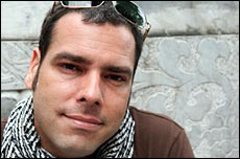
Robert Scales

'You cannot stop people from recording': Raincity's Robert Scales.

Robert Scales stands on a bustling Chinese sidewalk and waves a thin, greenish stick in front of the camera. "We're at the street food market," he says. "And this is snake."

He takes a bite. Strings of white flesh stretch taut from his mouth. "It tastes like squid almost, or something."

During the Beijing Summer Games, Scales walked the streets with cameras in hand, capturing the sights and sounds of a city gripped by Olympics frenzy.

He shot dozens of YouTube videos, wrote a fan diary for the BBC and uploaded daily photos to Flickr. He wanted to share his experiences with the world.

When Vancouver's own Olympics hit town next year, the self described "gonzo journalist" and head of locally based social media company Raincity Studios wants to do it all again.

But this time around, Scales will be part of a phenomenon on the verge of breaking huge.

Internet rules more lax than in China and a rapid proliferation of recording devices and open-source websites could mark a turning point for social media -- a prospect that has some of Vancouver's most active new media pioneers counting down the days.

"2010 is the junction," Scales told The Tyee. "I'm a fervent believer that that moment in time is going to change how we play this game."

What is social media?

In the shift from traditional media forms to something entirely new, crowd-generated content is everything. On sites such as Facebook, Flickr, and Blogspot, hundreds of millions of people connect daily to share personal experiences and document the world around them.

Kris Krug, a colleague of Scales' who blogged the Olympics in Torino and Beijing, said the idea of social media is as old as the Internet itself -- and changing just as fast. He traced a clear line through pre-Internet bulletin boards to community forums in the '90s -- from the first wave of blogging in the early 2000s to multimedia platforms such as YouTube. And most recently, the real-time updates of Twitter and Facebook.

If today's numbers are any indication, the trend is growing exponentially. Technorati has indexed 133 million blogs since 2002, Facebook boasts over 175 million active users and YouTube draws enough Americans each month to dwarf domestic Superbowl ratings.

The open source explosion is being fueled by an abundance of smart phones -- advanced mobile devices often featuring Internet and video -- which have made it simpler than ever to enter the public dialogue.

"Things are getting easier, cheaper, faster and more ubiquitous," Krug said. "If you can publish a video report to your blog in real-time you essentially have a television station in your pocket."

Why Beijing wasn't a turning point

When Krug and Scales attended the 2006 Games in Torino, the world of social media was just awakening to its potential. High-speed Internet and record bandwidth allocation made it possible to publish videos of informal street hockey games and informal interviews with Canadians abroad.

But the technology and the amount of people using it wasn't quite advanced enough to propel social media coverage into the mainstream, Krug said.

In the years to follow, a Wi-Fi boom and the wide-scale adoption of mobile units such as the iPhone -- which has sold roughly 13.7 million units since its 2007 debut -- blew the door open for real-time events coverage.

As the Beijing Olympics approached, it looked like social media could be poised to transform the way big events are documented. The Summer Games did see an unprecedented level of amateur coverage, but Internet restrictions limited its impact.

Bloggers, podcasters, cell phone videographers and social network users were dismayed to find that China blocked platforms such as Wordpress and Blogspot, while Facebook access was unreliable, Krug said.

"They crushed the infrastructure which the social media movement is built on," he said. "While the technology had advanced from Torino, and the amount of people doing it there had advanced from Torino, I don't think we quite saw Beijing fully harness the power of the age that is available."

A new model for news coverage?

Four years ago, Vancouver local Michael Tippett started NowPublic.com with the goal of building the world's largest news organization. These days, his site is a global locus of citizen journalism, with 170,000 members and up to 60,000 contributors each month.

The concept is a mix of social and information networks, where amateur news creators armed with their own recording technology share videos, photos and written reports from all corners of the planet.

At its best, this sort of coverage is more timely and visceral than traditional outlets can offer, Tippett said. When armed extremists gunned down tourists and residents in Mumbai last fall, live Twitter updates and on-the-scene footage brought the carnage to the world. In its 2008 wrap-up, NowPublic ranked the attacks as the most important user-generated news story of the year.

"You're finding that stories as they break are being told by people on the ground," Tippett said.

During the 2010 Games, anyone with a personal-recording device and an eye for breaking news can upload content to NowPublic. The site will also feature the sort of coverage Scales and Krug have helped pioneer for the past two Games: tourists experiencing Chinatown for the first time, on-the-street interviews with family members of competing athletes. "There are no limits," Tippett said, "as long as it's quality."

"What happens to the overflow?"

There's no doubt come 2010, Vancouver will be a media circus. On top of the 10,000 accredited media anticipated by VANOC, a further 3,000 "unaccredited" passes will be issued by the British Columbia International Media Centre.

Scales was accepted into this second group, and plans to show up at Robson Square Plaza each day for official briefings and meetings with other reporters -- though he'll be barred from all Olympic venues. As thrilled as he was to receive access, he's concerned that untold legions of bloggers, citizen journalists and tech-savvy spectators won't benefit from the same resources.

"What happens to the overflow?" Scales asked. "Are they not entitled to cover the same stories? Are they not entitled to have a space to collaborate?"

For the past few months, Scales and Krug have participated in talks aimed at starting an alternative media centre. The True North Media House is still a work in progress, but could see 500 Games-time passes issued to everyone from international broadcasters to figure skating bloggers. Scales and Krug envision a social media hub where pros and amateurs trade sources, avail themselves of speedy upload technology and gain access to First Nations, protest and cultural groups outside of conventional channels.

"There's going to be all these people who aren't sports journalists who are here to figure out what Vancouver's about," Krug said. "The centre is about harnessing all these individuals doing alternative or outsider coverage of the Games."

Up against the IOC

Advocates of social media often portray citizen-led coverage as a phenomenon that takes place outside traditional outlets. But come Games-time, official broadcasters still get to call the shots.

This year, the CTV-Rogers Olympic consortium caused jaws to drop when it paid the highest price in Canadian history to broadcast the 2010 Olympics. For $90 million (U.S.), the group secured exclusive rights to air events and results in Canada -- and a squadron of IOC lawyers.

In the lead-up to the Beijing Games, the committee released a set of blogging guidelines -- to be updated in April -- that recognized the legitimacy of the medium, but placed restrictions on its scope.

"The dissemination of moving images of the Games through any media, including display on the Internet, is a part of the IOC's intellectual property rights," say the rules.

"The IOC reserves the right to take any and all other measure(s) it deems fit with respect to infringements of these Guidelines, including taking legal action for monetary damages and imposing other sanctions."

If material coming out of the True North Centre falls into IOC crosshairs, Scales will be quick to comply with official orders. But given the realities of today's social media landscape, the IOC may end up fighting a losing battle.

"You cannot stop people from taking pictures with their cell phones, you cannot stop people from recording," Scales said. "It's too much. There's no way they'll be able to monitor it all."

Support social media, boost ad revenues

Rather than limit the amount of social media coverage coming out of the Games, the IOC and official broadcasters should encourage it, argued Michael Geist, a leading expert in digital policy and law based at the University of Ottawa.

His reasoning is simple. Networks need viewers to sell advertising, so the more people engaged with the Olympics, the more potential revenue.

"They ought to recognize that there's great opportunities to increase interest in their broadcasts," Geist said.

The main argument against them is that amateur recordings could erode the Olympic brand and steal viewers from rights holders. But Geist countered there's little chance a grainy cell phone video of a Games event can compete with the official high-definition footage broadcast from coast to coast.

So instead of wasting resources in a broad clampdown, he said, organizers should push athletes, spectators and bloggers to document their own eye-level Games experiences, and aggregate the content on an ad-friendly platform.

To date, VANOC and the IOC have been unreceptive to a Games-sponsored social media website, Scales said. But the social media phenomenon is gaining so much momentum, he thinks it's only a matter of time before organizers recognize the inevitable.

"The trend is going to be massive," he said. "Just as was the adoption of the cell phone and the microwave and the automobile."

Related Tyee stories:

 [Tyee]

15  Comments:

  • cboo44

    22-03-2009

    "Social Journalism"?

    Funny, I didn't read one word about "truth" or "responsibility". I'm thinking "social journalism" will be as slanted and biased as the rest of the crap we are force-fed.

  • leftofcentre

    23-03-2009

    Great...more fake news

    You pretty much have it right cboo44. "Social journalism" will only serve up the news the way the left wishes it would be. And when people actually question the validity of their "facts", they'll just be called "corporate flacks" or be accused of persecuting them.

    What the extreme left continuously forgets is that freedom of the press doesn't mean freedom from criticism. Most "Social journalism" wants to be immune from this.

  • gaulois

    23-03-2009

    Mediacheck check

    I would have thought that Maurice Cardinal's OlyBlog.com would have deserved at least a mention in this story. Looks to me like "dog eats dogs" all over again with the results it normally create. Have we not learn what happens to the predators of our media environment???

  • Jeffrey J.

    23-03-2009

    Social Journalism To Counter Fake News

    Fake news is indeed the problem. Emanating from top-down financial elites, carefully created in think tanks and PR firms, and foisted on citizens across the country, with little interest in truth or accuracy. It's no wonder monopoly driven mainstream media have an ever shrinking audience.

    Indeed, the IOC is one of the worst offenders of tightly managing an agenda that has little to do with Olympic athletes or the citizens of the local venue. As UBC Prof. Chris Shaw chronicles in Five Ring Circus, the machinations behind the Olympics is really about generating profits and real estate deveopment. http://www.newsociety.com/bookid/3995

    Citizen journalism will finally permit people of all walks of life, not just the elite or docile, to see multiple stories and views of the world at large. Another giant step forward for democracy. Great coverage Tyee!

  • Popin

    23-03-2009

    Left leaning blogoramma

    There is no barrier to people on the "right" of the political spectrum to use social media, web 2.0 or anything else that may come online in the future.

    Let's look at the micro situation, right here there are two comments on this story that question the article and bring up points not dealt with in the original piece.

    This simply would not happened with the traditional media of the past, we're not hoping that a letter to the editor gets printed or we make it through a call-in switchboard.

    Great question is what voices will be out there and what ethics are they using to guide themselves with?

  • scales

    23-03-2009

    Let's not jump to conclusion and assume the worst!

    My two cents. News websites such as Now Public and CNN Public Eye provide people who have valid, verified stories a place to share / a medium for distribution. People who feel they have a responsibility to cover more than what the mainstream media will cover, should be able to have a reputable venue to do their work.

    This article is about more than citizen journalism, it is about providing tools for people to share their moment, experience and live the olympic spirit. The goal here is to actually work with the local organizing committees and the IOC to provide a platform for fan and athlete to share/communicate together.

    I'm not sure why Olyblog wasn't mentioned, we certainly talked about many folks out there doing similar work and preaching the same song when we did the interview.

    Overall it is a great article, sadly we are only covering the tip of the iceberg, there is a bigger giant under this issue and until it has caught up with the rest of the world, we won't see a resolution.

  • shabbaranks

    23-03-2009

    TMI

    There's just too much. It will be overwhelming if these social-media prophecies are to be believed. Some of us will have our preferred social media outlet that we will look at. Some of our more plugged-in (conversely plugged-out from the real world around them) techno-savvy types will have a few dozen social media bookmarks that they will review and then spin off to the rest of us.

    But the majority of us will turn to the aggregator of information - the mainstream media. Oh, they will make full use of twitters and liveblogging and whatever useless superficial medium is popular at the time, but this will be merely to keep up with what the techies are threatening them with.

    I have no problem watching the evening news, or doing my morning reads of what happened last night. I for one don't need my cell phone to buzz every 7 minutes to check out what new amazing insight a twitterer has deemed worthy enough to share with the world.

    Don't believe the hype.

  • Maurice Cardinal

    23-03-2009

    Think Local Act Global

    Thanks for the mention gaulois.

    It's disappointing to read comments like those from cb004 and leftofcentre, but I appreciate wholly why they feel like they do.

    I've also been involved with developing the 2010 indie media centre, but unless people understand exactly how Olympics organizations manage news media in a Host region I'm afraid not much will change.

    The fact that The Vancouver Sun and the Globe and Mail are official Olympic sponsors/suppliers, and that this conflict of interest does not seem to bother anyone is the real story. All the rest is secondary until we deal effectively with this issue.

    I asked for a news media inquiry way back in 2006, but unfortunately, because it means news media would have to actually criticize itself, it never amounted to much. I even pitched it to The Tyee as an idea for an article, and have addressed it in posts at The Tyee.

    This is why cb004 and leftofcentre are justified in their criticism.

    Most only care until their nose bleeds.

    If anyone here wants a better understanding of the real world issues standing between social media and the Olympics, read this article posted on my blog way back in 2006 http://www.olyblog.com/f/06/ShawLeeF09282006.shtml#INQUIRY

    It will give you a sense of why everyone in Vancouver has to

    THINK LOCAL and ACT GLOBAL.

    For a more recent article that describes how to save Vancouver from 2010 and save the Olympics at the same time, read this;

    http://www.olyblog.com/f/09/GregorSaves2010F01102009.shtml

    The only way VANOC can save the 2010 Olympics is to embrace the community. Social media is all about transparency, and the IOC is all about secrecy. The IOC would like everyone to think that people are either "for" or "against" the Olympics because it gives them an opportunity to play the patriot card, but I've suggested for years there is a middle ground that has to be considered.

    For example, I'm Pro-Olympics - with a TWIST, which means I love the sport, but hate the politics.

    The fireworks are about to begin.

    Maurice Cardinal
    Editor: www.OlyBLOG.com
    Author: www.LeverageOlympicMomentum.com

  • Maurice Cardinal

    23-03-2009

    Demographics shabbaranks

    You make great points shabbaranks, but newspapers are filing for bankruptcy every day. All of them attribute it to the economy, but the real reason is that they no longer serve their customers.

    In a few years the only newspapers left will be community papers like The Courier. The rest will be history.

    We are currently experiencing the leading edge of the shift, but as you've seen over the last few months the change is growing exponential.

    You're right when you say newspapers are merely trying to fend off "techies," but the tipping point is fast approaching, and when it does arrive a divide will open between old school and the rest of us who want the truth, not a version of the news tainted by advertising dollars.

    There will be a huge leap when techies feel confident and brave enough to go after local mainstream news media and put them out of their misery.

    The challenge currently though is that too many "social media" types still get excited when the local newspaper writes them up. They still don't fully appreciate they don't need local mainstream news media to qualify their existence or drive their economic success.

    Most SocMeds still don't get that they are in competition with publishing companies that collect and distribute news, and that these big companies will not let them live out the dream of a truly open source news market.

    Ahh the ideology of youth.

    P.S. Merci Robert!

  • morechatter

    23-03-2009

    Whose got the real story?

    As Corporations and Big Advertisers look for new places to show their wears and new places to ensure their plans for the province and country are not interfered with by its local yokels as they push for a license to steal. And whose stupidity is made fun of on a continually as the rhetoric is none stop as fools rush in and take it in like Gospel and speak it like it was the truth?
    And I to have had the pleasure of being in the news on more than one occasion and truth be know in both stories there was little that rang true leaving me to doubt the credibility of the news. So a little of this and a little of that and what do you get? A story. So blog away wanna be journalists because you certainly can't do any harm but add to the already twisted news. As citizens look to the news as either an insult to their intelligence or a game of whose got the real story?

  • cboo44

    23-03-2009

    "Social Journalism"?

    You miss my point. Left, right bias we already have access to. I'd really like to see truly responsible, objective journalism.
    I'd like to read exactly what Gordo Campbell or Marc Emery SAID, not what they "seem to believe" or a slanted editorial piece masquerading as a "report". I think I have the ability and intelligence to "research" the background of someone, actions speaking louder than words. What I want is the straight goods, so I don't HAVE to hit the lefty news and then the righty news and draw an arbitrary line down the middle.

  • Maurice Cardinal

    23-03-2009

    Transparency is the key

    Transparency is the best way to lessen bias cb004.

    Everyone is biased, the issue today is how, or whether, you hide it.

    It was only recently The Vancouver Sun placed the 2010 Olympic logo on their front page.

    I've lobbied for a long time that if a newspaper is an official Olympic sponsor/supplier, and paid to tell the Olympic side of the Olympic story, they have an ethical obligation to make sure readers know their bias.

    CBC and CTV don't have a problem using the rings to identify their bias, so how come a newspaper, which purports to have such influence over our community, feels it's OK to hide their bias?

    It took way too long for The Sun to put the Olympic rings on their front page. By the time they gave in to my argument, the damage was done.

    Transparency can only be achieved by identifying who you are and who you represent.

    If you get rid of the cheaters the system will eventually correct itself.

    Some journalists claim democracy will die when newspapers die.

    On the contrary ...

    Democracy is moving to a new and better place.

    The Olympics is a perfect closed loop news system that holds great potential to illustrate to the world the bias of mainstream news media.

    I'm working hard along with people like Robert Scales and many others to make 2010 the turning point for news democracy, but if average people in Vancouver don't get on board, the accolades will go to London in 2012.

    If you want to send a message to the IOC and strike a blow for truthful news reporting tell VANOC you won't volunteer until Olympic Sponsors contribute more funds. Why should taxpayers underwrite their profit?

    Olympic sponsors generate incredible revenue, including local newspapers, and you pay for it. It's like paying a bonus to AIG VPs.

    While you're at it, the next time you hear someone making plans to volunteer for 2010, explain to them why unconditionally cooperating is hurtful to our Host community and send them to this page.

    I believe transparency is the new truth.

    Do you believe?

  • mr. globe

    24-03-2009

    the "new media"

    this is typical of the sophomoric advocates of the so-called "new journalism"....At its best, this sort of coverage is more timely and visceral than traditional outlets can offer, Tippett said.

    note "At its best"....this is true of all media, when they do something well...

    but remind me again, why a guy wandering around beijing and eating snake contributes to a new frontier of journalism....self-indulgence, thy name is blog/twitter/facebook/youtube,etc....accoutnable only to oneself...frightening!

  • DNA

    24-03-2009

    Olympics are a tv event

    I'm going to really enjoy monitoring the social media going on during the 2010 Olympics, but as big as that scene may become, it will be dwarfed by the 3 billion or so watching the competitions on regular television. It's first and last a sports competition... like the Superbowl or the World Series. All the local chatter surrounding the games will be just that... local. (Do you even remember where the Superbowl was this year? Or the World Series? Does Tampa come to mind?)

  • Maurice Cardinal

    25-03-2009

    Myth busting

    The Olympics used to be sports centric DNA, but no longer.

    The Olympics is now controlled by large corporations and they've turned it into profit centric enterprise.

    The shift occurred right after the Games in LA in 1984.

    I agree with you completely that the sports segment of the Games is a TV medium, but I think you're going to be surprised at what happens in Vancouver, or at the latest London (if we, Vancouverites, don't our act together) regarding community involvement.

    The Games are under increasing pressure to move to only one or two cities permanently, and no longer operate as a travelling show.

    The last four Games in a row have gone bust.

    How many more casualties do we need before someone at the IOC makes an ethical decision and puts the Olympics back on track? If all other businesses are moving towards ethical practices, why not the Olympics?

    Besides, all this controversy is not good for sponsors or athletes. The latest Michael Phelps incident devalued gold medal endorsements for ALL athletes.

    Last year alone 4 major Olympic sponsors quit their sponsorships. It broke an all time record for sponsors quitting.

    You can read more about it at my blog.
    http://www.olyblog.com/f/09/GregorSaves2010F01102009.shtml and here ... http://www.olyblog.com/f/08/BeersLaPointeF03062008.shtml#BOYCOTT2008

    Or go here to read what Kodak told Business Week when they cancelled their Olympic sponsorship affiliation last year.
    http://www.businessweek.com/globalbiz/content/jul2008/gb20080731_125602.htm?chan=top+news_top+news+index_global+business

    If you recall, long time Olympic sponsor Coca-Cola also took a huge hit at Beijing 2008.

    How much more punishment can sponsors endure before they all walk away. And if that happens, the Olympics end.

    Sponsors and athletes have no choice but to start acting ethically, and social media is the perfect tool to show them the error of their ways.

  • The discussion for this story is closed. No more comments can be added.