


 SHARE:
Generally, I get peeved pretty easily. However, smart meters, to my surprise, haven't irritated me as much as I thought they would. To me, the real nuisance generated by BC Hydro is a more fundamental one. It lies in the awkward knot of lines that stretch out of my house and connect me to the world. I don't fantasize dwelling in a micro-universe of self-sufficiency -- I fully understand how utopian the ideal of utter disconnection is -- but I find those wires and cables jutting out into the bushes and reaching for the nearest pole indomitably ugly.
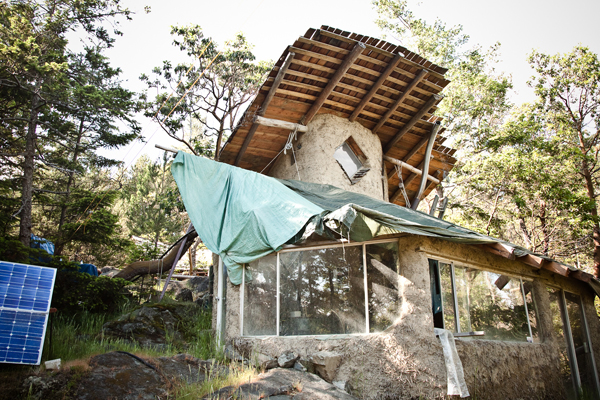
I envy Daniel. There are no lines sticking out of his off-grid house on Lasqueti Island. Until recently he used to "really live off-the grid," he tells Jonathan and me as we walk around his front yard under the lukewarm rays of a shy spring sun. He had candles for light, no phone of any kind, no Internet, and no electricity. Compared to that, his current home -- powered by solar, with no back-up generator -- is nothing special, he says.
Frugality, sustainability, self-sufficiency, resiliency, and thriftiness make up a philosophy that has come to be known as voluntary simplicity. Fueled by impulses to hamper the reach of consumerism, the urgency to reduce dependence on non-renewables, and the desire for "downshifting," voluntary simplicity has gained many proselytes lately. "Voluntary" refers to a deliberate choice: a realization that global society has spun out of control due to its voracious addiction to consumption. "Simplicity" refers to a drastic willed curtailment of the so-called unnecessary complications of everyday life.
Living simply, off the grid, is not for everybody, Daniel says. "Never mind being off BC Hydro; if you want to understand if you can pull it off, you should try it and go for a week or two without electricity of any kind. No appliances, no phone, no internet, nothing at all. If you can make it, and if you enjoy it, then you can be off the grid, I mean, really off the grid."
If there is anyone that BC Hydro really irked even before the smart meter debacle that would be Lasqueti Island. The story -- though, as everything else on Lasqueti, the "correct version" really depends on whom you ask -- goes like this. Two different bundles of electricity lines were being laid out around the island in the 1970s. One was connecting scattered communities north of Parksville to the rest of the Vancouver Island grid while the other was stretching the provincial grid throughout the Sunshine Coast. As BC Hydro engineers were about to connect to the grid to Texada Island the offer was put to Lasquetians to be on the electricity grid as well.
It was a simple proposition; the line was going to connect Vancouver Island, Texada Island, and the Sunshine Coast anyway, and Lasqueti was just going to be a few extra meters along the route. But, Lasquetians said, "No, thanks." They did not want the trappings of power. "We were angry," Daniel relays the story, "and we scared them off. They were caught by surprise. They thought we were insane, and they left." Like other voluntary simplifiers, many of the off-gridders Jonathan and I meet on our travels strive to reduce dependence on non-renewables and take an active role in smaller scale living. Not every off-gridder lives it this way, but being off-grids potentially epitomizes these two values, allowing disconnection from the infrastructures that make it easy to consume. A strong do-it-yourself ethic quenches all that thirst for dependence.
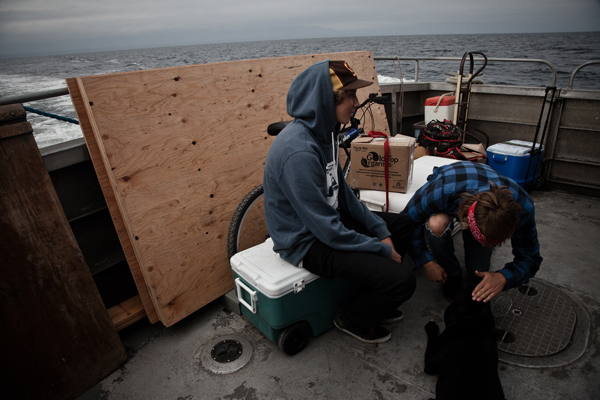
Daniel built his home himself. Thanks to his job he had almost unlimited access to spare wood, so he easily obtained building material for a nominal fee. Roofing material was a different story. "When you have little money to buy roofing material, but have a lot of wood for the framing and the sides of the house," he explains with a grin, "it makes sense to build vertically -- that way you get a big house and don't have to worry about paying for a big roof!" The result is a tower-like structure that defies the architectural imagination.
With little money to spare, Daniel saw no point in installing a septic tank and septic field. Besides, like many other Lasquetians, he believes that nobody in their right mind should urinate and defecate inside their own home, throw precious water on it, and then send all that to waste. So an outhouse -- decorated by a wavy wooden roof that too qualifies as an architectural wonder -- is where Daniel and his family do their business.
This potty behavior may seem odd to the contemporary urban reader, but we need to remind ourselves that flush toilets were not always available to our society. One of the reasons why they became so popular was, presumably, because they enabled us to forget where our shit goes. When we flush away urine or feces we do not think about what happens next. Living off-grid brings these issues to the everyday consciousness of homeowners in a very carnal way.
Daniel has to be mindful of monitoring the accumulation of feces in the compost containers below his outhouse, and when a critical level is reached he needs to empty the bucket in strategic ways. When properly treated human fecal matter can work as manure, and can be especially effective for fruit trees. Rather than flushing it all away and forgetting about it, Daniel and other off-gridders circulate humanure around the eco-system of their homes, from intestine back to intestine.
Similarly attuned to his own domestic ecology is Dave. Dave's house lies on the northern end of the island, some 15 kilometres away from our cabin, up an incredibly steep hill that not even our lowest gear can conquer. Drenched in sweat, gasping for oxygen, Paul and I lay down for a while on the side of the road to recompose ourselves before abandoning our bikes in a small ditch for the final walking stretch. The trail to Dave's house, carved out of low-hanging conifers overgrown over basaltic bedrock, is barely large enough for our backpacks, leading us to wonder how in the world anyone shipped here the material necessary to build a house.
Dave is a committed, well-informed environmentalist who divides his time in stretches between Vancouver and Lasqueti. He has lived on Lasqueti for nine years now, and spent most of his time here building his dream eco-friendly home. For the first six years he lived in a tent pegged down at the bottom of his property, and for the last three years he upgraded to a cob shed, to which he is now adding a green house. In the meanwhile he is working toward building the final home, just down the path.
Dave wants to rely on renewable resources to pass on his skills and values to his seven-year old daughter. Her future will be much different -- he predicts as we walk -- because life on the planet soon won't be the same as we've known.
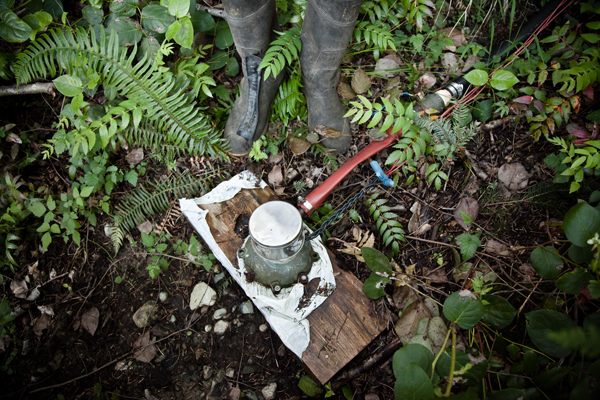
We begin our visit by the highest and sunniest point atop the rocky hill, where Dave has placed -- right on the ground, resting on the bare rock -- two small containers covered by metal and glass. Inside each of the containers is a steaming pot, which has formed a great deal of condensation on the glass side cover. Dave excuses himself for interrupting the conversation as he bends down to pick up each of the containers. He lifts them gingerly and moves them a few feet.
"You've seen these before, right?" asks Dave, sensing our curiosity.
"I don't think so," I answer, embarrassed.
Surprised Dave responds, "Oh, they're solar ovens. They work like a normal oven. I'm just cooking dinner in them. You see, the water is going to be boiling soon for the pasta in this one, and I'm making tomato sauce in the other one."
The trick is to move them around throughout the day, we learn, as the sun plays peak-a-boo with the trees as it moves east to west. Depending on cloud cover and temperature it can take anywhere from all day to less than three hours to cook a normal meal in them.
Sun ovens are not the only off-grid tools that require being moved around throughout the day and the seasons, in harmony with the movements of the sun, the clouds, the temperatures, and the winds. The angle of solar panels has to be adjusted for maximum efficiency, for example, and solar shower bags need to be shifted around, amongst many other tasks. "I plan every movement very carefully," Dave says.
And I can see why: the trail down to his cob oven is narrow and steep. Even steeper and narrower are the two paths to his micro-hydro station and 3,000 gallon water tank -- which, we learn, he "rolled" down to its current location with the help of three neighbors through the bushes. Indeed building a homestead as a whole is an exercise in choreography. From making the most of a water stream for micro-hydro power to integrating passive solar into a house heating system, building and maintaining an efficient off-grid homestead is like line-dancing with nature and technology.
Of all these movements, I must admit, no one impresses me more than his bicycle. Few, very few off-gridders are able or even willing to surrender their automobile, as off-grid homes are generally in remote locations without public transport. Unfazed by the latter challenge Dave relies on a recumbent bike to travel to downtown Vancouver. "A recumbent bike is great for your upper body," Dave remarks, "it's so comfortable that at times I almost fall asleep on it." He makes it look easy.
Simple doesn't mean uncomplicated
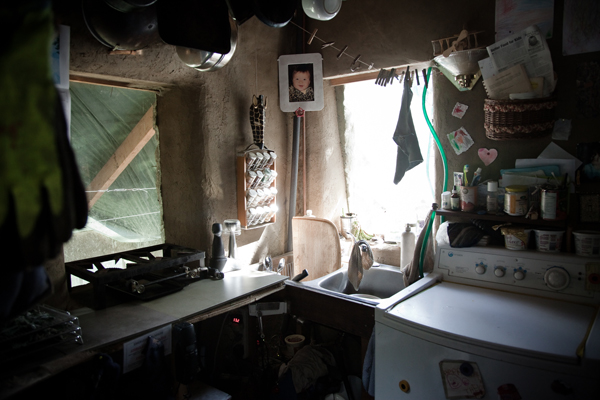
Yet living off-grids is clearly not so easy. Living on the grid is much, much easier. Flicking on a switch to light up or warm up a room requires little knowledge on the consumer's part; it simply demands she pays her monthly BC Hydro bill. Living off-grid relies instead on a deeper knowledge of the capacity of one's energy-generating system, of the precise extent of one's needs and wants measured in kilowatt/hours, and of the mechanics and ecology of one's dwelling. It's common to experience complications and difficulties, and to boot an off-gridder generally needs to make do with a bit less, or at the very least needs to wait for a sunny or windy day to satisfy basic needs.
But the simplicity invoked by many off-gridders does not consist in a state of living an uncomplicated life. Life is meant to be complicated, and it's too easy to forget this fact when living on the grid. Rather than dodging difficulties, the key to off-grid simplicity is in a conscientious freedom from guile: from the pretense that life is so necessarily damn complex that is unlivable without highly developed infrastructures and technologies.
Off-gridders are instead consciously aware that the technologies and infrastructures designed to make modern life convenient and comfortable have resulted in making us dependent, lazy, unskilled, scared to fend for ourselves, and unaware of the vast amount of resources we consume.
Daniel and Dave's lifestyle puts them back in touch with the necessary complexities of living. In that daily practice they uncover that it is actually quite normal, un-daunting, indeed even expected of a living being to put up with it all.
When you see it that way, this way of life seems even smarter than putting up with a BC Hydro meter. ![[Tyee]](/design-article.thetyee.ca/ui/img/yellowblob.png)
Read more: Environment, Urban Planning + Architecture





Tyee Commenting Guidelines
Comments that violate guidelines risk being deleted, and violations may result in a temporary or permanent user ban. Maintain the spirit of good conversation to stay in the discussion.
*Please note The Tyee is not a forum for spreading misinformation about COVID-19, denying its existence or minimizing its risk to public health.
Do:
Do not: