From BikeCamp to Bolivia, a creative new breed makes change from the bottom up.
[Editor's note: The Tyee is proud to co-publish with Rabble.ca a multi-part investigation of Maker Culture -- the do-it-yourself movement fast evolving in North America and beyond. This is episode five of 11, running Fridays.]
What happens when the political becomes personal? Then who has the power?
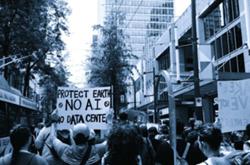
Does Stephen Harper because he's our prime minister? For sure. Does Oprah Winfrey because she's a multi-million media celebrity who likes to share her political views and ideas? Yep, she's got some sway. How about ordinary citizens who come together to champion certain causes, or try to tackle certain socio-economic problems? Do they have any political power? Darn right they do. And they're what MakerCulture politics is all about. People, united in cause, working together to spread a message and set changes in action.
Whether at the local, provincial, national or global level, examples of MakerCulture politics are everywhere. And in this episode we'll open your eyes to just some of these movements. We'll show you that political power is not limited to a select few with high profile positions. Rather, it's everywhere there's people coming together to make change happen.
London activism: Empowerment Infoshop
There's an American and Canadian flag that says "United We Fall" right above the dining room table, and a Barack Obama poster above the door with the words "You won't make change" scratched across it.
This is the headquarters of Empowerment Infoshop, a radical information centre in London, Ontario. And those are just two signs among many that show the political views of the shop.
It's not that the members dislike Americans, but they are frustrated with capitalist systems and mainstream governments. According to Anthony Verberckmoes, the facilitator of Empowerment Infoshop, he and his activist friends aren't the only ones unhappy with the current government.
"There was just a poll that came out... and 20-something per cent of the Canadians in this poll were against the capitalist system," said Verberckmoes. "I mean, that's a fifth of the Canadian population. That's an enormous number." In London, Ontario there is a growing number of activists who are taking action to make political change.
Verberckmoes is one of those activists. Common Cause is an Ontario-wide federated anarchist organization that recently added a London chapter. Verberckmoes is a member of the group as well as Alex Balch, a Fanshawe College student.
Balch says Common Cause members are putting their political plans into action. "We're trying to get a free school organized now," said Balch. "Also a lot of members are active within unions and trying to push for anarchist organizing methods and we have workshops and educational and stuff like that for the public."
Another up-and-coming organization in town is the London Activist Assembly which was created in September by a group of the University of Western Ontario Students. Heather Graham, a founding member, says the assembly, is also against capitalism and large corporations.
"The fact that everything is being turned into a business and it's very hard for individuals to promote their own skills, their own services and their own needs, separated from the consumer culture that we live in -- that's been a very big issue of ours," said Graham.
She says the assembly is largely into guerrilla campaigning which involves things like posting stickers around the city to promote their political views. Both Common Cause and the London Activist Assembly agree that with the growing number of Canadians getting frustrated with government bodies, Canadian activism is sure to increase in the coming years.
LINKS THAT HELPED MAKE THIS STORY
To find out more about London activism, check out these sites:
The Empowerment Infoshop web site
A community networking site where activists often post events and volunteer opportunities
The Common Cause anarchist organization web site
The London Activist Network, a great way to get in touch with activists in London who are from various organizations
An alternative source for London news, and as the web site puts it, "Plotting to take over City Hall since 2001"!
To find out more about bike advocacy check out these sites:
The Toronto Cyclists Union's website, which has more about the issues, events and agenda for Toronto's cyclist movement
An article that appeared in NOW magazine two days after the BikeCamp event which discusses the movement in Toronto.
The most complete directory of Critical Mass rides worldwide
The Vancouver Critical mass blog
A site for New York bike advocates, which has one of the world's largest cyclist populations.
Toronto's municipal homepage on cycling issues in the city
To find out more about the Open movement check out these sites:
The official City of Toronto site where municipal datasets are posted
An offshoot site of the Open Data TO movement where people can make requests for certain datasets to be made public, and where discussion about the data takes place
A site about the Toronto Innovation Showcase where the Open Data Toronto movement in Toronto was unleashed
The Centre for Social Innovation is an open space office building in downtown Toronto. It's home to over 100 social innovators, including Mark Kuznicki
A YouTube video series that features five videos about the rationale behind and the work coming out of the CSI
To find out more about Bolivia check out these sites:
The Democracy Center promotes social justice through reporting and has a base in Bolivia from which it reports on issues in the country
Canadian national coalition made of various groups based in Vancouver, Toronto, Montreal and Ottawa/Gatineau that support the struggle of the Bolivian people
Part one of a video produced by the Bolivia Action Solidarity Network documenting January's referendums
Part two of a video produced by the Bolivia Action Solidarity Network documenting January's referendums
A blog that documents the political changes that are happening in Bolivia
To find out more about Change Camp, check out these sites:
Change Camp is an un-conference that aims to recreate community and open dialogue between citizens and government
Information on Change Camps past and present, including conference notes and Twitter feeds
Mark Kuznicki organized the first Change Camp and works out of the Centre for Social Innovation
Dave Cournoyer is an avid blogger who covers Alberta politics and helped organize Change Camp Edmonton
Cyclist advocacy movement: bike camp
Hundreds of cyclists huddle in a cramped conference room. The room's walls are covered with pieces of paper on clipboards. At the top of each page are suggestions on how to best promote cycling issues in Toronto, followed by a series of empty dots. Jason Diceman, a facilitator for BikeCamp, yells above the crowd.
"Read these, fill in one dot to record your opinion! How many dots?" Diceman playfully asks the crowd. "One," the crowd responds. "Tell your friends!" Diceman jokes. "Fill in one dot and sign the sheet!" As Toronto's next municipal election approaches, city cyclists join forces to strategize about how to get their issues on the agenda.
The Toronto Cyclists Union (TCU) and community members met at BikeCamp in mid-October last year to outline what issues they want to push for during the 2010 mayoral race. Their strategy is decided on democratically. The TCU aims to act on those ideas which received the most dots.
What were BikeCamp's three top ideas? The first is get a segment on cycling rights and rules into Ontario's driver handbook and driving courses. Second, to promote a specific route or bike lane with support from wards across Toronto. And the last is to get cycling education in schools.
Brainstorming is the easy part, according to Margaret Hastings-James, a BikeCamp organizer and avid cyclist. The hard part is actually getting people to work on those projects. "The most important thing that will come out of today is getting some new energy. People that are interested to pick up on some specific campaigns or events and to actually run with that and make it their own project," Hastings-James explains.
Hastings-James has been a bike advocate since 2003, after she was hit by a car while cycling. Luckily her injuries weren't serious, but the accident made Margaret realize the need for more bike lanes and stricter traffic rules. Although hundreds of cyclists showed up for BikeCamp in October, only a small group donates their time to bike advocacy.
"You come and there's people here all presenting awesome ideas and then they leave the room and it's like, 'Wait a minute, who's going to implement all this?'" says Hasting-James.
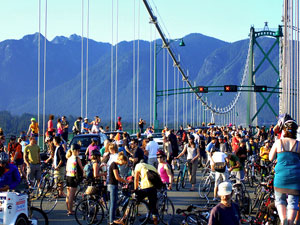
But she remains positive. Rising gas prices, concern for the environment and crowded streets have increased participation in cyclist movements. Only decades ago bike advocacy was virtually unheard of, but now attracts support from people in all walks of life.
"It's really encouraging to see a lot of new faces here today. I find that the movement in general in Toronto is changing face," said Hasting-James. "It's not the same die-hard sort of 'enviro' freak types... there's a lot of variety in people here." In only one year of operation the Toronto Cyclists Union is 730 members strong. And continues to grow.
Open data and the Age of Participation
Cell phones, digital cameras, the Internet: they are all tools of the 21st century trade that make it easy for people to capture and share content, images and ideas. Tools that make it easy for people to connect with one another, and build community.
"We can all create. We can all participate in a lot of different ways that we couldn't before," says Mark Kuznicki, a social innovator who is behind a number of political movements including ChangeCamp and OpenData Toronto.
"It's the age of participation," Kuznicki says, "and this has a huge implication for government." Citizens can come forward and get involved with political issues, and make change. A recent movement that embodies the participatory philosophy is Open Data Toronto. This November, the city of Toronto opened up its municipal data to the public. At a two-day conference called Toronto Innovation Showcase, Toronto Mayor David Miller, launched toronto.ca/open. This site hosts official datasets from the city containing information about everything from the city's wards to apartment standards to food bank services.
The posted data not only increases the city's transparency, it also fuels the creation of new software programs and applications, says Kuznicki. He explained that within 90 minutes of the mayor's announcement, a developer had created a Google Maps application. Although Kuznicki says the initial Google Maps application wasn't overly useful to Torontonians, "it shows how quickly change can happen... and shows there's an engaged community ready to do something with the raw data that's put out there."
While the Open Data Toronto movement's in its infancy, the project's a manifestation of a political movement that dates back to the time of the stoics in 3 B.C. That's when the stoics laid out the framework for anarchism, says Professor William McKercher, who teaches at Kings College in London, Ont. and has written several books about anarchy. McKercher says the stoics believed "rules should be made by the community in a non-coercive fashion."
While anarchist tendencies may have changed over time, the original anarchist notion of citizens working together to improve their state of existence is reflected in Toronto's Open Data movement.
And Kuznicki hopes the open movement will continue to pick up steam by more people accessing and analyzing the data.
"We're hoping for future events that'll be more of a hack-lab kind of a session. Where we get lots of developers and people with ideas together with data over a day or a weekend to see what we can do in a very short period of time."
Change camp
When the governor general prorogued parliament in Dec. 2008, Kuznicki realized there was something deeply wrong in Canada. The political process had devolved into petty squabbling to the point where the opposition parties couldn't even put aside their differences to form an effective coalition.
But while dialogue had broken down in Ottawa, Kuznicki noticed that people were more engaged than ever through social media, the only question was, how do you mirror online social interactions in the real world? "It's not just government that needs to change, our ideas of citizenship also need to change," Kuznicki said.
Last January, he came up with the idea for change camp, an unconference designed to get people together and get them talking. From its beginnings in Toronto, the idea has spread across the country, with Montreal, Ottawa, Vancouver and Edmonton hosting their own camps.
"It's a new citizen-style think tank," said Michael Janz, marketing director for the Edmonton Federation of Community Leagues. "You don't need to turn to the Fraser Institute or the Canadian Taxpayer's Federation. New results can be coming organically right out of the coffee shops in your community."
Janz attended Edmonton's change camp in mid-October last year, and said it's a place where socially-conscious people can get together, bounce ideas around, and come up with solutions. However, far from the providence of young radicals, change camp attracts people of all ages and interests.
"It wasn't just young people, all university students. It wasn't just all tech people. There was a real mix of students, people from the public service, people from the private sector -- people who were just interested," said Dave Cournoyer, a political blogger based in Edmonton. "They knew that something was going on and they wanted to discuss how things could happen differently."
Because the movement is still in its infancy, it's difficult to see the products of change camp. However, Chris LaBossiere, one of the organizers behind Edmonton's camp, said a successful change camp event is its own product.
"We wanted people in the room, and we got that," said LaBossiere. "We just wanted this great discussion, and we wanted people to walk out knowing more people who care about the same topics, and we really feel that we succeeded."
International movements: Bolivia
Grassroots political change is happening much further afield too. Bolivians took matters into their own hands and elected their first indigenous president, Evo Morales, in 2005.
Morales became president after a series of social movements that mobilized the indigenous population of the country. And he handily won the election there in early December last year. Bolivia is an example of a participatory democracy. In December, 2009 Morales won two thirds of the Senate and a strong majority in the House. There was over 80 per cent voter turnout in the 2005 elections.
According to Elections Canada, the Canadian federal election in 2008 only saw 58.8 per cent voter turnout. The activist group Toronto Bolivia Solidarity is trying to change the way people in Canada look at government and democracy.
They sent a group to Bolivia in February of last year to cover the referendum that took place -- and saw a change in their constitution allowing the indigenous people to have more power within the government. Raul Burbano is a member of Toronto Bolivia Solidarity. He will be travelling down south to document the political process surrounding the elections in December.
"We've seen the people and grassroots taking power, not through traditional institutions, through their own. The most interesting component is that it's done peacefully. Non-violent through democratic means," he said.
Burbano also wants Canadians to learn from the documentary his group will be producing and be motivated to participate more in their own political process. "I think Canadians can learn a lot from the concept of participatory democracy," he said. "We see a political apathy not just by Canadians, it's a phenomenon that's taking place in the North because people don't trust political parties, they don't feel that there is an alternative," he added.
Bolivians are taking the democratic into their own hands to effect change. Evo Morales came to power as an opposition leader who spoke out against the United States. He gained a significant amount of power in 2002 after the U.S. ambassador to Bolivia told Bolivians that a vote for Morales meant that aid from the United States would be put in jeopardy, said Jose Antonio Lucero, an assistant professor of International Studies at the Henry M. Jackson School of International Studies at the University of Washington in Seattle.
There are critics of Evo Morales out there, Lucero said, but their criticisms will not be enough to remove him from power. "In a country that is as polarized as Bolivia is right now even indigenous folks who have their critiques aren't about to abandon him for folks who are opposing him," Lucero said.
It turns out Lucero was right. Evo was re-elected on Dec. 6, with 63 per cent of the vote. ![[Tyee]](http://thetyee.cachefly.net/ui/img/ico_fishie.png)
Katie Atkinson, Andrea Damiano, Shannon Kelley, Conal Pierse and Alana Power are students in the MA Journalism program at the University of Western Ontario in London, Ontario.
25
Login or register to post comments
seth
3 years ago
activists vs thumpers
The problem is Harper and Campbell don't give a rat's ass about activists. The more you protest the more you scare their core support and more solid it gets.
You need to direct your resources more effectively at consolidating the left.
Here's the program:
1) 50% of you instead of protesting buy BC or fed liberal memberships. You show up at meetings and you vote out all the cons. You elect your homey's as delegates, go to conventions, and pass progressive agendas. You boot the Campbell cons from the BCLibs and backrooms boys from the fed Liberal party. Boot Iggy if he doesn't toe the line.
2) Send 10% of your protesters over to the green party and overwhelm the stupid irresponsible activists that run that organization and change its mandate to a lobbying organization like the Canadian Taxpayers Federation. No more candidates no more splitting the progressive vote.
3) In a similar fashion send 40% of your protesters over to the NDP party and get control or that party. Move a cooperate with the new Liberal brothers and sisters agenda. In ridings where NDP support is strong the Liberals run no or weak candidates. The NDP brothers and sisters return the favor.
Right now the Cons are owned by the evangelical movement. The vast majority of their members and MP's are evangelicals. They can get 100K people out to riding associations overnight. You can't beat them that way like David Orchard did years back.
Read this article for inspiration.
http://www.straight.com/article-281991/vancouver/defeatist-democrats-and-lethargic-left
There are lots of real Liberals in the Liberal party and they need your help!!!
Instead of organizing protests (other than for publicity), use a core leadership group to keep track of political party meetings, conventions, and nomination meetings nation wide provincial and federal. Use some sort of bot to send messages to facebook adherents reminding them when a relevant political party event is taking place in their riding along with a suggested plan of action.
The Liberal, NDP, and Green parties have so few active members a well run facebook group with dedicated members could take these organizations over easily.
If a small fraction of protesters grew a pair and did something effective instead of waving signs, we could get Canada and BC on the way to recovery.
alive
3 years ago
it would take a revolution
The capitalistic system will continue as long as people keep buying the products they push.
There are co-op organizations, but very few people bother to join --- does that tell a story?
Van Isle
3 years ago
We haven't had a capitalist
We haven't had a capitalist system for guite a long time; we have a corporatist system. Corporations don't believe in the basics of capitalism, they don't like competition, they like monopolies. See much competition with the oil companies? Nope, the only difference is their corporation logos. Also the little companies get no support from our Governments. Guess who gets the tax breaks? Certainly not the little guy.
ME2
3 years ago
definitions, please
And Co-ops aren't part of "the Capitalist system", Alive? ROFLOL
ME2
3 years ago
more definitions
Pardon me Van Isle, but are you aware that there are three basic methods of implementing Capitalism - Fascism, Socialism, and Communism?
If none of these suit you, what would you replace Capitalism with?
anarcho
3 years ago
Excuse me ME2!
Saying that socialism is capitalism is a kind of oxymoron. Capitalism is based upon: 1. The means of production are owned and controlled by a small minority. 2. People are forced to sell their labour power to the owners of this wealth. 3. they have no say over the work process or where the wealth they create goes. 4. The goal of capitalism is maximization of profit. 5. Large scale organization is hierarchical, centralized and authoritarian.
Socialism seeks to 1. return the property to the people 2. Have the workers democratically run industry. 3. The goal is solidarity and mutual aid.
4. Large scale through federalism
Coops are democratically run, but not all are worker coops of course. With cops the property belongs to the members and not a tiny group. The goals of coops are solidarity and mutual aid. Large scale coops are federal in structure, not authoritarian centralism. Coops do exist within capitalism, but then so does everything else...
anarcho
3 years ago
Nice to see...
Good to see anarchism taken seriously in the Tyee. What is not explained is the Common Cause is a class struggle, working class oriented anarchist group and adheres to the Platformist concept. (Platformism is a form of anarchism that developed as a response to the repression of the anarchists by the Bolsheviks in Russian Revolution and emphasizes the need for a disciplined organization.
ME2
3 years ago
Why is it so difficult for so many people to understand this?
Sorry Anarcho, you are wrong on all counts except one, in describing Capitalism. Capitalism is not a political theory, it is an ECONOMIC system which ALL modern political theories, including Communism, must employ because of your definition #4.
"4. The goal of capitalism is maximization of profit."
Capitalim is just a tool, and needs only a regulatory system and no perticular social theory to make it work. Nobody but nobody is going to do away with Capitalism. Until you understand that simple truth, all you are doing is playing into the hands of the Capitalists.
There are three basic political/social methods of employing and at the same time controlling the economic tool of Capitalism, and they are, as I noted above, Fascism, Socialism and Communism. What you are protesting against is Fascism, and until you can clearly make that distinction, you are only pissing into the wind.
Fiat lux
3 years ago
We're self sufficient in
We're self sufficient in many ways and it paid off big in our old age.
The problem is that all we can hear from young people these days is:"Why should I make anything, when I can buy it?" or "Why should I read a book, when I can watch TV?"
All people want is "jobs, jobs, jobs" so they can buy things.
This Olympic hysteria is a good example: I know the millions of mittens people are proudly waving around, have been made in China but how many of the uniforms and other paraphernalia, even the flags people are waving, have been made in Canada ?
The whole phony capitalist system is bloody sick and about time for it to collapse, as its idiot twin, communism, has collapsed in its own corrupt pile of crap, so people can become living, working and creative human beings once again.
Ed Deak.
anarcho
3 years ago
The ethical vs. the amoral
The difference between a capitalist and a progressive non-capitalist economy is the difference between an economy with an ethical basis and one that is totally amoral. The maximization of profit is not a goal of non-capitalist economies. Other things such as production of useful items, service to the membership, solidarity, internal democracy, quality of goods and services etc., takes priority. Coops typically put service, solidarity and internal democracy ahead of maximization of profits. So do fair trade organizations.
alive
3 years ago
word splitters
Thanks for the support anarcho.
Maybe you have noticed that ME2 likes to hang his hat on definitions but fails to get the general idea of any comment?
Personally I do not care how you define capitalism for me it as all describing how a few wealthy organizations manage to screw the rest of us.
To me co-ops is one way we can try to get products we need, without being fed ratshit by the usual scources.
My point was that people protest, but are so accustumed to selecting their brand name products, that any co-op still is bound to have to deal with those firms.
Fiat lux
3 years ago
It also depends what we call
It also depends what we call "cooperatives"?
The Soviet industries and kolkhozes were also called cooperatives, but were the biggest slave drivers, with "norms" and Stakhanovists etc.
I was working with a guy once, in Austria, who was late for work twice in one of the Soviet cooperatives and sentenced to the gulags as a "saboteur", freed by the Germans.
Cooperation, not competition is the best economic system and cooperatives can be a very good part of them provided they don't kill private initiative.
There's nothing wrong with private enterprise as long as it is at a limited scale and ensured that the workers are paid and treated respectfully.
I was en employer of tradesmen in Vancouver for 22 years, often the lowest paid in the shop, lower than the apprentices, but even years later my guys told me that it was the happiest job they ever had.
But what we have today are monster mega corporations collectivizing, enslaving the world, like communist politbureaus used to do, making people incompetent so they won't be able to stand on their own feet.
Here's an interesting video from Haiti, showing what the "foreign investors" and "industrialization" have done to the country and how , at least some people are beginning to wake up. Perhaps they can even force their puppet government not to lick the boots of the colonizers.
http://www.commondreams.org/print/52761
Ed Deak.
ME2
3 years ago
There's no reasoning with ideologues.
I believe that Sociallism is the only possible method of controlling the abuses of unregulated Capitalism, aka Fascism. Just in case you two boneheads haven't noticed, that is precisely the argument being fought over in the US at the moment.
Here in Canada, we're nowhere near having that argument, since our one Socialist party is deathly afraid to utter either of the words "Socialist" or "Fascist", lest they frighten away the middle-of-the-road voter.
And BTW, I hope that if either of you decide to sell your house, or your car, you'll be sure not to act like filthy Capitalists and take a profit on either. ROFLOL
silvervalley
3 years ago
Common Cause relations
I wonder if the Common Cause mentioned above has any relationship to the Common Cause started in the US by John W. Gardner, former President of the Carnegie Corporation and CFR member? He oversaw the preparation of an important report published by the Rockefeller Brothers Fund, The Pursuit of Excellence: Education and the Future of America.
http://en.wikipedia.org/wiki/John_W._Gardner
Also wonder about possible relationship to Common Purpose in UK.
http://en.wikipedia.org/wiki/Common_Purpose_UK
zalm
3 years ago
ME2
Are you sure you're not defining "money" instead of capitalism? And I'm pretty sure communism is merely "the establishment of the socialist order by means of violent overthrow of the governing order". It doesn't stand on its own as an economic system.
anarcho
3 years ago
Please read ME2
ME2, it would be good if you actually read what I wrote. I wrote MAXIMIZATION of profits. I didn't say NO profits. No system could stand that consumed more than it produced or did not set aside something for repairs, raw materials etc. Put it this way Suppose you could make 10% profits and not harm anyone and make 20% through slave labour. An ethical approach would be the first choice. The profit maximization choice would be the second.
anarcho
3 years ago
Different Common Cause
No this is a different common cause group - an anarchist or libertarian socialist group See
http://www.linchpin.ca/
Fiat lux
3 years ago
Money doesn't exist any more
Money doesn't exist any more as a traditional representation of barter. It has become crime wave.
"With bank deregulation money has become a licence for the control of energy, issued by a special interest sector for its own benefit."
The instruments of colonization and enslavement in the past have been religion and weapons. With bank deregulation certain banks are now "creating" unlimited amounts of money from the air to take control over the world's resources and enslave billions. Once again, Haiti is an excellent example of what damage the perceived power of imaginary can do. Far more than any earthquake.
If this is not a criminal racket, what is it ? Getting robbed by gunpoint has a certain reality behind the actions of the criminals, but billions enslaved by imaginary computer figures is now the biggest crime wave in human history.
As far profits are concerned, it is obvious that they're needed for the survival of businesses, but people should realize that profits are just another form of taxation and should be accountable to the public exactly the same way as any other form of taxation.
But what we have now is perennial propaganda against governments and taxation, but never a question of corporate profits, especially when they leave the country, or are used for obscene executive salaries and for more collectivization of the economy into the hands of international oligopolies and monopolies. In other words, goddamn crooks.
40-50 years ago highly paid executives were collecting $25-50,000 per year and people could survive on minimum wage, full time jobs.
With and over 1,000% inflation of living costs, the same executives should now be receiving quarter to half million per year, and not tens of millions, while forcing their employees into foodbank lines in part time, minimum wage jobs.
In 2008 the head of the Royal Bank took home over $42. million, or $23,000/hr.
This is outright theft and only one of the thousands , while millions starve.
And the way they can get away with it is because this crime wave is being taught in our universities as "economics", at the same intellectual level of nazi racial theories.
Ed Deak.
Van Isle
3 years ago
ME2
I know I'm a little late to answer your question ME2, but I have been to a few Communist Countries (not by choice but for the various companies I worked for) before they fell apart. No system whether economic or political can survive with corruption. As far as I'm concerned the best system that I have witnessed and experienced is the Scandinavian model. I have worked in a couple of those countries. It isn't perfect but a hell of a lot better than we have here and any former communist countries. Norway (4.5 million people, roughly the same as BC) for example has paid off their national debt with revenue from their oil. Looky here in Canada; natural resourses up the butt and so is our debt. The scandinavian countries have a good mix of capitalism too. Norway has more small companies per portion to population than BC has. I could goo on and on about how the scandinavian system is different but I think you've caught my drift.
John Greg
3 years ago
Fiat Lux ...
Well, I suppose so, Ed. But it's also so we can provide ourselves with shelter and food.
;)
I sure hope I see that happen before I die.
Excellent point.
ME2
3 years ago
Response to Van Isle
You and I are on the same page, Van Isle. Norway has always been my example of what is known as "Democratic Socialism" in which both the State and Capital partner for mutual benefit. Unlike the BC Liberal version of PPP's - Norway's version, as in their oil industry - returns profit to both the State and Industry, not just to Industry, as with Campbell's RoRs.
Not only does Norway have no national debt, it also has the world's largest Capital Reserve Fund - some $500 billion when I researched it a couple of years back.
It was #2, behind the California State Teachers Pension fund back then, but the FASCIST'S (capitalised for the benefit of those two donkeys above) "Meltdown" fixed that.
Those ideologues who insist that Norway hasn't gone anywhere near far enough, must realise Norway is just an outpost in an European Fascist milieu that is hostile to fundamental Socialist principles concerning economics.
That situation is far worse here in North America, but it good to note that South Americans are catching on.
greengreen
3 years ago
Anarchy?
Am I to believe that political activity is anarchism. That democracy means giving all power to the elected few and letting those few do as they please as we sit on our asses and do nothing? To me, this article provided a fine example of democracy in action, those being governed influencing those doing the governing. This is hardly anarchy although those in power may like to have it perceived this way so that we remain passive and uninvolved.
Have those on the "right" who have held the power for quite some time, achieved their success through anarchism? No,,,they set out "to take over" and through infiltrating business, universities, media etc. gained influence to get their way. They won-democracy in action.
Van Isle
3 years ago
ME2
As your probably aware, it's interesting to note that Norway has had 2 referendums to join the EU. It was overwhemingly shot down both times. I think thats the key in why Norway is doing so well is that they're independent. The Prime Minister at the time Gro Harlem Bruntland was very much in favour of joining the EU. They do have an agreement with other Nordic nations but it is no way like the EU agreement. The other country that is doing OK is Switzerland; again, no foreign trading agreements. Hell, they only joined the UN within the last 10 years and only with observer status.
anarcho
3 years ago
Please read about anarchism before you make assumptions
Greengreen, actually you and I probably don't differ all that much. But anarchism is not chaos or disorder. Please read up on it instead of assuming the "received wisdom" is correct. (Received wisdom is virtually always wrong!) Start with the Anarchist FAQ or even Wikipedia on "anarchist theory." Put in a nutshell anarchism is not disorder but maximization of direct democracy and self-management. The other name for it is "libertarian socialism" ie a socialism based upon cooperatives and not the state.
greengreen
3 years ago
Anarchy?
Thanks for your input, anarcho. Having taken your advice,(reading up) I am still a little confused.....is any action against "government" considered a form of anarchism? I think I have always associated anarchism with some form of "overthrowing" a gov't-an action(s) that, not necessarily violent, pretty dramatic. Is one walking down the street with a placard an anarchist? Perhaps the term has a more general application than I have usually assumed. Again, thanks for your input.