

 SHARE:
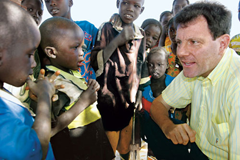
How do you create compassion? What does it take to make us help those in need? New York Times reporter Nicholas Kristof reads the scientific research, and the news isn't exactly encouraging.
We'll give if we're shown a photo of an African child in need. Show us two, and the giving diminishes. Add some statistics, and the giving drops dramatically. Give us the statistics only, and we turn away. Call it evolutionary psychology. Or as Stephen Colbert said to Kristof, why should Americans care about what happens beyond their borders?
Not long after his interview with Colbert, Kristof wrote a column about a Darfur puppy to highlight the issue. Yet while Kristof uses the techniques of all those adopt-a-child aid programs as he tries make us care about the world's human rights crises, he works for the New York Times, so he has to provide a little context.
In Eric Metzger's documentary Reporter (trailer below), we follow Kristof to the Congo, where 5.4 million people have died in the last decade as a consequence of conflict -- making it the most lethal since the Second World War. The human face Kristof uses on this trip to dramatize the Congo crisis belongs to Yohanita, who developed an infection after a nasty fall and couldn't get the medical help she needed because of the civil unrest. Hers is an unremarkable Congo death -- one that hardly resonates on the six o'clock news.
Kristof had better luck in Darfur. His relentless coverage is widely credited with bringing that humanitarian crisis to world attention, and it garnered him his second Pulitzer Prize. The world hasn't solved the Darfur crisis, but we've saved a lot of lives. Nicholas Kristof has saved a lot of lives.
Creating a culture of giving
Charles Annenberg Weingarten has similar goals, but he takes a slightly different tack. He wants to make us care about people like Nicholas Kristof, so we might become more like him. He wants to inspire us by showing us what's possible, by showing us good things where we least expect them. "I try to replace fear with trust."
Annenberg Weingarten, who will speak and show some of his own short films at the VanCity Theatre on Thursday, June 11, in conjunction with a screening of Reporter, recently visited Darfur. He said the six o'clock news gives us no meaningful sense of the place. "The Darfur I saw and the Darfur you see are two different Darfurs." Sure, the area is wracked by conflict. "War is a powerful business model." But despite the distress, Annenberg Weingarten said, "the place that's supposed to be the scariest was actually the most welcoming. They have nothing, but they live like they have everything."
Annenberg Weingarten is one of five family trustees of the Annenberg Foundation, which ranks 11th in the U.S. in terms of charitable giving, and has doled out more than $4 billion in grants since it was created in 1989 with a third of the proceeds from the sale of the Annenberg family's Triangle Publications. Annenberg Weingarte'’s Explore Philanthropy is a foundation offshoot with a dual mandate. Explore's short films, available on the Internet, showcase charitable work around the globe. The travel involved in making the films helps Explore identify opportunities for its own charitable giving.
Time matters more than money
However, it's not giving so much as his mission to create a culture of giving that motivates Annenberg Weingarten. Ask him about the blow delivered to foundations by the stock market collapse, and he shakes off the concerns. "We immediately associate philanthropy with money," he said on the phone Tuesday, as he prepared for a day trip with Sam Sullivan to Bowen Island. "What's more important than money is time. Forget giving money. Personalize philanthropy. There is intrinsic value in getting outside of yourself and helping others."
Annenberg Weingarten laments that governments forgo a lot of tax revenue if you donate cash or stock but if you give your time the government offers no reward. "There should be more incentives to be of public service."
In 2007, according to Statistics Canada, 84 per cent of Canadians donated money (about $10 billion, with religious organizations getting nearly half). Just 45 per cent of us donated time (although those who did gave a staggering 2.1 billion hours, the equivalent of 1.1 million full-time jobs).
Annenberg Weingarten wants us all to walk into a soup kitchen. It might even help us replace a little fear with a measure of trust.
Explore Philanthropy's mission fits well with the overarching aim of the Annenberg Foundation of better communication. The foundation funds education programs at all levels, from elementary-school language programs to advanced training for journalists. But its grants really know no boundaries, and Annenberg Weingarten -- whose mother's family comes from Newmarket, Ontario -- says his own work with Explore has strong B.C. connections.
Funding the underdogs
Those local connections began with First Nations work and continued with the Sam Sullivan Disability Foundation. When the Inner Change Charitable Society, which Sullivan has championed, began its work on drug substitution research trials, Explore assisted with a $175,000 grant. Annenberg Weingarten sees Vancouver, which he situates not in Canada so much as in the Pacific Northwest region of the Americas, as "a pearl" and a pivotal place in our global future.
And while Explore gives to some of the usual local suspects -- the Museum of Anthropology, the Vancouver Aquarium -- he likes the "talented underdog", which explains Explore's funding for Sam Sullivan's favoured projects, assisting the disabled and drug addicts. It also explains funding for two iconoclasts working on Orca research on either side of the border -- Ken Balcom and Paul Spong.
Balcom's Center for Whale Research in the San Juan Islands has drawn attention to the damage that sonar can inflict on Orcas and other members of the dolphin family. Spong is a Vancouver Aquarium outcast who opposed keeping Orcas in captivity long before it was fashionable, and his Orca Lab on Hanson Island in Johnstone Strait has been a key organization in developing our understanding of these iconic creatures. Annenberg Weingarten's Orca Guardians is among the four short films that will screen at the VanCity Theatre.
But whether the subject is education for the poor, protection for species at risk, or catastrophic human conflict, all the films in program exemplify the quote that opens Reporter: "If I look at the mass, I will never act. If I look at the one, I will." ![[Tyee]](/design-article.thetyee.ca/ui/img/yellowblob.png)
Read more: Rights + Justice







Tyee Commenting Guidelines
Comments that violate guidelines risk being deleted, and violations may result in a temporary or permanent user ban. Maintain the spirit of good conversation to stay in the discussion.
*Please note The Tyee is not a forum for spreading misinformation about COVID-19, denying its existence or minimizing its risk to public health.
Do:
Do not: