Life

Working out with Heavyweights of Physics

What I learned about supersolids, our possible Martian origins, and more.

By David Secko, 26 May 2005, TheTyee.ca

collider

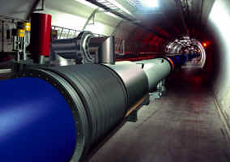
CERN’s Large Hadron Collider

Physicists can be a hard breed to pin down. Most tend to breathe mathematics, universal constants and experimental proof, and rarely do they deign to translate for the lay person. But recently some of the brightest minds in physics hit Vancouver, brought by the Pacific Institute of Theoretical Physics (a kind of physics talent agency) to UBC to speak, share and experiment with peers. One of the promises of their stay: three lectures directed towards the public.

I found that hard to resist. I have just one university level physics course under my belt, which is enough to stoke my curiosity but not to guarantee I'd understand much of anything said. As it turns out my curiosity was more than rewarded. The three scientists spoke of liquids that flow up walls, how to look into an atom and why we may all be Martians. Their talks were complicated at times, but each spoke directly to the need of the human mind to understand the universe.

Accept here, please, my best attempt to share their thinking with readers of The Tyee.

A frictionless contraption

Moses Chan, an experimental physicist and professor at Penn State, came to Vancouver to speak of a remarkable thing -- liquids and solids that don't experience friction.

Upon entering the lecture hall for Chan's talk, I beheld two metal plates suspended from a bar. In unison, these plates were slightly rotating from side to side, a video camera projecting their movements onto a large white screen.

The only clue to the purpose of this contraption was Chan's lecture title: "Einstein's legacy in low temperature physics; superfluids and supersolids". (Chan would later confess that although Einstein had a lot to do with low temperature physics, he did partly use his name to draw people into attending the lecture.)

Turns out this contraption is called a "torsional pendulum." Chan and his UBC colleague Walter Hardy, who machined the pendulum specifically for the lecture, used it to demonstrate the idea of superfluids -- a mysterious fluid that lacks friction and can flow up the sides of a cup.

I understood quickly why Chan's UBC colleague Philip Stamp, a Professor of Physics and Astronomy, calls him "quite a character," as Chan began to poke fun at Hardy, a physicist whose papers he was forced to read as a student and who was now acting as his assistant for the demonstration. "This is a highlight for me," said Chan.

The idea of the demonstration is that in a normal situation when you twist the bottom plate the top plate twists too, but in the case of a superfluid, when the bottom plate twists the top plate stays still because it lacks any friction.

So far so good, I understood that the lack of friction would allow the superfluid to be pulled up the walls of a cup. This is because a cup is covered with a microscope layer of the superfluid-like any cup with liquid in it, says Chan -- which is no longer held stationary by friction and begins to flow.

Chan and his colleagues recently discovered a solid, termed a supersolid, which does the same thing. "This loss of viscosity allows it [the supersolid] to move through a pore that is 70 angstroms," says Chan, "a normal fluid or solid would get instantly stuck." An angstrom is small too, in relation to a human hair, about 500,000 times smaller. These fluids and solids are definitely doing things normal matter can't.

"This is a spectacular discovery that most people believed to be impossible," says Stamp. Many people believe that Chan will one day win the Nobel Prize for finding a supersolid.

Little stuff, big eyes

Such oddities of matter are one thing, but understanding what this matter is made up of is another. In the second talk, Gerard 't Hooft, a Nobel Prize winner in 1999, tried to explain how we (or physicists at least) know what we know about the building blocks of matter -- information that could only come from gigantic and powerful machines.

't Hooft's talk was a tough one. Although he is a well-known figure in physics, in part due to the fact that he completed the work that would win him a Nobel Prize before finishing graduate school, 't Hooft faced the task of explaining a math-laden field of elementary particles to me. Nevertheless, he got me thinking about what would fall out if you cracked an atom like an egg.

"The universe is beautiful and spacious," says 't Hooft, from the Royal Dutch Academy of Sciences. "But there is also a whole universe within the atom," he says. This universe includes many particles, from quarks to gluons to photons, as well as 23 constants and natural laws.

Really understanding how these particles and forces work requires a lot of math, which 't Hooft declined to go into, and this was probably for the best, my seat that day was near the door. Nevertheless, theoretical work has organized elementary particles, and their interactions, into a 'standard model'. But it's much more than a model, says 't Hooft with some emphasis, it is a very accurate representation of reality.

The standard model provides guidance to physicists looking to study or find elementary particles. While my mind grasped to understand this, 't Hooft asked an interesting question that often passes people by: "If you want to study tiny things [like elementary particles], why not build tiny machines?"

Today, experimental physicists use huge particle accelerators -- the Large Hadron Collider at CERN is 27 km circle -- and particle detectors, which can be five times as tall as a human, to study elementary particles. But why are they so big?

Turns out, "the smaller things are the bigger eye you need," says 't Hooft. To study the atom (and thereby verify the 'standard model') you therefore need very large machines.

Are we from Mars?

In the last talk, Paul Davies made the intriguing suggestion that maybe life didn't start on Earth at all. Instead, Mars could be our ancestral home.

Davies', a cosmologist at the Australian Centre for Astrobiology, is already a media star, having authored several popular books over the years, including How to Build a Time Machine. And it showed in the heavy attendance at this talk and light tone he struck while tackling the question of the "origin of life".

"Why should we care about the origin of life," asks Davies. Well, it leads to one of the deepest philosophical questions around, "Are we alone in the universe?" Currently, we are quite ignorant of the answer to this idea, says Davies.

However, part of the answer lies in whether life originated on Earth, or somewhere else in the Universe and subsequently seeded our planet. The reason this is even a question, explains Davies, is due to the paradox that life appeared on Earth during a period of heavy bombardment with asteroids. A period not that conducive to the formation of life, says Davies.

Instead, Davies suggests that Mars was a much better place to start life. An idea bolstered by recent evidence suggesting that Mars has water.

"If life did start on Mars, than I think it is inevitable that it would have come to Earth," says Davies. The reason for that is that asteroid impacts would have sent rocks with life of it to Earth, he adds. Martian meteors have been found on Earth, but it is not yet clear whether they could have carried life here.

Answers to our origins may therefore lay in a future trip to the Red Planet, says Davies.

Who cares?

No matter which way you cut it, physics lectures are always going to be somewhat cerebral. But, they also have a knack for surprising you.

Many non-physicists attending the PIPT talks, like me, were left scratching their heads at moments, only to be pleasantly surprised seconds later by an interesting revelation. At the end of Chan's talk, one fellow asked: "I appear to be the only non-physicist here, but what is the practical application of supersolids?"

A slight smile on his face, Chan replied, "There is no practical application." Not yet at least. Nevertheless, its intellectual interest appears to be infinite.

It is this pure intellectual interest that often blocks experimental and theoretical physics from discussion in the public domain. And to be fair, physics is also difficult to understand at times. Nevertheless, I did get a few nuggets out of the each lecture. I therefore think the PIPT is doing a good public service in bringing physicists to Vancouver.

On my walk home, I mused about how little the average person is exposed to the fascinating thinking discussed in the lectures. Maybe we worry we'll strain ourselves by trying to pick up such big ideas. If so, that's too bad. After all, as Albert Einstein said, "the whole of science is nothing more than a refinement of everyday thinking."

(For those interested to learn more, the PIPT website is rich with information.)

Dave Secko is on staff at The Tyee.  [Tyee]

34  Comments:

Login or register to post comments

  • Truman Green

    7 years ago

    Comments on "Working out with Heavyweights of Physics"

    I'm very happy to see this kind of stuff on the Tyee. Supersolids and superfluids, eh, well I'm still trying to understand nearly-massless neutrinos which flit around the universe going straight through anything in their way. Now I'm wondering if these strange bits are available at room temperature --or not, which would make them quite useless as your expert suggests. Reminds me of the cold fusion sensation, which turned out to be a hoax like Piltdown Man. Regarding us being Martians--now THAT suggestion might be seriously overblown. Remember when scientists discovered apparent bacteria fossils among the Martian artifacts? They turned out to be polycyclic aromatic hydrocarbons, and quite ubiquitous around here. As of yet there is no evidence of life on Mars--or of it ever having been there. Mind you, there is a lot of speculation--the entire basis for SETI and others deciding that there is other life in the universe--besides us--something which I strongly doubt. A couple of years ago I was lucky enough to engage another media star,(as your Mr. Chan) Seth Shostak, chief astronomer of SETI, in an email discussion of the liklihood of there being other life in the universe. I was intrigued to learn that the entire rationale for such life is based upon the number of planets in the universe. I pointed out to him that there can be no logical mathematical extrapolation of liklihood based upon the number 1. That is, so far we know of only one planet with life. That's pretty much a probability dead end. His response didn't convince me that he was any more impressed by my logic than I am of the Drake formula, which Drake and Sagan used to compile their cache of earthly artifacts to send into space upon Voyageurs 1 and 2. Anyway, great writing Mr. Secko. Hope to see more science writing!

  • Dungeness_Crab

    7 years ago

    Although this isn't strictly on topic, I think it deserves a mention here:

    http://www.wired.com/wired/archive/13.06/craven.html?pg=1&topic=craven&topic_set=

    This one DOES have practical applications.

  • North of Hope

    7 years ago

    An interesting article and thought provocking. With reference to the above response, I believe that ideas that are thought provocking are practical. I teach science and several of my students find many these topics provocative and interesting. It is a lot of fun to discuss them with students and they enjoy the possibilities. We love their enthusium of the theory but we must temper it the demand of proof by experimentation.

  • Bailey

    7 years ago

    Truman Green, hello again. I'm curious, where did you hear that cold fusion was a hoax? Was there a development recently?

    Last I checked, admittedly some time ago, all of the original phenomena demonstrated in the original apparatus at Brigham Young had been replicated in multiple ways by many independent researchers. As I understood the story, Pons and Fleischman, the researchers who discovered the effect, were hired by a Japanese firm, which built them a private facility in France. They seem not to publish, so I haven't heard what they do there.

    Also, not to be a stickler, but one is a perfectly adequate basis for logical extrapolation. The existence of one of anything demonstrates all the processes, circumstances and statistical probabilities necessary to lead to the existence of that thing.

    To assert that any possible structure that arose once, never arose again anywhere is so logically improbable, given the size and nature of the universe, one would have to postulate absurdities to conclude that.

    I hope you're wrong about cold fusion being a hoax. When I was very young, I observed that the world of humans was going straight to hell in a proverbial handbasket, and the synergistic amplification of crummy effects was accelerating in an exponential way.

    Alarming thoughts for a teenager. I set my mind to figure out a possible salvation for my species that didn't involve most of us dying horribly, and what I came up with was a thought. If there could be a way of getting the energy out of water catalytically, or since that would be a dangerous thing to have on a water planet, then at least cleanly, we might be saved.

    Water is rocket fuel, tremendously powerful potentially, but bound in a strong, stable molecule. I was very pleased and hopeful to hear of the cold fusion device sitting on that desk. Even more pleased when several of the first attempts to replicate the thing exploded violently, since that demonstrated the enormous energy available in a glass of water.

    Even after they were driven out of the scientific community for their cheekiness, I keep hoping that someday they'll come out with a nice, water heater sized appliance that will run your house and fuel your car, and coincidentally save the humans. They're my favourite species.

  • Truman Green

    7 years ago

    Hi, Bailey. Try googling "cold fusion hoax" and you'll get enough stuff to read for a year. It's probably the biggest hoax of all time, with the possible exception of a benevolent god or evolution by means of natural selection. As for extrapolating probability from the number one, well to me it seems so self-evidently impossibly that I hesitate to comment further. Would you like to read some of my email to and from Seth Shostak, chief astronomer at SETI? For a good laugh on this look up the DRAKE formula. It's basically mathematical much ado about nothing. Your reasoning regarding the liklihood of life in outer space is identical to Shostak's by the way, but I think I can prove to you that it's incorrect, if you wish. Good to see a bit of science on Tyee, eh. Furthermore...okay, I'll give it a shot: You write: "Also, not to be a stickler, but one is perfectly adequate basis for logical extrapolation. The existence of one of anything demonstrates all the processes, circumstances and statistical probabilities necessary to lead to the existence of that thing." The simple answer, Bailey is that the fallacy of your rationale is inherent in the statement which begs the response, "yeah, but what does it say about the existence of another?" The answer is NOTHING. A hint about cold fusion: As you know fusion, not fission (a word first borrowed by Manhattan Project types from the process of bacteria replication) is the process by which our atoms come down from the precursor hydrogen to helium singularities. If we could get it at room temperature there'd be no American troops in Iraq or Toyota Priuses running around. Energy would be basically free. As for energy in a glass of cold water. Well, we all know the mass-energy equivalency and the law of the conservation of energy. Try getting that energy out at room temperature. That's the rub. My reference to the cold-fusion-helium 4 superfluid-like supersolids is the result of the premature heralding of a discovery that has not yet been confirmed. That is, like the supposed cold fusion, no other scientists have been able to duplicate the experiment. Anyways, I'm up for more on the Drake formula and the number 1. Comments?
    Great story, Mr. Secko.

  • Peter Dimitrov

    7 years ago

    Great stuff...it brings me back to my days when I was a serious student of mathematics and physics. Here are some questions:

    All sentient life, including humans, exists within a field/ocean of 'consciousness' . Taking consciousness as a 'object' of study - what is the nature of THAT consciousness, its characteristics? How can you be sure as a scientists that you seeing an independently existing 'object' within time & space ....and not an object that exists only within the field of consciousness.

    ...of course the Sages of Buddhism and the Vedas, who have made it their pre-occupation to study the nature of mind & consciousness...have a lot to say about these matters....as does that movie "What the Bleep Do You Know"!

  • Bailey

    7 years ago

    At the time, I thought there were three main problems with cold fusion. The first was the way it was announced. It was done in a way calculated to annoy the maximum number of establishment scientists.

    There were two theories about that. One, that there were other teams working on the same effect, and the press conference was a straight credit grab, an attempt to steal a march on the competition. The flaw with that is that the controversy that was bound to generate was guaranteed to pollute the reputations of all involved, which is what actually happened.

    The other was that the researchers lives may have been in danger from those whose fortunes were committed to the energy industry. This is not so far fetched. People are killed in great numbers over control of oil, just look at the recent history of the Arabian Peninsula. Then, consider that that same year, research into hot fusion was granted nearly a trillion dollars to be going on with. Boy, were those guys pissed.

    Last, they never really found the right radiation leakage or produced the right by-products for fusion. They never should have called it fusion.

    From the first day to this day, scientists are violently split. Some are adamant. They howl fraud, and charlatan, and deny the evidence six ways from Tuesday. Others have been working on it, and as far as the publications go, they seem to have reproduced the excess heat, the gaseous emissions, all the phenomena found by the original guys, just not all in the same experiment like that.

    There's a fair analysis in Wikipedia that lists the relevant papers and such.

    http://en.wikipedia.org/wiki/Cold_fusion

  • Bailey

    7 years ago

    PS. Mr. Dimitrov! You surprize me, sir. I never knew your mind ran along thse lines.

  • skeptikool

    6 years ago

    Bailey,

    You wrote:

    "The other was that the researchers lives may have been in danger from those whose fortunes were committed to the energy industry. This is not so far fetched. People are killed in great numbers over control of oil, just look at the recent history of the Arabian Peninsula. Then, consider that that same year, research into hot fusion was granted nearly a trillion dollars to be going on with. Boy, were those guys pissed."

    Surely you don't believe that Iraq was about ahything other than democracy?

    A video well worth renting is The Saint, with Elisabeth Shue. It is very much about cold fusion, and the Russian mafia holding a freezing Moscow to ransom with hoarded fuel. I don't think I'll spoil the movie for you by telling you that, in it, the technology does work.

    It seems such a simple, table-top apparatus, that the controversy existing many years after Pons and Fleischman released their findings on cold fusion defies logic.

    Something smells terribly. One would have to be smoking some pretty powerful stuff to not realize, already, that we are victimized daily by deliberately withheld technmology.

  • Bailey

    6 years ago

    Funny how, when I looked for a way to save the world, I turned to physics. When Peter Dimitrov considers physics, he winds up at "the Sages of Buddhism and the Vedas". And when Truman Green hears about the non-practical applications of quantum physics in the world of humans, he goes straight to his favourite hoax.

    An interesting connection exists that ties all these approaches together. Quantum physics has evidence of a 'Quantum hologram'which constitutes the whole universe in a sort of bubble, where meanings and other vibrations interact just like a laser hologram, to give rise to all the phenomena that ever was or will be.

    This is simply a restating in other terms of 'the teachings of the sages of Buddhism', but it's physics, and it's exactly the kind of physics where researchers are searching for proof or disproof of Truman's favourite hoax, and my favourite hope.

  • Bailey

    6 years ago

    One other comment, Truman Green; To get energy out of a glass of water at room temperature, immerse an anode and a diode in it, seperated from each other. Power the one from the positive end and the other from the negative end of a battery. When it bubbles, collect the hydrogen and oxygen in a balloon, and burn it.

    I've done it myself, in high school. Of course you have to put in more energy than you can generate with the gases, but that ain't necessarily necessary. People do come up with remarkable stuff sometimes.

  • skeptikool

    6 years ago

    Hydrogen production by splitting water, and photovoltaic units producing direct current, as they do, seems well matched for that task.

  • Bailey

    6 years ago

    You'd need a lot of sun and a lot of water.

    You could build a pipeline, maybe.

    How much do you like Death Valley?

  • skeptikool

    6 years ago

    Like it a lot!

    Apparently more alive than here.

  • skeptikool

    6 years ago

    Seriously though, it would certainly work here today in B.C.'s Lower Mainland and probably over the whole province.

    Sadly, the energy sources of solar, tide and wave, with their potential to phase out our reliance on fossil fuels, are much neglected.

    At a Solar conference I attended at Ukia CA, I recall a gallon of chili simmering in a loosely capped jar painted flat-black, (except a small window) sitting in a cardboard box that had its top flaps open at about 45-degrees and cover in aluminum foil. I couldn't help reflecting (no pun) on seeing this, on all the tropical forests decimated so that the human inhabitants might have cooking fuel.

  • skeptikool

    6 years ago

    A very interesting article today by Jon Hykawy, Director of Technology Research at Fraser Mackenzie Ltd. in Toronto: Why hydrogen is not the super fuel of the future.

    The article reminds us that more money and energy go into the hydrogen production than it returns and that better alternatives exist, including natural gas.

    I've long maintained that much of the research around the hydrogen fuel cell has had as its priority, stock promotion. Hykawy doesn't go that far but suggests that public funding of
    of such research must be reviewed.

  • Bailey

    6 years ago

    Stock promotion is certainly part, because money is the only way to motivate people in definate directions reliably. A lot of people will have to do a lot of work to get a fuel cell that produces enough voltage for an affordable price. But it's work that will be worth it.

    I read an article long ago in a popular science magazine about a guy with a dune buggy in Ohio. In place of a carburator, he had a collar attached to a bank of coils and a water injector.

    According to Omni magazine, who drove in it and interviewed the inventor, the collar thing developed high enough energy levels to instantly split the little squirt of water into H and O2 and the rest was a standard internal combustion car engine. The dune buggy ran on water. Steam, and a trace of nitrogen were the only exhaust.

    I wonder whatever happened to that guy and his dune buggy. The article said he was showing it and giving rides to practically anybody who asked, claiming he'd turned down a fortune to suppress it. I can't remember his name now, or even what year the article appeared, but I always expected to hear more about that story.

  • skeptikool

    6 years ago

    At the same Ukia conference previously mentioned, saw a film of a similarly powered vehicle - with on-board electrolysis unit.

    Don't recall the vehicle model but did wonder what sort of range such a vehicle might have with the internal combustion engine needing to maintain considerably more battery charging capacity to afford the water conversion.

    I doubted the vehicle could perform at today's highway speeds but believe the technology has terrific hybrid potential - particularly coupled with diesel that has much less electrical demands.

  • Bailey

    6 years ago

    Your point about stock promotions is salient here. I've noticed that whatever people decide to do eventually gets done, in some fashion.

    In a hundred years of autos, they've evolved into a form that's probably several thousand times more efficient than the first one was. Because thousands of people worked to make it so.

    Same with all sorts of things, space travel, construction, electronics, all sorts of things. Basically, I think that all you really have to do to make something happen is make it profitable enough. That's the problem with the current energy system; it's just too damn profitable.

    The idiots who make all the money off it (no offense, Mr Bush, Mr Cheney) just refuse to see that they're the natural ones to develop and control the next thing, and so be even richer for longer than by defending the old way.

    But I'm quite sure that if a major effort were made to make a way to run an engine on water, we'd be running on water for sure. The energy potential is there, we're demonstrably clever enough. Exxon and Shell just doesn't think that water could be made expensive enough.

    And Exxon and Shell and the like seem to be calling the shots. Thanks again, Bush and Cheney.

  • Truman Green

    6 years ago

    Hi Bailey. Your suggestion that the government shut down cold fusion applications because of its affiliation with big energy consortiums might identify you as a conspiricist,(good word, eh, I THINK I made it up) as you have described me. However, for cold fusion to provide us with free energy there must be no external power supply in its derivation. And, of course, more energy must be produced than was advanced into the system. NO BATTERIES ALLOWED. Regarding your suggestion that finding life beyond earth is inevitable because the probabilities can be extrapolated in the same manner than we deduced the existence of one planet with life. Well, this is so strange that, on my way home from the internet cafe, (Surrey Public Library) I concluded that you were kidding. And I must say that it would have been a very witty and sophisticated joke. If, by chance, you're serious I might suggest that WE DON'T USE PROBABILITY TO DETERMINE THE REALITY OF LIFE ON ONE PLANET. My self-assurance that there is no life in THIS universe, other than our own, is derived from my personal perception of degrees of complexity. Seth Shostak, and you, have erroneously concluded that because, as he says, there are more planets in the universe than there are grains of sand on all the beaches in Canada, we can pretty well conclude that intelligent life has evolved on at least some of these planets. Similarly, there are 100 trillion cells in the human body. Each of these contains the genetic information to clone another COMPLETE copy of a human being.
    Hopefully, this is at least a primer for understanding the comlexity of one individual in one species. My favourite account of complexity (here on earth) is the following, pointed out by Jeremy Narby in The Comsmic Serpent. "If the six inches of DNA packed into the invisibly small nucleus of each of our 100 trillion cells were stretched out end to end, a jet plane traveling 1,000 kilometers per hour would fly for more than two centuries to reach it's end." According to Elizabeth Sahtouris in her World Watch Essay, "A Message to Us, From Our Genome" the human genome project updates Narby's calculations to SIX FEET of DNA which as she writes, "leaves our poor jet pilot flying continually for over 2400 years." My theory, Bailey, is that Sagan, Shostak, Drake and millions of others have all reversed traditional reasoning processes because of nothing more sophisticated than wishful thinking. A general rule of thumb has always been: THE MORE COMPLEX SOMETHING IS THE LESS LIKELY THAT MORE THAN ONE EXISTS. This only scrapes the surface of my by doubt about more intelligent life. My second class of reservations has to do with the meaning of nuclear fusion events in the last fourteen billion years producing the elements which make up the bodies of organisms--from hydrogen to helium and so on down to the heavy elements and of course, CHONPS, the major elements in our bodies. Class three reservation is the fact, as Shostak concedes, there is absolutely no evidence of life anywhere besides earth. Class four reservations have to do with the amount of time and resources that have been involved in the search. I guess I shouldn't get started on the fallacy of natural selection, which is--indirectly--the underpinning of the Drake theory and all other beliefs in life in outer space. Unless, of course, anyone is interested! Classes five and six reservations have to do with the nucleotide-protein, chicken and egg dilemna.

  • Truman Green

    6 years ago

    Oops, all those typos and spelling mistakes are sure embarassing. I guess I'm going to have to read this stuff before posting it from now on. (Second Law of Thermodynamics, eh.)

  • Bailey

    6 years ago

    That would be the one that states that the probability one made an embarrassing mistake is in inverse proportion to the amount of care one took in proofreading? Your post above requires a lot of answering, Truman.

    Conspiricist is a good word alright, I think you might have made it up, but I knew what it meant right away.

    I am one, too. You're right there. I never understood the way some people ridicule conspiricy theories. In my experience, conspiricies are one of the major types of human interaction. I've been a central conspiricist in dozens, all my life, and everybody I ever knew was too. For purposes diverse and sundry. To deceive parents or control children. To influence the behaviour of misbehaving governments, (I don't think Bush and Cheney are really the government of anything, any more than stealing a bus makes you a bus driver, they're just conspiricists). To create almost anything that requires more than two people to create requires some kind of a conspiricy.

    Nobody said cold fusion was free. Nothing is free. Energy is usually required to release energy, which to be released must already be present in potential. Batteries are always required, just rarely included.

    Your conclusion about the likelihood of other life is based on unlikely assumptions. I would say that the more complex something is, the MORE likely it is to be one of a class. When you see your first crystal, you have to realize that crystals grow. Thus conclude that the universe must be full of crystals, all kinds of crystals. Even though you only ever saw one.

    For complex structures to exist requires principles of existence that require complex structures to exist. Life exists here because life exists. The principles that lead to it are general principles. This is clear from observation of the single example. If it weren't so, it would have occurred by accident, lasted very briefly in simple form, then ceased. That didn't happen.

    Instead it grew, proliferated into every niche that could provide sufficient energy. Let's look at life from an entropic point of view.

    Entropy requires that organisation levels continually decrease. That things move generally from higher to lower levels of energy and organisation, but that's not always true. Systems exist that increase energy and organisation. First generation stars turn H into He and other higher forms, up to iron. Second generation stars continue the process, creating everything up to the trans-uranics.

    If you define life as that which acts to create higher states of energy and organisation out of lower ones, work contrary to entropy, then by that definition, stars are alive. Like creatures that take simple nutrients and sunlight and create complex living bodies. If the universe contains any at all, it contains lots.

    I once read a calculation like the DRAKE one you dislike so much. It went something like this--if the big bang had contained one ten thousandth part more energy, it would have expanded faster, dissipated, and matter would never have condensed into being. With one hundredth part less energy, it would have expanded briefly, a few tens of millions of years, then collapsed. Again, no matter comes into being. Therefore, given the initial conditions at the beginning, matter was not just possible, it was inevitable. It was required.

    The same argument can be made for life. It has to exist, given the way the universe is organised and constituted. It probably exists in whatever form, everywhere conditions exist that permit it. This is an extrapolation from the single observable example. We might not recognise it, depending on our understanding and perceptive abilities. But it's most likely there.

    It works for me. It agrees with observed phenomena. Occam's razor applies. To deny it, you have to limit your definitions to such narrow parameters they're just about squeezed free of any meanings at all.

  • Truman Green

    6 years ago

    Also, thanks to Dungeness-Crab for his link to cold water energy, a bit off the subject of cold fusion, but highly interesting. It might be more akin to geo-thermal energy, a method of using the natural heat coming up from the centre of the earth where it's 9000 degrees F. or so. (4000 miles down) Even 60 metres down its about 50 F, and this heat can be used via special vertical pipes and heat pumps to heat homes. I know of one on Semlin Drive in East Vancouver. I invite everyone to google geo-thermal!

  • Truman Green

    6 years ago

    Hi, Bailey. You're comment's rife with assumptions and tautologies. Life exists because it MUST exist? With all due respect, (and that's a lot) I think we can chop with Occam's razor all over the place. Regarding my new word, "conspiracist." Well, I once thought I invented the concept, "moral equivalency" until I saw it used by a Frumian New York writer named, Goldberg, I think, poking fun at those who claim "moral equivalency" between Sharon and Arafat. My "moral equivalency" was somewhat different--more about the need to take into account the discrepancies between the wonderfully free lives we have here in the democracies and the degeneracies in places like the DRC, which are still suffering from the Leopold twos of Western Europe, de beers massive diamond conspiracy,(hoax, that is) and the World Bank and IMF's determination to use Africa as a dumping ground, and keep it in debt and refuse to allow it to enter the world markets. (Did you happen to catch the three African delegates testifying before our Senate Foreign Relations committee a few days ago? They claim that all the foreign aid received from Canada is equal to the amount of goods purchased from Canada--a claim of equivalency that actually shocked more than one committee member. I'm trying to get the transcripts and hope to do an article on them.) I also was once sure I invented the word,"chemosynthesis" (as opposed to photosynthesis) to describe the energy source of critters like tube worms living miles beneath the surface of the ocean. (Geothermal radiation, actually). It soon popped up on NOVA. Maybe there's nothing new under the sun as Solomon claims in Ecclesiastes. Anyhow...You have written,"For complex structures to exist requires principles of existence that requires complex structures to exist. Life exists here because life exists." Bailey, I'm loath to alienate your tyee comaradie but this kind of circular reasoning is not up to the best Bailynesque traditions, and I'd invite you to stick a bit closer to the new scientific methods that have recently come into vogue. More to the point, when scientists have discovered two or three planets containing life, we may begin to employ our probability concepts regarding our a prior theories of "suitable conditions" with which to judge the liklihood of there being MORE planets containing life. While we have only 1, probability does not really come into play, regardless of your strange doggedness.

  • Truman Green

    6 years ago

    And finally...honest: I asked my tenant's three-year old why he was picking the leaves off my plumb tree. He said, "Because." I accepted that from him, Bail, but you'll need to be a bit more convincing.

  • Truman Green

    6 years ago

    Whadya mean, you never saw a plumb tree? It's a new kind of Surrey tree that's guaranteed to grown exactly perpendicular to level.

  • Bailey

    6 years ago

    Yeah, OK. I will cop to the "logical equivalency" (TM copyright 2005, Billions and Billions Ltd.) of our arguments. It all really seems to come down to a choice of how you want to distribute the weight of the evidence. We see the same phenomena, I choose to perceive deeper pervasive principles, such as science finds attached to all such evidence, you choose to see only surface details, without the processes that drive them. My definitions can be stretched to include stars, yours seem to want to disallow any extrapolation.

    That's all OK, just a matter of definitions. Yours are made to fit your feelings, mine mine. No sweat there. Jiggering with definitions is the main technique in sophistry of all kinds. Science of all kinds, for that matter. We can only go where our language permits. To go new places we need new words.

    I know why I incline to my view. I want life to be more because otherwise I'm gonna have trouble explaining large pieces of my life and experiences to a psychiatrist.

    Why do you want so much for it to be less? You seem to insist on our being alone and accidental. You work hard to maintain that view. I'm just curious.

  • Bailey

    6 years ago

    Oh, and by the way, we're not all that thorough. We've almost certainly now got five or six planets with evidence of life on them.

    We sent it there ourselves.

  • Truman Green

    6 years ago

    Appreciate your responses, Bailey and all of your other comments. I was hoping someone would bite at my "natural selection is a hoax" pronouncement. All the best to you! Tyee's great, eh. I wish they'd start charging, though. I'm starting to feel guilty. Regarding your question...Well, actually I know damn well there's some kind of creative intelligence out there, but I think it needs a good talking to. As we speak methicillin resistant staphlococcus bacteria are exchanging information on how to defeat even more of our antibiotics. Not to mention hemalytic strep A. (necrotizing fascitis) As recent as a couple of years ago I would have chaulked up their expertise to them being, by virtue of exponential reproduction (asexual binary fission)the only viable case of natural selection. But today I'm forced to admit that they're probably nature's smartest conspiricists. I've decided to keep your second "i" in conspiricists--it looks more professional. Maybe I'll let "conspiracist" go as the adjective. And, oh yeah, I'm a strong anthropic principle guy. The entire universe and all its apparently extraneous galaxies was created as a precursor for,--wait for it--consciousness. I tend to reserve my atheism for all those degenerate religions. Imagine, believe in me and you shall have everlasting life and all that crap. It's pretty immoral, eh. Hope to see a lot more of your stuff, Bail.

  • Bailey

    6 years ago

    Well, you know, there's a great bit of circular reasoning about that consciousness generated reality idea. Let's see if I can remember it.

    God is defined in Judeo-Crispian dogma by three qualities:
    -Omniscience, He knows everything.
    -Omnipresence, They are present in every moment in every place.
    -Omnipotence, all powers belong to God

    So, in order;
    -knowing is done in many ways by many very different beings. To know all, God must share in the knowing of all. Somehow, whatever any of us knows, is known by God.
    -to be present in every place, She must be present in places that are already occupied by animate and inanimate things. As well, in places that seem to be otherwise unoccupied. In short, to be everywhere, you have to be everything, as well as several things that aren't.
    -Everything has it's little powers. We have the power to love, and steal, and reason in circular fashion. The sun has the power to create warmth. Squirrels have the power to get nuts, and they're not the only ones. So if all powers belong to God, then all things must participate in that process somehow.

    We begin to see a pattern. We aren't seperate things, phenomena aren't disconnected. We all participate, and the name we give that great collective being is ...well, actually I've heard that there are nine billion names for it.

    But, each being contributes her steps to the dance. Trees contribute uprightness, stars light, minds thought. Our eyes are God's eyes, and the giant squid's eyes are too.

    It's a participatory theology. All participate. And all the nine billion names are true names.

    Whew, talk about waxing poetic.

  • Truman Green

    6 years ago

    I suppose I should cop to a kind of "intelligent design" belief, but the creationists are using it to support their religious mythologies and I wouldn't want to encourage them. Whether MRSA bacteria are exchanging information intelligently (without recourse to mutagenesis) has no bearing on why god apparently teased Abraham about killing his own son and other sinister nonsense like that. Viruses (hunks of dna surrounded by a protein coating) actually hang out in the neighbourhoods of our cells and flirt with them to get them to send out defenders. Then they kick the crap out of the immuno legions and enter the cell, at which time they exchange the cells' dna with their own, thereby using our innocent, and trusting cells to reproduce more viruses. Talk about good guys finishing last or what! I mean... where's the benevolence in THAT?

  • Bailey

    6 years ago

    Well, it's benevolent if you're a virus, I suppose. Listen, it's not necessarily necessary to use the G word to explain things. There are secular metaphors that do perfectly fine. But if you are, then you have to couch all your terms in the same language. It's like making your tenses agree, if you don't, it's just too confusing.

    If you say we're all servants to the will of God, which is a true statement in this language, then you have to define God's will, don't you. Good. So God being the Creator of all, then all things are expressions of God's will. Yes? So, when you look around at all the process, life and death and everything, you must conclude that God really doesn't much care whether something is alive or dead. It's clearly not an issue, except that everybody lives off the bodies of the dead, so maybe there's a slight bias in favor of death, in God's will. I mean oysters produce literally millions of live offspring, to get a couple of survivors, so maybe a mathematician could do the odds.

    So to deny God in these terms because things die is senseless, since God must make them die. Probably so the rest of us can find a place to park while we go for a burger. See? God makes things die out of benevolence. Must do, since benevolence is part of the definition of that term in that metaphoric realm. I mean that realm of meaning.

    So if you're really pissed at God for some reason and don't want to acknowledge that concept, you just step out of that realm and into another linguistic mode. Science, or magic, or just plain old bloody mindedness. Where you use other terms to describe the phenomena.

    Just keep your terms consistent, and one language is as good as another.

  • Truman Green

    6 years ago

    Bailey, again in all due respect, you're not really participating in this discussion. I'm not choked at god. I don't think the kind of god one would get choked at even exists, although I'm sure there is what I refer to as "creative intelligence" (sort of "intelligent design" which is currently all the rave)in the universe and in other universes. I'm talking about what I see is the nature of evolution--whether bacteria relate to each other intelligently, (as opposed to by mutations being chosen by "natural selection" as many modern biological evolutionists believe) Whether the anthropic principle is correct. (The universe is the way it is because if it wasn't we wouldn't be here to comment on it)Whether the second law of thermodynamics precludes progressive speciation. The second law is about the fact that in a closed system entropy or disorder increases. The concept means that it is highly unlikely that random or Darwinian evolution could have produced organisms with high degrees of specialization because in all closed systems things fall about over time. (Murphy's Law.)Even mutations, which in reality rescued the whole idea of natural selection from it's rightful demise, are almost always retrograde, not progressive. Mind you unless you believe that life is an after-thought, or not part of the original mix, this becomes irrevelant because entropy is known to have local or temporary diversions from its long term applications. When I say I'm a "strong" anthropic believer it means that I think the entire universe, and by necessity, all other universes, are involved in creating the elements, (usually by nuclear fusion from hydrogen to uranium etc--atoms combine) in order to construct elemental building blocks which can provide the latticework for organic progression to consciousness, and then intelligence so that they can build machines like the ones we're using and contemplate on the nature of singularities (the big bang) that construct universes. I didn't say anything about "logical equivalency, as you somehow think, nor did I say anything like, "we're all servants to the will of god." I was writing about "moral equivalency" and my suspicion that I had invented the term. Most of this is inspired by Mr. Secko's expert's suggestion that we may be Martians. And I'm certainly not talking about anything like, as you say, "consciousness generated reality." I realize that I'm having this litle talk all by myself, but carry on--I suppose you could have used THAT as a pretty good case of equivalency. Bye for now, fellow traveller.

  • Bailey

    6 years ago

    Truman, my apologies for misinterpreting your words. It was me who mentioned logical equivalency, not you.

    I tend to regard language as a kind of quasi-mathematical construct, applying meaning as one might apply algebraic values.

    Things that are equal to the same thing are equal to each other.

    • No best comments selected by an editor for this story yet. To see all comments, click the All Comments tab, above.
    • The discussion for this story is closed. No more comments can be added.