The Boy's Got Bite
Why people are vamping it up again, a century after 'Dracula.'
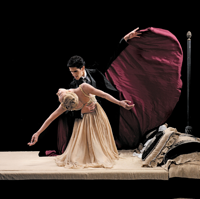
Tara Birtwhistle and Jaime Vargas in Dracula. Photo by David Cooper.
Whenever Dracula makes an entrance, as he will today when the Royal Winnipeg Ballet kicks off its B.C. tour of Dracula at Vancouver's Queen Elizabeth, it's hard to ignore the notion that we're really nothing but Victorians with better technology.
The ballet, which is based on Bram Stoker's classic 1897 novel, tells the vampire tale that is as popular at the turn of this century as it was at the last fin de siècle because, while contemporary furniture is better, the anxieties are much the same.
Or so says Stoker scholar and vampire expert Elizabeth Miller, who will be delivering her 40th pre-show chat tonight. The professor emeritus with Newfoundland's Memorial University taught Romantic and Victorian literature, which is how she came to be fascinated by Dracula and the bloodsucking immortals.
Vamp academia
"For a scholar this is such a rich text -- it explodes with interpretations," she said, which explains why, five years after her official retirement, Miller is still teaching courses on vampires at York and the University of Toronto. Not to mention entertaining everyone from balletomanes to Goth clubs with her views on vamps.
Sex and death have always been interrelated in the human psyche -- except for that one, brief, shining moment post-antibiotics and pre-AIDS -- and Drac's debut coincided with the Victorian syphilis epidemic. Not surprisingly, the rise of the current vampire mania coincided with the discovery of AIDS.
"In the novel, Dracula is polluting women -- they become lascivious and try to seduce men and pass on the disease. He was also a foreigner [from Transylvania] polluting the English bloodline -- it reflects the racism and fear of immigration," Miller said, explaining that the vampire always embodies the contemporary threat.
Dracula is in you
"The next thing there will be is a novel that presents the vampire as a terrorist," Miller said, adding that the Eastern European vampire-as-mobster novel, Fangland, has just hit the bookstores.
Dracula, as a serial killer, reflected the hysteria over Jack the Ripper, who began his spree in 1888, and is still one of the creatures we fear most. The vampire also embodies occult beliefs in myth and magic that surfaced in the 19th century and reflected the fear about scientific leaps, including evolutionary theory. The Romantic movement was a reaction to the previous age of reason.
"Dracula is a shape-shifter who becomes a bat or a wolf. He's an atavistic creature, which suggests he's devolving."
That fear of science is still obvious in places like the Fraser Valley and large spans of the American Midwest and South where supporters of "intelligent design" are trying to replace biology with the new creationism. And Miller said that Victorian streak of anti-intellectualism is also echoed in the romantic myths of today's New Age movement.
Fear of women's sexuality
Vampire legends stretch back for centuries, but the Gothic version of the demon lover that still resonates in the 21st century, originated with "The Vampyre," an 1819 short story by John William Polidori. He modelled the monster on the quintessential bad boy, dark, brooding lady-killer and Romantic poet, Byron -- who was dubbed "mad, bad and dangerous to know" by one of his spurned lovers. While that image is reflected in Stoker's later take on the creature, Dracula also incorporated the cultural tensions of the day, most of which are still with us.
The novel touches on Victorian society's unease with women's sexuality, and choreographer Mark Godden's 1998 ballet is true to the novel. Like the book, the ballet is divided in two, with the first half of the story telling the tale of Lucy, as a traditional woman who is violated by the predator, becomes enthralled with him, then goes on to infect healthy men when she grows her own set of fangs.
"You see the fear of sexual women," Miller said, adding that the belief in Victorian sexual repression is something of a myth. "That was only for certain [society] women. Most gentlemen had prostitutes."
From Dracula to Buffy
The feminist backlash to one of European history's most misogynist eras is also reflected in Stoker's novel. Miller notes that he makes reference to "the new woman" as she was dubbed in 1893. That generation of feminists -- who demanded the vote, education, bicycles, professional careers and an end to whalebone corsets -- is represented by Mina, the woman who resists Dracula in the second half of the story.
"She's instrumental in defeating him -- Van Helsing couldn't do it without her."
Making her the forerunner of Buffy the Vampire Slayer? Joss Whedon, who created Buffy, has often said in interviews that he envisioned the cult heroine as the stereotypical blond victim who ran down an alley to escape the monster -- and when the creature followed, she turned out to be his worst nightmare.
"I always think Van Helsing -- the vampire hunter in Dracula -- inspired Buffy. But that's an interesting idea that she comes from Mina," Miller said. "See what I mean, about the text being so rich..."
Gender benders
The vampire's gender ambiguity also lends itself nicely to the contemporary era in which sexual reassignment surgery, as it's called, is becoming the new tummy tuck. Stoker's Dracula has long nails and hair, and while there's no hard evidence he actually drains men, the crew of the ship he takes to England does disappear mysteriously. Miller is currently studying Stoker's notes to determine, among other things, whether the Count was bisexual. Miller thinks it's quite possible.
"Oscar Wilde's trial [for homosexuality] was going on and Stoker would have been well aware of it -- especially since he had [been a rival for Wilde's] wife."
Miller's view that the contemporary love of vampire is due to it being the perfect metaphor for us, and our fears, is persuasive. This isn't a monster we can flee, since it's a twisted -- or perhaps unfettered? -- version of us.
My alter ego, the dance critic, would add that the vampire is the perfect ballet icon -- it's in keeping with classical ballet's fascination with the living dead. In the past, women have always danced the undead roles. They're ghosts, fairies, sylphs, dolls, birds of all sorts (swans, bluebirds, firebirds), and there's an occasional comatose princess thrown in for good measure. But they're never whole and healthy women. Although, I particularly love the wilis in Giselle -- they're the spirits of jilted women who hang out in the forest at dusk, waiting to kill the next man who comes along. Unlike most of their pointe-shoed sisters. they're not perpetual victims, which is why I always cheer 'em on.
Male undead
So I'm relieved to see a male character in the form of undead star for a change. Not least because it says good things about how the thinking about women is changing, even in the dance world. And how we might be dragging ourselves out of the women hating we've inherited, culturally, from the Victorians.
While Miller doesn't realize it, her explanation of why the vampire resonates in two such superficially disparate eras plays into one of my pet theories: that we're really just late-stage Victorians. Not only is "postmodernism" a crock philosophically, it's a way of denying that we're still wrestling with all the social changes of modernity.
Clearly, I'm right. The popularity of the vampire icon is just another symbol of the way our society is still caught in a quagmire of anti-modernist thinking -- New Age Wingnuttery, religious mania, misogyny, rampant pornography, racism, the anti-education movement, occultism, authoritarian politics...
Right?
Miller laughs, and handles the question with a finesse developed over decades of wrangling slightly-crazed grad students.
"That could be one interpretation of the text."
The Royal Winnipeg Ballet's interpretation of the text can be seen in Vancouver, March 22 to 24; Nanaimo, March 26 and 27; Duncan, March 28; and Victoria, March 30 and 31.
Related Tyee stories:
- Me, a Yoga Devil?
If suffering is the road to redemption, yoga is the autobahn. - Pitching Woo-Woo
Why is UBC promoting New Age pseudoscience? - So You Think You Can Dance?
I resisted hard. But I have the fever.


48
Login or register to post comments
nightbloom
4 years ago
Fantastic culture
Fantastic culture commentary!
You hit a lot of things bang-on in such a short space. I couldn't agree more on the Victorian and Late Romanticism thing. We're still caught in the Romantic Age, and recognizing this is essential to an accurate understanding of what's going on with the broader culture.
One of my favourite feminists and culture critics, Camille Paglia, has long argued that post-modernism is a transient and largely meaningless mirage, and that we're actually caught in the later stages of Romanticism. That's why these potent symbols keep recurring in popular culture, trickling down from High Art (literature, pre-Raphaelite painting, etc.) to continually resurface in everything from pulp fiction to music videos...and now rolling back up the cultural chain into (in this instance) ballet.
Great piece of writing. More please!
Bluenose
4 years ago
Miller Laughs
"That could be one interpretation of the text."
Clearly ... Elizabeth Miller is a teacher who is wiser than her students.
Stump
4 years ago
PoMo
That's a big statement to make without a least one example why.
Perhaps the author meant to say, "Clearly, I THINK I'm right."?
Postmodernism is difficult to understand given our learned preconceptions. I think that's why many are dismissive of it. My limited reading on the subject suggest to me there's much about Pomo thinking that hangs together quite nicely.
Stump
4 years ago
Camille
will say and do whatever it takes to stay in the media spotlight, but I think her fifteen minutes are up.
G West
4 years ago
Stump
You're not surprised are you?
This is the same author who one week writes decrying woo woo and a few weeks later tells us she's been practicing yoga (and a particular brand thereof that also pitches a fair amount of woo woo of its own) for some 20 years (as I recall, in truth I only scanned her yoga piece).
You surely weren't expecting rational considered argument were you? Shannon is also a journalist who turned an article ostensibly about Wikipedia in the G&M into a chop piece on Kevin Potvin. In addition, of course she's the self-same journalist who jumps into conversations on these comment threads from time to time to deliver a few low-blow ad hominem insults of her own to all and sundry.
I think postmodernism, whatever it may be or may not be, will survive this assault - whether mounted by Camille Paglia, Shannon Rupp or dear friar nightbloom - separately or in concert.
I may have more to say about Bram Stoker’s rather late contribution to the cult of the Gothic novel. My copy is in storage and it’ll take me a couple days to dig it out. As casual reading material, its epistolary format leaves a great deal to be desired.
I’m sure the ballet will be divine.
Stump
4 years ago
Dracula and Frankenstein and PoMo
Yeah, not the best written work, esp. when compared to "Frankenstein" by Shelley.
Although no doubt the potent combination of sex and death has made the vampire a more potent cultural symbol than the man-made monster. Further, Frankenstein has rarely been brought to screen in a way that parallels the literary version (an repugnant-looking Superman) but rather a sub-moronic monster with feelings to characterize the original as played by Karloff.
Returning to the idea of post-modernism, I wonder if the very idea of movie criticism and scholary study (the critic/scholar bringing their interpretations to the 'text') is rather post-modern in some ways.
G West
4 years ago
astute observation, stump
Once I've refreshed my memory of the Stoker text, read again The Castle of Otranto by Horace Walpole, which marked the beginning of the Gothic/Romantic era in English when it was published in 1765, brushed up on Keats and Byron and, as you say, Mary Shelley, perhaps we could convene a seminar to discuss the genre and whether or not Stoker was really part of the movement or simply a theatrical Victorian latecomer.
My view, he’s the latter.
Of course, the image, and the filmic presentations of the non-dead creature of the night – including Nosferatu and a plethora of other musical, operatic and stage adaptations are part of a nearly century-long blood-sucking genre of which this ‘balletic’ one is only the latest. All of which, in a different sort of interview by a different kind of journalist, I’m sure Elizabeth Miller would have been thrilled to discuss.
Stoker, for all his wooden prose, found in folk tales and a few historical analogues a kind of universal human 'fear' mechanism into which his story very nicely meshed.
Kind of like the boogey man and things that go bump in the night, human beings love the frisson of contemplating the sublime nature of 'letting go' to something dark and primordial and deep seated in the reptile brain.
My view.
Bluenose
4 years ago
Bram Stoker's Dracula
This might be of interest to some of you (even to Mönchnachtblüte):
In the earliest manuscript of Dracula, dated 8 March, 1890, the castle is set in Styria, although the setting was changed to Transylvania six days later. Stoker's posthumously published short story Dracula's Guest, known as the deleted first chapter to Dracula, shows a more obvious and intact debt to Carmilla, and the setting of Styria remains unchanged.
Both stories are told in the first person. Dracula expands on the idea of a first person account by creating a series of journal entries and logs of different persons and creating a plausible background story for them having been compiled. Stoker also indulges the air of mystery further than Le Fanu by allowing the characters to solve the enigma of the vampire along with the reader.
The descriptions of Carmilla and the character of Lucy in Dracula are similar, and have typified the now-stereotypical appearance of the waif-like victims and seducers in vampire stories as being tall, slender, languid, and with large eyes, full lips and soft voices. Both women also sleepwalk.
Stoker's Dr. Abraham Van Helsing is a direct parallel to Le Fanu's Dr. Hesselius: both characters used to investigate and catalyse actions in opposition to the vampire, and symbolically represent knowledge of the unknown and stability of mind in the onslaught of chaos and death. (Baron Vordenburg also influenced Dracula's Lord Godalming.)
http://en.wikipedia.org/wiki/Carmilla
One critic notes of Camille (Carmilla?) Paglia:
Drunk ... aggressive ... shrill ... invective ... vituperative ... repetitious ... hmmm ... that reminds me of someone who posts on these forums ...
Here is a link to Paglia's Pornography of Ideas ... an essay that is well worth reading:
http://www.etext.org/Politics/AlternativeOrange/1/v1n5_ppi.html
G West
4 years ago
Very interesting bluenose - and thank you.
I couldn't help, as I read that essay, to think that the same sort of intellectual dishonesty and inversion of the truth, with far from benign intent, is at the bottom of Ann Coulter's recent and much-remarked comment at a Mitt Romney event a week or two ago.
Paglia has a lot of disciples on the fascist wing of the hopefully-dying neocon project. Pew has just published a paper on political trends in America from, I think, 1987 - 2007. I'm at work right now and don't have the link but I'll post it later for anyone who's interested.
There are, at long lost, some real indications that the worm has turned and the current almost-panic on the right appears to be a reflection of this.
G West
4 years ago
bluenose
here it is:
http://people-press.org/reports/pdf/312.pdf
Bluenose
4 years ago
People-Press
G West: Thanks for the link! Particularly telling in the report is the statement: "The decline in social conservatism is being hastened by generational change." I've found this to be true of many immigrant families as well: some Christian fundamentalists have pinned their hopes on the immigration of Hindus and Muslims to North America, the idea being that they and their children will bring their conservative values with them and change the social landscape to reflect more "traditional" beliefs and practises. In fact, the opposite seems to be occurring, with the children of these families embracing more "permissive" values than those held by their parents. Another bite to the jugular from the PoMo Prince of Darkness!
Skookum1
4 years ago
Ugly supermen
Just wondering if you've seen the Branagh-de Niro version? De Niro mostly avoids the Karloff cliches; it's a noble effort, and some nice acting delivery; not quite everything it could be, but as much as I like Boris Karloff just for pure camp cheesiness it's way closer to the original idea.
If I had the "ten videos to take to a desert island" I might consider Abbott and Costello meets Frankenstein (or is it meets Dracula; they meet both of them, plus the Mummy and the Werewolf).
As for the staying power of vampires in film, especially independent and student film, I'd say it more has to do with a lack of imagination (except for the twisted nogging Josh Whedon); ditto with the zombie/undead fad.
nightbloom
4 years ago
Pay no heed to the nattering
Pay no heed to the nattering nabobs of negativity, Shannon. Truth needs no partisans - Romanticism lives!
Stump
4 years ago
the truth
I don't really see it as nattering negativism. Shannon made a pretty big statement w/out back-up. I wouldn't blame her for not posting in the thread, but more explanation (for basically discounting PoMo w/out any real explanation why) in the article might have been useful.
Perhaps you might expand upon why you feel we haven't moved past Romanticism?
Wouldn't you agree that critics dissecting a 'text' is an essentially PoMo act?
G West
4 years ago
Stump
I liked the way Branagh dealt with Mary Shelley's ideas and critique of power but I couldn't quite warm to De Niro as the monster.
To tell you the truth, I find the whole filmic presentation of Frankenstein has been spoiled forever by Mel Brooks' "Young Frankenstein", although the Abbott and Costello version is fun too. And you're right, I think they covered the whole Gothic/horror genre at one time or another - or perhaps all at once.
I still can't get over the reaction I had to Peter Boyle's classic rendition of 'Puttin' on the Ritz' in the Brooks' film. And of course Madeline Kahn's 'curtain call' bedroom aria at the end was also worth the price of admission. Call me shallow if you like, but that's my favourite monster.
When I feel the need to consider the significance of Mary Shelley's masterpiece and what it still says to modern society, I go back to the book and remember the 'real' monster was VICTOR Frankenstein and not his pathetic creation.
In a way Dracula is kind of the reciprocal of all this. The book ain't much worth the effort - after the first go through - and the thrills come from the almost endless succession of blood-lust-generated and sexual lust steeped film versions.
My veiw. I'm working up a list of the various filmed adaptations that I'll post later. I think we even had a Canadian production once upon a time in which Jack Palance played the big dead bloodsucker. Have you seen that one?
G West
4 years ago
Foggy memory
Jack Palance did star as the great undead one, and very convincingly too. The made for TV film (which was also released theatrically) was done in 1973 by Dan Curtis.
The production, however, was British, not Canadian.
The TV movie I was thinking of was a CBC production, also directed by Curtis and starring Palance, along with Oscar Homolka and Denholm Elliot among others. It was made in 1967 and the title of course was DOCTOR JEKYLL AND MISTER HYDE - hope you'll excuse my confusion.
Skookum1
4 years ago
Carmina - Suspiria?
The Jack Palance comment made me think of a French-Canadian made horror movie, with badly dubbed English, which I remeber as being Carmina.....maybe Suspiria? Vampires/immortals running amock in Montreal...
Skookum1
4 years ago
Ringo Starr
What am I thinking of - oh yeah, Son of Schmilsson, the Harry Nilsson vampire pic, Dreadful (especially Ringo as his mentor-wizard), but a great soundtrack. Or was it just Son of Dracula, and the soundtrack album was Son of Schmilsson?
G West
4 years ago
Skookum1
I have my little filmography just about finished and it is incredibly long...I'll get back to you on Schmilsson.
G West
4 years ago
Filmography - it'll have to be in two sections
It is an amazing list.
Part I: (first 36 films)
1. Nosferatu 1922 Prana feature/ Germany Max Schreck (Count Orlok)
2. Dracula 1931 Tod Browning Feature/ Universal / Bela Lugosi
3. Dracula [Spanish Version] 1931 George Melford Feature
4. Dracula’s Daughter 1936 Lambert Hillier Feature/ Universal / Gloria Holden (Countess Zaleska)
5. Son of Dracula 1943 Robert Siodmak Feature/ Universal / Lon Chaney Jr (Count Alucard)
6. House of Dracula 1945 Erle C. Kenton Feature/ Universal / John Carradine (Count Dracula)
7. Blood of Dracula 1957 Herbert L. Strock Feature
8. The Curse of Dracula/ or The Return of Dracula 1958 Paul Landres Feature/ United Artists Francis Lederer (Count Dracula-Bellac Gordal)
9. The Horror of Dracula 1958 Terence Fisher Feature/ Hammer (UK) /Christopher Lee (Count Dracula)
10. The Brides of Dracula 1960 Terence Fisher Feature/ Hammer (UK)/ David Peel (Baron Meinster)
11. Batman Dracula 1964 Andy Warhol Feature
12. Dracula - Prince of Darkness 1965 Terence Fisher Feature/Hammer (UK) Christopher Lee (Count Dracula) Released in the US in 1966.
13. Billy the Kid vs Dracula 1966 William Beaudine Feature/ Circle Productions (U.S) John Carradine (Count Dracula)
14. The Fearless Vampire Killers 1967 Roman Polanski Feature/ Cadre – MGM (France – U.S.) Ferdy Mayne (Count Von Krolock)
15. The Blood of Dracula's Castle 1967/69 Al Adamson Feature/Crown International (U.S.) Alex d’Arcy (Count Dracula), John Carradine (George the butler).
16. Dracula Has Risen from the Grave 1968 Freddie Francis Feature
17. El Conde Dracula 1969 Jesús Franco Feature
18. Dracula, the Dirty Old Man 1969 William Edwards Feature
19. Taste the Blood of Dracula 1970 Peter Sasdy Feature/ Hammer-Warner Pathé (UK) Christopher Lee (Count Dracula)
20. Web of the Spider 1970 Anthony M. Dawson Feature
21. The Scars of Dracula 1970 Roy Ward Baker Feature
22. In Search of Dracula 1971 Calvin Floyd Documentary
23. Twins of Evil 1971 John Hough Feature
24. Lake of Dracula 1971 Michio Yamamoto Feature
25. Dracula vs. Frankenstein 1971 Al Adamson Feature
26. Dracula's Great Love 1972 Javier Aguirre Feature
27. Vampir 1972 Pedro Portabella Feature/ Films 59 (Spain) Christopher Lee (Count Dracula)
28. The Saga of Dracula 1972 León Klimovsky Feature
29. Countess Dracula 1972 Peter Sasdy Feature
30. La Fille de Dracula 1972 Jesús Franco Feature
31. Dracula A.D. 1972 1972 Alan Gibson Feature
32. Dracula 1973 Dan Curtis Feature/ Jack Palance (Count Dracula)
33. Blood for Dracula 1973 Paul Morrissey Feature
34. Blacula 1973 William Crain Feature/American International William Marshall (Count Dracula)
35. Lemora: A Child's Tale of the Supernatural 1973 Richard Blackburn Feature
36. Legend of the Seven Golden Vampires 1973 Roy Ward Baker Feature
G West
4 years ago
And here's the rest of them:
37. Count Dracula and His Vampire Bride 1973 Alan Gibson Feature
38. Son of Dracula 1974 Freddie Francis Feature
39. Vampyres 1974 José Larraz Feature
40. Dracula 1974 Andy Warhol/ Paul Morrissey Feature/ Carlo Ponti- Braunsberg Rassam Productions Udo Kier ( Count Dracula)
41. The Evil of Dracula 1974 Michio Yamamoto Feature
42. Tender Dracula 1974 Pierre Grunstein Feature
43. Old Dracula 1975 Clive Donner Feature
44.Dracula Père et Fils 1976 Edouard Molinaro Feature
45. Count Dracula 1977 Philip Saville TV
46.Doctor Dracula 1977 Al Adamson Feature
47. Lady Dracula 1977 Franz Josef Gottlieb Feature
48. Zoltan, Hound of Dracula 1977 Albert Band Feature
49. In Search Of: Dracula 1977 Documentary
50. Vlad Tepes 1979 Feature
51. Dracula 1979 John Badham Feature
52. Loves of Dracula 1979 Feature
53. World of Dracula 1979 Kenneth Johnson Feature
54. Dracula Sucks 1979 Philip Marshak Feature
55. Dracula 1980 Documentary
56. Mama Dracula 1980 Boris Szulzinger Feature
57. Les Charlots Contre Dracula 1980 Jean-Pierre Desagnat Feature
58. Dracula 1984 Animated
59. Fracchia Contro Dracula 1985 Neri Parenti Feature
60. Dracula: The Great Undead 1985 Documentary
61. Dracula's Widow 1988 Christopher Coppola Feature
62. Dracula: A Cinematic Scrapbook 1991 Ted Newsom Documentary
63. I Created Dracula 1992 Ian Graham Video
64. Bram Stoker's Dracula 1992 Francis Ford Coppola Feature
65. Dracula Rising 1993 Fred Gallo Feature
66. Dracula: Fact or Fiction? 1992 Steve Michelson Documentary
67. Dracula: Dead and Loving It 1995 Mel Brooks Feature
68. Dracula: The True Story 1997 Matthias Kessler Documentary
69. Die Hard Dracula 1998 Peter Horak Feature
70. The Fiancee of Dracula 1999 Jean Rollin Feature
71. Dracula: The Dark Prince 2000 Feature
72. Wes Craven Presents: Dracula 2000 2000 Patrick Lussier Feature
73. Dracula, Pages From a Virgin's Diary 2002 Guy Maddin Performance
74. Wes Craven Presents Dracula II: Ascension 2003 Patrick Lussier Feature
75. Dracula's Curse 2004 Feature
76. Dracula.3000 2004 Darrell James Roodt Feature
77. Lust for Dracula 2004 Feature
78. Batman vs. Dracula 2005 Michael Goguen Animated
79. Great Books: Dracula Video
Didn't include any of the Ann Rice/Vampire spin-off genre.
Can't imagine any other subject matter/source that has more examples - even withouth including the Abbott and Costello or the 3-Stooges varietals.
Whew!
Skookum1
4 years ago
also
Maybe I missed it, but Ed Wood and Invasion from Planet Nine or whatever it's called, where Lugosi accompanies space aliens and Bobby The Robot in an attempted conquest of Earth... and all those other Lugosi-bgrades also fall into the category, if only because of the character and not the plot....
Rice should have been mentioned in the article if she wasn't; modern-era romanticism, albeit self-conscious, exploring the "erotic" and intellectual nature of vampirism....until she kept on repeating herself it was a very novel view, and her take on the psychology of immortals gets very interesting; esp. in The Mummy but throughout the Lestat series, esp. Marius.
Skookum1
4 years ago
that was Robbie the Robot
How could I have forgotten? Also meant to say that Rice explores the tragic nature of being a vampire in a way that maybe only a few others did, like the Scorcese version, and even to some degree Nosferatu. Not sure about the original Stoker, although elements of Dracula's former humanity are in the early movie version.
nightbloom
4 years ago
Those of us who have been
Those of us who have been down PoMo Lane don't need no mo' backup.
G West
4 years ago
I've been digging
Apparently - and I think there was actually a drug-steeped film made about these events, Mary Godwin (Harriet Shelley didn't drown herself until September of 1816), Byron, Byron's doctor (a guy you'll remember called John Polidori) Shelley and another writer by the name of Matthew Lewis (who had written a Gothic Romance called The Monk in 1796) spent an evening together in Geneva in the summer of 1816. I suppose Shelley was there as well along with Mary’s 15 year old stepsister Jane Clairmont with whom the poet had a ‘triangular’ relationship (he’d also tried early on to share his wife with his friend Thomas Jefferson Hogg) – he certainly spent the summer of 1816 in Geneva.
Certainly sounds like the makings of a horror story to me.
There was rain, wind and lightning and Byron suggested that each of them should create a horror tale of some sort modeled on the German ghost stories they'd been reading. Polidori and Mary Godwin, (just 18 at the time) were the only ones to rise to Byron's challenge and the results were Mary Shelley's classic Frankenstein, or the Modern Prometheus (1818) and Polidori's The Vampyre. Shelley and Godwin didn't marry until after Harriet Shelley died.
Polidori as a literary figure sank like a stone and rates not a mention in Drabble or Chambers so I expect bluenose's citation from Ludlam may be more to the point as a source for Stoker's Dracula.
And of course, the epistolary form of Stoker's novel also hints of the Frankenstein precedent.
Interestingly, Ludlam also records a bit of a letter that Stoker's mother Charlotte wrote to Bram on the occasion of the book's publication:
...[Dracula] is splendid, a thousand miles beyond anything you have written before, and I feel certain will place you very high in the writers of the day...No book since Mrs. Shelley's Frankenstein or indeed any other at all has come near yours in originality, or terror -- Poe is nowhere [108-9]. Biography of Dracula: The Life Story of Bram Stoker
Stump
4 years ago
I'll try again Nightbloom
Wouldn't you agree that critics dissecting a 'text' is an essentially PoMo act?
Especially interested in your take on my second observation.
I think it would be a little sad to hear you complain about a lack of civilized discourse here... and then not bother to share your opinions on a subject for which you claim to have some expertise.
G West
4 years ago
Stump
On the subject of analysis, there is scholarship that looks at Bram Stoker's long-term 'relationship' with the late-Victorian actor / impresario Sir Henry Irving as something a trifle out of the ordinary.
Further, Stoker wrote another rather strange little horror/shocker called The Lair of the White Worm to which the public never took much of a fancy.
I'd be interested in hearing Elizabeth Miller's feelings about a plot that involves a creature thousands of years old who lives in a very deep well; a creature, which has honed its powers of mimicry and imitation to the point that it can appear as a beautiful woman with strange, and well-night irresistible but far from benign powers over MEN.
It does call up some serious questions about Stoker's fascination with powerful and hungry women....
And of course some question, a least from the psychological point of view, about whether Stoker is really a ‘Romantic’ in the strict sense of the word – or – something entirely different.
G West
4 years ago
errata
That's 'well-nigh' - not well-night.
Sorry.
Skookum1
4 years ago
white worms
Further, Stoker wrote another rather strange little horror/shocker called The Lair of the White Worm to which the public never took much of a fancy.
Oh yes, but it sure made a great film. Hugh Grant, as I recall....can't remember the villainess/serpent goddes...
Skookum1
4 years ago
A Voyage to Arcturus
Have you ever read A Voyage to Arcturus by David Lindsay? Unfilmable because of the plot/context need for two extra primary colours, never mind bizarre and ever-changing prosthetics, but there's at least one vampire creature, towards the end (if you get that far; it's a difficult read, though short), who tries to drain the life from the book's antihero Maskull (he wins).
G West
4 years ago
Nope - I'll see if I can find it
At a local second-hand bookstore.
Thx Skookum.
There was an interesting observation by Leonard Wolf in the intro to my copy of Dracula.
I just posted it on the 'Down with Campbell' thread. Seemed somehow more appropriate there but, in truth, could be quoted here as well.
Have a look.
Skookum1
4 years ago
Arcturus
If you find it, make sure you take at least some mild hallucinogens/euphorics before you start reading it ;-) The first chapter's very Gothic, but once they hit Tormance (the planet of Arcturus where the action takes place) it gets totally surreal; just visualizing Poolingdred and the Ifdawn Marest will take all your synapses firing. Never mind integrating his explanations of the kinaesthetic/emotional nature of the new primary (and secondary) colours resulting from the planet's second (blue) star.
I'm still not sure what the book "means", if it is really is an allegory. Colin Davis reckoned it "the greatest novel of the 20th Century". No idle boast, even though written c.1917.
Skookum1
4 years ago
two colins
Colin Wilson. Colin Davis is the symphony conductor....
G West
4 years ago
I suppose
in some functional way Stoker's experience during the 28 years he served as Irving's go-to guy and confidant, in addition to being the manager of his theatrical enterprises and personal secretary, gave him a real understanding of what 'worked' as a staged spectacle. Combining that with his extensive researches in the British Museum and a fascination with schedules, timing and record keeping seems to have made him a better playwright and dramaturge than an author.
Certainly, the filmic output of the Dracula oeuvre - even restricting the measure to just those titles listed above that have more than just a nominal connection to the story (as well as the success of the celluloid version of the "White Worm") - would lead one to believe that Stoker, had he been born in 1947 instead of 1847, would have found a comfortable niche in Hollywood.
Although the book has never been out of print (and it's now well and truly in the public domain and can be read complete on the web), the printed version has never achieved anything like the popularity the movie version evokes more than a hundred years after the book was published.
nightbloom
4 years ago
It seems a dash of 'Google'
It seems a dash of 'Google' and a sprinkle of 'Wikipedia' has turned us all into sages and savants on any given subject matter...
Why did I bother accumulating $55K in student debt when I could simply cut-&-paste my way through the motions...?
G West
4 years ago
Another interesing observation
Relative to the suggestion that people are 'vamping it up' of late as opposed to - say - in the 60s and 70s (for example) can be analyzed by comparing the number of Dracula films produced from 1960 - 1979 with the number of Dracula films produced in a 20 year period ending this year. Even including the RWB production as one item within that grouping the results are as follows:
1960 - 1979 = 45 films
1987 - 2006 = 19 films + 1 ballet = 20.
Even according to this rough calculus, the period when the most 'vamping it up' occurred was not the fin de siècle era but the 60s and 70s.
Furthermore, by generously including a few of the Ann Rice film noir offerings and their analogues – say a generous 10 of them – the result is still heavily weighted in favour of the cold war era and not the turn of the century.
Now I wonder what that means? Clearly Shannon’s little observation, what was it she wrote – isn’t all that relevant and insightful is it?
Moreover, as bluenose so astutely observed not so far back up the thread, Elizabeth Miller just laughed.
Skookum1
4 years ago
learn more in school than out...
It seems a dash of 'Google' and a sprinkle of 'Wikipedia' has turned us all into sages and savants on any given subject matter...
Why did I bother accumulating $55K in student debt when I could simply cut-&-paste my way through the motions...?
Well, most of the people I know who are currently accumuluating $55k in debt are also cutting-and-pasting their way through the motions, when not actually plagiarizing. Most are too busy with the drivel of curriculum readings to ever read outside their field, to "broaden their minds" as university used to be for, and are overworked as well as underpaid and overcharged (tuition et al.), and nearly all admit that they'll not remember anything of what they're being tested on by the time they get out and their "qualifications" get them a job where it's the credential rather than the actual knowledge that matters. No wonder the world is going to hell in a bushel basket, huh?
Books like Lindsay's and even Stoker's fall into the realm of "higher education" that has long since been abandoned by universities, which are now degree mills that are part money-making corporation, and part indoctrination-ground for the Religion of Big Business/Government. Ironically, to me, some of the people I met at SFU a few years ago who DID have a broader view had had one particular Econ 100 prof who made them read stuff from other fields; most of hte people I met within Arts/Humanities faculties didn't read outside their field, except critically/with their field's blinkers on.
University should be an immersion in reading, discussion, multilple fields of knowledge, civility and courteous conduct and debate, and so on. Now it's a push-and-shove one-note-samba danced by hyperdressed credit-card brats draped in bling, prepping for exciting careers as investment firm managers and human resources executives and marketing strategists. Literature? Philosophy? History? That's for know-nothings, it won't make you any money, why bother?
nightbloom
4 years ago
I couldn't agree more,
I couldn't agree more, Skookum1.
On another note, I just noticed Bluenoses' cut-&-paste critique of Camille Paglia. In appraising her contribution, it's always best to give her a try, read her own words, and decide for yourselves. There's a lot of politically motivated misinformation out there (case in point: she's no neo-con by any stretch of the imagination). Here's a sample of a handful of her shorter pieces, which are easily accessible on the web. They provide a good shorthand indication of where she's coming from and the breadth of her critique:
The Magic of Images: Word and Picture in a Media Age
http://www.bu.edu/arion/Paglia_11.3/Paglia_Magic%20of%20Images.htm
Cults and Cosmic Consciousness: Religious Vision in the American 1960s
http://www.bu.edu/arion/paglia_cults00.htm
Camille Paglia On Pre-Raphaelite Art
http://privat.ub.uib.no/bubsy/astro.htm
And a sample of her freehand editorial style, as a special present for Bluenose:
The Gay Inquisition
http://www.frontpagemag.com/articles/ReadArticle.asp?ID=1975
G West
4 years ago
Bluenose
I looked at your 'cut and paste' critique of Ms Paglia - which pretty much confirmed my own impressions of her excretory style. I think she and Matt drudge pretty much deserve each other.
As for her status as an art critic, I'm not aware that she actually has any. Manet more or less put paid to the idea of exemplum virtutis in art and none too soon in my opinion. It took a bit longer in music of course.
Nevertheless, there may still be those who're susceptible to the effects of Stendhal’s Syndrome around in this day and age. At least, thank heaven, virtually no one mistakes the illness for an example of moral sensitivity any longer.
nightbloom
4 years ago
Looks like your chronic
Looks like your chronic negativity has killed this thread too, Gwest. Are you going for a record or what?
I still encourage people to check out Camille Paglia for themselves. The criticism Bluenose linked is 15 years old (article dated 1992), when the ultra-p.c. campus marxist-feminist establishment was in full backlash mode against the initial publishing of Paglia's Sexual Personae, a classic that put the "human" back into the Humanities (I remember those days well: I was starting my second year as an undergraduate at what was then the neo-Stalinist Soviet Socialist Republic of Carleton University).
Paglia explored a lot of the themes that Shannon touches upon in this article. Her work endures, but where oh where have her critics gone...? Why, the great Dust Bin, of course.
G West
4 years ago
Shannon doesn't really 'touch' any themes at all
If you'd actually taken a moment to do a little of your own research - checking out the RW Ballet site and the material from and about Elizabeth Bennett there you'd have found who really did the cut-and-paste job my friend.
The fact is, you just used a poorly-written article that isn't much more than a free ad for the Ballet's performance as another springboard for YOUR pet peeve.
My opinions about Camille Paglia as an art critic are hardly exceptional by the way.
You may be able to run rings around me if we're discussing the Schleiffen Plan, my friend; but as an art and literary critic you are on extremely thin ice.
I think Paglia is an interesting arriviste culture critic - and that's about all. Like Stoker’s output, the fuss made about her is more illuminating than her actual output.
As for my negativity – it’s your negativity about the people around here that’s the most disgusting thing I’ve seen lately.
ookpik
4 years ago
meanwhile...
I took the "clearly I'm right" comment as a bit of a joke (she lumps herself in with "slightly crazed" students after all).
The bit that got me was the declaration that "sexual reassignment surgery, as it's called, is becoming the new tummy tuck." That comes out of nowhere. Wow! It's *hard* to get sex reassignment surgery; it's only performed as a therapeutic procedure... unless that was referring to something else ("sexual" reassignment? Maybe that changes your libido?). Anyway. A minor complaint. I get the point about gender deconstruction in the news.
I've read Dracula almost as many times as I've read Alice in Wonderland, and it's still fun to see what I can pull out of it. Stoker's hilarious visions of romantic non-competition ("I will avenge your wife, because I love her as much as you do! But don't be threatened by this! We all love each other! Go team!"), Christian presumptions masquerading as compassion ("I'm sure the vampire will be happier if we kill him, and save him from his current damnation..."), so much!
I love stories like this, that get retold so many times they start to turn into universal legends instead of single novels. That list of Dracula interpretations could also include League of Extraordinary Gentlemen (the comics are great-- Alan Moore is a master of retelling and reinterpretation).
I wish I wasn't booked the night this is playing in Victoria. RWB was great in the Guy Maddin movie.
nightbloom
4 years ago
Quote:You may be able to run
Holy shit, does this guy have a long memory or what--?
Do these threads keep you up at night Gwest? You're like that old white haired kung-fu master in 'Kill Bill' who trains Black Mumba - you won't let up until everyone admits your famous Chicken Claw move beats their measley tiger-paw. You remember the character I mean?
G West
4 years ago
ookpik
One of the things I liked best about the novel was the way Stoker does Van Helsing, his English I mean - so proper and formal and yet so entirely 'foreign' but not from any recognizable country.
Do you remember this line?
Let me tell you, he is known everywhere that men have been. In old Greece, in old Rome; he flourish in Germany all over, in France, in India, even in the Chersonese; and in China, so far from us in all ways, there even is he...
Or this?
It is cold, cold; so cold that the grey heavy sky is full of snow, which when it falls will settle for all winter as the ground is hardening to receive it. It seems to have affected Madam Mina; she has been so heavy of head all day that she was not like herself.
Almost makes one think Stoker prefigured Jack Kerouac and, in some ways the product of his research in the British Library comes tumbling out, pell mell, in much the same way. Little bits and pieces of information, snippets of fact and folly swept up into these pseudo journals. In a way not so very different from Walter Benjamin’s Arcades.
nightbloom
4 years ago
Pretentious
That's getting a little pretentious, Gwest.
And Paglia is no "arriviste".
G West
4 years ago
n/bloom
You're talking to me about pretensions.
Mon Dieu, nightbloom, you belong to that category of critics who, like David Horowitz, go from spouting the mantra of the extreme left to espousing the equally didactic nonsense of the far right without a hint of logic or good sense in between.
That is the definition of pretentious. In fact, I think Horowitz has actually written 3 or 4 books about his conversion and never once made it sound either rational or well-considered. And about once a month he sends me an invitation to join him in some equally nonsensical campaign to root the remaining foul leftists and Marxists out of their burrows in Campuses all across both Canada and United States. I usually forward these appeal to a journalist I know who isn’t on his mailing list. Now that’s an example of pretentiousness, in my opinion.
Jonathan Chait actually puts it quite well:
As he notes and this could be equally well applied to Paglia, it's mostly about style and there really isn't much substance.
Just like your failure to analyze Shannon's little puff piece for what it is; so anxious were you to turn it into your usual cultural bête noire commentary.
Have you read Dracula or not?
It really is quite a grab-bag of late Victorian ephemera and nominally bad, typically Victorian writing. It is quite a collection of essentially fearful reflections on the power of lascivious female desire and power over weak and pusillanimous men. You might find it interesting.
Frank
4 years ago
Schlieffen and Dracula
I've never read Dracula (in fact I think the world's best vampire movie was Love At First Bite) but I'm up for a discussion on the Schlieffen Plan anytime. I dimly remember the previous discussion but can't recall if we ever agreed on anything.
G West
4 years ago
I don't remember either
But given the amount of blood spilled I think Dracula won.
Don't bother with the book if you've already seen one (or more) of the films though.