

- Ms Kaye is a Tyee Builder. You can be, too.
- Mary Carlisle is a Tyee Builder. You can be, too.
- Prem Gill is a Tyee Builder. You can be, too.
- Nancy Flight is a Tyee Builder. You can be, too.
- Justin Everett is a Tyee Builder. You can be, too.
- John Westover is a Tyee Builder. You can be, too.
- Nora Etches is a Tyee Builder. You can be, too.
- Edward Henderson is a Tyee Builder. You can be, too.
- Bharadwaj Chandramouli is a Tyee Builder. You can be, too.
- Dean Chatterson is a Tyee Builder. You can be, too.
- Marius Scurtescu is a Tyee Builder. You can be, too.
- Robert Parkes is a Tyee Builder. You can be, too.
- James Murton is a Tyee Builder. You can be, too.
- Susan Doyle is a Tyee Builder. You can be, too.
- Vincent Strgar is a Tyee Builder. You can be, too.
- Helen Spiegelman is a Tyee Builder. You can be, too.
- Subir Guin is a Tyee Builder. You can be, too.
- Kimball Finigan is a Tyee Builder. You can be, too.
- Joanne Manley is a Tyee Builder. You can be, too.
- David Leach is a Tyee Builder. You can be, too.
Filming the Future, Thinking about Today
'Children of Men' asks what it means to be human.
The movie of the millennium?
When I went to see Alfonso CuarĂ³n's Children of Men last week, the lineup to get into the theatre stretched outside. Everyone waited glumly in place, like they were heading into a mass dental appointment. People filed in one after the other, in a series of zigzagging rows, a phenomenon, which oddly enough, was exactly echoed in the film when detainees are herded into an internment camp. After the film was over, I stepped out into the grey Vancouver bleakness and thought, "Well, it's not quite that bad...yet."
The appeal of dystopia is that it offers a glimpse of reality through the funhouse mirror of fiction. You can still make out the real ideas and events that inspired the story, and here, they aren't even all that distorted to begin with. Children of Men looks terribly familiar. Set in 2027, the future is pretty much like today, with the addition of a few more barbed-wire fences and soldiers with guns. But even as the world collapses, life goes on.
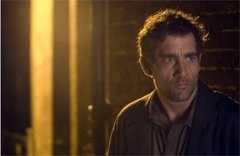
The one thing that the film gets right is the sense that people can adapt quite easily to horror; they still need to get coffee in the morning and trudge off to work. Theo (Clive Owen) is one such dead-eyed trudger. A hollow crust of a man, he takes his small comforts wherever he can find them -- a flask of whiskey, or the mellow pleasures of "Strawberry Cough," a marijuana hybrid raised by his aging hippie friend (played with evident glee by Michael Caine) -- anything to erase the hopeless present and bittersweet memory of what came before.
Hello-goodbye world
For the past 18 years, the piping voices of children have slowly vanished from the Earth. No babies equals hello-goodbye, and the human race is slowly dying out, courtesy of infertility. Everywhere in the world, society has disintegrated into a constant state of guerrilla warfare, with the exception of Britain, where through sheer dint of tradition, a semblance of order still stands. The class system putters on and Buck House is still there. Outside of the immediate environs of London, however, the country is over-run with refugees, and anti-government terrorist groups. Even with the end in sight, humanity is still fighting over the scraps like a pack of mongrel dogs.
The thin wash between present and future tense occasionally borders on the corny, with dead Diana-type banks of bouquets, and carbonized cow corpses burning in England's green land, but the feeling of genuine dread rings true. Much of this veracity is due to the presence of Clive Owen as Theo. Whether it's a kitten crawling up his leg, or the ringing in his ears that precedes the dying frequency of his senses, his is the view through which we see and understand this world. As such, he is an honest guide. Theo's confusion, grief and ultimately flinty determination give the film its core.
When Theo is kidnapped by his ex-wife Julian (Julianne Moore), a leader of the revolutionary band called the Fishes (read Christians perhaps), he's dragged into the heated middle of what could be the tipping point of humanity's future. The Fishes have stumbled onto a miracle, because lo, unto them a babe is born. When Theo is introduced to Kee, a young woman with the swelling belly of eight months of pregnancy, all we see is his face and the wash of emotion that overtakes him -- the heat flash of shock, followed by a dawning wonder. It's a beautiful moment, and the fact that it takes place in a manger is telling. Mary, meet your Joseph.
Non-Christian nativity story
If the Biblical implications of a saviour baby are explicit, the film has no ready agenda to push. It takes a few gentle pokes at old Jesus, but the archetype of mother and child goes so deep, it's almost beyond religion, or at least conventional religion. One of the things that jumped out at me when I visited the art galleries of London and Paris was the endless, and I do mean endless, images of mother and child, with nary a father in sight. The sheer repetition of this iconography was striking because it's so damned old, and really, motherhood is the ultimate miracle. The image of the Goddess and her child was co-opted quite nicely by Christianity, playing as it does to the deepest and most instinctual impulse people have. Children of Men also uses this image deftly for maximum impact.
Kee's unborn child is already claimed by different factions as a means to their ends, but it is a mysterious group called the Human Project, that has a nice little place on the Azores, that seems to offer the only hope. Theo and Kee take it on the lam, and the film evolves into a long chase sequence that is as nerve rattling as it is grim. Violence comes suddenly and peace is fleeting. Some of the set pieces in the film are literally terrifying to behold; there are scenes that you might have to watch through your fingers. A tiny newborn trapped in the middle of a firefight of machine guns and tanks is enough to make anyone remotely human collapse in horror. In the midst of concussive blasts, people scamper like rats for cover. The immediacy of this moment is captured in the tiniest details, like Theo's fingers twitching in preparation for a sudden bolt into the fray, or the blood that spatters the camera lenses, as if some phantom documentary crew were filming the entire thing.
The film bludgeons you into whimpering submission, until all you can think is, "Please don't hurt the little baby." The constant juxtaposition of fragile life and near constant death is held up as the twin sides of human experience. They are also the stuff of story telling -- beginnings and endings and the need to continue. The only true heroism in such a world is to fight for the preservation of life.
Communal film
Unlike other dystopian science-fiction movies, there are no flying cars or cool shiny outfits here. Everyone looks pale, grimy and cold. The future is a touchable, understandable place, the physical sensations of which we already know in our hearts and guts, hence its draw to people who're looking ahead with no small amount of discomfort. It's useful to see a film like this with an audience where the communal act of watching the movie is as much about the people in the theatre as it is about the story on the big screen. David Denby's recent piece in the New Yorker about the differing impacts that format can have on a film experience -- the difference between watching a film on an iPod or a big screen, for example -- was literally born out for me while watching Children of Men.
People sitting beside me wept openly. And after the film was over, the audience remained hunched over in their seats, as if reluctant to leave the shared space of the theatre.
In reality, you still have the benefit of being able to walk out, to emerge blinking into the daylight and think, "Well, it was only a movie." But perhaps at some point in the immediate future, the thin line between fiction and reality will forever blur. (In many places in the world, this has already happened.) The statement, "It was just like a movie!" might come to mean that what was once sublimated to the big screen -- explosions, bullets flying and the screams of the dying -- will emerge in three dimensional life. Caught in the middle will be women and babies, and a few bewildered men. Then maybe we really will wish to retreat back to the controllable, comprehensible world of fiction, where we are safe and warm and huddled together in the dark, watching the future unfurl.
Related stories:


14
Login or register to post comments
murdock
5 years ago
ya right
Puhleezze!
'bludgeon'?
'whimpering'?
'submit'?
Many years ago there was an experiment conducted with a rat habitat, within it 300 adult rats could happily survive comfortably, provided the food and water rations were maintained at set levels.
First the rations were tripled, until there were 500+ new baby rats; once these rats grew to survive their gestation and weaning, the food rations were dropped back to normal levels.
First there were females miscarrying, then young were eaten. Later the adolescent male rats that were largest began to 'act out' in very violent ways towards other younger rats and the very old.
Then the rations were cut to half normal levels.
Within 48 hours the entire habitiat had transformed into a madhouse of violence of all against all...
After study and attempting to understand this...such imaginary films as this are like watching those commercials about starvation in the 3rd world, you know the ones where you know the film crew has not missed a meal...
Bluenose
5 years ago
Flicker
I have yet to see "Children of Men" but ... read the book "Flicker" by Theodore Roszak. Darren Aronovsky is in the process of making a movie based on the novel.
It's also about children, but from a very different perspective. It's motto might be: "The only true heroism in this world is to fight for the prevention of life."
I loved the ending -- the protagonist gets exactly what he deserves. I can't wait for the film to appear. In the meantime, I'll go see "Children of Men" and have a good laugh.
alqpr
5 years ago
Silly Premise
The film is technically quite well done with effective cinematography and acting, but the premise is more than silly; in fact it is quite harmful. I am not referring primarily to the implausibility of sudden global unexplained human-specific infertility, but rather to the fact that the story would have us believe that decades of such infertility lead to massive refugee camps and violence everywhere and that our salvation lies in restoring our fertility. What bunk! The miracle of childbirth is all very nice, but now and for the foreseeable future the less often it happens the better.
hautecuisine
5 years ago
murdock
murdock, i don't think anybody wants to see a film featuring lab rats. where is the draw? you are a terrible movie executive.
nightbloom
5 years ago
Good review. I like the
Good review.
I like the film, and I liked the notion that society was blindsided by something originating from within (as opposed to aliens or nuclear holocaust or any of the usual external catalysts for apocalyptic societal breakdown in sci fi stories).
I hadn't read the story beforehand, and to be honest I only went because I luv Julianne Moore. So I was disappointed that her part was so small.
I was aware of the religious undertones, but the manger scene totally went over my head...Dunno where my brain was at!
I like Clive Owen as a leading man. It's a fresh, much-needed alternative to the suave Hollywood pretty-boys like Pitt and Clooney, et. al. Funny how the Brits (Daniel Craig, etc.) are putting the testosterone back into leading male roles, as opposed to the Yanks. It's refreshing, since film has traditionally portrayed the British gents as the fops and fems, and the Yank buckaroos as the manly-men.
marta
5 years ago
Good review
It's a good film.
The novel it is based on is equally worthwhile; P.D. James moves away from her usual murder mystery format.
doggone
5 years ago
teared up reading the review
don't think I can handle the movie yet.
What a whimp!
Dorothy's description of the lineup to get in reminds me of standing on Granville waiting to see "Altamount" - someone was hawking LSD along the line. I declined
T'anks God.
Last thing I need is more sensitivity in this world.
Paxel, maybe
Growlhisss
5 years ago
Honestly, I thought the
Honestly, I thought the movie was cheesy as hell, and I revel in dooomsday stuff. It totally sucked ass.
Step easy
5 years ago
Goodbye Rubie Tuesday
This film was technically very well done. The cinematography was as good as could be for this genre, this subject. From the opening scene (which i missed half of because of the incredible line up/chaos at silver city) my mood was taken hostage by grim looking, angry, well beyond cynical characters, which was a complete opposite to the last movie i saw in theatre (Pursuit of Happyness). The overall feel of this film (the bleak, violent, desperate sense of doom) was quite powerfully portrayed and i must say the battle scenes pinned me uncomfortably to my chair.
Yes, of course the whole idea of human inferility seems, at best, wildly implausible. But i watched this film simply for the film experience and for that i think i got my money's worth.
I did notice the score contained a lot of old Brit pop which i'm not sure if it added or detracted. For sure those few 'sensitive' scenes were absolutely welcome and necessary as emotional buoys, keeping myself at least from dropping too low on the human chaos monitor.
I agree with Nightbloom on the suitablity of Clive Owen for the role he played. A fine actor in my book.
CM Tara
5 years ago
I agree about Clive Owen
I agree about Clive Owen being a good leading man for this genre, and yes, the cinematography was very effective; however, I was disappointed with this film. I also thought a lot of the movie was cheesy and the premise (complete infertility of humans, but somehow not animals) implausible. The dialogue seemed urbane and thin. And I was puzzled by the title: as the reviewer says, the mother/child iconography was used repeatedly so why Children of "Men"?
I loved Michael Caine's performance and Clive Owen was fantastic as usual. This film could have been better.
Tulip
5 years ago
So Much Potential
I was quite excited to see this film, and I don't see too many really because most are trash, and I was really dissapointed to have this one turn out in a similar fashion.
I found the premise of the story very interesting, and the visuals fantastic but the actual plot was just paper thin. It could have been a truly epic dystopian story, but it turned into just another action flick, with the last fourth of the movie basically just one giant explosion. 1984 it wasn't, that's for sure.
The sad thing is, I think people are so desperate for good and meaningful films in mainstream cinema that they'll jump on to the band-wagon of any second rate production that even "looks" the part. The substance just wasn't there.
nightbloom
5 years ago
Quote:the mother/child
The title was another religious reference:
"How excellent is thy lovingkindness, O God! therefore the children of men put their trust under the shadow of thy wings." (Psalms 36:7)
The phrase 'Children of Men' evokes more than the biological production of babies - it refers to the personhood created by society and its structures. The 'children' in this case were the people doing the shooting, as well as the people trying to survive it. They were simultaneously product and victim of the legacy of 'mankind'.
nightbloom
5 years ago
Actually, now that I do a
Actually, now that I do a quick search, the Old Testament is riddled with the phrase 'Children of Men'.
For some reason, it would be hard to capture the same poetic gravitas by changing it to 'women'. You'd have to resort to Shakespeare's more cumbersome "woman-born" (Macbeth), and even that reduces it to a biological statement rather than expressing a whole meme representing the patriarchal construct of 'society' and the subordinate relationship to a divine law that is (traditionally) mandated by it.
Fish-counter
5 years ago
Ageing population
In a sense, this movie isn't a fiction at all. With an ageing population and fewer kids being born than ever before, it is a new experience NOT to have kids as the primary focus of every community.
Elementary schools are closing down and some may be used as low-cost housing. If this movie strikes a chord, it is because it is partly true. Time and time again, we hear the phrase "When you close down a school, you kill a community". The school in question usually closes, days afterwards.
Perhaps all those tears over school closures across BC (and the rest of the western world) are recognition of a greater malaise. The school boards are just seeing the first symptoms.